1. Introduction
Kin selection is one of the foundations of modern evolutionary biology. It explains how selection works when individuals affect not only their own fitness but also the fitness of relatives. This is often summarized by Hamilton’s inclusive fitness rule, which sums up all of these fitness effects, after multiplying each by relatedness of the actor to the recipient (Hamilton Reference Hamilton1964). If this inclusive fitness effect is greater than zero, the trait will be favored. A key case is the evolution of altruism, which is otherwise problematic; altruism evolves if –c + rb > 0, where c is the fitness cost to the altruist, b the fitness gain to its beneficiary, and r their relatedness.
In a series of recent papers, E. O. Wilson (Wilson and Hölldobler Reference Wilson and Hölldobler2005; Wilson Reference Michener2008, Reference Michener2012; Nowak, Tarnita, and Wilson Reference Nowak, Tarnita and Wilson2010) and a few others (Alonso Reference Alonso1998; Alonso and Schuck-Paim Reference Alonso and Schuck-Paim2002; Hunt Reference Hunt2007) have criticized the theory of kin selection. This article is a response to those criticisms. My discussion partially overlaps with previous comments (Foster, Wenseleers, and Ratnieks Reference Foster, Wenseleers and Ratnieks2006a; Abbot et al. Reference Abbot2011; Boomsma et al. Reference Boomsma, Beekman, Cornwallis, Griffin, Holman, Hughes, Keller, Oldroyd and Ratnieks2011; Bourke Reference Bourke2011b; Ferriere and Michod Reference Ferriere and Michod2011; Herre and Wcislo Reference Herre and Wcislo2011; Strassmann et al. Reference Strassmann, Page, Robinson and Seeley2011) but also explores additional interesting points about kin selection that may not be widely appreciated. In addition, I bring two running themes to the account. First, a number of the criticisms are issues that would apply equally to other forms of selection. Second, some of the criticisms of kin selection are more historical or psychological than logical criticisms of the theory and evidence. Though these factors should not be decisive in assessing the validity of kin selection, they are interesting from the standpoint of the history of science, and understanding them may help bridge the disagreements. I primarily discuss social insects, because they have been the focus of the controversy, but of course kin selection applies much more broadly.
2. Does Kin Selection Equal Inclusive Fitness?
Hamilton (Reference Hamilton1964) developed his method of inclusive fitness to analyze social behaviors in general. The most novel part involves effects on relatives, so Maynard Smith (Reference Maynard Smith1964) coined the term “kin selection.” Historically, these have often been conflated, but they are not the same. Inclusive fitness is a method that can describe kin selection, but also selfish behaviors and, by extending relatedness beyond pedigree kinship, other forms of social evolution (Queller Reference Queller1985; Fletcher and Zwick Reference Fletcher and Zwick2006; McGlothlin et al. Reference McGlothlin, Moore, Wolf and Brodie2010; Gardner, West, and Wild Reference Gardner, West and Wild2011). Kin selection is a process that can be described by inclusive fitness, but also by other means, including Hamilton’s neighbor-modulated fitness, game theory, population genetics, and quantitative genetics (Hamilton Reference Hamilton1964; Michod Reference Michod1982; Queller Reference Queller1992; Taylor and Frank Reference Taylor and Frank1996; Frank Reference Frank1998; McElreath and Boyd Reference McElreath and Boyd2008; McGlothlin et al. Reference McGlothlin, Moore, Wolf and Brodie2010). There is some dispute about how exact and general the inclusive fitness method is, but that is not the topic of this paper. That debate is complex and requires some mathematical sophistication to understand. Its resolution either way would not strike down the core importance of the process of kin selection, which is the topic of this paper. Here the issues are comparatively simple and are more biological than methodological. I do assume that Hamilton’s rule using pedigree relatedness, even if sometimes inexact, is accurate enough to use as a reasonable guide for kin selection. This is well justified theoretically when selection is not too strong and fitness effects are not too nonadditive (Michod Reference Michod1982). It is also justified empirically by the success of the approach (Queller and Strassmann Reference Clutton-Brock1998; Abbot et al. Reference Abbot2011; Bourke Reference Bourke2011a).
3. Is Kin Selection Primarily about High Relatedness?
Wilson points to cases of eusocial insects where relatedness is below ¾ or even ½ as problems for kin selection (Wilson and Hölldobler Reference Wilson and Hölldobler2005; Nowak et al. Reference Nowak, Tarnita and Wilson2010; Wilson Reference Michener2012). But Hamilton’s rule is not just relatedness; it also includes the costs and benefits. When relatedness to helped young is less than relatedness of offspring (½), altruism can still evolve if b/c > 1. Historically, it is probably true that kin selectionists have emphasized relatedness. That is partly because it is the most novel part of the theory and partly because, with molecular markers, it became the easiest part of Hamilton’s rule to estimate (Queller and Goodnight Reference Queller and Goodnight1989). But this historical quirk should not be mistaken for the full logic of the theory. It is anyway an incomplete quirk; kin selectionists have also worked on benefits and costs (see sec. 6).
4. Should We Reject Kin Selection Because of the Haplodiploidy Hypothesis?
Hamilton, in addition to devising inclusive fitness theory, proposed a particular extension of it. Haplodiploid genetic systems have odd relatednesses, including a very high full-sister relatedness of ¾. This could be why eusociality is common in haplodiploid Hymenoptera (ants, bees, and wasps), why only females are workers, and why these workers sometimes rear their own sons but not their own daughters (Hamilton Reference Hamilton1964). These explanations became the famous textbook support for kin selection and were crucial in Wilson’s own longtime acceptance of it (Wilson Reference Michener2012).
But the professional community of kin selectionists has long been skeptical of the haplodiploidy hypothesis. Alexander (Reference Alexander1974) pointed to the potential for parental manipulation, and West-Eberhard (Reference West-Eberhard1975) argued for the importance of benefit/cost ratios higher than 1. There are also robust alternative explanations of the patterns (Alexander, Noonan, and Crespi Reference Alexander, Noonan, Crespi, Sherman, Jarvis and Alexander1991; Queller and Strassmann Reference Clutton-Brock1998). For example, any association of eusociality with haplodiploidy might be due to exceptional preadaptations in the haplodiploid Hymenoptera, such as parental care and the sting. Moreover, these preadaptations belong to females only, possibly explaining why only females become workers. Finally, workers may lay only male eggs simply because this is all they can do without mating. These and other reasons have led to something approaching a long-standing consensus that the haplodiploid hypothesis is not well supported (Andersson Reference Andersson1984; Alexander et al. Reference Alexander, Noonan, Crespi, Sherman, Jarvis and Alexander1991; Bourke and Franks Reference Bourke and Franks1995; Queller and Strassmann Reference Clutton-Brock1998).
Wilson came to this view late (Wilson and Hölldobler Reference Wilson and Hölldobler2005) and then drew the unusual conclusion that he should reject kin selection. The logical error seems simple, as is shown by a parallel case. Darwin proposed a general theory of natural selection and a host of subsidiary hypotheses. He thought that whales were derived from bears and, more fundamentally, that heredity was controlled by gemmules that migrated from the tissues to the reproductive organs. Both of these are false, but no one rejects his theory of natural selection on that account. Why? Because both the bear–whale link and gemmules were subsidiary hypotheses, and there were many ways for the general theory to be correct without them. If the haplodiploid hypothesis doesn’t work, it may simply mean that other parts of kin selection, the costs and benefits, are more important here (Foster et al. Reference Foster, Wenseleers and Ratnieks2006a).
Wilson does raise an interesting point: if a hypothesis was used as important evidence for theory, shouldn’t the rejection of that hypothesis be used against it (Wilson Reference Michener2012)? This would be reasonable if it were the only evidence. But a wealth of other evidence for kin selection has accumulated (Queller and Strassmann Reference Clutton-Brock1998; Abbot et al. Reference Abbot2011; Bourke Reference Bourke2011a), some of which is noted below, so any failure of the haplodiploid hypothesis must be chalked up to its own special assumptions.
5. Do Kin Selectionists Fail to Consider Alternative Hypotheses?
Probably all scientists sometimes fail to consider and test all alternative hypotheses. Each researcher has limited interests, imagination, and skill sets. The hope is that the collective interest, imagination, and skill is great enough to make up for this, but some critics of kin selection feel that this has not been the case (Alonso and Schuck-Paim Reference Alonso and Schuck-Paim2002; Wilson and Hölldobler Reference Wilson and Hölldobler2005; Hunt Reference Hunt2007). The response to this criticism should simply be that we should try to do better, but the history of the haplodiploid hypothesis provides clear evidence that it is not a systemic problem. Yes, Hamilton loved his haplodiploid hypothesis, and many textbooks picked it up. But its history shows that even this most appealing of hypotheses received close scrutiny and skepticism (Andersson Reference Andersson1984; Alexander et al. Reference Alexander, Noonan, Crespi, Sherman, Jarvis and Alexander1991; Bourke and Franks Reference Bourke and Franks1995; Queller and Strassmann Reference Clutton-Brock1998).
6. Is Kin Selection Supported Only by Correlative Evidence?
Nowak et al. (Reference Nowak, Tarnita and Wilson2010) acknowledge only correlative evidence for kin selection, presumably the poor relation of the more noble “experimental.” Everyone recognizes the advantage of being able to control extraneous variables experimentally, but comparative evidence has an important role, particularly in historical sciences where experiments may be difficult, or in the early stages of assessing a theory. For example, consider Wilson’s own The Theory of Island Biogeography (MacArthur and Wilson Reference MacArthur and Wilson1967). It was a great, pathbreaking work, though based almost entirely on models and correlative evidence, with experimental evidence coming only later.
Kin selection followed a similar path. Early tests tended to be comparative, but there have now been many experimental studies. I do not review the entire literature here since it is well discussed elsewhere (Queller and Strassmann Reference Clutton-Brock1998; Abbot et al. Reference Abbot2011; Bourke Reference Bourke2011a), but to illustrate the point, it is sufficient to consider the work of two researchers, Francis Ratnieks and Jeremy Field, at a single institution, the University of Sussex.
Ratnieks’s work has focused on worker reproduction and its control. The control is often largely via policing by other workers, who can either let a reproductive worker’s egg develop or destroy it, allowing only queen eggs to develop. Under worker policing, workers should reproduce not when they are least related to colony mates and therefore expected to be most selfish, but rather when they are most related and not selected to suppress each other (Ratnieks Reference Ratnieks, Veeresh, Mallik and Viraktamath1990). Comparative studies uphold this prediction (Wenseleers and Ratnieks Reference Wenseleers and Ratnieks2006a, Reference Wenseleers and Ratnieks2006b). Perhaps this sounds like special pleading, just an ad hoc explanation of why the simplest prediction (low relatedness, more selfish reproduction) does not hold. But it is not, as shown by additional work, in this case experimental. Queens were removed from colonies, so that there was then no reason for worker policing in favor of queen eggs (Wenseleers and Ratnieks Reference Wenseleers and Ratnieks2006b). With worker policing thus eliminated, the simpler hypothesis holds; more workers now develop their ovaries more in the species with low relatedness.
Field has studied a wasp, Liostenogaster flavolineata, whose colonies have a dominant queen and a handful with workers who are capable of reproducing, provided they reach the top of the dominance hierarchy. Experimental removal of individuals showed the sensitivity to kin selection costs and benefits. Removal of higher-ranking wasps causes an individual to decrease its rate of risky worker behavior, which might now cost it the chance of inheriting the queenship. Conversely, when lower-ranking wasps are removed, an individual increases its work rate because of the increased need (Field, Cronin, and Bridge Reference Field, Cronin and Bridge2006). Such removals, by simulating worker death, also bear on the nature of the helping benefit (Field et al. Reference Field, Shreeves, Sumner and Casiraghi2000). The survivors were, as predicted by one hypothesis (Queller Reference Queller1989, Reference Queller1994, Reference Queller, Turillazzi and West-Eberhard1996; Gadagkar Reference Gadagkar1990), able to carry on and benefit from the “dead” female’s past investment in dependent young. Grouping thus reduces the cost of early death in species with dependent young.
This work illustrates how kin selection is supported by careful experimental studies and also underlines that kin selection researchers study costs and benefits.
7. Must Kin Selection Be Tested by Measurements of Inclusive Fitness?
Nowak et al. (Reference Nowak, Tarnita and Wilson2010) argue that inclusive fitness is never measured and therefore cannot be accepted. But to test a theory, it is not necessary to measure every aspect of it. The biologists who accepted natural selection in the first 100 years after Darwin did not do so because of measurements of selection. They relied on other predictions from the theory, as in the kin-selection examples above. Consider Nowak et al.’s (Reference Nowak, Tarnita and Wilson2010) own model for the evolution of eusociality. The haplodiploid version contains 17 simultaneous differential equations and dozens of parameters. No one will ever successfully estimate all those parameters. Nevertheless, one might still test predictions of the model (although it is hard to find any that differ from kin selection, because kin selection is implicit in the model; Liao Reference Liao, Rong and Queller2015).
Kin selection requires far fewer parameters, so why are there relatively few direct measurements of inclusive fitness? The main reason is that it is indeed difficult, partly for reasons that make all measurements of selection hard, and partly for a special reason. The special reason is that the behaviors in question are often themselves fitness dependent. Those who choose to be workers may be in poorer condition (West-Eberhard Reference West-Eberhard1975; Craig Reference Craig1983). It is then inaccurate to use a nonworker’s fitness to estimate what a worker would have gotten had it chosen to reproduce (Queller and Strassmann Reference Queller, Strassmann and Clutton-Brock1988). It means that difficult experimental manipulations need to be done to create a class of individuals who make the alternative choice but are otherwise equivalent. This is not a problem with Hamilton’s rule; it is a biological problem that needs to be addressed under any modeling strategy. It is a virtue of Hamilton’s rule that it incorporates this biological difficulty and a weakness of other approaches (e.g., Nowak et al. Reference Nowak, Tarnita and Wilson2010) when they do not.
8. Is Kin Selection Primarily Dissolutive?
Wilson argues that kin selection is dissolutive, meaning that it promotes conflict rather than cooperation (Wilson and Hölldobler Reference Wilson and Hölldobler2005; Nowak et al. Reference Nowak, Tarnita and Wilson2010; Wilson Reference Michener2012). It is true that, historically, some of the best evidence for kin selection comes from conflicts. But this is primarily because the theory is easy to test when it predicts two parties working in opposite directions because one does not need the more difficult fitness measurements mentioned above. For example, queens lay more male eggs, but workers destroy them (Sundström, Chapuisat, and Keller Reference Sundström, Chapuisat and Keller1996). Workers lay male eggs, and other workers eat them (Wenseleers and Ratnieks Reference Wenseleers and Ratnieks2006a). Melipona stingless bee females opt to develop as queens, and the workers slaughter nearly all of them (Wenseleers, Ratnieks, and Billen Reference Wenseleers, Ratnieks and Billen2003). Each of these puzzles makes easy sense under kin selection. They are examples that support the general logic of kin selection and relatedness, and no reason has ever been advanced for why these examples should work while more cooperative ones should not.
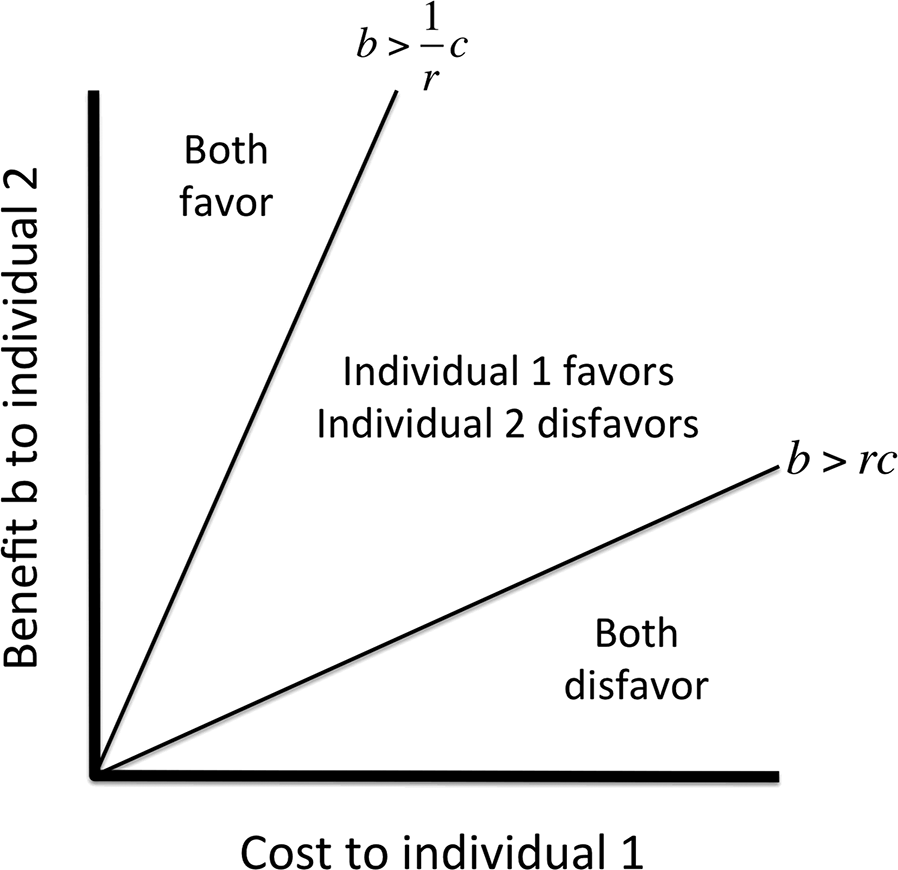
Moreover, though these examples include dissolutive elements, the role of relatedness and kin selection in these conflicts is actually the opposite of dissolutive. Suppose a behavior causes individual 1 to lose c units of fitness and a relative, individual 2, to gain b units. Hamilton’s rule tells us that individual 1 favors this behavior if rb > c and individual 2 favors it if b > rc. Figure 1 shows these conditions plotted in b/c space. Sometimes both inequalities are satisfied, and sometimes neither is, but there is a region of potential conflict (r < b/c < 1/r) where inequality 1 is satisfied but inequality 2 is not. The role of r is clearly to reduce conflict. If r = 0, then there is conflict over the entire space (where both b and c are positive). If r = 1, there is no conflict (1/r = r). So while kin selection theory predicts conflict, it predicts that kinship reduces conflicts. If Wilson’s terms are relevant to kin selection, then direct selection tends to be dissolutive, while indirect selection via kin tends to be binding or cooperative.
Kin-selected conditions for individuals 1 and 2 to favor or disfavor a cost of c units to individual 1 and a benefit of b units to individual 2.

9. Is Kin Selection Just an Optimality Approach?
Hamilton’s rule gives the direction of change, but other approaches are sometimes claimed as superior in also giving rates of change (Goodnight Reference Goodnight2013). In general, Goodnight’s paper is admirable in seeing similarities between approaches. But the optimality versus rates distinction he sees is just a historical difference between the approaches, not a logical one. The actual derivations of Hamilton’s rule generally do include rates. For example, equation (5) of Gardner et al. (Reference Gardner, West and Wild2011) shows that the change in genetic value for an altruistic trait would be Δg = (−c + rb)Var(g), that is, the inclusive fitness effect times the genetic variance for the trait. Kin selectionists tend to drop consideration of the Var(g) to leave Hamilton’s rule, because, as Goodnight notes, they have been less interested in current selective rates than in adaptations that have been selected over time. This dichotomy is not unique to social selection. For any trait we can ask either about its current rate of change or about its historical selection, and both approaches are valuable.
10. Has Kin Selection Hindered Research on Mechanisms?
Hunt (Reference Hunt2007) has claimed that kin selection hinders research on proximate mechanisms. Nowak et al. (Reference Nowak, Tarnita and Wilson2010) cite this approvingly, but at the same time they argue that research on mechanisms has flourished without much input from kin selection. Both are claims about history, not about the logic of the theory, and both can be contested. Mechanistic research has indeed flourished. Some of this was more or less independent of kin selection theory—which is not a failure of that theory—and some of it directly stimulated by kin selection theory. As an example of the latter, consider research on kin recognition. Wilson himself wrote that it “has been shaped to a remarkable degree by the concept of kin selection,” to such an extent that “rarely in the history of biology has a domain of empirical knowledge followed so closely and fruitfully after an abstract theoretical idea” (Reference Wilson, Fletcher and Michener1987, 7), and that “new physiological processes are more easily discovered when research is animated by kin selection theory” (Hölldobler and Wilson Reference Hölldobler and Wilson1990, 197).
11. Has Kin Selection Hindered Research on Theory?
A similar claim has been made with respect to theory: “Similarly, from a theoretical perspective, the narrow focus on relatedness has prevented kin selectionists from the discovery of mechanisms for the evolution of cooperation” (Nowak et al. Reference Nowak, Tarnita and Wilson2010, online suplement, 3). But in fact, kin selectionists have not only been open to other forms of social selection—they have pioneered them. Consider Nowak’s (Reference Nowak2006) own “five rules for the evolution of cooperation.” Of these, kin selection was developed by W. D. Hamilton, direct reciprocity by R. L. Trivers (Reference Trivers1971), and indirect reciprocity by R. D. Alexander (Reference Alexander1979, Reference Alexander1987), all kin selectionists. Network reciprocity can be viewed as kin selection arising from population viscosity (Grafen Reference Grafen2007; Lehmann et al. Reference Lehmann, Keller, West and Roze2007), a concept dating back to Hamilton’s original papers. Group selection predated kin selection, but it is probably fair to say that kin-selection thinking forced group selectionists to be more rigorous and explicit about the importance of genetic structure (relatedness). To Nowak’s list, one might also add parental manipulation (Alexander Reference Alexander1974) and the use of game theory in social evolution (Maynard Smith Reference Maynard Smith1974, Reference Maynard Smith1982). Overall, that seems like an extremely good record for kin selectionists, though contributions from other approaches have been valuable as well.
12. Does Cooperation without Relatedness Refute Kin Selection?
The paragraph above gives lie to the claim that kin selection is falsified in general if some other process is found to be important for particular cases. In particular, cooperation does not require relatedness because there are various mechanisms for getting a direct benefit out of cooperating that are accepted and indeed developed by kin selectionists (though not kin selection, these cases can be covered by inclusive fitness because inclusive fitness includes fitness effects on self).
13. Does Group Selection Preclude Kin Selection?
I cannot review the full contentious history of group and kin selection. At one time kin selectionists made the mistake of saying that something cannot be group selection if it involves kin selection. More recently, we are seeing the reverse error, that if something appears group selected, that rules out kin selection (Alonso Reference Alonso1998; Wilson and Hölldobler Reference Wilson and Hölldobler2005). Most theoreticians now agree that social behaviors can be analyzed either in terms of effects on the self and others (e.g., inclusive fitness) or in terms of effects between and within groups (multilevel selection) (Queller Reference Queller1992; Foster et al. Reference Foster, Wenseleers, Ratnieks and Queller2006b; Okasha Reference Okasha2006; Lehmann et al. Reference Lehmann, Keller, West and Roze2007; McElreath and Boyd Reference McElreath and Boyd2008; Marshall Reference Marshall2011). They are different languages that can describe the same thing (even if some debate continues over whether they are always identical).
14. Does Coercion Preclude Kin Selection?
Some researchers believe that coercion might explain most apparent altruism. Queens or workers might force their young to be nonreproductive, for example, by limiting food (Alonso Reference Alonso1998), and strong Dictyostelium cells might force weaker ones to be nonreproductive (Atzmony, Zahavi, and Nanjundiah Reference Atzmony, Zahavi and Nanjundiah1997). These are reasonable hypotheses that might explain why some individuals forego reproduction, but two points must be added.
First, there may be a more subtle mix of coercion and kin selection (Wenseleers and Ratnieks Reference Wenseleers and Ratnieks2006b). A wasp that receives a bit less food as a larva may not be forced to be nonreproductive. Instead, her reproductive potential may be reduced, tipping her kin-selection balance in favor of rearing siblings (West-Eberhard Reference West-Eberhard1975) provided that limited food does not equally impede worker effectiveness (Craig Reference Craig1983).
Second, even complete coercion cannot explain the full evolution of complex helping. Simple helping could emerge immediately via spring-loaded preadaptations (Alonso Reference Alonso1998; Nowak et al. Reference Nowak, Tarnita and Wilson2010); a nonreproductive daughter might use her preexisting behavioral programs for foraging and feeding on behalf of siblings. But, in the absence of kin selection, further improvement of worker behavior is nearly impossible; a mutation that improves worker behavior is not passed on unless the colony’s reproductive members also carry it. Thus, coercion cannot account for the elaborate complexity of insect societies or for the considerable complexity of Dictyostelium stalk production.
15. Is Kin Selection Irrelevant When Reproduction Is Not a Viable Option?
Social insect researchers who focus on the evolution of higher social insects, such as honeybees and most ants, may not see much utility in kin selection as a research program. This may be partly a proximate–ultimate divide, but not solely, because even for ultimate questions, such researchers may prefer to focus on optimization of colony efficiency rather than kin selection. This is entirely reasonable as a research strategy but is perfectly consistent with kin selection when workers have no reproductive options. They should be selected to do all they can for the reproduction of the queen (maximize rb), and that is usually equivalent to maximizing colony fitness. Kin selection is still crucial to understand how these colonies reached this point. Moreover, it is sometimes forgotten that while researchers may ignore kin selection, the social insects do not. Kin selection and relatedness are still necessary for the evolution and maintenance of all worker traits. When a mutation causes a change in a gene expressed in workers, that mutation is selected to the degree that it helps their reproducing kin, times relatedness. Relatedness is what causes heritability of worker traits. If there is no relatedness, there will be no response to selection.