Introduction
Visceral leishmaniasis (VL) is a neglected tropical disease that accounts for 200 000–400 000 new cases each year worldwide, and is endemic in 70 countries on the five continents (Alvar et al., Reference Alvar, Vélez, Bern, Herrero, Desjeux, Cano, Jannin and de Boer2012; WHO, 2018). Currently, VL is present in 12 countries of the Americas, with 96% of the cases being reported in Brazil (4200–6300 cases per year), an incidence rate of 2/100 000 inhabitants and a case fatality rate of around 7% (Romero and Boelaert, Reference Romero and Boelaert2010; Menon et al., Reference Menon, Rossi, Nshimyumukiza and Zinszer2016). In the Americas, the aetiologic agent is the protozoan Leishmania (Leishmania) infantum, which is usually transmitted by the bite of the sandfly Lutzomyia longipalpis (Romero and Boelaert, Reference Romero and Boelaert2010), although there is already a study that has identified other species as transmitters of leishmania (Rêgo et al., Reference Rêgo, Souza, Miranda, Peixoto and Andrade-Filho2020). Dogs represent the main urban reservoir (Romero and Boelaert, Reference Romero and Boelaert2010).
In Brazil, the first urban epidemic was reported in Teresina (Piauí state) between 1981 and 1985, when the disease, initially limited to rural areas, expanded to peripheral areas of the city (Costa et al., Reference Costa, Pereira and Araújo1990). Since then, the disease has been expanding from cities in the Northeast to other regions of the country (Badaro et al., Reference Badaro, Jones, Carvalho, Sampaio, Reed, Barral, Teixeira and Johnson WD1986; Costa et al., Reference Costa, Pereira and Araújo1990; Evans et al., Reference Evans, Teixeira, McAuliffe, Vasconcelos, Vasconcelos, Sousa, Lima and Pearson1992; Jerônimo et al., Reference Jerônimo, Duggal, Braz, Cheng, Monteiro, Nascimento, Martins, Karplus, Ximenes, Oliveira, Pinheiro, Pereira, Peralta, Sousa, Medeiros, Pearsoni, Burns, Pugh and Wilson2004; Moreno et al., Reference Moreno, Melo, Genaro, Lambertucci, Serufo, Andrade, Antunes and Carneiro2005; de Oliveira et al., Reference de Oliveira, Paniago, Sanches, Dorval, Oshiro, Leal, de Paula, Pereira, da Cunha and Bóia2008; Falqueto et al., Reference Falqueto, Ferreira, dos Santos, Porrozzi, da Costa, Teva, Cupolillo, Campos-Neto and Grimaldi2009).
The literature reports occurrences of VL epidemics in different countries worldwide (Imamura et al., Reference Imamura, Downing, den Broeck, Sanders, Rijal, Sundar, An Mannaert, Vanaerschot, Berg, Muylder, Dumetz, Cuypers, Maes, Domagalska, Decuypere, Rai, Uranw, Bhattarai, Khanal, Prajapati, Sharma, Stark, Schönian, Koning, Settimo, Vanhollebeke, Roy, Ostyn, Boelaert, Maes, Berriman, Dujardin and Cotton2016). However, there is no literature record of systematic reviews and meta-analysis regarding factors associated with occurrences of VL epidemics. In this respect, our study sets out to elucidate the knowledge gaps regarding the factors associated with VL occurrence in different urban contexts during epidemic processes. This systematic review aims to describe the factors associated with the occurrence of VL epidemics in humans in urban areas.
Materials and methods
This study was conducted using the guideline Preferred Reporting Items for Systematic Review and Meta-Analysis (Moher et al., Reference Moher, Liberati, Tetzlaff, Altman and Group2015). We registered the protocol before its execution in the International Prospective Register of Systematic Reviews (PROSPERO) under registration number CRD42019128998.
Selection criteria
In this review, we included epidemiological ecological, case series, cross-sectional and case-control studies that described associations among individual characteristics (demographic variables), socioeconomic and environmental variables (climates, household characteristics and social, urban and population structures), presence of vectors and animals (dogs and other animals) and the occurrence of any outcome related to VL. This outcome could be the infection by L. infantum, the clinical disease or the notification of cases to the health services.
Eligibility criteria
We included studies that investigated factors associated with VL infection and clinical disease confirmed and notified in situations of epidemics in Brazil. No restrictions were applied regarding language for the inclusion of the studies.
Research and selection of studies
The search was carried out in the electronic databases PubMed (by Medline), Cochrane Library, Embase, Amed, LILACS and grey literature [Google Scholar and handsearch of the database of the Information System for Notifiable Diseases (SINAN), Department of Informatics of the Brazilian Unified Health System (DATASUS)]. Papers cited in the selected studies were included as grey literature. Pre-defined descriptors were used for each database to increase the sensitivity of the search. The search strategy was defined following prior consultation of the uniterms leishmaniasis, association and occurrence. This consultation was carried out in MeSH (PubMed by Medline) and adapted for other databases. For LILACS, we used the Health Sciences Descriptors (DeCS), and for Embase, we used Emtree.
The references retrieved in the search strategies were exported to an Endnote® X7 file and the duplicates were removed. The studies were independently selected by two researchers who used a form previously tested in five selected articles to identify any adjustments needed before their application in the remaining studies. Any disagreements were resolved by consensus.
Studies were included according to our criteria for each section following the order of evaluation in three phases: 1st: titles; 2nd: abstracts and 3rd: main text.
An epidemic was defined as the occurrence of a health-related event that exceeds normal expectations, with a number of cases higher than expected in a specific area and time, in the presence of an epidemiological link (Braga and Werneck, Reference Braga, Werneck and RA2008).
Studies analysing factors associated with VL that did not specify whether they were carried out at the time of an epidemic and were investigated using the database of the Information System for Notifiable Diseases (SINAN), Department of Informatics of the Brazilian Unified Health System (DATASUS). For each study, we searched for the number of confirmed cases in the places and years in which the study was carried out, including an interval of 3 years before and after, to verify the number of cases of the disease. Therefore, if an above-expected increase in the number of cases that would characterize an epidemic was detected, even if the article did not describe the occurrence of an epidemic, it was included in the present review.
Analysis and presentation of results
The results of the synthesis of the articles were presented qualitatively and quantitatively with the factors related to the occurrence of VL pointing out the specificities and regional differences of the occurrence of the disease considering the context of the study (Table 1). The characteristics of the included studies were described considering each group of factors by region studied.
Studies carried out in periods of epidemics in Brazil, according to the location of the study, year of execution and period of epidemics, from 1980 to 2019

a Studies carried out during periods of an epidemic as described in the paper.
b Studies identified in the periods of epidemic according to the analysis of the data from the DATASUS.
Results
Description of included studies
The search strategies retrieved 3143 titles, out of which 23 studies met the eligibility criteria and were included in this systematic review (Fig. 1). Studies have shown the factors present in the context of epidemics between the years 1980 and 2014 in Brazil. In the 1980s, two epidemics were analysed, and in the 1990s epidemics were described between 1990 and 1998. In the first decade of the 2000s, the studies analysed included epidemics that occurred in all years, except in 2001 and 2002. As of 2010, studies described epidemics in 2010, 2011 and 2014. The first urban epidemic occurred in 1980 in the state of Piauí, and the most recent epidemic process included in this review occurred in 2014 in the state of Ceará.
Systematic review on factors associated with urban epidemics of human VL in Brazil.

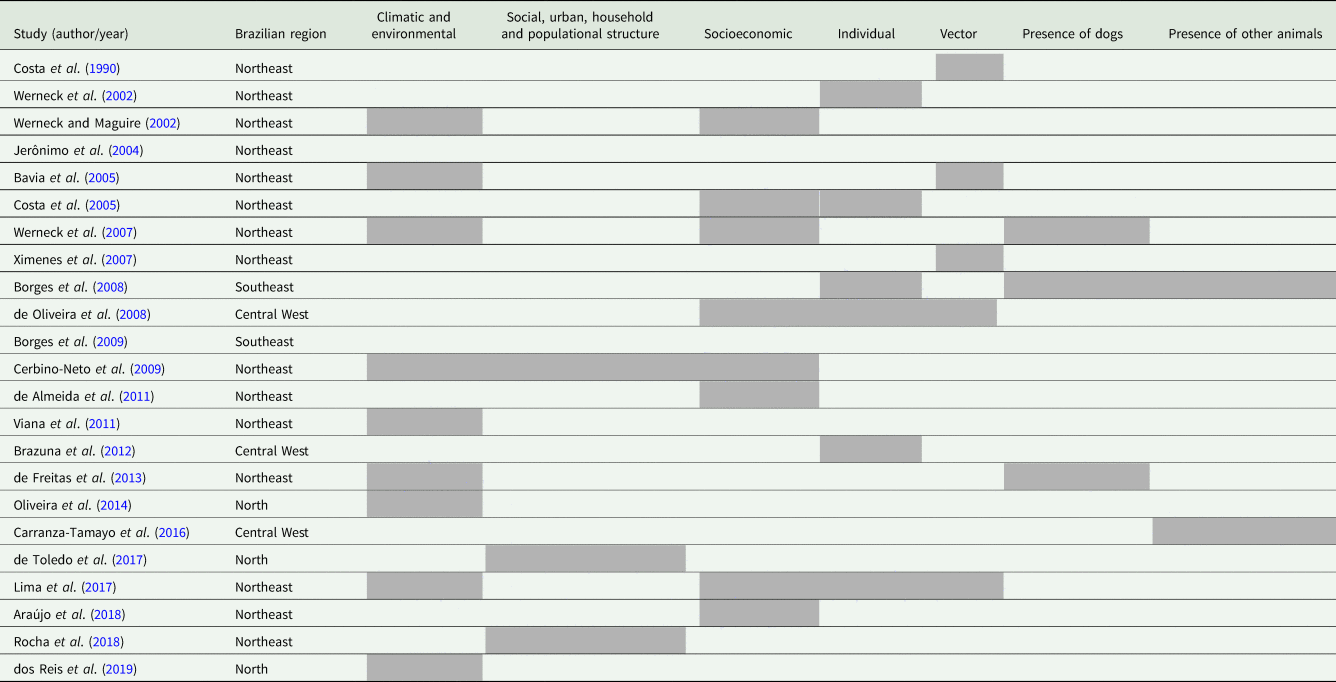
Of the 23 selected studies, nine (39%) were ecological studies, nine (39%) were cross-sectional studies, two (9%) were case series studies and three (13%) were case-control studies. Regarding the coverage areas, 15 (65%) studies were carried out in the Northeast region of Brazil, three (13%) in the Central-West, three (13%) in the North and two (9%) in the Southeast (Table 1 and Supplementary material 1).
Four studies (17%) evaluated factors associated with asymptomatic L. infantum infection, and the others analysed factors associated with the VL clinical disease.
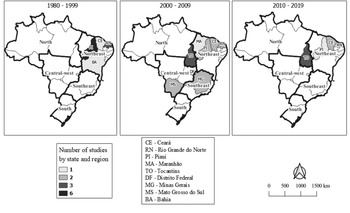
From 1980 to 2000, VL epidemics were described and analysed in five Brazilian states, four in the Northeast and one in the Central-West. An increase in the epidemic record was observed in the first decade of the 2000s, with expansion to the North and Southeast regions, and records in seven states. Between 2010 and 2019, the studies in this review presented epidemic records in three states in the North and Northeast regions (Fig. 2).
Distribution of studies on VL epidemics in Brazil from 1980 to 2019, by state.

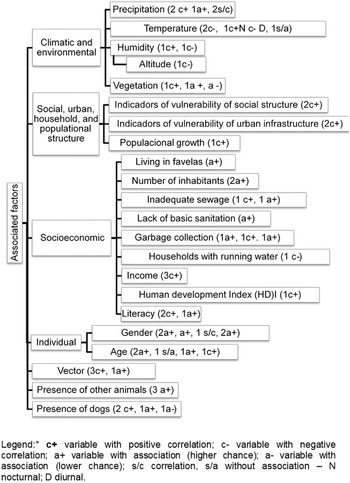
The factors related to VL in urban epidemics are shown in Table 2, Fig. 3 and Supplementary material 1 by author and occurrence of visceral leishmaniasis by region of Brazil.
Categorization of studies on factors associated with the occurrence of VL in the context of epidemics, according to the geographical area and type of factor

Factors related to human VL described in the studies included in this systematic review.

Climate and environmental factors
Six studies pointed out climatic and environmental factors related to VL in the context of an epidemic in the Northeast region. Living in areas covered by green vegetation (Werneck and Maguire, Reference Werneck and Maguire2002), and increased vegetation have been associated with a high incidence of human VL (Werneck et al., Reference Werneck, Costa, Wlaker, David, Wand and Maguire2007). VL was also correlated with locations with the presence of green areas (Cerbino-Neto et al., Reference Cerbino-Neto, Werneck and Costa2009). Bavia et al. (Reference Bavia, Carneiro, Gurgel, Madureira Filho and Barbosa2005) demonstrated that low values of the normalized difference vegetation index (NDVI) in municipalities at high risk for VL were related to the high number of positive cases of the disease.
Precipitation showed a positive correlation with the incidence rate of VL (dos Reis et al., Reference dos Reis, Balieiro, Fonseca and Gonçalves2019), and also with the incidence of VL in the previous year (Lima et al., Reference Lima, de Lima, Coutinho, de Sousa and Rodrigues2017). There was an association between the number of cases of VL and precipitation (Viana et al., Reference Viana, Nascimento, Rabelo, Diniz-Neto, Binda-Júnior, Galvão, dos Santos, Santos-Júnior, de Oliveira and Guimarães2011).
The average temperature was negatively correlated with the incidence rate of VL (de Freitas et al., Reference de Freitas, Sampaio-Filho, Santos, Lima and Nunes-Pinheiro2013; Oliveira et al., Reference Oliveira, Batista, Peluzio, Pfrimer, Rodrigues and Carmo-Filho2014). Similarly, daytime temperature also showed a negative correlation with VL (dos Reis et al., Reference dos Reis, Balieiro, Fonseca and Gonçalves2019). However, night-time temperature showed a positive correlation with the incidence rate of VL (dos Reis et al., Reference dos Reis, Balieiro, Fonseca and Gonçalves2019).
The relative humidity of the air showed divergent behaviour patterns in the studies of the North and Northeast regions. It presented a negative correlation with the incidence rate of VL (de Freitas et al., Reference de Freitas, Sampaio-Filho, Santos, Lima and Nunes-Pinheiro2013) and a positive correlation between the incidence rate of VL minimum and maximum humidity (dos Reis et al., Reference dos Reis, Balieiro, Fonseca and Gonçalves2019).
The effects of altitude were analysed in the municipalities of the state of Tocantins and the results showed a negative correlation between the municipalities with higher altitudes and the incidence rate of VL (dos Reis et al., Reference dos Reis, Balieiro, Fonseca and Gonçalves2019).
Factors related to social, urban and population structure
Studies conducted in the North and Northeast states showed a positive correlation between indicators of social and urban structure and the incidence of VL (de Toledo et al., Reference de Toledo, de Almeida, Chaves, Sabroza, Toledo and Caldas2017; Rocha et al., Reference Rocha, de Espindola, Soares, Rocha and Costa2018). Rocha et al. (Reference Rocha, de Espindola, Soares, Rocha and Costa2018) pointed out statistically significant clusters between the incidence of the disease and the indicators of vulnerability of social structure, household structure, urban infrastructure and composite index of vulnerability. Cerbino-Neto et al. (Reference Cerbino-Neto, Werneck and Costa2009) demonstrated that the incidence of VL was positively correlated with population growth.
Socioeconomic factors
Studies related to socioeconomic factors were carried out in states in the Northeast region. The factors that were associated with the incidence of VL in the context of epidemics were: living in a slum (Werneck and Maguire, Reference Werneck and Maguire2002), percentage of literacy in the neighbourhood and homes without sanitation (Lima et al., Reference Lima, de Lima, Coutinho, de Sousa and Rodrigues2017). The average percentage of households with at least one indoor bathroom connected to the sewage network was associated with the average annual incidence rate of VL (Cerbino-Neto et al., Reference Cerbino-Neto, Werneck and Costa2009).
As for the risk of developing VL, living in a house with more than four members doubled the risk of VL, and living in a house with an inadequate sewage network (without a bathroom) showed a high risk of VL (Costa et al., Reference Costa, Werneck, Rodrigues, Santos, Araújo, Moura, Moreira, Gomes and Lima2005). People living in households without regular garbage collection were more likely to develop VL (Costa et al., Reference Costa, Werneck, Rodrigues, Santos, Araújo, Moura, Moreira, Gomes and Lima2005).
The average number of residents per household (Lima et al., Reference Lima, de Lima, Coutinho, de Sousa and Rodrigues2017), households with no garbage collection (Cerbino-Neto et al., Reference Cerbino-Neto, Werneck and Costa2009) and areas with a lower percentage of households with garbage collection (de Almeida et al., Reference de Almeida, Medronho and Werneck2011; Lima et al., Reference Lima, de Lima, Coutinho, de Sousa and Rodrigues2017) were positively correlated with the incidence of VL.
The lowest per capita income and the lowest human development index showed a positive correlation with the average number of cases of VL (Araújo et al., Reference Araújo, de Freitas-Neta, Teixeira, e Silva-Neto, Monteiro, Alves, Cândido and Firmino2018). The annual incidence rates of VL correlated with the average income and illiteracy (Cerbino-Neto et al., Reference Cerbino-Neto, Werneck and Costa2009).
The average percentage of households with running water was negatively correlated with the incidence rate of VL (Cerbino-Neto et al., Reference Cerbino-Neto, Werneck and Costa2009). There was a spatial correlation between VL rates and the lowest average income of heads of households and illiteracy and a lower percentage of households with garbage collection (de Almeida et al., Reference de Almeida, Medronho and Werneck2011).
However, in the Northeast, de Oliveira et al. (Reference de Oliveira, Paniago, Sanches, Dorval, Oshiro, Leal, de Paula, Pereira, da Cunha and Bóia2008) found no relationship among accumulation of waste in the home, literacy of the head of household and infection by Leishmania.
Individual factors
A greater number of cases of VL in men were reported when compared to women (Brazuna et al., Reference Brazuna, e Silva, Brazuna, Domingos, Chaves, Honer, van Onselen and de Oliveira2012) and men were more likely to contract the disease than women (Borges et al., Reference Borges, Silva, Haddad, Moreira, Magalhães, Ribeiro and Fiúza2008). VL was also associated with males and age groups (Lima et al., Reference Lima, de Lima, Coutinho, de Sousa and Rodrigues2017). In the Northeast, de Oliveira et al. (Reference de Oliveira, Paniago, Sanches, Dorval, Oshiro, Leal, de Paula, Pereira, da Cunha and Bóia2008) found no relationship between gender and infection by Leishmania.
The positivity in the skin test for Leishmania increased with age in the study by Werneck et al. (Reference Werneck, Rodrigue- Júnior, Santos, Araújo, Moura, Lima, Gomes, Maguire and Costa2002). Costa et al. (Reference Costa, Werneck, Rodrigues, Santos, Araújo, Moura, Moreira, Gomes and Lima2005) pointed out that greater chances of developing VL were found in children aged 5–10 years, and children aged 1–4 years were 14 times more likely to develop the disease than those older than 10 years. The study by Borges et al. (Reference Borges, Silva, Haddad, Moreira, Magalhães, Ribeiro and Fiúza2008) showed an increased risk of contracting VL in children under 10 years old. Carranza-Tamayo et al. (Reference Carranza-Tamayo, Werneck and Romero2016) demonstrated that VL infection in humans was associated with an age greater than 7 years. Oliveira et al. (Reference Oliveira, Batista, Peluzio, Pfrimer, Rodrigues and Carmo-Filho2014) described that there was a higher prevalence of the disease in children under 15 years old than in the age group from 1 to 5 years. However, in the Northeast, de Oliveira et al. (Reference de Oliveira, Paniago, Sanches, Dorval, Oshiro, Leal, de Paula, Pereira, da Cunha and Bóia2008) found no relationship between age and infection by Leishmania.
Factors related to vectors
Ximenes et al. (Reference Ximenes, e Silva, de Queiroz, Rego, Cortez, Batista, de Medeiros and Jeronimio2007) found an association of vector species and distribution of diseases with demographic and physiognomic characteristics, disordered growth in the metropolitan region, living conditions and environmental degradation of the East Coast of the state of Rio Grande do Norte. The number of sandflies was associated with VL in the study by Bavia et al. (Reference Bavia, Carneiro, Gurgel, Madureira Filho and Barbosa2005). Studies have demonstrated a correlation between the incidence of VL and vector infestation and relative abundance of L. longipalpis (Lima et al., Reference Lima, de Lima, Coutinho, de Sousa and Rodrigues2017), as well as a correlation between households investigated and infested by L. longipalpis (Costa et al., Reference Costa, Pereira and Araújo1990). The number of sandflies was associated with VL (Bavia et al., Reference Bavia, Carneiro, Gurgel, Madureira Filho and Barbosa2005).
Presence of dogs
Studies carried out in the states of the Northeast and Southeast regions showed divergent patterns for the presence of dogs and VL. Dog owners were more likely to contract VL when compared to individuals who did not have them, and an increased chance of contracting VL was observed for individuals with two dogs and for people who kept their dogs indoors during the day (Borges et al., Reference Borges, Silva, Haddad, Moreira, Magalhães, Ribeiro and Fiúza2009). The canine population negatively influenced the number of cases of VL and the percentage of positive dogs showed a correlation and positive influence on the incidence rate of VL (de Freitas et al., Reference de Freitas, Sampaio-Filho, Santos, Lima and Nunes-Pinheiro2013). In a multilevel model study, Werneck et al. (Reference Werneck, Costa, Wlaker, David, Wand and Maguire2007) described an association between the prevalence of canine seropositivity and the incidence of the disease in humans. Jerônimo et al. (Reference Jerônimo, Duggal, Braz, Cheng, Monteiro, Nascimento, Martins, Karplus, Ximenes, Oliveira, Pinheiro, Pereira, Peralta, Sousa, Medeiros, Pearsoni, Burns, Pugh and Wilson2004) found no association between LV and dog ownership.
Presence of other animals
The relationship between the presence of other animals and VL has been described in the Southeast and Central-West regions. The increase in the number of cases of VL was associated with the presence of ducks, rodents and chickens (Borges et al., Reference Borges, Silva, Haddad, Moreira, Magalhães, Ribeiro and Fiúza2009). The presence of opossums in the vicinity reduced the chances of falling ill with VL (Borges et al., Reference Borges, Silva, Haddad, Moreira, Magalhães, Ribeiro and Fiúza2009). In another study, the presence of opossums around the homes increased the chances of human infection (Carranza-Tamayo et al., Reference Carranza-Tamayo, Werneck and Romero2016). However, in the Northeast region Jerônimo et al. (Reference Jerônimo, Duggal, Braz, Cheng, Monteiro, Nascimento, Martins, Karplus, Ximenes, Oliveira, Pinheiro, Pereira, Peralta, Sousa, Medeiros, Pearsoni, Burns, Pugh and Wilson2004) did not find an association between LV and the possession of other animals.
Discussion
Urban VL has occurred in Brazil since 1980, but little is known about the dynamics of L. infantum transmission in urban centres or the variables that determine the distribution of the disease in these places in the context of an epidemic. As this is a relatively rare event, the context of epidemics provided us with more robust results in quantitative terms in analytical approaches in this review.
Factors related to the occurrence of VL in the context of epidemics were compared among regions and described on an individual and aggregate scale. In this scenario, the Northeast region stands out with the largest number of variables studied and related to the occurrence of the disease.
As for the individual factors analysed in this review, men were more likely to contract the disease or infection, which was also observed in studies carried out in the endemic period (de Delgado et al., Reference de Delgado, Feliciangeli, Gomez, Alvarado, Garcia and Bello1998; Oliveira et al., Reference Oliveira, Diez-Roux, César and Projetti2006; Gouvêa et al., Reference Gouvêa, Werneck, Costa and Carvalho2007; da Silva et al., Reference da Silva, de Aquino, Bezerra, Melo, Leonardo, e Silva and Pinheiro2016; Menezes et al., Reference Menezes, Luz, de Sousa, Verne, Lima and Margonari2016). Other studies on VL and male sex suggest explanations for these results: hormonal or immunological problems can affect the progress of the infection (Sharma et al., Reference Sharma, Gupta, Saran and Sinha1990); men could be more exposed to vector bites (Costa et al., Reference Costa, Pereira and Araújo1990) and men are more frequently involved in domestic chores or outdoor leisure activities during the period of greatest vector activity (Gouvêa et al., Reference Gouvêa, Werneck, Costa and Carvalho2007).
Considering age as a factor related to VL, in studies carried out in the context of an epidemic, the results showed that children are more susceptible to both infection and illness. When analysing the difference between skin and serological tests in Teresina, the study showed that prevalence estimates based on the leishmanin skin test increased with age and that those based on serological tests showed a non-significant variation with age (Werneck et al., Reference Werneck, Rodrigue- Júnior, Santos, Araújo, Moura, Lima, Gomes, Maguire and Costa2002). Still in Teresina in an endemic period, a study showed an association between a positive reaction to the Montenegro skin test and age (Gouvêa et al., Reference Gouvêa, Werneck, Costa and Carvalho2007). The meta-analysis study by Belo et al. (Reference Belo, Werneck, Barbosa, Simões, Nascimento, Silva, da Silva and Struchiner2013) of VL in the Americas showed that children are more likely to develop the clinical disease and less likely to become infected. However, as it is known that children are less likely to have asymptomatic infection, the Montenegro test indicates infections that have occurred throughout an individual's life (Nascimento et al., Reference Nascimento, Alcântara-Neves, Muniz, Nunes, Paranhos and Carvalho1993). However, the study by Silva et al. (Reference Silva, Romero, Prata, Costa, Nascimento, Carvalho and Rodrigues2006) in Porteirinha, Minas Gerais, which must also be considered, demonstrated that serological tests for VL can also continue to be positive after the treatment of the disease, not indicating a bad prognosis or a poor therapeutic response.
The studies by Cunha et al. (Reference Cunha, Freire, Eulalio, Cristovao, Netto, Johnson, Reed and Badaro1995); Desjeux (Reference Desjeux2001) and Albuquerque et al. (Reference Albuquerque, da Silva Júnior, Freire, Oliveira, Daniel Medeiros Almeida, da Silva, Cavalcante and Sousa2009) showed that the occurrence of VL in the North and Northeast regions was related to socioeconomic and migratory factors. However, the results of this review indicate the occurrence of climatic and environmental factors, socioeconomic factors, vulnerability indicators of the social structure and urban infrastructure, individual characteristics, factors related to the vector, presence of dogs and other animals present during the context of the epidemic in the Northeast region of Brazil. These results corroborate with the observation of Sherlock (Reference Sherlock1996) in Bahia and other regions of the country in which poverty, malnutrition and high density of phlebotomines were associated with the presence of domestic animals, sanitary conditions and low socioeconomic level in the areas of transmission of VL. Among the factors present in the context of epidemics in Brazil, climatic and environmental factors deserve to be highlighted as the spread of VL may be related to these conditions normally found in poorer areas, with less urban infrastructure and with little sanitation.
Some points in the temperature and precipitation variables identified in this review should be considered as related to the increase in the number of cases of VL in the context of epidemics. Among the points, we highlight the influences of these climatic variables in the epidemiological cycle of VL, due to their influence on the activity of sandflies (Rivas et al., Reference Rivas, de Souza, Peixoto and Bruno2014; Lima et al., Reference Lima, de Lima, Coutinho, de Sousa and Rodrigues2017; Sevá et al., Reference Sevá, Mao, Galvis-Ovallos, Lima and Valle2017) which can influence the spread of the disease.
The influence of vegetation on VL cases can also be related to the different forms of urbanization and infrastructure of the studied places (or areas) and to the demographic and environmental characteristics, and also to the presence of the vector. As demonstrated in Teresina, the periods with high rates of the disease in the peripheral neighbourhoods were coincident with the expansion of the city area and population growth; and that green areas are positively associated with the occurrence of VL (Werneck and Maguire, Reference Werneck and Maguire2002; Cerbino-Neto et al., Reference Cerbino-Neto, Werneck and Costa2009). These results were corroborated with the evidence from Feliciangeli et al. (Reference Feliciangeli, Delgado, Suarez and Bravo2006) in which the proximity of houses to the forest is a probable risk factor for Leishmania infection. In the state of Bahia, the spatial comparison of human disease cases between NDVI and vegetation maps suggests that the highest incidence of VL is concentrated in areas with lower NDVI values, with the caatinga as the predominant vegetation (Bavia et al., Reference Bavia, Carneiro, Gurgel, Madureira Filho and Barbosa2005).
Other climatic and environmental factors, such as altitude and relative humidity, were discussed in only one of the studies included in this review, which limits the analysis of these variables. Studies that address these variables in other contexts and locations are still needed.
Studies have demonstrated socioeconomic factors related to VL in different locations (Werneck et al., Reference Werneck, Rodrigue- Júnior, Santos, Araújo, Moura, Lima, Gomes, Maguire and Costa2002, Costa et al., Reference Costa, Werneck, Rodrigues, Santos, Araújo, Moura, Moreira, Gomes and Lima2005) through different mechanisms. The included studies pointed out the high incidence of VL associated with the worst living conditions of the populations and the lowest urban structure corroborating with the study by Araújo et al. (Reference Araújo, de Freitas-Neta, Teixeira, e Silva-Neto, Monteiro, Alves, Cândido and Firmino2018). Such factors are also responsible for the expansion of the disease in endemic regions (da Silva et al., Reference da Silva, Tauil, Cavalcante, Medeiros, Pires and Gonçalves2008). The poor living conditions of the population contribute to the strengthening of the VL epidemiological chain (Ponte et al., Reference Ponte, Souza, Cavalcante, Barral, de Aquino and Caldas2011).
Studies carried out in epidemic periods point to a relationship between infestation and vector abundance and disease, which is also observed in the occurrence of VL in endemic periods. Ponte et al. (Reference Ponte, Souza, Cavalcante, Barral, de Aquino and Caldas2011) showed that the presence of sandflies in the home was among the variables associated with infection in the municipality of Raposa (state of Maranhão). The fact that L. longipalpis is capable of adapting to different habitats (de Oliveira and Araújo et al., Reference de Oliveira and de Araújo2003; Barata et al., Reference Barata, França-Silva, Mayrink, Silva, Prata, Lorosa, Fiúza, Gonçalves, de Paula and Dias2005) with evidence of the presence of sandflies in intra- and peri-domiciliary areas (Resende et al., 2006) may explain the relationship with the disease.
Cases of positive dogs have been linked to VL in humans in epidemic periods in the study by de Freitas et al. (Reference de Freitas, Sampaio-Filho, Santos, Lima and Nunes-Pinheiro2013) in Fortaleza (Ceará), from 2006 to 2012. Similar observations were reported in Belo Horizonte (Minas Gerais) (Oliveira et al., Reference Oliveira, Assunção, Reis and Proietti2001; de Araújo et al., Reference de Araújo, Pinheiro, Almeida, de Menezes, Morais, Reis, Assunção and Carneiro2013; Bruhn et al., Reference Bruhn, Morais, Bruhn, Cardoso, Ferreira and Rocha CM2018) and in Feira de Santana (Bahia) (Carneiro et al., Reference Carneiro, Bavia, Rocha, Lobão, Madureira-Filho, de Oliveira J, da Silva, Barbosa and Rios2004) in endemic periods. In addition to the dog being considered the most important reservoir of infection in urban environments (Braga et al., Reference Braga, Lainson, Shaw, Ryan and Silveira1986), the proximity between homes and shelters for domestic animals may be responsible for the presence of insects inside the home, together with their capacity for endophilia (Missawa and Dias, Reference Missawa and Dias2007).
For the presence of other animals, although there is no clear evidence about risk factors, and they are not reservoirs for Leishmania (Otranto et al., Reference Otranto, Testini, Buonavoglia, Parisi, Brandonisio, Circella, Dantas-Torres and Camarda2010), the studies in this review showed a relationship between VL and the presence of other animals. The presence of other animals in the household may be related to the favourable environment for the breeding of phlebotomine by the production of organic waste produced by these animals (Carvalho et al., Reference Carvalho, Rebêlo, Araújo and Barros2000).
This study has some limitations that should be mentioned. In the sample of studies selected and analysed, there was no longitudinal study addressing the factors associated with VL, despite the importance of these studies to increase the strength of the scientific evidence of the results. Moreover, it was not possible to perform a meta-analysis due to the weaknesses of the measurements used and the differences in them performed in each study.
The studies included in this review took place in the states of the Northeast, North, Southeast and Central-West regions. The higher concentration and the absence of studies in certain regions reflect the distribution of the disease in Brazil. Studies that better clarify the risk factors are needed for intervention and planning of disease control policies in different regions of the country and to help design effective strategies to control the spread of VL in urban areas.
Despite the identification and description of the factors related to epidemics in Brazil presented here, more robust studies are needed to investigate the different behaviour patterns of the factors in different regions and within the same region. These studies will guide strategies to control VL transmission in epidemic contexts.
Supplementary material
The supplementary material for this article can be found at https://doi.org/10.1017/S0031182021000019.
Author contributions
CSSC, DSB and MC conceptualized the study design. CSSC and NSG independently selected the studies. CSSC, VCO and DTC contributed to analysing the studies. CSSC, DSB, NSG and MC drafted the manuscript. All authors read and approved the final version of the manuscript.
Financial support
MC is grateful to CNPq-Brazil (Conselho Nacional de Desenvolvimento Científico e Tecnológico) for the productivity research fellowships and Fundação de Amparo à Pesquisa de Minas Gerais – FAPEMIG for the financial support of Pesquisador Mineiro (PPM-00591-16). DSB is grateful for the research grant (409901/2016-4) from CNPq-Brazil (Conselho Nacional de Desenvolvimento Científico e Tecnológico).
Conflict of interest
None to declare.
Ethical standards
Not applicable.