

Throughout Australia, over 900 children and adolescents are diagnosed with cancer each year (Australian Institute of Health & Welfare [AIHW], 2012). Their survival rate has increased significantly over the past 20 years, and when all cancer types are considered, the survival rate 5 years after diagnosis is 81% for this population group (AIHW, 2012). The improved survival rates, which have occurred despite stable cancer incidence rates, are due to medical and technological advances (AIHW, 2012; Scheurer, Bondy, & Gurney, Reference Scheurer, Bondy, Gurney, Pizzo and Pollack2011). However, for the many children and adolescents who survive cancer, treatment can come at a cost during a critical developmental period of their lives.
Childhood Cancer
The most common cancers diagnosed in children and adolescents in Australia are leukaemia, cancers of the central nervous system (including brain tumours), lymphomas, kidney and bone cancers (AIHW, 2012). The most common treatments for childhood cancer include surgery, radiotherapy, chemotherapy and bone marrow transplant, with a child often receiving a combination of these treatments, referred to as multimodality treatment (Adamson, Bagatell, Balis, & Blaney, Reference Adamson, Bagatell, Balis, Blaney, Pizzo and Pollack2011; Wayne, Reference Wayne, Weiner and Pao2009). The duration for cancer treatment is subtype specific and may be quite prolonged. For example, acute lymphoblastic leukaemia (ALL), the most common cancer diagnosed in children, usually involves 1–2 months of intensive chemotherapy within the induction phase, 8–10 months of consolidation chemotherapy, and then one year or more of maintenance chemotherapy (Adamson et al., Reference Adamson, Bagatell, Balis, Blaney, Pizzo and Pollack2011; Wayne, Reference Wayne, Weiner and Pao2009).
During the induction and consolidation stages of treatment a child is generally unlikely to attend school because of the intensity of the treatment as well as the reduced immune status of the child. During the maintenance phase and in the years following initial treatment, medical appointments and ongoing health issues will continue to impact upon the child's attendance at school.
Childhood Cancer: A Developmental Disability
While the percentage of children who survive a cancer diagnosis has increased substantially, up to two thirds of children and adolescents diagnosed with cancer will also experience at least one long-term consequence or late effect of their cancer and the associated treatment (Armenian, Meadows, & Bhatia, Reference Armenian, Meadows, Bhatia, Pizzo and Pollack2011; Armstrong & Reaman, Reference Armstrong and Reaman2005; Butler & Mulhearn, Reference Butler and Mulhearn2005; Daly & Brown, Reference Daly, Brown, Weiner and Pao2009; Keene, Reference Keene2003; Nathan et al., Reference Nathan, Patel, Dilley, Goldsby, Harvey, Jacobsen and Armstrong2007). These long-term treatment effects include: neurocognitive dysfunction resulting in IQ changes over time; difficulties with memory, executive function, problem solving, information processing and organisational skills; hearing loss or mobility issues; ongoing fatigue; visual, perceptual and motor function difficulties; and attention and concentration difficulties. Psychological distress and manifestations are also common and include anxiety, depression, post-traumatic stress, social isolation, adjustment difficulties, risky behaviours and school absenteeism (Armstrong & Reaman, Reference Armstrong and Reaman2005; Butler & Mulhearn, Reference Butler and Mulhearn2005; Keene, Reference Keene2003; Nathan, et al., Reference Nathan, Patel, Dilley, Goldsby, Harvey, Jacobsen and Armstrong2007; Upon & Eiser, Reference Upon and Eiser2005; Wakefield et al., Reference Wakefield, McLoone, Goodenough, Lenthen, Cairns and Cohn2010). With many of the above treatment effects being classed as long-term or late effects, these cognitive and psychosocial complications may not become evident for several years after a child completes treatment and has returned to school.
Given the high likelihood of treatment side effects following a diagnosis of cancer in childhood and adolescence, the developmental trajectory for children may be impacted upon, leading to the recent recognition of childhood cancer as being a developmental disability (Waber & Pomeroy, Reference Waber and Pomeroy2008). This recognises that the medical treatments targeted at organs within the body of a developing child cannot be separated from the integrated nature and complexity of child development, which encompasses the physical, social, emotional and cognitive domains of the child. Leigh and Conklin (Reference Leigh, Conklin, Pizzo and Pollack2011) overview a model to explain the developmental emergence of these deficits in the context of educational issues for children. This model was originally proposed by Armstrong and Horn (Reference Armstrong and Horn1995). According to this model, treatment with central nervous system directed therapies (such as is received by children with acute lymphoblastic leukaemia and brain tumours) interferes with the normal development of the prefrontal cortex at the level of white matter deficits, which in turn interrupt or delay the functions that would have emerged throughout the child's normal developmental course. Examples of prefrontal cortex functions include what is commonly referred to as executive functioning; that is, the planning and execution of thought and behaviour.
Educational Risk
If a child or adolescent's development is interrupted or delayed as a result of cancer diagnosis and treatment there will be direct implications for a student's education, placing them at risk in terms of their ability to participate, respond and learn. Additionally, the fact that a student who has been treated for cancer may miss up to two years of school due to treatment and recovery means that they miss much more than literacy and numeracy skill development. They miss the opportunity to participate in social and sporting activities, group activities, excursions, award ceremonies, examinations and the structure of the school routines and expectations. Children and adolescents may lose confidence and interest in school due to long absences from school and the lack of peer contact (Wakefield et al., Reference Wakefield, McLoone, Goodenough, Lenthen, Cairns and Cohn2010). This in turn may lead to emotional, developmental and behavioural conditions that are recognised as occurring at a rate three times higher in children and adolescents with chronic health conditions as compared to the general population (Blackman, Gurka, Gurka, & Oliver, Reference Blackman, Gurka, Gurka and Oliver2011).
The late effects of cancer treatment may also be dismissed as issues related to the child (such as laziness or disinterest), rather than being recognised as genuine neuropsychological dysfunction such as executive functioning difficulties or delays (Nathan et al., Reference Nathan, Patel, Dilley, Goldsby, Harvey, Jacobsen and Armstrong2007; Upon & Eiser, Reference Upon and Eiser2005; Wakefield et al., Reference Wakefield, McLoone, Goodenough, Lenthen, Cairns and Cohn2010). Fatigue in students may also be misinterpreted in the classroom and yet it can be a debilitating condition for many students during and beyond cancer treatment (Broyd et al., Reference Broyd, Pritchard-Jones and Edwards2008; Wakefield et al., Reference Wakefield, McLoone, Goodenough, Lenthen, Cairns and Cohn2010).
Research suggests that regular education for children while on cancer treatment is associated with better quality of life 10 years later (Armstrong, Reference Armstrong2008). Specific educational strategies that have been shown to assist with the ongoing education of students with cancer include structured re-entry programs, planned learning support meetings, greater utilisation of technology, modified curriculum, social skills programs, cognitive remediation, exam special provisions, rest breaks, additional tutoring and buddy programs (Armstrong, Reference Armstrong2008; Butler & Mulhearn, Reference Butler and Mulhearn2005; Butler et al., Reference Butler, Sahler, Askins, Alderfer, Katz, Phipps and Noll2008; Children's Oncology Group, 2006; Keene, Reference Keene2003; Leigh & Conklin, Reference Leigh, Conklin, Pizzo and Pollack2011).
Parents and Siblings
Maintaining the educational support for students diagnosed with and treated for cancer extends beyond the child and may affect parents, siblings and other relatives. It has been recognised that maintaining educational support for childhood cancer patients leads to more positive outcomes for the student and the family as a whole (Broyd, Reference Broyd, Pritchard-Jones and Edwards2008; Keene, Reference Keene2003). Additionally, the relationship between parental stress levels and the child's quality of life indicates positive benefits for parents when their child with cancer is well supported (Kazak & Barakat, Reference Kazak and Barakat1997; Kupst et al., Reference Kupst, Natta, Richardson, Schulman, Lavigne and Das1995; Weiner, Hersh, & Alderfer, Reference Weiner, Hersh, Alderfer, Pizzo and Pollack2011).
The experience of siblings of cancer patients has received increasing recognition both through international and national research and support organisations such as the Australian organisations CanTeen and Camp Quality (Alderfer & Hodges, Reference Alderfer and Hodges2010; CanTeen, 2011; Houtzager et al., Reference Houtzager, Grootenhuis, Hoekstra-Weebers and Last2003; Prchal & Landolt, Reference Prchal and Landolt2009). These siblings are likely to have their own educational needs, absences from school and psychological responses to their brother or sister's cancer diagnosis, treatment regimen and educational progress (Alderfer & Hodges, Reference Alderfer and Hodges2010; Prchal & Landolt, Reference Prchal and Landolt2009). An example of a likely impact on the educational experience of a sibling is when a family has to relocate to metropolitan regions for cancer treatment and the sibling either relocates and changes school or remains at home under the care of others.
Problem Recognition
Despite international recognition of the educational issues associated with the diagnosis and treatment of cancer for children and adolescents, minimal structured research and program implementation has been documented pertaining to Australian students and their families. In response to this literature and program deficit, a research and resource program titled the Educational Pathways Project commenced in 2008 (Donnan, Reference Donnan2011). Senior paediatric oncologists from Sydney Children's Hospital, The Children's Hospital at Westmead and John Hunter Children's Hospital: Kaleidoscope established a collaborative partnership with Ronald McDonald House Charities, a well-recognised organisation working with sick children and their families.
Research Aims
Research questions aimed to: determine the level of educational resources and needs of children and adolescents in NSW and the Australian Capital Territory (ACT) who have been diagnosed with cancer in the previous 10 years; provide parents/carers with the opportunity to identify and discuss educational services, challenges and suggestions for supporting the educational outcomes of children and adolescents with cancer; and utilise quantitative and qualitative data to inform current practice and future initiatives. The current study investigated the relationship between cancer type, cancer treatment, time absent from school, school services and academic areas affected by the cancer diagnosis within the context of these research aims. The study utilised the parent perspective and incorporated both an online survey and optional focus group participation.
Method
Participants
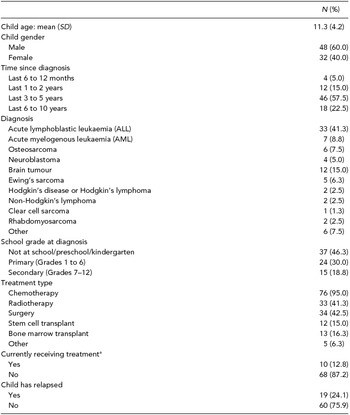
Participants were recruited from three paediatric oncology treating hospitals in NSW and families from the Ronald McDonald Learning Program. Eligibility criteria included participants who were the parent/carer of a child or adolescent who had been diagnosed with cancer in the previous 10 years, as well as having been enrolled in a school in NSW or the ACT since diagnosis. The survey participants were 80 parents (71 female: 9 male) located in NSW and the ACT. Forty-three participants were in the 35–44 years of age bracket, seven participants were in the 45–54 years of age bracket, with the remaining 10 participants younger or older than these age brackets. The vast majority (98.7%) of participants were the biological parent of the child with cancer. Sixty-six participants were in two-parent families, seven in single-parent families, five in blended families (one biological parent, one step-parent). Two participants were categorised as ‘other’ (grandparent custodian of the child). Parents’ highest education levels ranged from primary level education to postgraduate qualification (see Table 1 for more details). Country of birth of the participants was reflective of Australian statistics (Australian Bureau of Statistics, 2011), with 75% of participants born in Australia and 25% born in other countries. Nine per cent of participants spoke a language other than English at home. Two participants were of Aboriginal and Torres Strait Islander descent.
Demographic and Other Characteristics of Children Affected by Cancer

Note: *Two people did not respond to this item.
There were 24 participants in the focus groups (22 female: 2 male). These parents represented 21 students, with two husband-wife pairs and one mother-grandmother pair attending the groups. Demographics of this group were in line with the demographics outlined as above for the survey participants, except that there were no Aboriginal or Torres Strait islanders represented in the focus groups.
Procedure
Approval to conduct the research was obtained from Hunter New England Human Research Ethics Committee. Site Specific Approval for additional sites was obtained. Participants were informed about the online survey through posters placed in hospitals and flyer distribution to Ronald McDonald Learning Program Mailing Lists and newsletter — for example, The Chemo Chronicles. Word-of-mouth recruitment was expected to occur as parents/carers communicated with other parents/carers within the hospital and community setting. Hard copy versions of the survey were also made available via designated social workers from the oncology wards at each of the three children's hospitals. Translator services were available if requested.
Participant consent for the online survey was obtained through voluntary completion of the survey. Surveys were non-identifiable. At the completion of the online survey, participants were invited to participate in a focus group held across five sites in NSW/ACT. The focus group locations were: The Children's Hospital at Westmead, Sydney Children's Hospital Randwick, The John Hunter Children's Hospital Newcastle, Coffs Harbour (regional NSW) and Canberra in the Australian Capital Territory. Willing participants were invited to contact the researcher via phone or email to register for a nominated focus group.
At the commencement of the focus group, information sheets (including consent forms) were provided to the participants. Follow-up contact details for support services were made available to all participants.
Measures
The online survey was developed by the research group following comprehensive discussion and research review. Piloting of the survey was undertaken by five parents of students with cancer. The survey contained a range of response types including multiple choice, rating scales, matrix of choices and open-ended questions. Additional comments were invited for many of the questions. Key elements related to the research questions were detailed within the survey. These included child age, grade, medical information and periods of school absence and hospitalisation. Education focused questions included pre-existing special needs of the student and identified areas of physical and educational need following treatment. Support services and preferences were questioned; for example, ‘What has been or was the most effective form of communication between yourself and your child's school?’ Sibling details, including their needs and support options, were also included in the survey design. Participant demographic questions were included as per Australian Bureau of Statistics data collection models.
Focus group content was structured to include introductory information and key questions. A discussion structure for the groups was developed and maintained to ensure continuity across groups. As per the research aims, the focus groups were structured to provide participants with an open forum in which to express and discuss aspects of educational concern. Demographic questions as per the online survey were provided in hard copy format to each participant at the commencement of the focus group.
Design
In order to provide a broad consideration of the research questions, quantitative and qualitative research methods were applied. Quantitative analysis calculated descriptive statistics for demographic data and selected survey questions. All focus groups were tape recorded and transcribed by an external transcriber service. Individual participants were identified via code only in the transcripts. Analytical coding was applied to the focus group data in line with the work of Richards (Reference Richards2005). Analytical coding in this instance refers to coding and the creation of categories that come from interpretation and reflection on meaning. Focus group data expanded upon the survey results. Conceptual categories were identified in response to pertinent themes, issues and discussion topics raised by the participants during the focus groups. Broad categories emerged from the analytical coding and included: Treatment Issue or Description, Parent Point of View, Government Involvement, Education Issue, Child Strength, Future Suggestion, Siblings, Hospital Schools, Medical Issue, Technology, Socialising, and Funding.
Results
Survey Results
The participating parents represented 80 students with cancer (32 female: 48 male) with an age range of 3–20 years, as well as 136 siblings. Representation at national statistic rates was obtained across culturally and linguistically diverse groups, cancer diagnosis and relapse rates (ABS, 2011; AIHW, 2008). The majority of participants had a son or daughter who had been diagnosed with cancer in the previous 3–10 years. All student grades from Kindergarten to Year 12 were represented; however, there was a greater incidence of younger children, with 46.3% either ‘Not at school’ or in ‘Preschool or Kindergarten’ at the time of diagnosis. The time spent in hospital was quantified and confirmed the high level of absences experienced by students.
Absenteeism
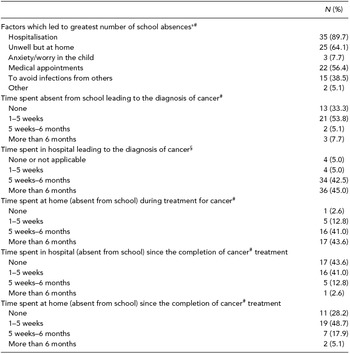
Of the cancer patients who were attending school (K–12) at the time of diagnosis, parents reported that 53.8% had been absent from school between 1 to 5 weeks leading up to their diagnosis. Furthermore, during cancer treatment 41% of patients had been absent from school between 5 weeks to 6 months and 43.6% more than 6 months, due to time spent at home. At treatment completion, 12.8% of cancer patients were absent from school between 5 weeks to 6 months and 2.6% had absenteeism of greater than 6 months, due to time spent in hospital; 49% of cancer patients missed between 1 and 5 weeks of school after treatment completion due to time spent at home (refer to Table 2 for summary of parent-reported absenteeism). The primary cause of absenteeism reported by parents was hospitalisation (89.7%). Other factors leading to absenteeism (multiple responses were allowed), included the child being unwell and therefore at home (64.1%) and medical appointments (65.4%).
Parent-Reported Absenteeism in Children With Cancer

Note: *Participants allowed to indicate more than one response; #Only includes the 39 participants who were in Years 1–12 at school at the time of diagnosis. §Two participants did not respond to this item.
Special needs and support received
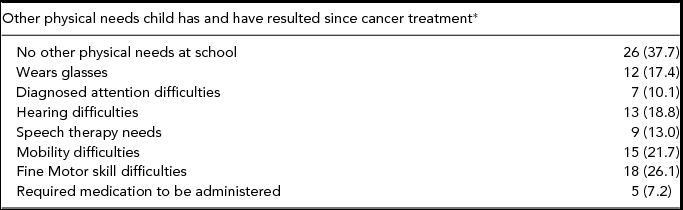
Fewer than one out of ten parents (9.1%) stated that their child had special needs prior to their diagnosis. The percentage of students reported as now having special physical needs at school resulting from cancer was 62.3%. These reported needs included difficulties with fine motor skills (26.1%), mobility issues (21.7%), hearing difficulties (18.8%) and attention difficulties (10.1%). (See Table 3 for the full list of parent-reported physical needs.) Despite this high level of additional needs, fewer than 10% of the students were reported as receiving additional funding for educational support at their school (9.3%). Focus group comments reiterated these findings with comments such as: ‘Unfortunately I feel that my son has slipped through the cracks as he is not labelled with any disability, but really he now has a hidden disability.’
Parent-Reported Physical Needs After Their Child's Cancer Treatment

Note: *Participants allowed to indicate more than one response.
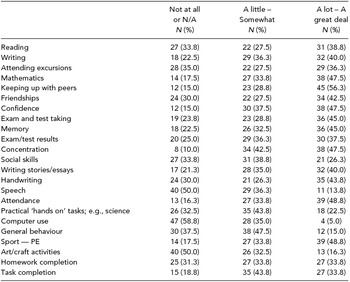
Educational areas that participants believed were affected ‘a lot’ or ‘a great deal’ since the child was diagnosed with cancer included: attendance (48.8%), sport (48.8%), mathematics (47.5%), concentration (47.5%), confidence (47.5%), memory (45.0%), examinations (45.0%), handwriting (43.8%), and writing (40.0%). (See Table 4 for full list of parent-reported educational areas affected.) Furthermore, 12.5% of children had repeated a school year since their diagnosis. Focus group comments supported the survey results with statements such as:
Parent-Reported Skills Affected by Their Child's Cancer Diagnosis

His reading level is probably a year behind where it should be and his handwriting is all over the shop.
His processing is slow and his concentration seems to be a bit impaired. Maths is just a disaster for him. As a result, he thinks of himself as dumb.
He does have learning difficulties as a result of this experience and he finds it very hard to plan things.
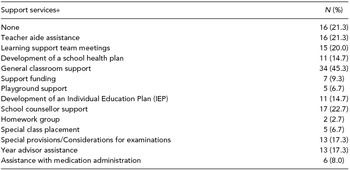
On their child's return to school, more than one in five parents identified receiving little or no structured support (21.3%). Of those parents who received support, the most common forms cited as being received from their child's school were ‘general classroom support’ (45.3%) and the ‘school counsellor’ (22.7%). Few parents received special class placement for their child (6.7%) or assistance with medication administration (8.0%). (Refer to Table 5 for school support services received.) Focus group comments provided further explanation of some of the challenges in working with school staff. Such comments included:
School-Based Support Services Received by Families

Note: *Participants allowed to indicate more than one response.
It is a small community and the teachers were traumatised by what was happening to her. They were more scared about her survival and us coping than her educational needs.
Teachers have very little experience with cancer. They have a stereotypical idea of what it's like, but in reality it is different for each kid.
When they get sick their mannerisms aren't normal and this can be taken the wrong way by schools.
Parent–school communication
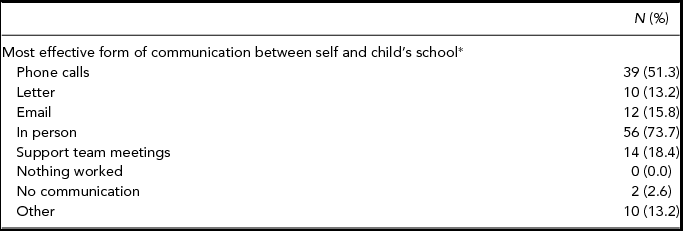
In terms of communication between the parents and their child's school, 73.7% of parents indicated that ‘in person’ communication was most preferred, followed by phone calls (51.3%). Three per cent of parents had no form of communication with their child's school (refer to Table 6 for full list of communication styles). The majority of parents agreed that they would like to see more information about education and children's cancer placed on websites (94.8%) and in books or booklets (92.3%). Furthermore, 70.6% of parents indicated they would be interested in attending parent education groups and stated they would like more help to understand the effects of cancer on their child's educational progress (82%).
Parents’ Preferred Mode of Communication With Their Child's School

Note: *Participants allowed to indicate more than one response.
Siblings
With regards to the siblings of the child with cancer, the majority of parents believed siblings had experienced educational difficulties related to the impact of cancer (59.1%, with 23.9% answering ‘not applicable’). Furthermore, 46.5% of parents agreed that the siblings of the child with cancer had a higher than usual absence from school due to their brother or sister's cancer diagnosis. The effect of cancer on siblings was well described by parents with comments such as: ‘It affects all the siblings’, ‘The siblings suffer just as much as the sick kid’, and ‘It's harder on the siblings than the sick, ’cause their world's been torn apart’.
Focus Group Results
Participating parents in the focus groups represented 21 students. The average age of the represented students was 11.8 years (range 4–20). Of the 21 students, 2 were still receiving treatment for cancer while 19 had completed their treatment. Six students had experienced relapse of their cancer. There was representative distribution of school type attend by the students, that is, government, private or Catholic systemic.
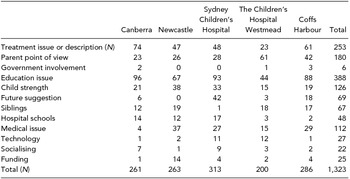
Each focus group was recorded and transcribed. Transcriptions were coded using the categories previously outlined. Frequency counts for the categories were calculated and are presented in Table 7. The categories of Education, Treatment Issue/Description and Parent Point of View provided the highest frequency counts. There was some variation in frequency counts across focus group locations. The category of ‘Future Suggestions’ received a higher frequency among participants at one hospital compared to other hospitals. The parents at this hospital all had high school aged or older children and two of the parents worked in the education sector.
Frequency of Focus Group Discussion Category

Aside from the serious nature of the cancer diagnosis for each participant's child, it was unusual for any of the children discussed to be facing only one medical issue post treatment. The combination of feeling unwell, fatigued and receiving treatment away from home meant that each of their medical issues kept children away from school for long periods of time: ‘Even though the school knows the story, they still send me letters every term saying that your child is showing abnormally high absenteeism’; ‘The teacher really didn't grasp the idea of what fatigue was’.
Additionally there was a strong expression across all focus groups about resulting psycho-social changes and/or issues for their child, as well as the lack of psychological support for parents, children and siblings alike:
He was a very, very lonely kid.
The cost is that she is constantly, and has been from the start, keyed up. She is incapable of relaxing.
I mean these kids have got strengths that others don't come near. They're grown up a lot.
He is just a different child now to what he was before. He has lost his confidence.
And then when you've finished [in hospital], there's no one really to talk to and no one else understands anything you face. So you don't even bother sharing it with anyone.
It's like a storm. Your mind is in turmoil ’cause so much is happening, you don't know which way to think.
Many parents indicated that education for their child was ad hoc and often relied on the will of individual parents to obtain educational support, rather than there being a systematic approach accessible by all:
The level of support you get is totally dependent on the school you are at. It should be more systematic.
The staff are not given any sort of heads up as to how they're supposed to treat this child. They need a protocol, a bit of extra help.
Parents expressed a strong desire for a system where the educational needs of each child were addressed individually — for example, via a case management model standardised across all schools. Comments referring to this need included:
It would be good if there was stronger liaison between the hospital school and home school.
In each school there should be a person who has or develops some expertise in the field that is given all the information about the child, their particular illness and knows everything that's going on and manages the school's response from year to year.
Many participants also experienced difficulties knowing what support was available or what support was required to maintain their child's ongoing educational and developmental needs: ‘I told the school about her, but the school did not pass it from one teacher to another’. They also described challenges in providing the home-based educational support their child needed: ‘I find it very hard to find the time to do the work with him, what with looking after the house and family etc. and I am not a teacher, so I find that hard’.
Discussion
The Educational Pathways research questions aimed to examine previously unexplored parental perceptions of the educational resources and needs of children and adolescents diagnosed with and treated for cancer in Australia. Cancer information obtained from the participating parents, who represented 80 students, reflected national cancer statistics related to cancer type, treatment and relapse rate (AIHW, 2008). Survey data quantified the high level of absenteeism experienced by students, as well as the additional educational and support needs experienced by this group of students and their families during and beyond treatment.
There were 62.3% of students identified as having additional needs that impacted upon their schooling following diagnosis and treatment for cancer and yet despite this high level of additional need, fewer than 10% of the students were reported as receiving support funding at school (9.3%). This 62.3% of students with additional needs reflect research findings associated with long-term or late effects of treatment (Armenian, Meadows, & Bhatia, Reference Armenian, Meadows, Bhatia, Pizzo and Pollack2011; Armstrong & Reaman, Reference Armstrong and Reaman2005; Butler & Mulhearn, Reference Butler and Mulhearn2005; Daly & Brown, Reference Daly, Brown, Weiner and Pao2009; Keene, Reference Keene2003; Nathan et al., Reference Nathan, Patel, Dilley, Goldsby, Harvey, Jacobsen and Armstrong2007). The most common additional need for students following cancer treatment, as identified by their parents, included: fine motor skills, mobility, hearing and vision. Movement, hearing and vision are central to a child's development and learning and clearly impact upon the educational experience for the child.
In addition to specific physical additional needs, nearly half of the students were also identified by their parents as experiencing educational decline in mathematics, concentration, memory, writing, and confidence. These areas of need are suggestive of a combination of possible neurocognitive decline such as in memory and attention, as well as lost skill development opportunities such as keeping up with mathematics content.
Almost half (48.7%) of the children had not started school when they were diagnosed with cancer. This figure reflects incidence rates in young children (AIHW, 2012). For these students, there are potentially 13 school years ahead of them as they attempt to manage the educational impact of long-term treatment effects. The challenge of managing additional needs within an educational system that may not adequately support students who have survived cancer is likely to put tremendous strain on both the child and parents. Statements from parents which referred to ‘a hidden disability’ and ‘falling through the cracks’ demonstrate the frustration that parents experience as they deal with school support options.
The majority of participants in this research (57.55%) represented students who were 3–5 years post diagnosis. This figure, along with the high level of additional needs and skills areas affected following treatment among the students (62.3%), reflects observational and service delivery experiences of the Educational Pathways team who initiated the research project. A key factor leading to this research was the observation that educational needs are often identified after the child has completed cancer treatment and returned to school. It is when the child is once again among his/her peers that academic differences in progress become obvious.
Addressing these post-treatment needs is a matter of recognising both the missed academic content and possible neurological changes in the child and tailoring remediation directed at both components. Teachers working with students recovering from cancer treatments are likely to require assistance in understanding not only these complex interactions but also their own response to illness. Focus group discussions recognised that school staff may require this additional support, with comments that referred to observing trauma in the teachers and a lack of teacher knowledge about issues such as fatigue and cancer in general.
The transcriptions of the focus groups held across NSW and the ACT approximated 100,000 words. The nature of many of the comments made by participants suggested that parents were very emotional, open and trusting as they shared their experiences. Given the educational focus of the research questions it was relevant that education was one of the highest focus categories discussed in the groups. Differences in category frequencies across sites were likely to be related to either the ages of the parents and/or their children. For some parents it appeared that it was possibly the first time that they had been given a voice to speak openly in a secure group about their many challenges. Raw emotion was described with references to turmoil, lack of understanding and having no one to talk to.
The strengths of this research included representation across the state of NSW and the ACT both demographically and according to cancer statistics for children and adolescents. A mixed method design enabled frequency counts on previously unknown aspects of the relationship between cancer treatment and education, such as absenteeism and affected areas of education. The research also provided the opportunity for the complexity of the experience as described by the parent, to begin to be documented. Given the broad scope of the inclusion criteria for participants and the survey distribution method employed, one of the limitations to the study was that the survey completion rate was unknown. Additionally, the 10-year time frame for inclusion is lengthy. During this time there may have been changes to medical treatments and educational supports that were not captured in this research. The invitation to participate in the focus groups was presented at survey completion. More than 25% of parents who completed the survey were also interested in sharing their stories within an open forum. This is a large proportion of the survey group and possibly reflects the unvoiced experiences of many parents.
Future research that incorporated validated measures of parental satisfaction and/or experience with educational systems would strengthen the research design. The use of such measures would also assist with the unknown factor of working with parental report and the natural bias/distortion that may occur in retrospective memory of events. Utilising retrospective memory was a limitation of this study, along with the lack of interrater reliability considerations within the focus group coding. Seeking the child perspective regarding their educational experiences and quality of life would also be highly beneficial in future research in order to target intervention and support. In addition to the child with cancer, this research quantified the increased school absences and possible psychosocial issues for siblings. Further research around the siblings’ educational experiences as they also attempt to continue with their schooling would be beneficial.
The perspective and needs of teachers, including hospital school teachers, working with students who have been diagnosed with and treated for cancer, was not included in this study. It would be beneficial to further understand what knowledge, skills and support strategies may be required by schools, individual teachers and school psychologists in order to better support students, particularly those students returning to school with additional needs.
This research identified three key areas of need for parents of children with cancer: the need for information, advocacy and improved educational support in order to minimise the compounding effects of missed education and possible late effects of cancer treatment. In response to these areas of identified need, the Educational Pathways Project Committee has continued to develop resources and models of support. A White Paper titled Educational Pathways for Children, Adolescents and Young Adults With Cancer (Donnan, Reference Donnan2011), was distributed to leading federal and state health, education and political bodies. A comprehensive book for parents titled What about School? A Resource for Parents of Children, Adolescents and Young Adults With Cancer (Donnan & Webster, Reference Donnan and Webster2013), is now in its second edition. This resource is distributed nationally to families via education and health specialists associated with oncology treatment centres.
Parent feedback from this research emphasised the need for a central education specialist to work with students, support parents, and liaise with multidisciplinary teams, hospital schools and home schools. This finding reflects recommended models of school re-entry, communication and educational interventions for students with cancer (Leigh & Conklin, Reference Leigh, Conklin, Pizzo and Pollack2011; Shiu, Reference Shiu2004; Weiner, Hersh, & Alderfer, Reference Weiner, Hersh, Alderfer, Pizzo and Pollack2011). Collaborative efforts from the Educational Pathways Project team have since seen Educational Liaison Coordinators established at three oncology departments, two in NSW and one in Victoria. Pilot evaluation of this service has been completed and formal evaluation is underway.
The benefits of recognising and supporting the educational needs of the student and family affected by childhood cancer are direct and far-reaching. These benefits include continuity of academic skills, educational progression, peer connectedness, psychological wellbeing and quality of life for the student and their broader family. In order to attain these benefits, clear systems of information, skill development and communication structures are required across and within families, multidisciplinary oncology teams, schools and educational departments.
This research has provided a preliminary overview into the educational experience of students diagnosed with and treated for cancer from the perspective of their parents. To the students at the centre of this cancer: experience, family, friends and school represent their daily life. Structured support that can maintain contact and continuity with all components of a student's life as it existed prior to diagnosis means that the student is more likely to maintain their sense of self, meaning and value while they continue on their developmental path through the educational system and on to adulthood.
Acknowledgments
The authors would like to express gratitude to Emma Doolan from the Behavioural Sciences Unit, Kids Cancer Centre, Sydney Children's Hospital, Randwick for her assistance with statistical analysis.
Financial Support
The Educational Pathways Project is a collaborative project jointly funded by Ronald McDonald House Charities, Sydney Children's Hospital, The Children's Hospital at Westmead and Kaleidoscope: The John Hunter Children's Hospital. Claire Wakefield is supported by a Career Development Fellowship from the National Health and Medical Research Council of Australia (APP1067501) and an Early Career Development fellowship from the Cancer Institute of NSW (ID: 11/ECF/3-43). The Behavioural Sciences Unit is supported by the Kids with Cancer Foundation.
Conflicts of Interest
None.
Ethical Standards
The authors assert that all procedures contributing to this work comply with the ethical standards of the relevant national and institutional committees on human experimentation and with the Helsinki Declaration of 1975, as revised in 2008.