The prevalence of congenital left main coronary artery atresia is very low. According to the literature, no more than 60 cases have been reported up until 2017. Reference Musiani, Cernigliaro, Maelli and Gasperis1–Reference Yajima, Toda and Nishi4 Therefore, it is difficult to diagnose and treat. Further, the reports about the long-term results of more than 10 years are limited. Reference Yajima, Toda and Nishi4 We report the long-term results of four patients whose diagnosis of congenital left main coronary artery atresia was not confirmed at the initial presentation.
Patient 1
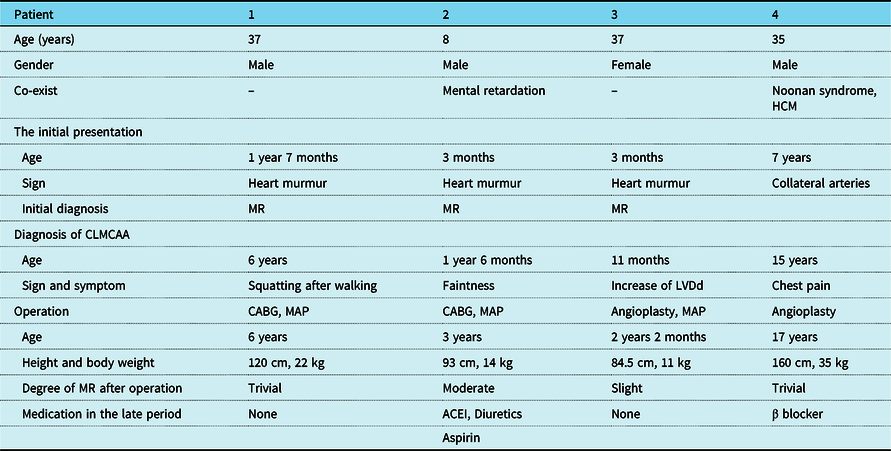
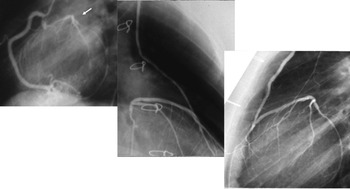
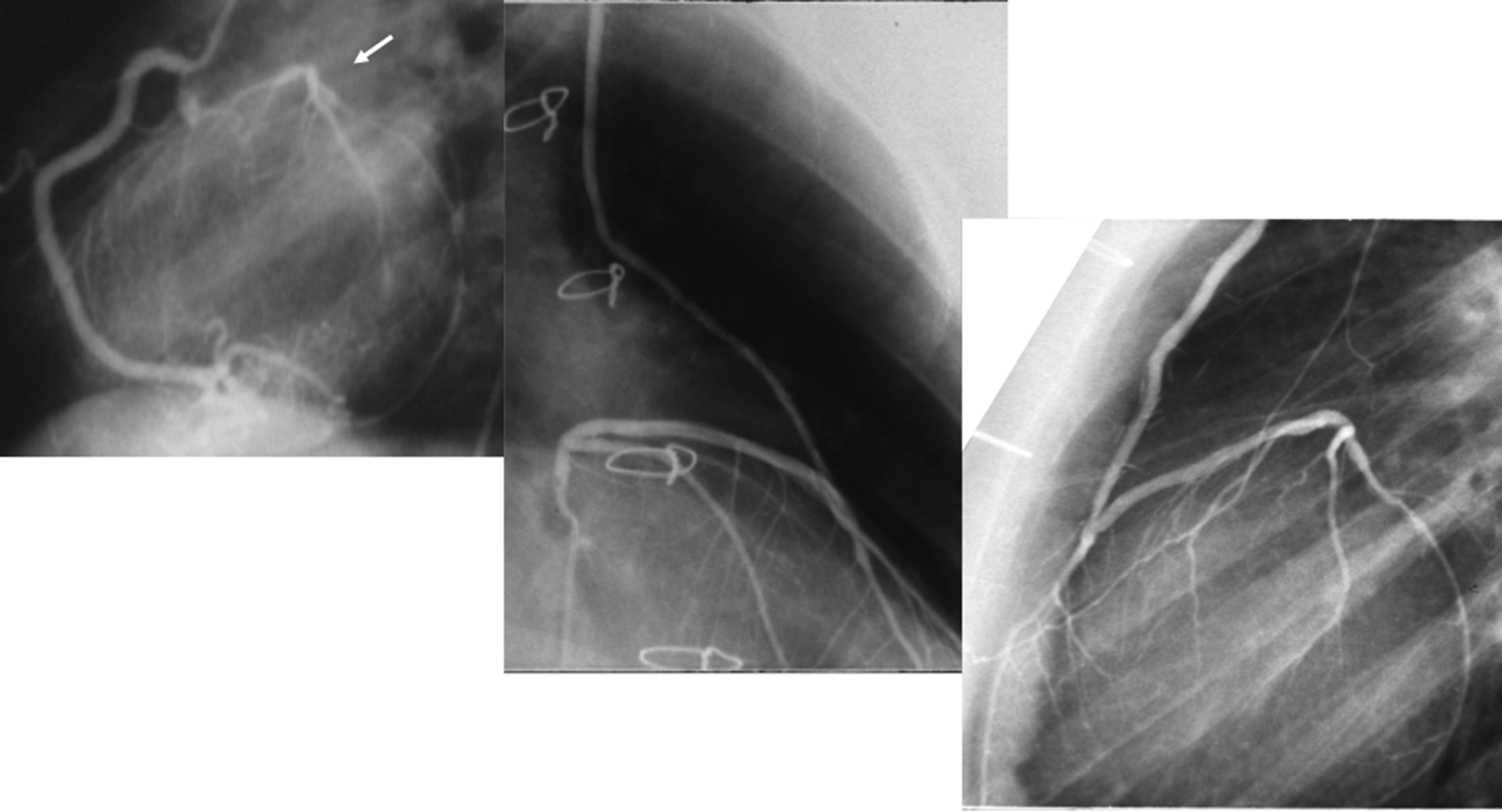
The heart murmur in the first patient was detected at 1 year old. He was diagnosed with mitral regurgitation by two-dimensional echocardiography at 3 years old (Table 1). After walking for 20 min at 6 years old, he became pale and had to squat down to rest. ST-T depression in leads V2–V4 was detected during the treadmill test. A selective coronary angiogram of the right coronary artery revealed atresia at the orifice of the left coronary artery (Fig 1 left). His height and body weight were 120 cm and 22 kg, respectively. He underwent a coronary artery bypass grafting of the left anterior descending artery using the left internal thoracic artery and mitral annuloplasty. At the age of 11 years old, the left internal thoracic artery graft was patent on the angiograms (Fig 1 middle, right). Myocardial ischaemia was not detected on exercise201Tl myocardial perfusion imaging. The ST-T depression during the treadmill test improved. On the two-dimensional echocardiogram at 37 years old, his left ventricular end-diastolic dimension and left ventricular ejection fraction were 50 mm and 61%, respectively, and the mitral regurgitation was trivial. The diameters of the right coronary artery and left anterior descending artery by two-dimensional echocardiography were 3.3 mm and 2.9 mm, respectively. He has had no cardiac events for 31 years.
Characteristics and treatment of congenital left main coronary artery atresia
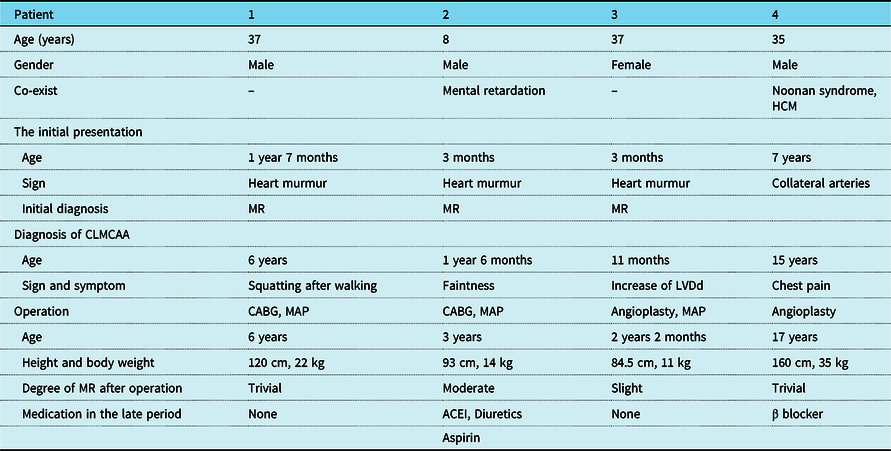
CLMCAA, congenital left main coronary artery atresia, HCM, hypertrophic cardiomyopathy; MR, mitral regurgitation, CABG, coronary artery bypass grafting, MAP, mitral annuloplasty; LVDd, left ventricular diastolic dimension; ACEI, angiotensin converting enzyme inhibitor.
Coronary angiograms before and after the operation (Patient 1) (Left) Right coronary angiogram at the age of 6 years old (Middle and right) Left internal thoracic angiograms at the age of 11 years old.
Patient 2
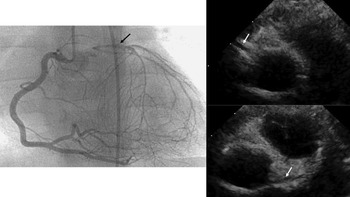
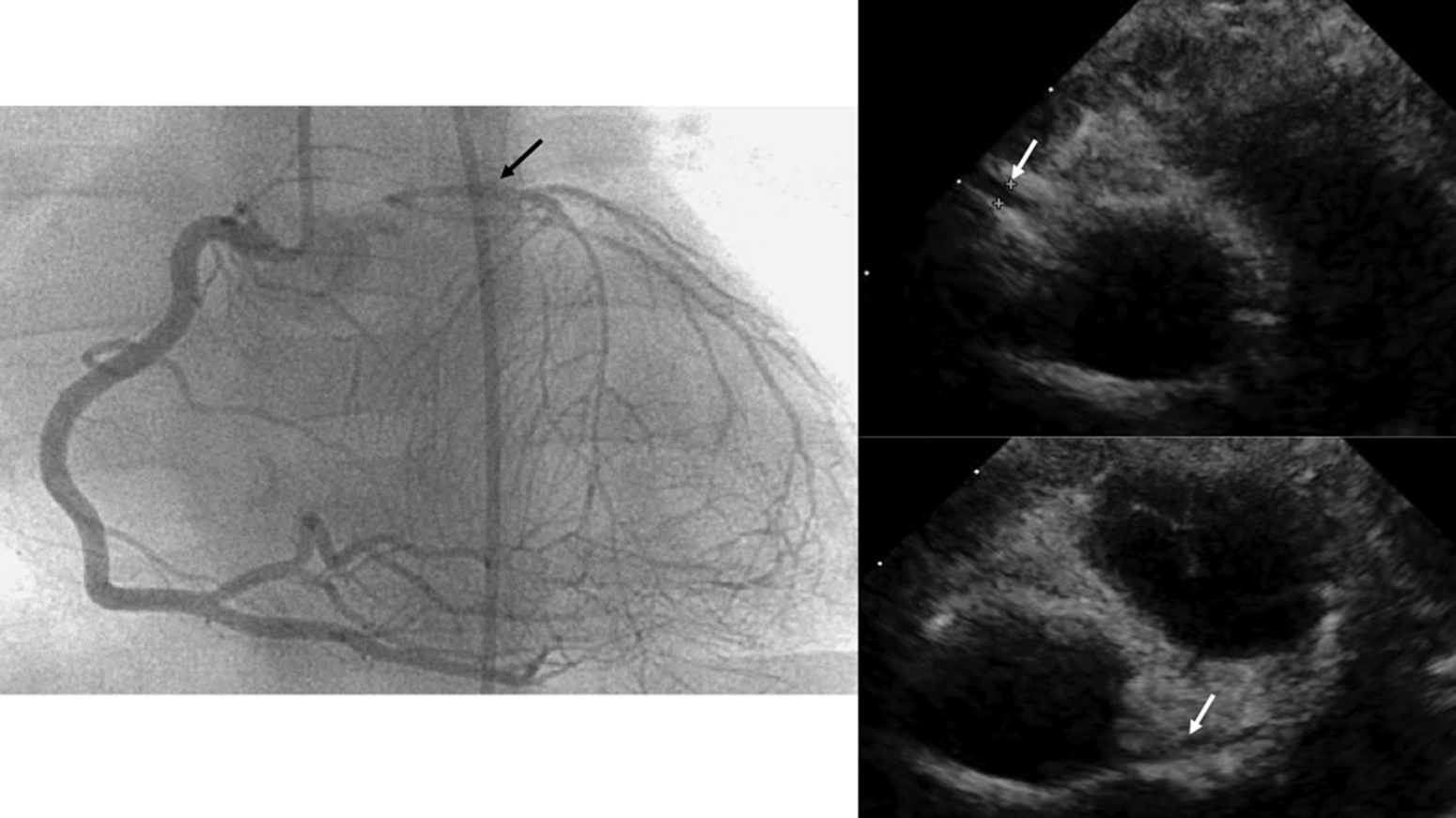
The second patient visited our hospital because of mitral regurgitation at 1 year and 6 months old. A heart murmur was detected at 1 year old. Furosemide, spironolactone, and enalapril were given. His left ventricular end-diastolic dimension and left ventricular ejection fraction were 41 mm (117% of normal) and 61%, respectively, and the mitral regurgitation was severe. The diameters of the right coronary artery and left anterior descending artery by 2DE were 1.9 mm and 1.7 mm, respectively (Fig 2 right). When he underwent cardiac catheterisation, he was diagnosed with congenital left main coronary artery atresia (Fig 2 left). A 12-lead electrocardiogram revealed an abnormal Q wave in lead aVL. He had been diagnosed with slight mental retardation. He underwent coronary artery bypass grafting to the left anterior descending artery and mitral annuloplasty at 3 years old in another hospital, because of faintness. His height and body weight at the time of the operation were 94 cm and 14 kg, respectively. The abnormal Q wave in lead aVL disappeared after surgery. The mitral regurgitation remained moderate at 8 years old; however, the left internal thoracic artery graft was patent on the angiograms after the operation.
Coronary angiogram and echocardiograms before the operation (Patient 2) (Left) Right coronary angiograms at the age of 1 year and 6 months (Patient 2) (Right upper) Right coronary artery (Right lower) Left coronary artery The diameters of the right coronary artery and the left anterior descending artery were 1.9 mm and 1.7 mm, respectively.
Patient 3
The third patient visited our hospital at 7 months old, after a heart murmur due to mitral regurgitation was detected at 3 months old. Her left ventricular end-diastolic dimension on a two-dimensional echocardiogram was increased at 11 months old. When she underwent a cardiac catheterisation, severe stenosis of the left main coronary artery was suspected. The atresia at the orifice of the left coronary artery was diagnosed at 2 years old during the operation. The orifice of the left coronary artery existed at just upper 2 mm in the commissure between the left cusp and the non-cusp. Her height and body weight at the operation were 87 cm and 11 kg, respectively. The diameter of the left main trunk was 1.5 mm. A fibrous ridge of the left main trunk was removed. She underwent an angioplasty at the orifice of the left coronary artery with a cut back and mitral annuloplasty. At the age of 11 years old, the orifice of the left coronary artery was well injected on the coronary angiogram. She delivered two children without any complications in her thirties. In the two-dimensional echocardiography at 37 years old, her left ventricular end-diastolic dimension and left ventricular ejection fraction were 51 mm and 73%, respectively, and the mitral regurgitation was slight. The left ventricular end-diastolic dimension and left atrial dimension were slightly dilated. The diameter of the right coronary artery, left coronary artery, and left anterior descending artery on two-dimensional echocardiography were 3.5 mm, 3.5 mm, and 3.0 mm, respectively.
Patient 4
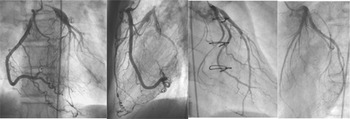
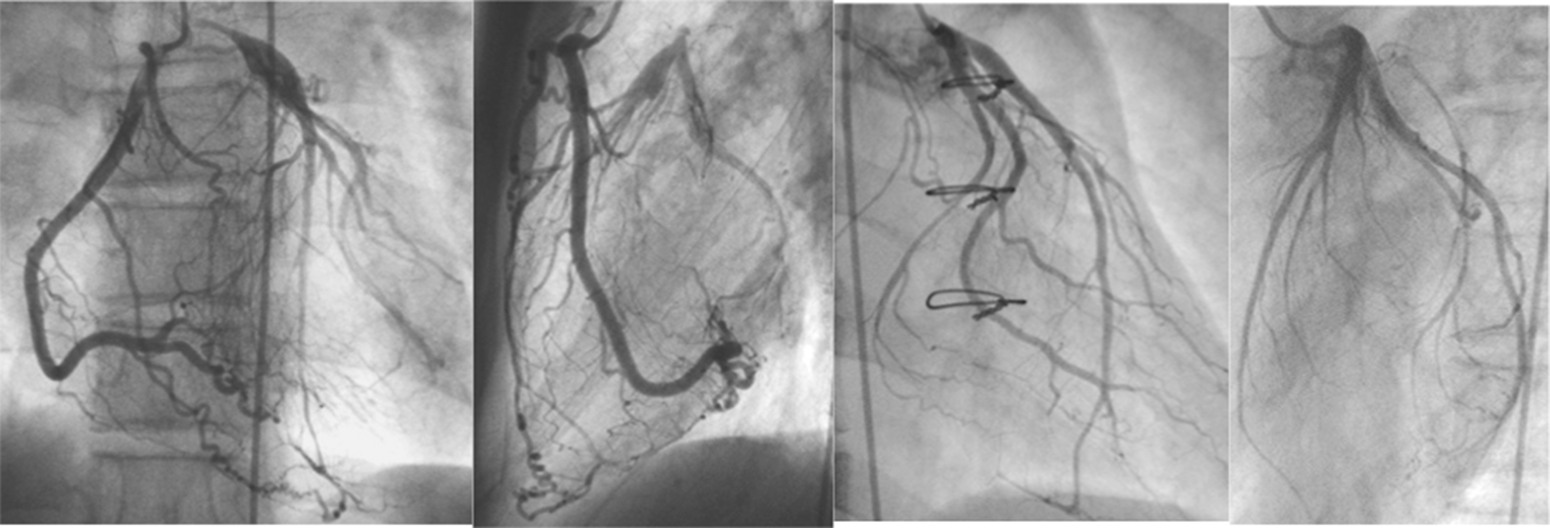
In the fourth patient, hypertrophic cardiomyopathy and Noonan syndrome were suspected at 1 year old. During the cardiac catheterisation at 7 years old, the communicating arteries between the conus branch and the left anterior descending artery had become well developed at the previous hospital. He sometimes had chest pain during exercise with aging. ST-T depression in leads V2–V4 was detected during a treadmill test. He was referred to our hospital. No perfusion defects were detected during the myocardial perfusion imaging with exercise. The diagnosis of left main coronary artery atresia was confirmed in the right coronary angiogram at 15 years old (Fig 3 left). An aneurysm of the left main coronary artery was also detected. The mitral regurgitation detected by two-dimensional echocardiography was trivial. It was also considered that angioplasty of the left coronary artery was possible by CT imaging. He underwent an angioplasty at the orifice of the left coronary artery at 17 years old. The coronary angioplasty was perfomed with a cut back method for membranous atresia. One year after the surgery, collateral arteries disappeared on the coronary angiograms, and the left coronary artery was well injected (Fig 3 right). He had no cardiac events after the surgery up until 35 years old.
Coronary angiograms before and after the operation (Patient 4) (Left) Right coronary angiograms before the operation (Right) Left coronary angiograms after the operation.
Discussion
In patients with mitral regurgitation detected within the first year after birth, mitral regurgitation should be differentiated from secondary mitral regurgitation caused by congenital left main coronary artery atresia. Reference D’Souza, Sameuel and Vettukattil5–Reference Ahmad, Haw and Vettukattil7 Its diagnosis would be difficult, because of its rarity and lack of abnormal findings. The left coronary artery can be detected as normal by two-dimensional echocardiography. The orifice of the left coronary artery seems to be normal at its position on the two-dimensional echocardiogram; however, the left coronary artery is slightly small. Reference Furuyama, Kinugawa and Nakajima8 The diameter of the right coronary artery is not always dilated on the two-dimensional echocardiogram at the initial presentation. Therefore, it is likely that a diagnosis of atresia of the left coronary artery will be missed. Severe myocardial ischaemia appears depending on an increase in activity with aging. Further examinations should be performed with occurrences such as an increase in the left ventricular end-diastolic dimension with worsening of mitral regurgitation and cardiac events such as chest pain, faintness, and squatting. Reference Musiani, Cernigliaro, Maelli and Gasperis1 The stronger the myocardial ischaemia, the earlier the appearance of symptoms. When myocardial ischaemia is speculated in patients with mitral regurgitation, coronary artery abnormalities should be re-evaluated. A coronary angiogram is needed to confirm the left main coronary artery atresia precisely. A selective coronary angiogram can reveal a small left coronary artery when injected retrogradely from the right coronary artery. CT angiography may be convenient for investigating congenital coronary abnormalities. Reference Saedi, Pouraliakbar, Ghaderian and Saedi9,Reference Nicol, Lyne, Rubens, Padley and Ho10
There was a case report about the left main coronary atresia with Noonan syndrome. Reference Ramond, Duband and Croisille11 Further, the coronary aneurysm of the left main coronary artery in the fourth patient may have been related to the characteristics of Noonan syndrome associated with hypertrophic cardiomyopathy. Reference Hakim, Gruden, Panse and Alegria12 The relationship between coronary abnormalities and Noonan syndrome and its gene abnormalities is very interesting. Reference Ramond, Duband and Croisille11,Reference Ly, Soulat, Iserin and Ladouceur13
Our long-term results showed that coronary artery revascularisation of congenital left main coronary artery atresia was useful for both angioplasty and coronary artery bypass grafting. Reference Kitamura14 Generally, most of the lumen of the left coronary artery in congenital left main coronary artery atresia reaches just the proximal portion of the left aortic cusp; however, it is often hypoplastic. Therefore, it may be possible to repair it using the cut back method or the patch angioplasty. Further, some methods for a repair of the left main coronary artery and percutaneous transluminal coronary intervention have also been reported. Reference Sunagawa, Shimabukuro, Kado, Ushonohama and Ohta15,Reference Yin, Zhong, Tao and Hu16 To choose the method for the coronary artery revascularisation surgery in each patient, CT imaging to measure the distance between the aorta and the lumen of the left coronary artery may be useful. Reference D’Souza, Sameuel and Vettukattil5 If an angioplasty of the left main trunk is difficult, coronary artery bypass grafting of the left anterior descending artery is also useful even in children to improve myocardial ischaemia. Reference D’Souza, Sameuel and Vettukattil5–Reference Ahmad, Haw and Vettukattil7,Reference Gebauer, Cerny, Vojtovic and Tax17 Even if there is one graft to the left anterior descending artery without a graft to the left circumflex, their outcome and morbidity could be preserved. The long-term outcome of coronary revascularisation for congenital left main coronary artery atresia was good. However, the degree of mitral regurgitation after surgery may affect the prognosis.
There is a difference in the time of the diagnosis between children and adult patients with congenital left main coronary artery atresia. In most cases of congenital left main coronary artery atresia, the diagnosis is made in childhood. In the child type of congenital left main coronary artery atresia without well-developed collateral arteries, usually the disease is detected by a heart murmur within the first year after birth, which is induced by mitral regurgitation due to myocardial ischaemia. Mitral valve tethering also occurs. The improvement in the degree of mitral regurgitation is also reported with the development of collateral arteries. On the other hand, fatal cardiac events such as an acute myocardial infarction and severe heart failure have been reported in patients with congenital left main coronary artery atresia. Reference Yin, Zhong, Tao and Hu16 An early diagnosis is possible if an appropriate examination is performed with the knowledge of the signs and symptoms of the speculated underlying disease. Further, congenital left main coronary artery atresia in adults is often detected in cases with well-developed collateral arteries from the right coronary artery to the left coronary artery. Reference Saedi, Pouraliakbar, Ghaderian and Saedi9,Reference Sohn, Jang and Choi18,Reference Kinoshita, Murata, Kazuno and Sato19 Chest pain on effort and arrhythmias occur due to myocardial ischaemia and involvement due to the progression of the disease and atherosclerosis with aging.
Conclusion
In patients with mitral regurgitation within the first year after birth, mitral regurgitation should be differentiated from secondary mitral regurgitation caused by congenital coronary abnormalities. The long-term outcome in the patients with congenital left main coronary artery atresia who underwent either coronary artery bypass grafting or angioplasty was good.
Acknowledgements
None.
Funding
This study received no specific grant from any funding agency, commercial, or not-for-profit sectors.
Conflicts of interest
None.
Ethical approval
All procedures performed in studies involving human participants were in accordance with the ethical standards of the institutional committee with the 1964 Helsinki declaration and its later amendments or comparable ethical standards.