1. Introduction.
The general account of scientific development given by Kuhn is well-known and has been extensively analyzed and criticized. Kuhn himself applied several adjustments over time in reply to these criticisms. Only a very brief summary will be given here, in order to place the target of my criticism—his evolutionary analogy—in the wider context of his approach.
The Structure of Scientific Revolutions (SSR; Kuhn Reference Kuhn[1962] 1970) is generally known for detailing the distinction, in the development of scientific disciplines, between alternating phases of ‘normal’ science and ‘revolutionary’ episodes. During the normal periods of a scientific discipline, scientists are busy solving the puzzles arising from empirical testing of the current paradigmatic ‘view of the world’ of that discipline, and from the need for local adjustments in the theoretical framework to account for minor anomalies. When the current paradigm begins to fail to fulfill its purpose of puzzle solving, and the unresolved puzzles turn into a considerable number of unexplained anomalies, a revolutionary episode occurs after which the whole paradigm is substituted with a new one. In Kuhn's view, some features of this change of paradigm are analogous to the features of both a gestalt switch and a language change (Reference Kuhn[1962] 1970, 111–114), and as a consequence it is impossible to map all terms from the old one onto the new one or vice versa. In particular, when translating from one natural language into another, some terms are simply impossible to translate into corresponding terms, because a certain language sometimes lacks the term for a concept expressed by a term in a different language. An analogous phenomenon occurs in science between different paradigms. A new paradigm will also bring different parameters for the identification of puzzles to solve. Although some of the previous puzzles will be solved by the revolution, others will simply dissolve and will not be present in the new phase of normal science, not even as ‘solved’ puzzles, and the difference between the theories belonging to different paradigms is called by Kuhn ‘incommensurability’. The gap implied by incommensurability, however, is not so wide as to imply the noncomparability of theories belonging to different paradigms. Theories can be compared in their capability to solve problems, and the increased power of successive theories in this task shows the progressive nature of scientific development. Kuhn is also convinced that this progression is enough to save him from the accusation of relativism, as he eventually specifies in the postscript: “Scientific development is, like biological, a unidirectional and irreversible process. Later scientific theories are better than earlier ones for solving puzzles in the often quite different environments to which they are applied. That is not a relativist's position, and it displays the sense in which I am a convinced believer in scientific progress” (Reference Kuhn[1962] 1970, 206).
2. Progress from the Evolutionary Analogy in The Structure of Scientific Revolutions .
In the main text of The Structure of Scientific Revolutions, Kuhn maintains that there is much equivocation about the nature of progress in science. Scholars who argue in favor of scientific progress conceive of science as progressing toward something, commonly closer to the truth. His notion of scientific knowledge, however, does not allow for such a directed progression. There is no neutral point of view from which we could assess the ‘distance’ between our theories and the truth, and in Kuhnian terms this very statement does not even make much sense. This is reinforced in the postscript: “the notion of a match between the ontology of a theory and its ‘real’ counterpart in nature now seems to me illusive in principle” (Reference Kuhn[1962] 1970, 206). The paradigm is the world the scientific community lives in, and the only interface between this and nature is the experimental apparatus used to test the proposed solutions to scientific puzzles. When the experiments or the observations confirm that the puzzle has been solved, there is no implication for the representation of nature implied by those theories, that is, for the ontology they depict (Reference Kuhn[1962] 1970, 206).Footnote 1 However, says Kuhn, there is a different kind of progress that science shows going through its revolutions and theory changes. It is the progress from something—that is from a certain set of tools to discover and solve puzzles to a better one. There is no direction toward anything, as such, no goal, only (indefinite) improvement from the status quo.
In my interpretation, Kuhn then introduces the evolutionary analogy with the intention of showing that this view of progress is defendable and tenable: it is possible and even plausible to regard science as progressive in the absence of a fixed goal because, he thinks, biological evolution is also progressive but nondirected. However, focusing on this defense does not provide a fruitful analogy.
In SSR he observes that scientific change is comparable to a biological process: it is irreversible, it proceeds from a starting point and it has no teleological goal: “Can we not account for both science's existence and its success in terms of evolution from the community's state of knowledge at any given time? Does it really help to imagine that there is some one full, objective, true account of nature and that the proper measure of scientific achievement is the extent to which it brings us closer to that ultimate goal? If we learn to substitute evolution from-what-we-do-know for evolution-toward-what-we-wish-to know, a number of vexing problems may vanish in the process” (Reference Kuhn[1962] 1970, 171).
Kuhn maintains that natural selection and revolutionary selection—that is, the process that accounts for the ‘survival’ of only the new paradigm—produce analogous results, since both choose the most viable of all possible alternatives, that which is most ‘fit’ for a particular, historical situation: “The resolution of revolutions is the selection by conflict within the scientific community of the fittest way to practice future science. The net result of a sequence of such revolutionary selections, separated by periods of normal research, is the wonderfully adapted set of instruments we call modern scientific knowledge” (Reference Kuhn[1962] 1970, 172). When a period of crisis occurs in a scientific community, he adds, the emergence of alternative theories might be seen as the occurrence of ‘mutations’, among which the most promising will survive.Footnote 2
Not much more seems to be implied by this analogy, at least in SSR, where Kuhn actually warns against easy generalizations:
The analogy that relates the evolution of organisms to the evolution of scientific ideas can easily be pushed too far. But with respect to the issues of this closing section it is very nearly perfect. The process described in Section XII as the resolution of revolutions is the selection by conflict within the scientific community of the fittest way to practice future science. The net result of a sequence of such revolutionary selections, separated by periods of normal research, is the wonderfully adapted set of instruments we call modern scientific knowledge. Successive stages in that developmental process are marked by an increase in articulation and specialization. And the entire process may have occurred, as we now suppose biological evolution did, without benefit of a set goal, a permanent fixed scientific truth, of which each stage in the development of scientific knowledge is a better exemplar. (Reference Kuhn[1962] 1970, 172–173)
Here, Kuhn does not elaborate further on the term ‘selection’. He refers to a process analogous to natural selection but he does not go into any detail and I will not comment on it here: Kuhn's passage only shows that, in science, a mechanism analogous to biological evolution is in place that accounts for the adaptation of our knowledge and practices to the problem-solving activity. The necessary outcome of this process is, for Kuhn, the specialization of scientific disciplines, an idea that will be further developed in “The Road since Structure” (RSS).
However, Kuhn's analogy already suffers from several defects at this stage. Firstly, it is not clear what exactly the terms of the analogy are. He opens the passage by drawing an analogy between organisms and scientific ideas, mapping ‘mutation’ into ‘theory change’. It is not clear, though, what evolutionary lineages of organisms should be mapped onto, given the fact that revolutionary episodes would suddenly create novel ideas, concepts and problems, many of which would be incommensurable with their predecessors. If we allowed the hypothesis that new ideas emerge slowly, as the continuous adjustment of previous ones, we would acknowledge the existence of chains of concepts that would destroy Kuhn's main standpoint of the incommensurability over revolutions. The main feature of scientific revolutions is the introduction of a discontinuity in the way the world is viewed and in the rules that dictate what a scientific problem is and what it is not. The emergence of these new view and rules would be analogous, in terms of Kuhn's sketched analogy, to the emergence of a new form of life from basic organic constituents. The problem would not arise, however, if we accepted the emergence of life from scratch as the biological event analogous to the emergence of these novelties. Nevertheless, even if we managed to overcome the difficulty posed by the observation that all living species seem to descend from the same ancestors, suggesting that the emergence of brand new life has been a unique (at least historically) event on earth, there would be another major obstacle. In the analogy, it would remain unexplained how new ideas would rise in their whole complexity, while new life would obviously start from the simplest forms.
Kuhn also adds that selection operates on scientific practices, and here it is even more difficult to follow the complete analogy and relate scientific practices to anything on the biological side, at least with the few details that Kuhn provides. His mention, in this context, of a sequence of revolutionary selections separated by periods of normal research could remind us of the concept of punctuated equilibrium,Footnote 3 while the increased specialization in separate scientific disciplines will be developed by Kuhn into his analogy with speciation in RSS.Footnote 4 The lack of further detail, however, prevents any fruitful analysis along this line of reasoning. At the end of this almost casual list of analogies between biological and scientific development, Kuhn states the main point he is trying to make, that is, the deceptiveness of conceiving a ‘permanent fixed scientific truth’ as the goal of science.
Alexander Bird (Reference Bird2000) analyzes this argument by comparing Kuhnian scientific progress to two alternative models: single-species and two-species evolving systems. In the single-species model, one species evolves in a fixed environment, for example, giraffes in an environment of fixed height trees. In this case there exists an optimal height (or range of heights) for the giraffes to evolve to under selective pressure. In this (oversimplified) case it makes sense to say that the evolution of giraffes is getting them closer and closer to a certain goal, toward an optimal height for feeding. However, in a two-species model, which is still an oversimplification but closer to the actual situation in nature, trees evolve as well.Footnote 5 In this case the changes in one species modify the selective pressure on the other and vice versa, and mutual evolution is in place. For example, trees would be advantaged if on average they were too high to have their leaves eaten by giraffes. Higher trees, however, would increase selective pressure on giraffes to grow even further and so on. Bird also states that in an evolutionary analogy, the selective pressure on the giraffes would map into the selective pressure of experimental tests on theories. As the results of experimental tests do not change (experimental replicability is a ‘requisite’ for scientific activity, due to the stability of the reality we are testing against), then the single-species model is the most accurate analogy for scientific development. In Bird's opinion, this is enough to show that Kuhn is incorrect; a properly designed evolutionary analogy cannot avoid progression toward truth:
If a hypothesis passes a well-designed and well-executed experiment we are usually confident that it will continue to pass tests of that kind if repeated, and that any extension of the theory will thus also pass the test. In broad terms, the single-species model captures the idea that in science our theories may change but the features of the world that they respond to are what they are independently of our theories, and are by and large constant over time. Recall that in the single-species model we could say that the giraffe is evolving towards an ideal and that there would be no pressure on the species to evolve once that ideal had been reached. Similarly we can say of an area of scientific research that it will evolve towards an ideal beyond which it cannot go. In the limit the giraffe reaches an optimal ‘fit’ with its (fixed) environment; a theory can reach an optimal fit with the world, and this would be a true representation of it, since only true theories cannot be falsified. (Bird Reference Bird2000, 213)
I find Bird's argument oversimplified in its treatment of both sides of the analogy. On the science side, for instance, it is not generally true that a certain hypothesis will pass a certain kind of test forever. An improved technique might be developed to perform the same kind of test, for example, by increasing the accuracy of measurements and causing the results to change.Footnote 6 Newton's laws passed all tests of celestial mechanics until some irreconcilable anomalies of Mercury's orbit were found (Kuhn Reference Kuhn[1962] 1970, 39–40). The focus, of course, is on what is meant by ‘well’ in the phrase ‘a well-designed and well-executed experiment’. In Kuhnian terms the quality of an experiment is relative to the current paradigm, although cross-paradigm tests are possible (and are decisive for the conversion of scientists to the new paradigm). I would add, however, that only after a certain amount of time is it possible to judge the quality of a test, usually in relative terms when compared to new versions of the test that have been available for some time. And even the newly available tests may be called ‘well-designed’ in a provisional fashion, only. I agree with “the idea that in science our theories may change but the features of the world that they respond to are what they are independently of our theories” (Bird Reference Bird2000, 213).Footnote 7 So, our desires cannot change what we read on a galvanometer, to use Campbell's (Reference Campbell and Schilpp1974) example. This, however, brings no guarantee to the claim that a good test will be always regarded as such across any number of successive theories extending the original one.Footnote 8 And this claim is the main underpinning of Bird's view of theories evolving toward an optimal state.
I also find Bird's biological models so simple as to be misleading. For example, to add some reality to the two-species scenario, it would suffice to note that trees and giraffes could not sustain their growth indefinitely. A number of additional effects and selective pressures would emerge: structural stability of both tree trunks and giraffe necks, exposure of a larger surface to the external environment, and higher visibility to predators, just to mention a few.Footnote 9 It does not seem to be a good idea to find simplistic scenarios for evolutionary biology in order to show that the least unrealistic ones do not fit the analogy with science development, because these attempts fail as soon as it is objected that the simplification itself causes the whole argument to lose its rigor. In particular, a better, more complex biological model would provide Kuhn's view with stronger arguments. For instance, in the more realistic scenario it is still possible to think of some sort of asymptotic stability for the two species plus their environment. In other words, for some time the length of the giraffes’ necks and the height of the trees might reach equilibrium within the given environment. This could resemble Bird's optimal fit, but only temporarily: changes in the given conditions might result in the trees evolving in a way that would affect the giraffes’ evolution as well, until a new equilibrium is reached. This, of course, fits much better Kuhn's account of periods of normal science intercalated by revolutionary episodes than the two-species scenario.Footnote 10
Although Bird's general perspective is understandable—I believe that science does follow a direction in a way that cannot be explained or modeled as an evolutionary dynamic, but full analysis is not possible here—I prefer to follow a different route to show the weaknesses of Kuhn's evolutionary epistemology. In my view, Kuhn's account of a ‘Darwinian’ progress in the development of science can be attacked better on two fronts. On the first front it can be argued that Kuhn's notion of progress in evolutionary biology is oversimplified and does not coincide with the notion currently accepted by evolutionary biologists. As a result, the recovery of progress in his account of scientific change is based on mostly rejected assumptions. On the second front it can be shown that, even if we ignore this detail about progress, the more articulate account of scientific change exposed in RSS is based again on a more general misunderstanding of the biological side of Kuhn's analogy, namely the notion of ecological niche and related concepts. I will begin by discussing the problems in Kuhn's notion of progress, leaving the second front for later, once the ecological niche has been clearly discussed.
2.1. Local and Global Progress.
In the passage from SSR quoted above, Kuhn refers to what I will call ‘global’ scientific progress. This progress, which coincides with an increased degree of puzzle-solving power, is measured across successive paradigms and revolutions. This global reach allows Kuhn to regard himself as a nonrelativist, at least in the sense that there exists a general and permanent criterion—puzzle-solving power—which measures the quality of a paradigm in comparison with the previous one. The revolutionary events also coincide with a higher degree of articulation and specialization of scientific disciplines. In RSS he refines this point and its analogy with biological evolution: in the living realm, over time new species spin off previous ones as a result of geographical isolation of populations, which eventually become reproductively isolated from the rest of the original species. A new species will be adapted to its own biological niche, which becomes narrower and narrower (Kuhn Reference Kuhn, Fine, Forbes and Wessels1990, 11).Footnote 11 Analogously, after a revolution the new scientific disciplines will become more and more isolated from the rest of the scientific community (Reference Kuhn, Fine, Forbes and Wessels1990, 7), until cross-communication becomes impossible. The specialization, says Kuhn, is accompanied by greater articulation; in other words the new disciplines focus on smaller and smaller portions of knowledge that become more and more complex and detailed.
The main problem, here, is that Kuhn's account of progress in evolutionary biology is different from the account that most biologists would provide, which I accept. In SSR, he connects together the two notions of adaptation (“wonderfully adapted set of instruments we call modern scientific knowledge”; Reference Kuhn[1962] 1970, 172–173) and complexification (“increase in articulation and specialization”; Reference Kuhn[1962] 1970, 172–173), but the two notions are sharply distinct in evolutionary biology. Radick points out that “‘progress’ names a conviction that most if not all evolutionists share: that life began with extremely simple forms, and that increasingly more complex forms have evolved at intervals thereafter” (Reference Radick2000, 476).Footnote 12 I would also call this kind of evolutionary progress ‘global’, because it relates to the whole history of biological life on earth and is measured across successive species. However, “so far as ‘progress’ suggests getting better at something, adaptation no doubt has a stronger claim to the term. Species more tightly fitted to conditions are ipso facto better at keeping alive and leaving descendants. Species more complexly organized are not necessarily better at anything” (Radick Reference Radick2000, 476).
I would call this kind of adaptive progress ‘local’, because it refers to the development of individual species in the context of given conditions. Clearly, Kuhn blurs this distinction between ‘local’ and ‘global’ progress and associates the articulation of disciplines (complexification) to their increased local success (adaptation). Kuhn points out that, in his view, “specialization and the narrowing of the range of expertise [is] the necessary price of increasingly powerful cognitive tools” (Kuhn Reference Kuhn, Fine, Forbes and Wessels1990, 8). I find this remark reasonable and I am ready to share it. If we represent our disciplinary scientific knowledge as a taxonomy of concepts, higher success in problem-solving can be only achieved when the taxonomy gets more complex, populated by new concepts and in new relations with each other, until the complexity of some portions of it makes the taxonomy unmanageable by a single group (better: by individuals belonging to a single group) and new disciplines arise, bringing further complexification. It is almost commonplace that powerful scientific practices are associated with high-level specialization and complexity. The analogue of this association does not exist in biology, however; adaptation is uncoupled from specialization and species can lose complexity over time. Radick quotes an example of a series of four insects: a springtail, a dragonfly, a beetle with wings, and a beetle without wings: “Compared with the wingless springtail, the winged dragonfly is the more highly organized creature. Compared with the dragonfly, which has two more-or-less identical wing pairs, the winged beetle is more highly organized because one of the wing pairs has become specialized for protection. [The] beetle that has lost its wings altogether … show[s] that evolution can reverse ‘the trend of greater differentiation and specialization’” (Radick Reference Radick2000, 476).
In particular, Radick also quotes empirical studies that “found descendant species as likely to be less complex or more complex than their immediate ancestors” (Reference Radick2000, 478). This is hardly surprising if we think that some species, such as our own, are now highly complex while many others, such as most bacteria, have never increased their complexity. So, if we interpret evolutionary progress as greater complexity, evolution by natural selection does not explain it. If evolutionary progress is interpreted as adaptation to local conditions, then natural selection does explain it. On the scientific change side of the analogy, this means that a mechanism for scientific development analogous to natural selection would explain only local progress for individual disciplines. In the long term, however, specialization and higher articulation would remain unexplained.
However, local progress as a necessary result of natural selection should not be taken for granted either. Lewontin's (Reference Lewontin1978) argument against adaptation (and natural selection) as an improvement process is particularly convincing. He mentions Leigh Van Valen's ‘Red Queen’ hypothesis, so called after “the character in Through the Looking Glass who had to keep running just to stay in the same place. Van Valen's theory is that the environment is constantly decaying with respect to existing organisms, so that natural selection operates essentially to enable the organisms to maintain their state of adaptation rather than to improve it” (Lewontin Reference Lewontin1978). Apart from the evidence that seems to support the Red Queen hypothesis,Footnote 13 I find it very reasonable because it only involves a simple principle of reaction or adjustment of the species to changes in its living conditions, instead of unexplained tendencies toward ‘improvement’ or complexification. At first, this may, in the context of Kuhn's evolutionary analogy, seem the confirmation that science is ‘not pulled forward but pushed from the back’. Scientific change may not be guided by the tendency to find the truth but rather stimulated by the accumulation of unresolved anomalies. This is a standpoint which might be reasonable, but only if we do not require this stimulus to account for the adaptation and complexification of scientific tools in analogy with evolutionary biology, because in evolutionary biology this does not seem to happen.Footnote 14
3. RSS: Adaptation and Niches.
Bird's aforementioned criticisms target an account of scientific change belonging to an ‘intermediate’ Kuhn, and then become obsolete if we take into account the more sophisticated picture of the evolutionary analogy provided in RSS. There, it is clear that Kuhn is well aware of the simple distinction between one-species and two-species scenarios and goes far beyond it. He questions the stability of the ‘environment’ against which theories would be tested in a naive evolutionary analogy, by including some more details from evolutionary biology, mainly Lewontin's (Reference Lewontin1978) account of the adaptationist program and his views on the concept of ecological niche. In evolutionary biology, notes the philosopher, the adaptation of a species does not occur simply toward a given environment in which the species lives, but the environment itself evolves with the species: every species lives in a biological niche that changes with the species adapted to it. More specifically, the biological niche cannot even be said to have an independent existence from the adapted population, so Kuhn's distinction is between “creatures within the niche together, on the one hand, and their ‘external’ environment, on the other” (Reference Kuhn, Fine, Forbes and Wessels1990, 11). The biological idea of niche and this latter distinction are transported by Kuhn into the conceptual realm, to give substance to his idea of a phenomenal world that changes with interaction with scientists, the ‘external world’ (the reality) staying the same:
The world is not invented or constructed. The creatures to whom this responsibility is imputed, in fact, find the world already in place, its rudiments at their birth and its increasingly full actuality during their educational socialization. … That world, furthermore, has been experientially given, in part to the new inhabitants directly, and in part indirectly, by inheritance, embodying the experience of their forebears. As such, it is entirely solid: not in the least respectful of an observer's wishes and desires; quite capable of providing decisive evidence against invented hypotheses which fail to match its behavior. … What people can effect or invent is not the world but changes in some aspects of it, the balance remaining as before. In both cases, too, the changes that can be made are not introduced at will. Most proposals for change are rejected on the evidence; the nature of those that remain can rarely be foreseen; and the consequences of accepting one or another of them often prove to be undesired. …
Niches may not seem to be worlds, but the difference is one of viewpoint. Niches are where other creatures live. We see them from outside and thus in physical interaction with their inhabitants. But the inhabitants of a niche see it from inside and their interactions with it are, to them, intentionally mediated through something like a mental representation. Biologically, that is, a niche is the world of the group which inhabits it, thus constituting it a niche. Conceptually, the world is our representation of our niche, the residence of the particular human community with whose members we are currently interacting. (Kuhn Reference Kuhn, Fine, Forbes and Wessels1990, 10–11)
As Sharrock and Read very clearly put it, in Kuhn's conceptual view we can distinguish between an ‘external world’ of nature and a plurality of ‘phenomenal worlds’ that scientists inhabit. These phenomenal worlds are like ‘evolutionary niches’ and their diversity is no more surprising than the “now routinely accepted idea of ‘plurality of evolutionary niches’” (Reference Sharrock and Read2002, 189).Footnote 15
I am now ready to discuss the second criticism of Kuhn's evolutionary analogy. After a brief account of what I believe is the correct interpretation of Kuhn's own source for the concept of ecological niche (Lewontin Reference Lewontin1978), I shall show this is not the interpretation given or implied by the philosopher in RSS and argue that his evolutionary analogy can be defended only on flawed evolutionary premises.
3.1. Ecological Niches, Localities, and Adaptation in Evolutionary Biology.
Lewontin points out that a clear-cut definition of ‘ecological niche’ is difficult. In general terms, an ecological niche is “a multidimensional description of the total environment and way of life of an organism. Its description includes physical factors, such as temperature and moisture; biological factors, such as the nature and quantity of food sources and of predators, and factors of the behavior of the organism itself, such as its social organization, its pattern of movement and its daily and seasonal activity cycles” (Lewontin Reference Lewontin1978).
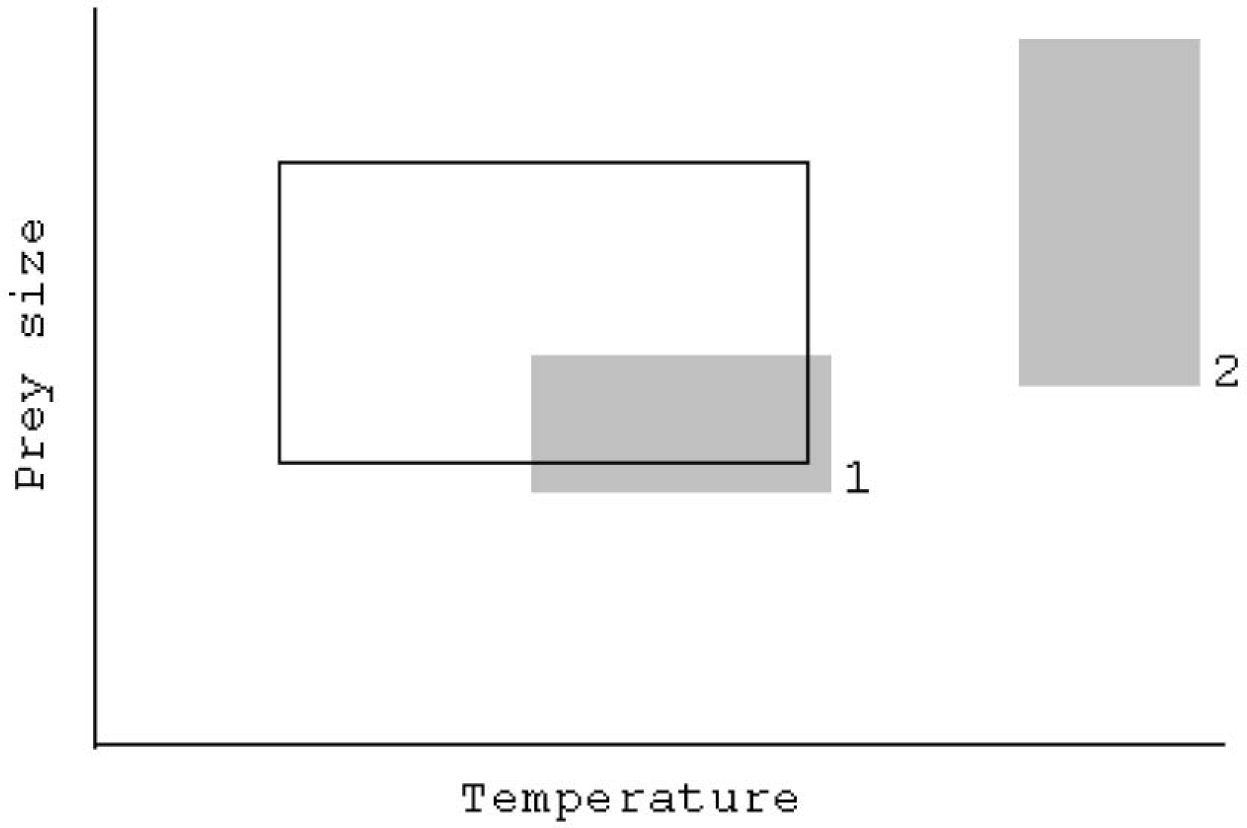
Focusing on measurable factors and closer to Hutchinson's original definition, Futuyma (Reference Futuyma1998, 68) represents a species’ ecological niche as the portion of a multidimensional space, where each dimension represents a factor relevant to the species’ survival, in which the organisms of that species can persist. If we take the example of an easy-to-represent bidimensional case of only two factors affecting the species’ life, such as the sizes of the prey the individuals can eat and the environmental temperatures they can tolerate, the niche would be represented by the clear rectangle in Figure 1 (adapted from Futuyma Reference Futuyma1998).
Figure 1.

The solid rectangles represent the conditions in different localities, and the species can persist in a locality (1, in this case) only if this overlaps its niche. Over time, the locality will change and the species’ niche will follow those changes or go extinct. As the changes in the locality conditions are also caused by the presence of the species itself, it is correct to talk about the coevolution of niche—a population characteristic—and locality and not of the adaptation of a species to a given environment.
The concept of ecological niche, when connected to a new and more dynamic concept of adaptation, may seem very well-suited to accommodate all of Kuhn's requirements. The traditional adaptationist view is well-rendered by Lewontin's words, which resembles both Kuhn's earlier position and also Popper's position: “The modern view of adaptation is that the external world sets certain ‘problems’ that organisms need to ‘solve’, and that evolution by means of natural selection is the mechanism for creating these solutions. Adaptation is the process of evolutionary change by which the organism provides a better and better ‘solution’ to the ‘problem’, and the end result is the state of being adapted” (Lewontin Reference Lewontin1978).
This simplisticFootnote 16 view is surpassed by the more complex dynamicity of the coevolution of the binomial niche-environment and the interactive dimension implied by the ecological niches is used by Kuhn to support his idea of a changing world that is evolving together with the group that inhabits it. This is the main point of the passages from RSS quoted above, but I shall soon argue that the interactive dimension is misplaced in Kuhn's interpretation of the concept of niche.
3.2. Kuhn's Confusions.
The first confusion that Kuhn shows in his argument, however, is between two different types of evolutionary epistemology: the evolution of epistemological mechanisms (EEM) and the evolutionary epistemology of theories (EET).Footnote 17 At the beginning of the passage quoted, he argues that natural selection is partially responsible for our knowledge of the world, in the same way theorized by EEM.Footnote 18 The ‘solid world’ experienced by the ‘creatures born into it’ is the (external) world of nature, the physical one we already find in place, and from his passage it is clear it is this world that causes the newborns to internalize such knowledge as ‘fire is painful’ or ‘falling hurts’. Some of this knowledge, Kuhn notes, is already internalized by inheritance; for instance, in my example, by giving an evolutionary advantage to the creatures that do not feel comfortable when getting too close to a fire, or that can count correctly and infer from seeing two tigers entering a cave and only one coming out, that it is not safe to approach the cave.
Immediately beneath this, however, Kuhn switches to EET and changes the meaning of the term ‘world’ without any warning. Namely, he mentions the changes to the world we can effect or invent: trivially, it is the phenomenal world we can alter; we cannot change the ‘external world’.Footnote 19 In particular, the changes we can make, which are not rejected on the evidence,Footnote 20 belong to a conceptual level: “the world is our representation of our niche, the residence of the particular human community with whose members we are currently interacting” (Kuhn Reference Kuhn, Fine, Forbes and Wessels1990, 11). This confusion of meanings greatly obscures the structure of Kuhn's argument. To contribute to the obscurity, Kuhn finds the analogue of this representational level also in the biological side of the analogy, in what he calls “something like a mental representation” (Reference Kuhn, Fine, Forbes and Wessels1990, 11). At this point, additionally, a break in the analogy synchronism occurs. As we have seen, he equates the changes we produce in our representations (scientific change) to the changes in the coevolving couple niche/group of organisms, not to the ‘mental representations’ of the organisms. Indeed, I would argue that he could not do otherwise, due to the radically different nature of the two ‘representations’, the scientific and the organismic one. The scientific representation is distinct and autonomous from what the representation is meant to represent, in the sense that it can be changed at will by the scientists until a temporarily satisfactory fit is found. The organism's ‘mental representation’ instead follows the niche/group coevolution and is not intentionally and autonomously produced. Properly, it cannot be distinguished from the niche itself.
The second and more fundamental confusion arises from what I think is Kuhn's misunderstanding of the distinction between niche and external environment in evolutionary biology. This misunderstanding spreads to the analogous distinction he specifies in scientific change and makes the whole analogy faulty at its root.
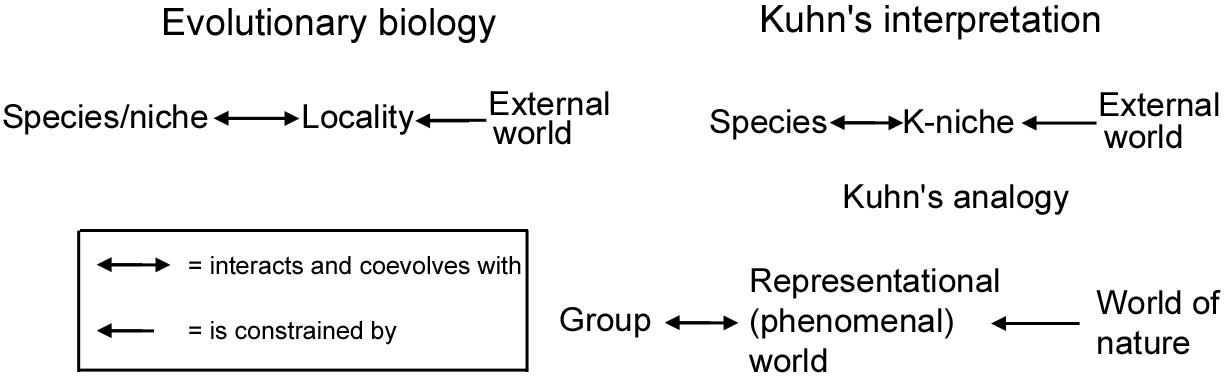
Kuhn, by reading Lewontin, extrapolates the possibility of drawing “a line between the creatures within the niche, on the one hand, and their ‘external’ environment, on the other” (Reference Kuhn, Fine, Forbes and Wessels1990, 11). If we read this in the context of Kuhn's argument, in which he is arguing against species adaptation to a fixed environment,Footnote 21 and arguing that “what actually evolves … is creatures and niches together,” it is clear that he is contrasting coevolving couples species/niche to an immutable ‘external environment’. Kuhn interprets Lewontin's remarks as if they were not meaningful to define a niche without the community that inhabits it, in an interactive fashion of coevolution. Properly though, an ecological niche is not “the world of the group which inhabits it” (Reference Kuhn, Fine, Forbes and Wessels1990, 11), which instead is the locality overlapping the niche. The actual coevolution does not involve species and niche, because species do not interact with the niche, they define their own niche (and the evolution of this) while evolving. The actual coevolution, meaning coupled evolution of interacting realities, is between niche (indirectly, through its population) and locality, not between species and niche.Footnote 22
My argument will be made clearer, I hope, by the diagram of Figure 2. In it, I represent what I think is the correct representation of the relations between a species, its ecological niche, the locality the species happens to live in, and the background of the natural reality. In Kuhn's interpretation of this system, what he calls ‘niche’ (and I mark as ‘K-niche’) is actually the ecological locality.Footnote 23 It is from this incorrect interpretation that he derives his evolutionary analogy. The net effect of Kuhn's erroneous interpretation is that, on the scientific side of the analogy, the scientific niche becomes the only world ‘visible’ to the group, the only reality the group can interact with. Each scientific group determines its own niche (whose representation constitutes the group's world), which coevolves with the group. The ‘external world’ still puts constraints on the results of our tests, and reveals the degree of adaptation of the representation of the groups’ niche—their world—to the niche. However, those tests do not carry any information about the correspondence of the group's world to the external world, and no progress toward a better correspondence can be conceived. This allows Kuhn to save his whole view of science and scientific change.
Figure 2.

4. Conclusion.
The two evolutionary analogies provided by Kuhn are either oversimplified and sketchy or based on inadequate evolutionary premises and concepts. Kuhn seeks help in the analogies to sustain his views on scientific specialization and progress in the absence of goal-directed activity and ontological adequacy. I hope to have shown, in this article, that his search has been void.