Introduction
Bipolar disorder (BD) is a chronic, multiphasic, and recurrent psychiatric condition characterized by oscillations in mood, energy, and functioning capacity.Reference Kessing, Andersen and Vinberg 1 , Reference Radua, Grunze and Amann 2 Clinical and epidemiological studies have reported lifetime prevalence rates for comorbid obsessive–compulsive disorder (OCD) in BD to be between 3.2% and 35%.Reference Chen and Dilsaver 3 - Reference Faravelli, Abrardi and Bartolozzi 6 The association of BD and OCD can complicate the course of these illnesses and increase the mortality and morbidity, as reflected in rise in suicide rate, substance abuse rate, total medical burden, economic cost, and quality of life.Reference Henry, Van den Bulke and Bellivier 7 – Reference Magalhães, Kapczinski and Kapczinski 10 It needs to be noted that the combination of the two symptomatic conditions (BD and OCD) may reflect common physiology rather than true comorbidity.Reference Maj 11 , Reference Jeon, Baek and Yang 12
Selective serotonin reuptake inhibitors (SSRIs) which currently are considered the first line treatment for OCD may shift euthymic BD patients toward manic episode.Reference Eddy, Dutra, Bradley and Westen 13 There are reports that these medications even in combination with mood stabilizers may lead to treatment-emergent mania/hypomania in patients with BD.Reference Gao, Kemp and Ganocy 14 In addition, up to 50% of OCD patients fail to respond to SSRIs,Reference Pittenger and Bloch 15 and many others suffer from the side effects associated with SSRIs like sexual dysfunction.Reference Barth, Kriston and Klostermann 16 Therefore, looking for alternative treatments is highly required for treating obsessive–compulsive (OC) symptoms in patients with BD.
Quetiapine is a second-generation atypical antipsychotic (SGA). It is distinguished from other SGAs (except clozapine) because of its low extrapyramidal side effects.Reference Srisurapanont, Maneeton and Maneeton 17 Quetiapine is a dibenzothiazepine with more potent serotonergic (5-HT2) than dopaminergic (D2) receptor-blocking properties.Reference Riedel, Muller and Strassnig 18 , Reference Nemeroff, Kinkead and Goldstein 19 The beneficial effects of quetiapine in the treatment of OCD have been reported in several studies.Reference Kordon, Wahl and Koch 20 , Reference Diniz, Shavitt and Fossaluza 21 Vulink et al, in their clinical trial of surveying the augmenting effects of quetiapine on OCD partiers, reported that quetiapine addition (N = 22, 69%) was associated with a significantly greater number of patients responding to treatment compared with placebo addition (N = 15, 41%; P = .019).Reference Vulink, Denys and Fluitman 22 Quetiapine high serotonergic receptor affinity may justify its anti-OCD effects.
One of the main goals of pharmacological treatment for BD patients is the prevention of manic/hypomanic and depressive episodes by the administration of mood stabilizer drugs. There are several studies that have revealed quetiapine’s mood stabilizing effects in BD patients.Reference Kishi, Ikuta and Matsuda 23 – Reference Escudero, Gutiérrez-Rojas and Lahera 25
Due to quetiapine’s mood stabilizing effects and anti-OCD properties, it may be a suitable remedy for patients with BD and OC symptoms. In this double-blind clinical trial, we would study its efficacy on OC symptoms in patients with BD.
Materials and Methods
Patients
Patients were recruited from Ebnesina Psychiatry Hospital affiliated to the Shiraz University of Medical Sciences from August 2019 to September 2020. The patients were diagnosed according to the Diagnostic and Statistical Manual of Mental Disorders, Fifth Edition (DSM-V) criteria for BD type 1 by a board-certified psychiatrist through Structured Clinical Interview for DSM-V, Clinical Version. They were complaining from OC symptoms too. Inclusion criteria were diagnosis of BD type 1, euthymic phase according to DSM-V criteria, and Young Mania Rating Scale (YMRS) <11 and Hamilton Depression Rating Scale (HDRS) <7, being between 18 and 65 years of age, and obtaining scores of 17 or more in Yale–Brown Obsessive–Compulsive Scale (YBOCS).
Exclusion criteria were being in manic or depressive phase of BD, existence of any other axis I and II diagnosis, major medical problems (cardiovascular, pulmonary, renal, or gastrointestinal diseases), pregnancy, and substance or alcohol abuse. All patients completed a general medical examination and blood chemistry tests, including TSH, FT4, liver function test, renal function test, and complete blood count before the study.
Procedure
The patients were randomly allocated into two groups using a predetermined random numbers list. Both groups were receiving lithium and clonazepam in the euthymic phase of BD. In the placebo group, the mean dosages of the medications were: lithium 800 mg and clonazepam 0.5 mg; whereas in the quetiapine group, the mean dosage of lithium was 825 mg and clonazepam was 0.35 mg. There is no contraindication for adding quetiapine to the patients’ current medications. In the quetiapine group, quetiapine was administered with the starting dose of 25 mg/d during the first week and tittered up to 50 mg weekly. The dosage of quetiapine was increased until the patient was symptom-free. The mean dosage of quetiapine was 325 mg/d. If any patient could not tolerate any more quetiapine dosage tittering up, increasing the dosage was stopped for him or her.
Measurements
To assess the outcome of two regimens, YBOCS was administered.Reference Goodman, Price and Rasmussen 26 Assessments of efficacy of the two drug regimens were performed at weeks 4 and 8. There is no standard cutoff point for YBOCS. Decrease of more than 34% in YBOCS was considered as response rate in our study based on expiratory analysis of data in previous similar studies.Reference Sahraian, Ehsaei and Mowla 27 , Reference Mowla and Ghaedsharaf 28 However, in one study on resistant OCD patients, more than 25% decrease in YBOCS was chosen as cutoff point for treatment response.Reference Mowla, Khajeian and Sahraian 29 Adverse effects of the medications were also registered.
For assessing mania symptoms at weeks 0, 4, and 8, YMRS was administered.Reference Young, Biggs, Ziegler and Meyer 30 This survey consists of 11 items; the score of each item of the questionnaire is scaled between 0 and 4. Our patients’ scores were less than 12 in each session (not manic).
Depressive symptoms were assessed by HDRSReference Hamilton 31 at weeks 0, 4, and 8. The patients’ scores in each session were less than 7 (not depressed). All the patients provided informed consent, and the study protocol was approved by the ethic committee of the Shiraz University of Medical Sciences that adheres to the Declaration of Helsinki Ethical Principles for Medical Research involving human subjects. This clinical trial was registered on the Iranian Registry of Clinical Trial (IRCT) database with IRCT number: IRCT 20190307042963 N1.
Statistical analysis
Software IBM SPSS (version 17.0) was performed for all statistical analyses. The mean and the standard deviation were used to describe quantitative variables. Categorical variables were compared with chi-square test, and t-test was applied to compare YBOCS score between two groups. P-values of less than .05 were considered as statistically significant.
Results
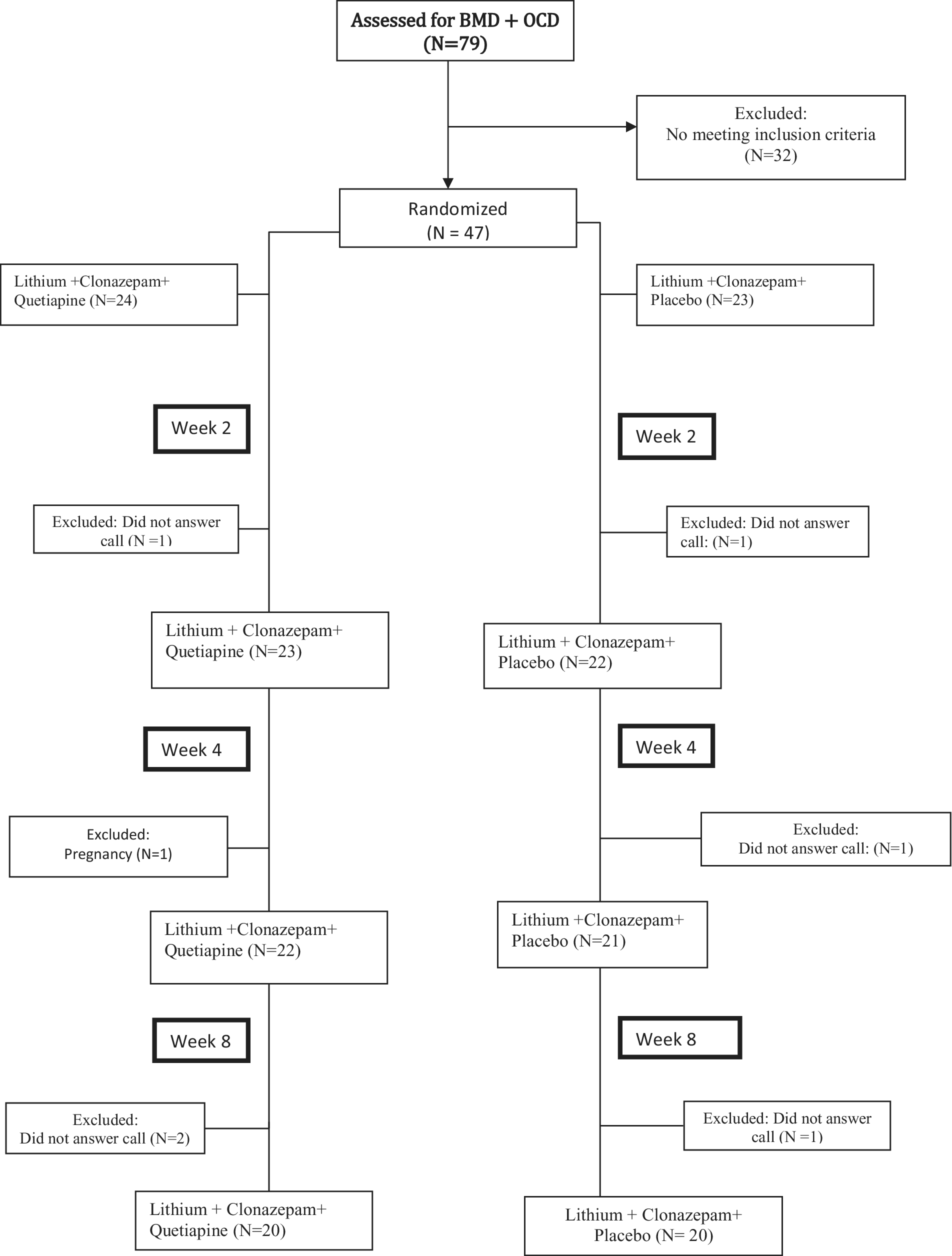
At first, 79 BD patients in euthymic state with OC symptoms were screened, and 47 patients were eligible to enter the study. The patients were randomly allocated in two groups of quetiapine (n = 24) and placebo (n = 23). Forty patients completed the trial. There were 20 patients in the quetiapine group and 20 patients in the placebo group at the end of the study. Figure 1 demonstrates the flow chart of the patients of the two groups.
Flow chart of the patients in the two groups.

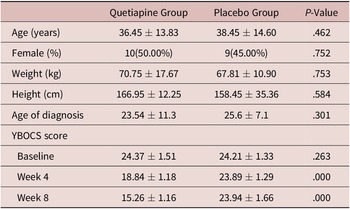
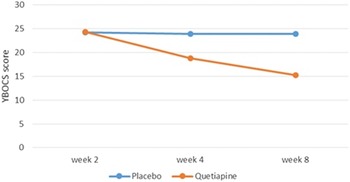
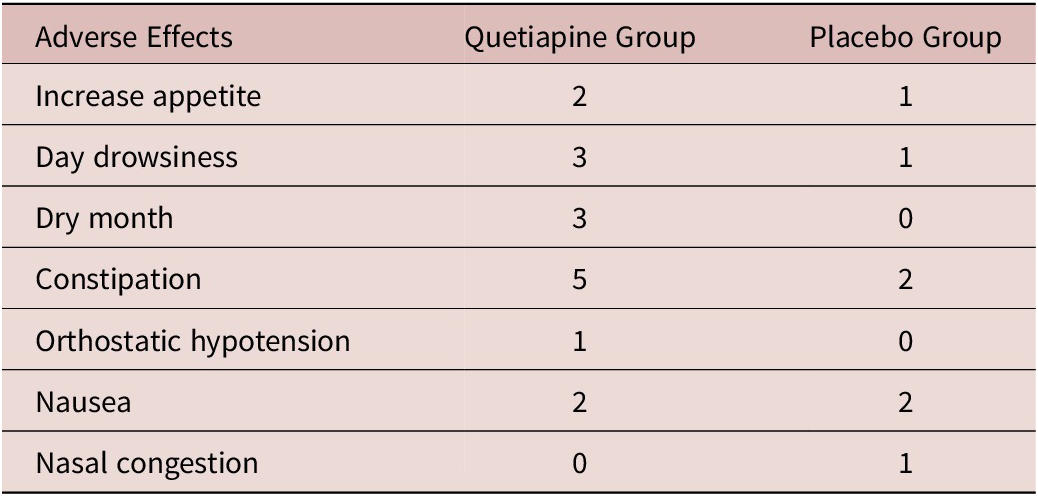
The demographic and clinical data of the patients are shown in Table 1. The findings of this study indicate a significant difference between the two groups regarding the number of patients with a decline of over 34% in total YBOCS score. Overall, in the quetiapine group, 12 (50%) patients showed more than 34% decrease in mean YBOCS score compared to 1 (5%) patient in the placebo group at the end of the trial (Figure 2). This ratio of improvement was statistically different between the two groups (X 2 = 5.0, df = 1, P < . 001). The adverse events experienced by the patients of both groups are depicted in Table 2. The quetiapine group showed a good tolerability and safety.
Demographic and Clinical Characteristics of the Patients

Abbreviation: YBOCS, Yale–Brown Obsessive–Compulsive Scale.
Response to treatment in quetiapine and placebo groups.
Abbreviation: YBOCS, Yale–Brown Obsessive–Compulsive Scale.

Adverse Effects in the Quetiapine and Placebo Groups

Discussion
Our double-blind placebo-controlled clinical trial revealed that quetiapine adjuvant may be effective in reducing OC symptoms in BD patients. Moreover, this adjunction was well tolerated and showed no significant adverse effects. The response rate in the quetiapine group was 50% compared to 5% in the placebo group.
Several studies have revealed that quetiapine has improved OC symptoms in inpatients or outpatients suffering from OCDs.Reference Kordon, Wahl and Koch 20 – Reference Vulink, Denys and Fluitman 22 All of these studies have reported good tolerability and benefits. No dangerous adverse effect has been reported after adding quetiapine to routine anti-obsessive medications. The results of our research support these studies. We did not detect any serious adverse effects too.
The risk of deterioration of manic symptoms or shift of stable BD patients toward hypomania/mania phases hinders the use of antidepressant SSRIs in BD patients.Reference Eddy, Dutra, Bradley and Westen 13 , Reference Gao, Kemp and Ganocy 14 Therefore, treatment of OC symptoms in BD patients is a challenge. Recently, antipsychotics have been surveyed as an alternative in treatment of OC symptoms in BD patients. Amerio et al in their systemic review revealed that Aripiprazole augmentation to mood stabilizers (lithium carbonate and valproate), even at low doses (10-15 mg/d), helped to achieve significant remission in affective and OC symptoms.Reference Amerio, Odone and Ghaemi 32 A 8-week, randomized, double-blind, placebo-controlled trial also demonstrated that aripiprazole can be used as an effective adjuvant agent for the treatment of OC symptoms during manic episodes. In particular, aripiprazole augmentation to lithium carbonate and clonazepam decreased the YBOCS scores more than the combination of lithium carbonate and clonazepam (91.30% vs 4.34%).Reference Sahraian, Ehsaei and Mowla 27 Our results demonstrate that quetiapine, another second-generation antipsychotic, can be considered as a treatment for OC symptoms in bipolar manic patients.
Topiramate and memantine augmentation to routine mood stabilizers was more effective than placebo in decreasing OC symptoms in BD patients in two separate clinical trials. These novel medications were well tolerated and safe.Reference Sahraian, Bigdeli and Ghanizadeh 33 , Reference Sahraian, Jahromi and Ghanizadeh 34 Our study of quetiapine for OC symptoms in BD patients is in line with these researches to find novel treatments for OC symptoms in bipolar patients.
However, there are some limitations to this clinical study. Small sample of patients and short duration of the study are pitfalls of this trial. In addition, the study was conducted only in a single center. Larger clinical trials with longer duration are needed to confirm our results.
In conclusion, quetiapine, as an adjuvant medication, was more effective than placebo in decreasing OC symptoms in patients with BD. No serious side effects also were reported in patients taking quetiapine.
Acknowledgment
This study was performed as postgraduate thesis for graduation of student Bahareh Ghahremanpouri in the Shiraz University of Medical Sciences.
Funding Statement
This study was financially supported by the Shiraz University of Medical Sciences with grant number 17717.
Disclosure
The authors declare no conflicts of interest.