INTRODUCTION
Most of the cultivated areas (about 2 million ha) in the North Eastern Region (NER) of India comprising the states of Arunachal Pradesh, Assam, Tripura, Meghalaya, Mizoram, Nagaland, Manipur and Sikkim of the Indian Republic are adopting organic farming practices for generations (Sanwal et al., Reference Sanwal, Yadav and Singh2007). The region has numerous advantages to go for organic food production, such as minimum use of fertilizer (<12 kg ha−1), availability of plant- and livestock-excreta-based organic manure and pesticides, and favourable climatic conditions for growing a wide range of crop species. The net cultivated area of the region is about 4 million ha and the estimated availability of organic manure is about 46 million megagram (Mg) which is almost sufficient for the region to go organic (Bujarbaruah, Reference Bujarbaruah2004). The soils of the region are much degraded owing to cultivation in steep slopes, negligible nutrient supplementation and biomass burning under traditional practices (Saha et al., Reference Saha, Chaudhary and Somasundaram2012). Cultivation of exhaustive crops such as ginger, turmeric, maize etc. on sloping land without proper soil and water conservation measures exacerbate the degradation process, making the soil unfit for cultivation (Saha et al., Reference Saha, Chaudhary and Somasundaram2012; Salahin et al., Reference Salahin, Begum, Hossain, Ullah and Alam2013). Thus, necessitating the need for appropriate soil management practices involving efficient cropping systems and nutrient management practices for sustainable hill agriculture (Das et al., Reference Das, Patel, Munda and Ghosh2010a, Reference Das, Patel, Ramkrushna, Munda, Ngachan, Kumar, Buragohain and Naropongla2013). Organic farming is considered as one of the best options for protecting/sustaining soil health and produce healthy foods (Das et al., Reference Das, Patel, Ramkrushna, Munda, Ngachan, Kumar, Buragohain and Naropongla2013; Surekha et al., Reference Surekha, Rao, Shobha Rani, Latha and Kumar2013). Organic farming is a production system which avoids, or largely excludes, the use of synthetic fertilizers, pesticides, growth regulators and livestock feed additives. The objectives of environmental, social and economic sustainability can be met through organic farming (Stockdale et al., Reference Stockdale, Lampkin, Hovi, Keatinge, Lennartsson, Macdonald, Padel, Tattersall, Wolfe and Watson2001). The key characteristics of organic farming include protecting the long-term fertility of soils by maintaining organic matter (OM) levels, fostering soil biological activity, nitrogen (N) self-sufficiency by the inclusion of legumes, effective recycling of OM including crop residues and livestock wastes, and weed, disease and pest control relying primarily on crop rotations, natural predators, diversity, organic manuring, and resistant varieties (Yadav et al., Reference Yadav, Babu, Yadav, Singh, Yadav and Pal2013). The soil fertility is maintained by returning all the residues to it through composts, thereby, minimizing the gap between nutrient addition and removal from the soil (Chhonkar, Reference Chhonkar2002).
In view of growing demand for organic food products worldwide including India, the NER of India has vast opportunity to emerge as major suppliers of organic products. By March 2011, India had brought more than 4.43 million ha area under organic certification process (Yadav, Reference Yadav2012). The world market for organic products was estimated at more than US$ 25 billion in 2003 and it rose by about 20% per year from 2001 to 2005 (Willer and Yussefi, Reference Willer and Yussefi2005). Such expansion of organic market makes it possible for farmers to reap the benefits of trade with relatively high price premiums (Gopinath et al., Reference Gopinath, Saha, Mina, Pande, Kundu and Gupta2008). Economic and environmental concerns have been the drivers for increasing demand for organically produced food (Ngouajio and McGiffen, Reference Ngouajio and McGiffen2002). The organic food production in Asian countries is mainly for the export market as the domestic consumption is still emerging (IFOAM, 2004). Due to growing purchasing power and health cautiousness, organic food products are being preferred by the consumers (Urkurkar et al., Reference Urkurkar, Chitale and Tiwari2010) and demand for organic vegetables is steadily increasing not only in international markets but also in domestic markets (Carolyn and Oberholtzer, Reference Carolyn and Oberholtzer2009; Das et al., Reference Das, Patel, Ramkrushna, Munda, Ngachan, Kumar, Buragohain and Naropongla2013). Vegetables constitute an important part in the diet of Eastern Himalayan population. Growing of vegetables like carrot, potato, tomato and French bean after kharif maize not only increases the cropping intensity but also utilizes the land efficiently while providing employment and economic benefits to the farmers who are mostly small and marginal in nature (Das et al., Reference Das, Patel, Ramkrushna, Munda, Ngachan, Kumar, Buragohain and Naropongla2013). A study carried out on five crops in Japan showed that application of OM enhanced root growth and nutrient uptake resulting in higher yields compared to that under conventional farming (FFTC, 1998).
Crop rotations, including a mixture of leguminous fertility building crops and cash crops are the main mechanism for nutrient supply within organic systems. Rotations can also be designed to minimize the spread of weeds, pests and diseases (Altieri, Reference Altieri1995). The development and implementation of well-designed crop rotations are central to the success of organic production systems (Das et al., Reference Das, Patel, Ramkrushna, Munda, Ngachan, Kumar, Buragohain and Naropongla2013; Lampkin, Reference Lampkin1990; Stockdale et al., Reference Stockdale, Lampkin, Hovi, Keatinge, Lennartsson, Macdonald, Padel, Tattersall, Wolfe and Watson2001). Organic rotations are divided into phases, one phase increases the level of soil N and another one depletes it (Altieri, Reference Altieri1995). The N building and depleting phases must be in balance, or show a slight surplus, if long-term fertility is to be maintained (Berry et al., Reference Berry, Stockdale, Sylvester-Bradley, Philipps, Smith, Lord, Watson and Fortune2003; Watson et al., Reference Watson, Bengtsson, Ebbesvik, Loes, Myrbeck, Salomon, Schroder and Stockdale2002).
Organic production systems have the potential to achieve sustainability of agricultural systems (Rigby and Caceres, Reference Rigby and Caceres2001; Van Diepeningen et al., Reference Van Diepeningen, De Vos, Korthals and Van Bruggen2006). Many of the sustainability issues are related to soil quality (Nannipeeri, Reference Nannipeeri, Pankhurst, Doube, Gupta and Grace1994). Soil quality includes microbial activity and soil fertility, which are closely related because it is through the biomass that the mineralization of the important organic elements occur (Frankenberger and Dick, Reference Frankenberger and Dick1983). Higher levels of total soil organic carbon (SOC), total N, soluble P, microbial activity and soil microbial biomass carbon (SMBC) were reported from soils under organic production system (Cavero et al., Reference Cavero, Plant, Shennan and Friedman1997; Clark et al., Reference Clark, Horwath, Shennan and Scow1998; Mader et al., Reference Mader, Fliebbach, Dubois, Gunst, Fried and Niggli2002). Organic manure increases soil productivity by enhancing the soil's physical, chemical and biological properties (Ramesh et al., Reference Ramesh, Panwar, Singh and Ramana2009; Tester, Reference Tester1990). Significant improvements in soil health have been reported in several organic farming experiments (Carpenter et al., Reference Carpenter, Kennedy and Reganold2000; Pathak et al., Reference Pathak, Kushwala and Jain1992). Higher microbial activity and SMBC were found in soils under organic farming practices. However, some researchers found no difference in bacterial biodiversity (Lawlor et al., Reference Lawlor, Knight, Barbosa-Jefferson, Lane, Lilley, Paton, McGrath, O’Flaherty and Hirsch2000) or in fungal communities (Franke-Snyder et al., Reference Franke-Snyder, Douds, Galvez, Phillips, Wagoner, Drinkwater and Morton2001) between organically and conventionally managed soils.
Although grain yield under organic farming is often lower than that under conventional farming, it is feasible to have increased yields under the former (Chitra and Janaki, Reference Chitra and Janaki1999), especially in hills (Das et al., Reference Das, Baiswar, Patel, Munda, Ghosh, Ngachan, Panwar and Chandra2010b, Reference Das, Patel, Ramkrushna, Munda, Ngachan, Kumar, Buragohain and Naropongla2013). Organic agriculture enables ecosystems to better adjust to the effects of climate change, and also improves carbon sequestration potential of soil (Bhooshan and Prasad, Reference Bhooshan and Prasad2011). While there are reports that organic cropping systems are less profitable than conventional systems (Dobbs and Smolik, Reference Dobbs and Smolik1997), some other studies have shown that returns from organic farm management are equal to, or exceed those from conventional management systems (Das et al., Reference Das, Patel, Ramkrushna, Munda, Ngachan, Kumar, Buragohain and Naropongla2013).
Farmers in NER of India rarely add any fertilizer or manure to field crops. However, whatever quantity of organic manure available is with them, it is provided to remunerative vegetable crops at the rate of 5–10 Mg ha−1 depending upon availability, either alone or rarely in combination with chemical fertilizers (Das et al., Reference Das, Patel, Munda, Hazarika and Bordoloi2008). Manures are provided without considering the crop needs and soil fertility. Inclusion of manures within a crop rotation can have positive effects on yields and crop quality (Stein-Bachinger and Werner, Reference Stein-Bachinger and Werner1997). There is limited research on effects of organic sources of nutrients on growth, yield and quality of crops and soil properties.
Maize is the most potential and predominant rainy season crop on the hills of NER of India (Das et al., Reference Das, Patel, Munda and Ghosh2010a). Exhaustive nature, wider spacing and poor ground cover under maize encourage soil loss through erosion and degrade soil (Saha et al., Reference Saha, Chaudhary and Somasundaram2012). Cover crops such as soybean are suitable intercrops with maize to utilize the land efficiently, increase ground cover while providing N through biological fixation and add organic manure to soil. The potential effects of leguminous green manure crops in cropping systems under organic crop production have been widely reported (Mueller and Thorup-Kristensen, Reference Mueller and Thorup-Kristensen2001; Poutala et al., Reference Poutala, Kuoppamaki, Korva and Varis1994). Green manures and cover crops have also been shown to have positive effects in keeping the diseases under control in vegetable crops (Abawi and Widmer, Reference Abawi and Widmer2000). Intercropping of cereals and legumes offers the opportunity to increase the use of symbiotically fixed N without compromising grain yield (Bulson et al., Reference Bulson, Snaydon and Stopes1997; Jensen, Reference Jensen1996). Tomato, French bean and carrot are potential pre-kharif (January to May) vegetables of the region and have good domestic demand (Das et al., Reference Das, Patel, Ramkrushna, Munda, Ngachan, Kumar, Buragohain and Naropongla2013). Potato is also a potential crop of the hills and is a constituent of daily diet of the population along with staple food rice (Kumar et al., Reference Kumar, Baisya, Ghosh, Gupta, Dubey, Das and Patel2012). Considering the potential and demand, these crops were included in the diverse cropping systems with the objective to identify component crops with optimum productivity, profitability and emphasis on soil health and crop quality parameters.
Farmyard manure (FYM) and vermicompost (VC) are the most available composts in the region and are made from livestock excreta, farm wastes, and crop and weed biomass available within the farm. FYM is more voluminous in nature compared to other composts but available in limited quantity with most of the farmers. On the other hand VC is comparatively less voluminous than FYM. Most of these manures are rich in N and K but deficient in P. VC is considered to be rich in micro-nutrients and growth hormones in addition to primary nutrients (Hazarika et al., Reference Hazarika, Munda, Bujarbaruah, Das, Patel, Prasad, Kumar, Panwar, Tomar, Bordoloi, Meghna and Girin2006) and required in comparatively lesser quantity than FYM (Das et al., Reference Das, Patel, Ramkrushna, Munda, Ngachan, Kumar, Buragohain and Naropongla2013). Research is needed to identify efficient organic amendments (sole or combinations of organic manures) for sustaining crop and soil productivity and providing optimum economic returns to the farmers.
Hence, we evaluated the efficacy of different organic amendments on performance of vegetable-based cropping systems as well as on soil health, crop nutrient uptake and produce quality during transition to organic farming in mid-altitude regions (950 m above sea level) of subtropical Meghalaya, India. The hypothesis tested was that application of nutrients through organic amendments would positively influence crop performance, soil health and produce quality depending upon their chemical compositions, physical properties and nutrient release pattern.
MATERIALS AND METHODS
Experimental site
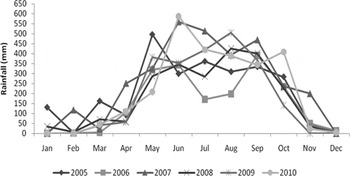
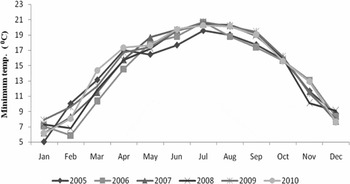
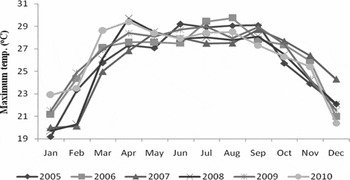
Field experiments were conducted during pre-kharif (January to April) and kharif (May to October) seasons for five consecutive years from 2005–06 to 2009–10 at the research farm of Indian Council of Agricultural Research (ICAR), Research Complex for North Eastern Hill (NEH) Region, Umiam, Meghalaya, India. Total annual rainfall at the experimental site varied between 1365.15 mm and 2528.6 mm during the five years of experimentation and average annual rainfall was 2020.66 mm during that period (Figure 1). The monthly mean maximum and minimum temperatures (Figures 2 and 3) during the study period ranged from 20.74 to 28.54 °C and 6.61 to 20.33 °C, respectively. The experimental soil had pH 4.8, SOC 18.0 g kg−1, available N 255.61 kg ha−1, available P 19.19 kg ha−1 and available K 232.10 kg ha−1. The soil was sandy loam in texture.
Average monthly rainfall during the experimental period (2005–10).

Average monthly minimum temperature during the experimental period (2005–10).

Average monthly maximum temperature during the experimental period (2005–10).

Experimental details and crop management
The experimental site was under maize (Zea mays)-toria (Brassica campestris, var. toria) cropping system and integrated nutrient management comprising 50% NPK through synthetic fertilizers (urea, single super phosphate and muriate of potash) and 50% through organic manure (FYM) during five years preceding the initialization of this present experimentation.
Keeping the prevailing cropping pattern and availability of organic nutrient sources in mind, field experiments were laid out in a split plot design with treatment combinations of three cropping sequences, namely, maize + soybean–tomato (CS1), maize + soybean–potato (CS2) and maize + soybean–French bean (CS3) in main plots, along with three sources of nutrients, 100% N through FYM, VC, integrated nutrient source (INS; 50% recommended doses of N through FYM + 50% recommended N through VC), and control (no manure) as four sub-plots.
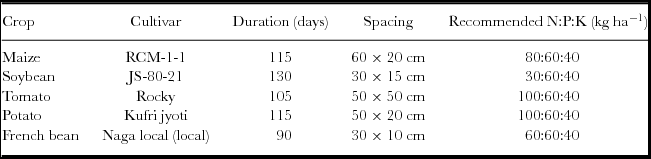
Soybean was grown as intercrop with maize in a 2:2 row ratio and maize and soybean were sown at a spacing of 60 × 20 cm and 30 × 15 cm, respectively. Soybean grows well due to favourable climatic condition at mid altitude and produces excessive biomass. Hence, at about 45 days after sowing, when the crop reaches maximum vegetative growth, one pruning was done by de-topping at a height of 25 cm uniformly. The fresh soybean biomass generated (pooled over five years) under FYM, VC, INS and control was 2.18 ± 0.37, 1.96± 0.41, 2.55± 0.47 and 1.42 ± 0.29 Mg ha−1, respectively, which was used as in situ mulch. Well-decomposed FYM and VC were applied on the basis of N equivalent and P requirement was supplemented through rock phosphate. P supplementation is necessary as the soil in this region is acidic and P availability is very low (Das et al., Reference Das, Patel, Munda, Hazarika and Bordoloi2008). As with conventional agriculture, the primary limiting nutrient in organic systems is N (Stockdale et al., Reference Stockdale, Rees, Davies, Cook and Lee1995; Torstensson, Reference Torstensson1998). Application of organic manure not only improves the SOC but also increases soil N. However, N-use efficiency is comparatively low particularly in high rainfall areas (>2000 mm average annual rainfall) where it is difficult to retain N in soil due to leaching, volatilization and denitrification. Among the major plant nutrients supplied through external sources, N is required in higher quantity and hence, it is the primary focus among all nutrients in organic farming systems (Margar, Reference Margar2004). Thus, N was supplied through various organic sources in the present study. The treatment combinations were replicated three times and fixed plots were maintained for respective treatments during the five years of experimentation. The gross plot size was 5 × 5 m. The details of cultivars used, their duration, spacing and nutrient contents of organic amendments are presented in Tables 1 and 2.
Details of crop cultivar and agronomic practices adopted in the experiment.

N–P–K and micronutrient concentration in different organic amendments used in the experiment.

Note: ± indicates standard deviation from mean.
Water management
The kharif (rainy season) crops were raised as rainfed crop, whereas, pre-kharif crops (January to May) were raised with life saving irrigation. For tomato, frequent life saving irrigations (weekly intervals) were given during seedling establishment after transplantation. In the case of potato, two irrigations were provided, one before earthing up (25 DAS) and another during tuber formation stage. Staking was done in French bean for providing support using bamboo sticks. Irrigations were adjusted as per the rainfall received during the season.
Pest and disease management
For the management of soil-borne pathogens, neem cake was added uniformly in all the plots @150 kg ha−1 during last ploughing and mixed with the soil. Derisom (a botanical pesticide, fractions of Derris indica) @2.5 ml lit−1 was applied at flowering stage and 15 days after first spray to manage insect pests. Diseased leaves were stripped off manually whenever possible.
Plant and soil sampling
Five random plant samples were collected from the earmarked area of each plot during harvesting. Plant samples were kept in a hot air oven at 60–70 °C till constant weights were obtained and oven-dried plant samples were used for determination of N, P and K content. Soil samples were collected after harvesting from 0–20-cm depth to determine the available nutrients after five years. Soil samples were also collected before the start of the experiment from 0–20-cm depth and analysed to establish the initial soil fertility status of the experimental plot. In the case of tomato and French bean, multiple pickings were done and yield was recorded each time. For other vegetable crops, such as carrot and potato, the tuber yields were recorded at harvest from the net plot area and expressed as Mg ha–1. The yields of kharif crops such as maize and soybean were recorded when the grain moisture content reached 14% after sun drying. Performance of all the crops was evaluated in terms of yield and yields of vegetable crops were converted to Maize Equivalent Yield (MEY) to compare cropping systems. The MEY of different crops under various nutrient management practices were calculated on the basis of prevailing market prices of various inputs and outputs.
Chemical analysis
The nutrient concentration of different crops was determined at harvest by following standard procedures. The grain/economic parts and straw/residues of rice and vegetable biomass were analysed for total N through micro-Kjeldahl method, while total P and K were determined using sulphuric-nitric-perchloric acid digest (Prasad et al., Reference Prasad, Shivay, Kumar and Sharma2006). Soil samples were analysed for various physico-chemical and biological parameters. The soil pH was determined in a 1:2.5 soil:water suspension (Jackson, Reference Jackson1973), SOC was determined using Walkley and Black method (Reference Walkley and Black1934), available N by alkaline potassium permanganate method (Subbiah and Asija, Reference Subbiah and Asija1956), available P by Bray method (Bray and Kurtz, Reference Bray and Kurtz1945) and available K by ammonium acetate extraction method (Jackson, Reference Jackson1973). The SMBC was determined by ethanol-free chloroform fumigation extraction method (Vance et al., Reference Vance, Brookes and Jenkinson1987) using Kc value of 0.45 (Jenkinson and Ladd, Reference Jenkinson, Lad, Paul and Ladd1981).
Economics analysis
The costs of the organic amendments, other inputs and outputs were estimated as per the prevailing market price (2009–10 price). The gross returns, net returns and benefit: cost (B:C) ratio for different nutrient management and cropping systems were assessed by computing the cost of the inputs and price of the produce/output. The net returns were obtained by deducting cost of cultivation from gross returns. The B:C ratio was computed by dividing gross returns with cost of cultivation. The prevailing market price was considered for economic assessment without any premium price as the local populations are not yet ready to pay higher price.
The prices of various inputs used in the present study were: FYM $12 Mg−1, VC $40 Mg−1, rock phosphate $60 Mg−1, Maize kernel (seed) $400 Mg−1, soybean seed $1000 Mg−1, French bean seed $3000 Mg−1, potato tuber (seed) $300 Mg−1 and tomato seed $1000 kg−1. The output prices were: maize kernel $200 Mg−1, soybean seed $400 Mg−1, French bean green pod $300 Mg−1, potato tuber $200 Mg−1 and tomato fruit $200 Mg−1. The labour wage was $2.4 man-day−1. The prices of inputs and outputs are subject to market demand, availability, time factor and other uncontrolled factors and hence, the economics presented in this paper is indicative and may change according to situation.
Statistical analysis
The analysis of variance method (Panse and Sukhatme, Reference Panse and Sukhatme1978) was followed to analyse the data. The significance of different sources of variations was tested by error mean square of Fisher Snedecor's ‘F’ test at 5% probability level (p = 0.05). In the summary tables of the results, the standard error mean (SEm (±)) and critical difference (CD) were provided to compare the means.
RESULTS AND DISCUSSION
Crop productivity
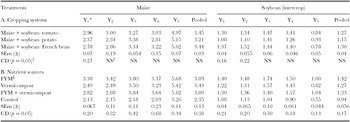
Maize grain yields during 2005–06 and 2006–07 were higher under FYM treatment followed by those under INS and VC in all the three cropping systems (Table 3). Whereas, in the third (2007–08), fourth (2008–09) and fifth (2009–10) years, INS as organic amendment produced higher maize yield compared to sole application of FYM and VC. The higher yield with INS could be due to the fact that FYM contains more OM and VC contains substances like hormones, auxins, vitamins, antibiotics and other beneficial microorganisms (Hazarika et al., Reference Hazarika, Munda, Bujarbaruah, Das, Patel, Prasad, Kumar, Panwar, Tomar, Bordoloi, Meghna and Girin2006). Maize grain yield was significantly (p = 0.05) higher with FYM in the first and second years of the experimentation; from the third year (2007–08) onwards, yield under INS was at par with the FYM treatment. However, the pooled grain yield recorded with VC and INS was at par with each other. Ramesh et al. (Reference Ramesh, Panwar and Singh2010) also reported higher crop productivity with combined application of FYM, VC and poultry manure under organic farming. In the present study, the five years pooled maize grain yield was 3.96, 3.76 and 4.24 Mg ha−1 in the cropping systems CS1, CS2 and CS3, respectively. Pooled seed yield of soybean was recorded significantly higher in INS followed by sole application of FYM in the CS1 and CS3 cropping systems. Similar findings were also reported by Ramesh et al. (Reference Ramesh, Panwar and Singh2010).
Maize and soybean seed yield (Mg ha−1) as influenced by various organic amendments and cropping systems.

*Y1: 2005–06; Y2: 2006–07; Y3: 2007–08; Y4: 2008–09; Y5: 2009–10; †CD: critical difference; ‡NS: non-significant; §FYM: farmyard manure.
Vegetables are profitable component in farming systems and highly responsive to organic amendments (Yadav et al., Reference Yadav, Babu, Yadav, Singh, Yadav and Pal2013). Significantly higher tomato fruit yield (Table 4) was recorded with FYM followed by INS in all the years except in the first year (2005–07). The tomato fruit yields recorded under FYM were 20.9, 28.4, 28.2, 44.0 and 27.35 Mg ha−1 in the first, second, third, fourth and fifth years, respectively. In the fifth year, lower tomato fruit yield was due to leaf blight infestation during fruiting stage. Pooled fruit yield of tomato was also significantly higher with FYM followed by VC and INS. Tomato fruit yields from VC and INS were at par with each other. Significantly higher tomato fruit yield with the application of FYM was also reported by Parray et al. (Reference Parray, Ganai and Fazili2007). The higher yields of tomato and cabbage with application of INS, compared to other organic amendments and conventional practices has been reported by Choudhary et al. (Reference Choudhary, Das and Patnaik2003).
Yield (Mg ha−1) of vegetables as influenced by various organic amendments and cropping systems.

*Y1: 2005–06; Y2: 2006–07; Y3: 2007–08; Y4: 2008–09; Y5: 2009–10; †FYM: farmyard manure.
Unlike tomato, higher potato tuber yield was recorded with VC followed by FYM and INS during all five years of experimentation. Pooled potato yield was also higher in VC (16.15 Mg ha−1) followed by FYM (15.4 Mg ha−1) and INS (14.10 Mg ha−1). The pooled potato tuber yields recorded with VC and FYM were 105 and 95% higher than control, respectively. Similar findings of significantly higher potato tuber yield with VC, compared to FYM and poultry manure application under high altitude of NER of India were reported by Kumar (Reference Kumar2009). Upadhyay et al. (Reference Upadhyay, Khan and Singh2008) reported superiority of VC over FYM for potato production. Mourao et al. (Reference Mourao, Brito and Coutinho2008) also reported that organically grown potato yielded 66% higher than those under conventional practices.
French bean green pod yield was significantly higher with FYM, followed by those under INS and VC in the first (2005–06) and second (2006–07) years of the experimentation. In third year, French bean yields under FYM and INS organic amendments were similar to each other. During the fourth and fifth years, the French bean green pod yield was significantly higher with INS followed by FYM alone. Whereas, five years pooled data showed that FYM as organic amendment produced higher green pod yield, followed by INS, which were at par with each other. The results are in conformity with the findings of Yadav and Kumari (Reference Yadav and Kumari2003).
In low-input agriculture, the crop productivity under organic farming is comparable to that of conventional farming. There is no risk associated with organic farming as the ethnic population practices low-input, no-chemical farming (Sanwal et al., Reference Sanwal, Yadav and Singh2007). Rather, there is opportunity for productivity enhancement in the region with scientific organic farming (Das et al., Reference Das, Patel, Ramkrushna, Munda, Ngachan, Kumar, Buragohain and Naropongla2013). Gradual increase in grain yield with the use of organic amendments over a period of time has been widely reported (Surekha, Reference Surekha2007; Urkurkar et al., Reference Urkurkar, Chitale and Tiwari2010). Tamaki et al. (Reference Tamaki, Itani and Nakano2002) reported better crop productivity under continuous organic farming than with conventional farming. Agro-economic study of practices of growing maize with compost and liquid manure (cow urine, vermiwash etc.) top dressing in low-potential areas showed significantly better performance than those of current conventional farmer practice of a combined application of manure and mineral fertilizers (Onduru et al., Reference Onduru, Diop, Van der Werf and Jager2002). Thus, the present study showed the potential benefits of organic crop production in subtropical climate which was also substantiated by the available literatures (Das et al., Reference Das, Baiswar, Patel, Munda, Ghosh, Ngachan, Panwar and Chandra2010b, Reference Das, Patel, Ramkrushna, Munda, Ngachan, Kumar, Buragohain and Naropongla2013; Yadav et al., Reference Yadav, Babu, Yadav, Singh, Yadav and Pal2013).
System productivity
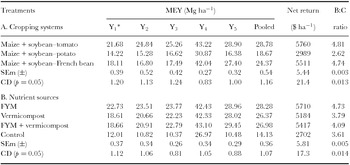
Total productivity of a cropping system is important to farmers for assessing the efficiency of various cropping systems. Total system productivity (assessed in terms of MEY) among the cropping systems tested under this experiment was higher in FYM as organic amendment followed by INS up to the third year of experimentation, whereas, during the fourth and fifth years of the experiment, INS recorded higher MEY followed by those under FYM and VC (Table 5). Among the cropping systems, maize + soybean–tomato produced maximum MEY followed by maize + soybean–French bean in all the five years. Pooled MEY under FYM and INS were 28.28 and 26.98 Mg ha−1, respectively. Das et al. (Reference Das, Patel, Munda, Hazarika and Bordoloi2008) also reported suitability of including tomato in field-crop-based systems for higher system productivity compared to other crop sequences in the NER of India. Vegetables such as tomato, French bean, carrot etc. have high yield potential under subtropical hill climate and because of their good market demand and higher prices than cereals, contribute to higher equivalent yield which results in higher farm income (Das et al., Reference Das, Patel, Munda, Hazarika and Bordoloi2008, Reference Das, Patel, Ramkrushna, Munda, Ngachan, Kumar, Buragohain and Naropongla2013).
System productivity (Mg ha−1) in terms of Maize Equivalent Yield (MEY), net returns and B:C ratio as influenced by various organic amendments and cropping systems.

*Y1: 2005–06; Y2: 2006–07; Y3: 2007–08; Y4: 2008–09; Y5: 2009–10.
Economics
Economic analysis of various vegetable-based cropping systems under organic cultivation revealed that maximum net returns were recorded with maize + soybean–tomato cropping system followed by maize + soybean–French bean (Table 5). Among the organic amendments, the highest net returns and benefit: cost (B:C) ratio was recorded with FYM followed by INS. Higher net returns and B:C ratio with maize + soybean–tomato cropping system were mainly due to higher production potential of tomato and good market price which were instrumental for attaining higher MEY. Increase in system productivity and farmers’ income, due to inclusion of tomato in cropping systems, has been also reported by other researchers (Das et al., Reference Das, Patel, Munda, Hazarika and Bordoloi2008, Reference Das, Patel, Ramkrushna, Munda, Ngachan, Kumar, Buragohain and Naropongla2013). Comparatively lower costs involved in supplying nutrients through FYM than VC resulted in higher income under FYM followed by INS.
Nutrient uptake
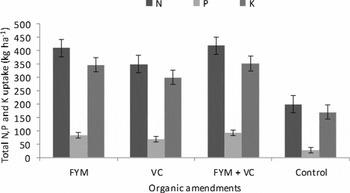
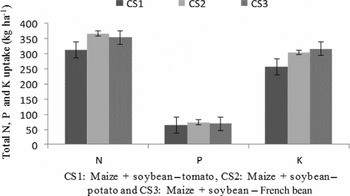
Higher total N, P and K uptake (Figure 4) were recorded with INS as source of nutrient supply followed by sole application of FYM than control. This is in line with the fact that the organic amendments when applied in combination are efficient in contributing to higher nutrient accumulation in plant parts. Among the cropping systems, maximum total N and P uptake was recorded in maize + soybean–potato followed by maize + soybean–French bean cropping systems, whereas, total K uptake was maximum in maize + soybean–French bean cropping system (Figure 5). Higher nutrient uptake due to supply of nutrients through combined source might be due to better soil health and less nutrient fixation (Das et al., Reference Das, Prasad, Shivay and Subha2004). Stein-Bachinger and Werner (Reference Stein-Bachinger and Werner1997) observed higher yields and nutrient uptake due to the addition of different manures within a crop rotation. Higher nutrient removal by potato compared to tomato, carrot has also been reported by Das et al. (Reference Das, Patel, Munda, Hazarika and Bordoloi2008). Conjunctive application of VC and FYM increased soil nutrient status (N and P) and thereby their uptake by the cropping system. The increased N uptake was due to mineralization of N from OM and mineralization effect upon native N (Sims, Reference Sims1987). The increased P uptake under INS is due to solubilization effect on the native P (Dahiya and Singh, Reference Dahiya and Singh1980; Singh et al., Reference Singh, Chahal and Singh1981). The decomposition of organic manure results in the formation of CO2, which helps in the solubilization of the native P, which forms the phospho-humic complexes that can be easily assimilated by the plants or isomorphous replacement of phosphate ions by humate ions, and coating of sesquioxide particles by humus to form a protective cover that reduces the P-fixing capacity of the soil (Singh et al., Reference Singh, Chahal and Singh1981).
Total N, P and K uptake (kg ha−1) as influenced by diverse organic amendments (vertical bar indicates standard error).

Total N, P and K uptake (kg ha−1) as influenced by diverse cropping systems (vertical bar indicates standard error).

Soil fertility
The role of organic manures in improving soil fertility and productivity is well documented (Baran et al., Reference Baran, Bielinska and Wisniewski1998). In addition to their richness in essential plant nutrients, organic manures also supply plant growth promoting substances and humus forming microbes in the soil. Thus, the application of VC and FYM improved the overall physico-chemical properties of the soil, which caused improvement in growth and yield attributes, yield, N and P content and uptake in dry matter (Jat and Ahlawat, Reference Jat and Ahlawat2006).
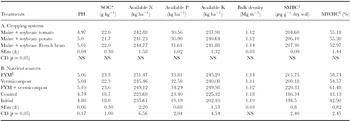
At the end of five cropping cycles, higher soil pH (5.01), SOC (22.0 g kg−1), available N (244.77 kg ha−1), P (31.61 kg ha−1) and K (241.88 kg ha−1) were observed under maize + soybean–French bean cropping system compared to those under maize + soybean–potato and maize + soybean–tomato cropping systems (Table 6). Among the amendments, INS as nutrient source recorded maximum pH (5.10), SOC (23.6 g kg−1), available P (34.29 kg ha−1) and K (249.98 kg ha−1) compared to other amendments. However, available N (251.47 kg ha−1) was maximum in FYM as organic amendment. Percentage increase in SOC, pH, and available N, P and K due to FYM as organic amendment were 22.2, 6.65, 6.73, 26.98 and 23.70%, respectively, compared to control after five cropping cycles. Maximum SMBC and water holding capacity were recorded under INS as source of organic amendment followed by those under FYM and VC, which were at par with each other. Minimum bulk density (BD) was recorded with VC (1.11 Mg m−3) followed by INS (1.12 Mg m−3) and FYM (1.14 Mg m−3) as organic amendments. However, the response of all three organic amendments on BD was not different from each other.
Soil parameters as influenced by various cropping systems and organic amendments after five cropping cycles.

*SOC: soil organic carbon; †SMBC: soil microbial biomass carbon; ‡MWHC: maximum water holding capacity, §FYM: farmyard manure.
SOC is considered as an indicator of N-supplying capacity of soils. It helps in economizing the external supply of N besides supplying a substantial proportion of N utilized by the crop from mineralizing SOM (Sahrawat, Reference Sahrawat2006). Continuous application of organic amendments were reported to improve the SOC, available N, P and K in soil, thereby sustaining the soil health (Das et al., Reference Das, Patel, Ramkrushna, Munda, Ngachan, Kumar, Buragohain and Naropongla2013; Panwar et al., Reference Panwar, Ramesh, Singh and Ramana2010). Maximum improvement in soil health related to SOC, available nutrient status and soil microbial population was observed with organic N sources alone or along with biofertilizers (Yadav et al., Reference Yadav, Babu, Yadav, Singh, Yadav and Pal2013). The increase in available P might be due to organic acids which were released during microbial decomposition of OM, which helped in solubility of native phosphates (Bhardwaj and Omanwar, Reference Bhardwaj and Omanwar1994; Chitra and Janaki, Reference Chitra and Janaki1999). The higher availability of K might be due to beneficial effect of OM on the reduction of K fixation, added OM interacted with K clay to release K from non-exchange fraction to the available pool. Increase in soil pH due to application of organic amendment like FYM and VC was also reported by Gopinath et al. (Reference Gopinath, Saha, Mina, Pande, Kundu and Gupta2008). The differences in SOC with the application of diverse organic amendments were due to differential rate of oxidation of OM by microbes (Trehan, Reference Trehan1997). The slow decomposition of applied and native SOM due to prevailing anoxic conditions, low temperature and supply of OM through diverse manure increased the SOC (Yadvinder-Singh et al., Reference Yadvinder-Singh, Ladha, Khind, Khera and Bueno2004). Increase in SOC due to organic farming has been also reported by other researchers (Babhulkar et al., Reference Babhulkar, Wandile, Badole and Balpande2000; Das et al., Reference Das, Patel, Ramkrushna, Munda, Ngachan, Kumar, Buragohain and Naropongla2013; Goldstein and Young, Reference Goldstein and Young1987; Stolze et al., Reference Stolze, Piorr, Haring and Dabbert2000). Addition of organic sources provide a stable supply of C and energy for microorganisms and results in increased microbial activities (Chitra and Janaki, Reference Chitra and Janaki1999). Superior soil fertility status on organic farms compared to soils under chemical fertilizers was also widely reported (Chitra and Janaki, Reference Chitra and Janaki1999; Mader et al., Reference Mader, Fliebbach, Dubois, Gunst, Fried and Niggli2002). Soil nutrient status build-up in an organic system takes a long time due to slow mineralization and release of nutrients from organic sources (Das et al., Reference Das, Patel, Ramkrushna, Munda, Ngachan, Kumar, Buragohain and Naropongla2013). The highest available soil N in tomato and cabbage fields was recorded with INS, while maximum K and SOC were obtained with VC (Choudhary et al., Reference Choudhary, Das and Patnaik2003). Organic compost contains bacteria, actinomycetes and fungi; hence, a fresh supply of humic material not only added microorganisms but also stimulate them (Balasubramanian et al., Reference Balasubramanian, Siddaramappa and Rangaswami1972; Gaur et al., Reference Gaur, Sadasivam, Vimal, Mathur and Kavimandan1973). Microbes in rhizosphere provide benefits to crops by better nutrient availability through mineralization of organic N, atmospheric N-fixation or solubilizing fixed mineral forms of P and other nutrients (Hegde et al., Reference Hegde, Sudhakara, Babu, Qurershi and Murthy2007).
Quality parameters of tomato
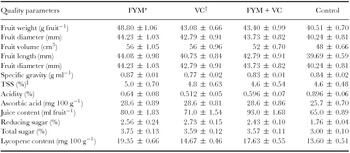
Various quality parameters of tomato grown under diverse cropping systems and nutrient management practices were determined at the ripening stage. Total soluble solids, average juice volume, ascorbic acid, total sugars, reducing sugars and lycopene content of tomato were recorded higher under FYM as organic amendment, which was closely followed by those under INS and VC (Table 7). Maximum average fruit weight, specific gravity and fruit diameter, TSS, ascorbic acid, total sugar and lycopene content were recorded with FYM, whereas, reducing sugar content was found maximum in VC as organic amendment. On the other hand, acidity was found moderately higher in control treatment. The produce quality is controlled by a complex interaction of factors, including soil type and the ratio of minerals in added manures (Warman and Harvard, Reference Warman and Harvard1998). Parray et al. (Reference Parray, Ganai and Fazili2007) reported that phenol, chlorophyll, ascorbic acid, oxalic acid, acidity, lycopene and carotenoid contents were improved with the application of FYM compared to control. Ramesh et al. (Reference Ramesh, Panwar, Singh and Ramana2008) also supported with their findings that the management of organic manures and crop rotation can have significant effect on yield and produce quality.
Quality parameters of tomato fruit at maximum ripening stage under various organic management practices.

*FYM: farmyard manure; †VC: vermicompost;‡TSS: total soluble solids.
Note: ± indicates standard deviation from mean.
CONCLUSIONS
FYM as organic amendment was found superior in respect to yield, nutrient uptake, produce quality and residual soil fertility status at equivalent N application rate followed by integrated application of equivalent amount of FYM and VC. Maize + soybean–tomato cropping system produced maximum system productivity and gave the highest net returns. Hence, maize + soybean–tomato system with FYM as organic amendment is recommended for economical and sustainable organic crop production at mid altitude of Eastern Himalayas. The C-sequestration potential of continuous organic farming with respect to diverse organic amendments and cropping systems needs to be studied in comparison to conventional farming practices to assess the actual benefit of organic farming. More crops and organic manures need to be evaluated to establish the best combinations of crop and manure for sustainable organic crop production.
Acknowledgements
The authors acknowledge the Project Directorate of Farming System Research (ICAR), Modipuram, India for technical and financial support in conducting the present study.