Introduction
The American Heart Association (AHA; Dallas, Texas USA) and European Resuscitation Council (Niel, Belgium) guidelines for management of cardiac arrest (CA) recommend using the intraosseous (IO) route of infusion when intravenous (IV) access cannot be obtained.Reference Burgert, Johnson, Garcia-Blanco, Fulton and Loughren 1 , Reference Neumar, Otto and Link 2 Survival of ventricular fibrillation (VF) is aided by rapidly administered vasoactive drugs.Reference Soar, Nolan and Bottiger 3 Vasopressin, a V1 receptor agonist, has been used as an alternative to epinephrine in the management of CA.Reference Burgert, Johnson, Garcia-Blanco, Fulton and Loughren 1 , Reference Neumar, Otto and Link 2 However, little data exist on the pharmacokinetics and resuscitative effects of vasopressin administered by the IO route for the treatment of adult VF.
Researchers studying tibial IO (TIO) vasopressin, in a swine model of pediatric CA, reported high rates of return of spontaneous circulation (ROSC) and hemodynamic measurements comparable with IV vasopressin.Reference Donnino, Salciccioli and Howell 4 The plasma concentration of vasopressin administered by the TIO route was reported to be comparable to IV vasopressin at 90 seconds and five minutes after ROSC.Reference Donnino, Salciccioli and Howell 4 Another study comparing TIO with IV vasopressin administration in a porcine CA model also found high rates of ROSC in the treatment groups. However, the maximum plasma concentration (Cmax) of IV vasopressin was significantly higher than in the TIO group.Reference Wenzel, Lindner and Augenstein 5
These previous studies increased the understanding of TIO vasopressin administered during CA.Reference Donnino, Salciccioli and Howell 4 , Reference Wenzel, Lindner and Augenstein 5 However, the first study was performed in a pediatric CA model using a second generation, manually-inserted IO device.Reference Donnino, Salciccioli and Howell 4 The second study built on the work of the first study by using an adult CA model, modern powered IO devices, and more detailed measures of survival probability and pharmacokinetics.Reference Wenzel, Lindner and Augenstein 5 However, both studies only considered the TIO route.
The humeral IO (HIO) route is a commonly used route of infusion used by emergency medicine practitioners. Like the TIO route, the HIO route is distant enough to not interfere with chest compressions and airway management interventions but is physically closer to emergency care providers than the TIO route. This difference may be particularly important for the efficiency of prehospital care providers. The HIO route also remains a useful alternative if lower extremity circulatory compromise, inferior vena cava injury, or fracture precludes use of the TIO route. Intuitively, it can be inferred there is likely no difference in the effects of HIO and TIO administered vasopressin on survival and pharmacokinetic measures. However, there are limited data available to support that presumption. Researchers have not fully addressed survival measures including the occurrence of ROSC, odds of ROSC, mean time to ROSC, and pharmacokinetic measurements of Cmax, time to maximum plasma concentration (Tmax), and plasma concentration over time of vasopressin administered by the HIO route during VF with ongoing cardiopulmonary resuscitation (CPR).
Although AHA guidelines for treatment of CA do not currently recommend vasopressin, it remains an alternative in the European Resuscitation Council guidelines.Reference Neumar, Otto and Link 2 While this study was performed in the context of VF, the results of this study may have broader applicability toward other uses of IO administered vasopressin, such as the management of shock. Emergency medicine and other acute care practitioners need to have knowledge of the behavior of HIO administered vasopressin during CA and hypoperfusion states.
The purpose of this study was to evaluate the resuscitative effects and pharmacokinetics of HIO vasopressin compared to IV vasopressin in a swine model of VF. The specific aims were to determine if there was a significant difference in the occurrence of ROSC, odds of ROSC, time to ROSC, Cmax, Tmax, and plasma concentrations over time between the HIO, IV, and control groups.
Methods
This study was a prospective, mixed, experimental design conducted in a laboratory setting and approved by the local Institutional Animal Care and Use Committee of the Navy Medical Research Unit - San Antonio (Texas USA). Yorkshire-cross, male swine Sus scrofa (N=27) weighing between 60 to 80 kg were randomly and equally assigned (n=9) to one of three groups using a computerized random number generator: HIO vasopressin with defibrillation, IV vasopressin with defibrillation, and the control group (IV saline with defibrillation). All swine were sourced from the same lot number and vendor. Male swine were used exclusively to avoid variance among the swine. Swine of this weight range were used as they represent the average weight of the adult human.Reference Johnson, Giles and Acuna 6
Housing and care of the swine were in accordance with the Animal Welfare Act and the Guide for the Care and Use of Laboratory Animals.Reference Paquette, Gordon and Bradtmiller 7 The animals received a complete health assessment by the attending veterinarian and were monitored by veterinary staff for the three days prior to beginning the study to ensure good health. If an animal was found to be ill, he was removed from the study. Animals were fed antibiotic-free feed until midnight on the day of the experiment and received tap water ad libitum until two hours prior to anesthetic induction.
Swine were pre-medicated 30 minutes before instrumentation with an intramuscular injection of Telazol (4.4 mg/kg; Tiletamine/Zolazepam, Fort Dodge Animal Health; Fort Dodge, Iowa USA). Anesthesia was induced with inhaled isoflurane (4.0% to 5.0%) in 100% oxygen. After endotracheal intubation, the investigators reduced the isoflurane concentration to a maintenance dose between 1.0% and 2.0%. Swine were ventilated with 8-10 mL/kg tidal volume at a rate of 10 breaths per minute with a Fabius GS anesthesia machine (Dräger Medical Systems; Telford, Pennsylvania USA). Heart rate (HR), electrocardiography (ECG), systolic blood pressure (SBP), diastolic blood pressure (DBP), mean arterial pressure (MAP), oxygen saturation (SpO2), end-tidal capnography (ETCO2), and body temperature (ºC) were monitored continuously with a Phillips MP 50 system (Phillips Healthcare; Andover, Massachusetts USA).
Intravenous access was secured in all swine with an 18-gauge catheter placed in an auricular vein. Lactated Ringer’s solution was infused at 100 mL/hour to maintain patency. The investigators used a forced-air warming blanket (Bair Hugger, Model 505, Arizant Inc.; Eden Prairie, Minnesota USA) to maintain body temperature ≥ 36.0 °C. The left carotid artery was surgically exposed and an arterial catheter was inserted and connected to the Phillips MP 50 monitor for continuous arterial blood pressure monitoring, and the Vigileo Hemodynamic Monitor (Edwards Lifesciences; Irvine, California USA) for measurement of continuous cardiac output. The arterial line also was used for blood specimen collection.
Swine in the HIO group had a 15 ga. x 45 mm EZ-IO device (Teleflex Medical; San Antonio, Texas USA) inserted into the humerus following surgical exposure. The humerus was surgically exposed as it is difficult to precisely place a HIO device in swine because of thick, soft tissue overlying the insertion site. Placement of all HIO devices was confirmed by aspiration of bone marrow and irrigation with 10 mL of normal saline.
After intubation and line placement, the swine were stabilized for 10 minutes prior to beginning the experiment. Ventricular fibrillation was induced electrically using the transcutaneous electrical induction method. 8 Anesthesia was discontinued after confirmation of VF to avoid myocardial depression. Swine remained in VF without intervention for two minutes. Chest compressions began two minutes post-arrest using the “Thumper” Mechanical Compression Device, Model 1008 (Michigan Instruments; Grand Rapids, Michigan USA) delivering 100 compressions per minute in accordance with AHA Basic Life Support guidelines.Reference Burgert, Johnson, Garcia-Blanco, Fulton and Loughren 1 Ventilations were delivered at a rate of six to eight breaths a minute without interruption of chest compressions. Quality of chest compressions was confirmed by observation of the arterial line waveform and the presence of a capnographic waveform. Basic Life Support continued for two minutes before vasopressin was administered. Vasopressin (40 U) was administered at four minutes post-arrest via HIO or IV followed by a 20-mL normal saline flush. Serial blood specimens (10 mL) were collected at 30, 60, 90, 120, 150, 180, and 240 seconds after vasopressin injection. Baseline vasopressin specimen collection was not necessary as the spectrographic signature of exogenous arginine vasopressin differs from the spectrographic signature of endogenous swine lysine vasopressin. Before each specimen collection, 10 mL of blood was aspirated and discarded to avoid dilution and contamination. After each specimen was collected, 10 mL of normal saline was injected to maintain arterial line patency. Following specimen collection (eight minutes post-arrest), swine were defibrillated (200 joules biphasic). Chest compressions resumed immediately if the animal did not convert to an organized, perfusing rhythm. Defibrillation (360 joules biphasic) was repeated every two minutes for 20 minutes, or until ROSC. Return of spontaneous circulation was defined in this study as an organized ECG rhythm in Leads II and V, an arterial SBP ≥ 60 mm/Hg, an observable capnographic waveform, and survival to the 30-minute post-ROSC experimental endpoint. Animals achieving ROSC received standard AHA post-CA care and were monitored for 30 minutes. Inhalational anesthesia was administered as tolerated. If the animal reentered a non-perfusing rhythm, the investigators repeated the resuscitation cycle as above. Each animal was limited to two additional resuscitation cycles. Animals were euthanized under general anesthesia according to local veterinary protocol at 29 minutes post-arrest or 30 minutes after ROSC.
Blood specimens were placed in lithium heparin tubes and immediately placed on ice. Specimens were centrifuged for 10 minutes at 4,000 rpm. Plasma was frozen at –40 °C, packed in dry ice, and shipped overnight to the University of Washington Pharmacokinetics Laboratory (Seattle, Washington USA) for analysis. The analysis of blood specimens for exogenous vasopressin was performed using high performance liquid chromatography with tandem mass spectrometry. Pharmacokinetic results were determined directly from this analysis.
Sample size estimation was based on a pilot study conducted by the investigators and data from similar investigations.Reference Burgert, Johnson and Garcia-Blanco 9 - Reference Schwarz, Mair and Wagner-Berger 12 Using means and standard deviations from those studies, a large effect size of 0.6 was calculated. The matrix of means was incorporated in a power analysis, using the Multivariate Analysis of Variance (MANOVA) option in the PASS 14 package (NCSS LLC; Kaysville, Utah USA) to minimize the number of animals used and achieve a statistically valid result. Using an effect size of 0.6, a power (1–β) of .80 with alpha of .05, it was determined a sample size of nine swine per group was needed.
Means and standard deviations were used to report data in all groups. Statistical significance was indicated by a P value ≤.05. Statistical analysis was performed using IBM SPSS Statistics for Windows v. 21.0 (IBM Corp.; Armonk, New York USA). Multivariate Analysis of Variance was used to determine if there were any significant differences between the groups relative to pretest data. Fisher’s Exact test was used to determine if there was a statistically significant difference in the occurrence of ROSC between the groups. Odds of ROSC were calculated and compared between the groups. One-way MANOVA was conducted to test for significant differences between the HIO, IV, and control groups on ROSC, Cmax, and Tmax. Wilks Lambda (Λ) was the test statistic for the MANOVA. The mean time to ROSC was calculated for each group. Analysis of Variance (ANOVA) was used to determine if there were statistically significant differences between the groups relative to time to ROSC and mean plasma concentrations over time.
Results
Twenty-seven swine, nine per group, were used in this study. Two swine in the HIO group were reassigned to the IV group, as a contingency, after the IO device dislodged from the humerus during chest compressions immediately before drug administration. Reassignment was necessary as a second attempt to gain IO access in the same humerus would lead to an unacceptable risk of extravasation and there was no time to surgically expose the contralateral humerus. Reassignment also was necessary to avoid needless sacrifice of the animals in accordance with the principal of reduction. Following reassignment, the experimental procedure continued as described in the methods section. The group sizes after reassignment were: HIO (n=7), IV (n=11), and control (n=9), which were used in all statistical analysis except pre-test data. The investigators acknowledge reassignment created heterogeneous groups and may be a limitation of this study. Future investigators should consider surgical exposure of both humeral insertion sites prior to beginning the experiment.
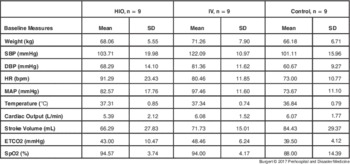
Pre-test physiologic measurement analysis is presented in tabular form (Table 1). Multivariate Analysis of Variance of pre-test data showed no significant differences between the groups on all measures (P>.05).
Pretest Descriptive Statistics

Abbreviations: DBP, diastolic blood pressure; ETCO2, end-tidal capnography; HIO, humeral intraosseous; HR, heart rate; IV, intravenous; MAP, mean arterial pressure; SBP, systolic blood pressure; SpO2, oxygen saturation.
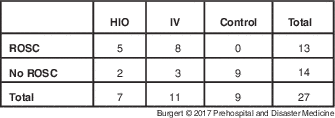
The number of subjects achieving ROSC was analyzed by group using Fisher’s Exact test, a hypergeometric probability distribution, and odds ratios. The cross-tabulations for ROSC by group are presented (Table 2). The occurrence of ROSC was significantly higher in both the HIO 5/7 (71.5%) and IV 8/11 (72.7%) groups compared to the control group 0/9 (0.0%; P=.001). The HIO and IV groups did not have a significantly different rate of ROSC (P>.47) when compared to each other.
Cross-Tabulations of ROSC by Group

Note: Two HIO swine were reassigned to IV group following inadvertent displacement of two HIO devices.
Abbreviations: HIO, humeral intraosseous; IV, intravenous; ROSC, return of spontaneous circulation.
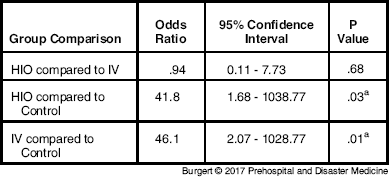
Odds ratios of ROSC between the groups were calculated and indicated the odds of ROSC favor IV over HIO by a small margin, but there was no statistical difference between the groups. As expected, there was significant difference in the odds of ROSC between both the HIO and IV groups compared to the control group (Table 3). The HIO and IV groups were 41.8 and 46.1 times, respectively, more likely to have ROSC than the control group. Because a null value existed in the control group odds ratio calculations, a factor of .5 was added to each cell in the 2X2 table to obtain a rational rather than an infinite result. Even with the addition of .5 to each cell, 95% confidence intervals in the control group calculations were erroneously wide and may limit their use as a true measure of effect size.
Odds Ratios of ROSC Between Groups

Abbreviations: HIO, humeral intraosseous; IV, intravenous; ROSC, return of spontaneous circulation.
a Indicates significance (P=.05).
Time to ROSC between groups was evaluated for those animals that had ROSC. The mean time to ROSC for HIO and IV groups was 621.20 seconds (SD=204.21 seconds) and 554.50 seconds (SD=213.96 seconds), respectively. Since the underlying distribution of these times was positively skewed, the difference was evaluated using the Mann Whitney U test. The difference between the treatment groups relative to time to ROSC was not statistically significant (U=11; P=.22).
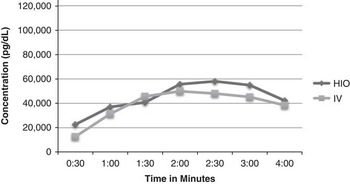
Mean plasma concentrations of vasopressin by infusion route over time were calculated and graphically presented (Figure 1). Repeated measures ANOVA indicated no significant difference in plasma vasopressin concentrations between the IO and IV groups at any point in time (P=.48).
Plasma Concentrations Over Time Curve for the HIO and IV Routes of Vasopressin Administration. Abbreviations: HIO, humeral intraosseous; IV, intravenous.

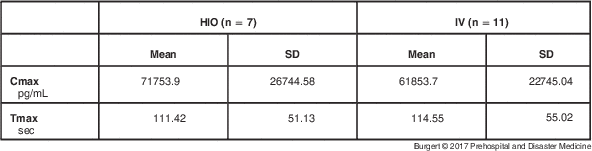
The mean Cmax and Tmax of vasopressin by infusion route were calculated from the raw data and presented (Table 4). The differences in Cmax and Tmax were analyzed by group. Neither variable had normal distribution; therefore, Mann-Whitney U testing was used to evaluate differences inferentially. There were no statistically significant differences in Cmax between the HIO and IV groups (U=31; P=.536). Further, there were no statistically significant differences in Tmax between the HIO and IV groups (U=38; P=1.00).
Pharmacokinetic Measures of Vasopressin by Group

Abbreviations: Cmax, maximum plasma concentration; HIO, humeral intraosseous; IV, intravenous; Tmax, time to maximum concentration.
Discussion
This study was designed to determine if there were significant differences in the occurrence of ROSC, odds of ROSC, time to ROSC, Cmax, Tmax, and plasma concentrations over time between the HIO, IV, and control groups when vasopressin was administered in a swine model of VF. The specific aims of this study were addressed successfully.
Analyses indicated the HIO route had similar rates of ROSC and time to ROSC compared to the IV route, suggesting the HIO route is comparable to the IV group relative to those measurements. As expected, there was significant difference in the odds of ROSC between the treatment groups compared to the control group indicating that vasopressin, whether administered by the HIO or IV routes, increased the chance that ROSC would occur. Conversely, the occurrence of ROSC greatly decreased in the absence of vasopressin as supported by the observation that no control group swine had ROSC. Vasopressin administered by the HIO and IV routes had similar Cmax, Tmax, and plasma concentration over time profiles.
The results of this study were consistent with some of the findings of studies performed by Wenzel et al and Johnson et al.Reference Donnino, Salciccioli and Howell 4 , Reference Wenzel, Lindner and Augenstein 5 Wenzel et al and Johnson et al found TIO vasopressin administration resulted in a high rate of ROSC compared to IV vasopressin: 6/6 vs 6/6 and 7/7 vs 7/7, respectively. However, the mean plasma vasopressin concentrations over time measured in the present study were considerably higher than those measured at 90 seconds and five minutes after IV and TIO administration by Wenzel et al: 13,706 pg/mL (SD=1857 pg/mL) vs 16,166 pg/mL (SD=3114 pg/mL) and 10,372 pg/mL (SD=883 pg/mL) vs 8246 pg/mL (SD=2211 pg/mL), respectively.Reference Donnino, Salciccioli and Howell 4
The Johnson studyReference Wenzel, Lindner and Augenstein 5 reported mean plasma concentrations over time of the IV group were significantly higher than the TIO group at the 60, 90, and 120 second time marks compared to the present study where no difference was noted at any time point. The Cmax of the IV group, 70,717 pg/mL (SD=28,118 pg/mL), in the Johnson study was consistent with the results of the present study. The Cmax of the TIO group in the Johnson study, 39,630 pg/mL (SD=12,641 pg/mL), was 32,000 pg/mL lower than reported in the present study. The Tmax of the IV and TIO groups in the Johnson study, 1.7 minutes (SD=.70 minutes) and 2.4 minutes (SD=1.2 minutes), were similar to the Tmax reported in the present study.Reference Wenzel, Lindner and Augenstein 5
The overreaching goal of the investigators of this study was to build and improve on the work of previous investigations. Strengths of this study included using swine approximating the size and volume of distribution of an adult humanReference Johnson, Giles and Acuna 6 and using a modern, powered IO device which greatly decreased the chance of extravasation or breakage seen in the less robust manual IO devices of the previous generation.Reference Burgert, Gegel and Loughren 13 Other measures used to increase methodological rigor included the addition of a control group, more detailed survival and pharmacokinetic measures, and use of a highly sensitive and specific technique for plasma vasopressin analysis. One of the previous studiesReference Donnino, Salciccioli and Howell 4 used manual chest compressions; although more realistic, they are not consistent nor reproducible from animal to animal. Plasma concentrations of medications in the early stages of administration are determined largely from their absorption and distribution. Absorption and distribution are primarily influenced by blood flow, tissue characteristics, and chemical properties of the medication.Reference Weiser, Hoffmann and Galbraith 14 Blood flow was controlled for by using a mechanical CPR device ensuring consistent and reproducible chest compressions from animal to animal.
The first study of IO vasopressinReference Donnino, Salciccioli and Howell 4 was conducted when IO access was reserved for use in pediatric populations and the TIO route was preferred for manual insertion of IO needles. The investigators used the HIO route of infusion in this study as it is a commonly used site of IO infusion that is convenient for clinicians to place and use without interfering with chest compressions and airway management.Reference Buxton 15 , Reference Levitan, Bortle and Snyder 16 In cases of traumatic CA, the HIO route may be more desirable than the TIO route because of potential lower extremity trauma or inferior vena cava injury. Other advantages of the HIO route are proximity to the central circulationReference Santos, Carron and Yersin 17 and a higher ratio of well-perfused red bone marrow compared to the tibia.Reference Paxton, Knuth and Klausner 18 A higher ratio of well-perfused red bone marrow to less-perfused and highly adipose yellow marrow may minimize any local distribution or “depot effect” and enhance drug absorption. Pharmacokinetic analysis conducted in this study did not reveal any evidence of delayed absorption because of depot or vasoconstrictive effects.
The main finding of clinical importance was the HIO route appeared to be an effective route of vasopressin infusion performing comparably with the IV route in this experimental model. The HIO route may be especially useful to clinicians when IV access fails or cannot be obtained during a crisis requiring immediate pharmacologic intervention and vascular access is limited to time-consuming central venous and peripheral techniques. The utility of the HIO route for the urgent administration of drugs may be especially useful during surgery, when access to conventional vascular access sites is limited because of pathology, positioning, or surgical drapes, as a bridge until definitive vascular access is obtained.
Limitations
While rigid controls were used to reduce the possibility of bias in the conduct of this experiment, potential limitations of this study may affect the generalization of its results to humans. The reassignment of two swine from the HIO group to the IV group after inadvertent displacement of the humeral IO catheters prior to time-sensitive drug administration and blood specimen collection was necessary to avoid needless sacrifice of the swine and to obtain usable data from them. However, this contingency created heterogeneous groups which may limit the results of this study. Another potential limitation was vasopressin administration preceded defibrillation, which is inconsistent with cardiac resuscitation guidelines. This change in order was necessary to ensure all blood specimens for pharmacokinetic analysis were collected in all subjects over the entire 4-minute collection time. The last potential limitation is use of a swine model. Swine have anatomically and physiologically similar cardiovascular systems compared to humans, making them a valid model for resuscitation and pharmacokinetic research.Reference Malkiewicz and Dziedzic 19 The investigators acknowledge the high rate of ROSC found in this study may have occurred because the study swine were healthy with no pre-existing cardiac disease. The use of the electrical method of inducing VF does not simulate acute coronary occlusion, the most common cause of VF in humans.Reference Swindle, Makin and Herron 20 , Reference Walcott, Kroll and Ideker 21 Studies report swine with electrically induced VF are more likely to respond to electrical and drug interventions than swine with VF induced by occlusive means.Reference Walcott, Kroll and Ideker 21 , Reference Niemann, Rosborough and Youngquist 22
Conclusions
Measures of the occurrence of ROSC, odds of ROSC, time to ROSC, Cmax, Tmax, and plasma concentrations over time after HIO administration of vasopressin were comparable to IV administration. The data indicated the plasma concentration of vasopressin in both treatment groups was therapeutically sufficient to achieve ROSC with no significant difference in time to ROSC. The finding of most clinical importance was the HIO route appeared to be an effective route of vasopressin infusion performing comparably with the IV route in this experimental model of VF.