


1. Introduction
A large body of literature maps out the historical aspects of the rise of mass education and its relationship with long-run economic growth and development (broadly conceived) in several countries.Footnote 1 Germany, Sweden and the United States are well-known cases in which widespread schooling favoured a more egalitarian and successful pattern of industrialisation and growth (Sandberg, Reference Sandberg1979; Lindert, Reference Lindert2004; Goldin and Katz, Reference Goldin and Katz2009). Several other countries engaged in fast industrialisation strategies throughout the 20th century, but the restricted coverage of primary education in most of these countries was among the major reasons behind their inegalitarian pattern of growth—particularly in regions such as Latin America (Frankema, Reference Frankema2009).
Brazil is a remarkable example of fast industrialisation with poor performance in public schooling.Footnote 2 Since at least the 1930s, the country explicitly pursued a state-led growth strategy based on import-substituting industrialisation (ISI).Footnote 3 However, nearly 40 per cent of the adult population was illiterate according to census data in 1960. Among the lucky ones who received any schooling, most children ended their education in the four-grade primary level and those who made it through often did not advance to the lower secondary education. Only in the 1990s did formal schooling reach nearly the entire population aged between 7 and 14. Given this historical record, the dismal results of the country in recent international tests (such as PISA) are not surprising.
The Brazilian military regime (1964–1985) is a crucial setting for examining the economic history of education in the largest country in Latin America. Extensive research has highlighted the interplay between political regimes, levels of centralisation or decentralisation, and mass education. Examples such as Prussia and the United States demonstrate how local autonomy under different political regimes can have a positive impact on the expansion of mass schooling (Lindert, Reference Lindert2004; Goldin and Katz, Reference Goldin and Katz2009; Go and Lindert, Reference Go and Lindert2010). However, decentralisation may also reinforce educational inequalities, as recognised by Lindert (Reference Lindert2004) and demonstrated by several studies in different contexts (Chaudhary et al., Reference Chaudhary, Musacchio, Nafziger and Yan2012; Go and Park, Reference Go and Park2012; Goñi, Reference Goñi2015; Cappelli, Reference Cappelli2016; Cinnirella and Hornung, Reference Cinnirella and Hornung2016; Cappelli and Vasta, Reference Cappelli and Vasta2020). Additionally, it is crucial to distinguish between administrative and financial decentralisation (Bardhan Reference Bardhan2002). In Brazil, subnational governments have been responsible for providing primary education, but with varying fiscal constraints throughout history (Kang, Reference Kang2011; Colistete, Reference Colistete2016; Musacchio et al., Reference Musacchio, Martínez-Fritscher and Viarengo2014). In a well-known study on education finance during the military regime in Brazil, David Brown (Reference Brown2002) only analysed federal education spending, but subnational governments have played a critical role in the provision of education in Brazil and other countries.
This paper shows that tax-based education spending might depend on the levels of centralisation in different institutional aspects. Using state-level data for education spending in Brazil from 1967 to 1985, we argue that trade policies compromised subnational governments' capacity to fund education from the mid-1970s. This means that education spending was undermined not by the overall state capacity of taxation but by the particular strategy of imposing export incentives funded by indirect taxation, the main source of state revenues. Indeed, this paper shows that state-level tax revenues per capita stagnated and negatively affected education spending per child after 1973, which in turn restricted the supply of education and stagnated enrollment rates. This happened in a context of increasing urbanisation and fast economic growth.
We argue that this stagnation resulted from national level policy decisions that reflected on the financial situation of subnational governments. The federal government imposed several export incentives from 1967 onwards including exemptions and subsidies based on the state indirect tax on consumption, which undermined the fiscal capacity of states. This became particularly acute after the oil crisis in 1973, when the federal government centralised even more resources in its hands in order to carry out a massive programme of investments in energy, intermediate and capital goods, the II National Development Plan (II PND).Footnote 4 Instead of pursuing a traditional adjustment in response to the external shock, the central government intensified export incentives, which impoverished subnational entities. Rates of the states' indirect tax, the major financial source of state governments, reached their minimum in the period after the oil shock. We will show that enrollment rates stagnated precisely during the heyday of the big push industrial policy (1974–1979), when the central government obtained the largest shares of tax revenues.
To our knowledge, nobody else has investigated the relationship between industrial policies and education outcomes in the period under analysis. Nonetheless, evaluations of the effects of industrial policies on macroeconomic aspects after the 1973 oil crisis are abundant. In a polemic essay, Barros de Castro and de Souza (Reference de Castro and de Souza1985) argued that the II PND was worthwhile because the recovery of external accounts in the 1980s was based on exports of the industries that received investments under the program in the mid-1970s.Footnote 5 Other studies, however, have underscored the high costs of the industrial policy (Lessa, Reference Lessa1978; Aguirre and Saddi, Reference Aguirre and Saddi1997). Balassa (Reference Balassa1979), for instance, argued that export incentives generated widespread inefficiency, while others emphasised the effects of the big push policy on external indebtedness and inflation (Cruz, Reference Cruz1984; Fishlow, Reference Fishlow1986; Genta dos Santos and Colistete, Reference Genta Dos Santos and Colistete2010). However, none of these studies attempted to evaluate the consequences of the II PND and export incentives on other areas, such as the expansion of mass education in the 1970s.
We argue that the costs of national industrial policies were partly absorbed by a relative decrease in the fiscal capacity of states and municipalities, which led to a stagnation in the expansion of primary education in the mid-1970s. Particularly after the global adverse shock, the latter was not absorbed only through a rising external debt as the literature often underlines. Education outcomes also paid a price. Primary education in industrial states such as São Paulo was strongly hit by these measures. In these regions, enrollment rates in primary schools only started to increase again after the end of the military regime, when the situation of external accounts was more stable and the tax system was decentralised in favour of subnational government levels.
Despite focusing only on Brazil, this paper is somewhat related to the extensive literature on the comparative growth and development in Latin America and East Asia.Footnote 6 Mass education policies were among the major differences between the development paths of the two regions according to several studies (Birdsall et al., Reference Birdsall, Bruns, Sabot, Birdsall and Sabot1996; Haggard and Kaufman, Reference Haggard and Kaufman2008; Ansell, Reference Ansell2010). Moreover, the Brazilian big push industrialisation strategy in the 1970s was in some respects similar to that pursued by South Korea during the same period, for example. Both counted on export incentives, even though the Brazilian version was substantially more costly and less effective (Moreira, Reference Moreira1995). More importantly to our case, South Korean trade policies apparently did not have a negative effect on the expansion of mass education the way (we claim) it happened in Brazil.
In this paper, we explore state-level variation of primary education funding and enrollment ratios through panel data regressions in the period 1967–1985. Musacchio et al. (Reference Musacchio, Martínez-Fritscher and Viarengo2014) also investigated how commodity booms led to an upsurge of education spending in several Brazilian states between 1890 and 1930, since the export tax was the main source of state revenues during that period. During the more centralised military regime, national tax policy affected the fiscal capacity of states in the 1970s, since the central government deliberately stimulated exports at the expense of state tax revenues in the 1970s. Our statistical results lend some evidence to an association between tax revenues per capita and education spending per child at the state-level; and the latter is also associated with the evolution of the gross enrollment ratio in primary education. Our qualitative evidence shows that the export policy associated with a big push industrialisation programme in the second half of the 1970s emerges as the most likely explanation for the stagnation of state tax revenues, which negatively affected education spending and outcomes.
This paper is organised as follows. Section 2 describes the evolution of education outcomes during the military period. Section 3 delineates how state-level taxation and education spending evolved during the period. Section 4 focuses on the proximate explanations for the stagnation of education outcomes providing some quantitative evidence of the effects of lower taxation on education spending and enrollments. Section 5 deals with fundamental institutional explanations showing how export incentives and industrial policy led to the demise of the financial capacity of states, particularly in more industrialised regions. Section 6 concludes.
2. Education outcomes during the military regime
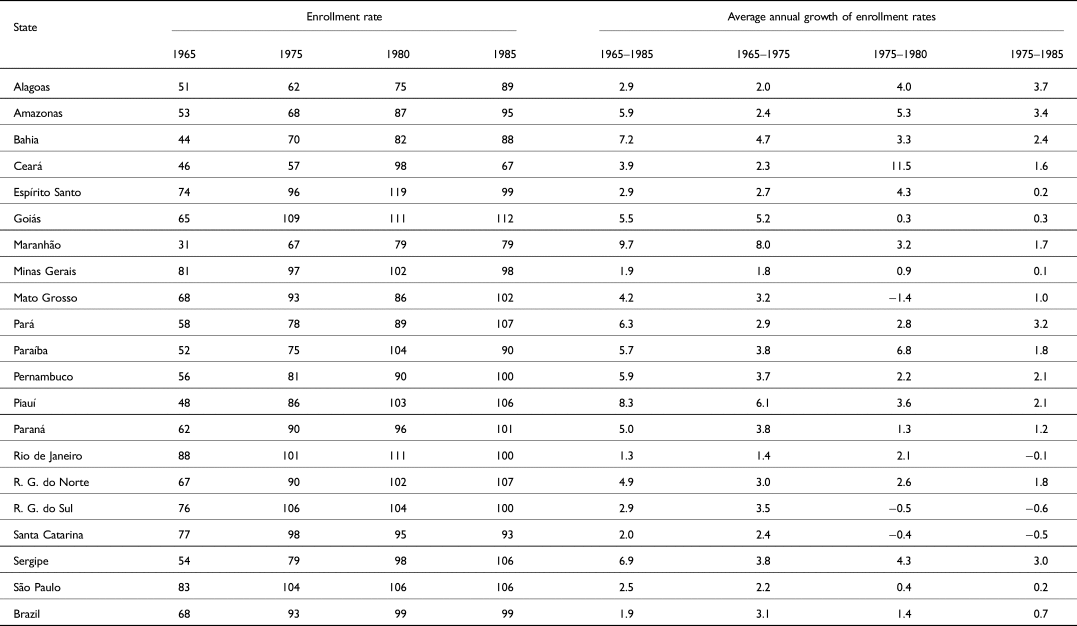
During the first decade under military rule, school enrollments increased substantially in Brazil. The gross enrollment ratio in the eighth-grade primary education was 67.5 per cent in 1965, whilst a decade later it reached 91.8 per cent.Footnote 7 The average annual growth rate of the enrollment ratio was 3.1 per cent between 1965 and 1975. However, the pace of enrollment ratio growth changed in the last decade of the military regime. In 1980 the national gross enrollment rate reached 98.4 per cent, a result of an annual average increase of 1.4 per cent since 1975. In 1985 the enrollment ratio (97.8 per cent) was even lower than the figure in 1980. In other words, the primary level enrollment rate nearly stagnated between the mid-1970s and the mid-1980s (see Table A1 in the Appendix).
One could argue that enrollment rates stagnated because Brazil had already achieved a high level of enrollments in the mid-1970s. However, while gross enrollment rates were close to 100 per cent, the country had reached a net enrollment rate of only 80 per cent in 1980. Given the exceptionally high retention rates that prevailed in Brazil, the gross enrollment rate had to be much higher than 100 per cent for us to conclude that the system covered the entire school-age population. The sharp growth of enrollment rates (even with a gross enrollment ratio of approximately 100 per cent) after the military left the government shows that there was room for an expansion of enrollments from 1975 to 1985.
The sluggish increase in enrollment rates from the mid-1970s seems relatively consistent with the fluctuations of the Brazilian economy during the last decade under military rule. After some years of slow economic growth up to 1967, the country achieved exceptionally high rates of economic growth during the so-called “economic miracle” between 1968 and 1973 (an annual average economic growth rate of 11.3 per cent). In spite of the oil shock, the Brazilian economy managed to keep high economic growth rates (annual average of 6.4 per cent) between 1974 and 1979. Given the still high rates of economic growth, the low increase in enrollment rates is surprising during the second half of the 1970s. This is different from the early 1980s, when the Brazilian economy was engulfed by the Latin American debt crisis and stagnated.
A regional perspective shows that enrollment rates increased at similar rates in most states before 1975 but at very different rates thereafter. From 1965 to 1975, most states presented an average growth between 2.0 per cent and 4.0 per cent in enrollment rates. States in Southeast and South regions were traditionally more industrialised and already had a high level of enrollments, in contrast to the poorer areas in North and Northeast regions. Despite that, southern states such as Paraná and Rio Grande do Sul continued to show fair expansions between 1965 and 1975 (3.8 per cent and 3.5 per cent annually, respectively). Only in the poorest states, such as Piauí and Maranhão, did enrollment rates rise quickly in the period (6.1 per cent and 8.0 per cent annually on average).
Enrollment growth differentials between states became more pronounced from 1975 to 1985. During this period, enrollment rate growth stalled in the densely inhabited and industrial state of São Paulo (0.2 per cent per year on average). Southern states such as Rio Grande do Sul (−0.6 per cent) and Santa Catarina (−0.5 per cent) presented a decrease in enrollment rates between 1975 and 1985. On the other hand, some states presented a somewhat faster growth of enrollment rates in the second half of the military regime: Alagoas (3.7 per cent), Amazonas (3.4 per cent), Pará (3.2 per cent) and Sergipe (3.0 per cent) for instance. In overall terms, however, enrollment rates nearly stagnated in the country because of the weight of Southeast and South regions (see Table A1 in the Appendix).
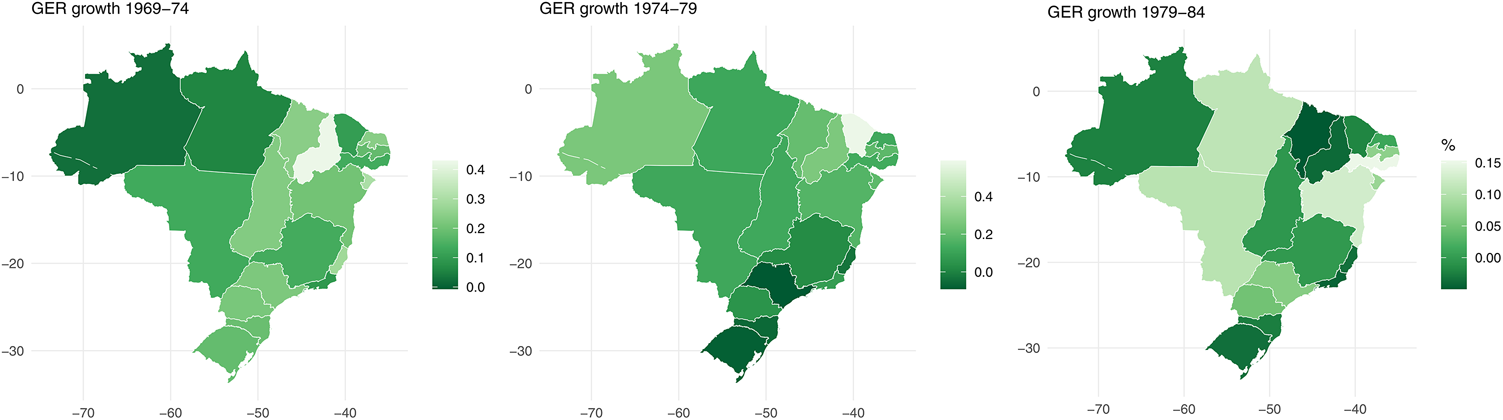
As the 1975–1985 period also covers the debt crisis of the early 1980s, public spending cuts in response to the crisis could be the most logical explanation for the slowdown in enrollment rate growth. To rule out this hypothesis, we analysed the period before 1980. Our dataset shows that enrollment rates decreased in states such as Rio Grande do Sul, Santa Catarina and São Paulo, despite the fact that other states (most of them in the Northeast region) presented positive results from 1974 to 1979. Figure 1 shows that enrollment rate growth between 1974 and 1979 was slower in more industrialised states, different from the patterns during the periods 1969–1974 and 1979–1984. What can explain the stagnation of enrollment rates in the second half of the 1970s, particularly in more industrialised states? To begin answering this question, we need to look at state-level fiscal conditions and education spending during the 1970s.
Gross enrollment rate growth by state, 1969–1974, 1974–1979 and 1979–1984.
Source: IBGE and Goldenberg (Reference Goldenberg1990).

3. Taxation and education spending in Brazilian states
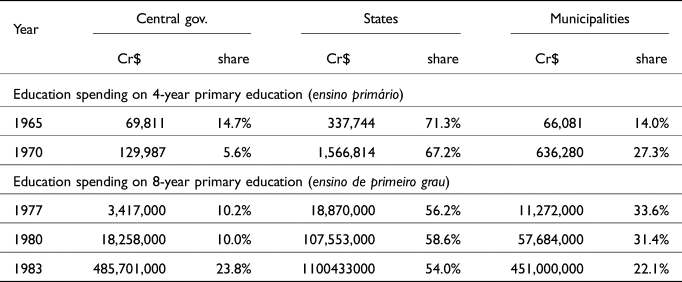
Even though municipalities had a non-negligible responsibility in the development of primary education, states still played a larger role because of their greater fiscal capacity. More than half of primary education spending was covered by states, while municipalities were responsible for approximately a third of primary education expenditures in 1977 and in 1980.Footnote 8 Furthermore, three-quarters of total state-level education expenditures (except administrative and other types of expenditures) were directed to primary education in 1980. The situation was similar in years for which we have disaggregated data (Mello e Souza, Reference Mello E Souza1979). Given the prominent role of states, there are few reasons (if any) to investigate local government spending in education. In the following subsections, we first describe the evolution of state tax revenues and then look at the behaviour of state-level education expenditures.
3.1 ICM Revenues
To analyse the behaviour of state-level finances, first we must consider the effects of the 1966/1967 tax reform. In the late 1950s, there was a clear diagnosis that the Brazilian state had a low fiscal capacity to finance industrialisation efforts without leading the country to inflation and indebtedness. Given the recurrent fiscal deficits, an increase in taxation was deemed necessary by policymakers (Varsano, Reference Varsano1982; Cossio, Reference Cossio1998). The tax reform promoted by the military regime modernised the system; it clearly defined the competence of each government level and created value-added taxes (Giambiagi et al., Reference Giambiagi, Além and Pinto2015). As a result, it significantly increased the fiscal capacity of the Brazilian state; tax proportion in terms of GDP increased from 16.0 per cent in 1963 to nearly 26.0 per cent in 1969.
For the sake of financing state government responsibilities, the tax reform created a value-added tax called Imposto sobre Circulação de Mercadorias (ICM), which became the most important financial source of states. While 80 per cent of the ICM was assigned to the states, the remaining 20 per cent was transferred to municipalities.Footnote 9
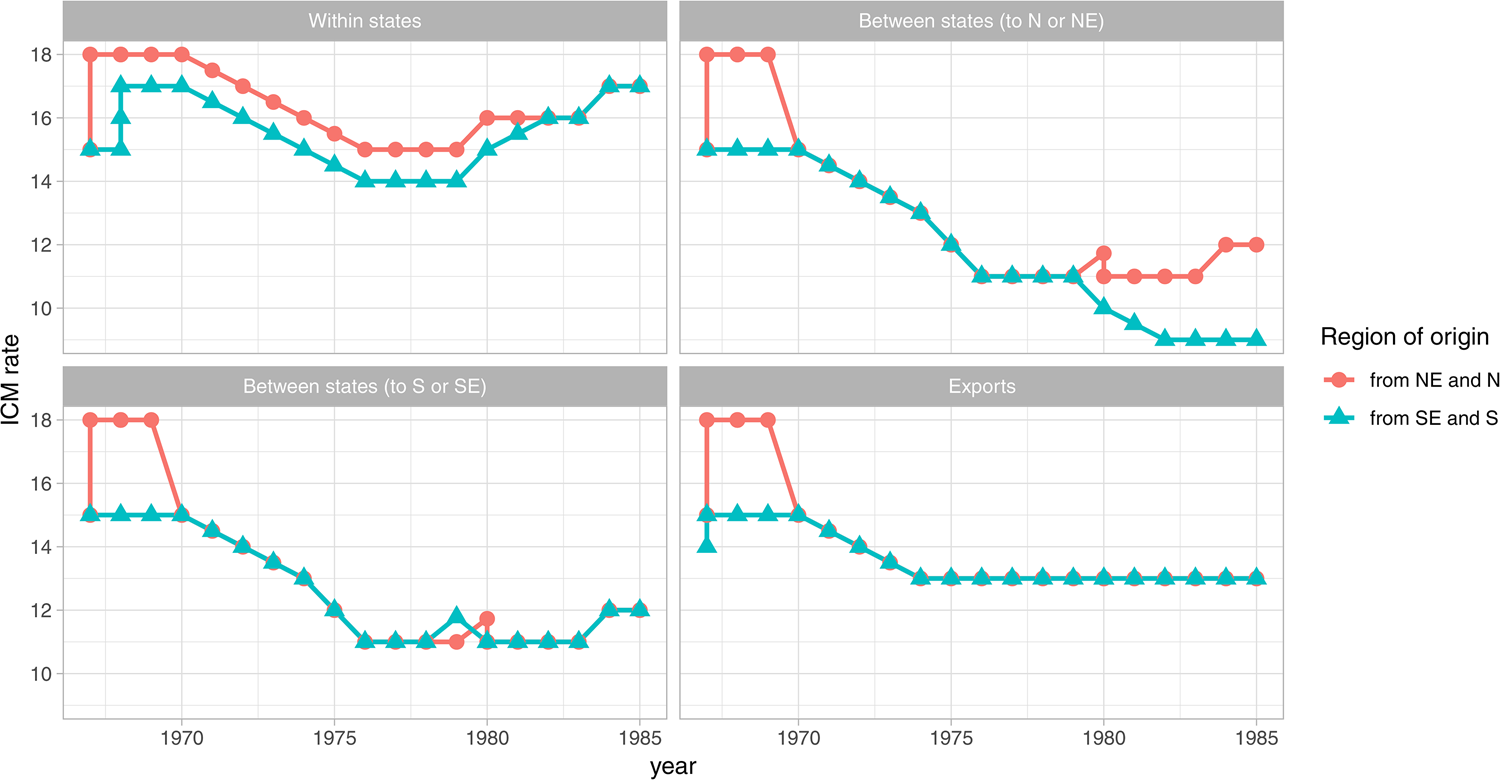
ICM had a uniform rate in the beginning as Figure 2 shows (Baratto, Reference Baratto2005). Neither the origin nor the destination of goods mattered in the very beginning; all cases were due 15.0 per cent in early 1967. However, the situation changed before the end of the year (which explains why all charts show vertical lines in 1967, since there were two rates during the same year). ICM rates increased to 18.0 per cent only on goods from states in North, Northeast and Central-West regions (no matter the destination), while ICM rates for within-state operations increased to 17.0 per cent in the case of southern and southeastern states in 1968. Though biased in favour of poorer states, this initial increase in ICM rates (along with the economic boom) led to a general rise in state-level tax revenues (Rezende, Reference Rezende2012).

However, circumstances changed once again when ICM rates began to decrease in 1970. The 1967 Constitution assigned the central government the responsibility to determine taxation levels even in the case of taxes under the competence of subnational governments (Cossio, Reference Cossio1998). Considering within-state operations, the richer regions experienced a decrease in ICM rates from 17.0 per cent in 1970 to 14.0 per cent in 1978, whereas in poorer states ICM rates also diminished from 18.0 per cent in 1970 to 15.0 per cent in 1977. The policy achieved its zenith between 1976 and 1979, when ICM rates reached their lowest levels in all categories. It is hard to measure a quantitative relation, but one can hardly avoid the conclusion that the decline in ICM rates explains, to a large extent, the decreasing share of state governments in the total amount of tax revenues.
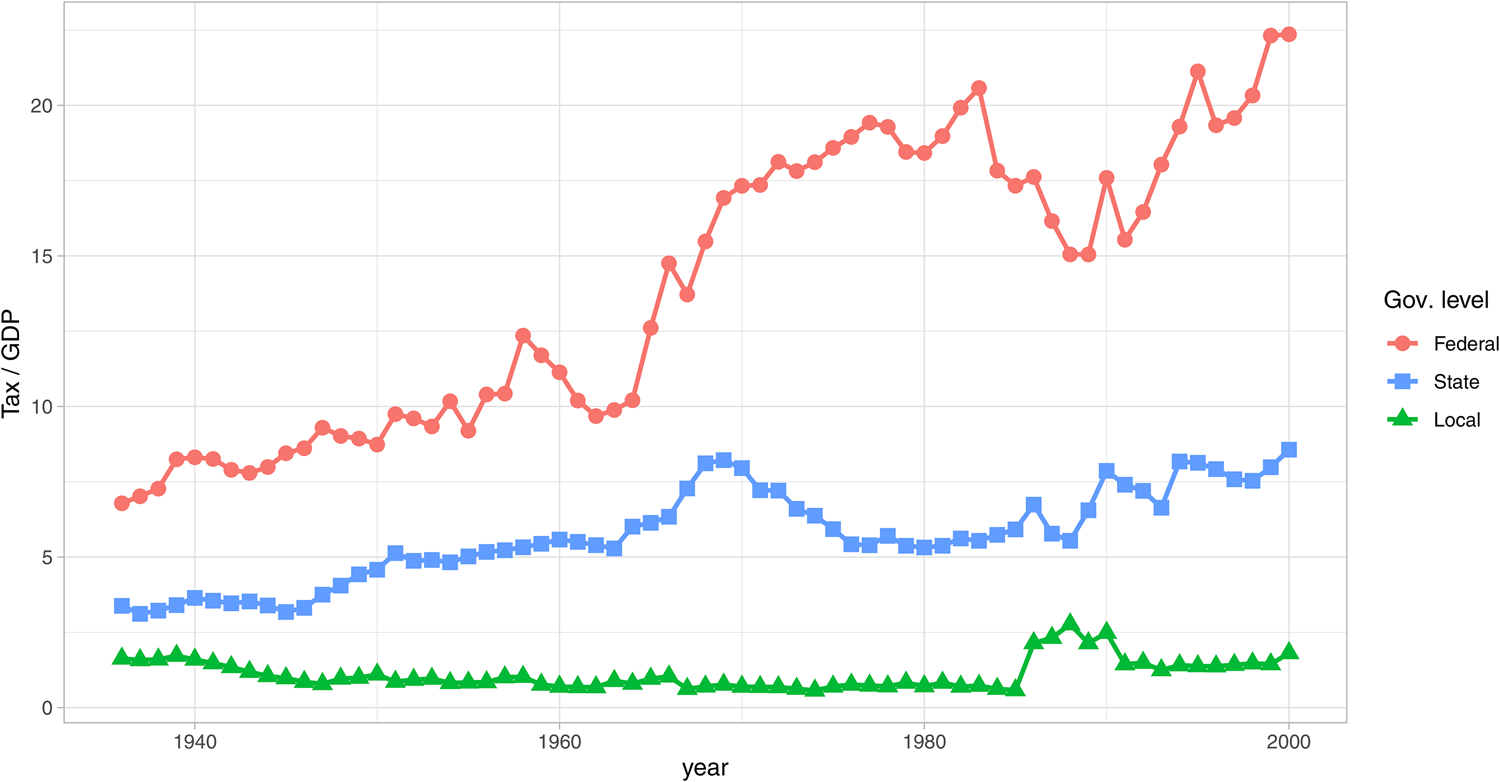
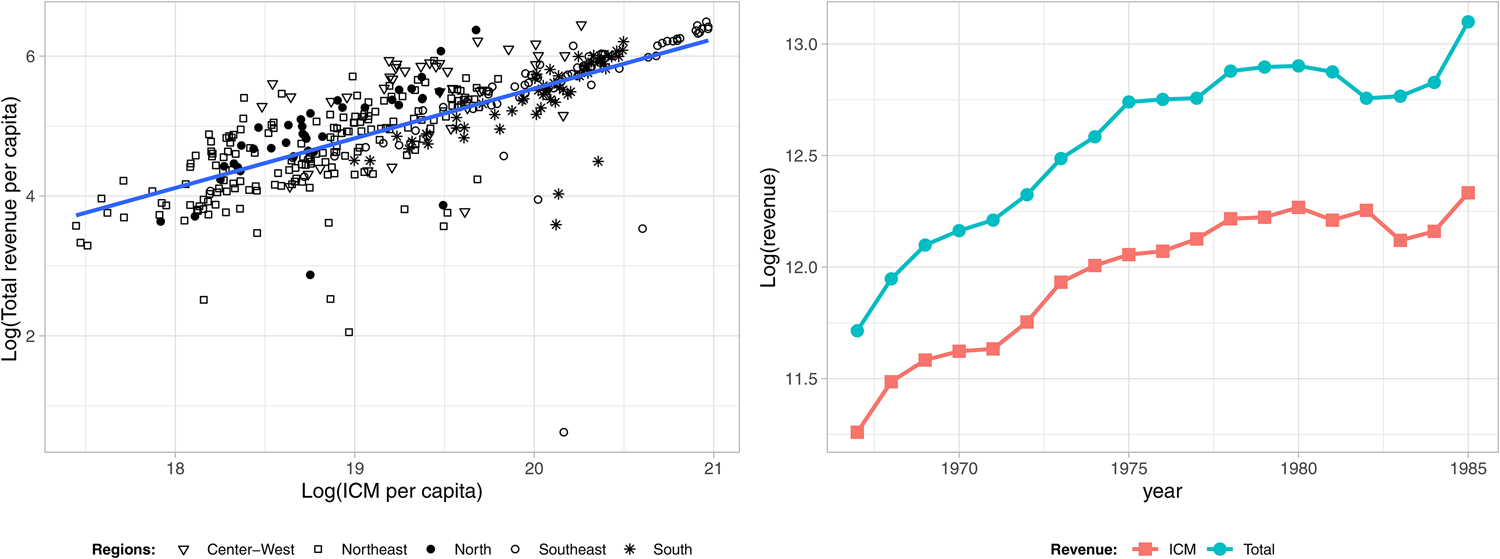
Figure 3 illustrates the relative financial rise and later relative loss of states; it depicts an upward movement of the share of states in total tax revenues until 1969, but this share declined continuously thereafter (see the period between the dashed lines). The lowest participation of state governments in total tax revenues considering all government levels took place in the aftermath of the global oil shock (the second half of the 1970s). Similarly, Rezende (Reference Rezende2012) showed that ICM revenues comprised about 6.5 per cent of GDP in 1972, but the series depicts a gradual decrease until a proportion of around 5.0 per cent was reached between 1976 and 1983, after which it started to rise again. Looking from another perspective, ICM was the most important revenue source of states during the period, even though its participation fell from 63 per cent of states' total revenues in 1967 to 46 per cent in 1985. Predictably, variation of ICM revenues and states' total revenues were highly correlated, as Figure 4 shows.
Tax revenues as a proportion of national GDP (%), all government levels, Brazil, 1936–2000.
Source: IPEA (2019).


Richer states lost comparatively more from the tax policy for at least three reasons. First, southeastern and southern states had lower within-state destination ICM rates from 1967 to 1981. Secondly, richer states depended more on tax revenues and less on federal transfers. Most of those transfers occurred through the States Participation Fund (FPE),Footnote 10 created to compensate the increasing centralisation of tax revenues in the central government.Footnote 11 The major redistribution condition of the FPE was income related; poorer states received larger shares of the fund. Third, ICM rates to exports were either lower or null—in the latter case because all exports of manufactured goods were exempted from ICM after 1967. Later, the government created more incentives for exporters, which will be discussed in Section 5. ICM-based export incentives were a main source of contention, since richer states were the major exporters.
In addition, we must consider demographic dynamics since we are dealing with per capita variables. In the 1970s, a large number of people migrated from northeastern states to the industrial Southeast region. Population increased around 23 per cent in the Northeast region from 1970 to 1980, but in the richer Southeast demographic growth achieved 30 per cent during the same period. To a large extent, the faster population growth in southeastern states was a result of migration flows rather than fertility issues. This created a further pressure on public services in richer areas.
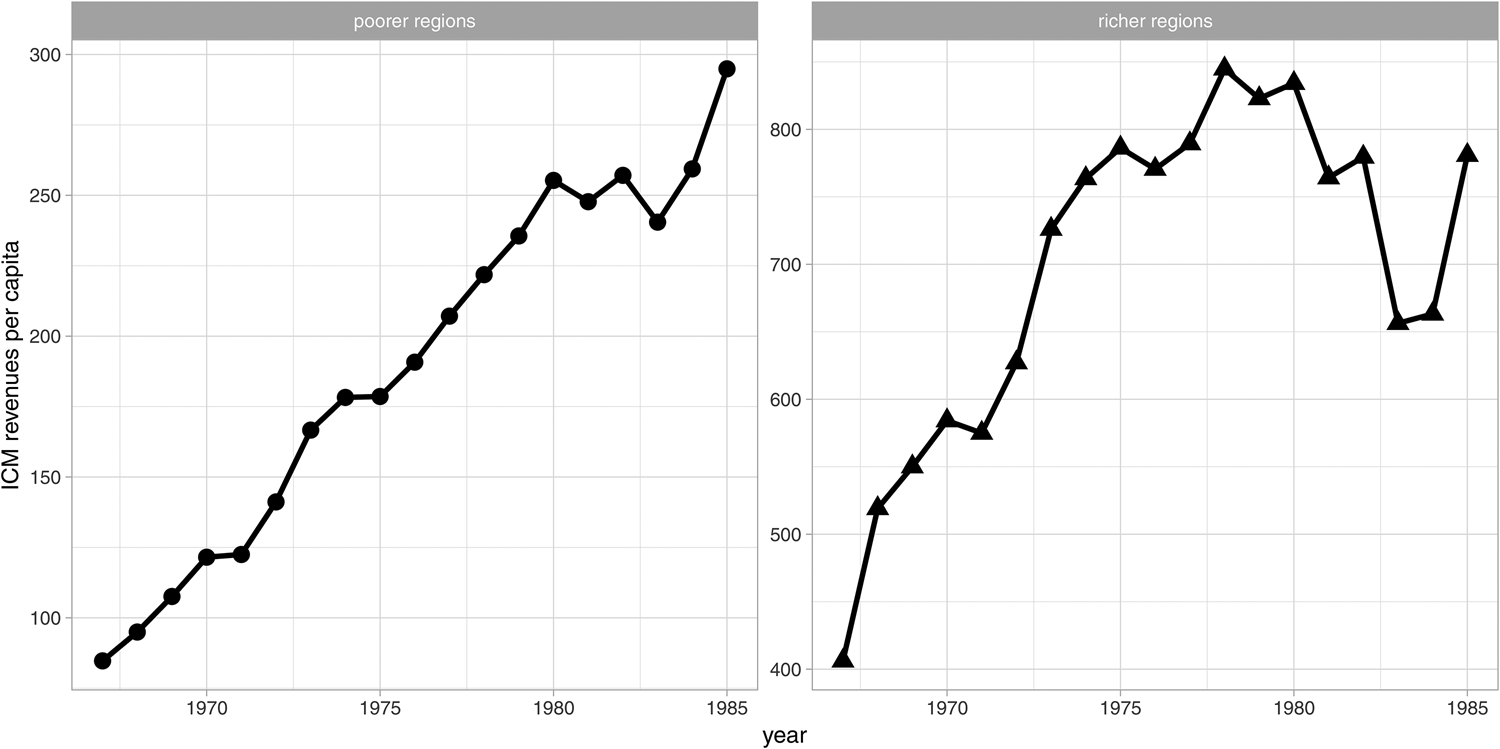
It is not a coincidence that ICM revenues per capita in southern and southeastern states stagnated in the mid-1970s, while revenues increased more steadily in poorer regions as Figure 5 shows. Even though the 1967 Constitution did not earmark state-level tax revenues to education, education expenditures per child seem to have almost followed the per capita amount of ICM raised by state governments—or, put differently, the financial demise of states decreased education spending, as we show in the next subsection.

3.2 State-level education expenditures
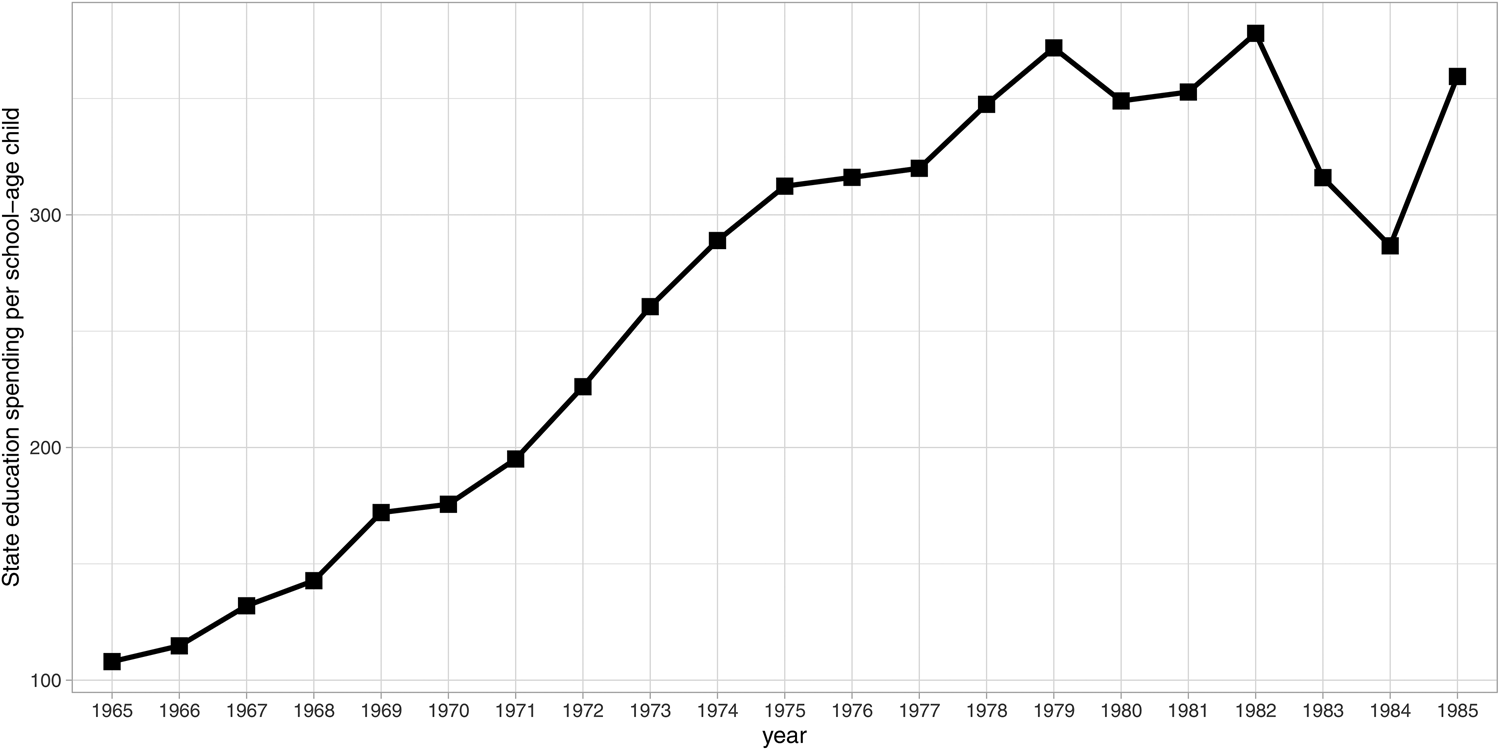
The annual average increase in state-level education spending per school-age child was approximately 6.2 per cent in real terms between 1965 and 1985.Footnote 12 However, there was a sharp difference between the first and the second decade under military rule. During the earlier period, education expenditures per child increased by 11.2 per cent on average per year, whereas the same indicator presented an annual average increase of 1.4 per cent from 1975 to 1985. The lower figures in the second period cannot be entirely attributed to the debt crisis in the early 1980s, since the annual growth of education expenses per child was also low (2.2 per cent) between 1975 and 1980 (see Figure 6).
State level expenditure on education per school child, reais (deflated by IGP-DI), Brazil, 1965–1985.
Source: IPEA (2019).

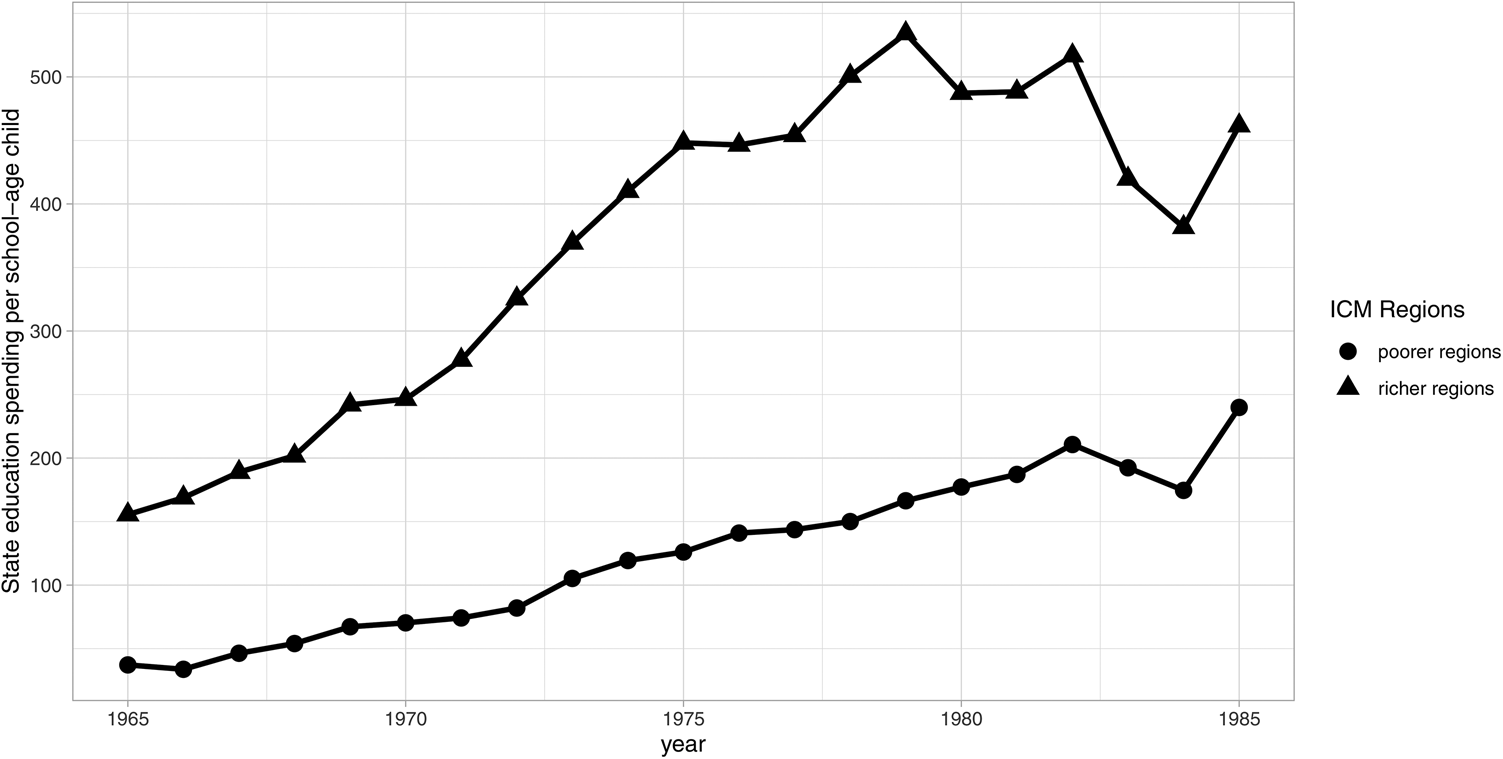
Figure 7 shows that state-level education expenses per child increased steadily in the richer regions until the mid-1970s, when the indicator started to present an erratic behaviour. We divided the states in two groups in terms of income: richer regions (South and Southeast regions) and poorer regions (North, Northeast and Central-West regions), since ICM rates diverged between these two groups (as we will explain in the next subsection). In several states there was a stagnation or fall of education spending per school-age child in real terms. In the industrial state of São Paulo (SP), there was a slight drop from 1975 to 1977. After a brief recovery in 1978 and 1979, real education spending per child fell continuously in that state until the end of the military regime. In the southern states, the graph shows almost a flat line from 1975 to 1980. Thereafter, the erratic behaviour in the early 1980s gave rise to a recovery in 1985. On the other hand, education spending kept increasing in Northeast and North regions (poor group). In some cases, expenditures per child on education grew even faster after 1975—this was the case in the northeastern states of Rio Grande do Norte (RN) and Ceará (CE), to name two examples.
State level education spending per school-age child, ICM Regions, Brazil, 1965–1985.
Source: IPEA (2019).
Note: ICM, the Imposto de Circulação de Mercadorias, was the most important income source of states. States in Southeast and South regions charged lower rates.

The erratic behaviour of the real spending series of richer states could be the result of within-year fluctuations of the price index, since inflation rates accelerated during the period. Unfortunately, we could not find monthly data on expenditures (and, therefore, we used annual nominal spending data and annual price indices to deflate the nominal figures). However, if within-year inflation were the issue, poorer states' real spending data should also report an erratic behaviour in the mid-1970s—which is only found in the richer states' series. In fact, a more erratic path in the poorer states series shows up only from 1983 onwards (when the annual inflation rate jumped from 99 per cent in 1982 to 210 per cent in 1983).
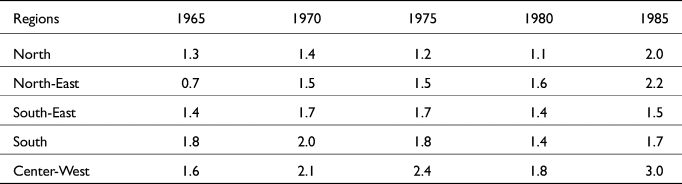
Table 1 provides data on state-level education spending as a proportion of GDP by regions from 1965 to 1985 in five-year intervals. While figures increased continuously in north-eastern states, the education spending as a share of GDP decreased abruptly in South and Southeast regions in the second half of the 1970s. Despite significant industrial growth in that particular period, education spending at the state level decreased from 1.7 per cent to 1.4 per cent of GDP in the Southeast region and from 1.8 per cent to 1.4 per cent in the South region. This happened in response to the fall in tax revenues in these areas, as we will show in the next sections.
State-level education spending as a proportion of GDP (%), Brazilian Regions, 1965–1985

Source: IPEA (2019).
4. Proximate explanations: tax revenues and education spending in regressions
To provide more quantitative evidence on the role of tax revenues on the stagnation of education spending and education outcomes, we present a section of panel data regression analysis. The links between tax revenues at the state level and national industrialisation policies are included in Section 5.
4.1 Data and methodology
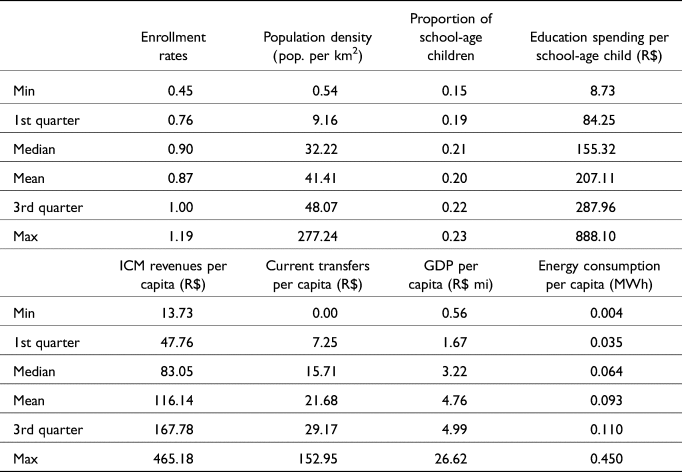
Our state-level data comes from several official sources. One important contribution of this paper is to assemble in a systematic and coherent way information from different sources, such as from Goldenberg (Reference Goldenberg1990) for data on gross enrollments from 1955 to 1987, or from MEC archives.Footnote 13 Table 2 provides descriptive statistics of the variables.
Descriptive statistics, Brazilian states, 1967–1985

Estimates of annual population (total and school-age) comes from interpolations of data from national demographic censuses.Footnote 14 Other demographic variables such as population density and the proportion of school children also come from interpolation of census data.
Public finance data from 1965 onwards are mostly available at the Ipeadata website, including state-level education expenditure and current transfers.Footnote 15 ICM data per state were obtained from official sources (Ministry of Finance and state-level finance departments).Footnote 16 Since state-level GDP figures are not available in several years from 1971 to 1984, we collected energy consumption by state as an alternative control. Table 1 shows descriptive statistics of the variables used in the regressions.Footnote 17
Through the century, some states in northern areas of the country were partitioned. In 1920 the country had only 20 federal states, while currently there are 26 states in Brazil. Most of the newly created states have smaller populations when compared to other states. For example, Acre, Amapá and Roraima had fewer than 800,000 inhabitants each in 2010, despite domestic migration to these new states during the period of military rule. We decided to keep these new states as part of their original states in 1920 for comparative purposes.Footnote 18 Despite causing us to lose some observations, adding those states would not only have distorted our estimates (because of their population size), but also generated inconsistent demographic estimations over time.
Our hypothesis is that the variation of ICM revenues, which results from ICM-based policy decisions by the central government, had straightforward effects on education expenditures. In order to verify this, we ran standard panel data OLS regressions by Brazilian states using fixed effects during the period 1967–1985. The model is the following:

where y it is the log of education spending per child of school age (7–14) in state i and year t, s it is the log of ICM tax revenues per capita and X it are controls for current transfers per capita, population density, population share of school-age children, and GDP per capita (or a proxy). Most specifications include current transfers, which constituted a relatively important source of income in some states, in order to rule out that other items of total state revenues could be interfering in the results. Besides state-fixed effects (δ i), we included year dummies (θ t) in order to capture time-varying trends.
In the second place, we also used education outcomes as dependent variables using a similar model. In this case, y it is gross enrollment ratios, while s it is the log of education spending. Therefore, after establishing an association between ICM revenues and education spending, we show that the latter is associated with enrollment rates.
4.2 Results on education spending
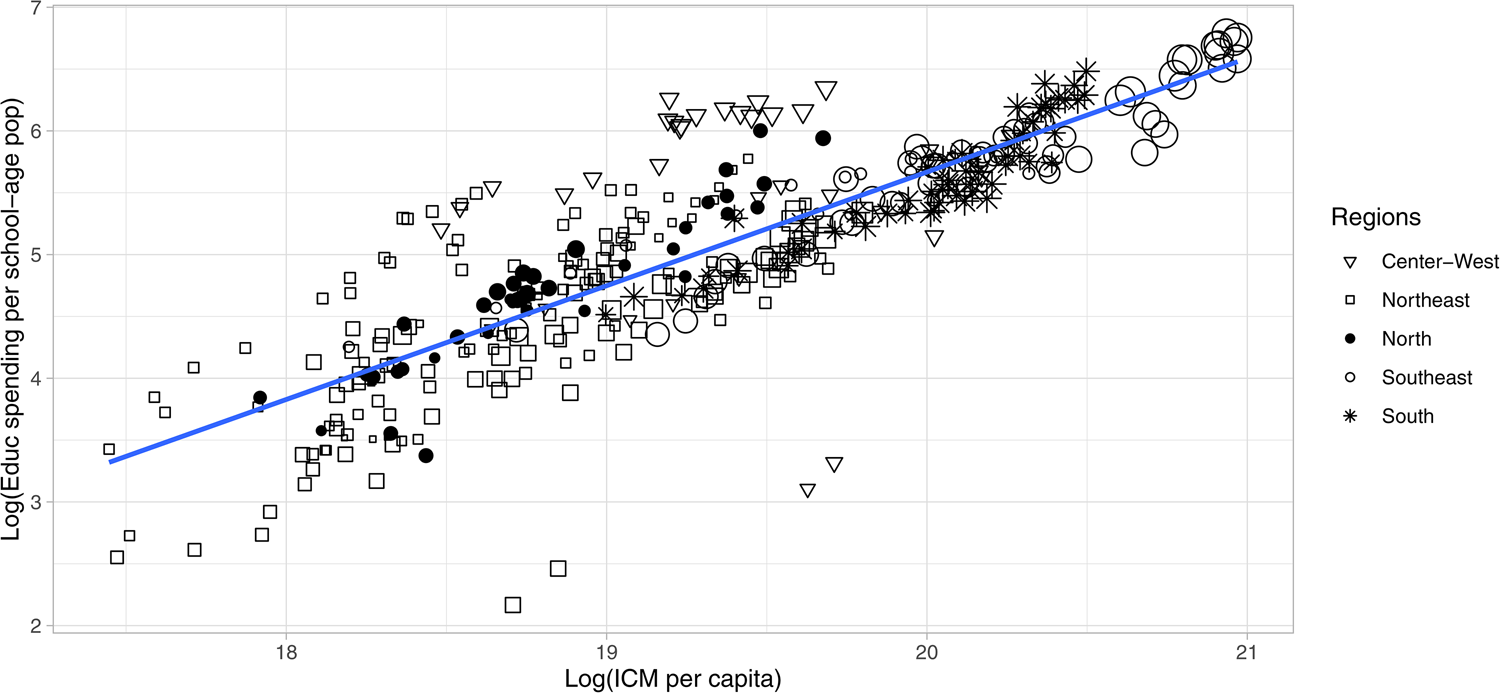
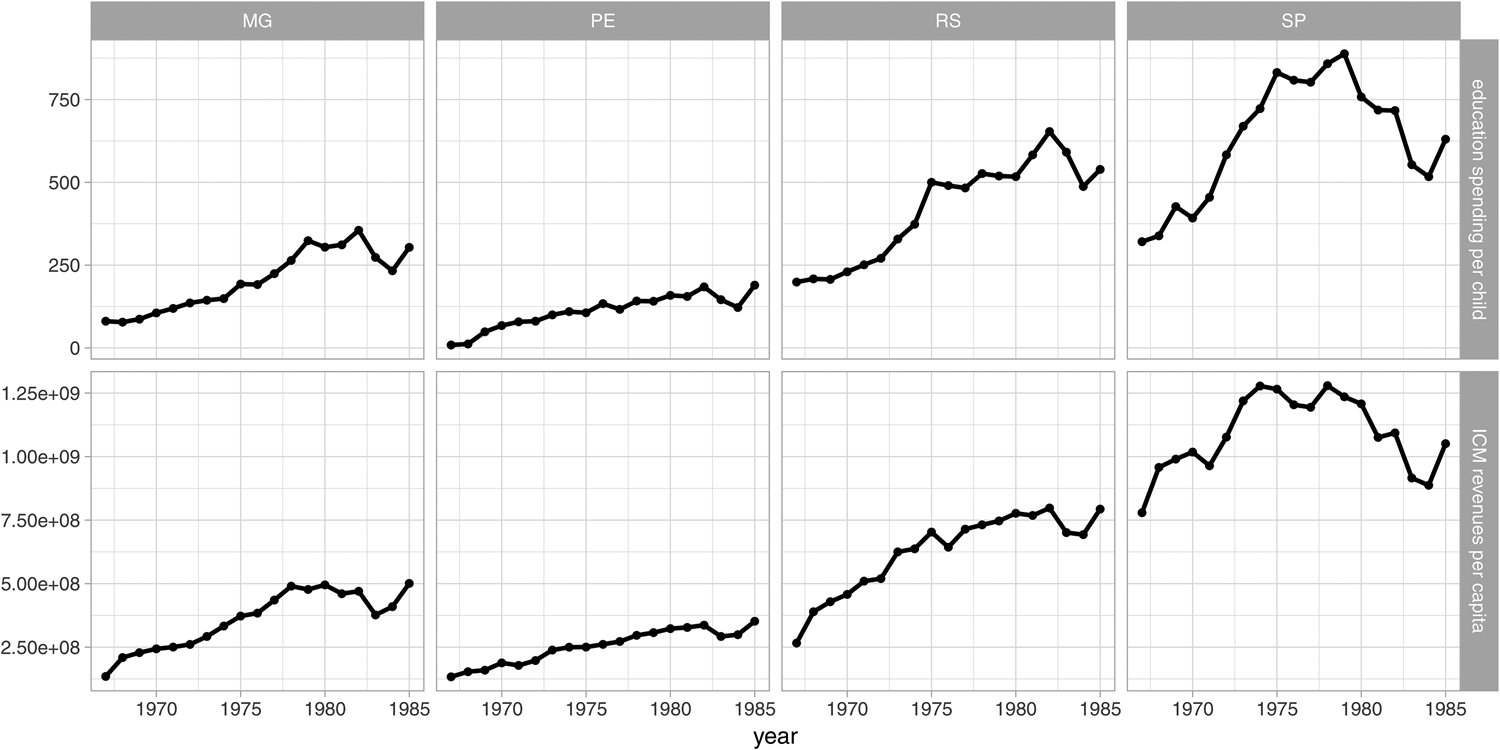
A first look at the relationship between ICM and education spending already suggests a strong association, as Figure 8 depicts. Plotting the data from four heavily populated states (Minas Gerais, Pernambuco, Rio Grande do Sul and São Paulo), there seems to be a very close relationship between ICM and education spending (Figure 9). Our regressions show that in most specifications ICM tax revenues per capita are associated with education spending per child even after controlling for several other variables. This is not an obvious finding since state taxes were not earmarked to education according to the 1967 Constitution, and the 1969 Amendment no. 1 earmarked tax resources for municipalities, but not for states.
ICM revenue per capita vs. state-level education spending per school-age child, Brazilian states, 1967–1985.
Source: Research data (2019).

State-level education spending per school-age child and ICM revenue per capita, states of Minas Gerais, Pernambuco, Rio Grande do Sul and São Paulo, 1967–1985.
Source: Research data (2019).

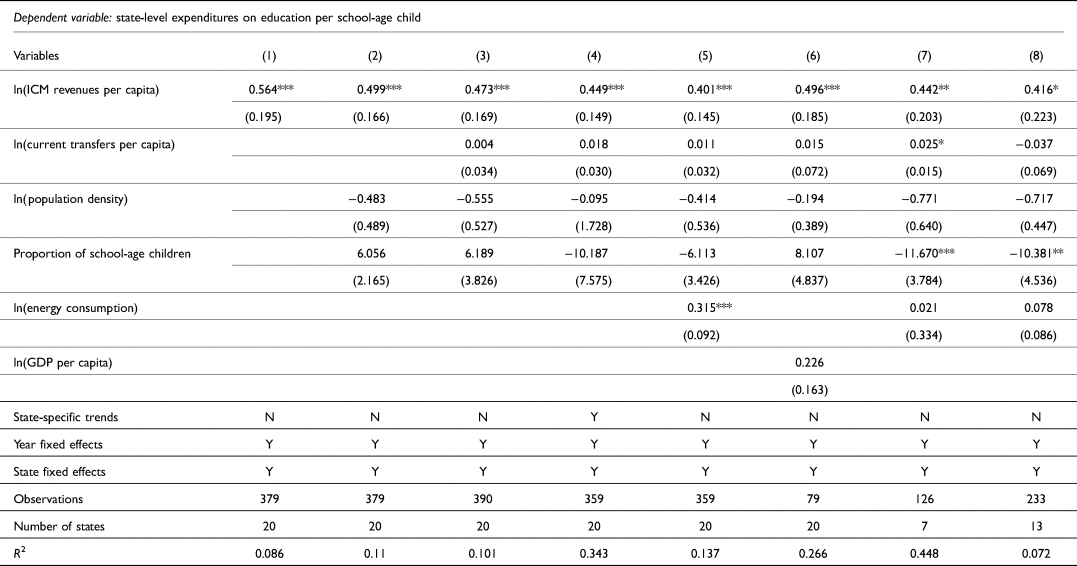
Table 3 shows that ICM revenues per capita are significant at 1 per cent level in all specifications. Even when we included state-specific time trends (specification 4) or GDP per capita (specification 6), ICM revenues per capita are significant at 1 per cent level. In short, ICM revenues per capita seems to be strongly associated with education expenditures per child. Results do not change qualitatively when we apply other panel data methodologies such as pooling OLS, random effects or first differences. We decided to report estimations using fixed effects because it is the most appropriate methodology when dealing with a panel of states, but the results are robust to several estimation methods.
OLS regressions with expenditures on education per school-age child at the state level, 1967–1985

* Significant at 10% level.
** Significant at 5% level.
*** Significant at 1% level.
Notes: Heteroscedasticity-robust standard errors between parentheses. The population estimates of our dataset considered states as in 1940. Distrito Federal was excluded from the sample because of its distinctive character. Acre, Roraima and Rondônia are considered part of Amazonas, Amapá as part of the state of Pará, Mato Grosso do Sul as part of Mato Grosso, Tocantins as part of Goiás.
Since there were two groups of states with different ICM rates, we ran specification (5) using both groups separately as a robustness check. In the first group we kept only states from Southeast and South regions, while in the second group only states from Center-West, North and Northeast regions were kept. As the number of states decreases, p-values become larger, but ICM revenues per capita are still significant at 5 per cent level (specification 7) in the first group regression and at 10 per cent level in the regression with poorer states (specification 8). All regressions present similar coefficients for ICM revenues: a 1 p.p. increase in ICM revenues per capita is expected to increase education expenditures per child between 0.40 p.p. and 0.56 p.p. We also dropped one state at a time to check whether a specific state was not driving the results, but our findings are robust to these changes.
We also ran regressions using random effects, which allowed us to control for variables related to colonial origins such as dummies for colonial crops (following the classification found in Naritomi et al., Reference Naritomi, Soares and Assunção2012) or the proportion of slaves by state according to the 1872 Census.Footnote 19 Since using fixed effects is a better strategy when one uses states as analytical units, these results were not reported in Table 3, but they all show that ICM is a statistically significant variable at 1 per cent with even higher coefficients (>0.6) than in the fixed effects specifications.
These results are then consistent with the hypothesis raised first by de Melchior (Reference de Melchior1987), namely, that ICM policies that impoverished states had negative consequences on education spending. These results are also similar to those found by Musacchio et al. (Reference Musacchio, Martínez-Fritscher and Viarengo2014), that reported an association between state tax revenues with education spending during the 1889–1930 period.
Some possible sources of bias must be addressed. The central government undertook a large-scale reform on Brazilian schooling in 1971 (Law 5,692). It created the new primary education (ensino de primeiro grau), a merger between the old primary education and the lower secondary education. The reform extended compulsory education from four to eight years of schooling. Thus, besides an increasing population and the demise of ICM revenues per capita, states suffered an extra financial pressure because of the 1971 reform.
The central government introduced a tax rate to fund primary education based on 1.4 per cent of the payroll of all firms in 1964. Half of the revenues of this tax remained in the state where the revenue was collected, while the other half went to a national fund (Fundo Nacional de Desenvolvimento da Educação—FNDE). As a consequence of the extension of compulsory education in the early 1970s and the demising fiscal capacity of states, this payroll tax was raised to 2.5 per cent of the payroll in late 1975 (starting in March 1976). Moreover, the share of states rose to two-thirds of the revenue and only one-third was left to the FNDE. No matter if the destination were state revenues or the FNDE, all resources should be spent on primary education.
The federal quota of the payroll tax was among the transfers of the central government to subnational entities, which are included in the regressions as “current transfers.” However, we did not find information on state quotas by states. According to aggregate information we obtained, payroll tax revenues represented about 10 per cent of state-level education spending. Figures increased to approximately 15 per cent after the government increased the tax rate. In addition, since the state quota increased from 1975 onwards, the redistribution effect of the payroll tax among states decreased. Given the upward bias of the state quota of this tax in southern and southeastern states, we would expect a rise in education spending in these states. However, education spending per child stagnated in South and Southeast regions. Therefore, the new tax rate probably did not change the general picture or just prevented enrollment rates from decreasing in those states.
Another financial relief for state governments was the increase of FPE and FPM shares. Initially, FPE and FPM received 10 per cent each from federal indirect tax and income tax revenues.Footnote 20 From 1969 to 1975, the quota was reduced to 5 per cent for each fund. The quota was increased year by year from 1976 (6 per cent) to 1980 (10 per cent). Since the largest beneficiaries of FPE and FPM were poorer states, the quota increase was more helpful for those states. This was particularly true regarding education spending in those states, since 20 per cent of FPE resources should be spent on primary and secondary education. However, this increase had little importance for richer southern and southeastern states. Overall, coefficients and statistical significance show that current transfers (among them the Fundos de Participação) had indeed little influence on education spending.
4.3 Results on education outcomes
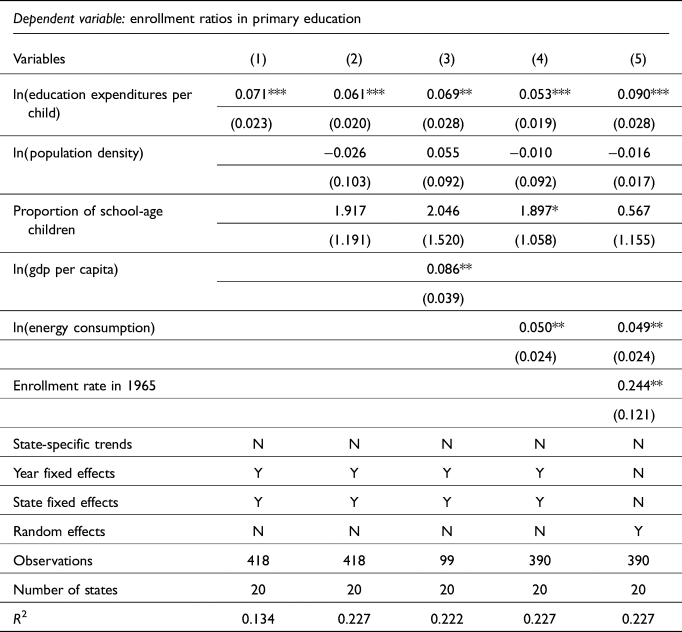
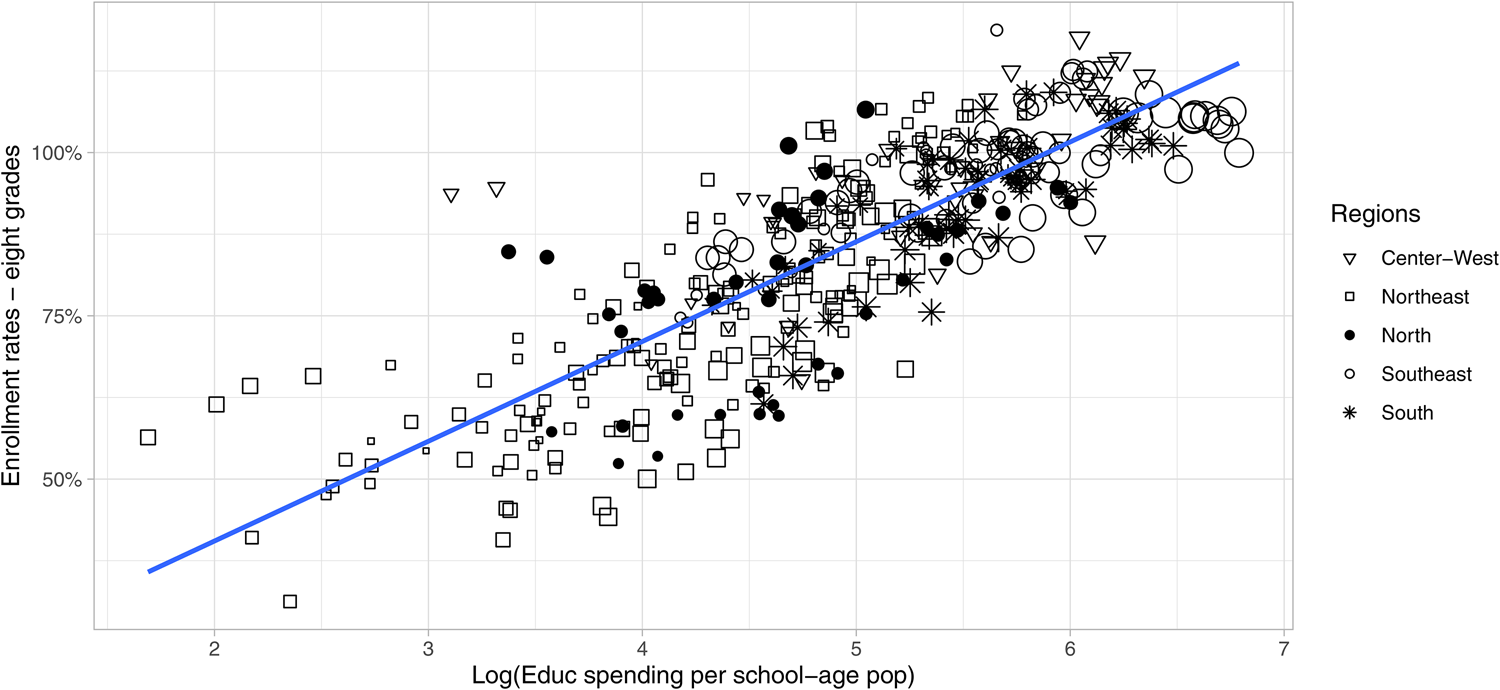
Whereas initial evidence presented above suggests links between the evolution of value-added taxes and education spending, it is important to examine whether the corresponding spending had relevant impacts on education outcomes. As a first approximation we can consider gross enrollment rates as our main education outcomes.Footnote 21 Evidence from fixed effect OLS regressions, reported in Table 4, suggests that education spending and gross enrollment rates were strongly related (see Figure 10).
OLS regressions with education outcomes (enrollment ratios in primary education) at the state level, 1965–1985

* Significant at 10% level.
** Significant at 5% level.
*** Significant at 1% level.
Notes: States as of 1920 because of the population estimates of our data. Distrito Federal was excluded from the sample because of its distinctive character. Acre, Roraima and Rondônia are considered part of Amazonas, Amapá as part of the state of Pará, Mato Grosso do Sul as part of Mato Grosso, Tocantins as part of Goiás.
State-level education spending per school-age child vs. gross enrolment rates (primary, eight grades), Brazilian states, 1965–1985.
Source: Research data (2019).

Specification 4, which provides the lowest coefficient in fixed effects estimations, shows that a 1 percentage point (p.p.) increase in education spending would lead to an increase of around 5 p.p. in enrollment ratios. In random effects estimations, we added other control variables such as literacy rates in 1960 and enrollment rates in 1965. The literacy variable is not even statistically significant. In the case of initial enrollment (5), even though the coefficient is large, as expected, (0.24) and significant at 5 per cent, the coefficient for education spending is larger than in the fixed effects estimation (0.09) and statistically significant at 1 per cent.
However, it is challenging to devise an appropriate counterfactual scenario because several policies affected state ICM revenues during the period (see section 5). If education spending per school-age child had increased by an average of 1 p.p., at least 1.15 million more students would have been enrolled in primary schools in 1980, given that the school-age population comprised about 23 million children. In other words, the gross enrollment ratio would have risen from 98 per cent to 103 per cent. It is worth noting that a net enrollment ratio of 80 per cent was equivalent to the 98 per cent gross enrollment ratio in 1980.
One could argue that education spending does not explain education outcomes in several settings.Footnote 22 However, there are good reasons to think that education spending mattered to the variation of enrollments during the military regime in Brazil.Footnote 23 In the Brazilian case, there was reportedly a shortage of teachers; salaries were often considered low and even interruption of payments was common for several reasons (De Mattos, Reference de mattos1988). There was also underutilised capacity in Brazilian schools because of the lack of teachers; Jornal do Brasil, an important newspaper in Rio de Janeiro, already reported the lack of teachers in 1973 and 1974.Footnote 24 In 1976, prospective teachers with grades slightly above zero in the public exam for teaching positions were called to take office.Footnote 25 According to another news item from the same outlet, about 50 teachers used to leave the profession every month in the state of Rio de Janeiro—probably because of low salaries.Footnote 26
There was also a pattern of spatial distribution of schools in favour of richer areas in some important cities. In the metropolitan area of Belo Horizonte (the capital city of Minas Gerais), a study found that while richer neighbourhoods presented excess supply, there were not enough places for students living in poorer and densely inhabited areas (Veiga, Reference Veiga1975). In Rio de Janeiro, secretary of education Teresinha Saraiva also acknowledged that poorer areas lacked schools.Footnote 27 Another study found that public schools located in richer neighbourhoods in Rio de Janeiro received more resources than their counterparts in poorer areas of the city (de Castro et al., Reference de Castro, Alves, Frigotto and Córdo1979). Pre-tertiary education was clearly underprovided in the neediest areas.
Our results show that enrollment rates in southeastern and southern states stopped growing because of the stagnation of ICM revenues per capita, which led to lower education spending per child. On the other hand, enrollment outcomes in poorer states kept improving after 1975. However, transfers were based on federal government taxes rather than on the ICM. As we argue in the next section, had not the federal government imposed a large cost of the national trade policy upon states, enrollment rates in richer states would have been higher without harming the expansion of mass education in poorer areas.
5. Fundamental explanations: export incentives, industrial policy and education finance
According to the results presented in the previous section, ICM revenues per capita were associated with state-level education spending per child, which in turn affected enrollment rates. Although ICM revenues in absolute terms kept growing until the end of the decade, the stagnation of ICM revenues per capita started years before the debt crisis in the early 1980s. Why, then, did the growth of ICM per capita stall in the mid-1970s? Here we argue that a national industrial policy combined with export incentives halted the growth of ICM revenues per capita, even though the economy was still growing. Unfortunately, state-level export data are only available from 1974 onwards, which prevented us from using this information in our regressions. However, we argue that export incentives and the big push programme are the only plausible explanations for the demise of ICM revenues. The complaints of state authorities about financial issues, particularly from Southeast and South regions, show that the debt-led growth strategy ended up harming the expansion of mass schooling.
5.1 Export incentives and macroeconomic adjustment
Decreases in ICM rates and export incentives were the main reasons behind the demise of state revenues, particularly in richer regions. The policy of export incentives was set up just before the so-called Brazilian “economic miracle” (1968–1973). According to Veloso et al. (Reference Veloso, Villela and Giambiagi2008), lagged effects of reforms undertaken from 1964 to 1967 explain the high rates of economic growth during the period to a large extent. Moreover, commodity prices and expansionary policies also contributed to the “miracle.” Partly because of the economic expansion, tax revenues increased in all government levels, but the central government tax revenues increased relatively more during the period. As we already highlighted earlier, two reasons explain the increasing control of the federal government over tax resources: the tax reform and the ICM policy.
The 1967 Constitution allowed federal intervention in state finance issues to make states' policies compatible with the national economic policy (Lago, Reference Lago and Abreu1989). Stressing the need for increasing exports given the high level of external debt, the federal government launched several incentives to stimulate exports (Presidência da República, 1970). Exports were already exempted from the federal indirect tax on manufactured goods (IPI) since 1964, but the exemption was extended to the ICM in 1967. Other benefits were created from 1970 onwards, such as state indirect tax credits—which also affected state finances. Other incentives included exemption of income taxes on profits from export activities, duty drawbacks, federal indirect tax credits, among others (Balassa, Reference Balassa1979; Pinheiro et al., Reference Pinheiro, Borges, Zagury and Mesquita1993).
During the “economic miracle,” ICM tax revenues per capita kept increasing despite ICM-based incentives. The situation began to change after the 1973 oil shock, which strongly affected the Brazilian economy. The quadruplication of oil prices and the world recession led to a fall of 16.7 per cent of the Brazilian terms of trade between 1973 and 1974 (Abreu, Reference Abreu1989). In 1974, General Ernesto Geisel took office as president, which represented the restoration of the moderate stream's rule among the military—a group that was in favour of a gradual political opening in the years to come (Skidmore, Reference Skidmore1988).Footnote 28 Tackling the oil shock, however, was a more urgent problem. Initially, the government reacted with some austerity measures in 1974, but inflation did not halt and industrial activity decreased. The electoral defeat of the government party in the legislative elections became an additional problem (Fishlow, Reference Fishlow1986).
The long-run political project of the new leadership (a gradual political opening) could not survive a standard adjustment to the shock.Footnote 29 According to Velloso, adopting a traditional adjustment was “inconvenient” since recession and unemployment would not help a country undertaking a “necessary political distension” (Velloso, Reference Velloso1978, p. 115). Instead of depreciating the domestic currency or raising general taxes, the government launched the II National Development Plan (II PND). It consisted of a massive investments plan in order to complete the industrialisation process through the stimulation of the production of basic inputs (e.g. energy), intermediate and capital goods. In terms of avoiding an immediate recession, the plan was successful; the average rate of economic growth was around 6.8 per cent between 1974 and 1979 (Abreu, Reference Abreu1989). According to Velloso, the government had deliberately averted recession “through an increase in exports and in self-sufficiency in basic inputs” (Carneiro, Reference Carneiro and de Abreu1989, p. 253).Footnote 30
The big push programme stimulated manufacturing production, which presented an average annual growth rate of 6.5 per cent between 1974 and 1979 (Abreu, Reference Abreu1989). Information from two national demographic censuses (1970 and 1980) shows that industrial production represented 27.6 per cent and 23.3 per cent of the total value added in the Southeast and South regions, respectively, in 1970. A decade later, these figures had jumped to 40.5 per cent and 41.1 per cent—clearly there was an exceptional industrial growth during the period.
The adoption of a strategy of massive investments in a period of international crisis created intense pressure on external accounts in a country already highly indebted. The Geisel administration responded not only by restricting imports and raising tariffs in some sectors, but also by deepening export incentive policies. ICM rates for exports reached their lowest point in 1975 (13 per cent), while ICM exemptions and credits for exporters of manufactured goods were maintained. According to several estimates, fiscal subsidies and incentives increased in the mid-1970s (Cardoso, Reference Cardoso1980; Musalem, Reference Musalem1981; Baumann and Moreira, Reference Baumann and Moreira1987).
Several scholars raised criticisms against those policies at the time, but mostly underscored efficiency issues and argued that fiscal and credit subsidies on exports largely benefited high-cost industries. According to Balassa (Reference Balassa1979), the distribution of subsidies and tax reductions was discretionary to a significant extent. Moreover, the plethora of controls and incentives stimulated the private sector to divert “the effort of firms from productive activities” (Balassa, Reference Balassa1979, p. 1,038). Fishlow (Reference Fishlow1986) also critically observed that fiscal incentives included “generous benefits for exporters of manufactured goods” (p. 523).
Balassa (Reference Balassa1979) and Fishlow (Reference Fishlow1986) also criticised the option of keeping an appreciated exchange rate and general taxation levels. An explanation linking the macroeconomic adjustment to education spending is the following: assuming that the real exchange rate is the ratio between the price of tradables and the price of non-tradables, a large nominal depreciation should have taken place after the external shock to adjust external accounts. However, the nominal depreciation was not sufficient and taxation did not increase. As a result, the government attempted to make an adjustment through the non-tradeable sector of the government. Since the central government shielded itself from income losses, public services provided by subnational entities—such as primary education—ended up paying for the external shock.Footnote 31
5.2. Centralisation and state finances
Fiscal federalism has a crucial role in the story told so far; subnational governments' finances were especially hit by the tax structure and incentives chosen by the military governments. In particular, the subordination of ICM rates to the national economic policy impoverished states and municipalities in highly populated and more industrialised regions.
Even politicians of the government party (ARENA) complained about the financial situation of subnational entities. According to Luís Viana Filho (ARENA/BA), “we are in a regime in which the federal government is rich, the states are poor and the municipalities very poor”.Footnote 32 Whereas state governments cannot be absolved for running recurrent fiscal deficits, there was a near consensus among public finance experts on the need for a tax reform entrusting more resources to subnational governments in the early 1980s. They recognised the positive innovations brought by the 1967 tax system, such as the introduction of value-added taxes and the economic rationality in terms of the competence of each government level. However, there was an excessive financial centralisation in the hands of the national government (Rezende, Reference Rezende1982; Varsano, Reference Varsano1982; Longo, Reference Longo1984).
The impoverishment of subnational governments had important consequences for basic education. As the statistical analysis showed, the stagnation or even fall in enrollment ratios and education spending was associated with lower tax revenues. Perhaps states could have chosen a different pattern of resource allocation in order to protect the expansion of schooling to the masses, but since this did not happen, the national trade policy had clear negative implications for primary education. Therefore, the costs of industrialisation policies were, to a substantial extent, postponed due to increasing external debt—starting in the “economic miracle,” but especially after 1974. However, part of the costs turned into lower enrollment rates; export incentives based on ICM harmed subnational government finances and hence primary education in several states.
States attempted to react in several ways in the mid-1970s. As described in the previous section, the share of the payroll tax increased from 1.4 per cent to 2.5 per cent, but this was far from enough for states. According to De Mattos (Reference de mattos1988), studies hired by the FNDE advised an increase of the payroll tax rate to 4.8 per cent to make schools reach the entire population aged between 7 and 14 years. The Secretariat of Planning (former Ministry of Planning) resisted and a compromise was agreed; the rate was settled at 2.5 per cent. Moreover, states demanded a larger share of federal taxes through the FPE (as described in the previous section). Despite the relative success of some initiatives of states towards less centralisation, the share of tax revenues in the hands of the national government remained relatively stable until 1983. Therefore, countervailing measures clearly sterilised decentralising initiatives (Varsano, Reference Varsano1997).
In January 1977, secretaries of finance complained to the central government about state financial autonomy because of the fall of ICM rates in previous years.Footnote 33 The cost of the policy was unevenly paid by the states that exported the most. A document prepared by the state finance officers from a number of richer states argued for an increase in the ICM rates in exchange for a decrease in IPI, a federal value-added tax. According to this document, fiscal incentives to exports should be borne by the central government rather than punishing subnational entities.Footnote 34 Unsurprisingly, six governors went to President Figueiredo to complain that their states were near bankruptcy in the following year.Footnote 35
In 1979, another report from southeastern and southern states estimated that the decrease in ICM rates led to a revenue fall close to 20 per cent during the 1976/1978 period. In addition, estimates by two of them (Rio Grande do Sul and Paraná) showed that the effects of tax benefits were even greater, reaching more than 50 per cent of ICM revenues (Rezende, Reference Rezende1982). The document clearly reflected the concerns of state authorities with substantial ICM losses, which “from 1970 onwards—due to the reduction in rates and the expansion of tax benefits—prevented state revenues from keeping up with the growth of domestic income” (Rezende, Reference Rezende1982, p. 70).Footnote 36
The National Monetary Council decided on the gradual abolition of several incentives including fiscal subsidies to exports starting in January 1979 (Balassa, Reference Balassa1979). However, this was not enough to recompose state revenues as the debt crisis strongly affected the country in the early 1980s. State revenues and enrollment rates only recovered by the end of the military regime, when a decentralisation process began to bestow more autonomy on states and municipalities. The growth of enrollment ratios also resumed around that time, a sign that education finance was the major issue rather than a lack of demand for schooling.
6. Concluding remarks
The historical literature on the political economy of education in Brazil often stresses the social basis of the political regime as the main cause of the priority given to tertiary education at the expense of mass schooling between 1964 and 1985. However, it does not seem to fully explain the variations in primary enrollment growth through the regime; spending and enrollment rates in primary education grew substantially during the first decade of the military regime and stalled afterwards.
The evidence examined here suggests that the major cause of the slow increase in primary school enrollments was a federal policy that weakened the fiscal capacity of subnational entities in industrialised regions. Despite the centralisation of tax revenues at the federal level and ICM-based incentives, ICM revenues per capita kept increasing during the “economic miracle” (1968–1973). In order to support industrial policies and exports, the central government intensified industrial policies after the 1973 global oil shock. The combination of slower economic growth and export incentives led to a decrease in state-level education expenditures per child and a stagnation in enrollment rates in several states after 1974.
Given the distribution of responsibilities and revenues in Brazilian fiscal federalism, the combination of export incentives with a big push industrialisation strategy became a burden to social policies.Footnote 37 Subnational governments did not receive enough compensations to fulfill their social policy mandates—including those regarding mass education. Southeast and South regions were especially affected and primary education was one of the major victims of the policy. The central government under military rule, in an ill-devised attempt to deal with the oil crisis, ignored the demands of these regions in terms of social policies and stagnated education spending.
It is tempting to compare the Brazilian experience with East Asian industrial policies around the same period. South Korea is a case in point, where a combination of similar export incentives and a successful expansion of mass education stimulated both growth and development (broadly conceived). In Brazil, however, members of the influential developmentalist school believed that education spending competed with industrialisation (Pires, Reference Pires2010). This paper attempted to show that the Brazilian industrial and trade policies siphoned off resources from primary education in the 1970s, as had already happened in the 1950s (Kang, Reference Kang2017). The institutional structure of Brazilian federalism was a crucial component of these results, as other studies emphasised for different time periods (Musacchio et al., Reference Musacchio, Martínez-Fritscher and Viarengo2014; Colistete, Reference Colistete2016; Kang, Reference Kang2017). More comparative studies on education, industrialisation, fiscal federalism and macroeconomic aspects (such as fiscal policies and national savings) are needed for a better understanding of divergent development paths.
Our study provided evidence that national economic policies in the 1970s harmed the expansion of mass education in Brazil. This impact was not a result of lower overall levels of resources at country level but of a reduction of resources emerging from decisions of the central government that impacted the funding of universal schooling. The target of universalising primary enrollments had to wait for two more decades to be achieved in Brazil, and the target of raising the quality of primary education remains elusive.
Acknowledgements
This paper is partially based on a chapter of Kang's doctoral thesis. Kang thanks the members of the thesis committee (Samuel Pessôa, Sergio Monteiro, and Bill Summerhill) for their comments. Menetrier is especially thankful to Samuel Pessôa and FGV IBRE for financial support. We also thank Marcos Wink, Pedro Zuanazzi, Raphael Gouvêa, Thales Z. Pereira, Bruno Witzel de Souza, Joana Genz Gaulke, Ricardo Ceneviva, Manoel Gehrke, Peter Lindert and Renato Colistete for discussions and comments. We also received useful comments at the following events: Brazilian EH Workshop (São Paulo, 2019), RIDGE EH Forum (Montevideo, 2019), UFPel (2020), “The rise of education” (online, 2021), NUPERGS/UFRGS (2021) and APSA EdPol Conference (online, 2022). Ben Ansell, David Samuels and three referees also made valuable comments in later stages. Gedalva Baratto and J. R. Afonso helped with data-related material. The usual disclaimer applies.
Appendix – Gross enrollment ratio by states, 1965–1985
Gross enrollment ratios in primary education (eight grades), level (%) and average annual growth (%), Brazil, 1965–1985

Education spending on primary education, all government levels, Brazil, selected years 1965–1983