Implications
The intestine of animals harbours a number of both undesirable and beneficial microbiota, the balance of which determines the digestive as well as systemic health of animals. Prebiotics could be useful for maintaining a beneficial microbiota in the intestine, and may confer a natural remedy for intestinal bacterial diseases. The responses of prebiotic feeding on digestibility, faecal microbiota composition and fatty acid concentration have not been studied by meta-analytic procedures in dogs and other animals including humans. Meta-analyses of data from different sources have been useful to explain the effects that otherwise could not be detected in single study. The results suggest that prebiotics may tend to decrease apparent crude protein digestibility; whereas, prebiotics at a dose of 1.40% dry matter intake could increase the beneficial lactobacilli and bifidobacterial populations and short-chain fatty acid concentrations in the faeces. The changes in beneficial bacterial numbers were affected by the interaction of initial bacterial numbers and dose of prebiotics; bacterial numbers increased more when initial bacterial numbers were low indicating the effectiveness of prebiotics in stress conditions.
Introduction
The large intestine contains a complex microbial ecosystem in which Clostridium, Bacteroides, Streptococcus, Bifidobacterium and Lactobacillus constitute the predominant bacterial genera. Bifidobacterium and Lactobacillus are two genera that have been recognized to confer health benefits in animals and humans (Gibson et al., Reference Gibson, McCartney and Rastall2005). A healthy or balanced microbiota helps prevent gastrointestinal disorders by protecting against incoming pathogenic microbes and modulating immune responses (Guarner, Reference Guarner2005; Ouwehand et al., Reference Ouwehand, Makelainen, Tiihonen and Rautonen2006; Suchodolski, 2010). A healthy or balanced flora in the gut is predominantly saccharolytic and comprises significant numbers of Bifidobacterium and Lactobacillus species (Gibson and Roberfroid, Reference Gibson and Roberfroid1995; Cummings et al., Reference Cummings, Antoine, Azpiroz, Bourdet-Sicard, Brandtzaeg, Calder, Gibson, Guarner, Isolauri, Pannemans, Shortt, Tuijtelaars and Watzl2004). The intestinal microbiota could be modulated by feeding probiotics and prebiotics. Unlike the situation with probiotics in which allochthonous micro-organisms are introduced to the gut, and need to compete against established colonic microbial communities, an advantage of using prebiotics to modify gut function is that the target bacteria are already commensal to the large intestine. Consequently, prebiotics are perhaps a more practical and efficient way to manipulate the gut microbiota than probiotics. However, if for any reason, such as disease, ageing, antibiotic or drug therapy, the appropriate health-promoting species are not present in the gut, the prebiotics are unlikely to be effective (Macfarlane et al., Reference Macfarlane, Steed and Macfarlane2008). Nonetheless, the appealing properties of prebiotics include the ability to reduce antibiotic use, the apparently high index of safety and the public's positive perception about ‘natural’ or ‘alternative’ therapies. Potential prebiotics are generally regarded as non-toxic as opposed to antibiotics, which have a number of recognized adverse effects. Prebiotic utilization has potential to become increasingly popular in therapeutic medicine in intestinal disease and disorders (Guarner, Reference Guarner2005). A number of studies have been conducted on the effects of prebiotics on intake, digestibility, intestinal microbial populations and immunity in dogs, but their effects are not consistent. For instance, apparent digestibilities of dry matter (DM) and crude protein (CP) were decreased by supplementation of oligofructose in the study by Propst et al. (Reference Propst, Flickinger, Bauer, Merchen and Fahey2003), but were not affected by fructooligosacharides (FOS) in the study by Flickinger et al. (Reference Flickinger, Schreijen, Patil, Hussein, Grieshop, Merchen and Fahey2003). Strickling et al. (Reference Strickling, Harmon, Dawson and Gross2000) reported that FOS did not affect the numbers of bifidobacteria and lactobacilli. However, Middelbos et al. (Reference Middelbos, Fastinger and Fahey2007b) reported that these bacteria were increased by FOS. Meta-analyses of data from different sources have been useful to explain the effects that otherwise could not be detected in single study (Sauvant et al., Reference Sauvant, Schmidely, Daudin and St-Pierre2008; Patra, Reference Patra2009). Meta-analysis related to prebiotic feeding has not been conducted in dogs and other animals including humans. Therefore, a meta-analysis was conducted to understand the responses of prebiotics on intake, digestibility, faecal short-chain fatty acid concentrations (SCFA), faecalmicrobial populations and serum immunoglobulin (Ig) concentrations in dogs.
Material and methods
Construction of database
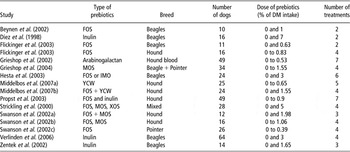
A meta-analysis of the effects of prebiotics on intake, digestibility, faecal SCFA concentrations, faecal microbial populations and serum Ig concentrations in dogs was conducted by pooling and analysing the data from published studies. Only studies published in peer-reviewed journals in the English language were included. These studies were conducted in apparently healthy dogs, and the concentrations of prebiotics in their diets were reported or able to be calculated from the data. Overall, 15 published studies for 65 different treatment means were included in the data set (Table 1). The database included the data on intakes of DM, CP and fats, digestibilities of DM, CP and fats, total SCFA, acetate, propionate and butyrate concentrations, the counts (log10 number of colony-forming units (log10 CFU)) of Bifidobacterium spp., Lactobacillus spp., Escherichia coli and Clostridium perfringens and the concentrations of serum IgG and IgA. All variables were not available across all observations in the database. Hence, the number of observations used for regression analyses varied between prebiotic dosage and response variables depending on the regressor variables available. Data reported in differing units of measure were transformed to the same units. Some records were incomplete or not reported uniformly, which necessitated the calculations from the reported data. When a study did not report all possible outcomes and it was not possible to calculate from the reported data, missing variables were considered as missing data.
Studies included in the database for meta-analyses of effects of prebiotics in dogs

DM = dry matter; FOS = fructo-oligosaccharide; MOS = mannan-oligosaccharide; IMO = isomalto-oligosaccharide; YCW = yeast cell wall; XOS = xylo-oligosaccharide.
Statistical analysis
Statistical analysis procedure used for meta-analysis of this database has been described elsewhere (Patra, Reference Patra2010). A brief account of statistical analysis is presented here. All statistical analyses were carried out using the PROC MIXED and PROC REG procedures of the SAS software system (SAS Institute Inc., 2001). Data were analysed according to St-Pierre (Reference St-Pierre2001), taking into account the random effect of study, using PROC MIXED (SAS, 2001) with the following model

where Y ij = the expected outcome for the dependent variable Y observed at level j of the continuous variable X in the study i; B 0 = the overall intercept across all studies (fixed effect); B 1 and B 2 = the overall linear and quadratic regressing coefficient of Y on X, respectively, across all studies (fixed effect); X ij = the the synthetic datum value j of the continuous variable X in study i; si = the random effect of study i; bi = the the random effect of study i on the regression coefficient of Y on X in study i and e ij = the unexplained residual error.
The variable study was declared in the CLASS statement. The slope and intercept of the study were included as random effects, as suggested by St-Pierre (Reference St-Pierre2001). An unstructured variance–covariance matrix (type = un) had been suggested at the random part of the model (St-Pierre, Reference St-Pierre2001), which was not possible to include due to few number of treatments in each study. Thus, a variance component (type = vc) of variance–covariance structure was performed at the random part of the model (St-Pierre, Reference St-Pierre2001). When the squared term of slopes was not significant (P > 0.10), the square term was not included in the model.
When the quadratic effect was tended to be significant (P < 0.10), adjusted data were further analysed to determine the break point (an inflection point above which the response variable changes) by fitting the quadratic broken-line regression model (Robbins et al., Reference Robbins, Saxton and Southern2006; Patra, Reference Patra2009) using non-linear (NLIN) procedure of SAS (2001) with the following model

where, Y = adjusted response variables; Y 0 = the value of response variables of Y at break point; X = dependent variables; B = the break point of the dependent variable (X) and S = slope of the broken-line regression analysis.
For proper graphic representation of statistical results from multi-dimensional space of studies into two-dimensional space, the Y observations were adjusted to take into account the random effect of the study (St-Pierre, Reference St-Pierre2001). The coefficient of regression (R 2) calculation also used the adjusted Y observation (St-Pierre, Reference St-Pierre2001).
Results
Description of database
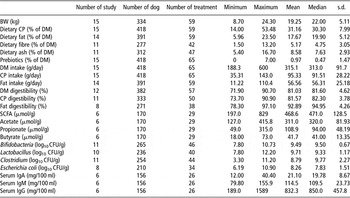
The body weight (BW) of dogs ranged moderately from 8.7 to 24.3 kg. Dietary concentration of CP ranged from 14.0% to 53.5% of DM and fat from 6% to 23.5% of DM, and accordingly a greater range of dietary nutrient intake by dogs was included in the database (Table 2). This indicates that this database evaluated a wide variety of diets and nutrient intakes in dogs. Inulin, FOS, mannan-oligosaccharide (MOS), isomalto-oligosaccharide, yeast cell wall (a source of MOS), xylo-oligosaccharide and arabinogalactan were used as prebiotics in this database, which have been classified as prebiotics or promising as prebiotic sources (Gibson et al., Reference Gibson, Probert, van Loo, Rastall and Roberfroid2004). The dose of prebiotics also ranged relatively widely. The digestibility of different nutrients and production of various SCFA varied depending upon the dietary composition and prebiotic dosage. The numbers of bifidobacteria, lactobacilli, E. coli and C. perfringens and Ig concentrations were within the normal ranges because diseased animal models were not included in the database.
Descriptive statistics of dietary nutrient composition (% of DM), intake (g/day), digestibility (%), SCFA concentrations ((μmol/g of faecal DM), intestinal microbial counts (log10 CFU/g faecal DM) and serum Ig concentrations (mg/100 ml) included in the database

DM = dry matter; SCFA = short-chain fatty acid; log10 CFU = log10 number of colony-forming units; Ig = immunoglobulin; BW = body weight; CP = crude protein.
Intakes and digestibilities of nutrients
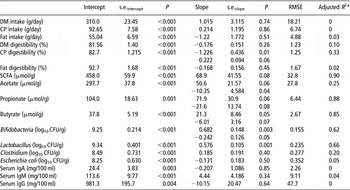
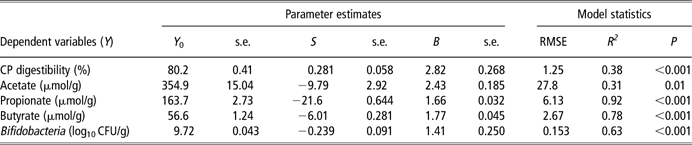
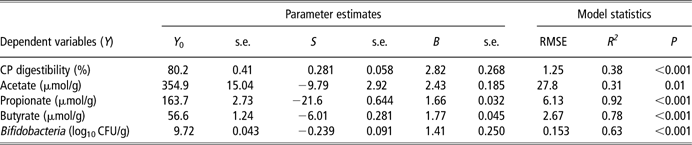
Feeding of prebiotics to dogs did not affect the food intake or CP and fat intakes (Table 3), nor did prebiotics change the apparent digestibility of DM. However, apparent CP digestibility tended to decrease quadratically (P = 0.06) with increasing dosages of prebiotics, although the degree of prediction was low (R 2 = 0.33). The apparent fat digestibility was not affected by prebiotics in dogs. Quadratic broken-line regression analysis showed that CP digestibility was lowest at prebiotic doses of 2.82% of diets (Table 4).
Effects (equations for linear and polynomial regressions) of prebiotics (% of DM intake) fed to dogs on intakes, apparent digestibility, SCFA (μmol/g faecal DM), microbial counts (log10 CFU/g faecal DM) and serum Ig concentrations (mg/100 ml)

DM = dry matter; SCFA = short-chain fatty acid; log10 CFU = log10 number of colony-forming units; Ig = immunoglobulin; CP = crude protein; RMSE = root mean square error.
*Adjusted R 2 with negative values have been presented as zero.
Quadratic broken-line regression analysisFootnote * of responses of prebiotics feeding (% of DM intake; X) on digestibility, concentrations of SCFA and bacterial numbers in faeces of dogs
DM = dry matter; SCFA = short-chain fatty acid; CP = crude protein; RMSE = root mean square error; log10 CFU = log10 number of colony-forming units.
* The quadratic broken-line model is Y = Y 0 + S ×(B−X) × (B−X), where (B−X) is defined as zero at values of X > B. Y = adjusted response variable, Y 0 = the value of response variable of Y at break point, X = dependent variable, B = the break point of dependent variable (X) and S = slope of the broken-line regression analysis.
SCFA concentrations
The concentrations of total SCFA in the faeces tended to increase linearly (P = 0.08) with increasing dosage of prebiotics in dogs and irrespective of dietary composition and breed, dosage of prebiotic predicted SCFA concentrations highly (R 2 = 0.90). The concentration of acetate (R 2 = 0.25), propionate (R 2 = 0.88) and butyrate (R 2 = 0.85) increased quadratically with increasing prebiotics feeding. The CP and fat contents in the diets did not influence the SCFA profile (data not shown). The concentrations of acetate, propionate and butyrate were highest at optimum prebiotic doses of 2.41%, 1.66% and 1.77%, respectively (Table 4).
Microbial counts
The numbers of bifidobacteria in the faeces increased quadratically (P < 0.01) with increasing dosages of prebiotics, and the degree of determination was quite high (R 2 = 0.62). However, the lactobacilli numbers increased linearly (P < 0.01; R 2 = 0.66). The numbers of clostridia and E. coli were not affected by prebiotics. The microbial numbers were also not affected by dietary CP and fat content and their intakes (data not shown). The peak values of numbers of bifidobacteria reached at the optimum prebiotic concentrations of 1.41% with corresponding numbers in log10 CFU was 9.72/g dry faeces.
Serum Ig concentrations
Prebiotics did not affect any of the Ig concentrations such as IgG, IgA and IgM in the serum of dogs. The Ig concentrations were not affected by dietary CP and fat content and their intakes (data not shown).
Discussion
Intake and digestibility
Prebiotics were included up to 7% of total DM intake in this meta-analysis study. Although prebiotic contributes bulkiness to the diet, it appears that they might not influence intake by dogs at low dosages presumably due to rapid fermentation by the intestinal microbiota without slowing the transit of foods. The decreased apparent digestibility of CP in response to feeding of prebiotics could be attributed to the increased microbial protein synthesis in the intestine (Hesta et al., Reference Hesta, Roosen, Janssens, Millet and De Wilde2003), and hence increased metabolic faecal nitrogen (MFN) excretion. It is also possible that prebiotics might influence the urea/ammonia cycling in the intestine of dogs. The MFN can be estimated from the intercept by regressing apparent digestible CP (ADCP) content (% of DM) on CP content (% of DM) in the diets (Van Soest, Reference Van Soest1988; Patra, Reference Patra2010). When the treatments without prebiotics supplementation were considered, the following relationship was noted:

The intercept of 1.056 represented the metabolic faecal CP excretion in g/100 g DM intake. Considering the average DM intake of 305 g/day and average BW of 17.6 kg in this data set, the MFN excretion was 59.9 mg/kg BW0.75. Kendall et al. (Reference Kendall, Blaza and Holme1982) also reported an MFN value of 63 mg/kg BW0.75 in dogs measured from feeding of protein-free diet.
However, when the treatments with prebiotic supplementation were only considered, the following relationship was noted:

The MFN excretion was 73.8 mg/kg BW0.75 for prebiotic-treated animals, which was higher than in animals without prebiotic treatment. The slopes of the above equations represent the true digestibility of protein, which were not affected by prebiotic administration.
Concentrations of SCFA
Prebiotics feeding increased the total SCFA as well as acetate, propionate and butyrate concentrations in the faeces of dogs, which is essential to maintain gut health (Gibson and Roberfroid, Reference Gibson and Roberfroid1995). Butyrate is the major fuel source of colonocytes, and high butyrate concentrations are thought to be associated with gut health, colonocyte proliferation and reduced colon cancer risks (Gibson and Roberfroid, Reference Gibson and Roberfroid1995; Roediger, Reference Roediger1995; Pool-Zobel et al., Reference Pool-Zobel, Van Loo, Rowland and Roberfroid2002). Increased SCFA production is also believed to act as immune modulation and pathogen inhibition (Gibson and Roberfroid, Reference Gibson and Roberfroid1995). The enhanced butyrate production is unlikely to be directly related to the increased numbers of bifidobacteria and lactobacilli concentrations, because these bacteria produce mainly lactate (Middelbos et al., Reference Middelbos, Fastinger and Fahey2007b). However, lactate can be used by other species such as Eubacterium spp. to form butyrate (Middelbos et al., Reference Middelbos, Fastinger and Fahey2007b).
Microbial counts and serum Ig concentrations
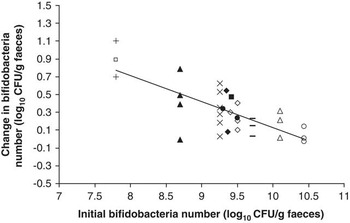
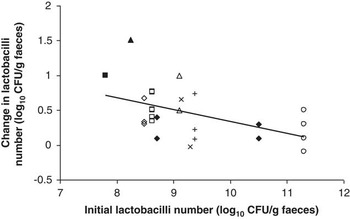
The numbers of healthy bacteria such as bifidobacteria increased quadratically and lactobacilli linearly with increasing doses of prebiotics. It has also been noted from the analysis that the changes (change of log10 CFU of bacterial numbers compared with control) in healthy bacterial numbers were affected by initial bacterial numbers (log10 CFU/g dry faeces) and dose of prebiotics (% of food DM intake). The following significant relationships were noted:
For bifidobacteria (Figure 1),

Effect of prebiotics irrespective of dose on changes in intestinal bifidobacteria numbers (log10 CFU/g of dry faeces) relating to initial bifidobacteria numbers (log10 CFU/g); log10 CFU = log10 number of colony-forming units;  = Strickling et al. (Reference Strickling, Harmon, Dawson and Gross2000);
 = Zentek et al. (Reference Zentek, Marquart and Pietrzak2002); + = Middelbos et al. (Reference Middelbos, Fastinger and Fahey2007b); □ = Beynen et al. (Reference Beynen, Baas, Hoekemeijer, Kappert, Bakker, Koopman and Lemmens2002); ▴ = Middelbos et al. (Reference Middelbos, Godoy, Fastinger and Fahey2007a); × = Grieshop et al. (Reference Grieshop, Flickinger and Fahey2002); ⧫ = Swanson et al. (Reference Swanson, Grieshop, Flickinger, Healy, Dawson, Merchen and Fahey2002c); ▵ = Grieshop et al. (Reference Grieshop, Flickinger, Bruce, Patil, Czarnecki-Maulden and Fahey2004); ◊ = Flickinger et al. (Reference Flickinger, Schreijen, Patil, Hussein, Grieshop, Merchen and Fahey2003); ▪ = Swanson et al. (Reference Swanson, Grieshop, Flickinger, Bauer, Chow, Wolf, Garleb and Fahey2002a);
 = Swanson et al. (Reference Swanson, Grieshop, Flickinger, Bauer, Healy, Dawson, Merchen and Fahey2002b).

For lactobacillus (Figure 2),

Effect of prebiotics irrespective of dose on changes in intestinal lactobacilli numbers (log10 CFU/g of dry faeces) relating to initial lactobacilli numbers (log10 CFU/g); log10 CFU = log10 number of colony-forming units;  = Middelbos et al. (Reference Middelbos, Godoy, Fastinger and Fahey2007a); + = Strickling et al. (Reference Strickling, Harmon, Dawson and Gross2000); Grieshop et al. (Reference Grieshop, Flickinger and Fahey2002); ▴ = Swanson et al. (Reference Swanson, Grieshop, Flickinger, Bauer, Chow, Wolf, Garleb and Fahey2002a); × = Swanson et al. (Reference Swanson, Grieshop, Flickinger, Healy, Dawson, Merchen and Fahey2002c); ⧫ = Flickinger et al. (Reference Flickinger, Schreijen, Patil, Hussein, Grieshop, Merchen and Fahey2003); ▵ = Grieshop et al. (Reference Grieshop, Flickinger, Bruce, Patil, Czarnecki-Maulden and Fahey2004); ▵ = Grieshop et al. (Reference Grieshop, Flickinger, Bruce, Patil, Czarnecki-Maulden and Fahey2004); ◊ = Swanson et al. (Reference Swanson, Grieshop, Flickinger, Healy, Dawson, Merchen and Fahey2002b); ▪ = Beynen et al. (Reference Beynen, Baas, Hoekemeijer, Kappert, Bakker, Koopman and Lemmens2002).

It indicates that change in bacterial numbers is affected by the interaction of initial bacterial numbers and dose of prebiotics. The greater relative increase in numbers of bifidobacteria and lactobacilli when their numbers are low in faeces indicates that the composition and numbers of bacteria in the intestines are balanced within particular ranges of bacterial numbers. Nonetheless, the above relationships suggest that responses of prebiotics might be better in stress, ageing and diseased conditions when the beneficial bacterial numbers decrease considerably (Hopkins et al., Reference Hopkins, Sharp and Macfarlane2001; Burkholder et al., Reference Burkholder, Thompson, Einstein, Applegate and Patterson2008; Shen et al., Reference Shen, Shi, Chen, Yu, Wu and Yan2009). The relative increase of lactobacilli and bifidobacteria could be physiologically important by enhancing health status or reducing the risk of disease (Gibson et al., Reference Gibson, McCartney and Rastall2005). For instance, feeding of Lactobacillus acidophilus and Bifidobacterium bifidum increased the numbers of these bacteria in faeces, which also enhanced the non-specific immune phagocytic activity of circulating blood granulocytes in humans (Schiffrin et al., Reference Schiffrin, Rochat, Link-Amster, Aeschlimann and Donnet-Hughes1995). Although increased probiotic bacterial populations maintain intestinal microbiota balance by competitively excluding or inhibiting pathogenic bacteria (Gibson and Roberfroid, Reference Gibson and Roberfroid1995; Suchodolski, 2010), E. coli and C. perfringens counts were not decreased significantly in this study. Increased bifidobacteria numbers may enhance the mucosal immunity in the gut through dendritic cell activity (Lindsay et al., Reference Lindsay, Whelan, Stagg, Gobin, Al-Hassi, Rayment, Kamm, Knight and Forbes2006). However, immunological indices were not affected by prebiotic supplementation because dogs in this study were all healthy. Besides, serum Ig concentrations are sometimes not correlated with gut mucosal IgA concentrations (Verlinden et al., Reference Verlinden, Hesta, Hermans and Janssens2006). For instance, Field et al. (Reference Field, McBurmey, Massimino, Hayek and Sunvold1999) reported that the fermentable fibres altered the canine gut-associated lymphoid tissue composition and activity, but no changes were noted in blood. It has been suggested that the full benefit of prebiotic supplementation may not be detectable unless the immune system is challenged during supplementation (Middelbos et al., Reference Middelbos, Godoy, Fastinger and Fahey2007a). There is evidence that the feeding of FOS increased the mucosal dendritic cell function associated with immune system in patients with Crohn's disease (Lindsay et al., Reference Lindsay, Whelan, Stagg, Gobin, Al-Hassi, Rayment, Kamm, Knight and Forbes2006).
Conclusions
Feeding of prebiotics to dogs has apparently no effect on intake and digestibility of nutrients except apparent CP digestibility in this meta-analysis study. However, prebiotics feeding up to 1.40% of DM intake may increase healthy bacteria such as Lactobacillus spp. and Bifidobacterium spp. and various SCFA productions, which are beneficial for gut health. It has been noted that the numbers of lactobacilli and bifidobacteria increased relatively more when numbers of these bacteria were low. The immunological indices such as serum IgG and IgA concentrations are minimally affected by prebiotics in healthy dogs, but the full benefit of prebiotics may not be detectable unless the immune system is challenged during prebiotic feeding. The response of prebiotics on microbial populations and SCFA profile in the canine gut is not influenced by the dietary nutrient composition. The results indicate that supplementation of prebiotics in diets could improve the intestinal health of dogs, which appears to be most beneficial in dogs under stress conditions, when the number of healthy microbiota in the intestine may decrease.