Introduction
Research into the range and costs of public benefits and services aimed at private corporationsFootnote 1 is extremely patchy. The form, cost and real and imagined effects of social welfare are frequently debated within academia and the popular media. But provision that benefits private businesses – here referred to as corporate welfare – is often obscured and rarely acknowledged by governments or business interests. Even where academic research has focused on state benefits for corporations, it has tended to be relatively narrow in terms of the analysis presented, and official data are either incomplete or non-existent. This is the case even in the most researched and clearly documented form of corporate welfare: state subsidies. Even the Office for Fair Trade, a branch of the UK's Department for Trade and Industry, stated in 2004 that ‘There is no single definitive source of data about spending on subsidies to businesses in the UK’ (OFT, 2004) and not much has improved since. As a result, current data still fail to ‘present a clear view of the total amount of subsidy provided by the public sector to private business’ OFT, 2004). The situation regarding other forms of assistance beyond subsidies is even worse.
The key problem with the official data is that, where these are collected, this is not for the purpose of gauging levels of support for businesses, nor to increase transparency or the effectiveness or efficiency of state programmes. Rather, data are aggregated and collated for general accounting purposes (which hide specific forms of support) and/or to comply with international regulations on business support that are in place to identify unfair trade advantage, which tends, as a result, to focus primarily on direct subsidies. The problem here is that international regulations are weak and/or extremely narrow in their coverage. As a result, the extent of public and parliamentary scrutiny of cash and in-kind support provided by the state to corporations lags far behind other areas, thus making it impossible to assess the full and relative costs and benefits to business and society more generally. Scrutiny of corporate welfare is extremely important for social policy analysis for at least five reasons:
(1) Recognising the importance of corporate welfare can strengthen the defence of the welfare state as a whole. To put it another way, a lack of recognition of the importance of corporate welfare allows critics of the state to propagate the argument that public expenditure is inefficient, undermines the economy and diverts resources away from the private sector towards the public sector to the detriment of the former.
(2) Although there is a great deal of debate on the impact of ‘welfare’ on the economy, there is no real evidence that public provision undermines the competitiveness of firms (for a comprehensive review of the evidence see Lindert, Reference Lindert2004). All states provide support for businesses and the most ‘generous’ states are, in this regard, also amongst the most competitive.
(3) Corporate welfare competes with social welfare for state resources at various levels. Governments often have to make a choice between the two in tackling the very same problems. For example, governments will often face the choice between subsidising a firm in order to prevent it from closing or providing benefits to those made unemployed by the closure.
(4) Well-planned and coordinated corporate and social welfare measures can increase the complementarity between them. A lack of coordination, on the other hand, tends to reinforce conflict and competition over resources.
(5) If, as is argued here, corporations obtain a great deal of value from direct and indirect state provision, it follows that businesses and wealthy business people should bear more of the related costs of the provision. However, partly because business representatives and government fail to recognise or acknowledge the importance of corporate welfare, the debate in most countries since the 1980s has tended to push in the opposite direction – to reduce the regulatory and tax burden on corporations.
The primary objective here is to reframe and advance the political economy approach to the welfare state. Political economy approaches, encapsulated in the work of O'Connor (Reference O'Connor1973), Gough (Reference Gough1979), Ginsburg (Reference Ginsburg1979) and Offe and Ronge (Reference Offe, Ronge and Offe1984) tend to focus on the systemic needs of capital (or capitalism) – in other words the general ‘needs’ of the economy – but focus less on the specific needs of individual businesses. Where they do focus on individual firms, they tend to be selective (focusing on monopolies) and they tend to conflate general economic needs and the specific needs of individual businesses (or corporations) as if they are the same thing. Sometimes they are; often they are not. A similarly narrow approach exists even in the varieties of capitalism literature – where the focus tends to be general employment-related programmes – despite the fact that Hall and Soskice (Reference Hall and Soskice2001), the original proponents of this work, promised to put the ‘firm’ at the centre. Certainly, governments pursue the systemic needs of capitalism, but they also service the specific needs (and often wants) of individual corporations. But in so doing, they may seek to satisfy the expressed or perceived needs of business in general and/or the expressed or perceived needs of specific businesses (Wetherly, Reference Wetherly2005: 134). The particular form of capitalism is likely to shape business preferences (ibid.) and policy-makers are likely to pursue the satisfaction of the ‘systemic’ needs of capitalism because the benefits of doing so accrue, not only to businesses, but to policy-makers themselves. Governments raise revenues and win elections on the back of economic success (for a Marxist interpretation of this process, see Offe and Ronge, Reference Offe, Ronge and Offe1984; for a pluralist interpretation, see Lindblom, Reference Lindblom1977).
The specific needs of individual companies, on the other hand, may be informed by the assumptions (and preferences) of policy-makers OR they may be informed by the lobbying activities of individual firms or trade associations operating on behalf of particular sectors. The key difference is that in the former case there are general benefits that accrue to most, if not all, businesses (for example, basic education), but, in the latter case, the benefits may accrue to a narrower range of companies (for example, highly specialised, firm-specific skills training), although the knock-on effects of this could spread the benefits wider. There may be further instances where the needs of individual companies are in conflict with those of citizens or, indeed, other companies. The key point here is that state programmes may satisfy systemic needs, and/or the specific needs of individual companies and citizens may or may not benefit from such interventions. It is also important to stress that business preferences (expressed by individual companies or business associations) may come to determine the political demands of business and these may be in opposition to the genuine collective needs of the wider business community.
Because the needs of businesses (to make profits) can conflict with those of employees, existing approaches tend to highlight the rivalry and trade-offs that extend to social policies – to meet economic or human needs. A picture is presented of fierce competition over resources and trade-offs between accumulation and legitimation functions, or productive and unproductive welfare. The reality, this paper argues, is not quite that simple. Trade-offs may occur between different expenditures, especially during times of crisis and especially between fixed and ‘discretionary’ provision or between different branches of the welfare state (Pontusson and Clayton, Reference Pontusson and Clayton1998: 67–98), but few forms of state provision bring benefits only to one interest or the other. Corporate and social welfare exist along a continuum; some forms of provision bring far-reaching benefits to corporations and citizens, whilst others more directly benefit businesses or citizens (but even here, the benefits are seldom restricted to either one). Bringing corporate welfare into social policy analysis increases our understanding of how we might best balance economic needs with the needs of citizens. To this end, this paper argues for a deeper recognition, understanding and embedding of corporate welfare in the welfare state analysis: to place corporate welfare on the social policy radar, to advance conceptually the analysis of corporate welfare and to provide some empirical evidence on the relative size of corporate and social welfare in a number of OECD countries.
Bringing corporate welfare in
The integration of corporate welfare into social policy analysis requires nothing less than a reconceptualisation of social policy and welfare more broadly and, in advocating such an approach, this paper belongs to a tradition of analysis that seeks to push at the boundaries of social policy analysis. The majority of work carried out into welfare states centres on a relatively narrow conception of welfare as social provision and the extent to which various collective interventions meet the needs of the individual. There have been notable exceptions to this of course. Although he did not look specifically at the benefits extracted from the state by businesses, Titmuss (Reference Titmuss1976) did highlight the importance of fiscal welfare as a key pillar of welfare (alongside social and occupational welfare), suggesting that individual firms, as well as individual citizens, benefited a great deal from various tax benefits (fiscal welfare). The notion of occupational welfare also firmly tied production and social policy in a way that echoes some of the arguments presented here. Later, Goodin and Le Grand (Reference Goodin and Le Grand1987) reminded us that the middle classes extract as much, or even more, out of welfare provision as do lower income groups. During the 1970s, neo-Marxists pointed to the role of social welfare in stabilising and promoting economic development and system legitimacy (O'Connor, Reference O'Connor1973). Others, including Cohen (Reference Cohen2000), Gough (Reference Gough2000: Introduction) and Wetherly (Reference Wetherly2005: Chapter 4) have discussed the ways in which governments service the needs of business (or capital) and capitalist economies, and still others have discussed the important role that social policies play in the creation of competitive markets (Cao et al., Reference Cao, Prakash and Ward2007: 301–27; Cerny, Reference Cerny1997: 251–74; Hudson and Kühner, Reference Hudson and Kühner2009: 34–46). More recently, in the aftermath of the post-2008 economic crisis, academics, journalists and campaign organisations have begun to focus their attention on corporate bailouts and various forms of in-kind assistance. The importance of developing a clearer conceptual framework of such provision is therefore even greater and more urgent in the post-2008 environment.
Adopting corporate welfare as a core concept in social policy is not, of course, without its risks and challenges. First, embracing corporate welfare means extending the focus of social policy to state provision that is aimed as much at corporations as it is individuals. The basic premise of this argument will not be unfamiliar to many working in the field, but relatively few today appear to recognise in practice that public and social policies variously, and often simultaneously, service the needs of individuals and corporations. Second, because the value of corporate welfare to private businesses is largely hidden – often deliberately by governments – and under-researched by academics, its precise costs to taxpayers are difficult to estimate. Third, and most importantly, there are problems associated with the use of the term ‘corporate welfare’ itself. In its common usage it has rather negative connotations, originating as it does in North America where ‘welfare’ is viewed, as Olson puts it, as ‘a term of opprobrium’ that suggests ‘undesirable characteristics’ and traits amongst its recipients (Olson and Champlin, Reference Olson and Champlin1998: 759–71). Indeed, such views of ‘welfare’ explain its extension in North America from the ‘undeserving‘ poor to the undeserving rich. On the basis of these associations, Egan cautions against using ‘welfare’ to describe public provision to private businesses on the basis that it risks further maligning the term (Egan, Reference Egan2002). But viewed through a European lens, the term is less stigmatised, broader, and the parallels between social and corporate welfare become clearer. In most European nations, ‘welfare’ denotes state programmes that are designed to meet a broad range of human needs and insure against various unforeseen or unexpected risks. Corporate welfare similarly functions to meet some of the fundamental and supplementary needs of business and to protect against various market-based risks. With this in mind, the term corporate welfare is defined here as the various benefits and services that directly, or indirectly, meet the needs of businesses. This conceptualisation of corporate welfare contrasts well with social welfare, consisting of the various benefits and services that directly or indirectly meet the needs of individuals. Where social welfare might decommodify market processes, corporate welfare commodifies or recommodifies markets through state programmes.
Despite these challenges, corporate welfare remains important to a more complete analysis of welfare states, especially in capturing the varied role of the state and the close and intricate relationship between economic and social welfare functions. As already noted, governments often attempt to fulfil the systemic needs of capitalism and the needs of individual capitalists – manipulating macro-economic demand and variously propping-up, protecting and preserving individual corporations. At the same time, various social policies help to meet the needs of citizens in various ways. For much of the time, there are few contradictions between these policy aims; at other times, they appear completely at odds with each other (Gough, Reference Gough2000). The following sections explore some of these contradictions, tensions and incoherencies in more detail.
States of corporate welfare
Esping-Anderson (Reference Esping-Andersen1990) concluded in his classic study of his worlds of welfare that class struggle, class coalitions and economic and state structures determine the shape of welfare (although he focused only on certain social welfare programmes). Hall and Soskice (Reference Hall and Soskice2001) illustrate how different state forms and institutional arrangements help to shape class relations and political possibilities, including debates and struggles surrounding the shape of welfare systems. Thus, the extent to which corporate and social welfare coexist or conflict with each other will depend on existing institutional configurations and, in particular, prevailing relations between employers and employees. Within acrimonious political environments, class struggle is likely to play a key role in determining welfare priorities and the shape and distribution of welfare provision (Glasberg and Skidmore, Reference Glasberg and Skidmore1997: 3). Within more consensual political environments, especially within corporatist states, where tripartite negotiations, between state, employers and employees are the norm, the trade off between corporate and social welfare is likely to be less stark. Under such conditions, it is more likely that corporate and social welfare will expand as competing interests try to find common ground. The extent to which this happens, however, will depend on a range of other factors, including available resources and the relative power of competing interests. As already indicated, struggle over resources is key to determining welfare (social and corporate) but the basis of such struggle is not confined to simple class divisions. Conflict over the provision and distribution of corporate and social welfare is subject to intra- as well as inter-class struggle. Ideological positions also illustrate the divisions that go to the heart of corporate welfare.
Corporate welfare is unusual, ideologically speaking, in that the radical Left and Right are relatively united in opposing it – albeit for different reasons. The Right oppose corporate welfare on the basis that it forces politicians to pick winners and losers (something that politicians are poorly equipped to do). It also reduces economic markets to politics, encouraging business people to foster political relationships in order to promote their own interests (and those of the company) rather than relying solely on market mechanisms. Corporate welfare, just as social welfare, is argued to distort markets, rewarding those companies that would otherwise fail within the marketplace and supplanting ‘superior’ objective markets with ‘inferior’ political judgements (Moore and Stansel, Reference Moore and Stansel1996) The problem with social welfare for the Right is that it protects individuals from their own bad choices, making them irresponsible and ever more dependent on the state. Corporate welfare, the Right argues, similarly rewards poor investment or production decisions and tends to lead to ever greater demands from business for higher levels of support. Within free market capitalism, the promise of wealth should promote competition between individuals and, by extension, firms. Wherever firms cannot compete with other firms they go out of business, and it is the promise of financial rewards and the threat of closure that ensures that efficient and competitive firms deliver goods and services that consumers want at a price they can afford. Where governments provide financial or other forms of assistance, however, the market is distorted to the detriment of all. This is damaging, not only to local consumers, but also to non-subsidised companies producing within the same national borders. It is equally damaging to foreign producers, especially within developing economies which are, as a consequence of these subsidies, unable to compete with the resulting cheaper products that flood international markets. For these reasons, the most vociferous anti-corporate welfare campaigns tend to be organised by the political Right. Moore and Stansel (Reference Moore and Stansel1996), writing for the Cato Institute in the US, echoed the free-market ideals of Hayek when they wrote that:
Corporate welfare is objectionable because it corrupts both our free-market system and our representative form of government. Corporate welfare converts the industrialist into a statist businessman whose market is the political arena in Washington, DC, not consumers.
Similarly, as Donlan (cited in Egan, Reference Egan2004: 11) put it:
Regardless of who gets it, welfare demoralises recipients and saps the strength of the productive economy.
Others have argued that corporate welfare brings few long-term returns to taxpayers (Moore and Stansel, Reference Moore and Stansel2000) and that it directs assistance to businesses that do not need it (see (Dawkins, Reference Dawkins2002: 269–91). Thus, for the Right, the answer to the challenges experienced by corporations generally lies in the creation of genuinely free markets rather than in public sector assistance. The exception is genuinely public goods, which could include some infrastructure.
The radical Left are ambivalent about corporate welfare for a different reason, not because it distorts markets, but because it diverts resources away from the needy and it rewards politically well-connected corporate elites. Ralph Nader (Reference Nader2000) argued that corporate welfare operates as ‘a function of political corruption’ designed to reward elite interests at the expense of those in genuine need. More generally, the American Left has tried to focus attention onto corporate welfare in an attempt to draw attention to the perceived indefensibility in cuts to social welfare budgets during the 1980s and 1990s whilst corporate welfare remained largely intact (Olson and Champlin, Reference Olson and Champlin1998: 759–71). More radically, some on the Left have argued that if state provision for businesses is necessary, it should translate into greater levels of control and public ownership. State provision, the argument goes, should not be offered in order to nationalise corporate risks whilst those same firms are able to privately appropriate profits. Opposition to such support increases where the wider social benefits of corporate welfare are more difficult to comprehend and wherever corporate welfare appears to directly compete with social welfare for resources.
Whilst the Right and Left are more closely united in their opposition to corporate welfare, direct public provision for private corporations finds much more favour amongst the political centre. For the centre, free markets inevitably suffer from periodic problems and crises that require state support. Without state intervention in various areas, capitalism would operate inefficiently and inequitably and would likely eventually implode. The ideas of Keynes are often cited in support of this view. For him, markets do not naturally clear – supply and demand do not tend towards a natural state of equilibrium – and thus do not naturally lead towards full employment. Only states, through the deliberate manipulation and management of demand, are capable of creating the correct conditions that maximises the welfare of their citizens and the fortunes of their resident businesses. Public policy programmes, encompassing social and corporate welfare, are an important part of the macro-economic strategies which governments should employ in order to increase the efficiency and fairness of markets. Social welfare is, for example, counter-cyclical – pumping most into economies during times of economic slowdown and reducing expenditure (by taking in revenues) during times of economic growth.
Reconciling the various tensions that surround corporate welfare is not always easy. This can be best illustrated with a fictitious example. A steelworks with over 2,000 employees – lets call it Company A – needs access to credit in order to invest in plant infrastructure and win lucrative new contracts. It needs to borrow to finance the investment. However, because the financing is considered high risk, it cannot borrow the money at affordable rates on the open market. If it does not secure the financing to invest, the company will collapse. Because the company is based in a remote part of the country, the knock-on effects of the collapse would be devastating for the region and likely lead to cycles of deprivation and social dislocation that could last for decades. The costs for the government, in terms of unemployment, associated benefits and social unrest could be huge. The costs in terms of votes lost at the election could also be significant. The company, trade unions and the local community are all likely to lobby hard in support of government intervention. Faced with this situation, a government could provide the financing, guarantee the loan or reduce costs for the company in other ways (for example, by providing tax breaks). In the event that the government provided the assistance in this way, it could guarantee jobs in the short term and it could stave off economic depression in an area for some time. By facilitating investment, it may also increase productivity and efficiency and competitiveness in the long run (orthodox economics tends to argue that such assistance has the opposite effect in pushing up prices in the long run because state provision props up failing and inefficient firms). Local citizens and local businesses, in addition to the immediately affected workers, may all benefit, provided the cost of such intervention does not reduce available resources for other state services and provided the company recovers. And the costs for government may be marginal – the state will be able to divert the costs that would have had to be met through social welfare to the corporate welfare measures it has put in place. However, there are also risks associated with such action. To begin with, Company B, a competitor steelworks, may be disadvantaged by the effective subsidy that is now being provided to Company A. Because of the subsidy it receives, Company A is able to compete for new business on more favourable terms and at more competitive prices. Company B may now be threatened with closure and the government will have to make a decision whether to intervene or not. If they are forced out of business, government will again face higher social welfare costs. If they are not, it will face higher corporate welfare costs. And spending in either area may have knock-on effects for the other.
This fictitious example presents a glimpse into the complexities and tensions that surround individual cases of state support for corporations. Shifting the focus to the broader debate over social and corporate welfare reveals a number of further challenges. Tensions are likely to arise where state provision stifles competition between corporations and results in higher prices. Mobile companies conflict with immobile corporations, where the former are able to exercise greater structural power in negotiating welfare deals and/or are able to seek out better ‘welfare’ deals elsewhere and where the latter are likely to bear some of the costs of this. Favoured sectors conflict with unfavoured sectors, where the former group is likely to be able to attract higher levels of assistance than the latter. Some sectors, for example agriculture, the nuclear industry and the steel industry tend to be heavily subsidised in all states, partly for historical reasons and partly for reasons of national security. Companies also conflict internationally over the provision of subsidies in different states. Firms that compete with imports are likely to argue more fiercely for subsidies in order to ‘level the playing field’ (Snape, Reference Snape1991: 139–64) and/or are likely to argue that the subsidies received by competitor firms should be challenged in international law (through the EU or the WTO, both of which have rules governing the provision of subsidies).
The way in which state benefits and services are delivered to individuals and companies can help to reduce or stoke these tensions. As already noted, conflict is not likely to be confined to rivalry between citizens and corporations. Certain forms of state provision will simultaneously meet the needs of individuals and businesses. Other forms will meet the needs (or wants) of one particular interest above another. It is where the benefits of provision are narrowest that tensions are likely to be greatest. Thus, the more that states can do to steer provision so that it meets the (general) needs of citizens and (general) needs of businesses the better. We will return to this point later.
This account of the tensions surrounding corporate welfare is by no means exhaustive, but it does provide some insight into the nature of the tensions that arise as states strive to balance competing priorities. Moreover, because of these tensions and divisions, consistent, coherent and clear inter- or intra-class positions on corporate welfare often fail to emerge. And even if such positions emerge at any given point in the economic cycle, they are unlikely to be sustained over time. Firms and other interests may well change their own positions over time, depending on their economic positions during the economic or industrial cycle. The same firm may oppose corporate welfare at one stage of its existence but come to depend on it at other times. A parent company may also change its view depending on its stage of development (as discussed above) and its overall portfolio (where it may come to depend more heavily on the state as it engages in future company takeovers or mergers with companies that bring new or different future needs).
But regardless of the balance of priorities of government, all the major economies contain elements of corporate and social welfare. Even in liberal states, which are often considered laggards when it comes to social policy, corporations have by no means been left to go it alone. It is also the case that social democratic nations often divert resources away from social welfare towards corporations. There is a historical dimension to this. As a host of commentators have made clear, from Marx (Reference Marx1992) to Polanyi (Reference Polanyi1957) and Esping-Anderson (Reference Esping-Andersen1990) to Hall and Soskice (Reference Hall and Soskice2001), capitalist states have progressed through several waves of development and it is clear that corporate welfare, in one form or another, has been intrinsic to capitalism's development. Social and corporate welfare have often played, and continue to play, complementary roles in economic and social policy, affecting both the strength of the economy and overall quality of life within nations. Corporate welfare can encourage the production and/or sales of certain goods or services, increase investment, provide essential support services to firms, rescue, resuscitate, stabilise and preserve essential industries and services and reduce the end price of commodities for consumers. It can also prevent company closures, unemployment, wage cuts and cuts in occupational benefits, including pensions.
What is also important for the purposes of this analysis is that social welfare not only brings general economic benefits, it brings significant benefits to individual businesses. Indeed, different forms of provision might more accurately be thought of as bringing various and varying benefits to businesses over time and in different settings. Thus, unemployment benefits are counter-cyclical and thus reduce the size and impact of economic downturns, when they occur, and their impact on both companies and their workers. During economic boom times, unemployment benefits may appear to be less important (at least to employers). Social provision may also help to fulfil wider social objectives by boosting incomes and thus encouraging companies to invest in long-term staff development and training (Cao et al., Reference Cao, Prakash and Ward2007: 301–27).
Education and training programmes can increase employee productivity and reduce the risks associated with freeloading (where firms can poach staff from companies that have invested in expensive training programmes). Public health systems can increase employee productivity. In addition to this, a significant chunk of state expenditure goes directly to private companies, including the companies that deliver contracted-out education and employment services, IT companies, pharmaceutical companies and the construction industry. Public sector wages and pensions are also directly or indirectly diverted through the private sector. Other public services are central to corporate need satisfaction. Subsidised rail, bus and road networks, for instance, ensure the sustainability of essential transport services and facilitate the transportation of freight. Evidence also suggests that social welfare programmes reduce employment costs where employers would otherwise have to provide benefits – in the form of occupational benefits – that are not provided publicly (Farnsworth, Reference Farnsworth2004b: 437–55).
These myriad interventions impact in various ways, both positive and negative. In that they respond to the needs of businesses and citizens in different ways, states shape the rules, conventions and expectations governing corporate welfare. They shape the governance and market behaviours of corporations. State provision can help to increase innovation, investment in R&D and thus increase competitiveness, but at the same time, it can help to create bloated and inefficient forms of capitalism, where corporations come to depend on state largesse for assistance. There is also the risk that corporate welfare may harm the national interest in the long term; provision aimed at preventing company collapses today may simply maintain lame-duck corporations that, in the long term, will continue to be uncompetitive. Expectations of assistance may also lead to harmful risk-taking corporate behaviour. There is a strong argument that suggests that the banks took unnecessarily large risks in the run up to the 2008 financial crisis because they knew, ultimately, that governments would bail them out. They were simply ‘too big to fail’ (Sorkin, Reference Sorkin2009). If true, this suggests that the availability of state support for corporations may impose large costs in the short term and help to create more risky forms of ‘casino’ capitalism, as Susan Strange (Reference Strange1997) put it, in the longer term.
There is also the additional risk that, in responding to short-term business needs, states lock themselves into particular economic trajectories that are not in the long-term national interest. A country that responds to the needs of mobile capital by providing subsidies to inward investors, reducing regulatory constraints and cutting taxation – all familiar practices in the race to acquire new foreign investment – will find it difficult to subsequently cut subsidies, increase regulations and increase corporate taxation for fear of the impact that this would have on existing and new inward investment. This is the classic globalisation problem. Sure, private companies are less mobile than is often assumed, but governments nevertheless respond to this perceived ability of corporations to play state off against state in securing favourable investment environments. In such scenarios, businesses come to depend on subsidies, low regulations and low taxation in order to remain profitable in the face of competition from elsewhere. What is clear, therefore, is that, beyond the basic need of business to make profit, supplementary needs may be relatively fixed in the short term but relatively flexible in the longer run. Thus, the ‘needs’ of business may be presented in a particular way by particular companies with the aim of securing better deals from government. They will then be observed or perceived by governments in particular ways and the government may respond to these needs. This is not the same as saying that governments always positively respond to the demands of business. The ongoing challenge for governments is to distinguish between needs and wants and, beyond this, to attempt to shape needs in various ways. The key point here is that, whilst the basic need of business is clear – profitability – this begs the question of how much profit corporations need and which particular need satisfiers will be utilised. The particular constellation of social policies within nation-states force businesses to evolve, adapt and thrive and, for their part, governments can help to ensure that businesses can thrive within diverse welfare regimes by selectively employing different policies and programmes that variously reduce the risks encountered by businesses or compensate them in some way for the costs associated these risks. Businesses in such environments will therefore grow to depend on quite different constellations of need satisfiers, and this includes state welfare itself. This helps to explain variation in business opinion on social policy over time and between states (Farnsworth, Reference Farnsworth2004a). This point is captured well by Pierson (Reference Pierson2000: 791–821) when he argues that:
Employers will gradually seek to adjust their own practices in important respects to fit the incentives that social programs create. Survival rates among the types of firms that are able to make such adjustments are likely to be higher over time. Thus, capitalists adjust the welfare state, and the welfare state adjusts capitalists. Over time, national welfare states become an important part of the institutional matrix shaping practices at the level of the firm and influencing broader efforts at national economic management.
This whole process of negotiation, perception and action is complex, of course, and takes place within the particular political and economic structures and institutions of different states with variable outcomes. We will return to this point later.
Governments do not simply react to pressures and concerns – pragmatism and ideas also play their part. They depend on private corporate investment and increasing profitability. If private companies cease to invest, the economy would slow down and unemployment would increase. In such situations, governing parties are rarely returned to power. In addition to this, governments raise revenues on private transactions, wages and profits. Thus, all other things being equal, governments will do all they can in order to induce private businesses to invest and ensure that business interests are prioritised above the interests of others. Such inducements include the full range of corporate welfare measures from direct subsidies to state investment in education and training.
The corporate−social welfare continuum
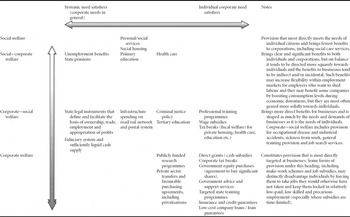
The above sections have attempted to conceptualise corporate welfare and the tensions that surround it. The most important point is that corporate welfare is essential and commonplace within capitalist societies and that corporate and social welfare at times compliment and balance each other and at other times conflict. To put it another way, social welfare at times becomes corporate welfare just as corporate welfare, at times, becomes social welfare. Table 1 maps state services along a vertical corporate−social welfare continuum and along a horizontal ‘systemic’/company need continuum. The latter maps provision that addresses the general need-satisfier related to the capitalist economy towards the Left, and individual corporate need-satisfiers towards the Right.
The corporate–social welfare continuum

At the extremes of the welfare continuum, provision might be said to most directly satisfy the needs of either citizens or businesses. Provision towards the middle helps to satisfy the needs of both. Social welfare expenditure covers services that most directly meet the needs of individual citizens but bring fewest benefits to corporations, including social care services. This is not to argue that these benefits exclusively benefit individual citizens; such provision, for instance, brings huge ‘benefits’ to companies that contract with the state to deliver these services (see Farnsworth and Holden, Reference Farnsworth and Holden2006). They also increase system ‘legitimacy’ since there is a close relationship between social care and social control (Jones and Novak, Reference Jones and Novak1999). Overall, such benefits tend to be most clearly directed towards individual citizens rather than corporations.
Unemployment benefits and pensions increase labour market flexibility and the former, in particular, brings general macro-economic benefits by boosting consumption levels during economic downturns. Both assist employers to shed unwanted labour. For this reason, most benefits, including pensions, are categorised as social−corporate welfare on the continuum. Social−corporate welfare brings clear and significant benefits to both individuals and corporations, but on balance it tends to be directed more towards individuals and the benefits to businesses tend to be indirect and/or incidental.
Corporate−social welfare is more closely linked to labour markets, but it also includes state support to aid the consumption of privately produced goods and services, including private health care, private education and housing costs (including mortgage subsidies), all of which help to reduce costs for consumers and boost consumer demand and profits for businesses. It also includes provision for occupational disease and industrial accidents, sickness from work, general training provision and job search services. As a result, corporate−social welfare brings direct benefits for businesses and is shaped as much by the needs and demands of businesses as it is the needs of individuals. Corporate welfare constitutes provision that most clearly and directly meets the needs of corporations. Indeed, some forms of provision under this heading, including make-work schemes and job subsidies, may distinctly disadvantage individuals by forcing them to take jobs they would otherwise have not taken and keep them locked in relatively low-paid, low-skilled and precarious employment (especially where subsidies are time-limited). Although, at its broadest, these forms of provision include a whole range of benefits and services that go beyond what is customarily included within the rubric of the welfare state, here the analysis is confined to direct and indirect cash and in-kind benefits. It is also important to note that, between these categories of welfare, there are other intermediate forms of provision that satisfy both the needs of individuals and corporations to varying degrees.
This following section seeks to illustrate the relative break-down of welfare priorities within various states by mapping categories of expenditure onto the broad forms of state provision identified on the welfare continuum. In this respect, it inevitably moves us away from the conception of state provision as delivering benefits and services that simultaneously bring benefits to citizens and businesses towards a more tightly fixed categorisation of state provision. Miller (Reference Miller1986: 236–60), following O'Connor (Reference O'Connor1973) attempted to overcome this problem in the 1980s by proportioning expenditure between ‘capital’ and ‘labour’ on a sliding scale, but his basis for doing this appears to be rather arbitrary and is, in any case, difficult to apply to international data. For now, therefore, we are left with the imprecise, but nonetheless useful, categorisation of provision advanced here. This exercise reveals interesting patterns of welfare provision within different nations.
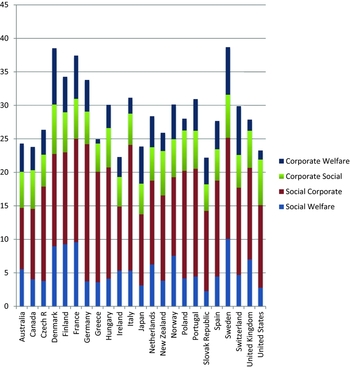
This section draws on two sources of OECD data: the SOXC (Social Expenditure) database (which includes national country data on the costs of provision that comes under the heading of social expenditure) and the OECD's Revenue Statistics database. Both are rich sources of data and the former is incredibly detailed, covering a range of measures of social expenditure from education and training expenditure to health care, housing, labour market programmes and the personal social services. These data have been assigned to the applicable vertical categories of the welfare continuum (Table 1). Tax benefits have been excluded here (although they are included in the analysis in Farnsworth, Reference Farnsworth2012). Although no single form of welfare could be argued to fit precisely into any one single category without spilling over into another,Footnote 2 the benefits of this exercise are that it reveals something of the relative priorities given to different forms of provision that lie on the continuum within different welfare systems. Figure 1 reveals the outcome of this exercise for the year 2005.
Expenditure as a % of GDP, 2005

Although the relative costs vary, these data illustrate that all governments spend significant amounts on corporate welfare provision and, in certain cases, direct provision to corporations exceeds direct provision to citizens. It will not surprise many readers to learn that Sweden and Denmark are the biggest spenders on social welfare, but what may be more surprising is that both countries, along with France, are also amongst the most generous in terms of corporate welfare. Denmark spends a similar amount (in GDP terms) on social and corporate welfare. General and workplace subsidies, delivered through Active Social Policies, are relatively high in all three economies. The US is a relative laggard in both corporate and social welfare spending. This is not the case if we look at either social−corporate welfare expenditure (which includes social protection and health care) and corporate−social welfare (which includes the majority of educational expenditure). Germany, Japan and Portugal are alone in spending more on corporate welfare than on social welfare. This is borne out of a long tradition of industrial support and corporatist arrangements in Germany and Japan.
Regarding the patterns of welfare expenditure, utilising Esping-Anderson's original classification would suggest that corporate welfare expenditure is lowest in liberal economies but higher in conservative and social democratic countries. Hall and Soskice's (2001) distinction between liberal and coordinated market economies would appear to fit better, conceptually and empirically. Liberal market economies devote less expenditure to corporate and social welfare, coordinated market economies devote more. But more work is clearly needed to test these models more thoroughly.
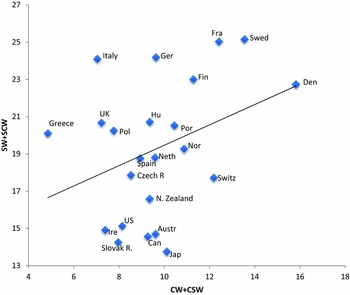
An interesting picture of the relationship between social and corporate welfare is revealed in Figure 2. Plotting corporate plus corporate−social welfare along one axis and social plus social−corporate welfare on the other axis indicates a positive correlation between the two broad categories. At least two clusters are revealed. Japan, Canada, the Slovak Republic, Ireland, Australia and the US are revealed as having relatively low levels of corporate welfare and moderate levels of social welfare, Denmark, Sweden, and France have relatively high levels of both categories of expenditure. No country could be considered to have low levels of both. This appears to suggest a great deal of compatibility between social and corporate welfare. It does not suggest a simple trade-off between the two, at least if we consider national economic data.
Scatterplot of corporate and social welfare

But all these are everyday expenditures; governments also have to step in to respond to periodic crises that threaten the existence of individuals firms or even whole systems, and there have been few crises that have been so wide-ranging as the post-2008 economic crisis (Farnsworth and Irving, Reference Farnsworth and Irving2011: Introduction). There is not the space here to go into detail, but it is important to note that the primary cause of the crisis can be traced to the bad lending practices and poor judgements of the finance industry, aided and abetted by the existence of regulatory holes within the governance structures of many states. The knock-on effects of this were devastating in terms of their impact; a major liquidity crisis occurred as banks withdrew lending facilities in order to ensure they could cover their own risks and in an attempt to ensure they did not expose themselves to further risks. A number of states, including the US and the UK, engaged in massive and sustained interventions in various attempts to reduce, or in some circumstances nationalise, risk and increase liquidity. A number of European Countries, the US, Japan and China, began pumping hundreds of billions into their banking systems to improve liquidity and stave off economic collapse. In the UK, state interventions included the nationalisation of key banks, including Northern Rock, HBOS-Lloyds, the Royal Bank of Scotland, Bradford and Bingley; a temporary VAT reduction (from 17.5 to 15 per cent) in order to increase consumer spending; and a reduction in the taxation levied on new cars to help the auto industry. The Brown and Coalition governments have also embarked on ‘quantitative easing’ (or printing money in order to increase liquidity) and have provided other forms of support, in the forms of grants and loans to private companies. In addition to this, benefit and other social welfare costs have increased with the rise of unemployment.
The full costs of these various crisis measures are impossible to estimate in their totality, but it is clear that they are falling disproportionately on citizens in many economies. Data from the IMF (see IMF, 2011: Table 1, p. 35) illustrates the costs of accumulated national debt and the consequent fiscal crisis that has been unleashed in many economies, and it confirms that the UK has taken one of the biggest hits in this regard.
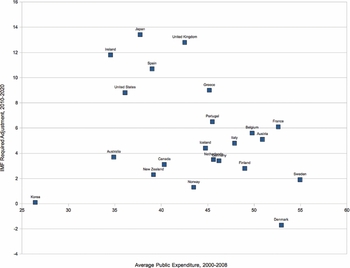
This situation is, the IMF, some governments and parts of the private finance industry have concluded, unsustainable (Farnsworth and Irving, Reference Farnsworth and Irving2012). In the opinion of the IMF, public spending should be reduced and fiscal holes should be plugged in order to solve growing debt problems and the impact on welfare systems will be devastating. Figure 3 plots the IMF's prescribed ‘medicine’ that different countries will need to take between 2010–20. Some of the largest prescribed cuts apply to the very economies that are already the lowest spenders on public expenditure and more recent crisis episodes, in Greece and Spain, accentuate this trend. Countries with the highest historical levels of corporate and social welfare expenditure – Denmark, Sweden, Finland, France, Austria and Belgium – require relatively minor fiscal adjustments or no adjustment at all (indeed, Denmark can afford to increase its expenditure slightly). Thus, the inevitable outcome of the proposed fiscal adjustment will be an even wider gap between states with big government and the welfare laggards. And since it will have a grave impact on social and corporate welfare, this will be likely to have a negative effect on economic growth and social well-being. It may also lead to more serious conflict between trade unions and business associations as both fight to maintain state support, especially in the face of deep spending cuts (Farnsworth, Reference Farnsworth, Farnsworth and Irving2011; Taylor-Gooby, Reference Taylor-Gooby2011). In the UK, the crisis precipitated a massive expansion in corporate welfare and subsequently, in order to try to recover the costs of this increase, as well as to operationalise their own ideological opposition to public provision, the Conservative-led coalition have embarked on a sharp and equally massive contraction in social welfare provision.
IMF required fiscal adjustment and average public expenditure 2000−2008
Source: Author's own calculations based on IMF, 2009 and OECD Revenue Statistics, 1965–2010 (OECD.Stat.Extracts, available at www.stats.oecd.org/).

Conclusion
This paper has argued for a new conceptualisation of welfare systems to incorporate corporate welfare. Direct and indirect public provision that is aimed at private companies accounts for a significant share of state expenditure and the costs of corporate welfare have increased exponentially as a result of the crisis. Analysis of government and public expenditure needs to factor in corporate welfare in order to both create a stronger defence of the state and to more widely and evenly distribute the costs associated with it. This is important particularly in the case of social policy analysis. Corporate welfare assists a diverse range of companies through their life course and plays an important role within nation-states. Indeed, in tackling social problems governments often face a choice between corporate or social welfare solutions or a combination of the two.
Bringing corporate welfare into the analysis of the welfare state does, however, raise a number of questions which require further investigation. Companies require different forms of provision throughout their ‘life course’ and different firms require different forms of assistance. More analysis is required concerning which forms of provision may assist different firms and how much this costs. It is also necessary to investigate in more detail how constellations of corporate welfare fit with various forms and stages of capitalism. For now it is important to conceptually embed corporate welfare into social policy analysis in order to emphasise what we do know: public provision is essential for private corporations and private companies need to pay a higher proportion of the costs of such provision.
Acknowledgements
In putting this paper together, I have benefited from helpful comments received from attendees of the symposium on corporate welfare during the 2012 Social Policy Association Conference. I am especially grateful to Adrian Sinfield, Sally Ruane, Hartley Dean and Ian Gough for their very helpful comments on earlier drafts.