Introduction
Successful invasions can have grave consequences, not only ecologically but also economically. Invaders can change biological interactions, modify the habitat and cause trophic cascades (Goldschmidt et al., Reference Goldschmidt, Witte and Wanink1993; Sakai et al., Reference Sakai, Allendorf, Holt, Lodge, Molofsky, With, Baughman, Cabin, Cohen, Ellstrand, McCauley, O'Neil, Parker, Thompson and Weller2001; Sax et al., Reference Sax, Stachowicz, Brown, Bruno, Dawson, Gaines, Grosberg, Hasting, Holt, Mayfield, O'Connor and Rice2007). Thus a lot of invasive species experience a reduction in selective pressures, allowing them to develop into pests and cause substantial damage to crops (Pimentel et al., Reference Pimentel, Zuniga and Morrison2003; Sax et al., Reference Sax, Stachowicz, Brown, Bruno, Dawson, Gaines, Grosberg, Hasting, Holt, Mayfield, O'Connor and Rice2007).
Fruit flies (Diptera: Tephritidae) are a good model group for ecological research on invasion success. They have high reproductive rates and good (passive) dispersive powers coupled by the global trade in fruit and expanding tourism, enabling them to colonize new areas rapidly. Additionally, by competing strongly and claiming their niche, fruit flies can successfully establish themselves in these new areas (Duyck et al., Reference Duyck, David and Quilici2007).
Bactrocera invadens, a fruit fly from Asia, possesses these qualities and is an invasive pest species in Africa. It is an economically important pest species, for example in its preferred host, mango (Mangifera indica), its infestation can reach up to 505 flies per kg (Mwatawala et al., Reference Mwatawala, De Meyer, Makundi and Maerere2009a ). It also has a daily population increase of 11% and a mean generation time of 31 days, which indicates that the population can double in 6 days (Ekesi et al., Reference Ekesi, Nderitu and Rwomushana2006). Therefore, B. invadens poses a huge threat to mango production and export (Mwatawala et al., Reference Mwatawala, Senkondo, Maerere and De Meyer2005; Ekesi et al., Reference Ekesi, Nderitu and Rwomushana2006).
B. invadens was first detected in Kenya in February 2003 and then Tanzania (Mwatawala et al., Reference Mwatawala, White, Maerere, Senkondo and De Meyer2004) and is now recorded from 27 African countries (Rwomushana et al., Reference Rwomushana, Ekesi, Ogol and Gordon2008a ; De Meyer et al., Reference De Meyer, Robertson, Mansell, Ekesi, Tsuruta, Mwaiko, Vayssieres and Peterson2010). Currently, B. invadens appears to continue spreading, not only in latitude but also in altitude (Ekesi et al., Reference Ekesi, Nderitu and Rwomushana2006; Mwatawala et al., Reference Mwatawala, De Meyer, Makundi and Maerere2006a , Reference Mwatawala, De Meyer, Makundi and Maerere b , Reference Mwatawala, De Meyer, Makundi and Maerere2009a ; Rwomushana et al., Reference Rwomushana, Ekesi, Gordon and Ogol2008b ; Geurts et al., Reference Geurts, Mwatawala and De Meyer2012). Its spread and successful colonization of higher altitudes seems to be limited by climatic conditions (Mwatawala et al., Reference Mwatawala, De Meyer, Makundi and Maerere2006b ; Geurts et al., Reference Geurts, Mwatawala and De Meyer2012), host availability and suitability (Rwomushana et al., Reference Rwomushana, Ekesi, Gordon and Ogol2008b ; Geurts et al., Reference Geurts, Mwatawala and De Meyer2012) and inter-specific competition with cold-tolerant species such as Ceratitis rosa (Mwatawala et al., Reference Mwatawala, De Meyer, Makundi and Maerere2006b ). B. invadens prefers areas at low altitudes with a warm and humid climate (Peña et al., Reference Peña, Mohyuddin and Wysoki1998; Rwomushana et al., Reference Rwomushana, Ekesi, Gordon and Ogol2008b ; De Meyer et al., Reference De Meyer, Robertson, Mansell, Ekesi, Tsuruta, Mwaiko, Vayssieres and Peterson2010) and will have its highest abundance in these areas (Geurts et al., Reference Geurts, Mwatawala and De Meyer2012). It is an extremely polyphagous species that is capable of surviving throughout the year by reproducing both in cultivated and wild fruits (Mwatawala et al., Reference Mwatawala, De Meyer, Makundi and Maerere2006a ). The presence of suitable hosts along an altitudinal gradient affects its density and distribution (Geurts et al., Reference Geurts, Mwatawala and De Meyer2012). Climatic conditions, however, seem to be the main determinant because the abundance of B. invadens remains low even in high-altitude areas where its preferred host, mango, is present (Geurts et al., Reference Geurts, Mwatawala and De Meyer2012). C. rosa, an indigenous African fruit fly, has adapted to cold and wetter circumstances (Duyck & Quilici, Reference Duyck and Quilici2002; Duyck et al., Reference Duyck, David and Quilici2006a ; De Meyer et al., Reference De Meyer, Robertson, Peterson and Mansell2008). It can even be found in the Central Highlands of Kenya (Copeland et al., Reference Copeland, Wharton, Luke, De Meyer, Lux, Zenz, Machera and Okumu2006), in the Cape region of South Africa (Baliraine et al., Reference Baliraine, Bonizzoni, Guglielmino, Osir, Lux, Mulaa, Gomulski, Zheng, Quilici, Gasperi and Malacrida2004) and on the islands of Mauritius and La Réunion (White et al., Reference White, De Meyer and Stonehouse2001). C. rosa was also found to be the dominant fruit fly species in temperate fruits such as peach, apple and pear (Mwatawala et al., Reference Mwatawala, De Meyer, Makundi and Maerere2009b ), which are only grown at high altitudes in Africa. Therefore its better adaptation to the climate and available hosts at high altitudes may favour its presence there, in comparison to B. invadens. However, the genus Bactrocera is renowned for its strong competitive abilities and capacity to largely displace other (indigenous) fruit fly species (Duyck et al., Reference Duyck, David and Quilici 2006a , Reference Duyck, David, Junod, Brunel, Dupont and Quilici b ). B. invadens is larger and more aggressive than Ceratitis species, which gives it an advantage during exploitation and interference competition (Mwatawala et al., Reference Mwatawala, De Meyer, Makundi and Maerere2009b ). Signs of Ceratitis cosyra, a native African fruit fly species, experiencing a competitive pressure have become evident in several African countries (Vayssières et al., Reference Vayssières, Goergen, Lokossou, Dossa and Akponon2005; Ekesi et al., Reference Ekesi, Billah, Peterson, Lux and Rwomushana2009), where numbers of C. cosyra have decreased and it has shifted hosts.
To ascertain how B. invadens can continue spreading, a study along an altitudinal gradient was conducted. In an earlier study along the transect, it was reported that climate, especially temperature, plays a big part in the spread of B. invadens (Geurts et al., Reference Geurts, Mwatawala and De Meyer2012) but also the presence of certain hosts along the transect on a temporal scale seemed to be important. To determine how host species and the presence of other fruit flies in these hosts can influence the spread of B. invadens, relative abundance and infestation ratios of possible fruit fly competitors were evaluated.
Material and methods
Study site
Studies were conducted in the Morogoro Region of Tanzania (S05°58′–10°00′; E35°25′–38°30′) from September 2008 to September 2009. Located in Eastern-Central Tanzania, Morogoro has a subtropical climate and is situated in the transition zone between the bimodal and unimodal rainfall belts of Tanzania (Mwatawala et al., Reference Mwatawala, De Meyer, Makundi and Maerere2006a ).
The transect lies in an embranchment of the Uluguru Mountains, which are part of the Eastern Arc Mountains. The vegetation consists of cultivated land as polycultures and by terracing (maize, sugar cane and beans), fruit orchards (mango, citrus, peach, apple, jambolan, avocado, papaya, feijoa and guava, depending on altitude) and fallow land overgrown with grasses and shrubs.
Trapping of fruit flies
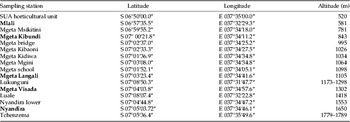
Traps (modified McPhail® traps; Scentry Cie, Bilings, MT, VS) were set from September 2008 until September 2009 at five trapping stations at similar intervals along a transect between 500 and 1650 m (table 1). Traps were hung on fruit trees, usually mango, except at the high-altitude sites, where traps were also hung in peach (Visada and Nyandira), plum (Nyandira) and apple (Nyandira) trees. They were baited with one of four different parapheromones, each attracting a different part of the fruit fly diversity in the region (Mwatawala et al., 2006b): methyl eugenol (ME), cue lure (CL), terpinyl acetate (TA) and trimedlure (TM). Where required, sticky glue was applied on the branches to prevent ant predation. At every trapping station there were three replicate sets of traps. Each set consisted of four traps, each with a different lure and a killing agent dichlorovos (vapona). The traps were activated (baited with lure and insecticide) for 1 week and after this period were emptied and then reactivated after a period of 3 weeks, during which the traps did not contain any lure or insecticide. The captured flies for each sample were uniquely coded, and brought to the lab where the specimens were counted and identified and finally preserved in 70% ethanol.
Geographical position of sampling stations (low to high) (trapping stations in bold).

Rearing of fruit flies
Fruits were collected following the protocol used by Copeland et al. (Reference Copeland, Wharton, Luke and De Meyer2002) at the trapping sites and at other sampling sites (table 1) along the transect and this was repeated every 2 weeks, from October 2008 to February 2009. Selection of fruit species was based on earlier rearing experiments (Mwatawala et al., Reference Mwatawala, De Meyer, Makundi and Maerere2009a ) and with an emphasis on preferred B. invadens hosts. The collection of fruits was highly dependent on the seasonality and availability of ripe fruits. The fruit samples were taken to the horticulture unit of the Sokoine University of Agriculture (SUA) in Morogoro (situated at 520 m) and were exposed to similar room temperature and humidity as outside. Fruit was kept for 4 weeks; large fruits were kept for 2 weeks longer. Sand was checked every 3 or 4 days for pupae. Emerging adults were removed from a rearing cage and kept in 70% ethanol.
Statistical analysis
Using the species and the abundance of fruit flies found in the traps the Simpson's diversity index (D) was calculated, because this index considers the number of present species together with the absolute abundance for each species. It was calculated as follows:
 $$D = \sum {\left( {\displaystyle{{n_i (n_i - 1)} \over {N(N - 1)}}} \right)} $$
n i is the number of individuals of the i th species and N is the total number of individuals. D varies between 1 and 0, indicating low and high diversity, respectively. This means that there is an inverted relationship; a high number on the index signifies a lower diversity. The fruit species collected every month and the presence of fruits on the trees when emptying the traps were used as an indicator of most common host presence along the transect (data shown in Supplementary appendix 1).
For fruit flies reared from fruits, the infestation ratio (number of adult fruit flies per kg of fruit) for every host collected at every altitudinal location (averaged over batches at different collection times) was calculated. Incidence (number of positive samples/total number of samples collected for each fruit species) and species composition were also verified for each fruit species.
Total infestation ratios per fruit fly species (calculated by averaging the infestation ratios per fruit fly species for every host collected, at every altitudinal location, thus pooling infestation ratios per fruit fly species across different hosts and altitudinal locations) were compared using a χ2 test and Mann–Whitney U test.
The trapping and rearing data were further analysed using generalized linear models performed in the statistical program R version 2.15.2 (R Core Team, 2012), using the package glmmADMB version 0.7.3 (Fournier et al., Reference Fournier, Skaug, Ancheta, Ianelli, Magnusson, Maunder, Nielsen and Sibert2012; Skaug et al., Reference Skaug, Fournier, Nielsen, Magnusson and Bolker2012). Infestation data were fitted with a generalized linear model with a Poisson error distribution (data constrained above zero) and Simpson diversity index data with a logistic regression (data varying between 1 and 0) using altitude, time (month when traps were sampled and collection week of fruits reared), host presence and the abundance of possible competitive fruit fly species as explanatory variables. Time was added as a variable as collection of fruits occurred non-randomly in time depending on their availability and the presence of fruit flies in traps could be influenced by the seasonality of environmental conditions during a yearlong sampling period and host availability of uncommon fruits not considered in the model.
Results
Variation in diversity and abundance of fruit flies captured in traps
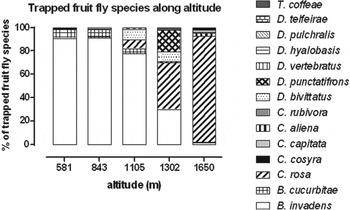
Along the transect 14 fruit fly species were trapped (fig. 1). The five species most abundantly found in the traps and being possible competitors were: C. rosa, C. cosyra, Dacus bivittatus, Bactrocera cucurbitae and B. invadens. The logistic model showed that in areas at intermediate altitude and areas where C. cosyra was present in higher abundance there was a higher fruit fly diversity (table 2). However, when peach and C. rosa were present in high abundance, diversity decreased (table 2). These effects are illustrated in fig. 1. Areas at higher altitude had a higher species richness and a higher evenness in abundance which results in a higher species diversity for the Simpson's index (explicitly using abundance in its calculation). For example at 1305 m there were seven fruit fly species with relatively similar abundances, whereas at 1650 m species richness was eleven, with C. rosa being the most abundant species, which resulted in lower evenness and a lower diversity index value.
Relative abundance of different trapped fruit fly species along altitudinal transect.

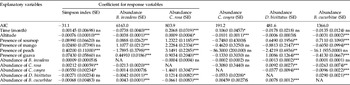
Results from logistic (for Simpson index) and Poisson regression (for common fruit fly abundances) modelling the variation in fruit fly diversity and abundance with time, altitude, host and competitor presence using data from traps.

P<0.0001***, P<0.001**, P<0.05*, P<0.1$, ns=non-significant.
The abundance of B. invadens significantly declined over time, with increasing altitude, where peach was present and where C. rosa was abundant (table 2) and increased where mango, guava and soursop were present. The abundance of C. rosa was not significantly affected by the presence of B. invadens and increased with time, altitude (P=0.04), the presence of soursop, mango, peach and guava. The abundance of C. cosyra was also not significantly affected by the abundance of B. invadens but significantly declined with increasing altitude.
Variation in infestation ratio of fruit flies reared from collected hosts
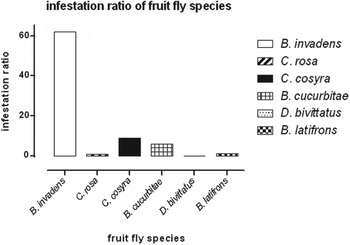
In total 2891 fruits were collected weighing 110.727 kg. Six fruit fly species were reared from the fruit batches collected over different times and altitudes: B. invadens, C. rosa, C. cosyra, B. cucurbitae, D. bivittatus and Bactrocera latifrons (Supplementary appendix 2). The infestation ratios averaged across altitudes, collection weeks and hosts differed significantly between fruit flies (χ2 1,5=41.93; P<0.001). B. invadens had the highest infestation ratio (fig. 2) and was significantly different from all other fruit fly species (table 3).
Total infestation ratio of different fruit fly species.

Mann–Whitney U test results for comparison of total infestation ratios per fruit fly species.

Significance level: <0.001=***, <0.01=**, <0.05=*.
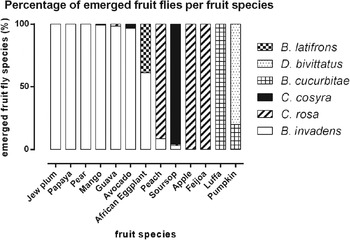
Different fruit fly species were found in specific hosts (Supplementary appendix 2 and fig. 3). However, not all fruit flies shared the same hosts (fig. 3). B. cucurbitae and D. bivittatus were the only species that were reared from pumpkin. African eggplant was the only host utilized by both B. invadens and B. latifrons. Avocado and mango were shared between B. invadens and C. cosyra. B. invadens was found together with C. rosa in guava and peach. Soursop was the only fruit where three fruit fly species were reared from: B. invadens, C. rosa and C. cosyra.
Infestation ratio in different hosts by different fruit fly species.

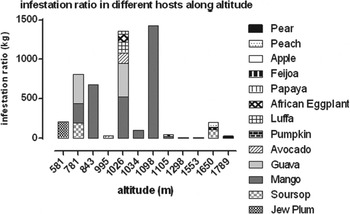
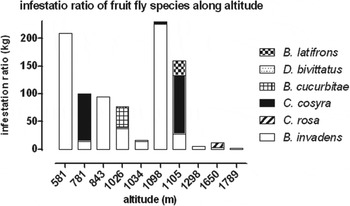
Most fruit fly species seemed to do well at lower altitudes, especially B. invadens, which reached its highest abundance in mango (1098 m) and guava (781 m) (figs 3 and 4 and Supplementary appendix 2). C. cosyra also emerged in large numbers from soursop collected at 781 m. Other fruit fly species were more abundant at higher altitudes (fig. 5 and Supplementary appendix 2). C. rosa had its highest infestation ratio in peach at 1650 m. Although B. invadens occurred across the entire altitudinal range, its infestation at high altitudes was low, such as in peach (1650 m) and pear (1789 m) (Supplementary appendix 2). Nonetheless, this means that B. invadens was infesting fruits up to 1789 m in altitude.
Infestation ratio along an altitudinal gradient.

Infestation ratio of different fruit fly species along an altitudinal gradient.

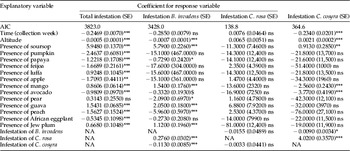
In order to evaluate these patterns, generalized linear models were run. A first model showed that total fruit fly infestation was negatively affected by altitude, time and the presence of pumpkin, papaya, feijoa, apple, avocado, peach and African eggplant (table 4). The presence of soursop, luffa, mango, pear, guava and Jew plum increased total fruit fly infestation (table 4).
Results from Poisson regression modelling the variation in infestation ratios of three common fruit fly species with time, altitude, host and competitor presence using fruit rearing data.

P<0.0001***, P<0.001**, P<0.05*, P<0.1$, ns=non-significant.
As we were most interested in how the infestation of B. invadens affected other fruit fly species, analyses were only run for species that actually emerged from the same fruit samples with B. invadens, i.e., C. rosa and C. cosyra (table 4). B. latifrons was reared from the same host that was also infested by B. invadens but they were not reared together from the same actual fruit sample.
The infestation of B. invadens increased with the presence of mango, soursop, guava and Jew plum and with increasing infestation by C. rosa and declined with time, altitude, the presence of papaya, pear and peach, and the increasing infestation by C. cosyra. The infestation of C. rosa was not significantly impacted by any variable (table 4). The infestation of C. cosyra was positively influenced by increasing altitude, the presence of soursop and C. rosa. Time, the presence of mango, avocado and the infestation of B. invadens decreased infestation ratio of C. cosyra (table 4).
Discussion
The general diversity and species richness in traps increased with altitude. The abundance of C. rosa negatively influenced diversity because it occurred in high abundance in peach at these higher altitudes and therefore lowering evenness and diversity (table 2). B. invadens did not have a significant impact on diversity because it was most abundant at lower altitude where diversity was low. This is possibly caused by overdominance by this fruit fly species (Mwatawala et al., Reference Mwatawala, De Meyer, Makundi and Maerere2009b ). It can also be the reason why C. cosyra was found to have a positive influence on the diversity because usually where C. cosyra was abundant, B. invadens was not. This was not an effect of direct competition as the abundance of B. invadens was not significantly influenced by C. cosyra in the second model (table 2). The highest evenness could be noticed at intermediate altitudes (fig. 1: 1302 m) where other fruit fly species could escape competition from both B. invadens and C. rosa.
In general fruit fly infestation was determined by altitude and the presence of host species where B. invadens was most abundant, as this species had the highest infestation ratio and therefore the entire fruit fly infestation was skewed towards its presence (fig. 2). Overall, the abundance and the infestation of B. invadens were influenced by the presence of its preferred host species (mango, guava and soursop) (Mwatawala et al., Reference Mwatawala, De Meyer, Makundi and Maerere2006a ) and the presence of its direct competitor C. rosa (tables 2 and 3). They were reared from the same fruits and especially in peach at higher altitudes, C. rosa appeared dominant (figs 4 and 5, Supplementary appendix 2). However the infestation ratio of B. invadens did not seem to be negatively affected by C. rosa (table 4). This could be caused by the fact they shared few host species and therefore the infestation by C. rosa did not affect the average infestation by B. invadens negatively. C. cosyra on the other hand did have a negative effect on the infestation by B. invadens (table 4). These species shared more host species and especially in soursop at higher altitudes C. cosyra kept its dominance (fig. 3).
The abundance and infestation of C. rosa did not seem to be significantly affected by the abundance of B. invadens, this is probably due, as mentioned previously, to its dominance in other high altitude fruit hosts (such as peach and apple, fig. 3) and therefore by nutritional and spatial segregation coexistence could be maintained.
The infestation by C. cosyra was negatively affected by B. invadens and this was especially true in mango and avocado (table 4). However, when analysing the abundance of C. cosyra in traps, it was not significantly affected by the abundance of B. invadens (table 2). This might be due to a host shift of C. cosyra to soursop, in which it is more successful and thus avoiding strong competition (Mwatawala et al., Reference Mwatawala, De Meyer, Makundi and Maerere2009a ).
The presence of suitable hosts and the competition between fruit fly species seem decisive for diversity along the altitudinal transect, although climatic suitability cannot be neglected (Geurts et al., Reference Geurts, Mwatawala and De Meyer2012).
At low altitude the high abundance and infestation of B. invadens in a lot of different fruit species make it a serious pest (figs 1 and 3 and Supplementary appendix 2) (Mwatawala et al., Reference Mwatawala, De Meyer, Makundi and Maerere2006a ; Rwomushana et al., Reference Rwomushana, Ekesi, Ogol and Gordon2008a ). Its detection in papaya is an addition to its range of possible hosts (Mwatawala et al., Reference Mwatawala, De Meyer, Makundi and Maerere2006a ).
At high altitude B. invadens still occurred in very low numbers, but it seems as though colonization has been initiated. It is reproducing in fruits, such as peach and pear, which only occur at high altitude. If this species is capable of further adapting to life at high altitudes it might replace C. rosa in the same manner as it has replaced C. cosyra and continue to spread throughout the altitudinal range.
B. invadens is a fruit fly with a high invasive potential. Although the high reproductive rate and population increase indicate r-selection (Ekesi et al., Reference Ekesi, Nderitu and Rwomushana2006; Geurts et al., Reference Geurts, Mwatawala and De Meyer2012) competition with the present fruit fly fauna indicate K-selection (Mwatawala et al., Reference Mwatawala, De Meyer, Makundi and Maerere2009b ). Those are ideal characteristics to allow for further spread and colonization of new areas (Duyck et al., Reference Duyck, David and Quilici2007). The broad climate range and host range of B. invadens (Mwatawala et al., Reference Mwatawala, De Meyer, Makundi and Maerere2006a , Reference Mwatawala, De Meyer, Makundi and Maerere2009a ; Rwomushana et al., Reference Rwomushana, Ekesi, Gordon and Ogol2008b ; Geurts et al., Reference Geurts, Mwatawala and De Meyer2012) increase the chances for further spread not only to higher areas, but also for example to subtropical regions (De Meyer et al., Reference De Meyer, Robertson, Mansell, Ekesi, Tsuruta, Mwaiko, Vayssieres and Peterson2010; Geurts et al., Reference Geurts, Mwatawala and De Meyer2012).
The supplementary materials for this article can be found at http://www.journals.cambridge.org/BER
Acknowledgements
The authors would like to thank Amon Maerere, Frank Senkondo, Resta Maganga and Kille Kiraba for their help with practical and field work, and the people who live in the study area for their kind cooperation. The Flemish Inter-University Council VLIR, awarded a travel grant to Katrien Geurts. We also acknowledge the support from the Belgian Development Co-operation through the Framework Programme with the Royal Museum for Central Africa (RAAC Project).