INTRODUCTION
In Ethiopia, 97% of agricultural production depends on rainfed systems and the variability in rainfall makes farming risky (Blocka et al., Reference Blocka, Strzepekb, Rosegrantc and Diaoc2008). Agricultural technologies which can mitigate the impact of the high seasonal rainfall variability on crop production in Ethiopia are imperative to improve the livelihoods of marginal farmers (Biazin and Stroosnijder, Reference Biazin and Stroosnijder2012; Kassie et al., Reference Kassie, Hengsdijk, Rötter, Kahiluto, Asseng and Ittersum2013; Sime et al., Reference Sime, Aune and Mohammed2015). The heavy dependence on low external inputs (Conway and Schipper, Reference Conway and Schipper2011; Demeke et al., Reference Demeke, Keil and Zeller2011) and widespread land degradation have further impaired the agricultural practice in Ethiopia (Haileslassie et al., Reference Haileslassie, Priess, Veldkamp, Teketay and Lesschen2005; Nyssen et al., Reference Nyssen, Temesgen, Lemenih, Zenebe, Haregeweyn and Haile2008).
The central rift valley (CRV) region in Ethiopia, where this study was conducted is one of the most climatically vulnerable areas with arid and semiarid land and frequent droughts (Garedew et al., Reference Garedew, Sandewall, Söderberg and Campbell2009; Meshesha et al., Reference Meshesha, Tsunekawa and Tsubo2012). Increasing population and livestock pressures on limited resources, traditional farming system and poverty are major factors causing increased land use, changes in vegetation cover and severe degradation in the region (Garedew et al., Reference Garedew, Sandewall, Söderberg and Campbell2009; Meshesha et al., Reference Meshesha, Tsunekawa and Tsubo2012). The expanding land degradation has decreased agricultural productivity, which further exacerbated food insecurity and poverty in the region (Garedew et al., Reference Garedew, Sandewall, Söderberg and Campbell2009; Meshesha et al., Reference Meshesha, Tsunekawa and Tsubo2012).
Despite the marginal agroecological conditions, farmers in the region are resource-poor and have financial constraints to use increased external inputs like fertilizers and improved seeds in crop production (Kassie et al., Reference Kassie, Hengsdijk, Rötter, Kahiluto, Asseng and Ittersum2013). Low cost, low risk and environmentally friendly technologies could motivate farmers to use external inputs in maize production. Such technologies could include decreasing certain inputs; for example, the microdosing method which is the use of more effective application of small amounts of fertilizer in the pocket beside seeds, and the use of row sowing method that saves the expensive seeds and fertilizers (Sime and Aune, Reference Sime and Aune2014), and better targeting early maturing and drought tolerant varieties of maize (Sime and Aune, Reference Sime and Aune2014; Sime et al., Reference Sime, Aune and Mohammed2015). Each of these technologies were reported to yield a promising significance in the agronomic and economic responses in maize production (Sime and Aune, Reference Sime and Aune2014; Sime et al., Reference Sime, Aune and Mohammed2015). Furthermore, such technologies have been identified as promising low-cost methods for increasing agricultural productivity in dryland areas of the Sahel (Aune and Bationo, Reference Aune and Bationo2008). In the current study, these technologies were differently packaged, designed and sequenced to further improve the agronomic and economic responses in maize while making maize productive more adaptive to the prevailing seasonal rainfall variability in the region. The ‘ladder approach’ can be considered as a way to provide such technology options in agricultural systems (Aune and Bationo, Reference Aune and Bationo2008). The ‘ladder approach’ shows the relationship between increasing levels of inputs and outputs. Various packages of these technologies at different levels of a ladder may intensify the productivity of maize and hence the economic benefits of farmers. The objective of this study was therefore to examine the additional productivity of maize that can be obtained by sequentially introducing the technologies of minimum tillage and seed priming, pocket application of phosphorus (P) fertilizer, surface mulching and application of nitrogen (N) fertilizer.
MATERIALS AND METHODS
Description of the study sites
The research sites, Ziway and Melkassa, are situated at 7°9′N and 38°43′E and 8°4′N and 39°31′E respectively, at 1642 and 1550 m.a.s.l. in the CRV of Ethiopia. They are characterized as semi-arid agro-ecological zones (Garedew et al., Reference Garedew, Sandewall, Söderberg and Campbell2009; Meshesha et al., Reference Meshesha, Tsunekawa and Tsubo2012). The soil in the CRV of Ethiopia is poor in fertility (Biazin and Stroosnijder, Reference Biazin and Stroosnijder2012; Temesgen et al., Reference Temesgen, Rockstrom, Savenije, Hoogmoed and Alemu2008) and is shallow soil with frequent crusting and plow pans (Biazin and Stroosnijder, Reference Biazin and Stroosnijder2012). The rainfall condition exhibits high intra-seasonal variability with a coefficient of variation of 15–40%, and temperature increased significantly (0.12–0.54°C per decade) over the past 30 years (Kassie et al., Reference Kassie, Rötter, Hengsdijk, Asseng, van Ittersum, Kahiluto and van Keulen2014).
Ziway has a well-drained clay loam soil (Sime et al., Reference Sime, Aune and Mohammed2015). The total amount of rainfall received over 2011 and 2012 was 598 and 857 mm respectively. The total amount of annual rainfall received during the experimental period of the 2011/2012 and 2012/2013 cropping seasons (June to October) was 434 and 732 mm, which is 73 and 85% of the total annual rainfall received, respectively. Melkassa has a well-drained loam soil (Sime et al., Reference Sime, Aune and Mohammed2015). The total amount of annual rainfall received over 2011 and 2012 was 923 and 924 mm, respectively. The total amount of rainfall received during the experimental period (June to October) for the same years was 685 and 822 mm, which is 74 and 89% of the total annual rainfall received respectively.
The rainfall data were obtained from meteorological stations at the Adami Tullu (in Ziway) and Melkassa Agricultural Research Centers for the Ziway and Melkassa experiments, respectively.
Crop production, mainly rainfed, cereal-based production systems and modest livestock rearing are the mainstays of livelihoods for farmers in the CRV. Maize is the major crop cultivated with significant role in the livelihoods of smallholders in the CRV (Biazin and Stroosnijder, Reference Biazin and Stroosnijder2012). There are two overlapping seasons for crop production. The first season usually extends from April to September depending on the onset of rain while the second season, which is the main rainy season, extends from June to October. July and August are the wettest months. Mid-maturing maize (Zea mays L.) is the main crop for the first (and longer) season while haricot bean (Phaseolus vulgaris L.), wheat (Triticum aestivum L.) and teff (Eragrostis tef (Zucc.) Trotter) are the main crops for the second season. Early-maturing maize is cultivated during both seasons.
Treatments, experimental design and procedures
On-station and on-farm experiments of maize were conducted for two successive years. The on-station experiments were undertaken in Ziway and Melkassa for the cropping seasons of 2011/2012 and 2012/2013. During the same cropping seasons, the on-farm experiment was conducted at Ziway in three villages with nine farmers.
There were five steps, levels or treatments both in the on-station and on-farm experiments:
-
1. Farmers practice as a control (CTc): CT (4 passes with plough) + non-primed maize seed + no fertilizer.
-
2. Step 1 (MP): Minimum tillage (1 pass with plough) + primed maize seed + no fertilizer.
-
3. Step 2 (MPM): Minimum tillage + primed maize seed + 53 kg ha−1 P fertilizer applied at planting.
-
4. Step 3 (MPMM): Minimum tillage + primed maize seed + 53 kg ha−1 P fertilizer applied at planting + 4 ton ha−1 mulch.
-
5. Step 4 (MPMMU): Minimum tillage + primed maize seed + 53 kg ha−1 P fertilizer applied at planting + 4 ton ha−1 mulch + 53 kg ha−1 N fertilizer applied at maize knee height.
The sources of P and N fertilizer were diammonium phosphate (DAP) and urea respectively.
The first level in the ladder represented farmers practice, whereas the other steps were used to give farmers different technology options in maize production (Figure 1). Most of these technologies are cost-saving technologies besides their potential to mitigate the effects of seasonal rainfall variability on maize production. Except seed priming, the individual effects of these technologies on maize production were studied in the same sites during the same period (Sime and Aune, Reference Sime and Aune2014; Sime et al., Reference Sime, Aune and Mohammed2015). At the same time, the same research team was interested to investigate the sequential effects of these technologies as a package on the agronomic and economic responses in maize. The choice of technologies was based on the major production constraints in the study area. They were packaged and sequenced in the order of the production costs, importance of inputs and level of availability of inputs. Minimum tillage was introduced as an option to conventional tillage with more tillage requirement and rental costs (Aune et al., Reference Aune, Bussa, Asfaw and Ayele2001; Sime et al., Reference Sime, Aune and Mohammed2015). In Ethiopia, fertilizer is expensive to most farmers, despite its unavailability and traditional way of application (CSA, 2008; Spielman et al., Reference Spielman, Byerlee, Alemu and Kelemework2010). Due to high prices, the use of urea is limited as a result, there is a failure to use DAP and urea in proper combinations (Endale, Reference Endale, Gebre-ab and Dorosh2010). This was the reason for the introduction of the fertilizer microdosing method, the pocket application of fertilizers beside seeds, which saves fertilizers besides increasing crop fertilizer use efficiency (Aune and Bationo, Reference Aune and Bationo2008; Sime and Aune, Reference Sime and Aune2014). The other constraint to maize production in relation to the impact of rainfall variability include poor seed germination, seedling establishment and partial or complete crop failure, that was the reason for the introduction of on-farm seed priming as an option for dry seed sowing. Seed priming is cheap and does not add any expenditure to farmers (Aune and Bationo, Reference Aune and Bationo2008) and improves maize establishment and yields in semiarid agriculture (Harris et al., Reference Harris, Joshi, Khan, Gothkar and Sodhi1999). Yield losses or no yield benefits are likely in the short-term practice of conservation tillage, which may need up to 10 years (Giller et al., Reference Giller, Witter, Corbeels and Tittonell2009). This was the reason for cofounding minimum tillage with seed priming. Mulching was used earlier than urea, because it is cheaper and more available to most farmers which otherwise would have been brought to the end of the ladder. It was introduced as part of the technologies to mitigate the effect of seasonal rainfall variability on maize production. In this regard, mulching was reported to give a promising significance to maize production in the region (Sime et al., Reference Sime, Aune and Mohammed2015).
A ladder showing different level of inputs as package of technologies.

The crop tested was drought tolerant early maturing variety of maize (Z. mays L. var. Melkassa-2). Maize seed was primed by soaking in water for 12 hours, then surface drying for 2 hours on dry cloth and being kept under shade and sowed immediately. Fertilizer and seeds were applied in two separate operations.
The plot size was 3 m× 4.5 m (13.5 m2). The spacing was 75 cm between rows and 25 cm between plants. The seed rate was 27 kg ha−1. The treatments were arranged in a randomized complete block design with four replications. The blocks were separated by a 1.5 m wide open space. Hand weeding was undertaken using a local hand hoe three and six weeks after planting. Permanent plots were used for the entire period of the experiments. Mulched treatments retained their maize stalks as mulching. A 4 ton ha−1 mulch was applied based on Matsumoto et al. (Reference Matsumoto, Plucknett and Mohamed2004) to control weed and increase soil moisture in the drylands of Ethiopia.
The different treatments presented above can be considered as different levels in the ladder approach (Aune and Bationo, Reference Aune and Bationo2008). There were four levels in the ladder to intensify the productivity of maize. The inputs were successively added to the first, second, third and fourth level in the ladder (Figure 2).
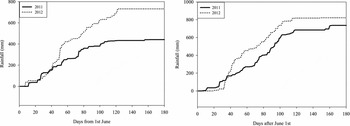
Cumulative rainfall (mm) at Ziway (left) and Melkassa (right) during the experimental period from first of June to November of 2011 and 2012.

Farmers at the study sites actively participated in the planting, weeding and harvesting; providing the main source of labour. The on-farm experiments were managed mainly by farmers and partly by researchers, following jointly agreed protocols.
Agronomic data measurements
The major agronomic data collected include days to emergence, pocket seed germination (50%), seedling vigour (rated 1–5 where: 1 = poor, 2 = low, 3 = moderate, 4 = vigorous, 5 = very vigorous), days to tassel (50%) and to physiological maturity (75%), lodging count, plant height (cm), and grain and stover yield (kg ha−1). Plants fallen, inclined or with broken stalk were considered as lodged. Plant height was measured from the ground level to the base of the tassel for five randomly selected plants per plot. Biomass weight was taken after sun drying for 8 days. Threshing was done manually. To avoid border effects, data of all the parameters were taken from the four central rows, thus, the net plot size was 9 m2. After harvesting cobs, for each treatment, cobs were shelled, weighed and grain moisture content was measured immediately by a multigrain digital moisture meter. Eventually, the grain yield weight was adjusted at 12.5% moisture level. Yield was extrapolated and then reported on a hectare basis.
Economic data measurements
The agronomic efficiency, risk and profitability of using fertilizers were assessed by calculating the fertilizer use efficiency (FUE), value cost ratio (VCR) and gross margin (GM).
Agronomic fertilizer use efficiency
The agronomic FUE of each treatment was computed as the difference in yield (kg ha−1) between each treatment and control divided by the amount of fertilizer applied (kg ha−1).
 \begin{equation*}
FUE = \frac{{Yt \times Ct}}{{Ft}},
\end{equation*}
where FUE is the agronomic fertilizer use efficiency of treatment t; Yt is the grain yield of treatment t; Ct the grain yield of the control treatment; and Ft is the rate of fertilizer used for treatment t.
Economics of fertilizer use
Standard enterprise budgeting techniques were used to estimate production costs and profitability. GM and VCR were used for the analysis of profitability of each treatment. Average labour cost for the various farm activities of planting, fertilizer application, mulching, weeding and harvesting was estimated as person−1 day−1. Oxen rental cost for one pass was estimated at 11 US$ ha−1. The input costs of maize seeds and fertilizer DAP and urea kg−1 was estimated at 1.14, and 0.82 and 0.63 US$ respectively at the local market. The price of grain, averaged over 2011 and 2012, was estimated at 0.23 US$ kg−1 at local markets. Gross income (GI) was calculated from grain price. Labour cost was estimated at 1.64 US$ person−1 day−1 across the sites (the average rate paid by research institutions and private organizations). The study sites have similar input and output markets. Total variable cost (TVC) was calculated as the sum of labour and input costs. Monetary values related to costs and incomes were converted from Ethiopian Birr at the exchange rate of one US$ to 18.24 Ethiopian Birr.
For each treatment, the GM was calculated as follows:
 \begin{equation*}
{\rm GM} = {\rm GI} - {\rm TVC}
\end{equation*}
The VCR was calculated as follows:
 \begin{equation*}
{\rm VCR} = \frac{{\Delta Y \times p}}{{Cf}},
\end{equation*}
Where ΔY denotes incremental grain yield resulting from treatment, p denotes grain yield price kg–1, and Cf denotes fertilizer cost ha–1.
The VCR for each treatment measures the increase in revenue relative to the increased cost of fertilizer compared to the control treatment.
Statistical analyses
The SAS System (Version 9.3) from SAS Institute Inc. (SAS, 2011) was used for the statistical evaluation of treatment effects on maize yield and yield characteristics compared to the control. To determine statistical significances between differences in means of the treatments, analyses of variance were carried out. Wherever there were significant differences, mean separations were carried out using least significant difference (LSD). Significant differences between means of treatments were determined at 5% significance level (p value < 0.05). Unless mentioned in the text, only significant differences between means of treatments were reported.
RESULTS
Increasing levels of inputs, yield characteristics and yield in maize
Different levels of input use were tested according to the ladder approach (Aune and Bationo, Reference Aune and Bationo2008). It was found that increasing levels (Figure 1) of intensification improved crop characteristics and maize yields (Tables 1 and 2), FUE and VCR (Table 3) and economic profitability (Tables 4 and 5). Dry spells and end of season drought could also affect maize yields (Figure 2).
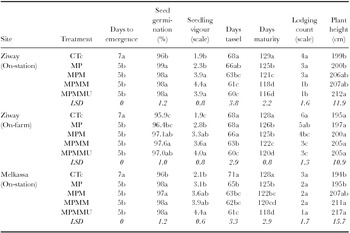
Average maize yield characteristics in response to minimum tillage, seed priming, fertilizer microdosing and mulching.

Means in the same column with same letter are not significantly different at p value < 0.05.
Key: CTc = conventional tillage with no priming, farmers practice; MP = minimum tillage with seed priming, MPM = minimum tillage, seed priming and microdosing of DAP; MPMM = minimum tillage, seed priming, microdosing of DAP; and mulching and MPMMU = minimum tillage, seed priming, microdosing of DAP, mulching and urea.
Seedling vigour (1–5 scores where: 1 = poor, 2 = low, 3 = moderate, 4 = vigorous, 5 = very vigorous).
Lodging count refers to number of plants fallen, inclined or with broken stalk.
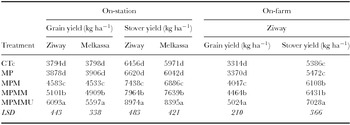
Average maize grain and stover yields in response to minimum tillage, seed priming, fertilizer microdosing and mulching.

Means in the same column with same letter are not significantly different at p value < 0.05.
Key: CTc = conventional tillage with no priming, farmers practice; MP = minimum tillage with seed priming; MPM = minimum tillage, seed priming and microdosing of DAP; MPMM = minimum tillage, seed priming and microdosing of DAP and mulching; and, MPMMU = minimum tillage, seed priming and microdosing of DAP, mulching and urea.
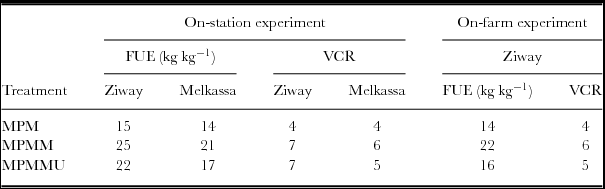
Average agronomic fertilizer use efficiency (FUE) and value cost ratio (VCR) in response to fertilizer microdosing.

Key: MPM = minimum tillage, seed priming and microdosing of DAP; MPMM = minimum tillage, seed priming and microdosing of DAP and mulching; and, MPMMU = minimum tillage, seed priming and microdosing of DAP, mulching and urea.
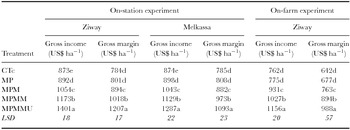
Average gross income and gross margin in response to minimum tillage, seed priming, fertilizer microdosing and mulching.

Means in the same column with same letter are not significantly different at p value < 0.05.
Key: CTc = conventional tillage with no priming, farmers practice; MP = minimum tillage with seed priming; MPM = minimum tillage, seed priming and microdosing of DAP; MPMM = minimum tillage, seed priming and microdosing of DAP and mulching; and, MPMMU = minimum tillage, seed priming and microdosing of DAP, mulching and urea.
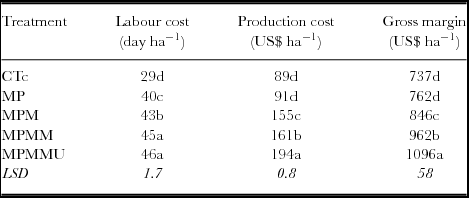
Average production cost, gross margin and labour in response to the sequential use of minimum tillage, seed priming, fertilizer microdosing and mulching over sites and experiments.

Means in the same column with same letter are not significantly different at p value < 0.05.
Key: CTc = conventional tillage with no priming, farmers practice; MP = minimum tillage with seed priming; MPM = minimum tillage, seed priming and microdosing of DAP; MPMM = minimum tillage, seed priming and microdosing of DAP; and mulching and MPMMU = minimum tillage, seed priming and microdosing of DAP, mulching and urea.
-
Step 1: Addition of seed priming and minimum tillage
-
Compared to farmers’ practice, the package of minimum tillage and seed priming improved days to emergence (DEM), pocket seed germination (GERM), while reduced days to physiological maturity (DMAT) in on-station experiments at both sites as well as days to tassel (DTAS) at Melkassa. This package improved DEM and seedling vigour (VIG) and reduced DMAT in on-farm experiment (Table 1).
-
Step 2: Addition of P fertilizer to step 1
-
Compared to farmers’ practice, the package of minimum tillage, seed priming and application of P increased DEM, GERM and VIG and reduced DTAS and DMAT in on-farm and on-station at Ziway as well as improved VIG in on-station at Ziway and reduced plant lodging (LODG) at Melkassa. It increased VIG and reduced DMAT in on-station at Ziway compared to the preceding step (Table 1). This technology package also improved maize yields both in on-station and on-farm compared to farmers’ practice and the package in the preceding step. The addition of P fertilizer to the previous step further improved maize yields in on-farm and on-station (Table 2).
-
Step 3: Addition of surface mulching to step 2
-
Compared to farmers’ practice, the package of minimum tillage, seed priming, application of P and mulching improved all the average maize yield characteristics except plant height (PH) in on-farm and on-station at Ziway. At Melkassa, likewise, this package improved all these characteristics except VIG and LODG in on-station. Compared to the package in step 1, VIG, DTAS, DMAT and LODG were improved in on-station and on-farm with improved GEM in addition to in on-farm at Ziway. Likewise, DTAS, DMAT and PH were improved in on-station at Melkassa. Compared to the package in step 2, DMAT and LODG in on-station experiments and DTAS and DMAT in on-farm were improved at Ziway (Table 1). This technology package also improved maize yields both in on-station and on-farm compared to farmers’ practice and all packages in the preceding steps (Table 2). Compared to the previous step, the addition of mulching had further improved maize yields in on-farm and on-station.
-
Step 4: Addition of N fertilizers to step 3
-
Compared to farmers’ practice, the addition of N to the variable inputs in step 2, i.e., the package of seed priming, P fertilizer application and mulching, improved most of the maize yield characteristics in both in on-station and on-farm except PH in on-farm and LODG at Melkassa. Compared to the package in step 1, VIG, DTAS, DMAT, LODG and PH in on-station at Ziway, VIG, DTAS, DMAT and LODG in on-farm and VIG, DTAS, DMAT and PH in on-station were improved at Melkassa. Compared to the package in step 2, this package improved DMAT and LODG at Ziway and DMAT at Melkassa in on-station and DMAT in on-farm. Similarly, the package in this step improved DTAS and DMAT in on-farm (Table 1). This technology package also improved maize yields both in on-station and on-farm compared to farmers’ practice and all other packages in the preceding steps (Table 2). The addition of N to the technology packages in the preceding step further improved maize yields both in on-farm and on-station compared to the technology package in the preceding step (Table 2).
Compared to farmers practice, the improvement in maize establishment (DEM, GERM and VIG) and the reduction in DTAS, DMAT and the improvement in yields appeared to favourably affect farmers’ livelihood by making maize production more adaptive to the prevailing seasonal rainfall variability. Farmers frequently suffer poor crop establishment and re-sowing. There was frequent short-term dry spells occurring during the growing seasons (Figure 2). For instance, earlier maturity would help plants to avoid the end of season drought in September (Figure 2).
Fertilizer use efficiency and economic responses
The package of seed priming, minimum tillage and application of 53 kg ha−1, P fertilizer generated an FUE value ranging from 14 to 15 across experiments (Table 3). The VCR value was 4 across experiments. The FUE and VCR were further increased with the application of mulching in step 2. The FUE value was between 21 and 25 in on-station experiments and was 22 in on-farm. Similarly, the VCR value was between 6 and 7 in on-station and 6 in on-farm. The application of 53 kg ha−1 N fertilizer in the final level of the ladder resulted in a FUE value ranging between 17 and 22 in on-station and was 16 in on-farm. The VCR ranged between 5 and 7 in on-station and was 5 in on-farm (Table 3).
Except at the lowest level, GM increased with increasing levels of intensification (Tables 4, 5). The cost of maize seed, DAP and urea was 31, 44 and 34 US$ ha−1 respectively. The oxen rental cost for minimum tillage and CT was 44 and 11 US$ ha−1 respectively. Thus, compared to CTc, minimum tillage reduced oxen rental costs by 75%. The difference in GM between fertilized and non-fertilized levels also extends to labour cost for fertilizer application.
DISCUSSION
Agronomic responses
Although the first level in the ladder of intensification did not significantly improve yields of maize, it had improved yield characteristics such as DEM, GERM, VIG, DTAS and maturity. The improvements in these yield characteristics most likely infer to seed priming. Previous studies indicated seed priming (soaking seeds in water) promotes GERM, yield and yield attributes (Aune and Ousman, Reference Aune and Ousman2011; Harris et al., Reference Harris, Joshi, Khan, Gothkar and Sodhi1999). Seed priming can be used as a strategy to mitigate the impacts of climatic variability on maize production (Harris et al., Reference Harris, Joshi, Khan, Gothkar and Sodhi1999). Seed priming will normally increase yields under dryland conditions (Harris et al., Reference Harris, Joshi, Khan, Gothkar and Sodhi1999). In this step, minimum tillage was combined with seed priming to avoid the risk of yield penalty. This is because yield losses or no yield benefits are likely in the short-term practice of conservation agriculture (Giller et al., Reference Giller, Witter, Corbeels and Tittonell2009). Other studies from the same region have shown that minimum tillage alone will not increase yield over short-term practice when compared with farmers practices (Sime et al., Reference Sime, Aune and Mohammed2015). Minimum tillage was therefore introduced as a cost saving technology for oxen traction power, which is expensive in Ethiopia (Aune et al., Reference Aune, Bussa, Asfaw and Ayele2001; Sime et al., Reference Sime, Aune and Mohammed2015) and environmentally friendly technology in terms of land degradation and soil moisture conservation (FAO, 2013).
In the following step, most of the yield characteristics improved almost in a similar way as in the preceding step compared to farmers practice but with further improvements in most of the yield characteristics. There was an apparent increase in yield which appeared due to the application of P. Previous studies also indicated that fertilizer microdosing in combination with seed priming is an efficient way to improve crop productivity in dryland agriculture (Aune and Ousman, Reference Aune and Ousman2011; Aune and Bationo, Reference Aune and Bationo2008; Aune et al., Reference Aune, Doumbia and Berthe2007). Microdosing, which consists of applying a small amount of fertilizer in the planting pocket has been found to increase yields at a low cost (Aune and Bationo, Reference Aune and Bationo2008; Aune and Ousman, Reference Aune and Ousman2011; Aune et al., Reference Aune, Doumbia and Berthe2007; Sime and Aune, Reference Sime and Aune2014). Therefore, the introduction of fertilizer microdosing method could be an opportunity for the marginal farmers in the CRV who due to high fertilizer prices and lack of technologies are unable to apply fertilizer in maize. Previous studies in the same sites showed similar advantage of fertilizer microdosing over farmers practice and national recommendation which apply high fertilizer rates (Sime and Aune, Reference Sime and Aune2014).
Then in step 3, the package in this step further improved most of the yield characteristics and yields. These agronomic improvements therefore signified the importance of mulching. Mulching was reported to have high potential in improving maize yields in the CRV (Sime et al., Reference Sime, Aune and Mohammed2015).
In the final step, like in the preceding steps there was increase in the yield characteristics and yield. The increase in maize grain yield by 47 to 61% and stover yields by 30 to 41% signified the importance of applying N in maize production in the region. In Ethiopia, due to the high costs of fertilizers and lack of sufficient training, the application of N in cereal production is low compared to the application of P (Dorosh and Rashid, Reference Dorosh and Rashid2013). Therefore, the high agronomic responses to applying small amounts of N fertilizer combined with package of minimum tillage, seed priming, P fertilizer and mulching may motivate farmers to apply N in maize production. Most of these technologies are cost saving and yield increasing. Therefore, such package of technology can be an available option for farmers.
Overall, the various packages of minimum tillage, seed priming, application of P, mulching and the application of N fertilizer substantially improve crop establishment, and grain and stover yields. The introduction of the different options of farming systems in the region may be used as a mitigation strategy for the increasing climatic variability (Kassie et al., Reference Kassie, Rötter, Hengsdijk, Asseng, van Ittersum, Kahiluto and van Keulen2014) that are worsening agricultural productivity and the livelihoods of farmers in the region. Therefore, the different levels give different options for farmers depending on their preferences based on their economic capacity, expected seasonal rainfall or both.
Fertilizer use efficiency and economic responses
A VCR above 4 is required in order to have an acceptable level of risk in dryland areas, such as the Sahel (Koning et al., Reference Koning, Heerink and Kauffman1998). In this regard, it is economically attractive for farmers to use the different levels of intensification. Normally, there is a clear drop in VCR as the level of intensification increases, but in this study it was possible to maintain the VCR above the acceptable level of 4, an effect which might be mainly achieved through the introduction of mulch. In Ethiopia, despite the considerable use of inputs and efforts for intensification, low technical efficiency in the application of fertilizer is a factor affecting agricultural productivity (Spielman et al., Reference Spielman, Byerlee, Alemu and Kelemework2010). Fertilizer application may be yielding negative returns for many farmers, limiting its further intensification (Byerlee et al., Reference Byerlee, Spielman, Alemu and Gautam2007). Our current study shows that it is possible to circumvent the problem of negative response to fertilizer by applying fertilizer as microdosing in pockets beside seeds. Our previous studies also indicated a similar VCR response to smaller rates of fertilizer microdosing without combining it with the technologies in the current study (Sime and Aune, Reference Sime and Aune2014).
Except at the lowest level, the GM increased with increased levels of inputs in an almost similar way as to the yields. The GM responses might therefore be better explained in terms of the yield benefits each level of intensification contributes. Likewise, except at the lowest level, production cost increased with increasing levels of intensification. The major differences in production costs between the different levels relate to the cost of fertilizer, oxen rental cost and labour requirements for tillage, fertilization and weeding. Labour cost tended to increase with increasing levels of intensification.
Constraints and opportunities for the intensification of maize production
Increasing land degradation (Garedew et al., Reference Garedew, Sandewall, Söderberg and Campbell2009; Meshesha et al., Reference Meshesha, Tsunekawa and Tsubo2012) and rainfall variability (Kassie et al., Reference Kassie, Rötter, Hengsdijk, Asseng, van Ittersum, Kahiluto and van Keulen2014) are major factors driving the need for an alternative farming system in the CRV of Ethiopia. Shrinking landholdings as well as rising human and livestock populations are additional factors. The technologies tested in this study appeared to improve the resilience to seasonal rainfall variability of maize production by improving crop establishment, reducing time to maturity and lodging and improving yields.
Seed priming and microdosing were identified as simple and low-cost technologies for increasing yields. The high labour demand in fertilizer microdosing method appeared to be a constraint to its uptake, but the labour demand can be reduced either through using a home-made measuring cup or the two-finger approach. Sime and Aune (Reference Sime and Aune2014) later reported a lower rate of fertilizer microdosing, 27 + 27 kg ha−1 of DAP + urea rate, as possible optimum rates in maize production in the same study sites. This smaller fertilizer rates may motivate farmers to apply fertilizers in maize. Although the practice of mulching is greatly constrained by free grazing after harvest in the region (Sime et al., Reference Sime, Aune and Mohammed2015), it can be used in maize production around homesteads which are traditionally fenced and protected from free roaming of livestock (Sime et al., Reference Sime, Aune and Mohammed2015). Such kind of maize cultivation is practiced widely by most farmers for filling critical food shortage often encountering during pre-harvest. Yet, in this regard more research is quite required to better integrate mulch into the wide open farming systems in the region.
CONCLUSION
Maize is the most important source of food and fodder. There is high seasonal rainfall variability; dry spells and droughts are frequent, which makes crop production risky. Farmers are resource-poor and cannot use high-cost technologies for the intensification of maize production. This study focused on the intensification of maize production through sequentially adding technologies: minimum tillage, seed priming, fertilizer application through the microdosing method and mulching. Except at the lowest level, production costs increased with increasing levels of inputs, while agronomic and economic return increased substantially. Gross margin and FUE increased with increasing levels of intensification. Seed priming did not add any financial outlay for farmers, but microdosing required the investment in fertilizer at a small cost. Mulching minimized the risk of fertilizer use as the VCR increased when used in combination with microdosing. Mulching was able to maintain a high VCR even at the highest levels of inputs. Increasing levels of inputs with the technologies tested in this study also appeared to improve resilience to seasonal rainfall variability as there was improved crop establishment and reduced time to maturity.
Acknowledgements
This research was funded by the Norwegian Ministry of Foreign Affairs through the institutional cooperation between Hawassa University, Ethiopia and Norwegian University of Life Sciences, NMBU. The authors are sincerely grateful to Dr Andargachew Gedebo (PhD) for his unreserved help during the entire period of field work. Melkassa Agricultural Research Center particularly Dr Dagne Wagary (PhD) deserve great thanks for recommending proper maize variety, providing seeds, encouragement, guidance and field visits. Mr Beyene, Yakob, Kaleb, Feyisso and partner farmers also deserve special thanks for their unreserved assistance during field work and in managing the experimental plots. Local farmers and agriculture development agents provided useful insights and assistance to researchers. We are grateful to District Agriculture and Rural offices for their generous hospitality and support.