Introduction
As consumer interest in alternative food systems (AFS) has grown in tandem with a proliferation of diverse food attribute labels (such as organic, local, humane, fair trade, etc.), a question that emerges is the extent to which alternative food consumers vary according to the particular food attribute(s) and associated labels they preferReference Berlin, Lockeretz and Bell1. A better understanding of alternative food consumer's preferences could help farmers and food retail/market managers determine what to grow, and help food retail market managers and buyers decide what to stock and how to promote or market their food products. From an academic standpoint, knowing which alternative food system attributes or combination of attributes are desired by various consumer subpopulations, and the personal and social basis of these preferences, is needed to understand the trajectory of the alternative food system movement and the characteristics of movement adherents.
This research seeks to investigate the pattern of consumer support and interest in two prominent AFS attributes, local and organic, and to assess the personal and social basis of interest in these two attributes. Drawing on data from a mail survey of the general population of Ohio and data from a mail survey of members of an alternative food co-op located in one Ohio City, we propose a typology distinguishing consumers according to their level of support or interest in local and organic foods. This typology accounts for the fact that some consumers may prefer one or the other attribute (organic or local), both attributes (organic and local) or neither attribute. We then compare and contrast select demographic and social characteristics of consumers according to how they were classified.
Recent Developments in Organic and Local Foods
While the production and consumption of organic foods first attracted interest among the counterculture; today there is increased support among mainstream consumers for these foodsReference Berlin, Lockeretz and Bell1. US consumer demand for organic foods has been increasing steadily with estimated annual sales growth of between 17 and 21% since 1997Reference Fromartz2, Reference Greene and Dimitri3. In 2005, organic food sales were estimated at $13.8 billion with more recent sales estimated at $23.6 billion4. Experts estimate that this pattern of growth will continue as more consumers seek out these foods.
While organic food production and consumption have increased, there also has emerged discontent among some regarding how the organic food system is evolving. One of the most contentious aspects of the organic food system's development of the last decade has been its regulationReference Rigby and Caceres5. In the US, the development and formalization of national organic standards have been viewed by some critics as undermining the longstanding traditions of organic philosophy and practiceReference Guthman6, Reference Vos7. At one point in the process of developing national standards, substantial controversy arose from the disparity between the technical definition of organic initially released by the United States Department of Agriculture (USDA) and the recommendations of the National Organic Standards Board (NOSB)Reference Vos7. According to critics, what was released by the USDA did not reflect NOSB recommendations and allowed a number of substances, as well as genetically modified organisms, sewage sludge and food irradiation to be included as organic. These allowances (and other issues) that did not uphold the integrity of organic as understood by many longtime sustainable agriculture and organic food system participants led to an onslaught of public comment and criticism of USDA and the proposed standards.
While the proposed rules were revised, some critics contend that the ultimate organic food standard adopted by USDA reflects a narrow understanding of organic as the presence or absence of certain substances and does not encapsulate some of the social and economic ideals, such as production occurring via an environmentally friendly system of small- and medium-scale independent producers serving local marketsReference Guthman8, Reference Hall and Mogyorody9. Some AFS advocates are also critical of the emerging organization of the organic food system—with distribution and retailing increasing in scale, global rather than local sites of production, farms that are capital intensive and highly mechanizedReference Hall and Mogyorody9, Reference Rigby and Caceres5.
As organics have become more mainstream and the critique of ‘industrial’ organic has evolved, locally grown foods (organic or otherwise) and the development of local food systems have emerged as an alternative pathway for achieving a more sustainable and just food systemReference DeLind10, Reference Ilbery and Maye11. The term ‘beyond organic’ has gained prominence in the public dialogue to describe the importance of qualities beyond chemical free and to suggest the importance of local food productionReference DeLind12. Among some local advocates, locally produced foods are deemed superior to certified organic because they embody a commitment to an economically, environmentally and socially sustainable system of agriculture and food production that is reliant on local resources and serves local markets and consumers, whereas organic production has become more about meeting the standardized criteria of organic and capitalizing on the premium that such criteria currently command in the marketplaceReference Lyson13. There are scholars, however, who caution that it is premature to privilege local over other forms of production, noting that just because food is produced locally does not ensure that it is more ecologically sustainable and socially justReference Born and Purcell14–Reference Hinrichs16.
Despite this caution, many different attributes of local are touted. An especially prominent argument for local food systems is that the dollars spent on locally produced foods circulates more through the community than dollars spent on foods produced elsewhere by multinational food corporationsReference DeLind17, Reference Ostrom18. Another potential benefit of local food systems is that, through closer connections between producers and consumers, a greater respect and a long-term commitment to farming emerge among all food system stakeholdersReference DeLind17, Reference Ostrom18. In fact, local food systems are believed to shorten the distance between producers and consumers both spatially and psychologically, allowing a greater trust and confidence in the food system to developReference Raynolds19. Local food systems are also argued to privilege small- and medium-scale farm and food businesses because they are less vulnerable to being incorporated into the industrialized food system due to their dependence on direct producer and consumer networksReference Hall and Mogyorody9.
Personal and Social Basis of Consumer Interest in Organic and Local Foods
The steady growth of the organic sector, the growing interest in local food systems, and some of these debates on the merits of organic versus local that have cropped up in recent years prompt us to investigate whether the same or different subsets of consumers are attracted to the local and organic attributes. A number of agro-food scholars caution against characterizing alternative food system movements as internally coherent and harmonious, rather they might be characterized by competing interests and tensions, although research disentangling differences and similarities has been limitedReference Berlin, Lockeretz and Bell1, Reference Raynolds19. A number of studies have focused on motivations and preferences for one or the other attribute and a review of this research suggests that support for local foods could be motivated by some different factors compared to support for organic productionReference Berlin, Lockeretz and Bell1, Reference Winter20. In the next couple of paragraphs, we outline some motivations for local or organic food consumption identified in the research.
One of the factors driving organic food consumption is some consumers’ desire food from a production system that does not require the application of synthetic and potentially harmful chemicals to the environment. A number of studies have indeed found an association between environmental concern and organic food consumptionReference Berlin, Lockeretz and Bell1, Reference Berlin, Lockeretz and Bell21–Reference Dimitri and Greene23. Organic food consumers are also motivated by food safety concerns. In the modern food system, consumers are increasingly responsible for reflecting on what they will and will not let in their body, leading some consumers to modify their food consumption practices to manage potential food-related risksReference DuPuis24–Reference Michaelidou and Hassan26. Choosing organic foods is a way some consumers choose to manage perceived risks in food production where they perceive residues from chemical sprays, fertilizers, artificial additives and preservatives as possible risks. Several studies have found food safety concern to be an important motivating factor in choosing organic foodsReference Tomazic, Katz, Harris, Wimberly, Harris, Molnar and Tomazic27–Reference Huang30.
Among some consumers, the organic attribute is simply not only less risky but also perceived as healthierReference Halkier25. According to DeLind, the absence of chemical residues on or in organically raised and processed food provides organic a reputation for quality among the health consciousReference DeLind12. For example, in the Hartman Group's national 2000 Organic Lifestyle Shopper Survey, it was found that 66% of organic food purchasers were motivated by health and nutrition factorsReference Dimitri and Greene23.
Studies of the motivations behind consumer interest in local foods lags behind that of organic foods, but relationships have been identified between environmental concern, food safety concern and interest in supporting local farming. A number of extant studies have found a positive association between support for local food systems and environmental concern. For example, HassaneinReference Hassanein31 found that 82% of community supported agriculture (CSA) shareholders in Missoula, Montana indicated that one of the personal benefits of being a CSA member was to support efforts to protect the environmentReference Hassanein31. In another study conducted in Iowa, TegtmeierReference Tegtmeier32 found a positive and significant correlation between the importance attributed to buying locally grown foods and closely following or monitoring environmental issues.
Purchase of local foods has also been perceived by some consumers as safer. And some suggest that local food systems or practices have grown as a result of anxiety or uncertainty related to the contemporary food system. Historically, perceptions of food quality were often the result of personal observation and social networks in the local communityReference Renting, Marsden and Banks33. Knowing where and who has produced a food served as an informal quality assurance program, whereas with mass-produced foods and markets, expert systems of quality assurance now exist devoid of any spatial or personal observation of the consumer. In Tegtmeier's Iowa study of consumers in Black Hawk County, food safety concern had the strongest association with support for buying foods grown locallyReference Tegtmeier32.
While environmental and food safety concerns are common concerns of both local and organic food system supporters, a distinct motivation of some local supporters is their desire to support local farming and farmers. A strong appreciation of local agriculture and a desire to support local farmers, whose loss is perceived as having negative consequences for local communities and their economies, is one reason identified as motivating consumer support of local food systemsReference Pugliese34, Reference Cone and Kakaliouras35. A number of studies find a relationship between concern for the local community and support for local foods. For example, two early consumer studies found that purchasing locally grown produce was viewed as a way of supporting local farmers and the local economyReference Stephenson and Lev36, Reference Bruhn, Vossen, Chapman and Vaupel37. Other more recent studies have found similar patternsReference Ostrom18, Reference Hassanein31, Reference Alkon38.
While the realization of improved health, improved environmental quality and more vital farming communities are all relatively new criteria consumers weigh, traditional food purchasing considerations remain quite salient for organic and local foods purchasesReference Berlin, Lockeretz and Bell1. Intrinsic qualities of food or those things that are physically part of a product, such as taste, nutritional value and appearance, have been identified as important qualities considered by organic or local foods consumersReference Ostrom18. Price, access and convenience (sometimes referred to as expediency factors) are also typical considerations most studies of food choice have examined and high price, inconvenience and unavailability have all been articulated as factors that may reduce consumer's interest or support of alternative foodsReference Tegtmeier32, Reference Hill and Lynchehaun39, Reference Weatherell, Tregear and Allinson40.
In sum, this brief review reveals some shared interests and differences in motivations of organic or local food consumption. Organic consumption would appear to have a stronger personal health motivation, while local has a stronger agrarian and community economic motivation. Concern for the environment and food safety concern are likely motivations for both. In our research, we are interested in the relative strengths of these purchasing considerations and preferences and are also curious about the configuration and relative strength of factors that motivate consumers who seek out foods that are both organic and local versus local only or organic only. We also consider the extent to which certain classes or demographics of people are relatively more interested in one attribute or the other.
Research Approach
Our research approach is designed to identify and profile distinct subsets of consumers who are variably interested in the organic and local food attributes. We compare and contrast these subsets of consumers across a range of characteristics. We anticipate that there will be some consumers interested in one or both food attributes as well as consumers with little interest in either. We anticipate that differences will exist among these consumer sets, particularly in terms of environmental, food safety and health concerns as well as their desire to support local farmers. We also consider the extent to which typical food purchasing considerations (taste, price and convenience) are related to preferred food attributes and whether there might be socio-demographic differences among these consumer groups.
From a practical standpoint, our approach leads to the creation of profiles of potentially distinct alternative food system supporters that might inform marketing, procurement and production strategies. From an academic standpoint, we expect there will not only be similarities but also differences that raise questions about the homogeneity of the alternative food system movement.
Data and methods
The data are from the 2004 Ohio Survey of Food, Agriculture, and Environmental Issues, a mail survey focused on measuring food, agricultural and environmental attitudes and from another mail survey of ‘Motivated’ Food Consumers (MFC). The 2004 Ohio Survey sample consisted of 3500 households located in Ohio, with an equal number of households sampled from rural and urban areas. The sample list was acquired from a private list provider that maintains an extensive household address database. The sample of MFC consisted of 600 households who are members of either a member-owned natural foods grocery store in operation since 1997 or a non-profit educational organization promoting environmental and social responsibility and which also served as the organizational sponsor of a number of local food system initiatives in Central Ohio (many of the households were members of both the co-op and the non-profit organization). For both surveys, the tailored design method guided the data collection processReference Dillman41. Five mailings (a pre-notification letter, a cover letter and questionnaire, a reminder postcard, a replacement questionnaire and a final reminder postcard) were sent during the summer and fall of 2004 to the Ohio Survey sample and in winter of 2005 to the MFC sample. A token financial incentive was included in the initial questionnaire mailing of Ohio Survey households to encourage completion and return; however, this was not deemed necessary for MFC Survey households as survey salience was anticipated to be high among this group. A final response rate of 56% was achieved on the Ohio Survey (n=1960) and a 73% response rate for the MFC Survey (n=438).
Typology construction
Segmenting and profiling consumers in an effort to better understand them is a common practice among market researchers. According to Baker and Burnham, markets are segmented by groups of consumers with similar needs and wantsReference Baker and Burnham42. Historically, those who study markets have segmented consumers by age, gender or income. Contemporary consumers, though, are not as easily classified according to these criteria and traditional segmentation criteria must be supplemented with an understanding of socio-cultural or attitudinal factorsReference Dagevos43. Two of the leading consumer research and market analysis firms specializing in health, wellness and natural foods, The Hartman Group and the Natural Marketing Institute, include attitudinal factors in their profiles of consumer segments interested in alternative foods. For example, the Hartman Group delineated four organic consumer types (the organic engaged; the organic attracted; the organic borderline; and the organic uninterested) based on their interest in organic products, their actual purchasing behavior and their attitudes about select health and environmental issuesReference Hartman44. We follow a similar approach to develop our (consumer) profiles.
Cluster analysis techniques in SPSS were utilized to classify Ohio Survey respondents into distinct groups according to their interest in local or organic foods. Cluster analysis is an empirical method of classification used for market segmentationReference Weatherell, Tregear and Allinson40, Reference Punj and Stewart45. The intent of cluster analysis is to organize the observed data into a taxonomy based on maximizing group attribute similarities and minimizing attribute differencesReference Wolfson, Madjd-Sadjadi and James46. Cluster analysis aims at identifying structures in data without necessarily explaining why they exist, although subsequent analysis of clusters through multivariate techniques can be pursued to investigate them more closelyReference Aldenderfer and Blashfield47.
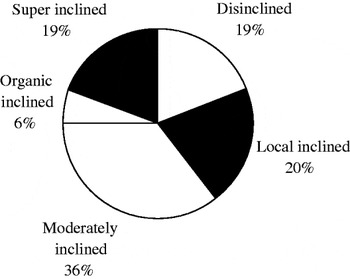
Our final cluster solution resulted in respondents being assigned into five clusters based on the level of importance the respondent attributed to either foods being locally grown or produced or labeled organic as a purchasing consideration (with 1 being not important and 7 being very important). One set of respondents rated neither the local nor organic attribute as an important consideration (we refer to them as the ‘disinclined (DI),’ n=342). Respondents who rated locally grown foods as very important but the organic attribute as not important fall into what we call the ‘locally inclined (LI)’ cluster (n=359). Respondents reporting a high level of importance to food being labeled organic but not locally grown comprise the ‘organically inclined (OI)’ cluster (n=100). Respondents reporting a modest level of importance to foods being both locally grown and labeled organic are part of the ‘moderately inclined (MI)’ cluster (n=634). Respondents rating a high level of importance to foods being both locally grown and labeled organic are labeled the ‘superinclined’ (SI) cluster (n=343). The percentage of respondents falling within each cluster is represented in Fig. 1.
Final clusters or types identified using K-means cluster analysis, Ohio Survey.

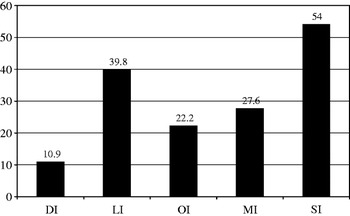
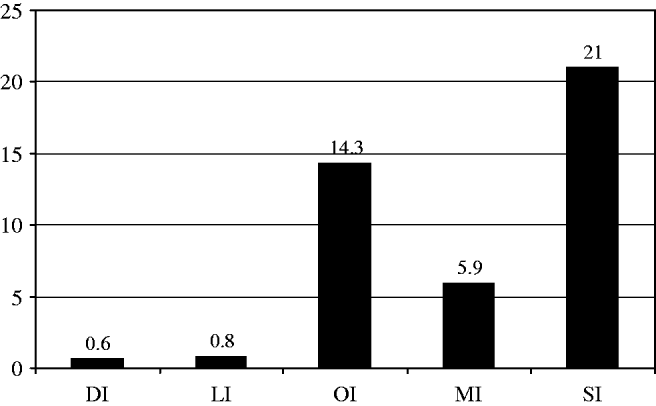
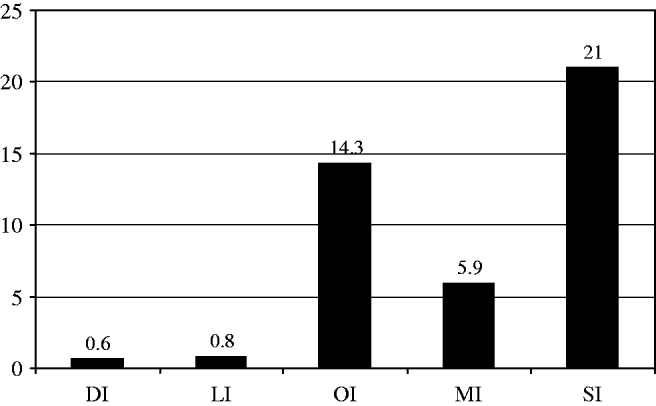
In their review of validity and cluster analysis, Punj and Stewart indicate that the user of cluster analysis should demonstrate that clusters are related to variables other than those used to generate the solutionReference Punj and Stewart45. Two other measures of support for local and organic foods were utilized to assess the validity of the cluster solution—frequency of purchasing and willingness to pay for local and organic foods were analyzed in relation to the clusters to assess our solution (Figs. 2 and 3). In terms of frequently purchasing foods organically grown or produced, the OI and SI report most frequently purchasing these foods (Fig. 3). Twenty-one percent of the SI cluster and 14% of the OI report frequently purchasing organic foods. Very few DI or LI respondents report frequently purchasing organically grown or produced foods. The pattern of frequency of purchasing local by consumer cluster is presented in Fig. 2. In terms of frequently purchasing local, the DI report less frequently purchasing local (10.9%) and, as expected, the LI group reports more frequently purchasing locally grown or produced foods (39.8%). The SI, or the cluster including individuals rating both local and organic as very important, report most frequently purchasing local (54%).
Percent frequently purchasing locally grown or produced foods by consumer types, Ohio Survey (DI=disinclined; LI=locally inclined; OI=organically inclined; MI=moderately inclined; and SI=superinclined).

Frequently purchasing organically grown or produced foods by consumer types, Ohio Survey, (DI=disinclined; LI=locally inclined; OI=organically inclined; MI=moderately inclined; and SI=superinclined).
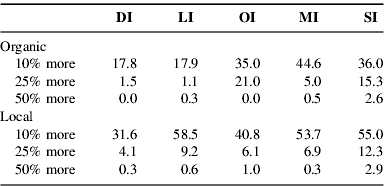
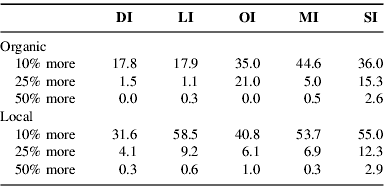
The pattern of each cluster's willingness to pay for organic or local reveals a similar pattern as purchasing frequency. Those favorable toward the organic attribute are more willing to pay more for organic. Over half of the OI (56%) and SI (53.9%) report a willingness to pay more for organic and just half of the MI are willing to pay more. A majority of the DI and LI are not willing to pay more for organic foods (80.7 and 80.7%, respectively). The OI and the SI are most willing to pay greater than 10% or more for organic compared to the other groups. In terms of willingness to pay more for locally grown or produced foods, a similar pattern exists, with the LI group reporting a willingness to pay more for these foods, which is similar to those rating both the local and organic attribute as a very important purchasing consideration. Over half of the LI (68%), the MI (60.9%) and the SI (70.2%) clusters report a willingness to pay more for these foods. The DI are least willing to pay more and only about half of the OI are willing to pay more for these foods. A larger percentage of LI and SI report a willingness to pay 10% or more for foods grown locally. Table 1 shows the percentage willing to pay a premium for organic and local. Overall, the patterns of purchasing and willingness to pay for local and/or organic validate the cluster solution.
Percent willing to pay more for organic and local by consumer types, Ohio survey (DI=disinclined; LI=locally inclined; OI=organically inclined; MI=moderately inclined; and SI=superinclined).
To further situate support for local and organic foods in the general population, we include comparisons with a reference group of MFC, who are known to have enrolled in ‘movement’ style alternative food system organizations. By including the MFC, we are able to make comparisons among those supportive of AFS in the general population and an even more refined subpopulation, persons known to be engaged in alternative food networks. This helps to fill a significant gap in our understanding of support for AFS and provides an even more nuanced picture of the possible heterogeneity of consumer support for sustainable or AFS.
Comparisons and measurement of variables
In an effort to develop profiles of consumer support for local and organic foods, we focus on three sets of comparisons: socio-demographics, purchasing considerations, and agricultural, environmental, and food attitudes or concerns. A number of socio-demographic items are compared, including age and education of survey respondents. Most studies of food-purchasing behaviors also include items that measure the relative importance of a number of intrinsic food qualities. Respondents to both the Ohio and MFC surveys were asked to rate on a scale of 1 to 7 (with 1 being not important and 7 being very important) the importance of price, availability of food products where they normally shop, taste and nutritional value as purchasing considerations. Four sets of attitudes and/or concerns are also included.
To measure food safety concerns, respondents were asked their level of agreement (five response categories ranging from 5=strongly agree to 1=strongly disagree) to three statements related to food safety concerns. The statements were ‘Food is not as safe as it was 10 years ago,’ ‘Food safety is a major concern of mine,’ and ‘Biotechnology is having a negative impact on the food supply.’
A diet health consciousness scale comprising six items was constructed to measure the extent to which individuals actively reflect on the relationship between their diet and health and their role in using diet to affect their health. This scale had Cronbach's alpha of 0.86 with scale scores ranging from 6 to 30, with lower scores indicating less diet health consciousness and higher scores indicating stronger diet health consciousness. Respondents were asked to indicate on a scale of 1 to 5 (1=strongly disagree; 5=strongly agree) their level of agreement with a number of health and diet statements. The items measuring diet health consciousness include: My eating habits are more healthy than others I know; I consider myself health conscious; I am interested in using food to maintain good health; I am interested in using food to prevent disease; I am knowledgeable of the health benefits of foods I eat; and I usually look for health information when I buy food products.
An additive scale comprising five items was created to measure agro-environmental concern. The scale has Cronbach's alpha of 0.76 and scores ranging from 5 to 35 with lower scores indicating less agro-environmental concern and higher scores indicating greater levels of agro-environmental concern. The questions combined to assess agro-environmental concern asked respondents to indicate on a scale of 1 to 7 (1=Not Concerned; 7=Very Concerned) their level of concern with a number of agro-environmental issues in the news in the past year. The items used for this measure include: global warming, pollution of Ohio's rivers, streams or groundwater; mad cow disease; development of large-scale poultry and livestock facilities in Ohio; and genetic modification of plants.
To measure concern for local farmers and rural communities four attitudinal items are included. The first two items assess the importance of agriculture for Ohio's economy and quality of life. Respondents were asked to indicate their level of agreement with the following statements (five response categories ranging from 5=strongly agree to 1=strongly disagree): ‘Ohio's economy will suffer if the state continues to lose farmers’ and ‘Overall, farming positively contributes to the quality of life in Ohio.’ The other two items measuring sympathy for farming and farmers asked respondents to indicate their level of concern (seven response categories ranging from 7=very concerned to 1=not concerned) about the loss of farmland as a result of urban growth and the loss of family farmers.
Results and Discussion
We now turn our attention to profiling each of the five consumer types identified in our general population as well as the motivated consumers (the members of an alternative food co-op or non-profit educational organization promoting environmental and social responsibility). We describe the characteristics of each consumer type, highlighting similarities and differences among the various types. Because we anticipated some concern and attitudinal differences, we are able to consider the extent to which the various consumer types conform to our expectations. We conclude our profiles with a synthetic summary of key patterns identified and questions we have for future consideration.
Consumer profiles: DI
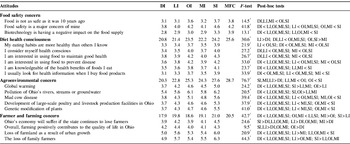
DI consumers (19% of the respondents) are interested in neither the local nor organic attribute. Not surprisingly, they reported the lowest level of agreement with all three food safety concern questions and the lowest level of diet health consciousness, the lowest level of agro-environmental concern, and the lowest level of farmer and farming concern (Table 4). In terms of standard food purchasing considerations, they rated price, availability where they normally shop, and taste as important considerations, comparable with the MI, LI and SI groups. On the other hand, they rated nutritional value and added health benefits beyond basic nutrition as less important purchasing considerations than any of the other consumer types.
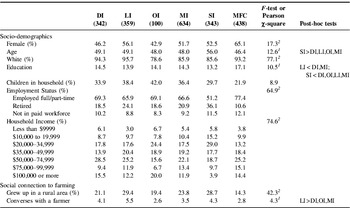
DI's attention to traditional purchasing considerations but limited sympathy for contemporary food, environmental and farming issues suggests that these are not alternative food consumers seeking to realize various social and personal goals via food consumption beyond basic sustenance. Demographically, our data do not reveal any sharp distinctions from the other consumer groups (Table 2). Because we do not know what this group's perceptions of local and organic are, future qualitative research might investigate this group more closely to understand their view of these attributes as well as their overall view of food's connection to health.
Socio-demographic comparisons across clusters and MFC (DI=disinclined; LI=locally inclined; OI=organically inclined; MI=moderately inclined; SI=superinclined; MFC=motivated food consumer).

1 F-test significant at 0.05-level.
2 Pearson χ2 statistic significant at 0.05-level.
MI
The MI were the largest consumer type identified, comprising 36% of the respondents. As their name suggests, they have a moderate interest in local and organic foods. Comparatively, they reported moderate food safety concern, diet health consciousness, agro-environmental concern and farmer and farming concern (Table 4). They rate price, availability where they normally shop and taste as important considerations at similar levels as the DI and LI (Table 3). Nutritional value and added health benefits beyond basic nutrition were rated moderately important compared to the other groups. Demographically, the MI was quite similar to the DI, LI and OI (Table 2). The sheer size of this group and their modest interest makes them a potential target for those interested in expanding the local or organic customer base.
Other food purchasing considerations across consumer types (DI=disinclined; LI=locally inclined; OI=organically inclined; MI=moderately inclined; SI=superinclined; and MFC=motivated food consumer).

1 F-test significant at 0.05-level.
LI
The LI (20% of the respondents) rated local as an important food attribute, but not organic. Compared to the OI and the SI, the LI expressed lower food safety concern, diet health consciousness and agro-environmental concern (Table 4). They did express relatively high farm and farming concern (not quite as high as the SI) (Table 4). The importance they place on price, availability where they normally shop and taste are comparable to the levels reported by the DI and MI. The importance they place on nutritional value and added health benefits beyond basic nutrition is comparable to the DI and lower than the OI, MI and SI (Table 3). Demographically, the LI are less educated than the MI or SI (Table 2). A relatively high proportion of the LI grew up in a rural area and they are the most likely to regularly converse with a farmer.
Personal and social attitudes/concerns by consumer type (DI=disinclined; LI=locally inclined; OI=organically inclined; MI=moderately inclined; SI=superinclined; and MFC=motivated food consumer).

1 F-test significant at 0.05-level.
In general, the LI appear to represent a consumer population that has an affinity for agriculture and farming, and their support of local may be a manifestation of that sentiment. On the other hand, their level of concern for food safety and health situates them near the DI and MI and might explain their low affinity for the organic attribute. As will become apparent in profiling the SI, this is one of two quite distinct consumer subtypes attracted to the local attribute. The existence of two distinct types is consistent with studies comparing consumers in four counties in Washington, USA and documenting distinct local food meanings and constituenciesReference Selfa, Jussaume and Winter48. It also raises some interesting questions about the extent to which the local attribute represents a food attribute valued for where it is produced, versus its transformative potential to reconstruct a more sustainable food systemReference Weatherell, Tregear and Allinson40, Reference Ostrom18.
OI
The OI represents the smallest consumer type identified (only 6% of respondents), but they are quite distinct. They report comparatively high levels of food safety concern, diet health consciousness and agro-environmental concern, but not quite as high as the SI consumer type (Table 4). They report relatively low levels of farmer and farming concern (not quite as low as the DI). Price, availability where they normally shop and taste are rated as important, but not as important as any of the other consumer types (Table 2). Nutritional value and added health benefits beyond basic nutrition are rated as more important than the DI, LI and MI, but not as high as the SI. A relatively smaller proportion of OI report having grown up in a rural area and they report the lowest frequency of conversing with a farmer.
The OI, as might be expected, are distinct from the LI in their high evaluation of added health benefits and nutrition, concern for food safety and the environment, while expressing low concern for farmers and reporting the greatest social distance from farming. The OI may be more apt to seek out the food attributes they desire, as price and availability where they normally shop are not rated as important purchasing considerations compared to the LI.
SI
The final consumer type identified in the general population, the SI, valued both the organic and the local attribute (19% of respondents). As would be expected of consumers valuing both these alternative food attributes, the SI are the most concerned about food safety, the most diet health conscious, have the greatest agro-environmental concern and expressed the greatest concern for farmers and farming. Despite their strong personal and social concerns about food, health, the environment and farming, the SI rate price and availability where they normally shop as more important than any of the other general population consumer types identified. They also rate taste, nutritional value and added health benefits beyond basic nutrition as very important as well.
Demographically, the SI were the most distinct of any of the consumer types identified, being the oldest, having relatively lower levels of education, a high proportion retired and their income levels were relatively low compared to the other groups. A high proportion (about as a high as the LI) grew up in a rural area and they reported relatively frequent conversations with farmers (but not as high as the LI).
The strong levels of personal and social concern were anticipated but the price consciousness and the convenience preference (available where they normally shop) were not expected. Despite this latter finding, the SI encompasses some of the concerns of the LI and the OI. There are some interesting demographic qualities to the SI, particularly their age. Future research might explore this finding in greater detail, especially the extent to which this finding might be a life course outcome (as persons age they become more sensitive to the foods they consume) or a generational issue (older generation more interested in unprocessed foods often associated with some alternative food products).
MFC
The final group we profile are the MFC we surveyed from a food co-op and non-profit educational organization in one Ohio city. In many ways they mirror the SI group identified from the general population, with a couple of critical differences. In terms of personal and social attitudes, they were more diet health conscious and more concerned than any of the general population types about food safety and the agro-environment. They were concerned about farmers and farming, but not quite as strongly as the SI. The importance of availability where they normally shop was of lower importance than for any of the other groups and price was a much lower consideration compared to the other consumer types. Demographically, the MFC were more educated, reported higher levels of income and a much higher percentage of motivated consumers were female. They also appear to be more socially distant from farming, with a much lower percentage reporting growing up in a rural area and they also report lower frequency of conversing with a farmer (at a level comparable to the OI).
It may be that the motivated consumers identified and surveyed in our study represent a subtype of the SI, which raises interesting questions about the potential heterogeneity of alternative food consumers who differentially access foods that conform to their ideals. In general, the MFC appear to be similar to the SI, but are not as price and convenience conscious. The motivated consumers may have the luxury of additional income, allowing them to be less price conscious compared to the SI. The high proportion of females among the motivated consumers might be because food shopping is traditionally a woman's activity and thus membership in the co-op might be skewed toward the female shopper. The relatively weak social connections to farming and rural places among the motivated consumers is interesting, given they do report reasonably high levels of concern for farmers and farming.
Conclusions and Future Research
Our cluster analysis utilizing the local and organic food attributes resulted in an intuitive and logical set of consumer groups. The cluster analysis results reveal consumers valuing the local attribute distinct from the organic attribute and a large segment of consumers favorable toward both attributes. This cluster solution suggests that a sizable subpopulation exists interested in local, but not excited by the organic attribute, as well as a sizable subpopulation interested in both the local and organic attribute (although we are unable to determine from our data the extent to which both attributes are simultaneously desired by these consumers). One limitation to be noted is that our data are from two Ohio-based mail surveys conducted several years prior to the economic downturn. Generalizations based on these results to consumers outside of Ohio should be made with caution; although, our results provide a benchmark for exploring patterns of interest and support in other areas. While the results are still timely in that they distinguish consumer interest in local from organic, the economic downturn has likely increased all consumers’ interest in price as a purchasing consideration and may be perceived as a much greater barrier for purchasing local and organic foods than when the data were originally collected for this study. Future research should explore the impact of the downturn on consumer perceptions and interest in local and organic foods and, specifically, in what ways is consumption and support of local foods impacted differently than support and consumption of organic foods. In terms of the discourse related to the decoupling of local from organic and the importance of both characteristics in definitions of sustainable agriculture, these results suggest that there may be market segments seeking production that satisfies one or the other or both criteria.
Consistent with our expectations, and shedding light on the diversity among alternative food system supporters, the profiles document some systematic differences among local and organic supporters. Organic supporters are more agro-environmentally concerned, more diet health conscious, and more concerned about food safety than the LI. The LI are more concerned about local farmers and rural communities than OI consumers. From a practical standpoint, these attitudinal differences point to the importance of developing marketing and communication strategies addressing or aligning well with these concerns.
Some critical considerations and questions emerge with regard to these findings, especially pertaining to future local food system development. On the practical side, the results suggest that there may be two different routes for promoting local foods, one through appeals to support local farmers and the other appealing to the triumvirate of local farmer support, diet-health benefits and environmental benefits. Promotion of diet-health benefits and environmental benefits draws the organic attribute into the mix as well. An interesting question that might be probed further is the extent to which the local-only crowd might actually be reluctant or repelled by the organic attribute (a possibility suggested by the fact local is valued but not organic by some consumers), but untestable with our data. Future research should probe the local food system support among different subsets of consumers qualitatively, as our measurement approach forced responses to closed ended questions and it would be interesting to learn how different subsets might express their motivations without the restrictions of a mail survey instrument.
With regard to local foods and availability, the findings suggest that even if there are high levels of support for local foods, having to go out of your way to purchase them (an inconvenience) may pose a significant barrier to a substantial proportion of potentially supportive consumers. If local foods are not convenient to purchase, then growing the market and movement for these foods may be difficult beyond the most motivated. The fact that price and availability are important purchasing considerations for many local food consumers also raises questions about maintaining the social and environmental ideals sometimes associated with local production, while seeking to mainstream local and getting products on traditional grocery shelves at competitive prices. Also, mass production of local produce (which may be necessary to overcome issues of availability and price) may benefit certain classes or scales of producers not currently associated with niche and farmer's market outlets and even undercut the price needs of these traditional local food producers.
Another interesting question related to the desire to support local farmers via local food purchases has to do with the growing social distance from farming among the US population. As people become further and further removed from agriculture, the critical question will be whether or not supporting rural people, farmers and rural places will continue to be valued and whether or not this is a frame that will resonate with future generations. Practitioners should be sensitive to this possible generational challenge and future research should address the extent to which views of food and farming change across the life course, but also the extent to which they are tied to particular generational experiences.
Similarly, with regard to the SI, our findings also reveal possible future generational challenges that may pose some unique challenges for practitioners working to increase awareness and consumption of local foods and may impact purchasing decisions among food retailers. Future AFS research should explore reasons for greater interest in local and organic foods among older consumers as we did not anticipate this. Perhaps the association is due to older respondents having greater familiarity and appreciation of minimally processed foods, with locally produced foods most likely being purchased in their basic, unprocessed form. The critical question emerging is whether or not younger generations will be as interested in AFS, especially local foods, as they require knowledge, time and interest in cooking with unprocessed foods.
A number of analysts have noted that the frames used by local advocates must also integrate social justice matters to truly meet expectations beyond organicReference Allen49. One noteworthy limitation of this research is we did not assess attitudes about improving food access or working conditions for farm workers. Future research should consider the possibility that there might be differences across consumer types with regard to these social justice concerns. These types of comparisons would substantially improve our understanding of AFS supporters and may help to shift some of the focus to other aspects of these systems that have been largely ignored by the organic movement, as well as the newer ‘beyond organic movement.’
Finally, with regard to organic supporters, a couple of interesting questions emerge that warrant future attention. If organic supporters are less price conscious (Table 3) and willing to pay more for organic foods (Table 1) and similar attitudinally to the MFC—are they a more loyal or committed consumer to organic than the LI are to local? Will preferences for organic and advocacy for a more sustainable agro-food system embodied in the government sanctioned organic attribute outlast efforts for more localized food systems due to their willingness to pay for attributes believed to contribute to that outcome? Will they become more engaged in groups or organizations supportive of a more sustainable or alternative agro-food system?
Acknowledgements
This research was supported in part by SEEDS: The Ohio Agricultural Research and Development Center (OARDC) Graduate Research Enhancement Competitive Grants Program.