


Introduction
Which parties can deliver the policies that they promised to voters? Responsible and responsive party government in representative democracies is predicated on the ability of parties to fulfill policy promises that reflect voter preferences (Dahl Reference Dahl1989; Huber and Powell Reference Huber and Powell1994). In systems characterized by single-party majority governments, a rich literature has succeeded in explaining and predicting policy outcomes (see, for example, Soroka and Wlezien Reference Soroka and Wlezien2010; Stimson et al Reference Stimson, MacKuen and Erikson1995; Wlezien Reference Wlezien1995). However, the majority of democracies around the world feature multiparty systems, characterized by coalition governments, in which this task is significantly more challenging.
Theoretical accounts have conceptualized policy making in multiparty contexts as a problem of parties bargaining from their prevailing resources in the existing government–opposition arrangement. These accounts build on a sophisticated literature that has often regarded a party’s bargaining spoils, that is, policy influence and ministerial portfolios, as interchangeable, co-determined outcomes (see, for example, Baron and Ferejohn Reference Baron and Ferejohn1989; Morelli Reference Morelli1999). However, one of the strongest regularities in political science is that a party’s share of government portfolios is highly proportional to its legislative seat share, a pattern referred to as ‘Gamson’s Law’ (Browne and Franklin Reference Browne and Franklin1973; Browne and Frendreis Reference Browne and Frendreis1980; Druckman and Roberts Reference Druckman and Roberts2005; Druckman and Warwick Reference Druckman and Warwick2005; Gamson Reference Gamson1961; Warwick and Druckman Reference Warwick and Druckman2001, Reference Warwick and Druckman2006). Neither legislative seats nor government portfolio shares, in fact, are an accurate predictor of policy bargaining power, as is evident when minor coalition or opposition parties exercise disproportionate policy influence and force government policy change (Kaarbo Reference Kaarbo1996; Seeberg Reference Seeberg2023). The literature on coalition policy making therefore analyses additional resources by which a party can achieve policy change. The agenda powers of ministers (Laver and Shepsle Reference Laver and Shepsle1996, Reference Laver, Shepsle, Calvert, Shepsle and Laver1994), veto points (Immergut Reference Immergut1990), veto players (Tsebelis Reference Tsebelis1995), and policing powers of government partners (Carroll and Cox Reference Carroll and Cox2012; Kim and Loewenberg Reference Kim and Loewenberg2005; Lipsmeyer and Pierce Reference Lipsmeyer and Pierce2011; Martin and Vanberg Reference Martin and Vanberg2011; Pedrazzani and Zucchini Reference Pedrazzani and Zucchini2013; Thies Reference Thies2001) all feature in explanations of the ability of parties to bring policy outcomes closer to their preferences. This literature has transformed our understanding of how parties achieve policy change, but it has two critical limitations.
First, these models theorize policy bargaining as a matter of parties’ resources in the prevailing government–opposition setting and ignore their bargaining leverage from options outside of the coalition. In reality, however, a party, especially one unlikely to be excluded from any new government, can bargain more aggressively and may even choose to walk away from policy negotiations with existing partners. Moreover, as the bargaining theoretic literature shows, leverage from credible outside options can trump parties’ existing resources (see, for example, Austen-Smith and Banks Reference Austen-Smith and Banks1988; Baron Reference Baron1998; Becher Reference Becher2019; Becher and Christiansen Reference Becher and Christiansen2015; Huber Reference Huber1996; Lupia and Strøm Reference Lupia and Strøm1995), but the empirical application of this work to policy making has until recently been hampered by the lack of a suitable measure of coalition bargaining leverage.
Secondly, existing models of coalition policy making examine how parties change status quo policy to bring it closer to their programmatic preferences (Tsebelis Reference Tsebelis1999), rather than how they realize specific electoral promises. Yet, the gap between moderating status quo policy and the fulfillment of an election pledge can be large and material. For voters, the realization of specific election promises is salient and consequential in a way that a degree of policy change is not (Guinaudeau and Persico Reference Guinaudeau and Persico2018; Matthieß Reference Matthieß2022; Naurin et al Reference Naurin, Royed and Thomson2019; Thomson et al Reference Thomson, Royed, Naurin, Artés, Costello, Ennser-Jedenastik, Ferguson, Kostadinova, Moury, Pétry and Praprotnik2017). A coalition party that does not realize its core election pledges may be viewed as having failed its voters, even if it achieved significant policy change. To understand the most politically salient aspects of policy representation in multiparty democracies, we therefore need to be able to study which party’s electoral commitments are ultimately fulfilled and reflected in government policy.
We address these gaps. Combining the concept of coalition leverage with theoretical work on bargaining with exit options, we present a more complete theory of policy making in multiparty settings. We define coalition leverage as a party’s probability of coalition inclusion if a new coalition were to form, which governs its risk from aggressive bargaining and captures its ability to make credible exit threats. Policy influence from a high probability of inclusion in a new government is not limited to governing parties. Opposition parties with a high probability of inclusion can also affect policy by strengthening the bargaining position of potential coalition partners in the current government and by providing them with a reason to adopt policies that would make them coalition compatible.
Examples can be found throughout politics but are most salient in periods of political stress, which have intensified over the last decade with the erosion of cartel parties, the ascent of populist challengers, accelerating party-system fragmentation, and elections that have disrupted entire party systems (for example, France 2017, Italy 2018). For instance, in March of 2025, the Freie Wähler, the conservative junior coalition partner in the Bavarian state government, publicly threatened to torpedo urgent efforts to amend the federal constitution in the upper house of the German parliament to allow more spending after the erosion of the US commitment to defend Europe. Their senior partner, the CSU, responded by threatening to replace them and form an alternative coalition with the pro-reform SPD. The Freie Wähler had no realistic coalition alternatives without the CSU and immediately capitulated, agreeing to let Bavaria provide the decisive vote in favor of the constitutional amendment (Banse and Buermeyer Reference Banse and Buermeyer2025).
Another high-profile case followed the threat of the European Commission in late 2018 to reject the budget of the new populist coalition government in Italy. The eurosceptic and right-wing-populist Lega had campaigned on fiscal promises of tax relief and simplification, including a flat income tax of 15 per cent on individuals and businesses, as well as a pension reform allowing earlier retirement. The Five Star Movement, their senior coalition partner, had promised the introduction of a ‘citizens’ wage’ providing income for the poor. To gain the Commission’s consent, both parties had to scale back the scope of their reforms. But after negotiations with their senior partner that could (and less than a year later actually did) replace them with the PD, Lega not only tempered its calls for fiscal sovereignty, it even agreed to new taxes on digital services, banking, insurance, and gambling (Graham Reference Graham2018).
Coalition leverage based on alternative coalition options can eclipse parties’ policy bargaining power from resources within their current coalition – including the agenda, veto, and policing powers that have been the central focus of the literature on coalition policy making to date – for two reasons. First, a party with extensive coalition leverage can achieve specific policy outcomes that are outside the coalition winset, that is, outside the set of policies that is preferred to the status quo by all coalition partners. Faced with the possibility of exclusion from a new government, a bargaining partner may even accept a policy that it judges inferior to the status quo. Secondly, parties with bargaining leverage can also achieve these outcomes at times when the prevailing distribution of resources appears to make policy change impossible. Our theory generates expectations about the realization of parties’ electoral policy promises. This is not only a politically salient and consequential outcome of coalition policy bargaining, it also generalizes across all policy fields, in contrast with the achievement of a degree of policy change in a singular policy area, which has been the focus of prior work.
To test our theory of policy bargaining from coalition leverage, we employ regression analysis – using coalition-leverage data from Kayser et al (Reference Kayser, Orlowski and Rehmert2023) and data on parties’ election pledge fulfillment in nine parliamentary democracies from 1974 to 2011 (from Thomson et al Reference Thomson, Royed, Naurin, Artés, Costello, Ennser-Jedenastik, Ferguson, Kostadinova, Moury, Pétry and Praprotnik2017) – and additionally estimate local average treatment effects near discrete shifts in coalition leverage. Both the regression and the regression discontinuity demonstrate that parties with greater coalition leverage are better able to realize their policy promises. Moreover, coalition leverage dominates the influence of a party’s bargaining power from resources in the prevailing government–opposition setting, for example its legislative seats, portfolio share, PM party status, and institutional prerogatives.
Our findings have far-reaching implications for understanding policy making and representation in parliamentary democracies and multiparty governments. The centrality of coalition leverage not only helps to explain which parties best fulfill their pledges, but because pledges, after all, are statements of policy goals, our findings also speak to research on coalition policy making, in which bargaining matters, but coalition leverage has been neglected (see, for example, Carroll and Cox Reference Carroll and Cox2012; Kim and Loewenberg Reference Kim and Loewenberg2005; Lipsmeyer and Pierce Reference Lipsmeyer and Pierce2011; Martin and Vanberg Reference Martin and Vanberg2011; Pedrazzani and Zucchini Reference Pedrazzani and Zucchini2013; Thies Reference Thies2001; Tsebelis Reference Tsebelis1999). Similarly important are the implications of our finding for multiple literatures on policy representation, including those on congruence (see, for example, Golder and Lloyd Reference Golder and Lloyd2014; Powell Reference Powell2009), thermostatic relations between policy and public opinion (see, for example, Soroka and Wlezien Reference Soroka and Wlezien2010), and punctuated equilibrium models of policy change (see, for example, Jones and Baumgartner Reference Jones and Baumgartner2005). These accounts of policy representation either stumble in, or neglect, multiparty settings, largely because they cannot explain how parties’ coalition leverage mediates the translation of party preferences into policy in coalition governments. We discuss these implications in the concluding section.
Parties and Policy Bargaining
Bargaining from Prevailing Resources
In the multifaceted theoretical literature that examines bargaining between parties with prevailing resources (see, for example, Baron and Ferejohn Reference Baron and Ferejohn1989; Morelli Reference Morelli1999), policy making is the particular focus of spatial models (see, for example, Crombez Reference Crombez1996; Krehbiel Reference Krehbiel1996; Laver and Shepsle Reference Laver and Shepsle1996; Schofield Reference Schofield2007; Steunenberg Reference Steunenberg1994; Tsebelis Reference Tsebelis2002). Spatial models theorize policy change as a function of bargaining with resources within the existing government–opposition constellation between the parties whose agreement is required to alter policy. These models explain policy stability by identifying the policy space in which change can (winset) or cannot (core) occur. Policy change depends on the size of the winset and the core. It is expected to decline in the number of parties that are negotiating, the distance between their ideal points, and the restrictiveness of the decision rule. Each of these factors decreases the size of the winset and increases that of the core (see, for example, Tsebelis Reference Tsebelis2002, 32–63). When no winset exists, no policy change can occur.
Empirical tests of spatial bargaining models therefore typically operationalize the winset as the frequency or probability of policy change, which can be of great substantive importance. This empirical literature musters considerable evidence that changes in coalition policy can be understood as shaped by the number of and distance between veto players as well as the restrictiveness of various control and oversight mechanisms in cabinet and parliament that can broadly be referred to as policing institutions (Carroll and Cox Reference Carroll and Cox2012; Kim and Loewenberg Reference Kim and Loewenberg2005; Lipsmeyer and Pierce Reference Lipsmeyer and Pierce2011; Martin and Vanberg Reference Martin and Vanberg2011; Pedrazzani and Zucchini Reference Pedrazzani and Zucchini2013; Thies Reference Thies2001).
We know, for example, that the number of significant laws passed in parliamentary democracies is lower in governments with more coalition members who are more ideologically distant (Tsebelis Reference Tsebelis1999), that the ability of labor ministers to reform unemployment and employment policy is restricted by the ideological distance between veto players (Becher Reference Becher2009), that cabinet leaders limit the ability of ministers to change monetary policy and macroeconomic outcomes (Goodhart et al Reference Goodhart2013), and that the ideological distance between the most distant government parties decreases the ability of minimal winning coalitions to introduce economic reform (Angelova et al Reference Angelova, Bäck, Müller and Strobl2018). Restrictive institutional rules additionally limit the scope for policy change. Strong legislative institutions confine change in social protection policies when the minister controlling that portfolio becomes more (or less) conservative (Martin and Vanberg Reference Martin and Vanberg2020), and also depress the scope for economic and social policy reform when coalitions and ministers change (Bäck et al Reference Bäck, Müller, Angelova and Strobl2022).
The contributions of this literature are seminal. Nonetheless, an understanding of coalition policy making as the result of bargaining between parties from existing resources remains incomplete for three reasons. It ignores parties’ leverage from threats (and insulation from others’ threats) to exit policy negotiations and form a new government, which is examined by a related literature that we discuss below. Moreover, politically, the meaning of the central dependent variable in this literature – a degree of policy change (or stability) – is indeterminate. A degree of policy change can amount to political victory or defeat, depending on whether it achieves the party’s specific policy goals, including its electoral promises. Finally, the focus on policy change requires a stable baseline, which has limited this literature empirically to the study of one policy area at a time (for example, economic policy, monetary policy, social protection). Yet coalition partners often trade influence across different policy fields. To date, no general test exists of a party’s policy bargaining power across the full range of substantive policy areas.
Bargaining with Exit Options
Just as efforts to understand policy making have built on spatial theories, they have also drawn on an impressive bargaining-theoretic literature. Formal bargaining theory recognizes that parties are not restricted to relying on prevailing resources in a negotiation, but may in principle exit the coalition. In multiparty policy bargaining, a party’s exit can precipitate government change, either within the existing parliament or by way of an early election (Baron Reference Baron1998; Becher Reference Becher2019; Becher and Christiansen Reference Becher and Christiansen2015; Huber Reference Huber1996; Lupia and Strøm Reference Lupia and Strøm1995). Policy stability and change are therefore not the only conceivable outcomes of negotiations between legislative parties – an additional alternative is a reallocation of control over policy making, which can impose costs onto other decision makers and influence policy outcomes (Austen-Smith and Banks Reference Austen-Smith and Banks1988; Huber and McCarty Reference Huber and McCarty2001; Lupia and Strøm Reference Lupia and Strøm1995). An exit threat brings strategic considerations of future incumbency and policy control to bear on current policy disputes by enabling strongly positioned parties to extract – in policy concessions – their negotiating partners’ cost of a government change (Lupia and Strøm Reference Lupia and Strøm1995).
Despite the contributions of legislative bargaining models, however, their impact on understanding policy outcomes has remained limited for theoretical and empirical reasons. While these models theorize the capacity of parties – and, indeed, individual ministers (Alexiadou Reference Alexiadou2015) – to make threats from outside options in policy bargaining, they regard credible threats as a matter of anticipated election outcomes and polling signals (Becher and Christiansen Reference Becher and Christiansen2015; Lupia and Strøm Reference Lupia and Strøm1995). But polling changes, even if accurate, often do not translate into viable coalition options, a point on which we expand theoretically in the sections Coalition leverage and the realization of specific policy promises and Explanatory variable: Coalition leverage, and visually in Figure 3 in the section Local average treatment effects. Empirically, work that tests and validates models of legislative bargaining from exit threats is extremely sparse and focused on threats from parliamentary dissolution alone – indeed, Becher and Christiansen (Reference Becher and Christiansen2015) is the only study of which we are aware. This reflects a near absence, until recently, of appropriate and general measures of bargaining power from viable coalition options – whether in the context of parliamentary dissolution or within the existing parliament.
The sole exception is the classical bargaining power indices (Banzhaf Reference Banzhaf1964; Shapley and Shubik Reference Shapley and Shubik1954), which conceive of parties’ outside options not as their vote or seat shares but in terms of their pivotal role in voting or coalition formation. Banzhaf (Reference Banzhaf1964) calculates the probability of a party being pivotal in forming a majority coalition (or vote), whereas Shapley and Shubik (Reference Shapley and Shubik1954) calculate the probability of a party joining an ordered sequence of parties as the party that induces a majority. These measures, however, rely solely on voting weights (for example, seats awarded to a party), which omit key coalition determinants (for example, ideological proximity, coalition history) and thus, as we demonstrate below, perform poorly when applied to legislative policy making (see, for example, Nurmi Reference Nurmi1997). As a result, there exists no general test of one of the central propositions deriving from legislative bargaining models. Namely, that in policy negotiations, strategic threats based on credible coalition options can trump a party’s prevailing resources.
Coalition Leverage and the Realization of Specific Policy Promises
Parliamentary parties negotiate policy in the shadow of potential government change. In this context, bargaining power arises from coalition potential. Parties that are strategically positioned to enter potential governments either within the existing parliament or following an early election carry less risk from bargaining aggressively and can more credibly threaten to exit the negotiations. The ability to make credible exit threats and the insulation from other parties’ threats to exclude a party from a new government is not primarily a matter of a party’s polling signals or anticipated election outcomes, or indeed of the central prevailing resource of legislative parties, which is their legislative seat share. Instead, a realistic theory of exit threats, such as we develop and test here, must account for the viability of coalition options. It is the strategic interaction between parties that determines how seats – as a function of polls or election outcomes – translate into viable potential coalitions. This process of negotiation depends on a rich set of determinants beyond seats, including, for instance, a party’s pro- or anti-regime stance (Druckman and Roberts Reference Druckman and Roberts2007; Grzymala-Busse Reference Grzymala-Busse2001), the ideological distance between parties (Mölder Reference Mölder2017), and their coalition history (Tavits Reference Tavits2008).
Policy bargaining power rises in coalition leverage. With coalition options, a party can credibly threaten to bring down a government in policy negotiations, or, if it is the responding party, repel such a threat effectively. Without coalition options, threats of government change lack credibility and ambitious policy demands entail peril. For opposition parties, too, coalition options increase policy influence. When an opposition party’s coalition outlook improves, incumbent parties come under pressure to appropriate its policies in order to neutralize the opposition’s advantage (Seeberg Reference Seeberg2023). Moreover, the bargaining leverage of the opposition party’s potential (and likely ideologically proximate) partners in the present government rises, and forward-looking governing parties have incentives to make themselves compatible for future coalitions.Footnote 1 For incumbent and opposition parties alike, therefore, we anticipate that the ability to achieve policy goals rises with their coalition options.
Intriguingly, the predictions of models that account for legislative bargaining with coalition leverage can diverge significantly from spatial theories. For instance, a party with extensive coalition leverage can achieve specific policy outcomes that are not only outside the coalition winset, that is, outside the set of policies that is preferred to the status quo by all coalition partners, but it can also achieve these outcomes at times when the prevailing distribution of resources appears to make policy change impossible.
Our account of policy bargaining from coalition leverage makes two central contributions to a fuller, more realistic understanding of policy making in multiparty contexts. First, the prevailing distribution of resources among coalition partners can be superseded by the bargaining leverage of parties that can credibly threaten to bring down the government and resist threats of government exclusion by others. In shaping policy, in other words, bargaining from coalition options can trump a party’s resources in the present government–opposition setting, including its legislative seats, portfolio share, agenda, veto, and policing powers. Secondly, our approach allows us to develop (and test) expectations about the realization of a party’s actual policy pledges, which generalize to all policy areas, have specificity, and have political relevance. This enables us to improve simultaneously on the generality, precision, and political import of prior theories of coalition policy bargaining, which generate expectations about a degree of policy change in a particular policy area, that may or may not be informative about the realization of a party’s key policy goals.
In sum, we expect coalition leverage to (i) increase a party’s fulfillment of policy promises (H1), and (ii) trump a party’s prevailing resources, namely, legislative seat share, portfolio share, agenda, veto, and policing powers, in realizing its policy promises (H2).
Empirical Strategy, Data, and Variables
To test our hypotheses about the effect of coalition bargaining leverage on the fulfillment of electoral pledges, we employ a multiple regression analysis applied to panel data (section Regression analysis using panel data) and then exploit discrete jumps in parties’ coalition inclusion probabilities to estimate local average treatment effects near these shifts (section Local average treatment effects).
We combine pledge-fulfillment data provided by Thomson et al (Reference Thomson, Royed, Naurin, Artés, Costello, Ennser-Jedenastik, Ferguson, Kostadinova, Moury, Pétry and Praprotnik2017) with coalition inclusion probability (CIP) data from Kayser et al (Reference Kayser, Orlowski and Rehmert2023).Footnote 2 The resulting cross-sectional time-series dataset comprises 160 observations from 1974–2011, covering fifty-three parties in nine countries.Footnote 3 This sample, while small, reflects the overlap between our two data sources and allows us to examine policy bargaining in the context of multiparty coalitions and single-party governments that operate in hung parliaments requiring interparty bargaining.Footnote 4
Dependent Variable: The Realization of Policy Pledges
We use pledge fulfillment to test our theory of coalition leverage in policy bargaining, which has two advantages over alternative outcomes:Footnote 5 It covers all policy areas, allowing us to conduct a first general test of any theory of multiparty policy bargaining across the full range of policy fields, and it is a precise, electorally consequential measure of policy bargaining success. Electoral pledges focus on salient policy issues (Håkansson and Naurin Reference Håkansson and Naurin2016; Mansergh and Thomson Reference Mansergh and Thomson2007), and voters evaluate parties based on their fulfillment (Thomson Reference Thomson2011), which gives government and opposition parties incentives to deliver (Budge and Keman Reference Budge and Keman1993; Klingemann et al Reference Klingemann, Hofferbert and Budge1994; Mansergh and Thomson Reference Mansergh and Thomson2007; Pomper and Lederman Reference Pomper and Lederman1980; Thomson Reference Thomson2001).Footnote 6
Pledge scholars explain variation in parties’ bargaining success mainly through parliamentary party attributes (for example, governing status and seat share, control of the premiership, and relevant portfolio), and government features (for example, coalition status, majority status, policy distance, and duration) (Mansergh and Thomson Reference Mansergh and Thomson2007; Naurin Reference Naurin2014; Naurin et al Reference Naurin, Royed and Thomson2019; Schermann and Ennser-Jedenastik Reference Schermann and Ennser-Jedenastik2014),Footnote 7 but neglect parties’ leverage from credible outside options.
Our dependent variable is therefore party-level pledge fulfillment, following Thomson et al (Reference Thomson, Royed, Naurin, Artés, Costello, Ennser-Jedenastik, Ferguson, Kostadinova, Moury, Pétry and Praprotnik2017). We aggregate all pledges made by a party in a given election and calculate the share fully fulfilled over the subsequent legislative term. The section Institutions and robustness presents additional analyses focusing on pledges that are particularly demanding to fulfill, including solo pledges, change pledges, and pledges outside a party’s ministerial portfolios (note that these fine-grained data are not available for all counties).
Explanatory Variable: Coalition Leverage
Our key explanatory variable, as developed conceptually above, is a party’s bargaining leverage from outside options, which reflects its ability to credibly threaten exit from the current government and insulation against exclusion from a new government, both of which increase in its coalition options. Our measure of this concept, coalition inclusion probabilities (CIP), developed by Kayser et al (Reference Kayser, Orlowski and Rehmert2023), matches the construct closely by calculating each party’s probability of being included in a new government if one were to form. Kayser et al (Reference Kayser, Orlowski and Rehmert2023) estimated CIP using a conditional logit model that predicts the formation of the actual government from the set of all coalitions that could plausibly form at a given formation opportunity, following either an election or a premature government breakdown. Building on the influential coalition formation framework of Martin and Stevenson (Reference Martin and Stevenson2010), they modified selected variable operationalizations and respecified the model to optimize out-of-sample prediction, thereby avoiding overfitting and facilitating application of the CIP measure to new datasets. The model accounts for key determinants of coalition formation, including majority status, ideological compactness, the inclusion of the largest (and second- and third-largest) parties, prior coalition experience, and the presence of anti-establishment parties.Footnote 8 Predicted probabilities are generated for every possible coalition, and a party’s CIP is then calculated as the sum of the probabilities of all coalitions in which it is included.
CIP ranges from 0 (certain opposition status) to 1 (certain government participation) and aggregates the probabilities of all feasible governments, including replication of the current one. It therefore captures leverage from credible exit threats and insulation from being excluded (Section C in the SM provides an illustration of CIP calculation and descriptive information on its distribution in our sample). We apply this concept to conduct a first general test – across all policy fields – of the theoretical claim that coalition leverage increases a party’s policy bargaining power in multiparty environments.Footnote 9
Covariates
In addition to our key regressor, bargaining leverage (CIP), we test alternative measures associated with bargaining power – seat share, portfolio share, the Banzhaf index, and the Shapley–Shubik index – to contrast CIP with potential rivals. We further control for factors commonly linked to pledge fulfillment, including government duration, cabinet size, ideological dispersion, and majority status (oversized or minority v. minimal winning governments), for which prior findings are mixed (see, for example, Matthieß Reference Matthieß2019; Moury and Fernandes Reference Moury and Fernandes2018). At the party level, we account for government participation, control of the premiership, ideological distance from the cabinet mean, and seat share. Coalition data come from ParlGov (Döring and Manow Reference Döring and Manow2016), and ideological positions from the Comparative Manifesto Project (Volkens et al Reference Volkens, Lehmann, Mathhieß, Merz, Regel and Werner2015). Descriptive statistics are reported in Table B1 in the SM.
Regression Analysis using Panel Data
Party Resources and Coalition Leverage
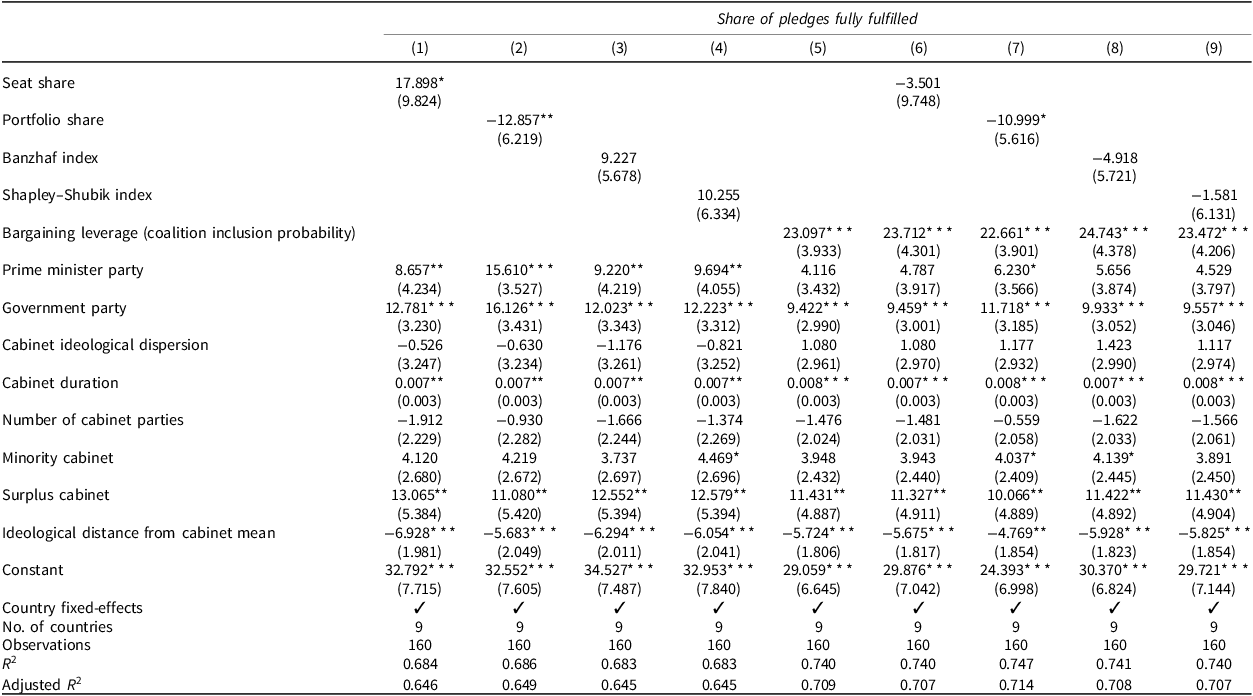
Do parties with coalition leverage fulfill a greater share of their election promises? We begin to examine this question by estimating ordinary least squares regression models with country fixed-effects and robust standard errors using our panel data.Footnote 10 Table 1 reports the results. Models (1) to (4) examine the effect of seat shares, government portfolio shares, and the traditional voting weights of Banzhaf (Reference Banzhaf1964) and Shapley and Shubik (Reference Shapley and Shubik1954).Footnote 11 Model (5) presents our coalition bargaining leverage indicator, and Models (6) to (9) combine our bargaining leverage with the other four indicators from the first four models in turn, testing our second hypothesis that coalition leverage trumps these prevailing resources.Footnote 12
Coalition leverage and pledge fulfillment

Table 1 Long description
The table presents data on the share of pledges fully fulfilled across various models and variables. It includes nine columns labeled (1) to (9), each representing different models or combinations of variables. The rows are labeled with different factors such as Seat share, Portfolio share, Banzhaf index, Shapley-Shubik index, Bargaining leverage, Prime minister party, Government party, Cabinet ideological dispersion, Cabinet duration, Number of cabinet parties, Minority cabinet, Surplus cabinet, and Ideological distance from cabinet mean. Each cell contains numerical values representing the coefficients and standard errors for each factor in the respective models. The table also includes a constant term and summary statistics such as the number of countries, observations, R-squared, and adjusted R-squared values. Notable trends include the significant positive coefficients for Bargaining leverage in models (5) to (9), indicating its importance in fulfilling pledges.
Note: linear models with robust standard errors.
*p < 0.1; **p < 0.05; * * *p < 0.01.
The results provide evidence that election pledge fulfillment rises strongly with a party’s coalition leverage but not significantly so with its seat share, portfolio share, or voting power. Across these models, many of the prevailing resources enjoyed by parties correspond to a higher share of fully fulfilled pledges. A greater share of seats in parliament, a smaller ideological distance from the cabinet mean, and agenda power (as captured by governing party status and the prime minister (PM) party indicator) all prove to be positive and statistically significant predictors. Seat share, however, in model (1), while positive, does not reach standard levels of statistical significance even when CIP is omitted. When bargaining leverage is added in model (6), the size of its effect drops, its sign flips, and its statistical significance evaporates, suggesting that seat share only matters to the extent that it is correlated with bargaining leverage.Footnote 13
Model (2) tests the effect of party portfolio share, a frequent outcome variable in the study of coalition politics, in part because it is presumed to drive policy influence. We see that portfolio share is negatively and statistically significantly associated with pledge-keeping in model (2) and only changes modestly when bargaining leverage is added in model (7). Recall that all models control for PM party status, government party status, and number of governing parties. In this context, this negative effect is driven by the success of parties outside of government (zero portfolios) in fulfilling some of their election pledges. Testing the effect of portfolio share on the share of fulfilled pledges only among governing parties, as we do in SM Table D5, yields a modest and statistically insignificant effect.
Turning to the Banzhaf and Shapley–Shubik indices in model (3) and (4), both indices prove statistically indistinguishable from zero, and their signs turn negative once CIP is added in models (8) and (9). This casts into relief the difference between, on the one hand, the naive voting weights calculated only from seat shares of Banzhaf (Reference Banzhaf1964), which closely resembles (Penrose Reference Penrose1946) and Shapley and Shubik (Reference Shapley and Shubik1954), and on the other, coalition inclusion probabilities calculated to take account of bargaining power from realistic exit options by Kayser et al (Reference Kayser, Orlowski and Rehmert2023).
The results for bargaining leverage from outside resources are strongly in line with both of our hypotheses. CIP reveals a large, positive, and statistically significant effect both on its own in model (5) with only the control variables, and in models (6) to (9), which also include each of the alternative predictors. The effect of several prevailing resources also diminishes or disappears once CIP is included. The effect of being in government drops by 26 per cent, while neither the effect of the PM party indicator nor seat share is statistically distinguishable from zero. Ideological distance from the cabinet mean remains significant but the effect size attenuates. Compared to alternative measures of bargaining leverage – seat share, portfolio share, and the traditional voting weights – only CIP exerts a strong and statistically significant effect in all models in which it is included. Seat share (Model 6), Banzhaf weights (Model 8), and Shapley–Shubik weights (Model 9) do not increase the share of explained variance in pledge fulfillment when added to a model that already includes CIP (Model 5). Portfolio share (Model 7) does increase the adjusted-R 2, but by a trivial amount, and when CIP is omitted (Model 2), the explained variance drops by over five points compared to the model that includes CIP instead of portfolio share (Model 5).
These results provide evidence that coalition bargaining leverage derived from credible exit threats enables parties to fulfill a greater share of their election pledges (H1). Shifting from a zero probability of inclusion in a new government to nearly guaranteed inclusion corresponds to a 23 to 24 percentage point increase in the share of completely fulfilled pledges – or an increase of 8.2 percentage points when the inclusion probability increases by one standard deviation.Footnote 14 The effect of coalition bargaining leverage also trumps that of variables associated with parties’ prevailing resources given the current government (H2). As anticipated, we see that coalition leverage consistently outperforms legislative seat share, portfolio share, and naive measures of voting weights as a predictor of successful pledge fulfillment. Indeed, the comparison of models (1) and (6) suggests that a sizable amount of the policy leverage traditionally attributed to factors such as seat share in fact derives from parties’ credible outside options, as is illustrated by the difference in marginal effects displayed in Figure 1. Seat share matters for pledge fulfillment only to the degree that it is correlated with coalition bargaining leverage.
Marginal effects of coalition leverage, seat shares, and other bargaining indices on the share of pledges fully fulfilled. Based on Models 6–9, Table 1.

To appreciate the substantive relevance of these results to coalition policy bargaining, consider smaller ‘kingmaker’ parties such as the German FDP or the Irish Labour Party. These parties’ policy bargaining power does not primarily derive from their seat share, but from their coalition leverage, that is, their ability to make or break governments and their insulation from others’ threats of omitting them from a new government. The distinction between seat share and coalition leverage as a source of parties’ bargaining power is particularly consequential for understanding the results of policy bargaining in typical parliamentary democracies, characterized by multiple medium-sized and smaller parties, such as the Netherlands or Germany, where the correlation between seat shares and coalition bargaining leverage is strikingly low at 0.26 and 0.55, respectively.
Institutions and Robustness
To examine the robustness of these results across different types of pledges, parties, and contexts we perform additional analyses. First, we examine whether our results are driven by pledges that have a symbolic quality or that are easier to fulfill (shared pledges, continuity pledges, and those that fall within a party’s portfolios). We therefore focus on pledges that offer a more exacting test of bargaining leverage and re-estimate our main models (cf. Table 1) for solo (excluding shared), change (excluding continuity), and out-of-portfolio (excluding in-portfolio) pledges (see Vodová Reference Vodová2023). Secondly, we compare how well the coalition bargaining leverage indicator performs when we introduce economic and institutional context variables previously found to be relevant for the policy performance of governments. The institutional variables in particular capture further bargaining resources available to parties. Thirdly, we take a closer look at small parties, for which the divergence between bargaining leverage and seat shares can be very significant. Our measure of coalition bargaining leverage accounts for the policy leverage that smaller parties can derive from a pivotal role in determining the formation of alternative coalitions, while seat shares do not. Finally, we take a look at government and opposition parties separately.
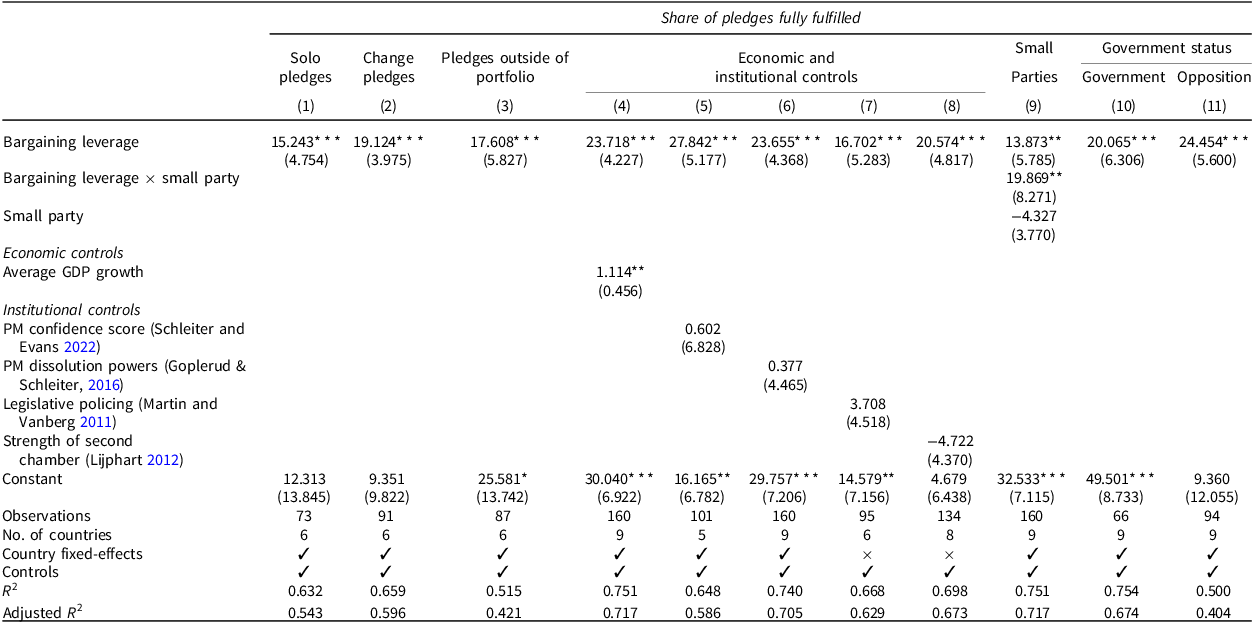
Table 2 summarizes the findings of the most relevant indicators in our auxiliary models, all of which have been estimated with the full set of control variables (full results for each of these models are available in Tables D2, D3, and D4 in the SM). Coalition bargaining leverage consistently exhibits a substantively strong and statistically significant effect on all types of pledges (models (1) to (3)), and in the presence of potential economic and institutional confounders, including GDP growth (model 4), and the institutional prerogatives of PM parties, the policing powers of legislatures, and institutional veto players (second chambers) (Tsebelis Reference Tsebelis1999), in models (5) to (8).Footnote 15 Model (9) focuses on smaller parties (parties with a seat share below the sample’s average), demonstrating the particular analytical advantage of measuring smaller parties’ policy influence through their coalition options instead of simple seat shares – something that seat shares and other bargaining indices fail to achieve (see Table D4). Finally, models (10) and (11) explore the impact of bargaining leverage for government and opposition parties separately, producing significant effects for both, as anticipated.
Pledge types, internal coalition resources, institutions, and party size

Table 2 Long description
The table presents data on the share of pledges fully fulfilled under various conditions. It includes columns for solo pledges, change pledges, pledges outside of portfolio, economic and institutional controls, small parties, and government status. Each column contains values for different models, with statistical significance indicated by asterisks. The table also includes observations, number of countries, country fixed-effects, and R-squared values. Panel A focuses on bargaining leverage, Panel B on economic controls, Panel C on institutional controls, Panel D on small parties, and Panels E and F on government and opposition status respectively. Each panel provides specific insights into the factors influencing pledge fulfillment.
Note: linear models with robust standard errors. Institutional variables are normalized to the [0,1] interval.
*p < 0.1; **p < 0.05; * * *p < 0.01.
The institutional variables in Models (5) to (8) warrant closer attention in their own right. A central contribution of this paper is to demonstrate the previously neglected importance – at least in empirical research – of outside bargaining options for policy making, which implies a comparison to the effects of key bargaining resources that are available to parties within the prevailing coalition. Figure 1 and Table 1 compared the effect of bargaining leverage to the most directly relevant prevailing coalition resource, legislative seat and ministerial portfolio shares. Models (5–8) in Table 2 employ additional measures of prevailing resources. When prime ministers have the power to call votes of confidence (Huber and McCarty Reference Huber and McCarty2001; Schleiter and Evans Reference Schleiter and Evans2022) (Model 5), or have the prerogative to dissolve the legislature (Goplerud & Schleiter, Reference Goplerud and Schleiter2016) (Model 6), they can leverage these powers to get their way on policy.Footnote 16 Legislative policing powers (Model 7) enable coalition members to monitor (and sometimes intervene in) policy making in ministries headed by coalition partners and, hence, prevent ministers from other parties becoming ‘policy dictators’ (Martin and Vanberg Reference Martin and Vanberg2011). An additional institutional variable that should detract from overall, rather than party-specific, pledge fulfillment is the strength of the second chamber (Model 8).Footnote 17 All of these institutional resources yield null effects, while the effect of coalition bargaining leverage remains positive, significant, and substantively large, lending further support to the expectation that bargaining leverage trumps parties’ prevailing resources (H2). Figure 2 illustrates these effects.
Marginal effects of bargaining leverage (coalition inclusion probability) and institutional sources of agenda power on the share of pledges fully fulfilled. Models from Table 2.

Local Average Treatment Effects
The regression analysis in the section Regression analysis using panel data above shows a strong correlation between coalition leverage (CIP) and pledge fulfillment. Changes in CIP, however, are neither gradual nor monotonic, shifting up or down like a step function at different seat shares as different coalitions become (un)viable. Given that changes in CIP, the treatment variable, occur in discrete shifts, pledge fulfillment shares just on either side of large shifts should differ considerably even though seat share has changed very little. Such local average treatment effects (LATEs) comparing pledge fulfillment shares on either side of CIP shifts offer a means of testing our hypotheses more granularly where the largest part of the variation in the treatment occurs. Moreover, because parties with seat shares slightly above and below a CIP shift are unlikely to differ much with respect to other covariates, this discontinuity method can better support a causal identification of the effect of coalition leverage (CIP).
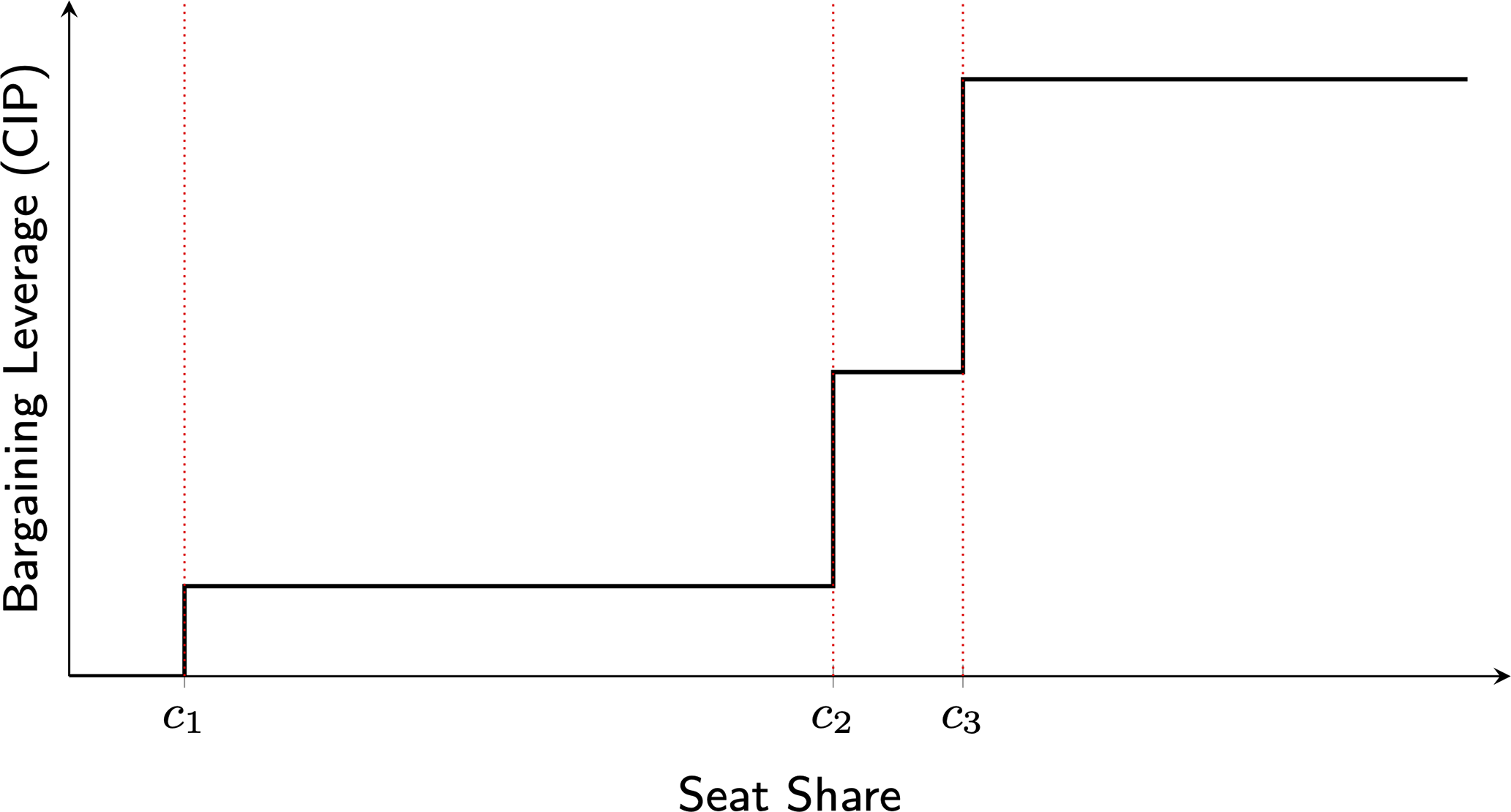
In practice, however, the design is more complex. The seat share threshold at which CIP shifts depends not only on seat share but also on a series of covariates that contribute to coalition formation, including, for instance, the ideological compatibility of parties and coalition history. Discrete shifts in coalition bargaining power can arise for a single party at various seat share levels. Figure 3 offers a theoretical illustration of how such discrete shifts in CIP identify seat share cut-offs (c 1,c 2,c 3) at which pledge fulfillment in our subsequent tests is expected to jump.Footnote 18
A Theoretical example. Cut-offs (c 1,c 2,c 3) mark the seat share values at which bargaining leverage (coalition inclusion probabilities) shifts.

Drawing on multiple parties from multiple coalition formation opportunities and countries, we follow a ‘normalize and pool’ procedure (Cattaneo et al Reference Cattaneo, Titiunik, Vazquez-Bare and Keele2016) in order to accommodate the fact that discrete shifts in bargaining power (CIP) occur at different seat shares. By setting the seat share at which a CIP shift occurs to zero and measuring seat shares as deviations from the shift, we effectively stack multiple cut-offs for multiple parties in multiple coalition formation situations on top of each other. This enables us to compare pledge fulfillment shares on both sides of CIP cut-offs with a running variable scaled as seat share percentage points below or above the cut-off.
Next, we identify CIP shifts empirically. First, we determine for each party the seat shares at which CIPs would shift if the seat shares were to differ from the actual allocation following each election. This is a simulation in which we add a percentage point to the actual seat share of a party and re-estimate its CIP. If the CIP jumps (or drops), we then know that the party is only one point below a CIP jump (or drop). We repeat this procedure for every party, iteratively adding (and subtracting) up to 10 percentage points, to identify all CIP changes in this range for all parties. To facilitate this, we rely on an assumption similar to that in multiparty election regression discontinuities in which the seat share margin of victory of a party serves as the running variable (Klašnja and Titiunik Reference Klašnja and Titiunik2017). Namely, we assume that the additional seat share point that we award or deduct to find potential discontinuities is balanced out by an offsetting amount to another party that is irrelevant to the outcome.
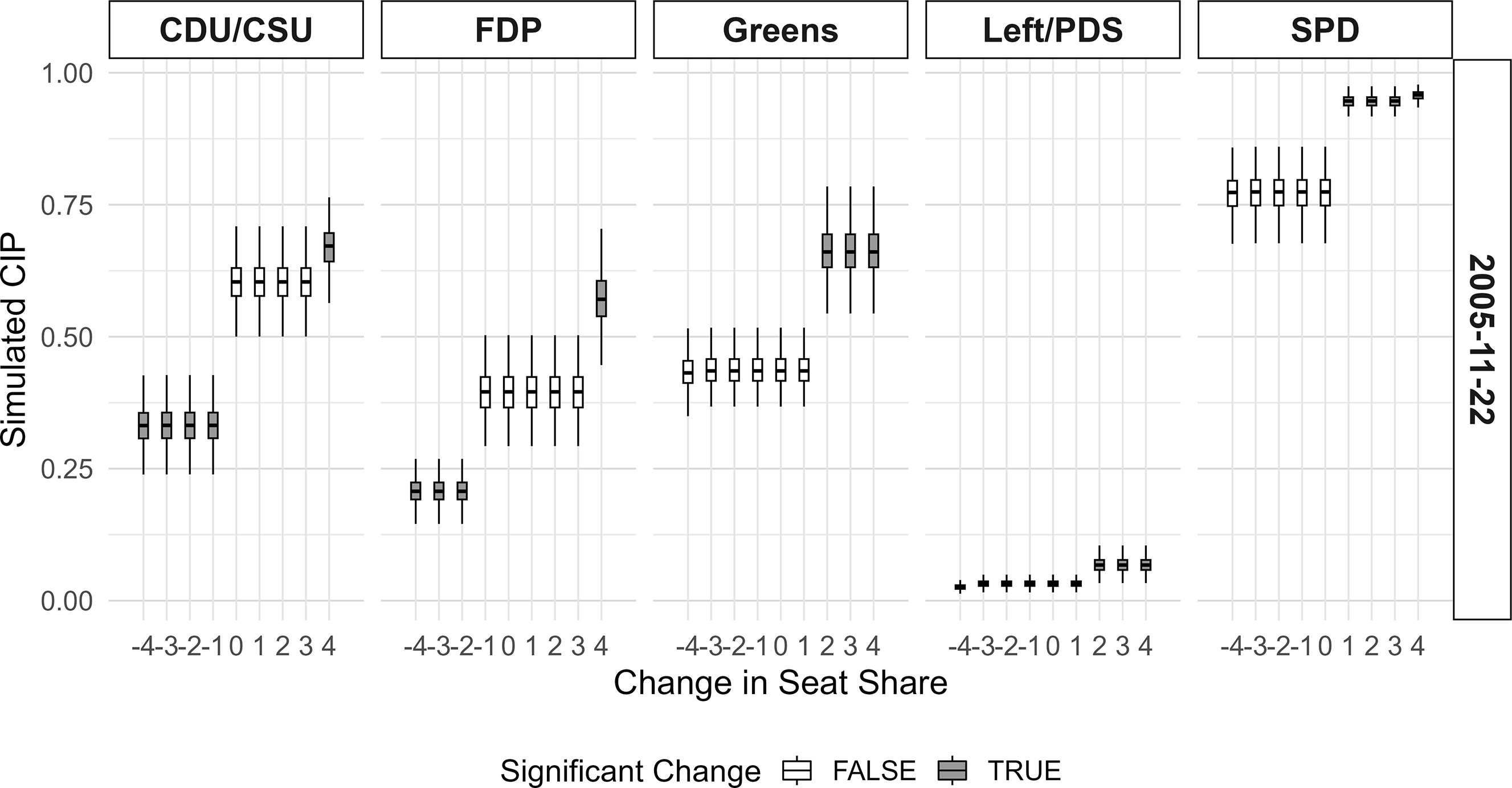
This exercise reveals multiple CIP shifts of varying magnitudes. We employ only CIP changes which differ statistically significantly from the mean actual CIP (p < 0.05). When a party experiences multiple CIP shifts, we choose the shift that is associated with the smallest deviation in seat share from the de facto post-election seat share. When two shifts in CIP are equally distant from the de facto seat share, we choose the one associated with the larger change in CIP. Figure 4 illustrates this procedure with an example from the 2005 German federal election.
Finding cut-offs, an example from the 2005 German Bundestag election. Coalition inclusion probability (CIP) jumps significantly for the CDU/CSU, FDP, Greens, the Left/PDS, and SPD as a function of hypothetical seat share change. Significant changes from the mean CIP based on actual seat shares (change in seat share = 0) are colored gray (p < 0.05).
Note: CDU: Christlich Demokratische Union; CSU: Christlich-Soziale Union; FDP: Freie Demokratische Partei; Left/PDS: Linke/Partei des Demokratischen Sozialismus; SPD: Sozialdemokratische Partei Deutschlands.

The treatment effect that we identify is an average in several ways. It is a local average difference between the observations above and below the cut-off. Because we have multiple cut-offs and heterogeneity in treatment magnitudes, it is also a local average treatment in those senses. We use a difference of means (see, for example, Imbens and Angrist Reference Imbens and Angrist1994) rather than a difference in Ŷ from regression models because there is no reason to expect a relationship between our running variable and the outcome variable. Whether a party is one or three percentages points above or below a cut-off should not matter to the share of pledges it fulfills, except via a change in bargaining leverage, thus fulfilling the LATE exclusion restriction. We also meet the second key assumption: there are no defiers given that assignment to a CIP shift is identical to a CIP shift.
Nine countries in our sample have at least one party with a statistically significant shift in CIP within ten seat share points of their seat share after an election.Footnote 19 This yields a maximum of seventy-seven observations at the maximum ten-point bandwidth, fifty when the bandwidth is four, and eighteen when it is one. Substantively, this means that fifty parties, for example, are within four seat share points of a CIP discontinuity. A bandwidth of ten is unusually large, while at the same time a bandwidth of one would only offer eighteen observations. We follow the previous vote and seat share literature (Valentim et al Reference Valentim, Núñez and Dinas2021) by focusing our main analysis on a four-point bandwidth, which is also the smallest bandwidth that delivers a reasonable number of observations (fifty – a robustness test employs a ten-point bandwidth).
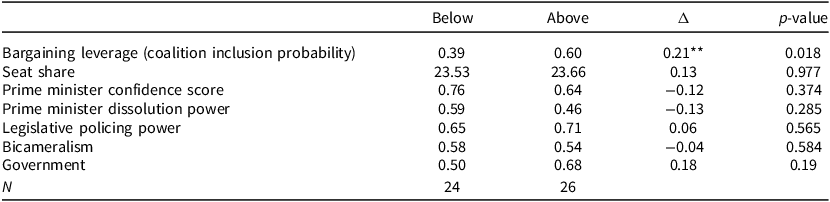
As the balance tests reported in Table 3 demonstrate, selecting only observations near a CIP cut-off ensures that the bargaining leverage (CIP) treatment is the only covariate that differs statistically significantly across groups.Footnote 20 The difference in the average seat share above and below the cut-off is not significant, nor is the difference for the institutional variables (Figure D2 in the SM demonstrates that this is also the case for other bandwidths). This enables our analysis, which compares the mean value of the percentage of fully fulfilled pledges on both sides of the bargaining leverage cut-off, to isolate the effect of a CIP change.
Covariate balance tests. Mean values above and below the cut-off. Bandwidth = 4. For coalition bargaining leverage (coalition inclusion probability), the table reports one-sided t-tests expecting higher values above the cut-off. Because we have no directional expectations for mean seat shares and institutional variables across the cut-off, we perform two-tailed tests. Institutional variables have been normalized to keep with the analysis in the section Institutions and robustness. *p < 0.1, **p < 0.05, * * *p < 0.01

Table 3 Long description
A table comparing covariate balance tests for various political metrics. The table has 8 rows and 5 columns. The columns are labeled Below, Above, Δ, and p-value. The rows are labeled Bargaining leverage (coalition inclusion probability), Seat share, Prime minister confidence score, Prime minister dissolution power, Legislative policing power, Bicameralism, and Government. The table reports mean values above and below the cut-off for each metric. For Bargaining leverage (coalition inclusion probability), the table reports one-sided t-tests expecting higher values above the cut-off. For seat share and institutional variables, two-tailed tests are performed. Institutional variables have been normalized. The p-values indicate the significance of the differences. The table shows that the bargaining leverage (coalition inclusion probability) treatment is the only covariate that differs statistically significantly across groups.
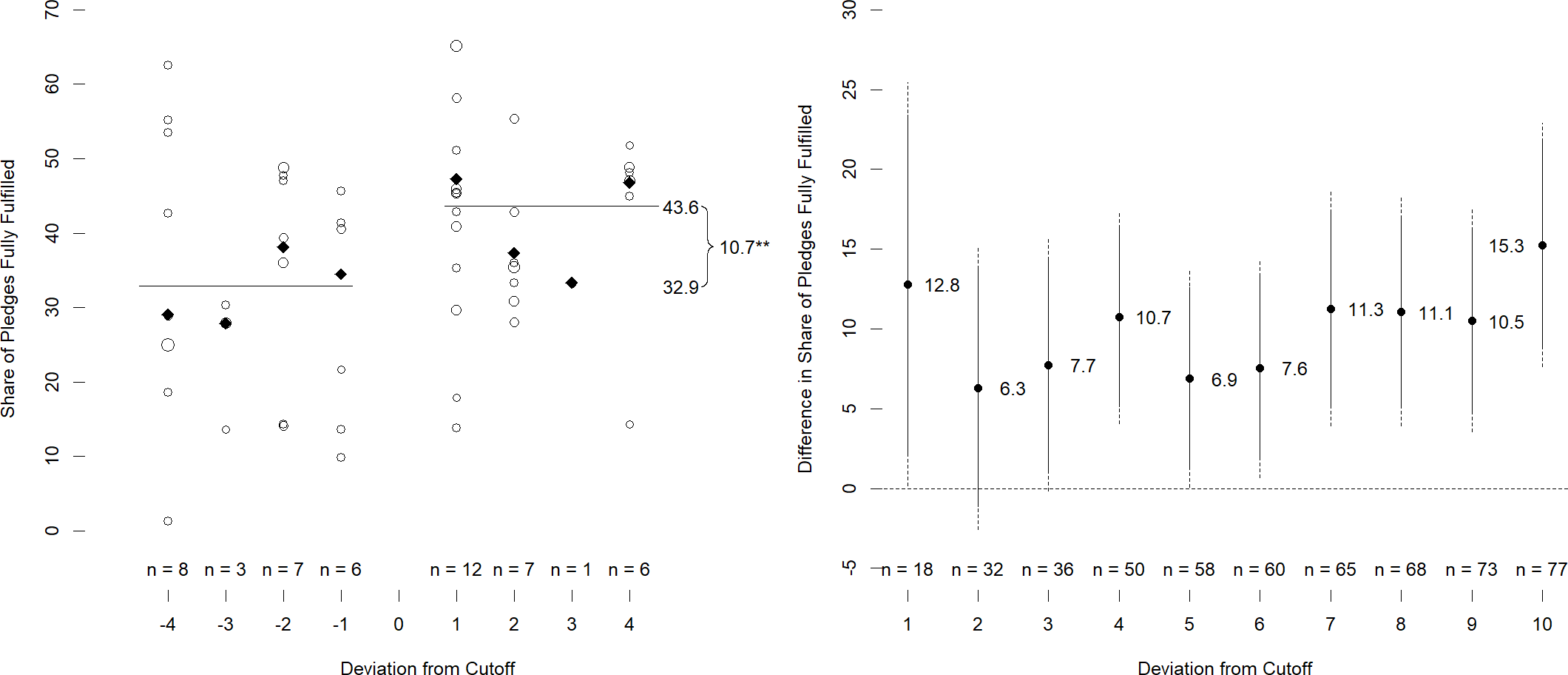
Figure 5 (left panel) presents the local average treatment effect on pledge fulfillment of a discrete shift in bargaining leverage for parties whose CIPs would have significantly shifted had their seat share percentage differed only modestly (by up to four points). Black diamonds mark pledge fulfillment means at specific deviations from the cut-off, while horizontal lines indicate means across the full bandwidth. On average, parties just above a shift in bargaining leverage fulfill a 10.7 percentage points greater share of their pledges than parties just below the shift, as is consistent with both of our hypotheses. The robustness test in the right panel no longer shows the individual observations but displays the sample size and effect (and its 95 per cent confidence interval) at each cut-off between one and ten points.Footnote 21
As the robustness test in the right panel shows, regardless of the bandwidth, the difference of means is positive and substantively large. Political parties with seat shares just above a shift in bargaining leverage (CIP) completely fulfill between 6.3 and 15.3 percentage points more of their electoral pledges than parties with a seat share just below. All effects presented in Figure 5 are based on fifty or more observations (bandwidth of four and above) and are significantly different from zero, as is, surprisingly, the effect when the bandwidth equals 1 and the sample is small. These discontinuity results provide stronger grounds for a causal interpretation than the regression models in the section Regression analysis using panel data. As our covariate balance tests show, only bargaining leverage differs systematically among parties above and below the cut-off; all other variation among the parties is as if random. This increases our confidence that the effect on pledge fulfillment is driven by coalition bargaining leverage alone, not seat shares or other institutional resources within a coalition (H2).
Local average treatment effects. The left panel presents a comparison of the mean shares of fully fulfilled pledges for parties up to four points below and above a cut-off, weighted by the size of the coalition inclusion probability jump. Diamonds show weighted means at each seat share point deviation from the cut-off. The right panel shows the difference in mean full pledge fulfillment for parties above v. below the cut-off at each bandwidth. 95 per cent confidence intervals. Sample sizes are cumulative.

Discussion and Conclusion
In parliamentary democracies, political representation hinges on bargaining between political parties over the implementation of electoral promises, a dependence that has intensified over the past decades with the accelerating erosion of cartel-party dominance and growing party-system fragmentation. In this paper we test a general theory of policy bargaining in multiparty systems that incorporates credible outside options, and demonstrate that parties deploy their full leverage, including the threat of government replacement, to advance their electoral commitments. While our conclusions speak most directly to the literature on pledge fulfillment, their broader significance extends to core questions of multiparty and coalition policy making, legislative bargaining, voter representation under multiparty government, and policy responsiveness in parliamentary democracies.
Our findings advance knowledge of policy making in multiparty contexts over prior work in two respects. First, they show that parties’ coalition bargaining leverage can eclipse their resources in the prevailing government–opposition setting, that is, the agenda, veto, and policing powers that have, to date, been the focus of this work. Secondly, we provide the first general test of a party’s policy bargaining power across the full range of substantive policy areas. By focusing on the realization of a party’s actionable pledges (rather than a degree of policy change in a particular area), we are able to improve simultaneously on the generality, precision, and political import of prior theories of multiparty policy bargaining. Our results also open promising new avenues of inquiry for the extensive empirical literature on coalition policy making, which examines why policy in a given area converges either on a minister’s preferences or on coalition compromise, but does not take account of parties’ coalition leverage from outside coalition options (Carroll and Cox Reference Carroll and Cox2012; Kim and Loewenberg Reference Kim and Loewenberg2005; Lipsmeyer and Pierce Reference Lipsmeyer and Pierce2011; Martin and Vanberg Reference Martin and Vanberg2011; Pedrazzani and Zucchini Reference Pedrazzani and Zucchini2013; Thies Reference Thies2001).
To the formal literature on legislative bargaining, we contribute the first empirical test of its central theoretical proposition that credible coalition options increase policy bargaining power. To date, the absence of an empirical measure to capture the key quantity of interest – coalition leverage – precluded its expansion into empirical work. The best measure of this leverage, we show, is coalition inclusion probabilities (rather than voting weights), and the best demonstration of how it matters for policy bargaining in systems with multiparty government is pledge fulfillment.
In several other areas, our results suggest a re-evaluation of prior findings or open new avenues for future research. The assumption that policy outcomes in multiparty governments represent a compromise is central to work on political representation. The arguments of Huber and Powell (Reference Huber and Powell1994) and Powell (Reference Powell2009), that proportional systems yield policy outputs closer to the median voter because coalition governments compromise between party positions, implicitly rely on this view. Yet, our findings show that coalition policy often reflects coalition leverage rather than mutual compromise. When the prime minister’s party is included in all viable coalition alternatives, for example, policy is unlikely to be closer to the median voter than in single-member district systems. Conversely, where leverage is more diffuse and opposition parties possess credible prospects of coalition inclusion, policy is more likely to track a broader distribution of voter preferences. Hence, cross-national averages likely conceal substantial heterogeneity.
Our findings also open new avenues for research examining coalition compromise and pledge fulfillment as voter-relevant cues. Recent work by Fortunato (Reference Fortunato2021), Green-Pedersen and Hjermitslev (Reference Green-Pedersen and Hjermitslev2024), and Ylisalo et al (Reference Ylisalo, Matthieß, Praprotnik and Ennser-Jedenastik2025) shows that voters interpret coalition bargaining, compromise, and pledge deviation in nuanced ways, as signals of party competence, distinctiveness, and responsibility, raising the question of how variation in coalition leverage shapes voters’ assessments of representation.
Finally, pledges offer a micro-level means of examining arguments about policy responsiveness, which are often tested at a much higher level of aggregation. Scholars have argued that government policy covaries with shifts in public opinion (Stimson et al Reference Stimson, MacKuen and Erikson1995), including in thermostatic reactions against policy initiatives (Soroka and Wlezien Reference Soroka and Wlezien2010; Wlezien Reference Wlezien1995), but have found evidence predominantly in the single-party government settings of the United States, Canada, and the United Kingdom. Similar effects in systems with multiparty governments have proved harder to document. Our finding suggests that while parties’ preferences may well track public opinion in coalition systems, the translation of these preferences into policy is mediated by coalition bargaining.
Even theories of policy generation that find support across single-party and multiparty systems depend on coalition leverage to some degree. Jones and Baumgartner (Reference Jones and Baumgartner2005) have prominently posited that a policy equilibrium of incremental change is occasionally, if infrequently, punctuated by large changes when issues receive attention, reframe their image, and change the venue in which they are decided from obscure committees to open debate in public, in the legislature and with the executive. Whether and how much policy change occurs, however, may depend on the bargaining leverage of the parties championing those issues, both in the government and opposition. Explicit recognition that policy in most parliamentary systems is negotiated strategically in the shadow of potential government change promises to improve our understanding and prediction of policy making across a broad set of domains.
Supplementary material
The supplementary material for this article can be found at https://doi.org/10.1017/S0007123426101641.
Data availability statement
Replication data for this paper can be found at https://doi.org/10.7910/DVN/AXZL37.
Acknowledgments
The authors thank Tom Arend, Henrik Bech Seeberg, Christoffer Green-Perdersen, Chris Hanretty, Heike Klüver, Lanny Martin, Sven-Oliver Proksch, Max Schaub, Florence So, Vera Troeger, Georg Vanberg, and participants in seminars at the Humboldt University, the University of Hamburg, the University of Aarhus, the Civica Political Behavior and Institutions (PoBI) conference, EPSA, and APSA for helpful suggestions.
Financial support
No external funding was used for this article.
Competing interests
The authors declare none.




 Open access

