Introduction
As more children living with perinatally acquired HIV (PaHIV) survive beyond childhood worldwide, there has been a growing concern about the toll on their mental health. It is well established that young people living with PaHIV have an increased risk of depression and anxiety compared to the age-matched general population (Le Prevost et al., Reference Le Prevost, Arenas-Pinto, Melvin, Parrott, Foster and Ford2018; Vreeman, McCoy, & Lee, Reference Vreeman, McCoy and Lee2017). However, there is little published data on the occurrence of psychotic disorders in this population.
Psychotic disorders represent a group of severe mental health disorders characterised by altered thought processes, perception, mood, and behaviour impacting on everyday functioning. The presentation of psychosis is varied; for example, the psychotic symptoms of schizophrenia are classified into positive – encompassing delusions and hallucinations, negative, such as self-neglect, apathy, social withdrawal and paucity of speech, and disorganised (disorganised speech, affect and behaviour) (World Health Organization, 2004).
The aetiology of psychotic disorders is complex. Twin studies in schizophrenia suggest heritability estimates of up to 80% (Cardno et al. Reference Cardno, Marshall, Coid, Macdonald, Ribchester, Davies and Murray1999; Hilker et al., Reference Hilker, Helenius, Fagerlund, Skytthe, Christensen, Werge and Glenthøj2018). However, environmental factors also play an important (Wahlberg et al., Reference Wahlberg, Wynne, Oja, Keskitalo, Pykäläinen, Lahti and Tienari1997) and some have argued, a more crucial (Fosse, Joseph, & Richardson, Reference Fosse, Joseph and Richardson2015) role. Biological factors including male gender, birth complications, neonatal infection, traumatic brain injury (McAllister, Reference McAllister1998), learning disabilities (LD) (Cooper et al., Reference Cooper, Smiley, Morrison, Allan, Williamson, Finlayson and Mantry2007), and strokes (Stangeland, Orgeta, & Bell, Reference Stangeland, Orgeta and Bell2018) increase the risk of psychosis in adult life. More recently, the role of the immune system in psychosis has become more apparent, and autoantibodies such as anti-N-methyl-d-aspartate receptor (NMDA) maybe implicated (Ellul, Groc, Tamouza, & Leboyer, Reference Ellul, Groc, Tamouza and Leboyer2017). Of relevance for people with PaHIV, the neurotropic side effects of commonly prescribed antiretrovirals (ART) such as efavirenz (Belcher & Marcangelo, Reference Belcher and Marcangelo2017; Foster, Olajide, & Everall, Reference Foster, Olajide and Everall2003) may also contribute.
Socio-demographic and environmental risk factors for psychosis include Black ethnicity in white-majority countries (Qassem et al., Reference Qassem, Bebbington, Spiers, McManus, Jenkins and Dein2015), being first- and second-generation immigrants (Selten, van der Ven, & Termorshuizen, Reference Selten, van der Ven and Termorshuizen2019), socio-economic deprivation (Hastings et al., Reference Hastings, Serbin, Bukowski, Helm, Stack, Dickson and Schwartzman2019), bullying (Trotta et al., Reference Trotta, Di Forti, Mondelli, Dazzan, Pariante, David and Fisher2013), childhood trauma (Popovic et al., Reference Popovic, Schmitt, Kaurani, Senner, Papiol, Malchow and Falkai2019; Varese et al., Reference Varese, Smeets, Drukker, Lieverse, Lataster, Viechtbauer and Bentall2012), and existing mental health problems or drug use, particularly cannabis (O'Donoghue et al., Reference O'Donoghue, Lyne, Madigan, Lane, Turner, O'Callaghan and Clarke2015).
Psychosis in people living with HIV, especially those with persistent HIV viraemia and advanced immunosuppression has long been described (De Ronchi et al., Reference De Ronchi, Faranca, Forti, Ravaglia, Borderi, Manfredi and Volterra2000), but there is a paucity of literature focusing on those who have grown up into adulthood with PaHIV. Adolescents and young adults living with perinatally acquired HIV (AYAPaHIV) in the UK have a litany of intersecting risks for developing psychosis; lifelong exposure to HIV, a highly neurotropic virus, with an increased prevalence of learning disability (Nozyce et al., Reference Nozyce, Lee, Wiznia, Nachman, Mofenson, Smith and Pelton2006), central nervous system (CNS) infection (González-Scarano & Martín-García, Reference González-Scarano and Martín-García2005) and immune dysfunction (Al-Diwani, Pollak, Irani, & Lennox, Reference Al-Diwani, Pollak, Irani and Lennox2017). From a social point of view, many young people with PaHIV in the UK are growing up in adverse socio-economic circumstances; the majority being first- or second-generation migrants of Black ethnic origin (Collins et al., Reference Collins, Foster, Tostevin, Tookey, Riordan, Dunn and Judd2017).
One aspect that can be particularly problematic is that once established, psychosis can create issues of ART non-adherence as well as disengagement from medical and social care follow up (Kane, Kishimoto, & Correll, Reference Kane, Kishimoto and Correll2013). Non-adherence is of particular concern in AYAPaHIV who are at risk of lower rates of virological suppression and are more prone to disengagement from care than their adult counterparts (Ryscavage, Anderson, Sutton, Reddy, & Taiwo, Reference Ryscavage, Anderson, Sutton, Reddy and Taiwo2011).
Given these intersecting risk factors, we hypothesise that AYAPaHIV is at a higher risk of psychosis when compared to the general population.
Methods
We conducted a retrospective electronic case note review of all individuals with PaHIV aged over 18 years registered for follow up at a dedicated clinic in the UK (Foster et al., Reference Foster, Ayers, McDonald, Frize, Chhabra, Pasvol and Fidler2020). All care, including psychiatric care, was delivered by standard National Health Services.
Data were collected from registration for clinical care to 20th May 2019 and included patient demographics encompassing age, ethnicity, place of birth, the place of birth of the patients' parents, post-code (anonymised) as well as age at the 1st psychotic episode; immunology (mean CD4 count at the time of psychosis and nadir CD4 count), past AIDS-defining illness (CDC-C diagnosis); virology including HIV plasma viral load and ART. Personal and family mental health history, and drug and alcohol use were recorded as well as whether the subject had a learning disability impacting independent living. Social deprivation was determined using the English Index of Multiple Deprivation (IMD) which ranks every small area in England from 1 (most deprived area) to 32 844 (least deprived area) (Ministry of Housing, 2015).
In those who had experienced a psychotic episode, details of their treatment for psychosis including use of psychotic medication and the length and setting of mental health care was recorded. ‘Non-organic psychosis’ (N-OP) was defined as a psychotic disorder diagnosed by a psychiatrist, after no organic cause was identified for the symptoms, after thorough investigations. ‘Probable organic psychosis’ (OP) was defined as a psychotic episode, in which an organic cause such as encephalitis, thyrotoxicosis or drug misuse was thought to be the primary contributor as diagnosed by a medical professional. Data were collected regarding psychopathological features, length of inpatient psychiatric stay, treatment given and recurrence of psychosis at follow-up. To determine whether there was an increased occurrence of psychosis in the cohort, we undertook a descriptive analysis. The study was undertaken as a clinical service evaluation and therefore research ethical approval was not sought.
Results
The clinic cohort included in this analysis comprised of 184 AYAPaHIV. At the time of evaluation, of 184 subjects, 12 (6.5%) had experienced at least one psychotic episode in their lifetime.
Demographics
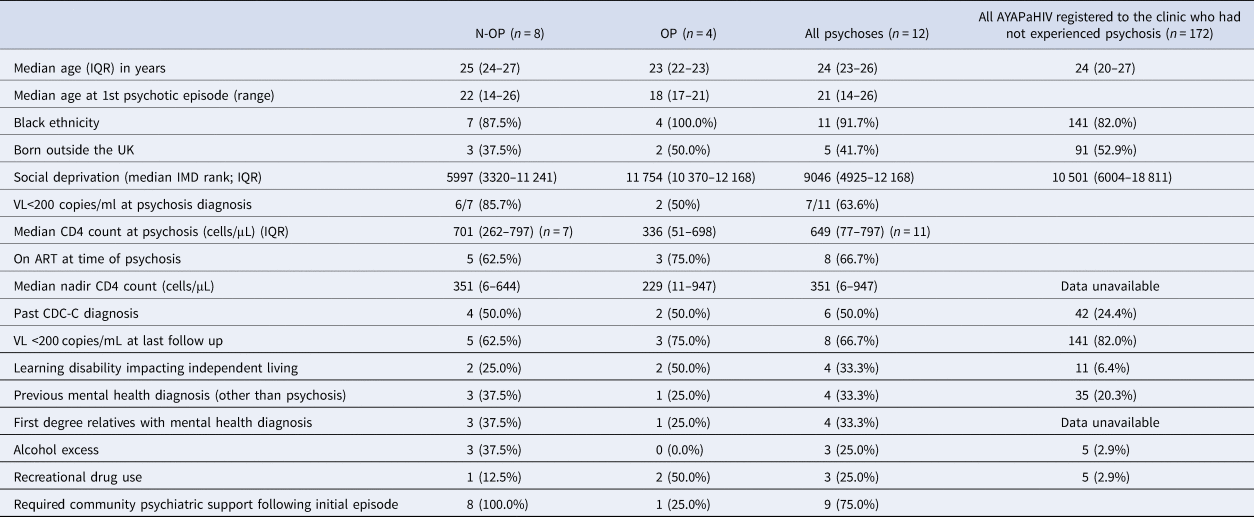
Of the clinic sample who did not experience psychosis, 98/172 (57.0%) were female, median age 24 years [interquartile range (IQR) 20–27]. 140/172 (81.4%) were of Black ethnicity and an additional 17 (9.7%) of other ethnic minority origins; 96/172 (55.8%) were born abroad and data were unavailable for second-generation migration status. Of the clinic population who had not experienced psychosis, the median deprivation index as described by IMD rank was 10 501 (6 004– 18 811). Amongst the 12 who had experienced an episode of psychosis, six (50%) were female with a median current age of 24 years (IQR 23–26). In total, 11/12 (91.7%) were of Black ethnicity, five (41.7%) had been born abroad, and a further two subjects were second-generation migrants. The median IMD rank amongst the 12 was 9 046 (4 925– 12 168) (Table 1).
Differences between those who experienced probable organic psychosis (OP) and non-organic psychosis (N-OP)

ART, antiretrovirals; IMD, Index of Multiple Deprivation; IQR, interquartile range; VL, viral load.
Psychosis onset and treatment
The median age of the first presentation with psychosis was 21 years (IQR 17–22). All 12 were treated as an in-patient at the first episode of psychosis; seven (58.3%) required hospitalisation and treatment in a mental health unit and the remainder on general medical wards.
Details of the presentation were available for 9/12 (75%) of those who had experienced psychotic episodes. The most common presentation was auditory hallucinations (5/9, 55.6%), followed by paranoid delusions (4/9, 44.4%), thought disorder (3/9, 33.3%), and two grandiose delusions (2/9, 22.2%). One person became suicidal (11.1%), however did not complete suicide.
Treatment history was available for 11 patients, nine of whom (81.8%) required antipsychotics. Of the others, in one person, thyroxine was stopped, and, in another, who tested positive for anti-NMDA antibodies, a watch and wait approach was adopted.
Of the total, 4/12 (33.3%) were known to have experienced more than one acute psychotic episode and nine (75%) needed community mental health (CMHT) follow up; the median length of follow up at the time of evaluation was 23.5 months (range 18–168 months).
HIV outcomes
Of the clinic sample who had not experienced psychosis, 82% (141/172) had HIV viral load <200 copies/mL at the last follow up. The median CD4 count was 623 cells/μL (IQR 443–810). In total, 42 of the 172 (24.4%) had a past AIDS-defining diagnosis as definied by ‘Category C' of the Centres for Disease Control Classification System for HIV Infection (a CDC-C diagnosis) (Centers for Disease Control [CDC], 1987).
Amongst the 12 who had experienced at least one episode of psychosis, viral load and CD4 count data at the time of the first episode of psychosis were available for 11. Of the 11, seven (63.6%) had viral load <200 copies/mL, and median CD4 count was 649 cells/μL (range 6–1132) at the first episode of psychosis. In total, 8/12 (66.7%) were on ART at the time of the first episode of psychosis. However, 1/12 was stable on efavirenz at the time of their psychotic episode, with no improvement in symptoms found after a switch to raltegravir. The nadir CD4 count amongst the 12 who had experienced a psychotic episode was 351 cells/μL (range 6–947) and 6/12 (50%) at the time of evaluation, had a prior CDC-C diagnoses.
Other mental health diagnoses
In our sample, 11/172 (6.4%) people registered to the clinic who had not experienced psychosis had a learning disability impacting independent living, compared to 4/12 (33.3%) in those who had experienced an episode of psychosis.
In total, 36/172 (21.0%) of those registered to the clinic but had not experienced psychosis had been diagnosed with a mental health condition other than psychosis, including anxiety disorders such as generalised anxiety disorder or obsessive-compulsive disorder (9/172, 5.2%) and depression (15/172, 8.7%). Eleven PaHIV who had not experienced psychosis (6.4%) were diagnosed with complex-post traumatic stress disorder (complex-PTSD) or borderline personality disorder, and one person had been diagnosed with PTSD (0.6%). Four (33%) of the twelve of those who experienced an episode of psychosis had also been diagnosed with depression, three of whom had an additional diagnosis of a non-psychotic mental health disorder: 3/12 (25%) had an anxiety disorder, and 1/12 had an eating disorder. Additionally, in the 12 who had experienced an episode of psychosis, 4/12 (33%) were known to have at least one first-degree family member with a mental health diagnosis.
Drug and alcohol use
Of those registered to the clinic who had not experienced psychosis, 5 (2.9%) were known to have a history of excess alcohol use whilst 5 (2.9%) were known to have a history of recreational drug use. Of those who had experienced psychosis, 3/12 (25%) were known to have a history of excess alcohol use and 3/12 (25%) had a history of recreational drug use.
Non-organic psychoses and probable organic psychoses
In 8/12 (66.7%) patients presenting with psychosis, no organic cause was identified (N-OP), an identifiable organic aetiology (OP) was identified in the other four (Table 1).
Discussion
The impact of growing up with PaHIV is likely to expose the person to a number of biological and social factors known to increase the risk of developing psychosis. This is the first case series to report the frequency of psychotic disorders amongst young people living with PaHIV.
At the time of evaluation, 6.5% of our clinic cohort had experienced at least one episode of psychosis during their lifetime. This is a far higher proportion than the percentage who have experienced psychosis within the UK general population. The Adult Psychiatric Morbidity Survey 2014 reported 0.5% of 16–24 and 1.0% of 25–34-year olds had a history of psychosis (McManus, Bebbington, Jenkins, & B., Reference McManus, Bebbington, Jenkins and Brugha2016). All those in our cohort who had experienced psychosis required in-patient care suggesting their symptoms were severe.
Whilst there is very little epidemiological data published on the prevalence of psychosis amongst people living with PaHIV, the link of the increased likelihood of psychosis amongst people living with behaviourally acquired HIV has been demonstrated. A national Danish cohort study found that people living with HIV had a greater risk of schizophrenia, independent from the presence of substance use disorders (Helleberg, Pedersen, Pedersen, Mortensen, & Obel, Reference Helleberg, Pedersen, Pedersen, Mortensen and Obel2015). Several studies across Africa have found increased HIV seroprevalence amongst psychiatric inpatients compared to the general population (Acuda & Sebit, 1996; Collins, Berkman, Mestry, & Pillai, Reference Collins, Berkman, Mestry and Pillai2009; Lundberg et al., Reference Lundberg, Nakasujja, Musisi, Thorson, Cantor-Graae and Allebeck2013; Maling, Todd, Van der Paal, Grosskurth, & Kinyanda, Reference Maling, Todd, Van der Paal, Grosskurth and Kinyanda2011; Opondo et al., Reference Opondo, Ho-Foster, Ayugi, Hatitchki, Pumar, Bilker and Evans2018).
In agreement with general population studies in the UK (Jones, Rodgers, Murray, & Marmot, Reference Jones, Rodgers, Murray and Marmot1994), Australia (Amminger et al., Reference Amminger, Harris, Conus, Lambert, Elkins, Yuen and McGorry2006) and Finland (Lauronen et al., Reference Lauronen, Miettunen, Veijola, Karhu, Jones and Isohanni2007) the median age of first presentation with psychosis in our cohort was 21 years (range 14–26 years). Lower age of onset of first-episode psychosis has been associated with environmental factors, in particular recreational drug use (O'Donoghue et al., Reference O'Donoghue, Lyne, Madigan, Lane, Turner, O'Callaghan and Clarke2015). We also found in our cohort, those who had a presumed organic aetiology and had a higher proportion of recreational drug use (50.0% v. 12.5%) and presented at a younger age than those who experienced N-OP (median 18 v. 22 years).
HIV is a neurotropic virus (González-Scarano & Martín-García, Reference González-Scarano and Martín-García2005) and in the perinatal setting, infantile HIV encephalopathy results in a spectrum of neurological sequelae including hypertonic diplegia and developmental delay (Laughton, Cornell, Boivin, & Van Rie, Reference Laughton, Cornell, Boivin and Van Rie2013). PaHIV children and adolescents are known to have poorer functional and biological neurodevelopmental outcomes (Ashby et al., Reference Ashby, Foster, Garvey, Wan, Allsop, Paramesparan and Winston2015; Judd et al., Reference Judd, Le Prevost, Melvin, Arenas-Pinto, Parrott and Winston2016; Laughton et al., Reference Laughton, Cornell, Boivin and Van Rie2013). In our cohort, there was a greater proportion of people living with a learning disability impacting independent living in the group who had experienced a psychotic episode (33.3%) than those who had not (6.4%).
Prior CNS infections have also been associated with psychosis (Dalman et al., Reference Dalman, Allebeck, Gunnell, Harrison, Kristensson, Lewis and Karlsson2008). There is growing evidence that neuroinflammation may play a role in developing psychotic disorders (Feigenson, Kusnecov, & Silverstein, Reference Feigenson, Kusnecov and Silverstein2014). Therefore, an increased risk of psychosis due to altered neurodevelopment in PaHIV youth is plausible. In our cohort, past AIDS-defining diagnoses was higher in the population who had experienced an episode of psychosis than in the clinic population who had not experienced psychosis (50% v 24.4%). Additionally, amongst those who had experienced psychosis, HIV viral suppression [viral load (VL)<200 copies/mL] at the time of the first episode of psychosis was low (63.6%) compared to the level of viral suppression amongst the clinic population who had not experienced psychosis (82.0%, at last, follow up). However, median CD4 count at time of first episode of psychosis was 649 cells/μL (range 6–1132), broadly similar to the median CD4 count at last follow up amongst the clinic cohort who had not experienced psychosis 623 cells/μL (IQR 443–810) – although there was greater disparity amongst those the former group.
Differences between the two groups remained, at last, follow up; we found a smaller proportion of those who had experienced psychosis were virally suppressed with HIV VL <200 copies/mL than the clinic cohort who had not experienced psychosis (66.7% v. 82.0%). As Kane et al. (Kane et al. Reference Kane, Kishimoto and Correll2013) suggest, non-adherence to medication amongst those who had experienced psychosis may have played a role, perhaps both causative and as a sequela.
The development of psychosis is multifactorial, involving a combination of genetic, biological and environmental factors. Certainly, there is evidence to suggest that there is a cumulative effect of multiple environmental factors such as social deprivation and concomitant traumas, adverse childhood events, migration status, place and season of birth in increasing the risk of psychosis and lowering the age of onset (O'Donoghue et al., Reference O'Donoghue, Lyne, Madigan, Lane, Turner, O'Callaghan and Clarke2015). UK data show that the people from Black ethnic minorities have an excess prevalence rate of psychosis compared with the white population even when controlling for social class and employment status (Qassem et al., Reference Qassem, Bebbington, Spiers, McManus, Jenkins and Dein2015). There is also an increased prevalence amongst migrants and children of migrants from developing countries to Europe (Selten et al., Reference Selten, van der Ven and Termorshuizen2019), possibly related to perceptions of discrimination as well as social isolation (Cooper et al., Reference Cooper, Morgan, Byrne, Dazzan, Morgan, Hutchinson and Fearon2008). We did not replicate these findings in our cohort – of the clinic population who had not experienced psychosis, 91 (52.9%) were born abroad, and data were unavailable for second-generation migration status. Similarly, five (41.7%) of 12 patients with psychosis had been born abroad, and Black ethnicity was common both in those who had experienced an episode of psychosis as in the clinic population who had not experienced psychosis (91.7% and 82.0%, respectively).
The IMD is the official measure of relative deprivation in England. This tool ranks neighbourhoods using postcodes from 1 (most deprived) to 32, 844 (least deprived area) (Department of Communities & Local Government, 2015), the median national rank, therefore, would be 16 422. Our findings suggested that although both populations are more deprived when compared to the national average, social deprivation was greater in those who had experienced an episode of psychosis (median IMD rank 9046) compared to the clinic population (median IMD rank 10 501).
A third of those who experienced psychosis in our cohort were known to have experienced more than one acute psychotic episode, and nine (75.0%) needed CMHT follow up; the median length of follow up at the time of evaluation was 23.5 months (range 18–168 months), these patients also lived with a high level of deprivation. Combined, this suggests these patients developed a functional severe and enduring mental illness, possibly schizophrenia.
Selten et al. (Selten et al., Reference Selten, van der Ven and Termorshuizen2019; Selten, van der Ven, Rutten, & Cantor-Graae, Reference Selten, van der Ven, Rutten and Cantor-Graae2013), have argued that many of the psychosocial factors associated with an increased risk of psychosis can be grouped under ‘social defeat’. They further posit that this prolonged exposure to feeling excluded from mainstream society dysregulates the mesolimbic dopamine system increasing risk of psychosis (Selten et al., Reference Selten, van der Ven, Rutten and Cantor-Graae2013).
People growing up with HIV must contend with many factors that may lead to further feelings of ‘otherness’ from non-infected peers. Stigma surrounding living with HIV, and, in some cases, parental illness or death have been associated with poor mental health including symptoms of anxiety and depression in AYAPaHIV (Le Prevost et al., Reference Le Prevost, Arenas-Pinto, Melvin, Parrott, Foster and Ford2018; Mellins & Malee, Reference Mellins and Malee2013).
Many AYAPaHIV grow up with intensely difficult childhood circumstances; in a retrospective study of 638 non-HIV infected individuals, early victimization events such as bullying, homelessness and being taken into local authority care increased the risk of psychosis in later life (Bebbington et al., Reference Bebbington, Bhugra, Brugha, Singleton, Farrell, Jenkins and Meltzer2004).
Several potential risk factors for psychosis aside from HIV exist in our population; our cohort is urban, predominantly comprised of migrants or children of migrants from Black ethnicity backgrounds, living in areas of deprivation. There is also a high incidence of LD and history of drug and alcohol misuse all of which are associated with an increased risk of developing of psychosis (Paramesparan et al., Reference Paramesparan, Garvey, Ashby, Foster, Fidler and Winston2010). However, the demographic makeup of our clinic population is broadly representative of the national cohort of AYAPaHIV in the UK (Chappell et al., Reference Chappell, Lyall, Riordan, Thorne, Foster, Butler and O'Callaghan2019) and may be generalised within the UK in this context. Our data are limited by its retrospective observational design and small study number, and, due to the unique demography of our cohort, the generalisability of our findings more broadly is uncertain.
Importantly however, our cohort is amongst the oldest of PaHIV cohorts worldwide (Slogrove et al., Reference Slogrove, Schomaker, Davies, Williams, Balkan, Ben-Farhat and Leroy2018); as more children survive into adulthood with PaHIV, more data to contextualise our findings are needed and would be potentially available, particularly from Sub-Saharan Africa where 75% of the world PaHIV population live (Slogrove et al., Reference Slogrove, Schomaker, Davies, Williams, Balkan, Ben-Farhat and Leroy2018). This is an important area for future research.
The importance of widening access to mental health care for people living with PaHIV is evident in the high risk of mental health disorders of all kinds, not just psychosis, in this population (Abrams et al., Reference Abrams, Mellins, Bucek, Dolezal, Raymond, Wiznia and Ng2018; Le Prevost et al., Reference Le Prevost, Arenas-Pinto, Melvin, Parrott, Foster and Ford2018; Mellins & Malee, Reference Mellins and Malee2013). In our sample, 36/172 (21.0%) of those registered to the clinic but had not experienced psychosis had been diagnosed with a mental health condition other than psychosis, including anxiety disorders (5.2%) and depression (8.7%) and 6.4% with complex-PTSD. Our findings are very similar to those reported by others. Abrams et al. (Reference Abrams, Mellins, Bucek, Dolezal, Raymond, Wiznia and Ng2018) reported that 27% of their sample of AYAPaHIV across New York City have met the criteria for a psychiatric disorder, of which the most common were anxiety and depression. Whilst the risk of anxiety and depressive symptoms, and particularly, low self-esteem amongst people living with perinatally acquired HIV is well established (Abrams et al., Reference Abrams, Mellins, Bucek, Dolezal, Raymond, Wiznia and Ng2018; Le Prevost et al., Reference Le Prevost, Arenas-Pinto, Melvin, Parrott, Foster and Ford2018), recent evidence suggests that PTSD is also common amongst people living with HIV (Tang et al., Reference Tang, Goldsamt, Meng, Xiao, Zhang, Williams and Wang2020) and our experience replicates this. Though the specific role of the virus itself remains unclear, worse outcomes for all mental health disorders, not only psychosis, are related to adverse events in childhood and socio-demographic deprivation (Mellins & Malee, Reference Mellins and Malee2013). Studies demonstrating similar levels of prevalence of mental health disorders amongst AYAPaHIV and adolescents who are perinatal HIV-exposed but uninfected suggest that the factors other than the viral infection may be the greater determinants of mental health outcomes (Abrams et al., Reference Abrams, Mellins, Bucek, Dolezal, Raymond, Wiznia and Ng2018; Mellins et al., Reference Mellins, Elkington, Leu, Santamaria, Dolezal, Wiznia and Abrams2012). There is some cumulative effect; in our cohort, the impact of mental health disorders was more profound in those who had experienced psychosis – a third of AYAPaHIV who had experienced psychosis had also been diagnosed with depression, and a quarter had at least three mental health diagnoses.
Our experience should provide impetus to further investigate the possibility of a significantly increased risk of psychosis amongst young people growing up with PaHIV in the UK. Further, national data are required to draw firm conclusions. The risk of developing psychotic episodes must be considered when arranging holistic care, and particularly, access to mental health care, for this vulnerable population with a view to identifying those most at risk and providing early intervention where possible as well as supporting those who do develop psychosis to optimise their physical and mental health outcomes.
Acknowledgements
We would like to thank the patients of the 900 Clinic. This research received no specific grant from any funding agency, commercial or not-for-profit sectors. SF has received funds from Imperial College NIHR BRC.
Conflict of interest
None.