INTRODUCTION
Speakers can often express the same message in different ways. For example, a picture of a tiger scratching a king can be described using an active sentence (e.g. ‘A tiger scratches a king’). But it can also be described using a passive sentence (e.g. ‘A king is scratched by a tiger’). Although they express the same meaning, the two sentence types involve different mappings of thematic roles to grammatical functions, and different constituent structures. In an active sentence such as ‘A tiger scratches a king’, the agent role is mapped to sentence subject in a constituent structure that involves a subject noun phrase (NP), verb and object NP; in a passive sentence such as ‘A king is scratched by a tiger’, in contrast, the patient role is mapped to sentence subject in a constituent structure that involves a subject NP, an auxiliary verb, main verb and oblique object prepositional phrase (PP). Substantial evidence suggests that children are able to comprehend and produce active sentences correctly at an earlier age than they can comprehend and produce their passive equivalents. But it is not clear whether the greater difficulty in processing passives than actives is attributable equally to passives' more complex constituent structure and to their non-canonical mapping of thematic roles, or whether one of these aspects of structure may be more problematic than the other, and may continue to cause difficulties after the other has been mastered. In this article we use a syntactic priming paradigm to address the question of whether the acquisition of the passive is a protracted process by examining six- and nine-year-old children's processing of passive sentences.
English-speaking children's acquisition of the passive has long been of interest to language acquisition researchers. Researchers have tended to assume that the passive structure is acquired later than other structures due to its morphosyntactic, semantic and pragmatic complexities (see Beilin & Sack, Reference Beilin, Sack and Beilin1975; Maratsos, Reference Maratsos, Aaronson and Rieber1979), and its rarity in the input relative to other transitive structures (e.g. Gordon & Chafetz, Reference Gordon and Chafetz1990; see also Kline & Demuth, Reference Kline and Demuth2010). Indeed, some researchers propose that children's acquisition of the passive syntax is maturationally constrained such that the syntactic elements of the structure are not acquired until particularly late in language development – after five years of age (Borer & Wexler, Reference Borer, Wexler, Roeper and Williams1987). In fact, there is considerable evidence that young English-speaking children continue to experience difficulties in comprehending and producing passives at even relatively late stages of acquisition (e.g. Baldie, Reference Baldie1976; Horgan, Reference Horgan1978).
In comprehension, Turner and Rommetveit (Reference Turner and Rommetveit1967) found that four-year-old children responded correctly to at most 40% of passives in a picture–sentence matching task, with difficulty persisting until a relatively late stage of acquisition: Even seven-year-old children understood fewer than 80% of passives. In contrast, nine-year-old children understood 95–100% correctly. In production, they found a similar pattern. In this case, the children heard two descriptions for a picture, one of which was an appropriate passive description and the other of which was a passive description with the arguments reversed, and had to say the description that matched the picture. Four-year-old children produced only 20–30% correct passives (scored for content, word order and morphology), and the six-year-old children's performance ranged between 30 and 60% correct. In contrast, the nine-year-old children produced 90–100% correct passives. Consistent with this, Marchman, Bates, Burkardt and Good (Reference Marchman, Bates, Burkardt and Good1991) found that just 23% of three-year-olds and 56% of seven-year-olds who were asked to describe scenes from the perspective of the patient produced passives, whereas 95% of nine-year-old children produced passives. These studies show similar patterns of performance: By nine, children produce and comprehend passives almost 100% correctly, whereas at seven, performance is somewhat lower at about 80% correct comprehension and around 50–60% correct production.
A characteristic error in young children's production is the production of reversed passives, in which the constituent structure is produced correctly but the mapping of agent and patient arguments to subject and object is reversed, for example, describing a picture of a dog chasing a girl as ‘The dog was chased by the girl’ (Hayhurst, Reference Hayhurst1967; Horgan, Reference Horgan1978; Lempert, Reference Lempert1989); such errors typically occur in reversible sentences (i.e. sentences involving a verb whose arguments can be swapped, e.g. ‘chase’), where semantic or top-down knowledge cannot be drawn upon in mapping thematic roles to argument positions (see Hayhurst, Reference Hayhurst1967; Harris, Reference Harris1976). Brooks and Tomasello (Reference Brooks and Tomasello1999) found that around 40% of three-year-olds' errors in producing passives in a novel-verb elicitation task involved reversals in thematic role mapping.
Evidence further suggests that children continue to make reversal errors in passive structures until relatively late in language development. Turner and Rommetveit (Reference Turner and Rommetveit1967) found that reversed passives constituted the most frequent error in their study of four- to nine-year-old children's production. The number of reversed passives decreased with age: The four-year-old children made significantly more reversal errors than the six-year-olds, and the six-year-old children produced significantly more reversal errors than seven- to nine-year-olds. Similarly, Whitehurst, Ironsmith and Goldfein (Reference Whitehurst, Ironsmith and Goldfein1974) reported that argument reversals were the most common error that five-year-old children produced in a selective imitation task: after hearing passive descriptions, children described pictures, with between 6% and 22% of their utterances being reversed passives.
Such a pattern contrasts strikingly with that found for active structures, where children do not seem to experience such difficulties. For example, Fernandes, Marcus, Di Nubila and Vouloumanos (Reference Fernandes, Marcus, Di Nubila and Vouloumanos2006) demonstrated that children are able to correctly map thematic roles to arguments of active transitives and intransitives at a young age, showing some abstract knowledge of semantic roles and their linking to syntax by three years. Similarly, Akhtar and Tomasello (Reference Akhtar and Tomasello1997) showed that at three years, children are able to produce active sentences involving novel verbs with correctly mapped thematic roles. Additionally, Gertner, Fisher and Eisengart (Reference Gertner, Fisher and Eisengart2006) showed in a preferential-looking experiment that children who were presented with an active transitive sentence involving a novel verb (e.g. ‘The duck is gorping the bunny’) correctly mapped the agent role to the subject and the patient role to the object at around their second birthday.
Taken together, such evidence suggests that children's performance on passive sentences is persistently poorer than that on active sentences, with children displaying difficulties even at six or seven years of age, and performance approaching adult levels only by around nine years of age. But such evidence to suggest that acquisition of the passive is a delayed or protracted process has been questioned by increasing evidence that some knowledge of the passive may be acquired relatively early. For example, Maratsos and Abramovitch (Reference Maratsos and Abramovtich1975) found evidence that by three, children recognize (at least some of) the constituent parts of passive syntax. In a series of comprehension tests, three-year-old children heard passive sentences in which the ‘by’ preposition was swapped for another preposition, such as ‘of’, or a novel word preposition, or was removed altogether. Maratsos and Abramovitch found that children were more likely to interpret a sentence as a passive if it contained a ‘by’ preposition than if it contained other prepositions, such as ‘of’. If it contained a novel word preposition or no preposition, then children did not interpret the sentence as a passive thus three-year-olds already know that the passive structure involves a prepositional ‘by’-phrase.
But most evidence for early acquisition of the passive comes from studies of syntactic priming effects. Syntactic priming is the tendency to repeat aspects of syntactic structures across otherwise unrelated sentences, such that prior processing of a particular syntactic structure facilitates subsequent processing of the same structure (see Branigan, Reference Branigan2007; Pickering & Ferreira, Reference Pickering and Ferreira2008, for reviews). For example, Bock (Reference Bock1986) showed that adult participants were more likely to describe transitive pictures using a passive structure (e.g. ‘The church was struck by lightning’) after hearing and repeating an unrelated passive sentence (e.g. ‘The referee was punched by one of the fans’) than after hearing and repeating a meaning-equivalent active sentence (e.g. ‘One of the fans punched the referee’). Such priming occurs from comprehension to production and vice versa, as well as within modalities, suggesting that it taps into modality-independent representations (Branigan, Pickering & Cleland, Reference Branigan, Pickering and Cleland2000; Branigan, Pickering & McLean, Reference Branigan, Pickering and McLean2005). Such priming effects can be informative about the nature of syntactic representations: For priming to occur, speakers must assign the same abstract syntactic representation to both the prime sentence and the target sentence (Branigan, Pickering, Liversedge, Stewart & Urbach, Reference Branigan, Pickering, Liversedge, Stewart and Urbach1995).
A series of studies have excluded explanations for syntactic priming in adults based on repetition of other levels of structure. Thus priming effects have been shown to occur in adults even when the prime and target sentences differ in prosody and thematic structure, as well as in open- and closed-class lexical content, and it has therefore been proposed that such priming is based on the repetition of particular constituent structure representations (Bock, Reference Bock1986; Reference Bock1989; Bock & Loebell, Reference Bock and Loebell1990; Pickering & Branigan, Reference Pickering and Branigan1998). Such constituent structure priming effects can occur alongside priming based on other aspects of structure, such as a tendency to repeatedly bind entities with particular animacy features to particular grammatical functions (Bock, Loebell & Morey, Reference Bock, Loebell and Morey1992; though note that other studies have failed to replicate such animacy-based effects, e.g. Bernolet, Hartsuiker & Pickering, Reference Bernolet, Hartsuiker and Pickering2009; Tanaka, Reference Tanaka2008).
Additionally, one study has shown that adult speakers may also tend to repeat particular orders of thematic roles, suggesting that some aspects of thematic structure can themselves be primed: Chang, Bock and Goldberg (Reference Chang, Bock and Goldberg2003) found that when sentence structure was not manipulated, speakers repeated orders of thematic roles in sentences. Chang et al. examined sentences involving locative alternating verbs (e.g. ‘spray’, ‘load’), where the same constituent structure [VPV NP PP] can appear in two alternative orders. In one order, the theme role appears following the verb, and the location appears finally (e.g. ‘The maid rubbed polish onto the table’); in the other, the location appears following the verb, and the theme role appears finally (e.g. ‘The maid rubbed the table with polish’). Participants were more likely to recall a target sentence using one order of thematic roles if a previously presented prime sentence used the same order than if it had used the other order; for example, they were more likely to recall a target sentence as ‘The farmer heaped straw onto the wagon’ following ‘The maid rubbed polish onto the table’ than after ‘The maid rubbed the table with polish’.
A number of recent studies have demonstrated syntactic priming of agent–patient passive sentences in children (Bencini & Valian, Reference Bencini and Valian2008; Huttenlocher, Vasileyva & Shimpi, Reference Huttenlocher, Vasilyeva and Shimpi2004; Shimpi, Gámez, Huttenlocher & Vasilyeva, Reference Shimpi, Gámez, Huttenlocher and Vasilyeva2007; though see Savage, Lieven, Theakston & Tomasello, Reference Savage, Lieven, Theakston and Tomasello2003, for alternative results and interpretation). For example, Huttenlocher et al. (Reference Huttenlocher, Vasilyeva and Shimpi2004) showed four-year-old children pictures of agent–patient transitive events that the experimenter and the child alternated in describing. The children heard either active (e.g. ‘The rain watered the flower’) or passive prime descriptions (e.g. ‘The flower was watered by the rain’) before describing another transitive event. Children who heard passive descriptions were 14–23% more likely to produce passive descriptions than those who heard active primes, regardless of whether they repeated the prime sentence or not. In a similar between-participants blocked priming task, Shimpi et al. (Reference Shimpi, Gámez, Huttenlocher and Vasilyeva2007) replicated Huttenlocher et al.'s (Reference Huttenlocher, Vasilyeva and Shimpi2004) findings with four-year-olds, and extended the results to show that three-year-olds who heard and repeated passive prime sentences produced 7% more passive descriptions than those who heard and repeated active prime sentences. Bencini and Valian (Reference Bencini and Valian2008) similarly found that three-year-olds who heard and repeated agent–patient passive sentences were 9–14% more likely to produce passives than children who heard and repeated active sentences.
Such findings of priming between agent–patient passive sentences involving different nouns and verbs have been taken as evidence that by the age of four or five years (Huttenlocher et al., Reference Huttenlocher, Vasilyeva and Shimpi2004), and even three years (Bencini & Valian, Reference Bencini and Valian2008; Shimpi et al., Reference Shimpi, Gámez, Huttenlocher and Vasilyeva2007), children already have an abstract syntactic representation for the passive that is not associated with specific lexical items. These findings therefore seem to provide evidence against the assumption that children do not fully acquire passive structures until relatively late in development. Specifically, they seem to suggest that children develop the appropriate constituent structure representation for the passive at a relatively early stage.
However, the interpretation of such findings is not entirely straightforward. The observed priming effect might not arise from priming of constituent structure, as these studies have assumed; but rather from a tendency to repeat particular orders of thematic roles, as Chang et al. (Reference Chang, Bock and Goldberg2003) found in adults; note that the verbs used in these studies typically involved agent–patient roles. In that case, the tendency to produce sentences like ‘The lemon was cut by the knife’ to describe a picture of ‘knife slicing lemon’ after hearing a sentence like ‘The pasta was cooked by the stove’ (examples from Bencini & Valian, Reference Bencini and Valian2008) would reflect a tendency to repeatedly place the patient before the agent. Some evidence consistent with this possibility is the fact that none of these studies report any reversed passives (involving a reversal of thematic roles) amongst the children's ‘Other’ responses, whereas we have seen that many other studies have shown this to be a frequent error in children's production and comprehension of passives. Thus the repetition of thematic role mappings in previous priming studies may itself have facilitated children's correct production of passives and/or boosted any priming effect based on constituent structure. Additionally, because previous priming studies used non-reversible verbs, such as ‘cook’ and ‘cut’, it is possible that children drew on top-down semantic information in generating their responses.
The possibility that repetition of thematic role mappings in previous studies may have facilitated children's correct production of passives or boosted any constituent structure priming is strengthened by the fact that all of the priming studies considered above used between-participants manipulations, in which children were exposed to multiple exemplars of one structural alternative, and did not experience the other alternative during the experimental session. Thus children heard either active or passive primes. (This contrasts with adult priming studies, which typically show trial-by-trial priming for both alternative structures within a single session.) Such cumulative exposure to patient–agent order (for participants in the passive-prime condition) might reinforce any tendency to repeat this order in their own productions. As such it is difficult to tell whether the current evidence from syntactic priming studies provides evidence about constituent structure, or alternatively about thematic role mappings.
However, if these priming effects do genuinely reflect facilitation of a generalized abstract syntactic representation of the passive, then they must be reconciled with the evidence from other studies showing a delay in children's acquisition of the passive structure, in particular their tendency to produce reversed passives with incorrect thematic role mappings. One possible explanation consistent with the evidence is that children's acquisition of the passive is a staged process: some aspects of structure may be more difficult to master than others, and hence may be acquired more slowly. More specifically, the non-canonical thematic role mappings associated with passives may be more difficult to acquire than the constituent structure associated with passives. Children may therefore master the constituent structure of the passive at a relatively early age, in the sense that they are able to consistently produce and parse this structure appropriately, before they are able to consistently achieve the relevant non-canonical mappings of thematic roles onto grammatical functions. Such a possibility is interesting because other research has suggested that children's early language may show a disparity between acquisition of aspects of language that relate to form and those that relate to meaning, with earlier mastery of forms than of the meanings that map onto those forms (Naigles, Reference Naigles2002).
In that case, the apparent disparity in experimental results with respect to acquisition of the passive would reflect the fact that different experimental methods tap into different aspects of structure. Because syntactic priming taps into processing of constituent structure, this account would explain why, at a relatively early age, children may produce more passive structures after hearing passives, but nevertheless continue to make errors of thematic role mapping in passive structures (such as reversed passives) in other production and comprehension tasks, when their processing is not supported by a preceding prime sentence with the same thematic role assignment.
If this account is correct, then children at a relatively advanced stage of development might show reliable priming for the constituent structure of the passive, and they might do so even when the thematic roles involved in the prime and target sentences differ (i.e. passive sentences involving one set of thematic roles should prime sentences involving a different set of thematic roles); but such priming, which would provide evidence for mature constituent structure representations, might occur simultaneously with a tendency to make errors in the appropriate mapping of thematic roles to grammatical functions in the same structure. Thus adult-like constituent structure processing and thematic processing should be dissociable.
In particular, we might expect that children beyond the early stages of acquisition (e.g. at six years) who are exposed to a passive prime might show facilitated production of correct passive constituent structure, but might also be unable to consistently map thematic roles onto this constituent structure correctly. Following passive primes, this would yield not only more well-formed passives than following active primes, but also more reversed passives, with the correct constituent structure but incorrect mappings of thematic roles to grammatical functions. Any such pattern would suggest that the children had mastered the abstract constituent structure associated with passives, but had not yet mastered the appropriate thematic role mappings, consistent with proposals that children may acquire structural forms before they fully acquire their associated meanings (Naigles, Reference Naigles2002). By the age of nine, however, we would expect them to have mastered both aspects, and hence would expect to find a tendency towards repeating constituent structure, but no tendency to produce reversed passives.
In contrast, if constituent structure and thematic role mappings were mastered at the same rate, we would expect evidence for acquisition of one aspect to go hand-in-hand with evidence for acquisition of the other; that is, children who were primed to produce the appropriate constituent structure should not produce thematic role errors when they did so. We would therefore predict that both six- and nine-year-old children would produce passives with correct constituent structure and correct thematic role mappings after hearing passive primes.
To test these alternatives, we examined six- and nine-year-old children's comprehension and production of passives in a syntactic priming paradigm. Groups of six-year-old and nine-year-old children described pictures of transitive actions in a variation of the popular British children's game ‘Snap’, in which the experimenter and the child alternated turning over and describing picture cards whilst looking for matching pairs (‘snap’) of cards (Branigan, McLean & Jones, Reference Branigan, McLean, Jones, Brugos, Clark-Cotton and Ha2005). We manipulated the structure of the experimenter's descriptions (active vs. passive) within participants, and examined how this affected the syntactic structure of the child's immediately subsequent description.
We additionally manipulated whether the prime involved the same thematic roles or different thematic roles (agent–patient vs. theme–experiencer) as the target (agent–patient). If any such priming effects genuinely reflect priming for generalized abstract structure that is independent of thematic roles, then children should show priming effects irrespective of whether the thematic roles are repeated or differ between prime and target. If, however, some component of the priming effect arises from repetition of particular (mappings or orders of) thematic roles, then children should produce more well-formed passives (and fewer reversed passives) when the same thematic structure is repeated across prime and target than when it differs.
We manipulated these factors within participants. This allowed us to verify whether children would show adult-like priming of passive sentences on a trial-by-trial basis, in a priming task involving exposure to two alternative structures, when thematic roles were repeated between prime and target, and when they were not.
Finally we manipulated age by testing both six-year-olds and nine-year-olds. Our nine-year-old children acted as a control group and allowed us to verify the effectiveness of our priming manipulation. Following previous work, we expected that nine-year-old children would be able to produce passives that have adult-like constituent structure and thematic role mappings; in our experiment, this would manifest itself as a tendency to produce thematically and structurally correct passives following passive primes, irrespective of verb type. However, our main interest was in the six-year-olds. If children have acquired adult-like constituent structure and adult-like thematic role mappings by this age, then we would expect that they would similarly produce thematically and structurally correct passives following passive primes, irrespective of verb type. However, if by this age they have acquired the constituent structure but not necessarily the thematic role mappings of passive structures (consistent with evidence from previous studies), then they should tend to produce appropriate passive constituent structure following passive primes, but this tendency might co-occur alongside the production of incorrect mappings of thematic roles to grammatical functions.
EXPERIMENT: PRIMING OF PASSIVES IN SIX- AND NINE-YEAR-OLDS
METHOD
Participants
A group of 16 six-year-olds, (eight girls, mean age 6 ; 7, range 6 ; 2–6 ; 11) and a group of 16 nine-year-olds (eight girls, mean age 9 ; 6, range 8 ; 8–10 ; 0) participated. They were recruited from and tested in an Edinburgh primary school. All children were monolingual English speakers; no language or developmental difficulties were reported.
Materials
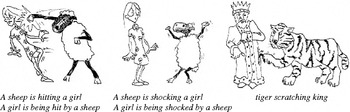
We created twenty-four experimental items, each comprising a prime picture, its associated active and passive description, and a target picture (see ‘Appendix’ for a full item list); all depicted a transitive event with animal characters as agents and human characters as patients. Target pictures involved agent–patient events and depicted different characters to those in the associated prime pictures (see Figure 1: ‘tiger scratching king’). There were two versions, involving the same characters, of each prime picture; one version depicted an agent–patient event (such as ‘hit’ in Figure 1), the other version depicted a theme–experiencer event (such as ‘shock’ in Figure 1).
Agent–patient and theme–experiencer verb primes and target.

We also created eight ‘Snap’ items depicting transitive actions that corresponded to four further verbs; four of these items had an active description, four were passives. Since these items involved, necessarily for the game, the same picture for both participants, they were not included in the scoring. The Snap and experimental items were depicted on cards and used as the playing cards for the game. We created an additional set of four practice items using different events and entities to the experimental and filler items.
The experiment therefore had a mixed 2 × 2 design with the factors prime (active vs. passive; within-participants), and verb type (agent–patient vs. theme–experiencer; within-participants). We produced four lists, such that across the four lists each target occurred once in each of the four priming conditions and within a list six targets occurred in each of the four priming conditions. Each participant received an individually randomized order.
Procedure
The experiment began with a warm-up session in which the child was asked to identify the characters (depicted on individual cards) that would appear on the Snap items. This was followed by a short game of Snap using the practice items. In both the practice and the main experiment, the experimenter placed a set of pre-arranged picture cards face down in front of each player (the experimenter and the participating child). She told the participant that they would take it in turns to describe the pictures and look for Snap items to win. The experimenter began each game by turning over the top card and describing it (following a script); this constituted the prime. The participant then took their top card and described it; this constituted the target response. The game continued with players alternating until all cards had been described. If the same picture appeared on both players' up-turned card, the first player to shout ‘Snap’ would win the cards in play. The experimental session was audio-recorded; participants' responses were transcribed verbatim and scored according to the criteria outlined below.
Scoring
Of the six-year-olds' 384 experimental trials, 9 trials were excluded because the wrong prime was given (6), the wrong card was described (1) or the participant did not provide a description of the target picture (2). Of the nine-year-olds' 384 experimental trials, 14 were excluded because the wrong prime was given (12) or the wrong card was described (2). The remaining trials were scored for active or passive structure or as Other responses.
We scored the first target description that a child produced on each trial. A target description was scored as an active if it was a complete sentence that provided an appropriate description of the transitive event in the target picture and contained a subject bearing the agent role, a verb, and a direct object bearing the patient role, and could also be expressed in the alternative form (i.e. a passive). A target description was scored as a passive if it was a complete sentence that appropriately described the picture's event and contained a subject bearing the patient role, an auxiliary verb (get or be), a main verb, a preposition (by), and an object bearing the patient role, and that could also be expressed in the alternative form (i.e. an active). A target description was scored as a reversed active or reversed passive if it was a complete sentence that contained the correct constituent structure of an Active or Passive but had the arguments reversed. All other descriptions, such as incomplete utterances (the first phrase in the following examples: ‘An elephant's poking the – the elephant's pet is a witch’; ‘Bear is being – pinching the soldier's bottom’; ‘Cat being – cat making nurse annoyed’) and non-transitive sentences (e.g. ‘A dog is racing with a man’; ‘A rabbit is jumping up to see the queen’; ‘An elephant is putting water on the burglar’) were scored as other. Note that if a child initially produced an incomplete description but subsequently produced a complete description (e.g. ‘A frog is getting kiss – a frog kissed the doctor’, only the first (incomplete) description was scored (as Other; see below for a reanalysis of this data).
Following this scoring, the six-year-olds produced 246 Actives, 63 Passives, 8 Reversed Actives, 16 Reversed Passives and 42 Others. Of their 42 Others, 26 were non-transitive responses and 16 were incomplete utterances. The nine-year-old children produced 280 Actives, 67 Passives, 2 Reversed Actives but no Reversed Passives and 21 Others. Of their 21 Other responses, 15 were non-transitive responses and 6 were incomplete utterances. To assess scoring reliability, 10% of the responses were independently coded by a second coder who was blind to experimental condition. The coders agreed on the structure of the target description for 92% (72/78) of target responses (Cohen's k = 0·89, p < 0·001).
Analysis
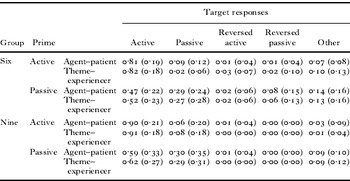
Following previous child priming studies (e.g. Huttenlocher et al., Reference Huttenlocher, Vasilyeva and Shimpi2004), we analyzed the children's target responses as proportions of all their responses (Table 1) in two-way mixed ANOVAs with the factors: prime (active vs. passive) × verb type (agent–patient vs. theme–experiencer), treating participants (F 1) and items (F 2) as random effects. In separate analyses, we examined the proportions of Active and Passive responses; the proportions of Reversed Active and Passive responses; and the proportions of Other responses. We additionally examined whether there was any evidence of a cumulative priming effect through the experiment, as characterized by an increase in the number of passives produced at the end of the experiment relative to at the beginning.
Six- and nine-year-olds' mean proportions of target responses (standard deviations)

Active responses
For Active responses, the analyses yielded a significant main effect of prime (F 1(1, 30) = 80·33, p < 0·001, partial η2 = 0·73; F 2(1, 46) = 90·94, p < 0·001, partial η2 = 0·66); children produced significantly more Actives following active primes (M = 0·86) than following passive primes (M = 0·55). There was a significant effect of age by items only (F 1(1, 30) = 2·46, p = 0·13, partial η2 = 0·08; F 2(1, 46) = 7·99, p = 0·007, partial η2 = 0·15); nine-year-olds produced more Actives (M = 0·76) than six-year-olds (M = 0·66). However, there was no effect of verb type (Fs < 2): children did not produce more (agent–patient) Actives following an agent–patient prime (M = 0·69) than following a theme–experiencer prime (M = 0·72). No other effects or interactions were significant (Fs < 1).
Simple main effects showed a significant effect of prime for both six-year-olds (F 1(1, 30) = 42·70, p < 0·001, partial η2 = 0·59; F 2(1, 46) = 48·54, p < 0·001, partial η2 = 0·51) and nine-year-olds (F 1(1, 30) = 37·30, p < 0·001, partial η2 = 0·56; F 2(1, 46) = 42·51, p < 0·001, partial η2 = 0·48); within both groups, children showed a significant tendency to produce more Actives following active primes than following passive primes. There was no simple main effect of verb type within either group, but there was a simple main effect of prime for both agent–patient verbs (F 1(1, 30) = 43·17, p < 0·001, partial η2 = 0·59; F 2(1, 46) = 51·48, p < 0·001, partial η2 = 0·53) and theme–experiencer verbs (F 1(1, 30) = 52·53, p < 0·001, partial η2 = 0·64; F 2(1, 46) = 58·43, p < 0·001, partial η2 = 0·56); children were more likely to produce Actives following agent–patient active primes than following agent–patient passive primes, and were more likely to produce Actives following theme–experiencer active primes than following theme–experiencer passive primes.
Passive responses
For Passive responses, the analyses yielded a significant main effect of prime (F 1(1, 30) = 32·74, p < 0·001, partial η2 = 0·52; F 2(1, 46) = 42·31, p < 0·001, partial η2 = 0·48); children produced significantly more Passives following passive primes (M = 0·29) than following active primes (M = 0·06). However, there was no effect of age or verb type (Fs < 1); there was no difference between nine-year-olds' production of Passives (M = 0·17) and six-year-olds' production of Passives (M = 0·18); there was no difference between the production of Passives following an agent–patient prime (M = 0·19) and following a theme–experiencer prime (M = 0·17). No other effects or interactions were significant (Fs < 2).
Simple main effects showed an effect of prime for both six-year-olds (F 1(1, 30) = 15·73, p < 0·001, partial η2 = 0·34; F 2(1, 46) = 19·53, p < 0·001, partial η2 = 0·30) and nine-year-olds (F 1(1, 30) = 17·02, p < 0·001, partial η2 = 0·36; F 2(1, 46) = 22·84, p < 0·001, partial η2 = 0·33); within both groups, children showed a significant tendency to produce more Passives following passive primes than following active primes. There was no simple main effect of verb within either group, but there was a simple main effect of prime for both agent–patient verbs (F 1(1, 30) = 18·50, p < 0·001, partial η2 = 0·38; F 2(1, 46) = 24·00, p < 0·001, partial η2 = 0·34) and theme–experiencer verbs (F 1(1, 30) = 26·30, p < 0·001, partial η2 = 0·34; F 2(1, 46) = 32·31, p < 0·001, partial η2 = 0·41); children were more likely to produce Passives following agent–patient passive primes than following agent–patient active primes, and more likely to produce Passives following theme–experiencer passive primes than following theme–experiencer active primes.
Thus the results for Actives and Passives show comparable findings to previous studies: by six, children can be primed to repeat active and full passive structures with the correct thematic and constituent structure. In further analyses, we examined whether there was any effect of the priming conditions on children's reversed responses or on their remaining Other responses.
Reversed Active responses
We analyzed the children's Reversed Actives as proportions of all responses. There was a significant effect of age by participants only (F 1(1, 30) = 4·36, p = 0·046, partial η2 = 0·13; F 2(1, 46) = 0·88, p = 0·35, partial η2 = 0·02); six-year-olds produced more Reversed Actives (M = 0·02) than nine-year-olds (M = 0·005). However, there were no other significant main effects, interactions or simple main effects on the Reversed Actives (all Fs < 3), nor were the simple main effects of prime within either group or verb type, or of verb type within either group significant (all Fs < 2). Hence children's likelihood of producing a Reversed Active response was not affected by the structure or verb type of the prime.
Reversed Passive responses
We also analyzed the Reversed Passive responses as proportions of all responses. There was a significant effect of prime (F 1(1, 30) = 5·41, p = 0·027, partial η2 = 0·15; F 2(1, 46) = 4·87, p = 0·032, partial η2 = 0·10); children produced significantly more Reversed Passives following passive primes (M = 0·04) than following active primes (M = 0·01). There was also an effect of age by items: (F 1(1, 30) = 3·64, p = 0·07, partial η2 = 0·11; F 2(1, 46) = 17·84, p < 0·001, partial η2 = 0·28); six-year-olds produced more Reversed Passives (M = 0·04) than nine-year-olds (M = 0). There was also a prime by age interaction (F 1(1, 30) = 5·41, p = 0·027, partial η2 = 0·15; F 2(1, 46) = 4·87, p = 0·032, partial η2 = 0·10); the effect of prime was stronger for the six-year-olds than for the nine-year-olds. No other effects or interactions approached significance (Fs < 2).
Simple main effects showed an effect of prime for six-year-olds (F 1(1, 30) = 10·83, p = 0·003, partial η2 = 0·27; F 2(1, 46) = 9·80, p = 0·003, partial η2 = 0·18), but not for nine-year-olds (Fs < 1). There was also a significant effect of prime for agent–patient verb primes (F 1(1, 30) = 5·93, p = 0·021, partial η2 = 0·17; F 2(1, 46) = 5·24, p = 0·027, partial η2 = 0·10) but not theme–experiencer verb primes (Fs < 2); Reversed Passives were more likely following agent–patient verb passive primes than following agent–patient active primes, but were not more likely following theme–experiencer verb passive primes than following theme–experiencer active primes.
The analyses of the reversed responses showed that six-year-olds produced more reversed responses than nine-year-olds, but only their Reversed Passive responses were influenced by the priming condition: six-year-olds produced more Reversed Passives following (agent–patient) passive primes than following (agent–patient) active primes. The production of Reversed Actives was not influenced by prime type.
Other responses
Finally we analyzed the proportions of Other responses: that is, incomplete utterances or utterances which did not involve a transitive verb. There was a significant effect of prime (F 1(1, 30) = 7·06, p = 0·012, partial η2 = 0·19; F 2(1, 46) = 10·53, p = 0·002, partial η2 = 0·19); there were more Others after passive primes (M = 0·11) than active primes (M = 0·06). There was also an effect of age by items only (F 1(1, 30) = 3·94, p = 0·06, partial η2 = 0·12; F 2(1, 46) = 6·16, p = 0·017, partial η2 = 0·12); six-year-olds produced more Others (M = 0·11) than nine-year-olds (M = 0·06). No other main effects or interactions were significant (Fs < 2).
Simple main effects showed a significant effect of prime on the nine-year-olds' Other responses (F 1(1, 30) = 5·24, p = 0·029, partial η2 = 0·15; F 2(1, 46) = 6·60, p = 0·013, partial η2 = 0·13); they produced more Others after passive primes (M = 0·09) than active primes (M = 0·02). Though the nine-year-olds' Other responses included six instances of incomplete reversed utterances (5 passives, such as, ‘A horse is being push-’; see below for further analysis of these), their Other responses mostly consisted of other, non-transitive, types of complete sentence (15 utterances). These results suggest the nine-year-olds were not more likely to produce more errors in passive utterances following passive primes than following active primes; rather, it was the case that they produced more non-transitive sentences following passive primes than active primes.
There was also a simple main effect of prime on the six-year-olds' Other responses, by items only (F 1(1, 30) = 2·16, p = 0·15, partial η2 = 0·07; F 2(1, 46) = 4·08, p = 0·049, partial η2 = 0·08); there were more Others after passive primes (M = 0·13) than active primes (M = 0·09). This effect partly reflects the fact that six-year-olds, like nine-year-olds, tended to produce other types of sentences following passive primes (26 of their 42 Others were non-transitives); however, unlike nine-year-olds, a substantial portion of the six-year-olds' Others (16 responses) were incomplete (4 incomplete actives) and incomplete reversed utterances (11 incomplete reversed passive and 1 incomplete reversed active). This, in addition to the six-year-olds' high number of complete (and uncorrected) Reversed Passive responses suggests that six-year-olds had difficulty producing descriptions following passive primes, in particular in producing thematically correct passive responses.
In a further analysis, we re-scored our data to include any complete response that children produced following an initial incomplete description. (Note that in the original scoring, the initial incomplete description was scored as Other, and any subsequent follow-up response was excluded from consideration.) Six-year-olds produced 16 incomplete responses; they subsequently followed up 11 of these with a complete transitive response: 7 complete passive responses following an incomplete reversed passive, 3 complete active responses following an incomplete reversed passive, and 1 complete active response following an incomplete reversed active. The remaining 5 incomplete utterances were either not followed up by a completed utterance (2) or were followed up by a non-transitive complete structure (3). Nine-year-olds produced 6 incomplete utterances; they subsequently followed up 5 of these with a complete transitive response: 3 complete active responses followed an incomplete reversed passive, 1 complete passive response followed an incomplete reversed passive, and 1 complete active response followed an incomplete reversed active. The remaining incomplete utterance, an incomplete reversed passive, was followed up by a non-transitive structure. Inclusion of the complete follow-up responses did not change the results in the analyses of the Actives and Passives. In the analysis of the (remaining) Other responses, the effect of prime was no longer significant and the effect of age was no longer significant. Hence once responses where participants initially produced an incomplete utterance but subsequently produced a complete utterance were excluded, the two groups produced similar numbers of Other responses across priming conditions.
Priming effect across the experiment
Finally, we compared the number of passives that participants produced at the beginning and at the end of the experiment as a measure of the priming effect across the experiment. We assume that in this picture-description situation, children are unlikely to produce passives spontaneously unless primed, given that the passive is the more rare and non-canonical transitive structure and that there are no discourse features to promote the use of the passive. If there is a cumulative priming effect, then we should see more passives produced at the end of the experiment (when participants have been exposed to more passives) than at the beginning (when participants have been exposed to fewer passives).
Paired samples t-tests showed that the six-year-olds produced as many passives in the first quarter of the experiment (i.e. following the first eight primes; M = 1·31, SD = 1·1) as in the last quarter of the experiment (i.e. following the last eight primes; M = 1·37, SD = 1·5; t(15) = −0·13, p = 0·45, 1-tailed). The nine-year-olds also produced as many passives in the first quarter of the experiment (M = 1·0, SD = 1·5) as in the last quarter of the experiment (M = 1·5, SD = 2·6; t(15) = −1·22, p = 0·12, 1-tailed). Hence neither group showed evidence of a cumulative priming effect.
General discussion
Substantial previous research has suggested that English-speaking children experience greater difficulty in processing passives than actives, but there has been debate about the timecourse of acquisition, and the nature of their difficulties. Some researchers have proposed that passive syntax is late acquired (Borer & Wexler, Reference Borer, Wexler, Roeper and Williams1987). Others have suggested that children develop an abstract representation of passive structures relatively early (e.g. Bencini & Valian, Reference Bencini and Valian2008), but such findings must be reconciled with studies showing that children still have difficulties with passive structures at six or seven years of age (e.g. Turner & Rommetveit, Reference Turner and Rommetveit1967). We used a syntactic priming paradigm to examine six- and nine-year-old children's production of passive structures, in order to investigate these issues.
In our experiment, six- and nine-year-old children described pictures after hearing an experimenter describe an unrelated picture using either an active or a passive sentence. Both age groups were more likely to produce passive descriptions after hearing a passive sentence than after hearing an active sentence, irrespective of whether the prime and target sentences involved the same or different thematic roles; indeed, six- and nine-year-old children showed comparable patterns of priming for passive structures (22% and 23% priming for passives respectively). Similarly, they were more likely to produce active descriptions after hearing an active sentence. Hence six- and nine-year-old children exhibited priming for active and passive sentence structure on a trial-by-trial basis, and did so independently of any repetition of thematic roles. Nonetheless, there were differences in performance: six-year-old children but not nine-year-old children were more likely to produce reversed passives, with well-formed constituent structure but inverted thematic role mappings, after hearing passive sentences than after hearing active sentences; there was no comparable difference between groups in the production of reversed actives. Six-year-old children were also more likely to produce Other responses, specifically incomplete initial responses, than nine-year-old children.
These findings suggest that children may be able to consistently deploy generalized abstract constituent structure representations for the passive before they have fully mastered the associated non-canonical thematic role mappings. These results are therefore consistent with claims that children develop an abstract representation of passive structures relatively early (e.g. Bencini & Valian, Reference Bencini and Valian2008), contra proposals that passive syntax is late acquired (Borer & Wexler, Reference Borer, Wexler, Roeper and Williams1987), but also consistent with studies suggesting a persistent difficulty with passives at six or seven years of age (e.g. Turner & Rommetveit, Reference Turner and Rommetveit1967). They suggest that children's persisting difficulties with the passive lie not in the more complex constituent structure of the passive, but rather in its non-canonical thematic role mappings.
These results therefore provide evidence that children's acquisition of the passive is a staged process, such that children master the passive's constituent structure (i.e. are able to process it with a consistently high degree of accuracy) before they master its thematic role mappings. (Note that there is some evidence that mastery of the constituent structure of the passive may itself also be staged in younger children, with phrasal structure being mastered before the appropriate verbal morphology; see Bencini & Valian, Reference Bencini and Valian2008, for discussion). Moreover, our experiment provides evidence about the timecourse of this process, showing that difficulties in thematic role mappings persist beyond the age of six but not beyond the age of nine: up to 40% of our six-year-olds' full (complete) passives involved incorrect thematic role mappings despite having consistently correct constituent structure, whereas our nine-year-olds' passives were consistently well-formed in both constituent structure and thematic role mappings.
Our experiment is consistent with previous research suggesting that children may master aspects of language form before associated aspects relating to meaning (Naigles, Reference Naigles2002). For example, young children correctly produce the third person singular marker ‘-s’ in English before they show comprehension of its significance for subject number (de Villiers & de Villiers, Reference de Villiers and de Villiers1973; Johnson, de Villiers & Seymour, Reference Johnson, de Villiers and Seymour1998). Similarly, young children appear to learn the form of gender agreement marking earlier than its meaning (Levy, Reference Levy1983); for example, Russian-speaking two-year-olds' errors in gender agreement are restricted to cases where there is a mismatch between the meaning and form of the gender marking, with children erroneously producing agreement based on the form of the noun rather than its semantic gender. Our finding of a disparity between six-year-olds' ability to process the constituent structure and the thematic role mappings of the passive provides converging evidence for this proposal, and suggests further that it holds true at a relatively advanced stage of acquisition, as well as for early language development. We now consider the implications of our results in more detail.
Consistent with previous research (e.g. Huttenlocher et al., Reference Huttenlocher, Vasilyeva and Shimpi2004), our results suggest that children of six and nine have acquired an abstract syntactic representation for the passive that is independent of lexical content but is common to both production and comprehension. Thus when they heard a passive sentence, children were able to retrieve a constituent structure representation that they could then reuse (with different lexical items) in subsequent production. The fact that children in both groups were more likely to produce an agent–patient passive after hearing a theme–experiencer passive shows further that this representation is not restricted to agent–patient passives, but rather is generalized by the age of six to apply to at least one subclass of non-actional passive. The finding of reliable priming between sentences involving different thematic roles also allows us to be confident that previous demonstrations of syntactic priming in children using agent–patient primes and targets are unlikely to reflect priming of particular mappings or orders of thematic roles. Moreover, the fact that priming was not greater when thematic roles were repeated suggests that any thematic component to priming was very small, and overridden by priming based upon the repetition of constituent structure.
Our results also demonstrate that priming may occur on a trial-by-trial basis, as a function of the most recently experienced structure. The children in our experiment heard both structures an equal number of times during the experiment, in an individually randomized order. This design, and the fact that we found equivalent numbers of passives produced at the beginning and end of the experiment, provide evidence that for six- and nine-year-old children, such priming effects are not reliant on a cumulative exposure to a single syntactic form or to repetition of the same thematic structure. Instead, the children had sufficiently robust syntactic representations for the passive, such that exposure to a single utterance of that structure induced subsequent reuse of that structure in production.
Critically for our key research question, however, we found evidence that the adult-like constituent structure representations observable through the occurrence of syntactic priming were not uniformly mirrored by similarly adult-like thematic role mappings: Whereas the nine-year-old children consistently produced passives that were well-formed in both constituent structure and thematic role mappings, six-year-old children displayed residual difficulty with mapping non-canonical thematic roles onto grammatical functions appropriately. Thus in a significant number of cases, when the structure of the prime sentence facilitated the production of a passive constituent structure, they nevertheless incorrectly mapped the relevant thematic roles onto the (grammatically well-formed) constituent structure, yielding reversed passives.
It is particularly striking that the production of reversed passives was significantly higher following an agent–patient passive than following an agent–patient active, but not following a theme–experiencer passive: agent–patient passive primes involved the same thematic mapping as the (invariably) agent–patient passive target, and hence might have been expected to act as a good cue towards the correct mapping. Indeed, one might have expected a thematic priming effect to manifest itself here, with repeated binding of particular thematic roles to particular grammatical functions being facilitated. But instead our results showed no such facilitation – and indeed poorer performance – when thematic structure was shared between prime and target than when it was not.
Similarly, the fact that six-year-old children were primed to produce reversed passive responses following passive primes provides evidence that the priming effect had its basis in the repetition of constituent structure rather than the repeated binding of particular animacy features (e.g. humanness) to particular grammatical functions: because the agents in our materials were always animals and the patients were always humans, any such tendency to repeat animacy bindings would result in the production of passives with the correct mappings, rather than – as we found – the production of reversed passives. That is, if priming were based upon repeated animacy bindings, a prime such as ‘A boy is being squashed by a pig’ should induce a correct passive description such as ‘A fairy is being tickled by a frog’, rather than a reversed passive such as ‘A frog is being tickled by a fairy’.
Our results suggest that even at a relatively late stage of language development, children may experience residual difficulties in processing non-canonical thematic roles. This may lead to a disparity between their ability to consistently build appropriate constituent structure representations and their ability to consistently map thematic roles onto the structural positions encoded in those representations, resulting in their production of utterances that are syntactically but not thematically well-formed: that is, reversed passives. It is important to stress that the disparity lies in the consistency with which children are able to process these different aspects of structure: in our experiment, six-year-olds produced structurally and thematically correct passives on the majority of occasions (60% of their passives were full, thematically correct passives). But on some occasions they produced structurally correct passives that were thematically incorrect. This implies that they had some representation of the relevant knowledge, but experienced difficulty in consistently deploying this knowledge during on-line processing. This pattern is consistent with the evidence of better performance in other studies that used non-reversible passives (such as with verbs like ‘eat’ or ‘drink’). Those studies did not find high rates of reversed passives, suggesting that children were able to use alternative cues such as verb semantics when available to support processing.
Our results raise two major questions. The first is why previous priming experiments have not shown younger children producing reversed passives. The answer may be related to the differences in design between the present and previous priming experiments. Previous studies used between-participants designs in which children were exposed to only one of the structural alternatives in the experimental session; children who heard only passives were more likely to produce passives than children who heard only actives (Bencini & Valian, Reference Bencini and Valian2008; Huttenlocher et al., Reference Huttenlocher, Vasilyeva and Shimpi2004; Shimpi et al., Reference Shimpi, Gámez, Huttenlocher and Vasilyeva2007). The children in those studies may therefore have performed more accurately than our six-year-olds because they received cumulative exposure to a single syntactic structure with the same thematic structure throughout the experimental session, and this may have enabled them to use alternative strategies to produce thematically well-formed passives, such as naming the patient before the agent. In contrast, in our within-participants design, children heard both passive and active structures involving both agent–patient and theme–experiencer verbs throughout the session. Thus without this intensive exposure to only one structure (and to one set of thematic-role mappings), their production of passives was less reliable.
A second question concerns the factors that might explain children's apparently marked delay in mastery of thematic role mappings. Given that knowledge of the thematic structure of the active transitive is observed at a much earlier age (e.g. Gertner et al., Reference Gertner, Fisher and Eisengart2006), we might have expected children to have mastered the corresponding thematic structure for the passive transitive well before the age of six years. The delay in mastery of the passive transitive thematic structure may be related to general cognitive development (e.g. the well-known changes in working memory capacity through childhood; Case, Kurland & Goldberg, Reference Case, Kurland and Goldberg1982). But it also seems likely to be related to both its non-canonicity and its sparseness in the input. In English, the first-mentioned noun is typically the highest on the thematic hierarchy (Fillmore, Reference Fillmore, Bach and Harms1968), for example the agent or actor in the described event. Note that this ordering is consistent with accounts of adult language production that stress the importance of incremental processing, with speakers processing elements in the order in which they become available. In such accounts, syntactic structure is partially determined by conceptual accessibility, or the ease with which concepts can be retrieved from memory. More predicable entities (such as typical agents) tend to be produced in higher grammatical functions and early word order positions because they can be retrieved and integrated into a message to be conveyed more quickly than less predicable entities (such as typical patients; see e.g. Bock & Warren, Reference Bock and Warren1985; Tanaka, Branigan, McLean & Pickering, Reference Tanaka, Branigan, McLean and Pickering2011, for discussion). In contrast, passive sentences involve a non-canonical mapping in which the patient of the event appears first; under current accounts of adult language production, this ordering tends to be generally disfavoured in adult production because patients tend to be less conceptually accessible than agents.
Consistent with such accounts, this non-canonical ordering of thematic roles is relatively sparse in the input: Gordon and Chafetz (Reference Gordon and Chafetz1990) reported that passives (most of which were short, i.e. agentless, passives) accounted for just 4% of children's input utterances in an 86,655 utterance dataset. Thus it may take a considerable amount of linguistic experience for children to learn that sentence subjects in English are not always the event's agent, and furthermore to be able to integrate this knowledge during sentence processing. The possible importance of frequency in the input is supported by cross-linguistic evidence showing that children acquire the passive earlier in languages in which it is a more frequent and more canonical structure (e.g. Kline & Demuth, Reference Kline and Demuth2010). Thus English-speaking children must learn the complexities of passive thematic structure from much sparser input than they experience for active thematic structure, with this difference in the relative proportions of active and passive input possibly reflecting the fact that active thematic structure tends to be more consistent with adult incremental processing preferences than passive thematic structure.
Our results suggest that children's difficulty in producing passive utterances with the correct thematic role mappings may be sufficiently pronounced to occur even in situations that do not involve particularly high task demands. In our experiments, children were never under time pressure to respond: although the task involved a game where the experimenter and child competed to win cards, the experimental trials never involved pictures that matched (and hence could be won); hence on target trials, children could (and did) take their time to describe their picture. They nevertheless made some errors – but they only did so when producing passive responses. Hence, the experimental situation itself did not appear to cause a high processing load; instead, the difficulty seemed to be associated specifically with the production of passive structures per se. Of course, we might expect that such difficulty would be exacerbated under conditions that impose high task demands for other reasons (e.g. production under time pressure or in a dual-tasking context).
In conclusion, our results go some way towards explaining apparently contradictory claims in previous studies of children's acquisition of the passive. We find evidence that passive structures continue to pose difficulties for children even until the age of six, and possibly beyond (though such difficulties seem to be resolved by the age of nine), but these difficulties are tied more to the non-canonical thematic mappings that such structures entail than to their (relatively more complex) constituent structure. Our results suggest that children's acquisition of the passive may be a staged process: children's mastery of the passive's constituent structure may considerably precede their mastery of its non-canonical thematic role mappings.
APPENDIX AGENT–PATIENT/THEME–EXPERIENCER ACTIVE/PASSIVE PRIME ITEMS
a bear is patting/frightening a girl/a girl is being patted/frightened by a bear
a rabbit is biting/surprising a doctor/a doctor is being bitten/surprised by a rabbit
a horse is pulling/scaring a fairy/a fairy is being pulled/scared by a horse
a lion is hitting/shocking a fireman/a fireman is being hit/shocked by a lion
a cow is carrying/annoying a queen/a queen is being carried/annoyed by a cow
a pig is squashing/upsetting a boy/a boy is being squashed/upset by a pig
a cat is patting/frightening a witch/a witch is being patted/frightened by a cat
a dog is biting/surprising a robber/a robber is being bitten/surprised by a dog
a tiger is pulling/scaring a soldier/a soldier is being pulled/scared by a tiger
a frog is hitting/shocking a king/a king is being hit/shocked by a frog
an elephant is carrying/annoying a clown/a clown is being carried/annoyed by an elephant
a sheep is squashing/upsetting a nurse/a nurse is being squashed/upset by a sheep
a dog is patting/frightening a king/a king is being patted/frightened by a dog
a horse is biting/surprising a fireman/a fireman is being bitten/surprised by a horse
a bear is pulling/scaring a witch/a witch is being pulled/scared by a bear
a cat is hitting/shocking a clown/a clown is being hit/shocked by a cat
a frog is carrying/annoying a boy/a boy is being carried/annoyed by a frog
an elephant is squashing/upsetting a queen/a queen is being squashed/upset by an elephant
a rabbit is patting/frightening a soldier/a soldier is being patted/frightened by a rabbit
a tiger is biting/surprising a nurse/a nurse is being bitten/surprised by a tiger
a lion is pulling/scaring a doctor/a doctor is being pulled/scared by a lion
a sheep is hitting/shocking a girl/a girl is being hit/shocked by a sheep
a pig is carrying/annoying a robber/a robber is being carried/annoyed by a pig
a cow is squashing/upsetting a fairy/a fairy is being squashed/upset by a cow
TARGET ITEMS
tiger shaking doctor
elephant washing robber
lion scratching nurse
cow licking king
pig pushing witch
bear pinching soldier
rabbit hugging girl
frog tickling fairy
horse kicking clown
cat chasing boy
sheep kissing queen
dog punching fireman
elephant shaking witch
bear washing clown
tiger scratching king
pig licking fairy
dog pushing girl
cat pinching nurse
sheep hugging boy
rabbit tickling queen
cow kicking fireman
horse chasing soldier
frog kissing doctor
lion punching robber
SNAP ITEMS
a bear is picking up a king
a rabbit is feeding a witch
a cat is poking a queen
a dog is dropping a fairy
a girl is being picked up by an elephant
a boy is being fed by a lion
a clown is being poked by a frog
a robber is being dropped by a tiger