1. Introduction
Research on multilingualism has advanced rapidly in the past few decades. The focus is no longer on how two or more languages are organized but rather has shifted to questioning if being bilingual or multilingual has major cognitive repercussions (Franceschini, Reference Franceschini, Larissa and Hufeisen2009). Contrary to early misconceptions that the early learning of two languages may cause intellectual delay in childhood (for critical review see Wei, Reference Wei and Brown2006), nowadays researchers agree that bilinguals show a tendency to have some cognitive advantages when compared to their monolingual peers (for review see Bialystok, Reference Bialystok2011). Indeed, cognitive control develops earlier in bilingual children than in their monolingual peers (Bialystok, Reference Bialystok2010; Carlson & Meltzoff, Reference Carlson and Meltzoff2008) and bilingual adults continue to outperform monolinguals on such tasks (Bialystok, Craik, Klein & Viswanathan, Reference Bialystok, Craik, Klein and Viswanathan2004; Bialystok, Craik, & Luk Reference Bialystok, Craik and Luk2008; Costa, Hernández, Costa-Faidella & Sebastián-Gallés Reference Costa, Hernández, Costa-Faidella and Sebastián-Gallés2009; Costa, Hernández & Sebastián-Gallés, Reference Costa, Hernández and Sebastián-Gallés2008; Luk, De Sa & Bialystok Reference Bialystok2011; Prior & MacWhinney, Reference Prior and MacWhinney2010). The above-mentioned studies used different executive control tasks such as the Simon Task (Simon & Wolf, Reference Simon and Wolf1963) and the Flanker Task (Eriksen & Eriksen, Reference Eriksen and Eriksen1974), which include congruent and incongruent trials. A general finding is that usually bilinguals and monolinguals perform similarly on single blocks of congruent trials but bilinguals outperform monolinguals on both congruent and incongruent trials when presented in mixed blocks (Bialystok et al., Reference Bialystok, Craik, Klein and Viswanathan2004; Costa et al., Reference Costa, Hernández and Sebastián-Gallés2008). The latter condition is considered more difficult and in need of greater executive control.
Hilchey & Klein (Reference Hilchey and Klein2011) raised some concerns about the reliability of these behavioral effects (i.e., the bilingual advantage in terms of reaction times on executive tasks), but, strikingly, it was recently reported that bilinguals as compared to monolinguals have increased grey matter density in areas related to cognitive control such as the anterior cingulate cortex (Abutalebi, Della Rosa, Green, Hernández, Scifo, Keim, Cappa & Costa, Reference Abutalebi, Della Rosa, Green, Hernández, Scifo, Keim, Cappa and Costa2011). Moreover, the latter study has also shown that the increased grey matter density correlates positively with behavioral performance on the Flanker Task. In other words, the increased grey matter density observed in the bilingual population corresponded to a faster processing of the conflict effect of the Flanker Task. A further finding was that bilinguals were also in need of less neural activity to outperform monolinguals (Abutalebi et al., Reference Abutalebi, Della Rosa, Green, Hernández, Scifo, Keim, Cappa and Costa2011). Hence, overall, there is now ample evidence showing that the bilingual experience may tune up executive functions. One interesting question is why would bilingualism entail such a strong enhancement of executive functions?
Nowadays, most researchers agree that the bilingual advantage essentially originates from the continuous need for bilinguals to control their two language systems (Costa et al., Reference Costa, Hernández and Sebastián-Gallés2008). Indeed, for successful communication in a formal setting, bilinguals must avoid using words or certain grammatical rules from one language in order to communicate adequately in the other. Yet bilinguals learn early in life to successfully resolve such language conflicts and to achieve this, they better develop (i.e., in terms of increased grey matter) brain structures related to executive control such as the anterior cingulate cortex (see Abutalebi et al. Reference Abutalebi, Della Rosa, Green, Hernández, Scifo, Keim, Cappa and Costa2011) and the left caudate (see Zhou, Ding, Abutalebi, Shu & Peng, Reference Zhou, Ding, Abutalebi, Shu and Peng2011). Since these structures are not only responsible for language control but also for extra-linguistic executive control (Abutalebi & Green, Reference Abutalebi and Green2008), the bilingual brain becomes better equipped to deal with tasks entailing executive control.
Luk et al. (Reference Luk, De Sa and Bialystok2011) recently suggested that there is a positive correlation between the length of time (i.e., years) being a bilingual and the processing advantage over monolinguals on cognitive tasks. However, it is still not clear whether bilingual advantages are dependent upon the level of language proficiency the speakers may have. Most studies have only compared groups of bilinguals to groups of monolinguals and therefore, at present, we lack comparative studies within populations of bilinguals with different degrees of language proficiency.
It is important to mention that, interestingly, different degrees of language proficiency in bilinguals also correspond to differences in grey matter density of yet other brain regions involved in cognitive control, such as the supramarginal gyrus (see for review Abutalebi & Green, Reference Abutalebi and Green2008). Indeed, Mechelli, Crinion, Noppeney, O'Doherty, Ashburner, Frackowiak and Price (Reference Mechelli, Crinion, Noppeney, O'Doherty, Ashburner, Frackowiak and Price2004) have shown that higher degrees of L2 proficiency are associated with increased grey matter densities in the left supramarginal gyrus (as compared to bilinguals with lower degrees of L2 proficiency). It is therefore interesting to investigate whether different degrees of language proficiency do, in fact, also correspond to behavioral differences in executive control tasks. In other words, higher degrees of language proficiency or language competence in general, may be linked to faster processing of extra-linguistic cognitive conflicts.
In order to test this hypothesis, we have addressed this issue by comparing a group of differentially proficient multilingual children on their performance on tasks that involve several components of the attentional control system. According to Costa et al. (Reference Costa, Hernández, Costa-Faidella and Sebastián-Gallés2009), the bilingual advantage is ascribed to a more efficient monitoring processing system, as the result of the constant need to monitor the appropriate language for each communicative interaction. This advantage should be potentiate in multilinguals, because they have to incessantly adapt to different communicative situations more than others. Multilingualism describes a cultural practice as well as individual competence and its access through cognitive processing (Franceschini, Reference Franceschini2011). As aforementioned, our assumption is that, keeping the age of acquisition criterion constant, very highly proficient multilingual children may outperform multilingual children of low proficiency, similarly to the differences in behavior as reported between monolinguals and bilinguals or multilinguals (e.g. Costa et al., Reference Costa, Hernández, Costa-Faidella and Sebastián-Gallés2009).
By using the Attentional Network Test (ANT), replicating the test version used by Costa et al. (Reference Costa, Hernández and Sebastián-Gallés2008), we were able to investigate the three major components of the attentional process: alerting, orienting and executive control (see Posner & Peterson, Reference Posner and Petersen1990). The alerting mechanism consists of achieving and maintaining an alert state, the orienting process consists of selecting information from sensory input and the executive control consists of monitoring and resolving conflict.
A further aim of our study was to determine if a possible attentional advantage could really be ascribed to a higher linguistic competence level, or if it was potentially due to a generally higher competence level based on other skill domains that a child may possess (i.e., comparison with other school subjects).
2. Methods
2.1 Participants
One hundred and eighteen early multilingual children (61 female/57 male; 111 right handed/7 left handed) with a mean age of 10.9 years (SD = 0.29) participated in this study. All participants were Ladin speakers from South Tyrol which is a multilingual region in northern Italy. Subjects lived in one of the two adjacent Ladin valleys in the Dolomites mountain range close to the border with Austria: 47 children live in Badia Valley (area: 402 km2; c. 10,000 inhabitants) and 71 in the valley of Gherdëina (area: 109 km2; c. 10,000 inhabitants). The children had spent their childhood in an almost exclusively trilingual environment, where Ladin is the socially dominant language, followed by German and Italian.
All children were enrolled in the 5th grade of primary schools that use the paritetic teaching model (as is implemented in the Ladin-speaking valleys in the Autonomous Province of Bolzano). Here the children are taught half in Italian and half in German with Ladin as a support language. Therefore, all children speak Ladin, Italian, German and English, but at different levels of proficiency.
In order to assess the proficiency level of the different languages spoken by the children, we collected both a self-evaluation form completed by the children (in questionnaire format) as well as an external evaluation by the teachers (based on the children's school grades, with a median value combination from the first and second semesters of the year).
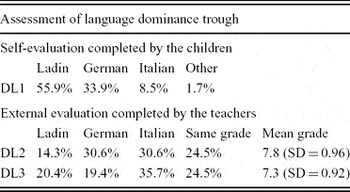
These data allowed us to categorize the levels of language proficiency as follows: The most Dominant Language (DL1) was classified as the first language acquired in the child's life and was expressed by the children as being the language they were most exposed to (commonly also indicated as their “mother tongue”). Across the spectra of languages, DL1 was classified as being Ladin (55.9% of the tested children), German (33.9%), Italian (8.5%) or another language (1.7%) (Table 1).Footnote 1
Language dominance of the participants (DL = Dominant Language).

Whereas DL1 was assessed on the self evaluation of the children, both DL2 and DL3 were assessed through the school grades that children were given by their teachers (ranging from the low mark 5 to the best mark 10). DL2 is the second language based on the highest grade marks received from the school (pertaining to one of the languages other than DL1 and English).Footnote 2 DL3 is the language with the lowest grade marks received from the school (also pertaining to one of the remaining languages other than DL1 and English), and finally the least Dominant Language (= DL4) was determined to be English for all the children involved in the experiment.
In detail, DL2 was classified as German in 30.6% of the children, as Italian in a further 30.6% of the children and as Ladin in a 14.3% of the children. On the other hand, DL3 was Italian in a 35.7% of the subjects, Ladin in a 20.4% of the subjects, and German in a 19.4% of the subjects. For 24.5% of the subjects it was not possible to determine which language was DL2 and which was DL3, due to the fact that this percentage of the children had reached the same level in both languages (see Table 1).
In order to create the most accurate language competence scale, we also assessed each child's individual language proficiency level as follows: The scores of the child's DL1 were compared to all the other participants’ DL1 scores regardless of the language in question. The proficiency level of the child's DL2 was measured based on the language with the highest scores (mean of the L2 marks: 7.8, SD = 0.96) and the DL3 was determined based on the lowest scores (mean of the DL3 marks: 7.3, SD = 0.92). Finally, the proficiency level of the child's DL4 was determined to be equal to that of all the other children tested in the experiment, with English entailing the lowest scores.
In the analysis, we specifically focused on three measures of language competence:
(i) DL1 = the most Dominant Language (classified as the first language acquired in the child's life and expressed by the children as being the language they were most exposed to (commonly also indicated as their “mother tongue”),
(ii) “global” multilingual competence relative to all the children's languages (DL1, DL2, DL3 and DL4), and
(iii) “added” multilingual competence relative solely to their DL2 and DL3.
2.2 Procedures
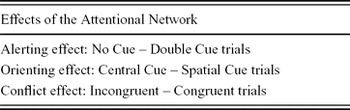
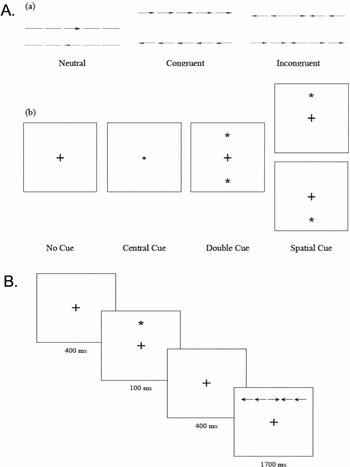
The experimental design of the ANT allowed us to test for both the reaction times (RT) of the subjects and their accuracy rate. These measurements were recorded for all 12 of the experimental conditions (see Figure 1 for details). Once recorded, adequate subtractions and calculations could be made to determine the three principal effects, each of which correspond to the efficiency of the three components of the attentional system: Alerting, Orienting and Executive control (Table 2).
Assessing the three attentional networks.

Note: The Alerting Effect is calculated by subtracting the mean RTs of the conditions Double Cue from the mean RTs of the conditions No Cue (Alerting = No Cue – Double Cue), because in absence of a warning signal (No Cue) the attention tends to remain diffused within the two potential positions of the arrows. The Double Cue diffuses the attention in the same way, but “alerts” the subjects of the imminent appearance of the arrows. The Orienting Effect, instead, is obtained by subtracting the mean RTs of the Spatial Cue from the mean RTs of the conditions of the Central Cue (Orienting = Central Cue – Spatial Cue). Although both cues act as a warning signal, the Spatial Cue permits the subjects to allocate the attention to the appropriate portion of the space before the appearance of the arrows. Finally, the Conflict Effect is measured by subtracting the mean RTs of the conditions Congruent from the mean conditions Incongruent (Conflict = Incongruent – Congruent) collapsed across the cue type.
The Attentional Network Test (ANT). A. Experimental design of the ANT. Participants performed the Attentional Network Test replicating the task version used by Costa et al. Reference Costa, Hernández and Sebastián-Gallés2008 (as developed from Fan et al. Reference Fan, McCandliss, Sommer, Raz and Posner2002). In this test participants are asked to indicate the direction of the central target arrow (left: ←; right: →) flanked by four other arrows or four horizontal lines. The stimuli appeared either above or below a fixation point. The test is characterized by two factors: Cue Type and Flanker Type. The latter refers to the position of the arrows in the space and is composed of three conditions: Congruent, when the arrows are all pointing in the same direction; Incongruent, when the central arrow is pointing to the opposite direction than the other four arrows; and Neutral, when the central arrow is accompanied by four horizontal lines (a). The Cue Type, instead, refers to the presentation of different combinations of asterisks before the appearance of the arrows. That factor is composed of four levels: the No Cue, the basic level, characterized by the failure of any asterisk, the Central Cue, that consists of the appearance of an asterisk in the center of the screen; the Double Cue, i.e. the presentation of two asterisks (one above and one below the fixation point); and the Spatial Cue, an asterisk that predicts the subsequent position of the arrows (b). The crossing of these two factors determines twelve experimental conditions for a total amount of 96 trials. B. Schematic representation of the experimental procedure with duration time of the single stimuli. The sample shows the Incongruent Condition preceded by a Spatial Cue. The single stimuli are presented in the following order: it starts with a fixation cross that appears in the centre of the computer screen. After 400 ms one of the four cue types compares for only 100 ms (except for the No Cue). The fixation cross appears again (400 ms) followed by the arrows, which remain on the screen for max. 1700 ms.

The ANT was performed using a laptop computer with a mouse. Stimuli were presented via the Software Presentation in random order. Participants were instructed to concentrate on the fixation cross and to pay attention to the central arrow (target stimuli). The task consisted of pressing as quickly and accurately as possible the left or the right key on the computer mouse, according to the direction of the target arrow.
The children were all presented with the same instructions by one instructor while in their classrooms. The participants were only tested once, singularly and in a separate room, and had no training session prior to the experiment.
2.3 Data screening
Before examining the statistical analysis, it is important to mention how the dataset used in the experiment was created. First we looked at the raw data from the ANT and were able to control any uncertainties presented by the reaction times and the potential outliers.
Uncertainties in this experiment can be defined as the interference of computer processes with the RTs: hence, a combination of all the RTs could skew the overall results, so in order to control these negative effects, we calculated the mean and the standard deviation (SD) of all the uncertainties presented from all the different trials, and were able to eliminate the trials that fell above two SDs of the overall mean (uncert. ≥ mean + 2*SD).
Subsequently, we analyzed the RTs for each of the subjects, and similarly as before, extracted any trials that fell two SDs above or below the calculated RT mean (RT ≥ mean + 2*SD.) (RT ≤ mean + 2*SD).
Based on the dataset we created, we were able to calculate the mean RTs for each condition, the accuracy for each condition, and the overall subtractions (that were described above), allowing us to obtain the three attentional effects.
2.4 Data analysis
While analyzing the results obtained from the ANT, we first examined the interaction between the ANT task and the participants, focusing on language competence as our main variable for investigation.
It is important to note that though these children were highly competent in all three languages from early age on, we nevertheless, for the purpose of this analysis, divided them up into a high and low competence level groups. Participants were categorized in a high and low competence group based on:
(i) the median value of the distribution of grades (from the 1st and 2nd semester of the school year) including all languages (Ladin, Italian, German and English) for assessing differences related to the aforementioned global multilingual competence;
(ii) the lower 25%-quartile and an upper 75%-quartile rankings of the distribution of grades including DL2 and DL3 for investigating differences arising from added multilingual competence.
Given that a broad variation can exist between teachers concerning the criteria used to assign marks on languages and on all other skills, for the purpose of this study we grouped the participants into a low and a high level of competence. The median and quartile split approach automatically divides our large sample into low and high competence groups, which have a considerable distance between them, and has the advantage that it results in a sufficient number of participants in each group, which allowed us to study differences across the “global” and “added” multilingual competence dimensions and their relationship with the attentional effects.
Thus, to analyze and isolate the effects of multilingualism on the ANT task at different levels, the following five effects were investigated:
1. The effect of global multilingual competence defined as the inclusion of all the school grades within all the linguistic disciplines: Ladin, Italian, German and English. This corresponds to DL1 + DL2 + DL3 + DL4.
2. The effect of added multilingual competence defined as the language competence added by the acquisition of languages DL2 and DL3, excluding DL1 and English (DL2+3).
3. The effect of different levels (low/high) of global multilingual competence on the attentional networks through assessing the correlation between the three attentional effects and global multilingual competence, and the interaction between global multilingual competence and attentional networks.
4. The unique influence of differences in levels of global multilingual competence on the alerting network by means of hierarchical multiple regression controlling for the influence of differences in general competence levels.Footnote 3
5. The association between DL1 competence, global multilingual and added multilingual competence ratio scores calculated for each participant, and their scores for the three attentional effects.
3. Results
3.1 General analyses of the ANT (all participants): Accuracy and RTs
In the descriptive analyses of error, accuracy was high for all groups in all conditions. The mean error percentage of the 118 participants was 3.88% (SD = 6%).
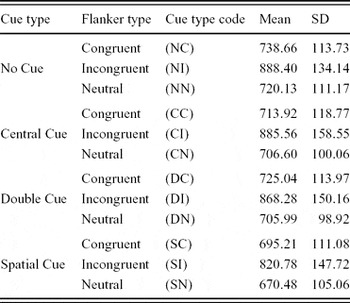
For the RT analysis, a 4 (Cue Type: No Cue, Central Cue, Double Cue and Spatial Cue) × 3 (Flanker Type: Congruent, Incongruent and Neutral) ANOVA was performed on the mean RTs of all participants (see Table 3).
Mean reaction times (n = 113).

The main effects of Cue Type (F(3,336) = 47.546, p = .000) and Flanker Type (F(2,224) = 433.751, p = .000) were significant. No interaction effect between Cue Type and Flanker Type were detected (F(6,672) = 3.242, p = .006).
Pairwise comparisons corrected for multiple comparisons revealed that for the Cue Type all participants were overall faster on reacting to the Spatial Cue, with a mean reaction time of 728.821 ms (SD = 10.539). Participants performed slowest on the No Cue, with a mean reaction time of 782.397 ms (SD = 10.377).
For the Flanker Type all participants were overall faster on the Neutral flanker type, with a mean reaction time of 700.797 ms (SD = 8.982) (vs. Congruent: –17.410 ms (SD = 3.348, p = .000)/vs. Incongruent: –164.960 ms (SD = 7.449, p = .000)). Participants performed slowest on the Incongruent flanker type, with a mean reaction time of 865.757 ms (SD = 12.904) (vs. Congruent: +147.550 ms (SD = 6.851, p = .000)/vs. Neutral: +164.960 ms (SD = 7.449, p = .000)). The mean reaction time for Congruent flanker trials was 718.207 ms (SD = 9.478).
The interaction between Cue Type and Flanker Type was also found to be significant (F(6,672) = 3,242, p = .005).
3.2 Analysis of ANT and effects of global multilingual competence
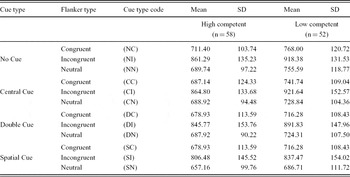
As mentioned above we defined global multilingual competence by computing the means of all the scores of the languages together: Ladin, Italian, German and English, and then divided the participants into two groups on the basis of the median value of their global multilingual competences resulting in a high competence group and a low competence group. On this basis we performed a 4 × 3 × 2 ANOVA with two internal factors, namely Cue Type with four levels (No Cue, Central Cue, Double Cue and Spatial Cue) and Flanker Type with three levels (Congruent, Incongruent and Neutral), and a between-subjects factor Group of Participants with two levels (high vs. low linguistic competence) (see Table 4).
Mean reaction times for the low and high multilingual competent group of participants.

For the purpose of this study we were only interested in looking at the main effect of Group of Participants and therefore only reported significant interactions within this group.
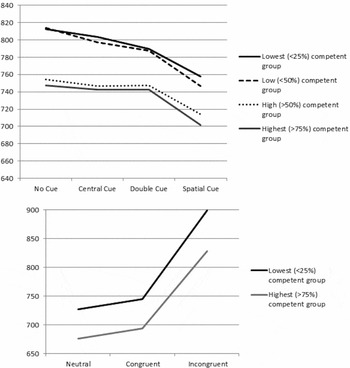
The main effect of Group of Participants was found to be significant (F(1,108) = 5.152, p = .025) revealing that in terms of RTs on the ANT, multilinguals with high linguistic competence performed significantly faster (–45.728 ms, SD = 20.147) than those with low linguistic competence. The interaction between Group of Participants and Cue Type was also found to be significant (F(3,324) = 3.480, p = .017).
Pairwise comparisons corrected for multiple comparisons showed that the high competence group of participants reacted significantly faster (–59.846 ms, p = .005) on the No Cue type and on the Central Cue type (–50.453 ms, p = .015). The high competent group of participants tended to also perform faster on the Double Cue type (–39.845 ms, p = .060) (see Figure 2).
Reaction times (ms) of Cue Type for the multilingual participants distinguished by competence level (top) and reaction times (ms) of Flanker Type for highest and lowest competent multilingual participants (bottom).

3.3 Analysis of ANT and effects of added multilingual competence
As aforementioned, to assess the effect of added multilingual competence, participants falling in the lower 25%-quartile ranking of the distribution of the grades (DL2 + DL3) were classified this time as the low competence group (n = 36 subjects) while those falling in the upper 75%-quartile ranking of the distribution were classified as the high competence group (n = 31 subjects).
Similar to the previous analysis, we performed the same 4 × 3 × 2 ANOVA with two internal factors (Cue Type with four levels – No Cue, Central Cue, Double Cue and Spatial Cue – and Flanker Type with three levels – Congruent, Incongruent and Neutral), and a between-subjects factor Group of Participants with two levels (high vs. low linguistic competence).
The main effect of Group of Participants was found to be significant (F(1,65) = 4.675, p = .034) revealing that in terms of RTs on the ANT, multilingual children with high language competence performed significantly faster (–58,016 ms, p = .034) than those with low language competence. The interaction between Group of Participants and Cue Type was found to be not significant in this analysis (F < 1) since the high competence group performed overall faster for all the different cue types.
However, after pairwise comparisons were corrected for multiple comparisons, we found that the high competence group of multilingual participants reacted significantly faster on the No Cue type sequence (–64.950 ms, p = .018) and on the Central Cue type sequence (–61.099 ms, p = .024). The high competence group of participants also tended to perform much faster on the Double Cue Type sequence (–49.701 ms, p = .089) and on the Spatial Cue Type sequence (–56.312 ms, p = .056) (see Figure 2).
The interaction between Group of Participants and Flanker Type was found to be not significant (F < 1) since the high competence multilingual group performed overall faster on each flanker type (see Figure 2).
3.4 The attentional networks and the effects of the global multilingual competence
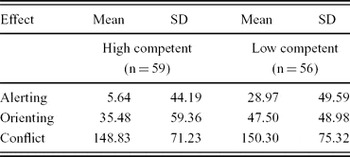
In order to establish the association between global multilingual competence (DL1–4) and the three attentional networks, Alerting (No Cue vs. Double Cue trials), Orienting (Central Cue vs. Spatial Cue) and Conflict (Incongruent vs. Congruent trials), we performed a correlation analysis between measures of these three attentional networks and global multilingual competence. The latter was defined as the categorical predictor that identified the two groups based on the median being split into both high (1) and low (0) competence groups. Unexpectedly, we found no significant correlation between the global multilingual competence and the conflict effect (–.10, p = .915), nor between the orienting effect (–.110, p = .240), but interestingly, we detect that multilingual competence and the alerting effect were the only ones found to be negatively correlated (–.243, p = .009), indicating that the group with high multilingual competence tended to show a smaller alerting effect.
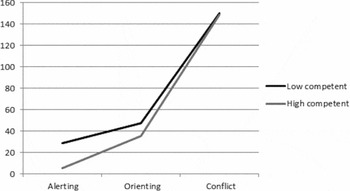
In addition to testing the interaction between the global multilingual competence and the attentional networks, a 2 × 3 ANOVA was computed for both Group of Participants (high and low) and Attentional Network (Alerting, Orienting and Conflict). The main effect of Group of Participants was found to be significant ((F(1,113) = 3.980, p = .048) proving that the high multilingual competence group showed reduced effects (–12 ms). More importantly though, the interaction between Group of Participants and Attentional Network was found to be not significant (F < 1), as pairwise comparisons only revealed a significant difference between the two groups in terms of the alerting effect (–23.326 ms, p = .009) (see Table 5 and Figure 3).
The attention networks for low and high competent multilingual participants.

The attentional networks for high (light line) and low (dark line) competent multilingual participants.

3.5 Hierarchical regression: The exclusive influence of the multilingual competence on the alerting network
In order to assess the unique relationship between multilingualism and the alerting network, we used hierarchical multiple regression to determine whether global multilingual competence accounted for the significant amount of variation in the alerting effect over the total school outcomes. This was accomplished by testing the R2 changes for statistical significance. For each step of the regression, we highlighted the contributions of the variables entered for that step while controlling for the effects of the variables entered at the preceding step. A dummy variable was created to capture high competence for each of the two variables of interest (global multilingual competence and total school outcome). As such, participants’ scores on global multilingual competence and total school outcome were coded as 1 and 0 to represent respectively the high competence group and the reference group to which the high competence group would be compared.
More specifically, we tested whether or not variance in the alerting effect was significantly reduced when the dummy variable for high total school outcome was entered in Step 1 and the dummy variable for high global multilingual competence in Step 2. The contribution of the high total school outcome was examined in Step 1, and, interestingly, the variance in the alerting effect was not significantly reduced (B = –11.057, R2 change = .013, F change = 1.510, p = .222) (B = unstandardized beta coefficients).
In contrast though, in Step 2, when high global multilingual competence was incorporated into the model, it yielded a significant amount of variance (B = –35.188, R2 change = .57, F change = 6.910, p = .010). In addition, only the second model (high general competence plus high global multilingual competence) predicted scores on the alerting effect to a statistically significant degree (F(2,112) = 4.249, p = .017).
To examine the potential threat of multicollinearity, both tolerance and the variance inflation factor (VIF) were calculated for both regression coefficients. Tolerance was .426 (above .20) and VIFs were 2.34 (below 4) indicating no serious multicollinearity problem in the analyses.
The unstandardized beta coefficients (B) can be interpreted as high global multilingual competence reducing the alerting effect by 35ms relative to the reference group.
3.6 The relationship between the competence of DL1, “global” multilingual competence, “added” multilingual competence and attention networks
The results outlined above offer general support for the hypotheses that differences between groups categorized in term of levels of language competence influence the alerting network. However, these are based on a median-split or a quartile-split categorization, which purges relevant information in the data through a dichotomization. Thus, the association between global multilingual competence and the three attentional networks was also tested based on a correlational analysis.
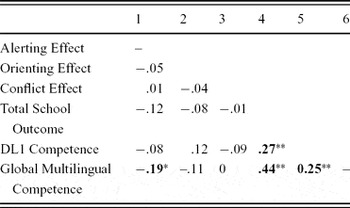
Correlations were performed in order to examine the relationship between total school outcomes, the competence of DL1, the global multilingual competence, the added multilingual competence and the scores for the alerting, orienting and conflict effect.
Since the variability among raw school marks for languages may somehow be influenced by total school outcome, it is useful to use a ratio score to examine specific effects related to linguistic competence that are not influenced by general higher competence. Consequently, we calculated the DL1 and the global multilingual competence ratio score transformation for each participant by subtracting the mean value of all marks (total school outcome) from the mean value of the mark related to the DL1 or the marks related to all languages (global multilingual competence) and subsequently by dividing the mean-corrected DL1 or global multilingual competence scores by the grandmean value for total school outcome of the entire group of participants (n = 115). In addition, the general competence grand-mean value for the entire group was subtracted from the total school outcome mean value for each participant.
On the basis of these scores, a significant correlation was only identified between alerting and the global multilingual competence ratio scores (r = –.186, p < .046). The correlation between the global multilingual competence and the orienting effect (r = –.105, p < .263) or the executive network effect (r = –.003, p < .974) were both found to be non-significant. Total school outcome scores or the competence of DL1 scores for each participant were not associated with effects in any of the three attention networks. All correlation coefficients are listed in Table 6.
Correlation coefficients.

* Correlation significant at .05 level (two-tailed)
** Correlation significant at .01 level (two-tailed)
Note: Bold indicates significant correlation effects.
In addition, in order to assess the influence of added multilingual competence on the alerting effect, we calculated an added multilingual competence ratio score transformation for each participant by subtracting the mean value of all marks (total school outcome) from the mean value of the marks related to DL2 and DL3 (added multilingual competence) and by dividing the mean-corrected added multilingual competence scores by the grand-mean value for total school outcome of the entire group of participants (n = 115). On the basis of these ratio scores, there was also a trend for a correlation between multilingual competence and the alerting effect (r = –.144, p < .062).
4. Discussion
Nowadays, the assumption that bilingual speakers process some cognitive functions somehow differently than their monolingual counterparts has become a widely accepted idea. Several studies using the ANT have shown that bilinguals outperform monolinguals in RTs, leading to the assumption that they have a bilingual executive processing advantage (Hilchey & Klein Reference Hilchey and Klein2011). However, there have only been speculations pertaining to whether or not this bilingual advantage is due to the linguistic competence of the bilingual subjects or whether it is due to some other factor that could account for the advantages. In this study we addressed how the attentional mechanisms of the ANT (i.e., alerting, orienting and conflict) were processed by multilingual subjects with differential language competence levels (i.e., high competent multilingual speakers vs. low competent multilingual speakers).
We tested a group of participants that were very similar in their language experiences. We chose children that were exposed to the same languages in their environment since early in life (i.e., Ladin, Italian, German), and shared similar multilingual experiences both in their school and in their homes, living in a similar socioeconomic status.
In line with previous studies investigating attentional mechanisms while using the ANT (e.g. Botvinick, Nystrom, Fissell, Carter & Cohen, Reference Botvinick, Nystrom, Fissell, Carter and Cohen1999; Costa et al., Reference Costa, Hernández and Sebastián-Gallés2008; Fan, McCandliss, Sommer, Raz & Posner Reference Fan, McCandliss, Sommer, Raz and Posner2002), we were able to confirm that: (i) subjects reacted faster when they were alerted by a warning cue presented before the target stimulus; (ii) children performed faster when they were oriented to the target's location, benefitting from the Spatial Cues and costs when No Cue appeared; and finally that (iii) subjects executed tasks faster in the Congruent trials than on the Incongruent trials.
Although the overall pattern was found to be similar for both groups of participants, the high competence group (based on the total of DL1–4) performed overall faster on the ANT, especially on the No Cue and on the Central Cue trials, with a tendency to be significantly faster on the Double Cue trials as well. These findings were also confirmed by the ANT results from both the highest and lowest competence groups of multilingual children (based on DL2+3). Hence, we may conclude that the attentional networks are correlated to the language competence level of multilingual children.
Remarkably, the impact of the multilingual competence affected all three components of the Attentional Network. Indeed, the high multilingual competence group showed overall reduced effects, yet the only significant difference between the two groups was that of the Alerting Effect. It is also important to underline that regarding the conflict effect, no significant differences were found in the magnitude of the conflict effect associated to language proficiency. This is surprising since the conflict effect is generally processed significantly faster by multilinguals as compared to monolinguals (Costa et al., Reference Costa, Hernández, Costa-Faidella and Sebastián-Gallés2009), and hence, we expected to replicate these findings similarly between subjects with high and low linguistic competence. One possibility is that the conflict effect is not susceptible to linguistic competence as much as the alerting effect is.
As to the alerting effect, to ensure that the observed advantage of the alerting effect was in fact exclusively exerted by high multilingual competence rather than by generally higher competence (such as from other skills and domains), we tested for the contribution of all the school outcomes in general. The hierarchical regression that was performed further confirmed the unique relationship found between high linguistic competence and the alerting network.
It may be surprising that the most important results in this study were centered on the Alerting Effect of the ANT. If the so-called bilingual executive processing advantage (Hilchey & Klein, Reference Hilchey and Klein2011) is a viable notion, we suggest that high language competence (such as being a proficient multilingual in particular) may enhance the reaction time to a target stimulus. Highly competent multilingual children in particular show a negative alerting effect that could be ascribed to their peculiarly high ability to manage different languages in an efficient way, reacting faster to the target stimulus, either in the presence of a warning signal, but also in its absence.
Previous work on children has also confirmed that bilingual children perform differently on attentional tasks than their monolingual peers (Bialystok, Reference Bialystok2011). Measures of nonverbal executive control such as the ability to selectively attend to relevant information, to inhibit distractions, and to shift between tasks is generally better in bilinguals than in monolinguals (Bialystok, Reference Bialystok2010). Bialystok and Feng (Reference Bialystok and Feng2009) also suggested that bilingual children may compensate for a smaller vocabulary size in their two languages with their more efficient executive control systems, allowing them to perform the same or even better than their monolinguals counterparts. In another study, Bialystok and Viswanathan (Reference Bialystok and Viswanathan2009) reported that bilingual children were faster than monolinguals in conditions testing for inhibitory control and cognitive flexibility but that there was no significant difference between the two groups in response to suppression or on a control condition that did not involve executive control. This assumption is also in accordance with those studies that compare highly proficient bilinguals with bilinguals of low proficiency, mostly to support or test for bilingual advantages, especially during tasks that involve executive control.
At the brain level, Abutalebi, Brambati, Annoni, Moro, Cappa and Perani (Reference Abutalebi, Brambati, Annoni, Moro, Cappa and Perani2007) identified an important area involved in language dominance in bilinguals, located in the anterior cingulate cortex (ACC). In detail, the ACC is more engaged for processing the less dominant language (Abutalebi et al., Reference Abutalebi, Brambati, Annoni, Moro, Cappa and Perani2007). The role of the anterior cingulate cortex can be related to Botvinick et al.'s (Reference Botvinick, Nystrom, Fissell, Carter and Cohen1999) assumption that it serves not to exert top–down attentional control but rather to detect and signal the occurrence of conflicts in information processing (see for review Carter & van Veen, Reference Carter and van Veen2007). This may suggest that the advantages of highly proficient multilinguals rely on the quickness in reaction times to a target stimulus, and the anterior cingulate cortex must therefore play an important role in detecting information, especially in conflicting situations. For this purpose, bilinguals develop also higher grey matter densities in the ACC (Abutalebi et al., Reference Abutalebi, Della Rosa, Green, Hernández, Scifo, Keim, Cappa and Costa2011) when compared to monolinguals because they are constantly faced with conflicting situations (i.e., language conflicts). As a future direction and related to our current study, it would be interesting to investigate whether there are regional brain differences in the ACC for highly competent multilinguals as compared to less competent multilinguals. On the basis of our present results, we may presume that high linguistic competence may induce higher levels of grey matter densities in the multilingual brain.
5. Conclusion
We concluded that high linguistic competence levels in multilingual children greatly impacted the children's alerting network system. Interestingly, we have reported that language competence rather than competence in other skill sets or domains influenced the alerting network. Hence, we suggest that the level of proficiency (i.e., linguistic competence) determines the cognitive ability of multilinguals to better detect and consequently to react faster to a given target stimulus (such as the ones presented in this experiment).