




No CrossRef data available.
THE MIRAGE OF GLOBAL JUSTICE
Published online by Cambridge University Press: 07 January 2006
Abstract
The political pursuit of global justice is not a worthy goal, and our aims in establishing international legal and political institutions should be more modest. The pursuit of justice in the international order is dangerous to the extent that it requires the establishment of powerful supranational agencies, or legitimizes greater and more frequent exercise of political, economic, and military power by strong states or coalitions. The primary concern in the establishment and design of all legal and political institutions should be not to secure justice but to limit power. It is a mistake to think that a distinction can be drawn between power created to do good and power created to do evil, or that we are capable of devising institutions that can honor the distinction.For helpful comments on earlier drafts of this essay, I would like to thank Jerry Gaus, David Miller, Dan Greenwood, Peggy Battin, Leslie Francis, Erika George, Cindy Stark, and Deen Chatterjee, as well as my fellow contributors to this volume. For especially detailed and helpful editorial comments and advice, I would like to thank Ellen Paul.
Information
- Type
- Research Article
- Information
- Copyright
- © 2006 Social Philosophy and Policy Foundation
I. Introduction
Theories of global justice address two main issues. First, what would a just distribution of benefits and burdens across the world look like? Second, what sorts of institutions would be required to secure such a just distribution? Many other related questions inevitably arise when these problems are addressed. Perhaps the most notable is how to establish such institutions given the diversity of sovereign nations and the fact of global inequalities of wealth and power. For many, these questions are urgent because we live in a world in which millions live in desperate poverty. They are salient not only because many people enjoy great wealth but also because the disparity in riches may itself be the product of unjust global institutions. On this view, it might be said, justice is the first virtue of global institutions. Institutions, no matter how efficient and well-arranged, must be reformed or abolished if they are unjust.
For some theories, however, the issue of global justice has a wider scope. The protection of human rights generally, it is argued, is a matter of justice. Just institutions would ensure not only that the distribution of benefits and burdens was morally justifiable but also that people were secure against the predations of despots and warlords. The security of people's individual liberties and political rights is also a matter of justice. To establish global justice requires institutions that secure human rights broadly understood.
The thesis of this essay is that the political pursuit of global justice is not a worthy goal, and that our aims in establishing international legal and political institutions should be more modest. Its primary argument is that the pursuit of justice in the international order is dangerous to the extent that it requires the establishment of powerful supranational agencies, or legitimizes greater and more frequent exercises of political, economic, and military power by strong states or coalitions. The primary concern in the establishment and design of all legal and political institutions should be not to secure justice but to limit power. It is a mistake to think that a distinction can be drawn between power created to do good and power created to do evil, or that we are capable of devising institutions that can honor the distinction.
The essay is organized in the following way. In Section II, I articulate a conception of global order in which justice has a limited part. In Section III, I advance the main reasons why our concern for justice should be limited. In Section IV, I consider some important objections to this viewpoint, particularly those advanced by such contemporary political philosophers as Allen Buchanan and Thomas Pogge, who contend that justice should be a central concern of global economic and legal institutions. In Section V, I offer replies to these criticisms, and in Section VI, I offer some general conclusions.
II. Justice and Global Order
There are two primary positions taken in contemporary political theory on global justice. The first asserts that justice, and in particular, social justice, is something that cannot be attained globally but can be pursued successfully only by the nation-state. The most influential statement of this view is offered by John Rawls in The Law of Peoples,1
John Rawls, The Law of Peoples (Cambridge, MA: Harvard University Press, 1999).
See David Miller, “Justice and Global Inequality,” in A. Hurrell and N. Woods, eds., Inequality, Globalization, and World Politics (Oxford: Oxford University Press, 1999), 187–210; David Miller, “National Self-Determination and Global Justice,” in Miller, Citizenship and National Identity (Cambridge, MA: Polity Press, 2000); and Michael Walzer, Spheres of Justice (Oxford: Blackwell, 1983).
See Allen Buchanan, Justice, Legitimacy, and Self-Determination: Moral Foundations for International Law (Oxford: Oxford University Press, 2004); Thomas Pogge, World Poverty and Human Rights (Malden, MA: Polity Press, 2002); Henry Shue, Basic Rights (Princeton, NJ: Princeton University Press, 1980); Peter Singer, “Famine, Affluence, and Morality,” Philosophy and Public Affairs 1, no. 3 (1972): 229–43; and Peter Singer, One World: The Ethics of Globalization (New Haven, CT: Yale University Press, 2002).
A particularly sharp statement of this second position is put forward by Darrel Moellendorf in criticism of Rawls, and in defense of cosmopolitan justice. Rawls, he observes, conceives of the international order as one in which toleration is extended even to regimes that are “unreasonable, intolerant, [and] oppressive” by the standards of Rawls's own doctrine as developed in his Political Liberalism.4
John Rawls, Political Liberalism, paperback edition (New York: Columbia University Press, 1996).
Darrel Moellendorf, Cosmopolitan Justice (Boulder, CO: Westview Press, 2002), 28.
My thesis in this essay is that justice should not be pursued globally. The position defended here differs from those of Rawls, Walzer, and Miller, however, because it also rejects the idea that justice is something that should be pursued within the nation-state. It acknowledges that the advocates of global or cosmopolitan justice have a point in demanding consistency from those who argue for justice at home but are prepared to tolerate injustice abroad. But it also acknowledges the force of the arguments of those who are skeptical about global justice, and who consider the pursuit of justice on that scale implausible.
Justice, it should be noted, may be understood in many different ways. At its broadest, justice could be said to be the subject of any general account of how people should live. On this view, Plato's Republic gives us an account of justice no less than does Marx's theory of communism—even if Marx regards “justice” as a bourgeois virtue that has no place in post-capitalist society. A narrower view of justice sees it as concerning the proper distribution of benefits and burdens in society. Justice is a characteristic of the rules or the institutions that determine the entitlements people have, individually or as groups, to parts of the material world, and to the services of others. A theory of justice would offer an account of what people are entitled to under the rules of justice, and also what measures may be taken by an appropriately constituted authority to ensure that justice is upheld. A narrower view still regards justice as a matter of the application of rules rather than a matter of the rightness or “fairness” of the rules. Justice, in this sense, may be served if the law is consistently applied, even if the law is systematically unfair.
My concern in this essay is with justice in the second of these three senses. That is to say, my concern is with social or distributive justice. Theories of distributive justice are numerous, ranging from the Nozickian view that a just distribution is any distribution that is the outcome of just acquisition and just transfer of resources,6
See Robert Nozick, Anarchy, State, and Utopia (New York: Basic Books, 1974), chap. 7.
On this understanding of justice, it is something that would be difficult to pursue in a society marked by a diversity of opinions and a variety of communities, since there would be many views about what justice demands. Any commitment to accommodating a diversity of ways of life would make it difficult to advocate a single standard of social or distributive justice. I suggest that it is neither possible nor desirable to pursue justice in this sense within a single nation-state. Consequently, we should not pursue social or distributive justice at the global level.
To put the issue schematically, there are four possible positions available on the question of whether justice (or social justice) should be pursued at home and abroad. (See Figure 1.) Position A suggests that social justice should be pursued at home and abroad; B that it should be pursued at home but not abroad; C that it should be pursued abroad but not at home; and D that it should be pursued neither at home nor abroad. Position C is perhaps the view least likely to find a representative, though it is not unusual for some political leaders to argue for global (re)distributive justice, while insisting on the importance of national sovereignty, and their own immunity from international criticism. This position has been expressed in a number of international declarations, such as the 1993 Bangkok Declaration.7
See the Bangkok Declaration of the ministers and representatives of Asian states, meeting at Bangkok from March 29 to April 2, 1993, pursuant to General Assembly resolution 46/116 of December 17, 1991, in preparation for the World Conference on Human Rights. While “welcoming” the attention paid to human rights in the international community, the declaration's evident concern was to downplay the relevance of human rights by asserting—and reasserting—the “principles of respect for national sovereignty, territorial integrity and non-interference in the internal affairs of States.” This concern is especially apparent in the declaration's wish to “discourage any attempt to use human rights as conditionality for extending development assistance,” to emphasize the importance of “the non-use of human rights as an instrument of political pressure,” and to reiterate “that all countries … have the right to determine their political systems, control and freely utilize their resources, and freely pursue their economic, social and cultural development.” Human rights, it seems, are very important—important enough to justify the spending of increasing sums of money to promote “awareness of human rights,” but not important enough to justify others' invoking them to scrutinize or criticize the workings of states. See http://law.hku.hk/lawgovtsociety/Bangkok%20Declaration.htm (accessed May 2001).
F. A. Hayek, Law, Legislation, and Liberty, vol. 2, The Mirage of Social Justice (London: Routledge, 1976).

Four positions on the pursuit of social justice.
In my view, then, the international global order should, like domestic or national societies, properly be conceived as a network of independent jurisdictions bound not by any shared (or imposed) understanding of justice but simply by a commitment to mutual toleration. The most important imperative in the international order is to avoid war. International institutions, including international organizations (such as the United Nations) and international regimes (such as that established by the 1951 Refugee Convention) may be useful if they help to keep the peace, and if they define mutually acceptable conventions by which problems common to global society might be peacefully addressed.
This view might appear to be a defense of a Westphalian model of international order, one that is dominated by sovereign states recognized as the subjects of international law. The Peace of Westphalia, which in 1648 brought an end to the Eighty Years' War between Spain and the Netherlands, and to the German phase of the Thirty Years' War, greatly weakened the power of the Holy Roman Empire. It confirmed the 1555 Peace of Augsburg, which had granted Lutherans religious toleration in the Holy Roman Empire, and it extended toleration to the Calvinists. In recognizing the territorial sovereignty of member states, it is often asserted, the Peace of Westphalia also established the principle cuius regio eius religio: that the religion of the head of state would be the religion of the people within that domain. This is not quite accurate, since the articles of peace required states to tolerate religious minorities. The authority of the Holy Roman Empire was dramatically reduced, however, and the sovereign power of some three hundred princes was increased. The modern world order could be said to operate on the Westphalian model in as much as it is a world of states, since European colonialism—and, more particularly, decolonization—brought states into being right across the globe. By the provisions of the Peace of Westphalia, princes eventually became absolute sovereigns in their own dominions, immune to the interventions of the Holy Roman Emperor. In the modern world, independence and immunity against foreign intervention are central aspects of state sovereignty.9
Strictly speaking, the doctrine that states as sovereign powers had the right to rule by their own structures of authority, without intervention from other states, was not established by the Peace of Westphalia but developed later in the legal theory of the Swiss jurist Emerich Vattel. “Westphalian sovereignty” is a widely used term, but it is probably a misnomer. See Stephen Krasner, Sovereignty: Organized Hypocrisy (Princeton, NJ: Princeton University Press, 1999). It is worth noting, as Krasner emphasizes, that states enjoy sovereignty to varying degrees.
At least to a limited extent, it is the Westphalian model that is commended in this essay. The virtue of the Westphalian ideal is that it divides power, recognizing as it does the diversity of claims of political authority, and that it appreciates the importance of avoiding war. Its weakness is that it strengthens the hand of the state, allowing it to act with immunity within its borders—even when its behavior is imprudent, unjust, or, at the extreme, barbaric. But if it is undesirable that there be any authority with power that can be so abused, it is even less desirable that such power be extended in scope to cover more and more domains—to create empires or a world government. Better to have many petty tyrants than a few great ones.
There are, of course, other reasons to be skeptical about the Westphalian model. In the 350 years and more since the Treaty of Westphalia was signed, not just Europe but the world has seen countless wars in which millions have died. Moreover, particularly in the twentieth century, the numbers killed in war have been dwarfed by the hundreds of millions killed by their own governments.10
See Rudolph Rummel, Death by Government: Genocide and Mass Murder in the Twentieth Century (New Brunswick, NJ: Transaction Publishers, 1994).
The virtue of the Peace of Westphalia was not that it established the authority of the state but that it weakened the forces of religious imperialism by lessening the influence of the Holy Roman Empire and the House of Hapsburg. It meant that religious questions could no longer be decided by a majority of the imperial estates and that future disputes would be decided by compromise among religious authorities.
This view does not assume that states must be regarded as economically self-sufficient units, or as culturally and politically undifferentiated entities, capable of relating to one another only as bargainers pursuing their own advantage. In freer political systems, cities and provinces, as well as other forms of association, will also be internationally significant political actors. Agreements will be reached between many different forms of associations besides states. States themselves may relinquish aspects of their sovereignty when they sign treaties or enter into conventions that bind them and limit what they may do even within their own borders. Signing the Kyoto Agreement on global warming (and then ratifying it) would limit a state's freedom to make laws that violated the agreement's provisions on acceptable greenhouse gas emissions. Being party to the 1951 convention on the treatment of refugees restricts a state's ability to turn people away from its borders if they come seeking asylum, for signing the agreement meant signing away elements of state sovereignty. A world of sovereign states need not be a world in which all political relations exist only between undifferentiated polities unaffected by international ties or international obligations.12
There is, however, the danger that the state will exercise its power to make treaties that end up binding provincial and local governments while also removing some responsibilities from their jurisdictions.
Despite these ties, however, ours is not a world united by shared moral convictions or a common idea of justice. The virtue of the Westphalian model of a world of sovereign states that emerged in the seventeenth and eighteenth centuries was that it was able to secure peace in the face of religious disagreement. The virtue of this model in the twenty-first century is that it might preserve peace in the face of ethical diversity. One way of describing this model of global order is as an archipelago of interdependent jurisdictions not subject to any common power, existing under norms of mutual toleration. Justice has no significant part to play in accounting for such an order.13
I have offered a more elaborate account of such an order in The Liberal Archipelago: A Theory of Diversity and Freedom (Oxford: Oxford University Press, 2003).
III. Reasons for the Limited Role of Justice
The primary reason for limiting the role of justice in international affairs is that understandings of justice are diverse and contentious. A secondary reason is that the pursuit of justice threatens to do little more than enhance the influence of the dominant states, and of the elites that guide them, while taking us further away from self-rule. We should consider these reasons more closely.
To begin with the primary reason, though justice is a value or an ideal that is universally recognized, it is also one whose content is widely disputed. It is disputed in several different and important ways. First, there is widespread disagreement about what are the fundamental requirements of justice. This disagreement is clearly in evidence among philosophers and scholars, who have disputed the merits of liberal, socialist, libertarian, utilitarian, Marxian, and other principles of distributive justice. However, even among people more generally, there are disagreements: for one thing, the various political parties in most Western democracies favor different standards of social justice, and appeal to different concerns or attitudes found in their electorates. Moreover, while the political parties may try to win office by appealing to the median voter, the fact remains that there are also voters at the extremes. It is also worth noting that often there is a significant gap between the attitudes of party elites and the masses within the party on a host of issues—including justice.
Second, there is disagreement about issues of justice because there is disagreement about questions of value.14
Here I have drawn on David Miller's analysis in “Justice and Global Inequality,” 193–96.
There is a further complication here. Often it is difficult to say just what is the value of the resources a particular society or community may have, since questions of value can only be settled against the range of background conditions that give things worth. Oil was not an asset but a liability when discovered in the days before there was any demand for petroleum. Today, uranium would be of little value to a society unable to exploit it, and soil suitable for cultivating vines would not be prized in a society of teetotalers. Even if value could be established here, however, there is also the problem of determining how different values are to be traded off. Some communities may prefer to trade off higher incomes from uranium sales for untouched wilderness and rural enterprise. Some communities may prefer to trade off future income by consuming their resources more rapidly now—opting for development rather than conservation. Some communities will simply have more children than others, and this will affect the distribution of resources. This can have a bearing on justice to the extent that these choices affect the overall distribution of resources not only within but also among different communities. Clearly, however, different communities will favor different conceptions of justice, since not every conception of justice will support the values of every community.
Third, a problem arises because different communities or societies have different understandings of property. This means not only that there are different understandings of what ownership means—what rights and duties come with possession of different kinds of things owned—but also that there are different understandings of how ownership may be transferred and to whom. Laws of inheritance vary from society to society, sometimes considerably.
Fourth, there may be disagreements about justice to the extent that there are more general ethical disagreements among people. For example, to the extent that people disagree about the morality of abortion or assisted suicide, they may also disagree about whether to subsidize pregnancy termination and related forms of medical care or to subsidize adoption—or whether to subsidize anything at all. But there are also other matters on which people disagree that have a bearing on justice. Different religions, communities, and societies have varying attitudes on the definition of childhood and the responsibilities of children and parents. They differ on what they recognize as marriage and what they consider the proper grounds for divorce. At the extreme, there are differences among people as to what constitutes harm to or violation of persons. Most people would consider female genital mutilation an unjustifiable violation of a child's body, but some communities consider it not just acceptable but a duty of responsible parents in their societies.
In the face of this great diversity of views about justice, and about morality more generally, how can justice be pursued across a variety of communities with different views about what justice demands? This is a problem not just for international society but also for domestic societies, particularly if a society is large and internally diverse. Countries such as India, China, Russia, Brazil, Indonesia, and the United States contain numerous communities with different languages, religions, customs, and ethical traditions. Under such circumstances, the most a society can reasonably pursue is the establishment of a framework or set of norms that might accommodate ethical disagreement, allowing different traditions to coexist.
An alternative view, however, is that even in the face of diversity and ethical disagreement, it is nonetheless important to pursue justice, at least to ensure that some standards of universal significance prevail. This is vital in the international realm no less than in domestic societies. This requires establishing international institutions, governed by universal ethical standards, aimed at promoting justice and ensuring that the actions of states and communities alike are governed by standards of justice. It means rejecting “moral minimalism” in favor of developing institutions governed by robust ethical standards that apply across international borders.15
“Moral minimalism” is a term used by Allen Buchanan in Justice, Legitimacy, and Self-Determination, 38ff.
This brings us to the secondary reason for limiting the role of justice in international affairs. If there are substantial differences over questions of justice, then trying to establish institutions whose purpose is to serve justice can produce either of two outcomes. First, it can lead to the creation of institutions of justice on which there is general agreement, but only because the understanding of “justice” is diluted or broadened to secure agreement among the different parties. Or, second, it can lead to the dominant powers establishing their own preferred understandings of justice, and running the institutions created according to their own ethical convictions—not to mention their interests. Most likely, we will see some combination of these two outcomes, which means that we will see some kind of rule by elites in the name of something they agree to call “justice.”
The establishment in 1998 of the International Criminal Court (ICC) provides an illustration of the problematic role of elites in the establishment of institutions of international justice. The impetus to create the court came from the failed attempts to prosecute General Augusto Pinochet in Britain and in Spain for crimes, including torture, illegal detention, causing the disappearance of persons, and murder, alleged to have been committed while he was president of Chile. The ICC, it was hoped, would help resolve the problem of determining the legal jurisdiction in which such charges could be brought against persons accused of war crimes or crimes against humanity. After several years of preparation and five weeks of negotiation in Rome, the ICC was established on July 17, 1998, but not before the provisions of the statute governing its operation, and the definitions of crime that it would work with, were suitably modified to placate the convictions and interests of various parties.16
Rome Statute of the International Criminal Court. The document may be found at http://www.icc-cpi.int/officialjournal/legalinstruments.html.
Ibid., 12.
The United States also had serious objections to the Rome Statute, worrying that the war crimes provisions could be used by its enemies to prosecute its soldiers serving abroad. Along with many other states, it expressed a concern over granting any proposed court the sole power to determine what constituted an act of aggression, particularly since this would contravene the authority of the United Nations Security Council. Since the United States is a permanent member of the Security Council, with a right of veto over its resolutions, the U.S. took a much less favorable view of such an outcome than did India, which would like to be but is not a permanent member. In the end, however, the final statute incorporated provisions ensuring the sovereign rights of states, and enabling the court to operate only at the invitation of states or of the Security Council—though even then, a number of states, including the United States, Russia, China, and all the states of the Middle East except Jordan, declined to become members of the ICC.18
For a helpful analysis, see Spyros Economides, “The International Criminal Court,” in Karen E. Smith and Margot Light, eds., Ethics and Foreign Policy (Cambridge: Cambridge University Press, 2001), 112–28.
In the end, an institution established to deal with criminal justice was shaped as much by the interests of important powers as by any concern for justice. The more general point this leads to is that international political institutions, like many domestic ones, are shaped by the interests and attitudes of elites. Unlike many local political institutions, however, the elites in question are a long way removed from the people who are ultimately governed by them.
To extend responsibility for justice to international institutions is to detract from self-government. This point was recognized in 1863 by Lord Acton in his analysis of the implications of the development of the nation-state itself and its usurpation of the powers of local jurisdictions. True republicanism, he argued, “is the principle of self-government in the whole and in all the parts.” In an extensive country, he continued, self-government could only prevail in a confederacy, “so that a large republic not founded on the federal principle must result in the government of a single city, like Rome and Paris.” A great democracy, he concluded, “must either sacrifice self-government to unity, or preserve it by federalism.”19
Lord Acton, “Nationality,” in Selected Writings of Lord Acton: Volume I: Essays in the History of Liberty, ed. Rufus Fears (Indianapolis: Liberty Fund, 1986), 409–33, at 414–15.
To try to establish a single standard of social justice even within a single country is a dubious undertaking. If a standard is agreed to by different communities, with different ethical traditions, that standard will be a weak one that reflects the compromises made to secure agreement rather than anything resembling justice. If the standard of justice is imposed by the more powerful, however, self-government will be sacrificed—without there being any assurance that the standards imposed have anything to do with justice rather than the interests of the dominant powers. This point holds even more strongly for international institutions. Powerful nations or coalitions will always find it advantageous to use the language of justice to defend the arrangements they establish. But this does not mean that justice is what they will pursue or defend.
We should be wary, then, of proposals to take action or devise institutions to secure international or global justice. The chances are that such proposals will simply serve the interests of elites, and will not secure justice even to the extent that we agree on what justice amounts to. More worryingly, however, appeals to justice, particularly when institutionalized, may simply serve as a cover or pretext for intervention in the affairs of people unwilling to accept ethical standards other than their own. At worst, such appeals may serve as pretexts for war. To the extent that it is important that we consider establishing international institutions to address matters of global concern, our priority should be not working out what justice requires and how it might be pursued but how to ensure that the power of global institutions, or the power that might be exerted through them, is kept limited. In the international domain, no less than in the domestic realm, the main political problem is how to keep power in check, not how to devise mechanisms to do good.
What this position implies is that in the international realm we should be concerned not to establish institutions that facilitate intervention in the affairs of other societies but to secure norms of toleration. A further implication of this outlook must also be recognized. If toleration is to take priority over justice, this means that injustice will have to be tolerated. This may be difficult if the perceived injustice is great. Nonetheless, toleration means nonintervention even in cases of injustice. For this reason, many hold either that toleration must be redefined so that justice establishes its limits, or that toleration must be subordinated to justice—perhaps to the extent that toleration simply becomes irrelevant as a substantial moral consideration.20
John Rawls advances the first view in A Theory of Justice (Cambridge, MA: Harvard University Press, 1999); Deborah Fitzmaurice advances the second in “Autonomy as a Good: Liberalism, Autonomy, and Toleration,” Journal of Political Philosophy 1, no. 1 (1993): 1–16.
It is important, however, to make clear what is not an implication of my view. The argument advanced here is not the one offered by Rawls in The Law of Peoples, which seeks to make a case not merely for nonintervention but also for respecting nonliberal peoples and states if they come up to certain minimal standards of morality.21
John Rawls, The Law of Peoples, with “The Idea of Public Reason Revisited” (Cambridge, MA: Harvard University Press, 1999).
Martha Nussbaum, “Women and Theories of Global Justice: The Need for New Paradigms,” in Deen K. Chatterjee, ed., The Ethics of Assistance: Morality and the Distant Needy (Cambridge: Cambridge University Press, 2004), 147–76, at 167.
To be candid, it seems to me that the idea that the state is (ever) an expression of human autonomy is a piece of wild romantic fiction. Its hold on the intellectual imagination is surely testimony to the brilliance and ingenuity of some of the outstanding philosophers of the past several centuries.
It is also important to note that my view denies the significance of a distinction sometimes drawn between “not tolerating” and “intervening.” The philosopher Kok-Chor Tan, for example, argues that a global theory of justice based on comprehensive24
“Comprehensive liberal” ideas contrast with “political liberal” ones. Comprehensive liberals take liberalism to be a doctrine that adheres to or upholds certain views about what values are central to leading a valuable human life—values such as individuality and autonomy. Political liberals think that comprehensive liberalism runs the risk of simply becoming another sectarian doctrine rather than adhering to the liberal ideal of finding neutral ground for the accommodation of different ideals of what makes for a good life.
Kok-Chor Tan, Toleration, Diversity, and Global Justice (University Park: Pennsylvania State University Press, 2000), 82.
Ibid., 60.
Nussbaum, “Women and Theories of Global Justice,” 165–66.
The problem with relying on this distinction (between “not tolerating” and “intervening”) to diminish the likelihood of being drawn down the path of intervention is that it does not recognize the significance of the presumption against intervention in the affairs of people in other states or communities. The reason for rejecting justice in favor of toleration is precisely that this stance makes clear that nonintervention is the default position. It is intervention, particularly if it is to involve coercion or violence, that requires justification. Tan and Nussbaum, in different ways, want to assert the primacy of justice or substantive standards of morality; but in insisting that such standards may only be enforced in very rare cases, they, in effect, concede the priority of the principle of nonintervention or toleration over justice. In the case of Tan's claim that criticism without intervention or enforcement is not toleration, the use of the word “toleration” seems odd to the extent that it makes even criticism an act of intolerance. It surely makes more sense to say that we are intolerant not when we reject or criticize another's views but when we try to impose our own through the exercise of force rather than through persuasive reasoning.28
See Glen Newey, Virtue, Reason, and Toleration: The Place of Toleration in Ethical and Political Philosophy (Edinburgh: Edinburgh University Press, 1999), esp. 18–35; see also Andrew J. Cohen, “What Toleration Is,” Ethics 115, no. 1 (2004): 68–95.
IV. Arguments for Global Justice
The main targets of this essay's criticism, then, are those who defend global justice as an ideal that should inform the establishment of international institutions, and would form the basis for collective action to enforce standards of morality across the world. The literature advancing the case for global justice is substantial. Rather than try to address it as a whole, the remainder of this essay will focus on arguments developed by two philosophers, Allen Buchanan and Thomas Pogge. Both reject the view advanced by Rawls and others that justice should be pursued only within the confines of the nation-state: Buchanan emphasizes the importance of protecting human rights as an imperative of the natural duty of justice, and Pogge emphasizes the importance of reforming the global basic structure to end world poverty. I will consider these arguments in turn, beginning with Buchanan's.
According to Buchanan, justice must be the primary moral goal of international law. He rejects the idea that peace should be the main goal of the international system, and that the ideals of peace and justice are in conflict. He writes:
[I]t is wrong to assume that justice and peace are somehow essentially in conflict. On the contrary, justice largely subsumes peace. Justice requires the prohibition of wars of aggression (understood as morally unjustifiable attacks as opposed to justified wars of self-defense or of humanitarian intervention) because wars of aggression inherently violate human rights. To that extent the pursuit of justice is the pursuit of peace.29
Buchanan, Justice, Legitimacy, and Self-Determination, 79 (emphasis in original).
He adds that “protecting some of the most important human rights is securing peace.”30
Ibid (emphasis in original).
This view, Buchanan insists, is not as extreme as might be thought. It does not deny that justice may sometimes conflict with peace—though, for the most part, this will be the case in the period of transition from very unjust to more just conditions.31
Ibid.
Ibid., 80–81.
Ibid., 259.
There are two arguments that Buchanan offers for the conclusion that justice is a morally obligatory goal of international law. The first is that there is a global basic structure of institutions through which people across the globe relate and that this basic structure can be assessed for its justice. If justice is, as Rawls asserted, the first virtue of social institutions, then “justice is a morally imperative institutional goal,” in the global as well as in the domestic sphere.34
Ibid., 84–85.
Ibid., 85. Pogge first developed this view in Thomas Pogge, Realizing Rawls (Ithaca, NY: Cornell University Press, 1989), though he has developed the arguments more forcefully in his later writings.
Buchanan, Justice, Legitimacy, and Self-Determination, 86.
Ibid., 88.
With this outlook comes a particular view of the state and its ethical basis. Buchanan rejects what he calls the “discretionary association” view, according to which the state is nothing more than a discretionary association for the mutual advantage of its citizens—designed to further their interests.38
Ibid., 98–99.
Ibid., 100.
Ibid., 103.
The view Buchanan defends is one he describes as “moderate cosmopolitanism.” It recognizes that we have moral obligations beyond our own borders, but without going to the extreme of suggesting that all our particular obligations are simply derived from our obligations to humanity more broadly.41
Ibid.
Ibid., 104.
Ibid., 104–5. Buchanan recognizes that a theory of democratic authorization is needed to make the argument complete, though it is not his immediate concern to fill in this particular gap.
Ibid., 106–16.
Central to Buchanan's argument is the claim that there are basic human rights, and that there is “an expanding global culture of human rights that exhibits a broad consensus on the idea that justice requires respect for the inherent dignity of all persons.”45
Ibid., 42.
Ibid., 201–2.
Ibid., 202–3.
Buchanan argues not only for theoretical innovation but also for practical reform of the international legal order. Two aspects of his argument merit special mention. First, he makes clear that it is necessary to develop “a more permissive law regarding humanitarian intervention,” for “liberalizing the international law of humanitarian intervention is likely to be a necessary condition for achieving” other reforms.48
Ibid., 445–46.
Ibid., 446–49.
[C]onsider again the proposal for a treaty-based, rule-governed intervention regime whose members would be restricted to the most democratic, human-rights respecting states. To the extent that it authorizes humanitarian interventions in the absence of Security Council authorization, such a regime would violate existing international law. But it would embody, rather than repudiate, a commitment to the rule of law in the normatively rich sense.50
Ibid., 462.
In fact, Buchanan insists that being “willing to act illegally to make a very unjust system more just need not be inconsistent with a commitment to justice through law; it may indeed be required by it.”51
Ibid.
Buchanan's concern is to present a case for the creation or reform of basic international institutions in order to bring about a more just world. Such reforms would bring about justice by protecting or enforcing individual rights. Despite some significant philosophical differences between their approaches, Buchanan's concerns are shared by Thomas Pogge, who also calls for reform of the basic structure of international society, but whose writings on global justice have focused on the problem of world poverty and human rights rather than on international law.52
See esp. Thomas Pogge, World Poverty and Human Rights (Malden, MA: Polity Press, 2002).
For Pogge, the interdependence of persons in a world order makes it essential that we look at justice in global rather than local terms. Institutional interconnections across the planet, he argues, “render obsolete the idea that countries can peacefully agree to disagree about justice, each committing itself to a conception of justice appropriate to its history, culture, population size and density, natural environment, geopolitical context, and stage of development.”53
Ibid., 33.
Ibid. (emphasis in original).
Ibid., 34.
Despite his emphasis on universalism, Pogge is aware of its shortcomings and has some sympathy for the contextualist ethics defended by philosopher David Miller.56
Ibid., 102–4.
Rawls advances the “difference principle” as a part of the second of his two principles of justice. Broadly, it asserts that in a just society, institutions of justice would permit inequalities only provided that social arrangements were such that the welfare of the least-advantaged or worst-off group in society was higher than it could be under any other arrangements. Rawls's most recent discussion of the difference principle is in John Rawls, Justice as Fairness: A Restatement (Cambridge, MA: Harvard University Press, 2001).
Pogge, World Poverty, 105. Rawls's claim is in The Law of Peoples, 116–18.
Pogge, World Poverty, 106.
For Pogge, there are compelling reasons why justice is an issue that has to be addressed globally. First, it is clear that many people live lives of desperate poverty and enormous suffering, even as others, particularly in the countries of the developed West, enjoy great affluence. Second, an important cause of this suffering—and affluence—is the system of global institutions that protects the wealth of some while prolonging the poverty of others. Third, to the extent that global institutions are capable of being reformed but have not been improved, those who benefit from those institutions must bear responsibility for the condition of those who suffer under them. In the world today, Pogge maintains, the affluent benefit from a system that sustains radical inequality such that they enjoy significant advantages in the use of a single natural resource base—the earth—from whose benefits the worst-off are excluded without compensation. This system itself emerged out of a historical process that was pervaded by massive, grievous wrongs.60
Ibid., 201–3. In this account, I have contracted Pogge's more elaborate, careful, and sophisticated argument, but without, I hope, misrepresenting it or failing to capture its spirit.
As a first step toward justice, Pogge proposes the establishment of a Global Resources Dividend (GRD)—a fund created by payments made by all states, to be used to eradicate poverty—“to ensure that all human beings can meet their own basic needs with dignity.”61
Ibid., 197.
Ibid., 206.
Ibid., 207.
Ibid.
Like Buchanan, Pogge defends what amounts to a moderate cosmopolitanism. What both philosophers share is a conviction that justice is a global issue, though both want to give particularism some due. Both thus make what they regard as moderate proposals for reforming global institutions. Neither thinks that a proper respect for human dignity or moral principle warrants anything less.
V. Against Global Justice
There can be no doubt that we live in a world in which many people suffer poverty and oppression, or that where one is born has a greater bearing on one's prospects in life than, say, one's talents or character. A modern variant of the ancient Chinese curse might well run, “May you live in an interesting country.” There is surely a case for helping the destitute, opening our borders to those looking to make a better life, and welcoming those who are trying to escape oppressive regimes. This does not mean, however, that there is a case for seeking the mirage of global justice, and the problems with the theories advanced by Buchanan and Pogge help to bring this out. Both set out to show that universal justice is desirable, and that it may be better secured across the world by the reform or creation of institutions authorized and empowered to do so. Yet the outcome of their philosophical effort is, in effect, a justification of rule by elites, guided by (and unchecked by anything other than) a commitment to a view of justice. We should be skeptical of these efforts, for they promise only elite rule, not justice.
One important reason for this is that political institutions cannot secure justice, particularly when they cover large areas of territory and a great number and diversity of people. The most they can secure is peace as people agree to abide by common laws and the rule of common authorities. There are two reasons why justice is not a likely outcome. First, given the nature of politics, the institutions or rules that are adopted will reflect not the demands of justice but the balance of power. Second, the likelihood of agreement on justice diminishes with the increasing size of the polity: any agreement reached will be a compromise, assented to in the end in order to bring negotiation to a close. To say this is not to take refuge in skepticism about justice. One might remain convinced that one view of justice is true and still recognize that political institutions are incapable of securing it, or that securing it is no part of their purpose.
Allen Buchanan takes a different view in arguing that justice subsumes peace, and that the best way to secure peace is to secure justice by protecting human rights. But this seems straightforwardly implausible. If two parties to a dispute disagree about justice but one is successful in having his view of justice prevail, there is no reason to think that this will produce peace between them. If peace is produced because one is able to persuade the other that his view of justice really is correct, it is agreement that produces peace, not the justice of the agreed-upon view. Peace would be the outcome even if the agreed-upon view of justice was wrong. If agreement were the outcome simply of the stronger party's being able to enforce his view of justice, the resulting peace would hardly be the product of justice, simply of power.
Consider as an illustration what is perhaps the most intractable of all problems in contemporary international politics: the dispute over Palestine. It would be simplifying matters considerably even to assert that there were only two sides to this conflict. We can say, however, that there are a number of issues in play: the legitimacy of the very existence of Israel; the proper boundaries of the Israeli state (whether they should be defined by the 1947 U.N. determination, or the war at the founding of the state, or the 1967 war, or the view of the present Israeli state, or some other set of considerations altogether); the right of return, if any, of Palestinian refugees; the status of Jewish settlers and their settlements on the West Bank; and the rights of Palestinians or Arabs living or working in Israel. It is safe to say that there is agreement neither among Israelis nor among Palestinians about what justice demands, let alone agreement between the government of Israel and the various groups, including the Palestinian Authority, who claim to speak on behalf of all Palestinians. To suggest that the path to peace in this land is to establish justice by protecting human rights seems utterly implausible given the unlikelihood that those who lose by the establishment of what is alleged to be justice will simply accept the outcome with good grace—even if the judgment were offered by Solomon himself. Buchanan suggests that justice requires the prohibition of wars of aggression “understood as morally unjustified attacks as opposed to justified wars of self-defense or of humanitarian intervention.”65
Buchanan, Justice, Legitimacy, and Self-Determination, 79.
As H. L. Mencken once observed, albeit with a slightly different point in mind, “injustice anyone can take, what really stings is justice.”
Buchanan, however, suggests that “progress towards justice is especially likely to require illegal acts if the system's imperfections include serious barriers to expeditious, legally permissible reform,” and recommends the creation of a “rule-governed intervention regime,” its membership restricted to the “most democratic, human rights–respecting states,” to authorize intervention in regimes that violate human rights.67
Buchanan, Justice, Legitimacy, and Self-Determination, 462.
Buchanan does try to make clear that his proposal is “not for a single state, or even a collection of states, to intervene lawlessly. Instead, the idea is to create a new system of rules—new principles, processes, and institutions—that embody the normatively rich conception of the rule of law.” Ibid., 462.
Buchanan uses these examples; see ibid., 464.
Buchanan's defense of lawbreaking is very different from that suggested by Robert Goodin, who argues that there may be cases in which it is justified as the only means of reforming international customary law. See Robert Goodin, “Toward an International Rule of Law: Distinguishing International Law-Breakers from Would-Be Law-Makers,” International Journal of Ethics 9 (2005).
This is a troubling view, but it is important to understand what lies behind it. Buchanan's concern is that existing international norms (and in particular, the structure of the United Nations) make it difficult to pursue justice or morality. Human rights abuses go unaddressed. Reform, he thinks, is necessary to make it more possible for human rights to be protected. What is troubling about this view is that it assumes or asserts that a world in which such constraints on intervention are removed or weakened will be a better world, presumably because the just are freer to act. Yet it would also leave the unjust freer to act. If the recommendation is that right-thinking states should combine when necessary, restructure patterns of international authority by establishing treaties, and then authorize themselves to act in the name of justice, this looks like a general invitation to all states to so act. No state thinks it is not right-thinking, and most even claim to recognize human rights—and indeed are signatories to the major human rights agreements, including the Universal Declaration of Human Rights (1948).71
Other important human rights declarations include the International Covenant on Economic, Social, and Cultural Rights; the International Covenant on Civil and Political Rights; and the Convention on the Elimination of All Forms of Discrimination against Women. For a fuller list, see the U.N. Office of the High Commissioner for Human Rights: http://www.unhchr.ch/html/intlinst.htm (accessed January 2005).
Buchanan's theory, in the end, requires that we accept either one of two views, the first one implausible and the second unattractive. The first view is that there is a level of consensus in the international order that would make it possible for global institutions to be restructured by concerted action of the kind he recommends. In fact, however, there is no such consensus—or at least, not yet. Now, Buchanan is aware of this argument, but he questions the claim that there is no consensus and suggests that the implication of denying the existence of consensus is a denial of the legitimacy of the international system as a whole.72
Buchanan, Justice, Legitimacy, and Self-Determination, 308–10; see also 38–45.
Ibid., 309.
See Kristen Hessler, “Resolving Interpretive Conflicts in International Human Rights Law,” Journal of Political Philosophy 13, no. 1 (2005).
The second view is that a minority of states should pursue the task of engaging in the restructuring of global institutions. The objection to this is not simply that any such effort would fail without the major powers, such as the United States and the European Union, going along with it, though Buchanan thinks there is much to be said for trying to engage in such restructuring without the United States, which is “widely regarded—and not without reason—as an international scoff-law.”75
Buchanan, Justice, Legitimacy, and Self-Determination, 452.
Ibid.
Ibid.
It is difficult to see how Buchanan's proposal here amounts to much more than a recommendation that like-minded states who believe in human rights should set out to collude and enforce, whenever possible, their own conception of justice. If this is so, it does not look like an improvement on the norm that Buchanan is looking to undermine: international customary law. The disadvantage of customary law is that it changes slowly and is not a tool that may readily be used to right serious wrongs. It depends on the development of consensus, mostly among states, and does nothing to enhance the capacity of international agencies to intervene in the affairs of tyrannical regimes. Its advantage, however, is precisely that it does make intervention, and the resort to arms, more difficult.
More generally, whatever the weaknesses of the Westphalian system, it does have some important virtues. In a world of unequal power, a norm of nonintervention, even if upheld by a convention recognizing states as sovereign powers, checks the capacity of stronger states to enforce their wills. For weaker states, sovereignty is an important asset, particularly if it can be deployed with effect against stronger states whose assertions of the common purposes of states in international society can easily be self-serving and to the detriment of lesser polities. As the theorist of international relations Hedley Bull noted, “If a right of intervention is proclaimed for the purpose of enforcing standards of conduct, and yet no consensus exists in the international community governing its use, then the door is open to interventions by particular states using such a right as a pretext.”78
Hedley Bull, “The Grotian Conception of International Society,” in Herbert Butterfield and Martin Wight, eds., Diplomatic Investigations: Essays on the Theory of International Politics (London: Allen and Unwin, 1966), 51–73, at 71.
In the end, the world is more diverse than Buchanan's theory is prepared to admit. We live in an international society that is pluralist rather than solidarist.79
On the use of these terms, see Edward Keene, Beyond the Anarchical Society: Grotius, Colonialism, and Order in World Politics (Cambridge: Cambridge University Press, 2002), 35–38.
This consideration calls into question the claims Buchanan makes on behalf of the Natural Duty of Justice. The Natural Duty of Justice is “the limited moral obligation to contribute to ensuring that all persons have access to just institutions.”80
Buchanan, Justice, Legitimacy, and Self-Determination, 86.
Ibid., 93.
See Immanuel Kant, The Metaphysical Elements of Justice, trans. John Ladd (Indianapolis: Bobbs-Merrill, 1976).
This is true even if one recognizes that there are positive rights that have to be upheld, and that one's duties go beyond merely forbearing from violating negative rights.
These considerations also tell against Pogge's arguments in defense of establishing an international regime to secure global economic justice. There is no question that large numbers of people live in poverty. Even on very modest assumptions about what constitutes poverty (say, an income of less than US $1.50 a day), nearly a sixth of humanity is poor. The moral imperative to address this problem is a strong one. Yet this does not mean that our obligation is to restructure the international system. There are a number of steps that can surely be taken unilaterally by individuals and governments with complete justification. First, it may be incumbent on those who are well off to act unilaterally to contribute more to relief of the poor and destitute. Since relief is often better supplied by collective action, it may be morally better to act through international agencies, such as Community Aid Abroad or Oxfam, to do so.84
For a discussion of the limits of such duties, however, see Neera Badhwar, “International Aid: When Giving Becomes a Vice,” elsewhere in this volume. (For Oxfam, see http://www.oxfam.org.uk.)
Even if it is useful to have the World Trade Organization to pressure other nations to lower their own trade barriers, there is no reason for wealthy nations acting within the WTO structure not to be more open than the terms of the WTO require.
Now it might be argued that these recommendations are not enough: first, because private unilateral action is not going to do very much good, and second, because it is simply politically naive to think that states will take unilateral action to open their borders to foreign goods and people. In the first instance, it is probably true that private charity will not be sufficient to make a substantial impact on global poverty. Other changes are necessary. Yet, second, if there is no possibility of states and international federations taking unilateral action to cease their harmful trade and immigration policies, there is surely little reason to think that more ambitious reforms of global economic structures are possible. What hope is there of a Global Resources Dividend in a world of butter mountains, wine lakes, and billion-dollar subsidies to grow rice in deserts, or sugar in the wilderness?
Pogge is looking for solutions that involve reform on a global scale, using mechanisms that will do justice by making possible large transfers of funds from rich to poor societies. In his view, justice requires such transfers to reduce the inequality that exists between the rich and the poor. The question is, who is to establish what justice demands, and how are we to ensure that justice is properly served? Pogge's answer is that these questions will be settled by states, or elites within them, who will enlist experts—economists and lawyers—to devise suitable schemes to raise and distribute funds. Whatever practical problems this may involve, two difficulties stand out. First, the GRD sets out to solve a problem of global distribution by creating yet another political institution. Yet given that the existing political institutions have struggled to address the problem of taking care of the world's poor, what reason is there to think that creating another layer of intervention will help in any way? Past experience suggests that all the problems that beset other institutions, from the nation-state itself to the agencies of the United Nations, would simply reappear. In particular, if a fund were created making available for redistribution tens of billions of dollars, it is hard to see how there could not be another scramble for a slice of the largesse, with the spoils going to those who know best how to manipulate the system. Even if the outcome of this was a greater share of the world's wealth going to the poor, it is not clear that this would be desirable if it means that poor nations put their energies not into learning how to develop and manage their productive assets but into perfecting the art of securing aid money.
Second, establishing institutions of global distributive justice in this way once again means entrenching the power of the world's elites: those powerful states who would supply the funds and control their disbursement, with the help of elites in developing countries. The assumption here is that good will and sound institutional design will overcome the major difficulties and enable us to get closer to eliminating global inequality and securing justice. Past experience, however, suggests only that it will take us closer to global political inequality.86
Much of Pogges's argument rests on the contention that global poverty and global inequality are increasing. While there is no doubt of the extent of global poverty, the claim of growing inequality is controversial. On this, see in particular the work of Surjit Bhalla, who has argued that, contrary to the received wisdom, inequality has been declining as a consequence of “globalization”—the lowering of trade barriers and the greater internationalization of commerce. See Surjit Bhalla, Imagine Theres's No Country: Poverty, Inequality, and Growth in the Era of Globalization (Washington, DC: Institute for International Economics, 2002). For criticisms of Bhalla, see Martin Ravallion, “Have We Already Met the Millennium Development Goal for Poverty?” Institute for International Economics, available at http://www.iie.com/publications/papers/papers03.htm (accessed February 2005). For Bhalla's reply, see “Crying Wolf on Poverty: Or How the Millennium Development Goal for Poverty Has Already Been Reached,” Institute for International Economics, available at: http://www.iie.com/research/globalization.htm (accessed February 2005).
VI. Conclusion
The fact of global poverty and the prevalence of oppressive regimes have provoked the call for attention to the problem of global injustice. The aim of this essay has not been to deny the existence of poverty or oppression; its aim has been to seek the appropriate response to these conditions. The main thesis it advances is that the solution does not lie in establishing or expanding political powers to address these problems. This promises neither to establish an acceptable understanding of justice, nor to do much more than provide another opportunity for political elites to pursue their own particular ends. However, it should also be made clear what is not being suggested here.
First, this is not a defense of realism in international politics. In Buchanan's account, realism recommends that states be guided at all times by a concern for their national interests. As a moral theory, this has little to commend it. The argument here is not that states should pursue their own interests but that we should not look for ways of increasing the power of political elites in the expectation that they will do anything but pursue their own interests. Contrary to what Buchanan and others suggest, the state and other political institutions are not instruments of moral progress. We should be more thoroughly cynical about political power, for justice is not its raison d'être.
Second, this is not a rejection of the importance of international law. What is rejected, however, is the idea that global justice demands sweeping reforms of international institutions, and the establishment of new structures.
Third, the argument here is not a rejection of cosmopolitanism, even though it criticizes the work of modest cosmopolitans such as Buchanan and Pogge. The main assumption of the essay in this regard is that the development of cosmopolitanism should not be the product of political reform. It may well be that there will be a convergence across the globe on common moral standards in the years to come. Unless that happens, however, we cannot even begin to think in terms of global justice.
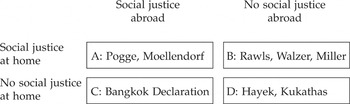
Four positions on the pursuit of social justice.
 You have
Access
- 24
- Cited by