Introduction
Early life environments shape patterns of childhood growth with long-lasting effects on health and human potential (Barker, Reference Barker1990; Gluckman et al., Reference Gluckman, Hanson, Bateson, Beedle, Law, Bhutta, Anokhin, Bougnères, Chandak and Dasgupta2009). Effects extend to later life mental health, with early exposure to maternal mental health problems predicting later childhood emotional and behavioural problems, many of which persist into adulthood (Swanson and Wadhwa, Reference Swanson and Wadhwa2008; Pearson et al., Reference Pearson, Evans, Kounali, Lewis, Heron, Ramchandani, O'Connor and Stein2013; Stein et al., Reference Stein, Pearson, Goodman, Rapa, Rahman, McCallum, Howard and Pariante2014). According to theories of the developmental origins of health and disease, in utero and postpartum development are characterised by heightened adaptive plasticity, allowing maternal transmission of environmental information to offspring to confer a later developmental advantage (Gluckman and Hanson, Reference Gluckman and Hanson2004). Heightened antenatal exposure to maternal stress-related hormones and inflammatory processes (Oberlander et al., Reference Oberlander, Weinberg, Papsdorf, Grunau, Misri and Devlin2008; Chan et al., Reference Chan, Nugent and Bale2018), and altered caregiving postnatally (Meaney and Szyf, Reference Meaney and Szyf2005; Newland et al., Reference Newland, Parade, Dickstein and Seifer2016), have both been implicated as risk processes.
However, links between maternal mental health and offspring development may have their origins in the years before pregnancy (Keenan et al., Reference Keenan, Hipwell, Class and Mbayiwa2018). According to evolutionary developmental and life course models, maternal biology and behaviour during pregnancy and postpartum reflect experience accumulated during the preconception years (Kuzawa and Quinn, Reference Kuzawa and Quinn2009). For most women, perinatal mental health problems are preceded by similar problems before pregnancy, many beginning in adolescence (Patton et al., Reference Patton, Romaniuk, Spry, Coffey, Olsson, Doyle, Oats, Hearps, Carlin and Brown2015). The persistence of preconception mental health problems into pregnancy may therefore affect offspring through increased exposure to antenatal and postnatal risks. Alternatively, animal studies have raised a possibility of preconception maternal mental health affecting the periconceptional environment or gamete directly, with independent effects on offspring stress responses (Zaidan et al., Reference Zaidan, Leshem and Gaisler-Salomon2013). In this latter case, it is further possible that effects previously attributed to perinatal exposures are in fact confounded by exposures occurring before pregnancy (Keenan et al., Reference Keenan, Hipwell, Class and Mbayiwa2018).
One early phenotypic indicator of infant vulnerability to later mental disorder is heightened emotional reactivity, characterised by irritability, negative mood, and intensity of reactions (Rothbart and Bates, Reference Rothbart, Bates, Grotevant, Damon and Eisenberg2006). It has been seen as an indicator of differential susceptibility to context, reflecting a greater capacity to benefit from enriched environments and interventions but also a heightened vulnerability to stress (Belsky, Reference Belsky, Ellis and Bjorklund2005; Boyce and Ellis, Reference Boyce and Ellis2005; Slagt et al., Reference Slagt, Dubas, Deković and van Aken2016; Hartman and Belsky, Reference Hartman and Belsky2018). Emotional reactivity predicts mental health problems in childhood with effects varying across contexts. Four-month-old infants classified by observers as highly reactive to stimuli were, for example, twice as likely to have anxious symptoms at age 7 years (Kagan et al., Reference Kagan, Snidman, Zentner and Peterson1999). Similarly, the parent-reported intensity of infant emotional reaction predicted a 1.5-fold increase in the odds of interviewer-assessed child psychiatric disorder at age 7 years (Sayal et al., Reference Sayal, Heron, Maughan, Rowe and Ramchandani2014). Maternal mental health problems also predict infant emotional reactivity, leading to a suggestion that this heightened early sensitivity to environmental context may be one step in the intergenerational transmission of mental health risks (Davis et al., Reference Davis, Snidman, Wadhwa, Glynn, Schetter and Sandman2004; Huot et al., Reference Huot, Brennan, Stowe, Plotsky and Walker2004; Bruder-Costello et al., Reference Bruder-Costello, Warner, Talati, Nomura, Bruder and Weissman2007; Davis et al., Reference Davis, Glynn, Schetter, Hobel, Chicz-Demet and Sandman2007; Rouse and Goodman, Reference Rouse and Goodman2014).
Questions remain as to the timing of these maternal effects, with implications for our understanding of the mechanisms involved and the optimal timing of interventions. In this study, using data from two longstanding Australian prospective datasets we consider the relative contributions of preconception, antenatal, and postnatal maternal mental health problems to the development of heightened emotional reactivity in infants. We further examine the extent to which any preconception associations are mediated by maternal mental health during pregnancy and in offspring infancy, as well as the extent to which any associations between perinatal mental health and offspring infant emotional reactivity are explained by a history of prior problems.
Ethical standards
The authors assert that all procedures contributing to this work comply with the ethical standards of the relevant national and institutional committees on human experimentation and with the Helsinki Declaration of 1975, as revised in 2008.
Methods
Sample
We used data from two prospective preconception cohorts located in Australia: The Victorian Intergenerational Health Cohort Study (VIHCS) and the Australian Temperament Project, Generation 3 (ATPG3). These cohorts both assessed women's mental health before, during and after pregnancy, and offspring infant emotional reactivity at 1 year postpartum (appendix p 1).
VIHCS sample
The VIHCS is an ongoing prospective intergenerational study of preconception predictors of infant and child health, described elsewhere (Patton et al., Reference Patton, Romaniuk, Spry, Coffey, Olsson, Doyle, Oats, Hearps, Carlin and Brown2015). It arose from a cohort study commencing in 1992 in the state of Victoria, Australia (The VAHCS) (Patton et al., Reference Patton, Coffey, Romaniuk, Mackinnon, Carlin, Degenhardt, Olsson and Moran2014). Briefly, a close-to-representative sample of 1943 Victorian mid-secondary school students (1000 female) were selected via a two-stage cluster sampling design and assessed six-monthly during adolescence (VAHCS Waves 1–6: mean age 14·9–17·4 years), and three times in young adulthood (VAHCS Waves 7–9: 20·7, 24·1 and 29·1 years). VIHCS began in 2006 during the ninth wave of VAHCS. Between 2006 and 2013 [participant age 29–35 years, encompassing median maternal and paternal age for Australian births (Australian Bureau of Statistics, 2013)], VAHCS participants were screened six-monthly for pregnancies via SMS, email, and phone calls. Participants reporting a pregnancy or recently born infant were invited to participate in VIHCS, and asked to complete telephone interviews in trimester 3, 2 months' postpartum and 1 year postpartum for each infant born during VIHCS screening. Participants' parents or guardians provided informed written consent at recruitment into VAHCS, and participants provided informed verbal consent at every subsequent wave. Protocols were approved by the human research ethics committee at the Royal Children's Hospital, Melbourne.
ATPG3 sample
The ATPG3 study is an ongoing prospective study of infants born to a 35-year, 15-wave, population-based cohort. The study has tracked the social and emotional health and development of the main cohort (Generation 2) since they were 4–8 months of age in 1983, along with their parents (Generation 1). The original sample (N = 2443 G2 infants and their G1 parents) were recruited through maternal and child health centres in 20 urban and 47 rural local government areas in the state of Victoria, Australia. The sample paralleled population characteristics at the time (Prior et al., Reference Prior, Sanson, Smart and Oberklaid2000). Families were since invited to participate via mail survey every 1–2 years until 19–20 years and every 4 years thereafter. In 2012, the study commenced recruitment of the Generation 3 (G3) infant offspring born to G2 participants and their partners, with a similar design to VIHCS. Identification of pregnancies occurred via participant email or phone every 6 months between 2012 and 2018, representing the peak period of first births in Australia when participants were aged 29–36 years. Telephone or web interviews were conducted in trimester 3, 2 months postpartum and 1 year postpartum. Consent was provided by Generation 1 participants from Waves 1–7, and additionally by Generation 2 participants from Waves 8–15, using consent forms approved by the relevant ethics committees. Generation 2 then provided informed written consent again on recruitment to the Generation 3 component of the study. Dependent on wave of data collection, study protocols were variously approved by human research ethics committees at the University of Melbourne, the Australian Institute of Family Studies and the Royal Children's Hospital, Melbourne.
Measures
Preconception maternal mental health problems were assessed during VAHCS Waves 2–7 (participant ages 14–21 years) using the Revised Clinical Interview Schedule (CIS-R) (Lewis et al., Reference Lewis, Pelosi, Araya and Dunn1992), a structured psychiatric interview designed to assess symptoms of anxiety and depression in community samples. The CIS-R has been validated for use with adolescent populations (Patton et al., Reference Patton, Coffey, Posterino, Carlin, Wolfe and Bowes1999). At each wave the total score was dichotomised at ⩾12 to identify mixed depression-anxiety symptoms at a level lower than major depressive or anxiety disorder, but which a general practitioner would view as clinically significant (Lewis et al., Reference Lewis, Pelosi, Araya and Dunn1992). At Waves 8 and 9 (participant ages 24 and 29), symptoms of psychological distress were assessed with the 12-item General Health Questionnaire (GHQ-12), a screening measure widely used to assess psychiatric illness in the general population. Total scores were dichotomised at ⩾3, a threshold that has been found to indicate psychological distress with sensitivity 76% and specificity 83% (Goldberg et al., Reference Goldberg, Gater, Sartorius, Ustun, Piccinelli, Gureje and Rutter1997; Donath, Reference Donath2001), and corresponds to a CIS-R threshold of ⩾12 (Lewis et al., Reference Lewis, Pelosi, Araya and Dunn1992).
Preconception maternal mental health problems in the ATP study were measured in adolescence and young adulthood using age-appropriate scales. Depressive symptoms were assessed in waves 10–12 (participant ages 13–18) using the 13-item Short Mood and Feelings Questionnaire (Turner et al., Reference Turner, Joinson, Peters, Wiles and Lewis2014). At each wave the total score was dichotomised at ⩾11 to identify moderate to severe depressive symptoms (Turner et al., Reference Turner, Joinson, Peters, Wiles and Lewis2014). Anxiety symptoms were assessed using adapted versions of the Revised Behavior Problem Checklist Short Form in wave 10 (age 13–14) (Quay and Peterson, Reference Quay and Peterson1987; Letcher et al., Reference Letcher, Sanson, Smart and Toumbourou2012) and the Revised Children's Manifest Anxiety Scale (Reynolds and Richmond, Reference Reynolds and Richmond1978; Letcher et al., Reference Letcher, Sanson, Smart and Toumbourou2012) in waves 11–12 (ages 15–18). For each scale, respondents rated frequency of anxious feelings on a scale from 0 ‘never/rarely’ to 1 ‘sometimes’ to 2 ‘often/almost always’, with mean scores > ‘sometimes’ denoting moderate to severe symptoms. At each wave, a summary variable was derived denoting presence of depressive and/or anxious symptoms. At waves 13–15 (ages 19–28), symptoms of depression and anxiety were assessed using the 21-item Depression Anxiety and Stress Scale (DASS-21; Lovibond and Lovibond, Reference Lovibond and Lovibond1995; Antony et al., Reference Antony, Bieling, Cox, Enns and Swinson1998). The DASS-21 comprises three 7-item subscales measuring depression, anxiety, and stress. It has good psychometric properties and can distinguish symptoms of clinical-level severity (Antony et al., Reference Antony, Bieling, Cox, Enns and Swinson1998). Participants rated their psychological distress and physiological symptoms on a scale from 0 ‘did not apply to me at all’ to 3 ‘applied to me very much or most of the time’. The depression, anxiety, and stress subscale scores were dichotomised at their respective thresholds for moderate to severe symptoms (⩾7, ⩾6, ⩾10), and for each wave a summary variable was derived denoting the presence of symptoms on one or more subscales.
For each cohort, we constructed variables denoting the presence of any mental health problems at ⩾1 adolescent wave (VAHCS Waves 2–6, ATP Waves 10–12), and ⩾1 young adult wave (VAHCS Waves 7–9, ATP Waves 13–15). Based on these dichotomous variables, we created a four-level variable denoting continuity of mental health problems (‘none’, ‘adolescent only’, ‘young adult only’, and ‘both adolescent and young adult’).
Antenatal and postnatal maternal depressive symptoms were assessed in both VIHCS and ATPG3 in trimester 3 and at 1 year postpartum for each pregnancy, using the Edinburgh Postnatal Depression Scale (EPDS) (Cox et al., Reference Cox, Holden and Sagovsky1987). The EPDS is a 10-item rating scale designed to screen for postpartum depression, which has also been validated for antenatal use (Murray and Cox, Reference Murray and Cox1990). The total score (range 0–30) at each wave was dichotomised at a threshold (⩾10) that is appropriate for use in community samples and when administered via telephone (Gibson et al., Reference Gibson, McKenzie-McHarg, Shakespeare, Price and Gray2009; de Figueiredo et al., Reference de Figueiredo, Parada, Cardoso, Batista, da Silva, Barbieri, de Carvalho Cavalli, Bettiol and Del-Ben2015). This cut-off has been found to indicate depressive disorder with sensitivity 76% and specificity 94% (Bergink et al., Reference Bergink, Kooistra, Lambregtse-van den Berg, Wijnen, Bunevicius, van Baar and Pop2011).
Infant offspring emotional reactivity was assessed in both VIHCS and ATPG3 via maternal report at 1 year postpartum using the Short Temperament Scale for Toddlers (STST), a 30-item survey designed to assess temperament in toddlers aged 1–3 years (Fullard et al., Reference Fullard, McDevitt and Carey1984; Prior et al., Reference Prior, Sanson, Oberklaid, Kohnstamm, Bates and Rothbart1989). The reactivity subscale comprises eight items. High scores indicate a tendency to react negatively to unpleasant experiences (e.g. cries after a fall or bump), intensity of reaction [e.g. responds to frustration intensely (screams, yells)], and high activity levels [e.g. plays actively (bangs, throws, runs) with toys indoors]. Parents rate the frequency of each item along a Likert scale, from 1 (almost never) to 6 (almost always). We calculated standardised mean scores for each individual, such that mean effects can be interpreted in units of standard deviations. In the absence of an established threshold we defined heightened emotional reactivity as an unstandardised mean score of ⩾4 (‘usually does’).
Covariates. Our conceptual causal model included factors that were potential confounders of the associations between maternal mental health at each phase and offspring infant emotional reactivity. These were selected based on prior evidence in the literature, and included socioeconomic circumstances, maternal substance use, and offspring birth order and outcomes. Each of these potential confounding factors is associated with maternal mental health, and may affect offspring socio-emotional development through alternative pathways including effects on fetal neurodevelopment, parenting behaviour, and/or broader environmental exposures. Binary variables were constructed as follows: Family of origin and adolescent characteristics: mother's parents' high school completion (neither parent v. at least one parent completed) and divorce/separation before or during mother's adolescence (ever v. never divorced/separated), mother's high school completion (never v. ever completed), mother's adolescent smoking (daily smoking at one or more adolescent wave v. no daily smoking), and mother's history of divorce or separation (ever v. never divorced/separated); pregnancy characteristics: mother's periconceptional smoking (⩾ v. < daily smoking immediately prior to pregnancy recognition), household perinatal poverty (< v. ⩾ AUD $ 40 000/annum), and mother's primiparity (first v. subsequent liveborn infant); and birth characteristics: infant low birth weight (< v. ⩾ 2.5 kg), and premature birth (< v. ⩾ 37 weeks).
Statistical analysis
Given that the cohorts were drawn from similar populations and employed similar offspring sampling and assessment procedures, the primary analyses used an integrated dataset that combined participant-level data from each cohort in order to increase sample size and statistical precision (Curran and Hussong, Reference Curran and Hussong2009; Hofer and Piccinin, Reference Hofer and Piccinin2009; Hutchinson et al., Reference Hutchinson, Silins, Mattick, Patton, Fergusson, Hayatbakhsh, Toumbourou, Olsson, Najman and Spry2015). We used linear and logistic regression to estimate the association between maternal mental health problems at each time-point (preconception, antenatal, and postnatal) and offspring infant reactivity at 1 year postpartum. Each model was fitted within a generalised estimating equation (GEE) framework to account for correlation between outcomes due to within-family clustering, and adjusted for cohort and background covariates occurring prior to or at the time of exposure. The antenatal and postnatal models were then progressively adjusted further for prior mental health problems. In online Supplementary analyses we repeated these analyses for each cohort separately.
We then performed a causal mediation analysis to examine the extent to which associations between persistent preconception mental health problems and offspring infant reactivity were mediated by antenatal or postnatal maternal depressive symptoms. We used a potential outcomes framework, specifically an interventional effects approach, which is considered appropriate given correlated, sequential mediators, and exposure-induced confounding of mediator-outcome associations (Vansteelandt and Daniel, Reference Vansteelandt and Daniel2017; Moreno-Betancur and Carlin, Reference Moreno-Betancur and Carlin2018).
An illustrative example of the conceptual model, with two mediators and two post-exposure confounders, is shown in Fig. 1. The interventional indirect effect via a mediator is defined as the change in the mean standardised outcome score if, hypothetically, we could change the distribution of the mediator in the exposed group to that in the unexposed group, while holding the distribution of any descendent mediator(s) to that in the unexposed group. This amounts to removing changes in mean standardised outcome score that arise via the pathways from exposure via the mediator but not via its descendants. The interventional direct effect is defined as the magnitude of the exposure-outcome effect that would remain if, hypothetically, we could change the joint distribution of all mediators in the exposed group to that in the unexposed group. The component effects sum to the total marginally-adjusted effect (as opposed to the conditionally-adjusted GEE effect estimate), allowing us to determine the percentage via each component.
Directed acyclic graph illustrating the causal pathways estimated in the two-mediator model.

The mediation model was adjusted for background demographic characteristics, post-exposure pregnancy and birth characteristics (perinatal poverty and preterm birth), and cohort. Because the post-exposure characteristics may be influenced by the exposure and in turn may influence the outcome, they were treated technically as mediators in the model. We estimated interventional effects as standardised mean differences using regression-standardisation methods based on Monte Carlo simulation (43, 44). Inferences were based on the non-parametric bootstrap.
All analyses included participants who responded at least once in each phase (adolescent, young adult, and perinatal). Among these, there were low levels of missing data on most variables (<10%). However, due to challenges detecting pregnancies, a greater proportion missed the antenatal interview (36%). Incomplete data were handled using multiple imputations by chained equations (White et al., Reference White, Royston and Wood2011). We imputed 35 complete datasets separately for each cohort, based on the proportion of participants with missing data (Bodner, Reference Bodner2008). Parameter estimates were obtained by pooling results across imputed datasets using Rubin's rules (Rubin, Reference Rubin1987). We performed online Supplementary analyses using available case data. To assess the potential for participation bias, we compared characteristics of participants in each cohort with those who were either not screened for pregnancies due to prior study withdrawal, or who were screened and eligible but did not participate. We used Stata 15 (StataCorp, 2015).
Results
The flow of participants through each study is presented in Appendix p 2. In total, 398 women participated in VIHCS with 609 infants and 395 in ATPG3 with 676 infants. Of these, 37 ATPG2 women did not participate in adolescence and were excluded from the analysis sample, leaving 358 ATPG2 women with 622 ATPG3 infants, and a combined analysis sample of 756 women with 1231 infants who participated at least once in each phase (adolescence, young adulthood, and perinatally). Comparisons of women screened v. not screened and participating v. eligible non-participants are presented in Appendix pp 3–4. Women who participated were broadly representative of those with live births during the screening on measured baseline characteristics in each study, but there were some differences between those screened and not screened due to prior loss to follow-up. The ATP women screened were less likely to have parents born outside of Australia, but remained similar to the original ATP sample on the level of parental education. The VAHCS women screened were less likely to have engaged in frequent adolescent drinking, but there were no other notable differences on measured demographic, mental health or risky behaviours in adolescence at VAHCS study entry.
Table 1 summarises infants' and their mothers' characteristics, by cohort and combined. The majority of infants [61%; (95% CI 58–64)] had mothers who reported preconception mental health problems at least once in adolescence and/or young adulthood; of these, most were adolescent-onset. Post conception, 14% of women reported antenatal depressive symptoms and 10% reported postpartum depressive symptoms. Because 4% of women reported depressive symptoms at both timepoints, the overall rate of antenatal and/or postnatal depression was 20%. There were negligible differences between cohorts on most variables, consistent with expectations given the samples were drawn from similar populations, though rates of perinatal depressive symptoms were slightly higher in the ATPG3 than in VIHCS.
Estimated preconception and perinatal sample characteristics of infants and mothers, in each cohort and combined

VIHCS, The Victorian Intergenerational Health Cohort Study; ATPG3, The Australian Temperament Project, Generation 3.
Frequency estimates were calculated from imputed percentage estimates and total number of infants.
The difference in mother's parents' secondary completion reflects between-cohort differences in the original study data capture, with VIHCS capturing non-completion of secondary school and ATPG3 capturing non-completion of post-secondary school qualifications. Other covariates were assessed consistently across the two cohorts.
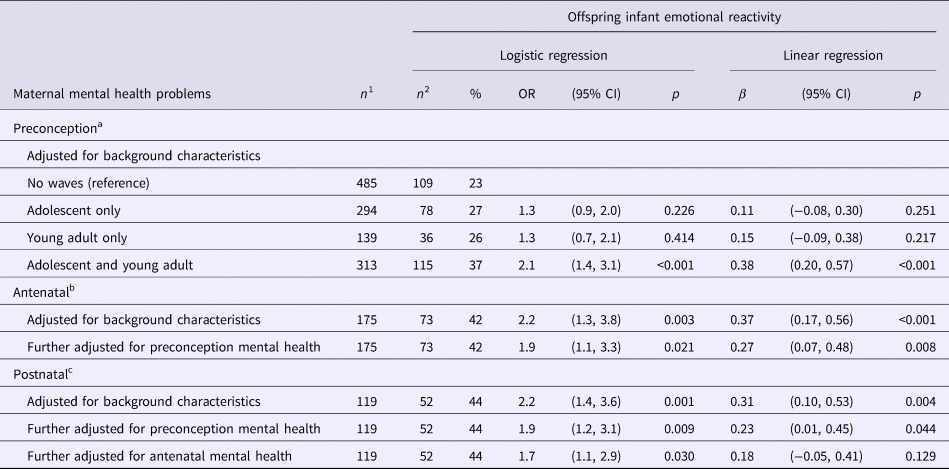
Table 2 shows estimated associations of preconception, antenatal and postnatal maternal mental health problems with offspring infant reactivity. The estimated proportion of infants with heightened reactivity was higher in infants of mothers with both adolescent and young adult mental health problems than in infants of those without [37% (31–44) v. 23% (19–27)]. After adjusting for background demographic characteristics and cohort, preconception maternal mental health problems that persisted across adolescence and young adulthood predicted a twofold increase in the odds of heightened infant reactivity [adjusted OR 2.1 (1.4–3.1)], compared with those with no preconception mental health problems. Similarly, in linear regression analyses, we found a mean difference in infant reactivity scores of 0.38 standard deviations between offspring of mothers with persistent preconception mental health problems and those with no preconception mental health problems. Maternal mental health problems antenatally and at 1 year postpartum were similarly associated with offspring infant reactivity, but the magnitude of these perinatal associations reduced somewhat after adjustment for prior exposure. Available case analyses of the combined cohorts yielded a similar pattern of results (Appendix p 5). In online Supplementary analyses we repeated these analyses in each cohort (Appendix pp 6–7). Preconception, antenatal and postpartum effects were evident in both cohorts. Postpartum effects were somewhat weaker in VIHCS linear models than ATPG3 linear models, but consistent across cohorts in the logistic models. In fully adjusted models, cohort was not associated with infant reactivity.
Estimated adjusted associations of preconception and perinatal maternal mental health problems with infant emotional reactivity, in combined data (N = 1231 infants of 756 women)

n 1 = number exposed; n 2 = number with exposure and outcome. Frequency estimates were calculated from imputed percentage estimates and total number of infants. Heightened infant reactivity at 1 year of age defined as unstandardised STST reactivity mean score ⩾4. Linear regression estimates are presented as standardised mean score differences.
a Background characteristics: cohort, mother's parents high school completion and divorce, mother's high school completion, and mother's adolescent smoking.
b Background characteristics: cohort, mother's parents high school completion and divorce, mother's high school completion, mother's adolescent smoking, mother's history of separation and divorce, periconceptional smoking, perinatal poverty, and parity.
c Background characteristics: cohort, mother's parents high school completion and divorce, mother's high school completion, mother's adolescent smoking, mother's history of separation and divorce, periconceptional smoking, perinatal poverty, parity, infant preterm birth, and low birthweight.
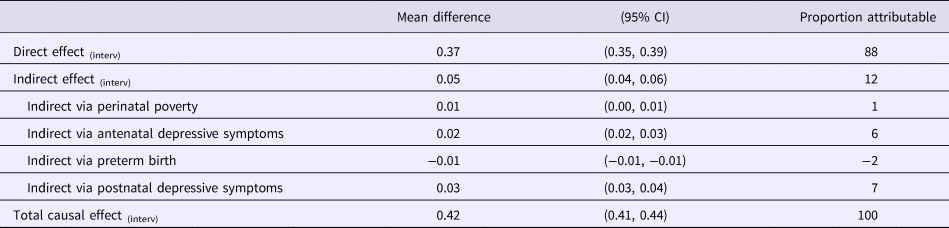
Table 3 shows the results of the mediation analysis as depicted in Fig. 1, examining the extent to which associations between persistent preconception mental health problems and offspring infant reactivity are mediated by antenatal or postnatal exposure. The marginally-adjusted total effect of persistent maternal preconception mental disorder on offspring infant reactivity was 0.42 of a standard deviation (0.41–0.44). Of this, around 1% was mediated by poverty alone. A further 6% was mediated by antenatal depression and not depression at 1 year postpartum, and 7% was mediated by depression at 1 year postpartum. The percentage mediated by preterm birth and not postpartum depression was −2%, slightly reducing the overall mediated effect size via an opposite pathway. The remaining 88% of the total effect was a direct effect of persistent maternal preconception mental health problems on offspring infant reactivity; not mediated by perinatal poverty, preterm birth, or maternal depressive symptoms antenatally or at 1 year postpartum.
Estimated direct and indirect pathways from persistent preconception maternal mental health problems to offspring infant emotional reactivity at 1 year of age, after adjusting for baseline and intermediate confounding, in combined data (N = 1231 infants of 756 women)

Marginally adjusted linear regression estimates are presented as standardised mean score differences. Proportion attributable was calculated as a percentage of the total effect. Persistent preconception maternal mental health problems defined as the presence of mental health problems during both adolescence and young adulthood. Model adjusted for baseline confounders (cohort, mother's parents high school completion and divorce, mother's high school completion, and mother's history of separation/divorce). The postnatal estimate includes an effect via the mediator's interdependence [see Vansteelandt and Daniel (Reference Vansteelandt and Daniel2017)] which was very small in this study.
Discussion
Mothers with persistent mental health problems before pregnancy had twice the odds of having an infant with high emotional reactivity. This effect was robust across two independent samples, and is similar in size to the effects found for antenatal and postnatal maternal depressive symptoms, in this and prior studies (Davis et al., Reference Davis, Snidman, Wadhwa, Glynn, Schetter and Sandman2004; Huot et al., Reference Huot, Brennan, Stowe, Plotsky and Walker2004; Davis et al., Reference Davis, Glynn, Schetter, Hobel, Chicz-Demet and Sandman2007). Despite strong continuities between maternal preconception and perinatal mental health, the effects of preconception maternal mental health problems on offspring infant reactivity were, for the most part, not mediated through greater offspring exposure to maternal depressive symptoms during pregnancy or postpartum. Furthermore, at least part of the associations between perinatal depression and infant emotional reactivity are accounted for by preconception exposure. Infants of mothers with preconception mental health problems may have greater emotional reactivity due to greater exposure during pregnancy and after birth but also through risk processes well before the recognition of the pregnancy.
Associations between both antenatal and postnatal maternal depressive symptoms and heightened infant reactivity are consistent with prior work. However, a finding of a similar-sized and largely direct effect of exposure to persisting maternal mental health problems prior to pregnancy is new. We cannot exclude confounding by genetic susceptibility (Luciano et al., Reference Luciano, Hagenaars, Davies, Hill, Clarke, Shirali, Harris, Marioni, Liewald and Fawns-Ritchie2018), though ‘children of twin’ studies indicate that independent links between parent depressive symptoms and offspring internalising or externalising problems persist after accounting for genetic transmission (McAdams et al., Reference McAdams, Rijsdijk, Neiderhiser, Narusyte, Shaw, Natsuaki, Spotts, Ganiban, Reiss and Leve2015). We have considered a range of baseline confounders related to family background, as well as those that might confound the relationship with mediators including perinatal household poverty and infant prematurity. It nevertheless remains possible that other unmeasured contextual factors have confounded the observed associations. These may include stressful life events, family violence or other childhood trauma, caregiver and peer relationship quality, or perceived social support (Stein et al., Reference Stein, Pearson, Goodman, Rapa, Rahman, McCallum, Howard and Pariante2014; Yehuda and Meaney, Reference Yehuda and Meaney2018).
Potential mechanisms
We considered the possibility that preconception mental health problems might affect offspring infant reactivity through the persistence of maternal symptoms into the antenatal and postnatal periods (Meaney and Szyf, Reference Meaney and Szyf2005). However, preconception exposure effects on infant reactivity were largely direct, with mediation through antenatal and postnatal processes relatively small. Although it is possible that a failure to fully identify maternal antenatal and postnatal mental health problems has led to an underestimation of mediation effects, depressive symptoms are the commonest perinatal mental health problem and prevalence at each timepoint in our study was consistent with previous meta-analyses in high-income countries (Woody et al., Reference Woody, Ferrari, Siskind, Whiteford and Harris2017).
It is also possible that chronic preconception mental health problems might have an enduring effect on maternal endocrine and immune-inflammatory physiology, affecting the fetal environment even when mothers report few perinatal depressive symptoms (Moog et al., Reference Moog, Entringer, Rasmussen, Styner, Gilmore, Kathmann, Heim, Wadhwa and Buss2018). One recent study linked maternal abuse in childhood to increased placental hormone production during later pregnancies, providing preliminary evidence that maternal stress before conception may influence offspring neurodevelopment through changes to the in utero environment (Moog et al., Reference Moog, Buss, Entringer, Shahbaba, Gillen, Hobel and Wadhwa2016). We assessed antenatal maternal depressive symptoms in the third trimester and may not have captured periconceptional exposure including during embryogenesis and implantation, both sensitive to environmental influence including maternal stress (Ord et al., Reference Ord, Fazeli and Watt2017). Brain regions integral to stress response regulation and susceptible to excess exposure to maternal hormones are identifiable by eight weeks gestation (Gunnar and Davis, Reference Gunnar, Davis, Rubenstein and Rakic2013). Similarly, preconception mental health problems may also be linked to infant emotional reactivity through increased risk of other exposures during pregnancy and postpartum, including health-related behaviours such as maternal substance use or diet, or social factors such as perceived social support, maternal attachment style, partner relationship quality and conflict, or family violence (Howard et al., Reference Howard, Molyneaux, Dennis, Rochat, Stein and Milgrom2014).
A final possibility is that persistent maternal mental health problems prior to pregnancy might directly affect the maternal germline with persisting effects on offspring stress response and reactivity (Chan et al., Reference Chan, Nugent and Bale2018). The epigenetic profile of gamete DNA can be altered by parental exposure to stress (Klengel et al., Reference Klengel, Dias and Ressler2015) but until recently these alterations were thought to be completely erased during embryonic development. There is now evidence that some epigenetic marks persist after fertilisation (Klengel et al., Reference Klengel, Dias and Ressler2015). Animal data support the intergenerational transfer of stress-related behaviours through epigenetic modifications to the paternal germline (Klengel et al., Reference Klengel, Dias and Ressler2015). Though studies of maternal germline transmission are limited, evidence is emerging that stress reactivity traits may also be maternally transmitted by epigenetic modifications to methylation of gamete genes associated with altered stress response (Mitchell et al., Reference Mitchell, Klein, Argyropoulos, Sharma, Chan, Toth, Barboza, Bavley, Bortolozzi and Chen2016). Non-epigenetic gametic alterations, such as the accumulation of metabolites and proteins in oocyte cytoplasm, may also influence fetal development and offspring phenotype (Kovalchuk, Reference Kovalchuk2012).
Developmental origins of mental health and disease: a role for preconception influences
Heightened reactivity in response to ante- and postnatal stress may have predictive adaptive utility, altering stress physiology and brain structure to confer survival advantage in environments characterised by scarcity or threat (Gluckman et al., Reference Gluckman, Hanson, Bateson, Beedle, Law, Bhutta, Anokhin, Bougnères, Chandak and Dasgupta2009; Sheriff et al., Reference Sheriff, Bell, Boonstra, Dantzer, Lavergne, McGhee, MacLeod, Winandy, Zimmer and Love2017). For example, evidence suggests that infants exposed to maternal depressive symptoms during only one perinatal timepoint (either pregnancy or postpartum) demonstrate lower mental development at 1 year postpartum compared to infants not exposed at either timepoint or exposed at both timepoints (Sandman et al., Reference Sandman, Davis and Glynn2011). The current study raises the question about whether predictive adaptive responses might arise prior to pregnancy, with longer-term maternal stress prior to conception providing a more stable source of environmental information (Kuzawa and Quinn, Reference Kuzawa and Quinn2009). Yet such adaptations might come at a cost with reactive infants having greater susceptibility to childhood emotional and behavioural problems (Belsky, Reference Belsky, Ellis and Bjorklund2005; Boyce and Ellis, Reference Boyce and Ellis2005; Bylsma et al., Reference Bylsma, Morris and Rottenberg2008; Slagt et al., Reference Slagt, Dubas, Deković and van Aken2016; Hartman and Belsky, Reference Hartman and Belsky2018).
Strengths and limitations
This study drew together data from two rare prospective intergenerational studies, with repeated assessment across adolescence and young adulthood, and during pregnancy and postpartum of the next generation, allowing us to examine the relative contribution of mental health problems at each phase. Combining data allowed us to achieve greater precision estimates via pooled analyses, and to examine the consistency of findings across intergenerational samples. The two studies maintained high retention rates, and 85% and 88% of women with live births during the VIHCS and ATPG3 recruitment phases respectively participated in the intergenerational studies. However, a number of limitations should be noted. First, despite consistency in most measures in VIHCS and ATPG3 (i.e. mediators, outcomes and most covariates), measurement of preconception mental health varied between studies. Nonetheless, the prevalence of preconception mental health problems and demographic characteristics were similar across cohorts; the overall pattern of results was similar in the pooled and within cohort analyses; and adjustment for cohort in the models did not alter effect estimates. Sample loss and related bias are further potential limitations. Aside from the loss of a small number of women with frequent adolescent drinking (VIHCS) or parents born outside Australia (ATPG3), those screened for and participating in each study remained broadly similar to the original and eligible study samples on measured characteristics at baseline. Even so, it is possible that the achieved sample differed on unmeasured confounders with some effect on associations found. There were low levels of missing data at most waves, in both cohorts; however, around one-third of antenatal interviews were missed due to difficulties in detecting eligible pregnancies. We addressed potential biases due to missing data using multiple imputation. We also only included infants born to women aged 29–36 years. This included the median maternal age at birth in Australia and maximised the number of included births, but it remains possible that the risk profiles of older and younger mothers may differ from those in focus in this study.
Finally, infant emotional reactivity was assessed by maternal report and usefully draws on a mother's knowledge of her baby's usual behaviour across contexts, particularly relevant for the study of phenotypic traits such as emotional reactivity (Shiner and Caspi, Reference Shiner and Caspi2003; Bates et al., Reference Bates, Schermerhorn, Petersen, Lewis and Rudolph2014). Maternally reported infant reactivity predicts later child social and emotional problems, with effect sizes similar to studies of independently assessed infant reactivity (Kagan et al., Reference Kagan, Snidman, Zentner and Peterson1999; Sayal et al., Reference Sayal, Heron, Maughan, Rowe and Ramchandani2013). However, maternal report of infant outcomes may be affected by a mother's mental state such that depressed mothers perceive their infant as more reactive (Najman et al., Reference Najman, Williams, Nikles, Spence, Bor, O'Callaghan, Le Brocque, Andersen and Shuttlewood2001; Luoma et al., Reference Luoma, Kaukonen, Mäntymaa, Puura, Tamminen and Salmelin2004). We investigated this possibility by including maternal depressive symptoms at the time of the outcome in our mediation model. The association between preconception maternal mental health and offspring infant emotional reactivity was overwhelmingly independent of maternal depressive symptoms at the time of the outcome, suggesting a minimal role of maternal reporting bias due to concurrent depression. These findings align with previous research indicating that depression-related biases explain only a small proportion of variance in maternally reported child behavioural traits (Goodman et al., Reference Goodman, Rouse, Connell, Broth, Hall and Heyward2011; Rothbart and Bates, Reference Rothbart, Bates, Grotevant, Damon and Eisenberg2006; Bagner et al., Reference Bagner, Pettit, Lewinsohn, Seeley and Jaccard2013).
Conclusion
Maternal mental health problems remain one of the most significant early life risk factors for childhood emotional and behavioural problems. The current findings do not detract from the importance of antenatal and infancy phases as intervention points for both mothers and offspring, to improve mental health outcomes for infants higher in emotional reactivity (Belsky, Reference Belsky, Ellis and Bjorklund2005; Boyce and Ellis, Reference Boyce and Ellis2005; Slagt et al., Reference Slagt, Dubas, Deković and van Aken2016). Indeed, highly reactive children encountering few challenges may have a lower likelihood of externalising problems, and greater prosocial behaviours, school engagement and cognitive competence than low-reactive children (Obradović et al., Reference Obradović, Bush, Stamperdahl, Adler and Boyce2010; Slagt et al., Reference Slagt, Dubas, Deković and van Aken2016). Yet the current study suggests that intervention in the perinatal period alone is unlikely to be sufficient to eliminate risks for the offspring of women with persistent mental health problems prior to pregnancy. It is perhaps one reason why the effects of existing postnatal interventions on maternal depression have been mixed (Poobalan et al., Reference Poobalan, Aucott, Ross, Smith, Helms and Williams2007; Stein et al., Reference Stein, Netsi, Lawrence, Granger, Kempton, Craske, Nickless, Mollison, Stewart and Rapa2018). There is now a need to further explore whether the effects of maternal preconception mental health problems extend to higher rates of emotional and behavioural problems in later childhood, as well as understand the processes whereby preconception exposure leads to heightened infant reactivity. Even so, the current findings suggest that a reorientation of clinical services and public health responses to the years prior to pregnancy is warranted. Current approaches to preconception care, for example, have largely focused on contraception (Patton et al., Reference Patton, Olsson, Skirbekk, Saffery, Wlodek, Azzopardi, Stonawski, Rasmussen, Spry and Francis2018) with little attention to maternal mental health. The growing calls for preconception health care around other aspects of health and health risk (Barker et al., Reference Barker, Dombrowski, Colbourn, Fall, Kriznik, Lawrence, Norris, Ngaiza, Patel, Skordis-Worrall, Sniehotta, Steegers-Theunissen, Vogel, Woods-Townsend and Stephenson2018) should also extend to mental health (Wilson et al., Reference Wilson, Howard, Reynolds, Simonoff and Ismail2018). It is likely that the benefits will extend beyond women themselves to their children's emotional development.
Supplementary material
The supplementary material for this article can be found at https://doi.org/10.1017/S0033291719000709.
Author ORCIDs
Elizabeth Spry, 0000-0003-2837-3514
Acknowledgements
The authors would like to thank the families who have participated in the Victorian Adolescent Health Cohort Study, the Victorian Intergenerational Health Cohort Study, the Australian Temperament Project and the ATP Generation 3 Study for their invaluable contributions, as well as all collaborators and the study teams involved in the data collection and management. Further information on the studies is available at https://www.melbournechildrens.com/vihcs/ and https://www.melbournechildrens.com/atp/ . The VAHCS, VIHCS, ATP and ATPG3 studies are located at The Royal Children's Hospital Melbourne. The ATP and ATPG3 are a collaboration between Deakin University, The University of Melbourne, The Australian Institute of Family Studies, The University of New South Wales, The University of Otago (NZ), and the Royal Children's Hospital. The authors acknowledge all collaborators who have contributed to the Australian Temperament Project, especially Professors Ann Sanson, Margot Prior, Frank Oberklaid, and Dr Diana Smart. This work was supported by the Australian Research Council (DP180102447). Data collection for VIHCS was supported by the National Health and Medical Research Council; Australian Rotary Health; Colonial Foundation; Perpetual Trustees; Financial Markets Foundation for Children (Australia); Royal Children's Hospital Foundation; and the Murdoch Children's Research Institute. Data collection for the ATPG3 was supported by the Australian Research Council. LMH receives salary support for an NIHR Research Professorship in maternal mental health to LMH (NIHR-RP-R3–12-011). LMH is also affiliated with the NIHR Mental Health Biomedical Research Centre at South London and Maudsley NHS Foundation Trust and King's College London. JR is supported by an NHMRC Dementia Research Leader Fellowship (APP1135727). GP is supported by an NHMRC Senior Principle Research Fellowship (APP1117873). Research at the Murdoch Children's Research Institute is supported by the Victorian Government's Operational Infrastructure Program.
Conflict of interest
None.