

Copious research has been conducted on affective teacher variables such as their attitudes, concerns, and efficacy for inclusive practice. This research has been predicated on the common belief that teachers who hold positive attitudes, high efficacy, and low concerns are more effective inclusive educators. But is this true? Research about the relationships between these variables has suffered from two main limitations. First, these affective variables have often been studied in isolation without questioning or studying their actual effects on classroom practice. Second, when practice has been considered in research designs, self-report teacher data about teachers’ practice or intended practice, rather than actual observations of teaching, have often been used to indicate teacher practices. Given the general agreement in the research that the most significant school-based predictor of student achievement is the quality of the teachers (Aaronson, Barrow, & Sander, Reference Aaronson, Barrow and Sander2007; Harris & Sass, Reference Harris and Sass2011), it is imperative that assumptions about the relationships between affective variables and effective, high-quality teaching are tested rather than accepted without appropriate evidence. By combining observational and survey data, we sought to test the hypothesis that affective variables predict teaching behaviours in inclusive classrooms.
Literature Review
Attitudes
Teachers’ attitudes toward inclusion are well researched, and a convergence of evidence has suggested that positive attitudes are associated with both teacher characteristics and environmental characteristics (Ahmmed, Sharma, & Deppeler, Reference Ahmmed, Sharma and Deppeler2012; Alquraini, Reference Alquraini2012; Cook, Reference Cook2002; Humphrey & Symes, Reference Humphrey and Symes2013; Malinen, Savolainen, & Xu, Reference Malinen, Savolainen and Xu2012; Silverman, Reference Silverman2007). Negative attitudes toward inclusion held by teachers (Unianu, Reference Unianu2012) and administrators (Horrocks, White, & Roberts, Reference Horrocks, White and Roberts2008; Sharma & Chow, Reference Sharma and Chow2008) have been shown to constitute the most considerable barrier to successful inclusion. The importance of positive teacher attitudes to the success of children with special learning needs as well as the future of inclusion as a principle has been supported extensively (Cologon, Reference Cologon2012; Malinen et al., Reference Malinen, Savolainen and Xu2012; Rakap & Kaczmarek, Reference Rakap and Kaczmarek2010; Ross-Hill, Reference Ross-Hill2009).
In a seminal piece, Avramidis and Norwich (Reference Avramidis and Norwich2002) conducted a review of the literature about teachers’ attitudes toward inclusion of students with special educational needs. They found that most teachers held positive views of inclusion. However, these attitudes were mitigated by the severity of the special need; inclusion of children with high levels of need was viewed less positively. Furthermore, the provision of physical and human resources to students and teachers fostered positive inclusive attitudes in teachers. Avramidis and Norwich found no relationship between attitudes toward inclusion and teachers’ years of experience.
Research on attitudes toward inclusion has received wide international attention (e.g., England; Humphrey & Symes, Reference Humphrey and Symes2013; Saudi Arabia; Alquraini, Reference Alquraini2012; and Bangladesh; Ahmmed et al., Reference Ahmmed, Sharma and Deppeler2012), perhaps explaining these differences based on cultural variations. Humphrey and Symes (Reference Humphrey and Symes2013) showed that administrators and coordinators for inclusion held more positive attitudes toward inclusion than did classroom teachers. Classroom teachers held the most negative attitudes about children with behavioural or severe special needs, a finding supported by de Boer, Pijl, and Minnaert (Reference de Boer, Pijl and Minnaert2011).
Similarly, Alquraini (Reference Alquraini2012) found that classroom teachers in Saudi Arabia held negative attitudes toward the inclusion of children with severe learning needs. Interestingly, he discovered no relationship between level of training in special education and teachers’ attitudes toward inclusion. This finding replicates those of Brady and Woolfson (Reference Brady and Woolfson2008) but is not supported by the work of many others (Avramidis & Kalyva, Reference Avramidis and Kalyva2007; Boyle, Topping, & Jindal-Snape, Reference Boyle, Topping and Jindal-Snape2013; Horrocks, White, & Roberts, Reference Horrocks, White and Roberts2008; Huang & Wheeler, Reference Huang and Wheeler2007; Koutrouba, Vamvakari, & Steliou, Reference Koutrouba, Vamvakari and Steliou2006) who showed that higher levels of training in special education are associated with more positive attitudes toward inclusion.
One of Alquraini's (Reference Alquraini2012) findings is more consistently supported in the literature: Teachers who have had experience teaching children with special needs generally have more positive attitudes toward inclusion (Ahmmed et al., Reference Ahmmed, Sharma and Deppeler2012; Avramidis & Kalyva, Reference Avramidis and Kalyva2007; Malinen et al., Reference Malinen, Savolainen and Xu2012; Rakap & Kaczmarek, Reference Rakap and Kaczmarek2010). Boyle et al. (Reference Boyle, Topping and Jindal-Snape2013) showed that contact, even in the form of having a friend or family member with special needs, was associated with more positive attitudes toward inclusion, a finding supported by Ahmmed et al. (Reference Ahmmed, Sharma and Deppeler2012).
Teaching efficacy
A second factor that has been investigated is teachers’ efficacy for inclusive teaching. Although the research literature on teacher efficacy for inclusive teaching is relatively small (Forlin, Sharma, & Loreman, Reference Forlin, Sharma and Loreman2014), studies have shown that efficacy for inclusive teaching and attitudes toward inclusion are positively related (Emam & Mohamed, Reference Emam and Mohamed2011; Malinen et al., Reference Malinen, Savolainen and Xu2012; Savolainen, Engelbrecht, Nel, & Malinen, Reference Savolainen, Engelbrecht, Nel and Malinen2012; Weisel & Dror, Reference Weisel and Dror2006).
Researchers such as Tschannen-Moran and Woolfolk Hoy (Reference Tschannen-Moran and Woolfolk Hoy2001), Ross, Cousins, and Gadalla (Reference Ross, Cousins and Gadalla1996), and Raudenbush, Rowen, and Cheong (Reference Raudenbush, Rowen and Cheong1992) have argued that teacher efficacy is not a global construct and that it varies across student groups, contexts, and cultures. That is, a teacher who is efficacious at teaching high school physics may not be equally efficacious at teaching Grade 4 social studies. Tschannen-Moran and Woolfolk Hoy therefore proposed that teacher efficacy should be studied within specific contexts and teaching tasks. Research by other scholars supports this recommendation as good advice insofar as it relates to efficacy for inclusive teaching: Smith (Reference Smith2000) found that teachers with high efficacy in typical classroom situations including children with less severe special needs reported lower efficacy when asked about their efficacy for including students with higher levels of special needs.
Savolainen et al. (Reference Savolainen, Engelbrecht, Nel and Malinen2012) showed that teachers’ perceptions of efficacy can be further differentiated into the different aspects of inclusive teaching. Their study showed that South African teachers believed their self-efficacy in managing behaviour in inclusive settings to be an area of strength, whereas the Finnish teachers in their study demonstrated low efficacy in this area. Sharma, Loreman, and Forlin (Reference Sharma, Loreman and Forlin2012) developed a scale to measure three distinct factors of teacher efficacy for inclusive teaching: efficacy for inclusive teaching practice, efficacy for collaboration, and efficacy in managing behaviour. Subsequent research using this scale has validated these factors as discreet by showing differential scoring across the three components with preservice teachers (Park, Dimitrov, Das, & Gichuru, Reference Park, Dimitrov, Das and Gichuru2014; Sharma & Sokal, Reference Sharma and Sokal2013; Sokal & Sharma, Reference Sokal and Sharma2014) and in-service teachers (Malinen, Savolainen, & Xu, Reference Malinen, Savolainen and Xu2012).
Similar to the findings about attitudes toward inclusion, researchers have investigated both teacher characteristics and environmental characteristics associated with efficacy for inclusive teaching. In a study conducted in Egypt, Emam and Mohamed (Reference Emam and Mohamed2011) found no relationship between teachers’ level of training and their efficacy for inclusive teaching. In contrast, Swedish researchers Engstrand and Roll-Pettersson (Reference Engstrand and Roll-Pettersson2014) showed that knowledge gained through professional development was associated with higher levels of efficacy for teaching in inclusive settings. This supports previous work by Roll-Pettersson (Reference Roll-Pettersson2008).
Humphrey and Symes (Reference Humphrey and Symes2013) found that coordinators and principals in inclusive settings had higher levels of efficacy for inclusive practice than did subject area teachers, suggesting that the employment assignment of an individual may influence his or her efficacy for inclusive practice. Malinen et al. (Reference Malinen, Savolainen, Engelbrecht, Xu, Nel, Nel and Tlade2013) conducted a study with teachers in China, Finland, and South Africa and found that, like positive attitudes, high efficacy for inclusive teaching was predicted by experiences teaching children with special learning needs. They suggested that mastery experiences foster efficacy. Furthermore, they posited that exposure to inclusive practices do no automatically produce high efficacy in teachers. Rather, these teachers must have had positive experiences in inclusive settings where they learned to overcome obstacles. This finding may explain the findings of Humphrey and Symes, in that individuals who are promoted to supervisory roles in inclusive settings are more likely to have had positive mastery experiences while teaching in inclusive settings and are more likely therefore to have higher efficacy for inclusive practice.
Wertheim and Leyser (Reference Wertheim and Leyser2002) suggested that perceived weaknesses in teaching efficacy can be addressed through practice with specific teaching strategies for effective inclusion. Malinen et al. (Reference Malinen, Savolainen, Engelbrecht, Xu, Nel, Nel and Tlade2013) supported their proposal that these experiences should be key components of teaching development programs. Forlin et al. (Reference Forlin, Sharma and Loreman2014) showed that when these types of experiences are included as part of teacher education coursework, they can increase teacher efficacy for managing behaviours in inclusive settings, and have a larger effect on female teachers than on male teachers. They further found that having information about relevant policies and legislation positively affected teachers’ efficacy for inclusive teaching.
Concerns
A third affective variable that has received research attention of late is teachers’ concerns about inclusion, although this research base is very sparse compared to those of the other two variables (attitudes and teaching efficacy) under consideration. Both preservice and inservice teachers have concerns about inclusion, mainly related to a lack of time or resources necessary to ensure inclusion is successfully implemented (Forlin & Chambers, Reference Forlin and Chambers2011; Horne & Timmons, Reference Horne and Timmons2009). Other common concerns expressed by teachers relate to their perceptions that they were unprepared to effectively address student behaviours in inclusive settings (Forlin & Cooper, Reference Forlin and Cooper2013). Forlin and Cooper (Reference Forlin and Cooper2013) showed that teachers’ concerns with student behaviours in inclusive classrooms resulted in the teachers feeling high levels of stress, including headaches, depression, and fatigue, as well as feeling helpless, embarrassed, frustrated, and guilty. Furthermore, Forlin et al. (Reference Forlin, Sharma and Loreman2014) showed that concerns and teacher efficacy for inclusive practice were related: as teachers’ concerns declined, their efficacy increased.
Teaching practice
Several researchers have examined the relationship between the affective variables of teacher attitudes, efficacy, and concerns about inclusive teaching and have determined that these variables are correlated. Positive relationships between teachers’ attitudes and efficacy have been found (Savolainen et al., Reference Savolainen, Engelbrecht, Nel and Malinen2012). The results of research undertaken by Soodak, Podell, and Lehman (Reference Soodak, Podell and Lehman1998) and Weisel and Dror (Reference Weisel and Dror2006) suggested that teachers’ efficacy for inclusive teaching is the main predictor of their attitudes toward inclusion. Sharma and Sokal (Reference Sharma and Sokal2013) examined all three variables together and found that preservice teacher education in Canada and Australia differentially affected the variables as well as their relationships.
Although some researchers have looked at these three affective variables together, there is a paucity of research that connects these variables alone or in combination to actual inclusive teaching behaviours. The relationships between affective variables and behaviours have been examined, but not teacher behaviours per se (for examples, see Dueck, Reference Dueck2003; Hwang & Evans, Reference Hwang and Evans2013; Killoran, Woronko, & Zaretsky, Reference Killoran, Woronko and Zaretsky2014; Wertheim & Leyser, Reference Wertheim and Leyser2002). Instead, the authors of these studies collected self-report data on teachers’ perceptions of their own behaviours or preservice teachers’ intentions to do certain behaviours rather than collecting data on teachers’ actual teaching behaviours. This may be an artefact of the high cost and time commitment required for observational research when compared to survey research, or it may reflect a reluctance on the part of teachers to be observed in their classrooms. In either case, in order to enhance our understanding about the relationships between affective variables such as attitudes toward inclusion and actual teaching practice, observational research designs are required.
Several research studies stand out from the body of literature in terms of their use of observational designs to study inclusive teaching practices. Jordan, Schwartz, and McGhie-Richmond (Reference Jordan, Schwartz and McGhie-Richmond2009) conducted a research study using multiple data collection methods. They undertook half-day observations of teachers teaching core subjects in their inclusive classrooms. They found that teachers who viewed teaching students with disabilities as part of their job (and thus were likely to have positive attitudes toward inclusion) were more effective with all their students, including the students in their classes who had special learning needs.
In a similarly strong but somewhat dated study, Stanovich and Jordan (Reference Stanovich and Jordan1998) examined the attitudes, efficacy, and beliefs about inclusion in both teachers and administrators and then considered their relationship with observed teaching practices in inclusive classrooms. Observations took at least 3 hours, included at least one class in a core subject area, and were conducted by a group of video-trained graduate students. They found that administrators’ beliefs about the origins of learning challenges as either ‘pathognomonic’ (attributable to an entity within the child) or ‘interventionist’ (a result of the relationship between the child and his or her learning environment) affected teachers’ classroom behaviours. That is, teachers whose administrators believed that all children can learn and that teachers must find the best way to teach each child employed teachers who used more effective teaching practices with all their students. Similarly, teachers who held beliefs in the ‘interventionist’ model of learning needs also had more effective teaching practices than those with ‘pathognomonic’ orientations. It is noteworthy that neither teachers’ attitudes toward inclusion nor efficacy for inclusive practices were significantly correlated with effective teaching practices in inclusive classrooms. The authors discussed the limitations of using surveys to measure affective variables in abstract ways as compared to using interview data that grounds the attitudes and efficacy within applied contexts.
Aim of the Study
This research was undertaken with the intent to fill in gaps in our understanding about how teachers’ affective variables relate to their inclusive teaching practices. More specifically, the key aim of this research was to find out if significant relationships existed between participants’ self-reported scores on attitudes toward inclusion, concerns about inclusion, and efficacy for teaching in inclusive classrooms with the inclusive practices they employed.
Method
Research Design
A cross-sectional survey and observational study design was used to conduct the research. In this design, data are collected at one point in time and the relationship between different variables is examined to make inferences about possible relationships (Creswell, Reference Creswell2003). In the current project, relationships among four variables (i.e., attitudes, concerns, efficacy, and teaching practices) were examined.
Participants
Participants for the study were practising teachers. The data collected for this study were part of a larger dataset of 131 practising teachers from a mid-sized Canadian city (Sokal & Sharma, Reference Sokal and Sharma2014). The participants of the larger study (Sokal & Sharma, Reference Sokal and Sharma2014) filled out online surveys that measured attitudes, concerns, and efficacy for inclusive teaching. They were invited to provide contact information if they were interested in participating in the observational portion of the study. Seven teachers submitted their information and were contacted to arrange the observations. After hearing the description of the work, five teachers agreed to participate in the observational portion of the study.
The participants included five general education classroom teachers (four female and one male), who were all employed full time in the public schools. All of these teachers were mature, with an age range between 40 and 49 years for all the female teachers, and an age of over 50 years for the male teacher. Three of the teachers (one male and two females) had completed an additional year of post-baccalaureate study beyond their teaching degree, and the other two held only baccalaureate degrees in education. All had undertaken one- or two-day special education workshops as part of their divisional professional development activities, although only one of the teachers with a post-baccalaureate held a certificate in special education. The women had been teaching for 6, 11, 20, and 22 years, and the man had been teaching for 9 years. Given that all but one of the teachers had graduated from their undergraduate Bachelor of Education programs before compulsory courses on special education were mandated, only the female teacher with 6 years of experience had taken 60 contact hours of coursework in programming for children with special learning needs. She also held a post-baccalaureate certificate in education.
One teacher taught Grades 1–3, three taught middle years classes (Grades 5–8) and one was a physical education teacher (Grades 4–9). All of these classes comprised fewer than 30 children.
The physical education teacher was observed teaching two different classes: one class of Grade 1 and 2 children; and one class of Grades 5, 6, 7, and 8 children. Their teacher described this small (under 20 students) Grade 1–2 class as having high energy, and having low levels of social and physical functional skills for their age. Two of the children had Level 2 funding, indicating that they had qualified through a competitive process to have an educational assistant (EA) with them at least half the time, or to share an EA with another Level 2 student on a full-time basis to support their learning. There was therefore one EA in attendance during the observations. This class comprised children who resided in the inner city and experienced the challenges of poverty.
Likewise, the Grade 5–8 physical education class attended the same school. Their teacher described the class as having many children with age-appropriate academic, social, and physical skills. This class included five children with special needs funding, including four children at Level 2 and one child at Level 3 who required, and qualified for, a one-on-one EA on a full-time basis. There were therefore three EAs in attendance during the observations.
Female teachers taught all three of the other middle-years classes. One class included no funded children, another included one student with Level 2 funding, and the third included two children with Level 2 funding. Thus, the latter two classrooms had EAs in attendance for at least part of each day. The class with no funded children included several children with social issues.
The final classroom was a group of under 20 Grade 2 students taught by a female teacher. This teacher is the teacher who had undertaken undergraduate coursework in special education and held a post-baccalaureate certificate in special education. Although none of the children were funded, some of the children in this class had attention issues and communication issues.
Instrumentation
A five-part questionnaire was used to collect data. The first section was designed to obtain general demographic information about each participant. The second section consisted of the Teachers’ Attitudes Toward Inclusion Scale (TATIS), designed by Bailey (Reference Bailey2004). The third section consisted of the Concerns about Inclusive Education Scale (CIES; Sharma & Desai, Reference Sharma and Desai2002). The fourth section consisted of the Teachers’ Efficacy in Implementing Inclusive Practices scale (TEIP; Sharma et al., Reference Sharma, Loreman and Forlin2012). In order to observe classroom practices, a new observations scale was developed for the current project.
Demographic information
Data gathered in the first part asked respondents to report their age, gender, highest educational qualification obtained, knowledge of local education acts and policies related to children with disabilities, and the level of confidence in teaching students with disabilities.
Teachers’ Attitudes Toward Inclusion Scale (TATIS; Bailey, Reference Bailey2004)
Part two of the questionnaire consisted of the TATIS, which contains 24 items. It measures an individual's attitude toward inclusion in five key areas: (a) Teacher Workload and Management, (b) Inclusion Benefits and Level of Disability, (c) Learning Challenges in Inclusive Education, (d) Excluded Students, and (e) Professional Training. Respondents were asked to indicate their degree of agreement with a number of statements using a 5-point Likert scale (1 = strongly disagree, 2 = disagree, 3 = neither agree nor disagree, 4 = agree, and 5 = strongly agree). The TATIS has been validated using factor analysis (Bailey, Reference Bailey2004) and has a high level of reliability (α = .91). In addition to yielding a total factor score, the TATIS also yields scores for five subscales. Alpha reliability scores for all five were high (above 0.74) except for Factor 5 (0.52).
Concerns about Inclusive Education Scale (CIES; Sharma & Desai, Reference Sharma and Desai2002)
The CIES is a 21-item questionnaire that measures educators’ concerns about implementing inclusive education. Respondents can indicate their level of concerns about inclusion using a 4-point Likert scale (4 = extremely concerned, 3 = very concerned, 2 = a little concerned, and 1 = not at all concerned). The scale yields a total score, the value of which can range from 21 to 84. A higher score on the scale is indicative of a higher degree of concerns about teaching in inclusive classrooms.
Factor analysis of the CIES was undertaken on an Indian sample by Sharma and Desai (Reference Sharma and Desai2002). It revealed that CIES consists of four factors: (a) Concern About Resources, (b) Concern About Acceptance, (c) Concern About Academic Standards, and (d) Concern About Workload. The reliability of the factors was calculated using alpha scores, and they all were found to be adequate (above 0.70). The internal consistency of the total scale was also adequate (alpha = 0.91).
Teachers’ Efficacy in Implementing Inclusive Practices (TEIP; Sharma et al., Reference Sharma, Loreman and Forlin2012)
The TEIP is an 18-item questionnaire that measures one's efficacy to teach in inclusive classrooms. Respondents can indicate the degree to which they agree or disagree with a number of statements using a 6-point Likert scale (1 = strongly disagree, 2 = disagree, 3 = disagree somewhat, 4 = agree somewhat, 5 = agree, and 6 = strongly agree). For example, ‘I am confident in designing learning tasks so that the individual needs of students with disabilities are accommodated’. Factor analysis of the TEIP was conducted by Sharma et al. (Reference Sharma, Loreman and Forlin2012) on a large sample of educators from four countries (Australia, Canada, Hong Kong, and Indonesia). It revealed three factors: (a) Efficacy to use Inclusive Instruction, (b) Efficacy in Collaboration, and (c) Efficacy in Managing Behaviour. The TEIP yields a total score, the value of which can range from 18 to 108. A higher score on the TEIP is indicative of a higher level of teaching efficacy to teach in inclusive classrooms. The scale has been found to be reliable across different countries. The alpha scores in the validation study ranged from 0.86 and 0.91 in all four countries (Sharma et al., Reference Sharma, Loreman and Forlin2012). The internal consistency of each factor was also found to be adequate, and it ranged between 0.64 and 0.97 across all countries studied.
Inclusive Practices Classroom Observation Scale (IPCOS)
A classroom observation scale, the IPCOS, was developed for this study (see Appendix). In order to develop the scale, literature on inclusive education was reviewed to identify practices employed by effective inclusive teachers (e.g., Avramidis & Norwich, Reference Avramidis and Norwich2002; Jordan et al., Reference Jordan, Schwartz and McGhie-Richmond2009; Sharma et al., Reference Sharma, Loreman and Forlin2012; Soodak et al., Reference Soodak, Podell and Lehman1998; Wertheim & Leyser, Reference Wertheim and Leyser2002). The items that were selected to be incorporated in the scale were in line with the current philosophy of inclusion. A total of 45 items were then drafted to capture inclusive education practice. Each item started with a stem ‘The teacher . . .’, which was followed by an observable behaviour. Examples of three observable behaviours in the scale are as follows: ‘plans instruction to address the strengths of students’, ‘relates learning activities to students’ personal and family experiences’, and ‘uses a variety of instructional strategies within the learning activity to engage all students’.
Five anchors were written to allow for the observation of teaching behaviour. These were: always (4), frequently (3), sometimes (2), and infrequently (1). In addition, another anchor, not observed (0), was added. This draft scale was sent to an expert panel for refinement. The panel consisted of seven academics who are involved in teaching inclusive education courses at university level and who have widely published within the area of inclusive education. The panel was asked to review items and report if any item was redundant or if any important item was missing. The panel was also asked to review directions provided to observers for undertaking the observations. The panel made several useful recommendations. For example, the panel identified 10 items that could be deleted from the scale. The panel also asked to reword a number of items that further improved their clarity. The newly developed 35-item revised scale was used for data collection. A higher score on the scale was indicative of a teacher using more inclusive practices compared to a teacher who obtained a lower score on the scale.
To facilitate use of the scale, brief training was provided to five research assistants (RAs). RAs were selected based on excellent performance in a class on inclusive education; on personal attributes, such as dependability, attention to detail, communication, and reliability; and on having experience with children with special learning needs. Initial training lasted 3 hours. A YouTube video of a classroom was shown to the RAs, and they were asked to rate the teacher in the video using the IPCOS. There were a few items where the observers rated the teacher differently. The most common discrepancies were noted in the rating of a particular teaching practice as always and frequently. In order to increase agreement between observers, they were told to rate a behaviour as ‘always’ if the teacher could not have shown the behaviour any better than what was observed. Also, observers were provided explicit criterion for each of the observation categories. For example, a behaviour could be rated as ‘infrequent’ when ‘the teacher demonstrates no or little implementation of the specified behaviour when opportunities are present’. After the initial video training, other videos were used to verify that the observers consistently rated the teachers in the new videos with levels at or above 80% interrater agreement.
Prior to the interviews and observations in the schools, the University of Winnipeg Research Ethics Board reviewed the project. The project met all the standards of research conducted with human beings, as outlined in the Tri-Council Policy Statement on Ethical Conduct for Research involving Humans (Research Ethics Panel, 2014), the national standards in Canada. As required by this policy document, all RAs took part in a 4-hour tutorial and received certification prior to embarking on any data collection.
Classroom Observations
Observational visits were scheduled ahead of time, and the teachers were aware they would be observed. Pairs of RAs independently observed each teacher five times for at least 30 minutes each visit. Lessons ranged from 30 minutes to 50 minutes. The project funding and scheduling of school breaks allowed for each teacher to be observed for five lessons. Lessons varied in length, resulting in the longest total observation being 5 hours and the shortest being just over 4 hours. Visits to the teachers began with a short interview, which was audiotaped using Echo® Smartpens, which produced both audio and print versions of the interview data. Teachers were asked about the intentions of the lesson, what outcomes they would measure, and if there were any special student considerations that influenced their plans. The RAs then sat separately at the back of the classes and independently observed the lessons. The RAs did not discuss their scores with one another. The teachers used strategies such as cooperative learning, hands-on centres, group work, The Respecting Diversity program (Katz & Porath, Reference Katz and Porath2011), levelled reading, and differentiated instruction and assessment.
After the lessons, the teachers were again interviewed to determine whether they perceived the lessons as going as they planned and whether they believed the outcomes had been met. These data were not used in the analyses but were collected to provide context for understanding what teaching and class activities were observed by the two RAs at each visit. Interobserver reliability between Observation 1 to Observation 4 ranged from 78 to 86%. There were three items that reduced the reliability between observers significantly. These items were 27, 28, and 29. A close examination of items suggested that the behaviours identified in the items were difficult to observe (e.g., Collaborates with team mates to support learning; Regularly shares information and/or best practices with colleagues to improve practice; Engages with families to share information and strategies to enhance student learning) in a typical classroom. In future, these items should be removed from the scale for observing inclusive education practices.
Results
Prior to undertaking analysis to determine if significant correlations existed between teachers’ affective variables (attitudes, concerns, and teaching efficacy) and their inclusive teaching practices, mean scores for the participants on different scales were calculated. Participants’ inclusive teaching practices mean score was 3.16, suggesting that teachers were using inclusive teaching practices extensively. Participants’ attitudes mean score was 3.72. Participants’ concerns mean scores on three factors were lower than 1.68 (Acceptance, M = 1.56; Workload, M = 1.68; Academic Standards, M = 1.52) but higher for Resources (M = 2.33). Their overall mean concern score was 1.80, suggesting that participants were not very concerned about including students with disabilities in their classrooms. A mean of 2 on the concern scale suggests ‘a little concern’ about including students with disabilities in regular classrooms, with higher scores indicating greater concern. Participants’ mean efficacy scores were high. Their total mean score on the TEIP was 5.07. The mean value of the TEIP score can range from 1 to 6, with higher scores indicating higher levels of teaching efficacy. The participants’ mean scores on three factors of the TEIP, Efficacy in Managing Behaviour, Efficacy to use Inclusive Instruction, and Efficacy in Collaboration, were 5.07, 5.43, and 4.70, respectively.
Due to the small sample size (N = 5), Spearman rho correlations were computed to get a preliminary idea regarding the relationships among the different variables in the study. Spearman rho correlation coefficient (rs) denotes the strength of the monotonic relationship between the paired data, and it does not assume normality in distribution as a prerequisite.
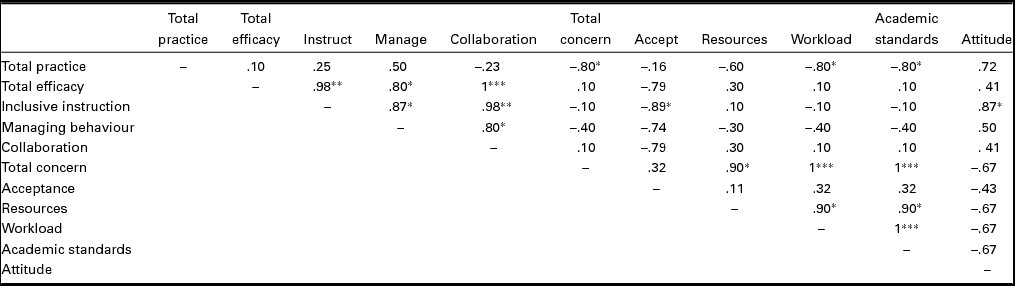
Table 1 provides a summary of the results of nonparametric correlations among teachers’ self-efficacy for implementing inclusive practices, concerns regarding inclusive education, their attitudes toward inclusive education, and teachers’ inclusive practices in the classroom.
Spearman Rho Correlations Among Teachers’ Self-Efficacy for Implementing Inclusive Practices, Concerns about Inclusive Practices, Attitudes Toward Inclusive Practices, and Their Inclusive Practices in the Classroom

Note. N = 5.
*p < .05. **p < .005. ***p < .001 (sig. one-tailed).
A positive relationship between teachers’ self-efficacy for implementing inclusive practices and observed inclusive practices in the classroom was noted. Similarly, while the correlation between teachers’ attitudes toward inclusion and inclusive practices was positive, a negative correlation between their practices and concerns for inclusive practices was observed.
Of the 55 correlation coefficients (rs) computed, 17 were statistically significant at p < .05 level (sig. one-tailed). Considering the association between teachers’ self-efficacy for implementing inclusive practices in classrooms and their inclusive practices in the classroom, it was observed that none of the correlations were statistically significant. Although teachers’ self-efficacy in managing behaviour was positively and moderately correlated with their inclusive classroom practices, as observed and assessed using IPCOS (rs = .50), explaining 25% of variance in their classroom practices, it could not reach statistical significance (p = .196). Interestingly, a weak negative correlation was observed between teachers’ efficacy in collaboration and observed classroom practices, although it was not significant statistically (rs = –.23, p = .358).
There was a strong negative correlation between teachers’ total score on the CIES scale (rs = –.80, p < .05) and their teaching practice, suggesting that the more the teachers were concerned about the inclusive education, the less likely they used inclusive practices in the classroom. By analysing the correlations between each of the four subscales under teachers’ CIES and their classroom practices, it was identified that teachers’ concerns regarding academic standard (rs = –.80, p < .05) and workload (rs = –.80, p < .05) were strongly but negatively correlated with their classroom practices. Although teachers’ concerns regarding resources were moderately correlated with their classroom practices (rs = –.60, p = .400), the correlations were not statistically significant.
Teachers’ attitudes toward inclusive education were found to be strongly and positively (rs = .72) associated with their classroom practices, explaining 52% of variance in teachers’ classroom practices, but the correlation coefficient could not reach statistical significance (p = .086).
Discussion
This study was undertaken to investigate whether significant relationships exist between the teachers’ actual classroom practices and three self-reported constructs (attitudes, concerns, and teaching efficacy). A few of the study's limitations are important to note before discussing the results of the study. Observational data could be collected from only five teachers due to time limitations and the cost involved in undertaking observations. We sent invitations to a large number of teachers (n = 131) for classroom observations but only five agreed to be observed. It is possible that teachers who agreed to classroom observations were those who were using inclusive practices. This may have reduced the variability in scores on self-reported constructs (attitude, concerns, and efficacy) and classroom practices. A larger and randomly selected sample of teachers would have been ideal for this kind of study.
The other limitation relates to the statistical methods employed in the study. As correlation coefficients are affected by sample size and stringent alpha levels (Yarkoni, Reference Yarkoni2009), the results should be interpreted with utmost care. Mindful of the limitation in terms of the low number of participants (N = 5) and, in turn, the power of the statistical tests performed, we acknowledge that there is a possibility of inflated correlations between the variables and Type II error. However, having identified the positive relationships of teachers’ inclusive practices in the classroom with their self-efficacy for implementing inclusive practices and attitudes toward inclusion, as well as the negative relationship between their inclusive practices and concerns toward inclusion, we strongly recommend further studies with a larger sample to arrive at more authentic and valid conclusions regarding the interrelationships among the variables of the study.
Despite these limitations, the current study revealed some interesting results. A number of researchers in the past have emphasised the need to determine educators’ attitudes, concerns, and their level of teaching efficacy, as it is believed that these constructs could influence teachers’ actual behaviour (Forlin & Cooper, Reference Forlin and Cooper2013; Forlin et al., Reference Forlin, Sharma and Loreman2014). However, there is very little research that has looked at teachers’ actual classroom behaviour and how these constructs (attitude, efficacy, and concerns) influence their teaching practice. The reason for a lack of research could be difficulty in recruiting teachers who are willing to be observed, the time and cost involved in undertaking the observations, and the lack of tools to make observations of inclusive classroom practices. In the current research, we have attempted to address some of these gaps.
The tool that was developed to support classroom observations in this study was found to be useful. The tool attempts to capture a range of classroom practices employed by effective inclusive teachers. Although used in the current study by outside observers, teachers can also use the tool to self-evaluate their practices to determine how inclusive they are in their teaching. Furthermore, data on a large sample of teachers is needed to further establish the tool's validity and reliability.
In terms of the research question, the current research demonstrated relationships between classroom practices and teachers’ affective variables in the direction that is consistent with past research. Past researchers have found that teachers who hold positive views about students with disabilities tend to use more effective practices (Jordan et al., Reference Jordan, Schwartz and McGhie-Richmond2009). Our research showed a similar positive relationship, albeit not statistically significant, with regard to teachers’ attitudes to inclusion and their classroom practices. The relationships between teaching efficacy scores and actual classroom practices of teachers were non-conclusive. Weak correlations were found to exist between these two variables. The results in this respect are consistent with Stanovich and Jordan (Reference Stanovich and Jordan1998), who also found that teaching efficacy scores were not correlated with effective teaching scores. We recommend interpreting the results of our study with caution, as the data were collected from a very small sample of teachers. Also, most teachers were already using inclusive practices and had high levels of teaching efficacy (M = 5.07), which may have reduced the likelihood of finding significant correlations (due to limited variability in efficacy and teaching practices scores).
The most interesting results in this research were found in relation to teachers’ concern scores and their inclusive teaching practices. Significant negative correlations were found to exist between teachers’ concern scores and their teaching practices. The results were significant for total mean scores and factor mean scores on two subscales (concern about workload and concern about academic standards). The findings suggested that teachers who have a lower degree of concerns tend to use effective inclusive teaching practices or vice versa. Interestingly, teachers who were using effective inclusive practices were significantly less concerned about an increase in their workload and about declining academic standards in their classrooms. It is clearly suggested that teachers who use effective inclusive teaching practices know that teaching in inclusive classrooms does not result in extra work when compared with teaching in any other classroom. It is also evident from their lower level of concerns about academic standards that teachers who use inclusive practices perceive the positive effects of such practices on all students, including those who do not have a disability. It may be possible that such beliefs develop as a result of teachers noticing that inclusive practices help both students with and without disabilities. Rather than a decline in academic standards, most students (with and without disabilities) do well both academically and socially in inclusive classrooms (Ruijs & Peetsma, Reference Ruijs and Peetsma2009).
This finding has significant implications for researchers, school leaders, and policymakers. Policies and legislation both internationally and nationally have emphasised the need for teachers to include students with disabilities alongside their peers without disabilities. As a result of these policies, a large number of students with disabilities are being enrolled in regular schools, but it is not yet clear if these students receive high-quality education when they are included in the regular classroom. On the basis of this study's results, we suggest that such students are likely to get high-quality education in the classrooms of teachers who have lower degrees of concerns about inclusion. Policymakers and school leaders should make an attempt to understand what concerns educators about teaching in inclusive classrooms and address their concerns. This goal can be accomplished by providing custom-made professional development programs targeting teachers’ concerns in school. It is possible that this approach will reduce teacher concerns and motivate teachers to use inclusive practices.
Conclusion
Research studies about the affective teacher variables associated with inclusion are interesting in their own right, but they lack utility unless they are clearly tied to actions that result in effective education for students with special needs. In effect, unless we can tie these variables to teacher and student effects, we can not be sure of their value in supporting students in inclusive settings. In the past, the research designs evident in the literature have not, with a few exceptions, investigated the relationships between affective variables and observed behaviours. Despite the limitations of the current study, specifically those related to sample size, two significant steps of progress have been made. First, we developed an observation scale of inclusive teaching practices that, if adopted by other researchers, will allow further verification of the measure while at the same time making observations of inclusive teaching practices more accessible and efficient. Second, we have made a small but tentative step in verifying that positive attitudes and lower concern levels are associated with more effective inclusive teaching practices. The lack of findings between teacher efficacy for inclusive teaching and their actual teaching practices is interesting, and will require further study with a larger, more diverse sample to tease out the underlying mechanisms that could explain this relationship.
APPENDIX
Inclusive Practices Classroom Observation Scale (IPCOS)
The scale is designed to determine how often an individual teacher employs inclusive classroom practices. It is ideal to observe the same teacher on a number of different occasions (3–5) on different days.
Directions for observations. Please rate each item based on how often the behaviour was observed using one of the four ratings of always, frequently, sometimes, and infrequently. It is possible that one or more of the behaviours may not be observed during the observations. You can interview the teacher before and after the observation and write your comments based on what the teacher indicates. Do not rate the particular item based on the comments made by the teacher regarding what he or she intended to do but rather rate it only based on what you observe in the class. You should also write comments about each item regarding any important observation you have made in the class to support your rating for a specific item.
Additional Notes
RA name:
Please indicate which teacher is being observed by writing his/her initials:
Please indicate which school is being observed by writing its initials:
Grade________Number of students_______
Date of observation:
Time of start and stop of observation:
Additional comments: