





1. Introduction
Learning a second language (L2) influences speech perception for the third (L3) and additional (Ln) languages at the initial stage (e.g., Cabrelli Amaro & Wrembel, Reference Cabrelli Amaro and Wrembel2016; Onishi, Reference Onishi2016; Qin & Jongman, Reference Qin and Jongman2016). However, the mechanism through which L2 learning influences L3/Ln speech perception remains unclear. Previous studies have suggested that L2 learning drives listeners to adopt L2 cue weighting strategies, thereby enhancing L2 speech perception (e.g., Levy & Strange, Reference Levy and Strange2008; Tsukada & Han, Reference Tsukada and Han2019; Zou et al., Reference Zou, Chen and Caspers2017). We hypothesized that L2 learning influences L3 speech perception by orienting listeners to adopt L2 cue weighting strategies. We also hypothesized that cognitive load would modulate the effect of L2 learning on L3 speech perception by altering L2 cue weighting.
1.1. The effect of L2 learning on L2 and L3/Ln speech perception
Growing evidence suggests that L2 speech perception generally improves as L2 learning progresses (e.g., Levy & Strange, Reference Levy and Strange2008; Tsukada & Han, Reference Tsukada and Han2019; Zou et al., Reference Zou, Chen and Caspers2017). For example, Levy and Strange (Reference Levy and Strange2008) compared L1-English L2-French speakers and L1-English speakers without L2-French learning experience on L2-French vowel discrimination. Relative to L1-English speakers, L1-English L2-French speakers discriminated L2 French vowels more accurately. Similar findings were reported in L2-Mandarin tone perception by L1-Dutch L2-Mandarin and L1-Korean L2-Mandarin speakers (Tsukada & Han, Reference Tsukada and Han2019; Zou et al., Reference Zou, Chen and Caspers2017). While the degree to which L2 speech perception improves differs depending on L2 sound contrast (Perceptual Assimilation Model: Best, Reference Best and Strange1995; Best & Tyler, Reference Best and Tyler2007; So & Best, Reference So and Best2010; Speech Learning Model: Flege, Reference Flege and Strange1995; Flege et al., Reference Flege, Aoyama, Bohn and Wayland2021), the overall improvement observable in L2 speech perception shows that listeners can adapt and adjust speech processing strategies in the face of new phonetic differences.
Interestingly, although L1 influence is well established in shaping learners’ L3/Ln speech perception (Rothman, Reference Rothman2015), L2 learning also appears to influence L3/Ln speech perception (e.g., Onishi, Reference Onishi2016; Qin et al., Reference Qin, Lee-Kim and Qi2024; Qin & Jongman, Reference Qin and Jongman2016; Wiener & Goss, Reference Wiener and Goss2019). For instance, L1-English speakers who have learned L2 Mandarin discriminate L3 Cantonese tone contrasts more accurately than L1-English speakers without Mandarin experience (Qin & Jongman, Reference Qin and Jongman2016). Likewise, L1-English speakers with experience in L2 Mandarin outperform those without such experience in discriminating L3 Japanese pitch accent (Wiener & Goss, Reference Wiener and Goss2019). In a within-subjects study on L1-Korean L2-English L3-Japanese speakers, L2-English minimal pair identification was significantly correlated with L3 Japanese speech identification and discrimination across eight consonant and vowel contrasts (Onishi, Reference Onishi2016). This suggests that the adaptive changes learners make in the perception of L2 sounds can also be recruited in the speech perception of other languages. Examples cited above suggest that such benefits are the most visible for phonetic features in the L2 that are not employed to signal phonological contrasts in the first language (L1). But the exact mechanisms that underlie the effects of L2 learning on L3/Ln speech perception remain poorly understood.
1.2. Cue weighting in speech perception
One potential mechanism underlying the effect of L2 learning on L3/Ln speech perception is cue weighting. Cue weighting in native speech perception is shaped by long-term linguistic experience (e.g., Holt & Lotto, Reference Holt and Lotto2006; Ingvalson et al., Reference Ingvalson, Holt and McClelland2012; Iverson et al., Reference Iverson, Kuhl, Akahane-Yamada, Diesch, Kettermann and Siebert2003). Native listeners direct their attention to acoustic cues that are more informative for identifying L1 linguistic categories (Holt & Lotto, Reference Holt and Lotto2006). English listeners, for instance, rely more on voice onset time (VOT) than onset pitch for distinguishing English initial consonant voicing (/b/ vs. /p/) (Francis et al., Reference Francis, Kaganovich and Driscoll-Huber2008b).
Cross-linguistic evidence shows that cue weighting in L2 speech perception is shaped by L1 experience (Chrabaszcz et al., Reference Chrabaszcz, Winn, Lin and Idsardi2014; Ingvalson et al., Reference Ingvalson, Holt and McClelland2012; Iverson et al., Reference Iverson, Kuhl, Akahane-Yamada, Diesch, Kettermann and Siebert2003). For example, Dutch speakers, who rely more on pitch cues than English speakers in identifying word boundaries in native words, place greater weight on pitch rise than English speakers in L2 French word-final boundary perception (Tremblay et al., Reference Tremblay, Broersma and Coughlin2018). Similarly, the second formant (F2) is a more important cue than the third formant (F3) among Japanese speakers (Iverson et al., Reference Iverson, Kuhl, Akahane-Yamada, Diesch, Kettermann and Siebert2003). Consequently, unlike L1-English speakers, L1 Japanese speakers place more focus on F2 than on F3 in perceiving the English /ɹ/-/l/ contrast (Ingvalson et al., Reference Ingvalson, Holt and McClelland2012; Iverson et al., Reference Iverson, Kuhl, Akahane-Yamada, Diesch, Kettermann and Siebert2003).
Importantly, cue weighting is also adaptive in the context of L2 learning (Chandrasekaran et al., Reference Chandrasekaran, Sampath and Wong2010; Tremblay et al., Reference Tremblay, Broersma, Zeng, Kim, Lee and Shin2021; Wiener, Reference Wiener2017). For example, whereas monolingual L1 English speakers usually place greater weight on pitch height than pitch direction in perceiving pitch patterns, L1-English L2-Mandarin speakers are able to shift their perceptual weight to pitch direction, approximating the pattern observed in L1-Mandarin listeners (Chandrasekaran et al., Reference Chandrasekaran, Sampath and Wong2010; Wiener, Reference Wiener2017). Similarly, Dutch weighs vowel quality less and pitch more than English (Tremblay et al., Reference Tremblay, Broersma, Zeng, Kim, Lee and Shin2021). As a result, L1-Dutch L2-English listeners place more weight on vowel quality as their L2-English proficiency increases (Tremblay et al., Reference Tremblay, Broersma, Zeng, Kim, Lee and Shin2021). Together, these findings suggest that L2 learning can facilitate the adoption of target-like cue-weighting strategies in L2 speech perception, especially when L2-relevant cues are weighted more heavily in the L1.
While L3/Ln speech perception may benefit from L2 learning, particularly when the L2 phonetic features do not signal phonological contrast in the L1 (e.g., Qin & Jongman, Reference Qin and Jongman2016), it remains unclear whether cue weighting can adequately account for L2 influence on L3/Ln speech perception. Moreover, it is still unknown whether this mechanism is contingent on a low cognitive load.
1.3. The role of cognitive load in speech perception
Cognitive load refers to the amount of cognitive resource required for completing the task (Antoniou & Wong, Reference Antoniou and Wong2015). It has been shown not only to modulate the influence of L2 learning in L2 speech perception but also to alter cue-weighting strategies in non-native speech perception (Asano, Reference Asano2018; Freeman et al., Reference Freeman, Blumenfeld, Carlson and Marian2022; Kong & Lee, Reference Kong and Lee2018). However, it remains unclear whether cognitive load similarly modulates the influence of L2 learning on L3/Ln speech perception through cue-weighting adjustments.
Previous studies have demonstrated that cognitive load modulates the influence of L2 learning in L2 speech perception (Asano, Reference Asano2018; Freeman et al., Reference Freeman, Blumenfeld, Carlson and Marian2022; Parlato-Oliveira et al., Reference Parlato-Oliveira, Christophe, Hirose and Dupoux2010). Specifically, increased cognitive load might require more cognitive resources to process task-relevant and task-irrelevant information, thereby reducing the resources available to access L2 knowledge stored in long-term memory (Asano, Reference Asano2018; Freeman et al., Reference Freeman, Blumenfeld, Carlson and Marian2022; Parlato-Oliveira et al., Reference Parlato-Oliveira, Christophe, Hirose and Dupoux2010). For example, in a high-cognitive-load L2 sequence recall task, L1-Japanese L2-Portuguese listeners could not apply their L2 phonological knowledge but relied on their L1 phonological knowledge (Parlato-Oliveira et al., Reference Parlato-Oliveira, Christophe, Hirose and Dupoux2010). In contrast, listeners could apply both L1 and L2 phonological knowledge in a low-cognitive-load L2 vowel identification task. Similarly, Freeman et al. (Reference Freeman, Blumenfeld, Carlson and Marian2022) demonstrated that L1-Spanish L2-English speakers could not apply L2 phonological knowledge during L2 processing in high-cognitive-load tasks involving metalinguistic processing, such as vowel detection and lexical decision. However, L2 phonological knowledge was observed in the AX word discrimination task, which required comparatively lower cognitive loads.
In addition, cognitive load has been shown to influence cue weighting in speech perception (Gordon et al., Reference Gordon, Eberhardt and Rueckl1993; Kong & Lee, Reference Kong and Lee2018). Cue weighting relies on attentional control and is thus vulnerable under conditions of high cognitive load. In Kong and Lee’s (Reference Kong and Lee2018) study, for instance, L1-Korean listeners placed less reliance on VOT – the primary acoustic cue for distinguishing Korean laryngeal stops – when performing an identification task that included a distractor. This shift in cue weighting resulted in different cue weighting patterns compared with the task without a distractor.
Empirically, cognitive load is often manipulated by memory load (e.g., Chen et al., Reference Chen, Antoniou and Best2022; Wayland & Guion, Reference Wayland and Guion2004; Werker & Logan, Reference Werker and Logan1985) and talker variability (e.g., Antoniou & Wong, Reference Antoniou and Wong2015; Choi, Reference Choi2022; Choi et al., Reference Choi, Yu, Chan and Lai2025; Tamati & Pisoni, Reference Tamati and Pisoni2014). Memory load is defined as the waiting period before participants are allowed to make their final judgments (Chen et al., Reference Chen, Antoniou and Best2022). In discrimination tasks, memory load can be manipulated by inter-stimulus interval (ISI) (Wayland & Guion, Reference Wayland and Guion2004; Werker & Logan, Reference Werker and Logan1985). With a relatively short ISI (500 ms), listeners can rely on the phonetic details of the stimuli to discriminate sound contrasts, since listeners can use their short-term memory to retain decaying memory for a relatively short period (Baddeley & Wilson, Reference Baddeley and Wilson2002). However, with a relatively long ISI (1500 ms), the phonetic details may gradually decay from working memory, making it more difficult for listeners to utilize them to discriminate sound contrasts (Wayland & Guion, Reference Wayland and Guion2004; Werker & Logan, Reference Werker and Logan1985).
For talker variability in speech perception tasks, listeners must adjust to differences across speakers for acoustic-to-phonetic mapping, which requires additional processing costs (Mullennix et al., Reference Mullennix, Pisoni and Martin1989; see a review of Luthra, Reference Luthra2024). Empirical evidence has suggested that processing talker variability increases cognitive loads, which may hinder speech perception (Antoniou & Wong, Reference Antoniou and Wong2015; Choi et al., Reference Choi, Yu, Chan and Lai2025). Listeners with poorer pitch perception demonstrate poorer multitalker pitch contour perception (Antoniou & Wong, Reference Antoniou and Wong2015). Additionally, non-native listeners find multitalker perception more challenging than native listeners (Tamati & Pisoni, Reference Tamati and Pisoni2014). In short, both memory load and talker variability can be utilized to manipulate the cognitive load in perceptual tasks.
1.4. L2 proficiency: A proxy for L2 learning
In previous studies, L2 learning has been measured through a range of variables including course level, length of residence, onset age of acquisition, frequency of exposure and language proficiency (for a review, see Tremblay, Reference Tremblay2011). In the present study, our main interest was the overall level of acquired knowledge and skills in the L2, rather than the length or amount of exposure, which may result in varied learning outcomes. Therefore, we operationalized L2 learning as language proficiency rather than experience-based measures.
L2 proficiency refers to L2 learners’ global and comprehensive linguistic skills and competencies in L2 speaking and understanding (e.g., Gaillard & Tremblay, Reference Gaillard and Tremblay2016; Hulstijn, Reference Hulstijn2011, Reference Hulstijn2012; Tracy-Ventura et al., Reference Tracy-Ventura, McManus, Norris, Ortega, Leclercq, Leclercq, Edmonds and Hilton2014). It reflects learners’ capacity to utilize fundamental linguistic units, including phonetic, prosodic, phonological, lexical and grammatical units, in the L2 (Hulstijn, Reference Hulstijn2011, Reference Hulstijn2012). During L2 speech speaking and understanding, proficiency relates to rapid parallel processing of these units (Hulstijn, Reference Hulstijn2011). Thus, L2 proficiency can be regarded as an index of overall L2 learning outcomes.
1.5. Current study
Our study aims to investigate whether L2 learning alters cue weighting strategies, thereby improving speech perception in an L3 or Ln with typological similarity. We propose two hypotheses. The first hypothesis posits that L2 learning influences L3/Ln speech perception by altering cue weighting strategies. The second hypothesis proposes that cognitive load would modulate this L2 effect by adjusting cue weighting in L3/Ln speech perception.
To examine the effect of L2 learning on L3/Ln speech perception, we tested speakers whose L1 was non-tonal but who had acquired a tonal L2. This design ensured that tone, as a linguistic structure, was present in the L2 but absent from the L1. Previous studies have shown that speakers of non-tonal languages who have learned a tonal L2 demonstrate better tone perception than those without such experience (Wayland & Guion, Reference Wayland and Guion2004). This advantage does not imply that the non-tonal L1 exerts no influence on non-native tone perception; rather, it suggests that these learners process tone differently. Although non-tonal L1 speakers can attend to acoustic cues such as pitch height and pitch direction when perceiving non-native tones (Francis et al., Reference Francis, Clocca, Ma and Fenn2008a; Gandour, Reference Gandour1983), they tend to process tones at a prosodic level – relying on intonation and stress patterns – rather than categorically, as tonal speakers do through their L1 tone system (Hallé et al., Reference Hallé, Chang and Best2004). This difference in the level of linguistic information accessed may explain why non-tonal speakers perceive non-native tones differently from tonal speakers (Hallé et al., Reference Hallé, Chang and Best2004; Qin et al., Reference Qin, Lee-Kim and Qi2024; Schaefer & Darcy, Reference Schaefer and Darcy2014). Building on this rationale, the present study investigates whether tonal L2 proficiency influences non-tonal speakers’ L3/Ln tone perception, thereby clarifying the role of tonal L2 learning in this process.
Our study investigated L1 speakers of Urdu/Hindi who had learned Cantonese as an L2 in Hong Kong. Cantonese is a tonal language with six different lexical tones: High level tone [T55], high rising tone [T25], mid-level tone [T33], low falling tone [T21], low rising tone [T23] and low level tone [T22] (Bauer & Benedict, Reference Bauer and Benedict1997; Chao, Reference Chao1947). The numbers in the square brackets for each tone represent the pitch level at the onset and offset, with 1 corresponding to the lowest level of the speaker’s pitch range and 5 to the highest (Chao, Reference Chao1930, Reference Chao1947). Urdu and Hindi exhibit lexical stress and phrase-level intonation but lack lexical tones, and are therefore classified as non-tonal languages (Hussain, Reference Hussain1997; Nair, Reference Nair1999). Typologically, they differ from tonal languages such as Cantonese. Previous research has shown that Urdu/Hindi speakers tend to assimilate L2 Cantonese tones into their L1 intonational and stress patterns, particularly rising contour patterns, which indicates L1 influence on tone processing (Yao et al., Reference Yao, Chan, Fung, Wu, Leung, Lee and Luo2020; Yu et al., Reference Yu, Lee, Lan and Mok2022). However, their tone perception accuracy has consistently been found to be lower than that of native Cantonese speakers (Yu et al., Reference Yu, Lee, Lan and Mok2022). Based on this evidence, we expect that L1 Urdu/Hindi speakers would improve their perception of novel tones as their L2 Cantonese proficiency advances.
To investigate the earliest stage of L3/Ln tone perception, we created a novel tone system as a proxy for an L3/Ln tone inventory. This design enabled us to examine learners’ L3/Ln tone perception upon first exposure, prior to any learning effects. It also allowed for controlled manipulation of tone type complexity while minimizing lexical confounds present in natural languages. This approach aligns with established practices in multilingualism research, which often employ artificial languages to examine early stages of L3/Ln acquisition (Grey, Reference Grey, Cabrelli, Chaouch-Orozco, Alonso, Soares, Puig-Mayenco and Rothman2023). In this study, the novel tone inventory was designed with pitch patterns distinct from those in Cantonese. To capture L3/Ln tone perception in a naturalistic manner (Liu et al., Reference Liu, Lai, Singh, Kalashnikova, Wong, Kasisopa, Chen, Onsuwan and Burnham2022), we included a range of tone types – level, rising, falling, peaking and dipping – rather than relying on orthogonal manipulation.
To evaluate the overall attainment of Urdu/Hindi speakers in L2 Cantonese learning, we used the Elicited Imitation Task (EIT) for Cantonese (Yu & Choi, Reference Yu and Choi2024). The EIT has been widely recognized as a reliable and effective tool for assessing language proficiency (Kostromitina & Plonsky, Reference Kostromitina and Plonsky2022). Research has suggested that the EIT can effectively assess both native and non-native linguistic abilities (Meir et al., Reference Meir, Walters and Armon-Lotem2016). To examine listeners’ novel tone perception, we included three perception tasks: two ABX novel tone discrimination tasks (i.e., ABX Tasks 1 and 2) and a novel tone identification task. ABX Tasks 1 and 2 differed in cognitive load, so that they could tap into the effect of cognitive load. Our research questions were as follows.
-
1. Does L2 Cantonese proficiency predict L1-Urdu/Hindi speakers’ novel tone discrimination and identification?
-
2. Is L2 Cantonese proficiency related to listeners’ cue weighting for novel tones?
-
3. Does cognitive load modulate the impact of L2 Cantonese proficiency on novel tone discrimination?
-
4. Does cognitive load modulate the impact of L2 Cantonese proficiency on cue weighting for novel tones?
2. Methods
2.1. Participants
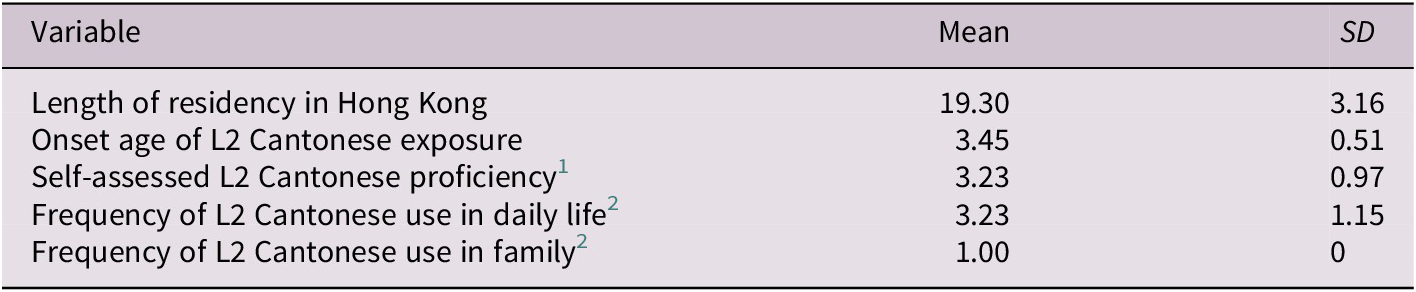
Twenty-two native Urdu/Hindi speakers (17 females, 5 males) participated in the current study. The inclusion criteria for participants were: (a) they were aged 18–35 years old; (b) they were raised in Urdu/Hindi-speaking households, and spoke Urdu/Hindi as their L1 and their dominant language, with parents who primarily used Urdu/Hindi at home; (c) they had no or very limited prior tone language experience except Cantonese, and spoke Cantonese as their L2; (d) they had no formal music training and (e) they had no hearing, speech or cognitive deficits. The participants in our study had a mean age of 20.00 years old (SD = 1.54 years) and an average length of residency in Hong Kong of 19.30 years (SD = 3.16 years). All participants gave informed consent and completed a questionnaire about their language and music backgrounds. Additionally, participants self-reported that their onset age of Cantonese exposure was 3.45 years old (SD = 0.51 years), approximately corresponding to the age they started kindergarten. Participants self-assessed their L2 Cantonese proficiency using a five-point Likert scale (1 = unable to understand or speak any words; 5 = able to understand everything and speak fluently in all situations) (Choi et al., Reference Choi, Tong, Gu, Tong and Wong2017; Choi & Chan, Reference Choi and Chan2025; Yu & Choi, Reference Yu and Choi2026), with a mean proficiency score of 3.23 (SD = 0.97). To control for potential effects of formal instruction on speech perception, we did not include Urdu/Hindi speakers who had attended formal Cantonese courses. All participants reported that they had not received any formal Cantonese training (see Table 1 for summary statistics).
Descriptive statistics of participants’ L2 Cantonese background

Table 1. Long description
The table consists of three columns: Variable, Mean, and S D.
* Length of residency in Hong Kong: Mean 19.30, S D 3.16.
* Onset age of L 2 Cantonese exposure: Mean 3.45, S D 0.51.
* Self-assessed L 2 Cantonese proficiency: Mean 3.23, S D 0.97. This is measured on a scale where 1 equals unable to understand or speak any words and 5 equals able to understand everything and speak fluently in all situations.
* Frequency of L 2 Cantonese use in daily life: Mean 3.23, S D 1.15. This is measured on a scale where 1 equals never and 5 equals always.
* Frequency of L 2 Cantonese use in family: Mean 1.00, S D 0. This is also measured on a scale where 1 equals never and 5 equals always.
1 1 = unable to understand or speak any words; 5 = able to understand everything and speak fluently in all situations.
2 1 = never; 5 = always.
2.2. Stimuli
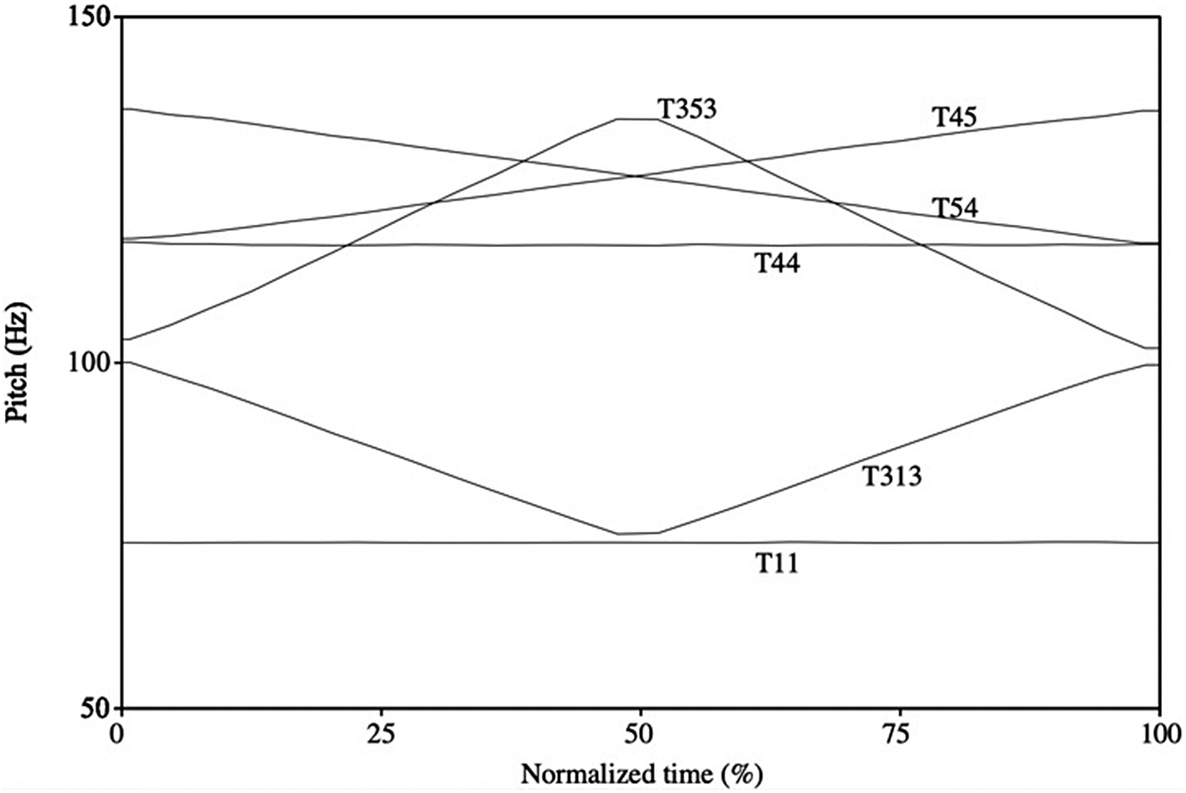
In this study, we used a novel tone system for tone perception. The tone system consisted of six distinctive tones that do not exist in the Cantonese tone system. Using Chao’s five-point scale for tone transcription (Chao, Reference Chao1930), the six novel tones can be described as Tone 11, Tone 44, Tone 45, Tone 54, Tone 313 and Tone 353 (see Figure 1). Two CV syllables, /phu/ and /ti/, were employed to carry the six tones. These syllables are phonologically legal in Urdu/Hindi and Cantonese. The stimuli were generated by manipulating the natural production of three native young Cantonese-speaking adults (two females and one male). The procedure for tone generation was as follows.
Pitch extractions of actual tonal stimuli produced by a male speaker.

Three Cantonese speakers produced each of the carrier syllables with the six Cantonese tones. Each speaker recorded the 12 combinations (2 syllables × 6 tones) seven times each. From these, a native Cantonese-speaking linguist selected two tokens per syllable-tone combination of each Cantonese speaker, using the token selection criterion outlined in Liu et al. (Reference Liu, Lai, Singh, Kalashnikova, Wong, Kasisopa, Chen, Onsuwan and Burnham2022). After that, two native Cantonese-speaking linguists blindly matched the selected tokens to the corresponding Cantonese tones, and the token with the highest match was selected for each syllable-tone combination. The purpose of this process was to create a full set of tones per speaker to identify the maximum and minimum F0 for each speaker.
These values were used to create the final stimuli by manipulating the high-level [T55] tokens produced by the speakers. The F0 values for the five pitch levels were calculated using the inverse transformation of the formula F′0 = [log10 (X/L)/log10 (H/L)] × 4 + 1, where H refers to the highest F0 value, L refers to the lowest F0 value and X denotes the points on a given pitch contour at the five pitch levels (Peng & Wang, Reference Peng and Wang2005).
The Pitch Synchronous Overlap and Add method in Praat (Boersma & Weenink, Reference Boersma and Weenink2013) was used to manipulate the F0 contours of the six selected tokens linearly through the voiced portion, resulting in 36 novel tone tokens (6 novel tones × 2 syllables × 3 speakers). Naturalness of the final stimuli was confirmed by six native speakers of Cantonese. Each token was approximately 450 ms in duration and normalized to 70 dB.Footnote 1
2.3. Tasks
The experiment was conducted in a sound booth. Participants completed the Cantonese EIT, two ABX tone discrimination tasks and a tone identification task. Participants completed the ABX discrimination tasks before the tone identification task. The stimuli of all tasks were presented on a Dell laptop computer via headphones (Sennheiser HD 280 PRO).
2.3.1. Cantonese elicited imitation task (Cantonese EIT)
The Cantonese EIT (Yu & Choi, Reference Yu and Choi2024) used in this study consisted of 30 sentences adapted from the Mandarin EIT of Wu and Ortega (Reference Wu and Ortega2013), which was based on the English EIT of Ortega et al. (Reference Ortega, Iwashita, Norris and Rabie2002). This task has been validated for assessing L2 Cantonese proficiency in the research setting (Yu & Choi, Reference Yu and Choi2024). While maintaining the content of the Mandarin EIT and the sentence lengths of the English EIT (i.e., increasing from 7 to 19 syllables), the Cantonese EIT included Cantonese-specific function words to ensure naturalness in Cantonese. Additionally, six sentences were used for a practice session before testing. The sentences were read by a female native speaker of Hong Kong Cantonese and were presented using E-Prime 3.0. Each sentence was played once, followed by a 3-second pause and a pure tone (Gaillard & Tremblay, Reference Gaillard and Tremblay2016). On each trial, participants were required to repeat the sentence after the pure tone, and the audio was recorded using a SHURE SM58 dynamic vocal microphone. The task was self-paced. Participants were instructed to press the space bar after repeating each sentence and press it a second time to proceed to the subsequent trial. The average task completion time was 14.25 minutes (SD = 2.23 minutes). To demonstrate the reliability of the Cantonese EIT in our study, we conducted Pearson correlations between L2 learning variables (self-assessed L2 Cantonese proficiency, frequency of L2 Cantonese use) and EIT scores. Results revealed a strong correlation between self-assessed L2 Cantonese proficiency and EIT score, r = .77, p < .001, and a moderately strong correlation between frequency of L2 Cantonese use and EIT score, r = .64, p < .01.
The scoring rubric for the Cantonese EIT was adopted from Ortega et al. (Reference Ortega, Iwashita, Norris and Rabie2002) (see Supplementary Table S1). It has a total score of 120. Two native Cantonese speakers rated 18% of the EIT data, with an agreement of .84 as assessed by Cohen’s Kappa. One of the raters scored the remaining data. Any disagreements were addressed via discussion by the two raters.
Our participants showed a wide range of L2 Cantonese proficiency, with an average score of 68.59 (SD = 27.95, range = 7–109). We computed the item means and the discrimination indices to explore how well the Cantonese EIT can differentiate between higher and lower Cantonese proficiency learners. Following the procedures described in Gaillard and Tremblay (Reference Gaillard and Tremblay2016), we first computed the mean score for each EIT item from upper- and lower-third learners. Then, we subtracted the mean of each EIT item among the upper-third learners from the mean of each EIT item among the lower-third learners. Subsequently, the variances were divided by four (i.e., the maximum score of each EIT item). Table 2 summarizes the means and discrimination indices among upper- and lower-third groups. Overall, the Cantonese EIT items showed strong discrimination between the upper- and lower-third Cantonese learners, with the discrimination indices being .51.
Summary of item means and discrimination indices for the Cantonese EIT among upper- and lower-third Cantonese learners

Table 2. Long description
The table consists of three columns: Category, Mean (S D), and Range.
* Item mean E I T scores for top third learners (n = 7): Mean of 3.29 with a standard deviation of 0.51; Range of 2.43 to 4.00.
* Item mean E I T scores for lower third learners (n = 7): Mean of 1.23 with a standard deviation of 0.90; Range of 0.14 to 3.29.
* Discrimination indices: Mean of .51 with a standard deviation of 0.16; Range of .18 to .79.
2.3.2. ABX tone discrimination tasks
The ABX tone discrimination tasks employed the stimuli carrying six novel tones. The tasks required participants to indicate whether the first (A) or the second (B) stimulus matched the third one (X) by pressing the key ‘f’ (X = A) or the ‘j’ (X = B) on a computer keyboard as quickly and accurately as possible. Fifteen tone contrasts with four combinations (ABA, ABB, BAB, BAA) were presented equally in the tasks. Two versions of the ABX were administered: ABX Task 1 and ABX Task 2. In Task 1, we used the tokens of one native Cantonese female speaker for A, B and X on all trials, with an ISI set to 500 ms. In Task 2, we employed the tokens of three native Cantonese speakers for A, B and X within each trial, with an ISI set to 1500 ms so as to diminish the echoic memory trace of the former (Werker & Logan, Reference Werker and Logan1985). The ABX sequence in each trial was played once in each task. Each task included six practice trials (6 tones × 1 syllable) and 120 test trials (15 tone contrasts × 2 syllables × 4 combinations) in a randomized order.
2.3.3. Tone identification task
The tone identification task employed the stimuli from two Cantonese speakers (one female and one male). The task consisted of a familiarization session and a test session. In the familiarization session, participants heard a stimulus once and viewed a tone diagram of six visualized novel tones (see Supplementary Figure S1). Participants were required to select an appropriate novel tone by pressing the corresponding key displayed on the tone diagram. After that, feedback on response accuracy and the correct answer was provided. The familiarization session included 18 trials (6 tones × 1 speaker × 3 repetitions). The procedure of the test session was identical to the familiarization session, except that the test session did not provide feedback or the correct answer. The test session comprised 72 trials (6 tones × 2 syllables × 2 speakers × 3 repetitions).
The performance scores of Cantonese EIT served as independent variables, and the performance of the ABX tone discrimination and tone identification served as dependent variables.
2.4. Statistical analysis
We employed the brms package (Bürkner, Reference Bürkner2018) in R (R Core Team, 2020) to fit Bayesian logistic regression models. Bayesian inference was utilized to investigate the effects of the predictors on the dependent variables. Following the established practices of previous studies (Laméris et al., Reference Laméris, Li and Post2023), we interpreted a suggestion of an effect if zero fell outside the 95% Credible Intervals (CrIs), or if zero was within the 95% CrIs but with a relatively high probability of direction (pd). We excluded data with a response time longer than 10 seconds for all tasks (Cooke et al., Reference Cooke, Lecumberri, Scharenborg and Van Dommelen2010), accounting for 1.44% of trials in the ABX discrimination task and 1.89% of trials in the identification task. Participants could respond at any time after the onset of the stimuli in the identification task, and we excluded trials with negative response time (0.38% of all trials).
In accordance with the established procedures (e.g., Gelman et al., Reference Gelman, Simpson and Betancourt2017; Laméris et al., Reference Laméris, Li and Post2023; Vasishth et al., Reference Vasishth, Nicenboim, Beckman, Li and Kong2018), we built the models with a weakly informative prior. All models were run with 3000 iterations (1500 warm-up iterations) and four chains. We also examined multicollinearity for all continuous variables. Variance Inflation Factors of the continuous variables were lower than 2, indicating that the associations between the continuous variables were low. The continuous variables were centered and scaled, and the categorical variables were sum-coded. We conducted model diagnosis by ensuring Rhat values near 1 and visually examining posterior draws with the pp_draws() command. We employed Leave-one-out cross-validation (Vehtari et al., Reference Vehtari, Gelman and Gabry2017) to assess the fit of the models.
We fitted separate mixed-effects models for each of the three perception tasks to explore whether EIT predicted perceptual accuracy. For the two ABX novel tone discrimination tasks, the models included Trial accuracy for each task (coded as 0 versus 1) following a Bernoulli distribution as the dependent variable, and EIT and Tone contrast as fixed factors, including the interaction of the two. In addition, we included a by-subject random intercept with a random slope for tone contrast and a by-item random intercept: Trial_accuracy_ABX ~ EIT * Tone_contrast + (1 + Tone_contrast | Participant) + (1 | Item). The model for the tone identification task contained Trial accuracy (coded as 0 vs 1) following a Bernoulli distribution as the dependent variable, and EIT and tone type as fixed factors, including their interaction. The model also included a by-subject random intercept with a random slope for tone type, and a by-item random intercept: Trial_accuracy_Identification ~ EIT * Tone_type (1 + Tone_type | Participant) + (1 | Item).
To investigate whether cognitive load modulated the predictive effect of EIT on tone discrimination, we constructed a mixed-effects logistic regression model with trial accuracy (coded as 0 vs 1, Bernoulli distribution) on novel tone discrimination across both ABX tasks as the dependent variable. Fixed factors included ABX_Task, EIT and Tone contrast, along with two-way interactions between ABX_Task and EIT. We included a by-subject random intercept with random slopes for ABX_Task and tone contrast, and a by-item random intercept: Trial_accuracy ~ EIT * ABX_Task + Tone_contrast + (1 + ABX_Task + Tone_contrast | Participant) + (1 | Item).
We ran multiple comparisons using the emmeans package (Lenth, Reference Lenth2022) if an interaction effect was suggested. If zero fell outside the 95% Highest Posterior Density, then a meaningful difference was suggested.
3. Results
3.1. Novel tone perception
3.1.1. ABX Task 1
EIT (b = 1.23 [0.41, 2.06]) had a positive effect on the overall accuracy of tone discrimination for ABX Task 1 (see Supplementary Table S2). Post-hoc comparisons indicated that EIT predicted four tone contrasts in ABX Task 1 (see Supplementary Table S3 and Figure 2): T11-T353, T44-T45, T45-T313 and T54-T353. These results suggested that these four tone contrasts were greatly affected by EIT in tone discrimination with a short ISI.
Predicted probability of discrimination accuracy for tone contrast and EIT in ABX Task 1.
Note: The bars indicate 95% Crls.

3.1.2. ABX Task 2
EIT (b = 0.97 [0.28, 1.64]) had a positive effect on the overall accuracy of tone discrimination (see Supplementary Table S4). Post-hoc comparisons indicated that EIT predicted six tone contrasts in ABX Task 2 (see Supplementary Table S5 and Figure 3): T11-T45, T11-T313, T11-T353, T44-T353, T45-T353 and T54-T353. These results indicated that these six tone contrasts were greatly affected by EIT in tone discrimination with a long ISI and talker variability.
Predicted probability of discrimination accuracy for tone contrast and EIT in ABX Task 2.
Note: The bars indicate 95% Crls.

3.1.3. Tone identification
EIT (b = 0.67 [−0.01, 1.37], pd = 97.35%) positively affected the overall accuracy (see Supplementary Table S6). Furthermore, post-hoc comparisons suggested that EIT predicted the accuracy of two tone types (see Supplementary Table S7 and Figure 4): T44 and T353. The results showed that these two tone types were positively affected by EIT in tone identification.
Predicted probability of tone identification accuracy for tone type and EIT.
Note: The bars indicate 95% Crls.

3.1.4. Two ABX tasks
The tone discrimination model revealed the effects of EIT (b = 1.26 [0.48, 2.02]) and ABX_Task (b = −0.89 [−1.05, −0.73]) on the overall accuracy of tone discrimination (see Supplementary Table S8). However, there was no effect of the interaction between EIT and ABX_Task (b = −0.32 [−0.85, 0.22]) (see Figure 5). The results indicated that the effect of EIT did not differ across the ABX tasks.
Predicted probability of discrimination accuracy for EIT and two ABX novel tone discrimination tasks.
Note: The bars indicate 95% Crls.

3.2. Cue weighting
To carry out multidimensional scaling (MDS) analyses on individual tone matrices of each participant, we employed the Individual Differences Scaling (INDSCAL) model (Carroll & Chang, Reference Carroll and Chang1970) with the discrimination sensitivity index (d’) as a dissimilarity measure (Liu et al., Reference Liu, Lai, Singh, Kalashnikova, Wong, Kasisopa, Chen, Onsuwan and Burnham2022). The INDSCAL model, a three-way extension of the MDS, was performed utilizing the smacofIndDiff function from the smacof R package (De Leeuw & Mair, Reference De Leeuw and Mair2009). Following common practice from previous studies (e.g., Chandrasekaran et al., Reference Chandrasekaran, Sampath and Wong2010; Gandour, Reference Gandour1983; Liu et al., Reference Liu, Lai, Singh, Kalashnikova, Wong, Kasisopa, Chen, Onsuwan and Burnham2022), we chose a two-dimensional solution representing pitch height and pitch direction. We also visually inspected the two-dimensional plots and checked the interpretability of the two axes. We utilized Kruskal’s stress (Stress-1) to assess the model fitness (Kruskal & Wish, Reference Kruskal and Wish1978). We employed randomstress() to establish baseline comparisons (Mair et al., Reference Mair, de Leeuw and Groenen2015) and found that the models for the ABX tasks demonstrated a good fit.
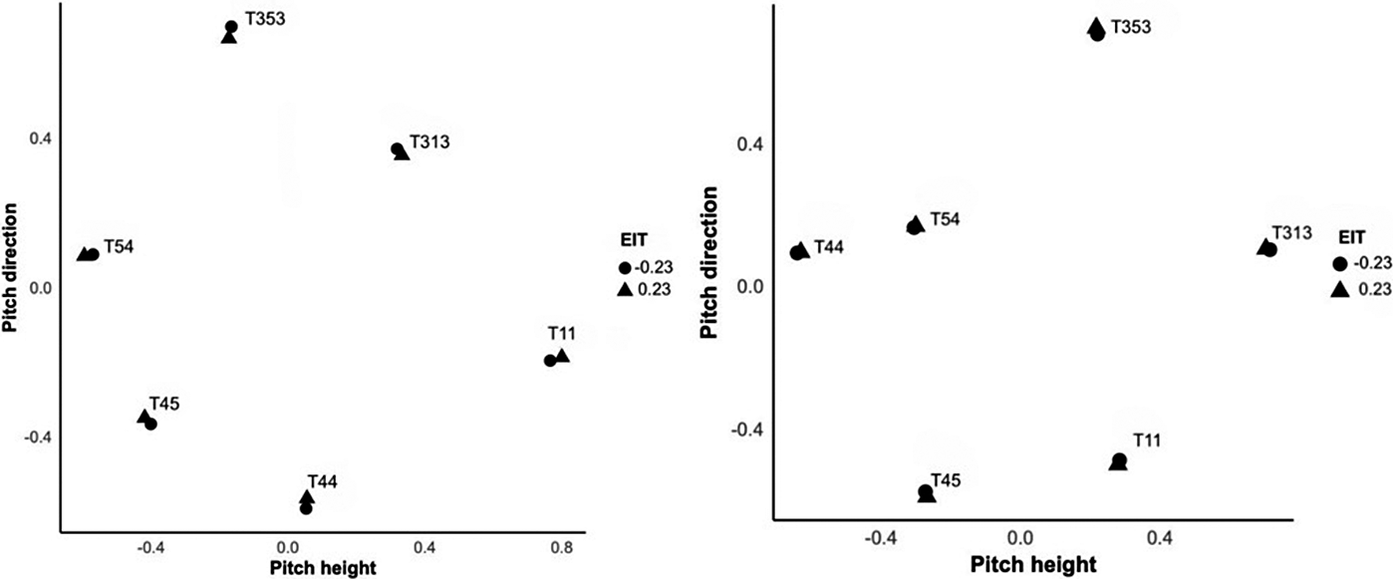
To interpret the dimensions, we compared them to the pitch measurements of each tone. Our study included 10 acoustic measurements, categorized into pitch height and pitch direction. The pitch height measurements comprised mean pitch, pitch at the midpoint, maximum pitch, minimum pitch, onset pitch and offset pitch. The pitch direction measurements included mean slope, slope at the midpoint, onset slope and offset slope (Gandour & Harshman, Reference Gandour and Harshman1978; Khouw & Ciocca, Reference Khouw and Ciocca2007). Our regression model included each dimension as a response variable and each acoustic measurement as a fixed factor with a by-subject intercept. We conducted ordinary linear regression analyses to verify whether the acoustic measurements were significant predictors of the dimensions. Our results align with previous studies on tone perception (e.g., Chandrasekaran et al., Reference Chandrasekaran, Sampath and Wong2010; Francis et al., Reference Francis, Clocca, Ma and Fenn2008a; Gandour, Reference Gandour1983). In ABX Task 1, Dimension One was interpreted as pitch height (estimates > −0.27, SEs < 0.01, ts > −30.76, ps < .001), and Dimension Two was interpreted as pitch direction (estimates > −0.001, SEs < 0.0007, ts > −4.63, ps < 0.05). In ABX Task 2, we found similar results, with pitch height as Dimension One (estimates > −0.13, SEs < 0.02, ts > −18.33, ps < 0.001) and pitch direction as Dimension Two (estimates > −3.02, SEs < 0.77, ts > −6.95, ps < 0.001).
3.2.1. Modeling
To examine the relationships between L2 Cantonese proficiency and the weights of the two dimensions, we fitted two separate Bayesian regression models for the two discrimination tasks with very weakly informative priors (Vasishth et al., Reference Vasishth, Nicenboim, Beckman, Li and Kong2018). In ABX Task 1, the model included Weight following a Gaussian distribution as the dependent variable and EIT and Dimension as fixed factors. We found no clear suggestion of an effect of EIT, b = 0.10 [−0.20, 0.41], or Dimension, b = −0.02 [−0.14, 0.09] (see Figure 6).
Two-dimensional INDSCAL configuration of the novel tone system in ABX Task 1 (left panel) and Task 2 (right panel).

In ABX Task 2, the model included Weight following a Gaussian distribution as a dependent variable. It included EIT and Dimension as fixed factors. We did not include the interaction in the model because there was no effect of the interaction between EIT and Dimension. Our results showed an effect of Dimension, b = 0.24 [0.12, 0.37]. However, there was no effect of EIT, b = 0.02 [−0.21, 0.25]. Post-hoc comparisons suggested that the weight of Dimension One was smaller than that of Dimension Two, b = −0.24 [−0.36, −0.11] (see Figure 6).
4. Discussion
We found a positive effect of L2 Cantonese proficiency on novel tone discrimination and identification. However, no evidence emerged for an effect of L2 proficiency on the weighting of pitch cues (i.e., pitch height and pitch direction). As predicted, our listeners with higher L2 Cantonese proficiency showed better novel tone perception. However, this influence could not be attributed to adjustments in cue weighting. Regarding cognitive load, it did not modulate the effect of L2 Cantonese proficiency in the discrimination tasks. However, it directly influenced the weighting of pitch cues.
4.1. Tonal L2 learning and early-stage L3/Ln tone perception
Tonal L2 learning was found to influence early-stage L3/Ln tone perception in non-tonal L1 listeners across perceptual tasks, such as discrimination and identification. Specifically, we found that L2 Cantonese proficiency was positively correlated with the discrimination and identification of novel tones. Our findings align with previous studies, suggesting that tonal L2 learning influences early-stage L3/Ln tone perception (Chan & Chang, Reference Chan and Chang2019; Onishi, Reference Onishi2016; Qin & Jongman, Reference Qin and Jongman2016).
Notably, L2 Cantonese proficiency exerted a selective, rather than a global influence on novel tone perception. In the low-cognitive-load discrimination task, it affected four tone contrasts; in the high-cognitive-load task, six contrasts; and in identification, two tones. These findings contradict claims of a global influence of L2 learning in L3/Ln speech perception (Onishi, Reference Onishi2016), but instead provide empirical support for the view that cross-linguistic influence in L3/Ln speech perception is selective (Flynn et al., Reference Flynn, Foley and Vinnitskaya2004; Slabakova, Reference Slabakova2017). Furthermore, the specific tone contrasts affected by L2 proficiency differed between the two discrimination tasks, suggesting that L2 learning selectively influences early-stage L3/Ln speech perception in a contrast-specific and cognitive-load-dependent manner.
Can perceptual assimilation explain the selectivity of the L2 Cantonese proficiency effect observed herein? In a previous study, Cantonese listeners assimilated the Mandarin high-level and mid-rising tones onto two distinct Cantonese tones (high level and high rising), yielding good identification of both (So & Best, Reference So and Best2010). In the current study, it might be possible that T44 and T353 were assimilated as two distinct Cantonese tones, such that L2 Cantonese proficiency exerted a beneficial effect on T44 and T353 perception. However, T44 and T353 were rated as dissimilar to Cantonese tones, implying that these two tones were unlikely to be perceptually assimilated into the L2 Cantonese tonal system. Thus, it is unlikely for perceptual assimilation to explain our findings. Future studies are needed to identify alternative explanations for how tonal L2 proficiency influences early-stage L3/Ln tone perception.
4.2. Tonal L2 learning and tonal L3/Ln weighting of pitch cues
Across both ABX discrimination tasks, no evidence was found that L2 Cantonese proficiency influenced native Urdu/Hindi listeners’ relative weighting of pitch cues (i.e., pitch height and pitch direction), as derived from INDSCAL analysis. Thus, our data provide no support for our first hypothesis and contrast with previous findings (e.g., Francis et al., Reference Francis, Clocca, Ma and Fenn2008a; Gandour, Reference Gandour1983; Qin & Jongman, Reference Qin and Jongman2016). For instance, Francis et al. (Reference Francis, Clocca, Ma and Fenn2008a) demonstrated that short-term L2 Cantonese learning alters pitch cue weighting toward native-like patterns in both tonal and non-tonal language speakers. We therefore adopt cautious interpretations, as detailed below.
One possibility is that tonal L2 proficiency may not affect L3/Ln cue weighting, implying that cue reweighting might not be the primary mechanism underlying the influence of tonal L2 proficiency on L3/Ln tone perception. Another possibility is that the null results may not necessarily invalidate cue weighting as a cross-linguistic influence mechanism but may reflect the limited sensitivity of INDSCAL-derived measures, which capture only two perceptual dimensions. Methodological constraints – such as the exclusion of additional dimensions or the lack of complementary cue-weighting assessments (e.g., speech categorization with orthogonal acoustic cues (Holt & Lotto, Reference Holt and Lotto2006), the temporal placement of the F0 turning point (Shen et al., Reference Shen, Lin and Yan1993) or decision strategies in speech categorization (Toscano & McMurray, Reference Toscano and McMurray2010) – may also account for the null effect. Future studies should explore these approaches for more comprehensive insights.
4.3. Cognitive load and the effect of tonal L2 learning
Our findings showed that the overall effect of tonal L2 learning on early-stage L3/Ln tone discrimination remained stable across varying levels of cognitive load, inconsistent with previous findings (e.g., Asano, Reference Asano2018; Freeman et al., Reference Freeman, Blumenfeld, Carlson and Marian2022; Parlato-Oliveira et al., Reference Parlato-Oliveira, Christophe, Hirose and Dupoux2010). One possible explanation lies in the typological similarity between L2 and L3/Ln, as both involve lexical tone, which may attenuate the influence of cognitive load on the L2 learning effects. Typological similarity has been argued to lower cognitive processing demand in cross-linguistic influence (Rothman, Reference Rothman2015). In this context, our L2 learners may be able to access L2 knowledge even under conditions of high cognitive load. This suggests that cognitive load does not necessarily weaken the influence of tonal L2 proficiency on L3/Ln tone discrimination. Instead, shared typological features between the L2 and L3/Ln may facilitate stable and efficient linguistic transfer, resulting in robust L2-proficiency effects across varying levels of cognitive load.
Notably, the effect of L2 learning varied across individual tone contrasts, with four proficiency-affected tone contrasts in the low-cognitive-load task and six in the high-cognitive-load task. This pattern suggests that cognitive load does not suppress the overall L2-proficiency effect but instead modulates L2 perceptual strategies at the level of individual tone contrasts. That is, learners may flexibly adjust their reliance on L2 knowledge depending on the specific cognitive demands associated with each contrast.
4.4. Cognitive load and cue weighting
We found that cognitive load affected the weighting of pitch cues for novel tone discrimination. Our results suggest that tonal L2 learners exhibit no clear preference for pitch direction or pitch height in the low-cognitive-load task. However, listeners weigh pitch direction more than pitch height in the high-cognitive-load task. One possible explanation for this cue-weighting shift is that increased cognitive load heightened reliance on the L1 prosodic system (Strange, Reference Strange2011). In our study, under such conditions, participants may draw more heavily on L1 intonational categories – particularly rising contours – when perceiving novel tones, thereby shifting their attention toward pitch direction in the high-cognitive-load tasks (Hussain, Reference Hussain1997; Yu et al., Reference Yu, Lee, Lan and Mok2022).
Our findings indicate that cognitive load plays an important role in predicting cue weighting in suprasegmental speech perception, thereby extending prior empirical evidence from segmental-level research (Gordon et al., Reference Gordon, Eberhardt and Rueckl1993; Kong & Lee, Reference Kong and Lee2018). For instance, Kong and Lee (Reference Kong and Lee2018) reported that native Korean listeners adjusted the weighting of a key acoustic cue – VOT – for Korean laryngeal stops under high cognitive load. The present results further demonstrate that the influence of cognitive load on cue weighting extends beyond the segmental level to the suprasegmental level.
Moreover, our findings reveal that cue weighting in non-native speech perception is not static but dynamic. Prior studies employing cue weighting theory have typically focused on stable weighting patterns while overlooking the role of cognitive load. For instance, tonal speakers tend to rely more heavily on pitch direction, whereas non-tonal speakers place greater weight on pitch height (Francis et al., Reference Francis, Clocca, Ma and Fenn2008a). Advancing this line of research, our study provides empirical evidence that cue-weighting patterns are not fixed; rather, they are modulated by cognitive load.
4.5. Theoretical implications and limitations
Our findings have several theoretical implications. First, the influence of tonal L2 learning on early-stage L3/Ln tone perception is selective rather than global. This finding supports current accounts of cross-language influence that emphasize its selective nature (e.g., Choi & Chiu, Reference Choi and Chiu2023; Flynn et al., Reference Flynn, Foley and Vinnitskaya2004; Slabakova, Reference Slabakova2017). Second, this influence remains relatively robust under increased cognitive load, suggesting that typological similarity between L2 and L3 may enable stable L2-proficiency effects (Rothman, Reference Rothman2015). Third, cross-linguistic cue weighting in suprasegmental processing is not static but dynamic, varying as a function of cognitive load. This finding points to the need to refine cue weighting accounts by extending them to suprasegmental domains and incorporating the role of cognitive load (e.g., Francis et al., Reference Francis, Clocca, Ma and Fenn2008a; Kong & Lee, Reference Kong and Lee2018). Lastly, we did not find evidence supporting cue weighting as the underlying mechanism for the influence of tonal L2 learning on early-stage L3/Ln tone perception. Alternative mechanisms should therefore be explored to better account for this influence.
There are two main limitations in our study. First, we did not include L1-Cantonese speakers or L1-Urdu/Hindi speakers without any Cantonese knowledge in Hong Kong. This was due to the generally high level of L2 Mandarin proficiency among young Cantonese adults, as well as the difficulty of recruiting Urdu/Hindi speakers in Hong Kong. Future studies should include both control groups to better assess the roles of L1 and L2 in L3/Ln speech perception.
Additionally, due to experimental feasibility constraints and to create a more natural-sounding L3/Ln tone system, we synthesized only six novel tone categories rather than independent continua of pitch height and pitch direction (e.g., Holt & Lotto, Reference Holt and Lotto2006). To more systematically examine cue weighting patterns for these two pitch dimensions, future research could employ orthogonal manipulations of pitch height and pitch direction.
5. Conclusion
The current study investigated (i) whether tonal L2 learning influences L3/Ln tone perception by altering cue weighting, and (ii) whether cognitive load modulates the effect of tonal L2 learning on cue weighting for L3/Ln tone perception. Specifically, we examined the influence of L2 Cantonese proficiency on novel tone discrimination and identification. The results showed that L2 Cantonese proficiency influenced novel tone discrimination for certain tone contrasts and identification for certain tone types, while also exerting a comparable effect across the two discrimination tasks. Regarding cue weighting, however, the relative weighting of pitch cues – pitch height and pitch direction – differed between the two discrimination tasks.
Overall, these findings suggest that tonal L2 learning exerts a selective influence on L3/Ln tone perception, but no evidence was found that this influence can be explained by adjustments in cue weighting. Moreover, cognitive load modulates listeners’ cue weighting strategies, but does not weaken the influence of tonal L2 learning on L3/Ln tone perception. Although our study found no evidence of the cue weighting theory to account for the influence of L2 learning on L3/Ln speech perception, this influence appears robust under varying cognitive loads. Moreover, cue weighting patterns are not static but are dynamically modulated by cognitive loads.
Supplementary material
The supplementary material for this article can be found at http://doi.org/10.1017/langcog.2026.10118.
Data availability statement
Data are available from the authors, subject to the ethical guidelines of the University of Hong Kong.
Acknowledgments
We wish to express our sincere gratitude to Professor Mitsuhiko Ota for his valuable feedback and suggestions for the improvement of this manuscript. We are also deeply grateful to Mr Kin Ho Chan for his statistical advice, and to the editors and anonymous reviewers for their insightful comments. This work was supported by the Tin Ka Ping Foundation Postgraduate Fellowship.
Competing interests
The authors have no known conflict of interest to declare.





 Open access

