The transmission of alcohol use disorder (AUD) and drug use disorder (DUD) in families shows evidence both of shared and disorder-specific familial factors (Bierut et al., Reference Bierut, Dinwiddie, Begleiter, Crowe, Hesselbrock, Nurnberger and Reich1998; Kendler, Ohlsson, Bacanu, Sundquist, & Sundquist, Reference Kendler, Ohlsson, Bacanu, Sundquist and Sundquist2020; Merikangas et al., Reference Merikangas, Stolar, Stevens, Goulet, Preisig, Fenton and Rounsaville1998; Rounsaville et al., Reference Rounsaville, Kosten, Weissman, Prusoff, Pauls, Anton and Merikangas1991). Across different substances of abuse, twin studies find evidence both for shared and substance-specific genetic risk factors (Kendler et al., Reference Kendler, Aggen, Knudsen, Roysamb, Neale and Reichborn-Kjennerud2011; Kendler, Myers, & Prescott, Reference Kendler, Myers and Prescott2007; Rhee et al., Reference Rhee, Hewitt, Young, Corley, Crowley and Stallings2003; Tsuang et al., Reference Tsuang, Lyons, Meyer, Doyle, Eisen, Goldberg and Eaves1998). Twin pairs, being of the same age, are exposed to similar levels of availability of psychoactive substances and social attitudes toward their use. Much less is known about the magnitude and sources of the genetic transmission of AUD and DUD across generations. While a number of classical adoption studies have examined AUD only (Verhulst, Neale, & Kendler, Reference Verhulst, Neale and Kendler2015) and a few DUD only (Cadoret, Yates, Troughton, Woodworth, & Stewart, Reference Cadoret, Yates, Troughton, Woodworth and Stewart1995, Reference Cadoret, Yates, Troughton, Woodworth and Stewart1996; Kendler et al., Reference Kendler, Sundquist, Ohlsson, Palmer, Maes, Winkleby and Sundquist2012), no adoption study of which we are aware has examined the cross-generational cross-transmission of these two major forms of substance use disorders (SUDs).
In many Western countries, including Sweden, attitudes toward and access to alcohol has been relatively constant over the last several generations, while the diversity, availability and normalization of use of illicit psychoactive substances have increased (Addiction, 2021; Hall & Degenhardt, Reference Hall and Degenhardt2009; Parker, Parker, Aldridge, & Measham, Reference Parker, Parker, Aldridge and Measham1998; Sznitman, Reference Sznitman2007). Therefore, in a study of current young adults, many grew up in social environments where illicit psychoactive substances were widely available, and their use relatively normalized. By contrast, for many of their parents, access to illicit drugs was restricted and sanctioned when they were young, leaving alcohol the only readily available and acceptable intoxicating substance.
In such a sample, individuals in the parental generation with AUD would likely carry a relatively non-specific genetic risk for substance abuse. By contrast, because of the more limited availability of illicit drugs in the older generation, and the greater deviance associated with their use, individuals in the parental generation with DUD would have a stronger overall liability to substance use and one that was relatively DUD-specific.
To test these hypotheses, we first conducted an expanded National Swedish adoption study of the cross-generational within-disorder and cross-disorder genetic transmission of AUD and DUD through an examination of three informative family types which can assess the degree of genetic parent–offspring transmission within and across SUDs: (i) families with not-lived-with (NLW) biological fathers, (ii) families with NLW biological mothers and (iii) biological parents from an adoption sample. As detailed below, NLW biological parents contributed genes to their offspring but never lived with them nor near them while they were growing up, thus approximating the relationship seen between biological parents and their adopted-away offspring in a classical adoption design.
From these analyses, we examined both the magnitude of genetic cross-generational transmission of (i) DUD → AUD, (ii) AUD → DUD, (iii) DUD → DUD and (iv) AUD → AUD. These analyses also permit us to calculate the genetic correlation for the cross-generational transmission of AUD and DUD.
Second, given evidence of rapid rises in rates of DUD across recent generations, we then divided our sample into older and younger cohorts to explore how the increasing availability and acceptability of drug use might impact on the pattern of cross-generational genetic transmission of risk to AUD and DUD.
In addition to these empirical questions about the cross-generational transmission of AUD and DUD in the historical setting of changes in availability, we are also interested in the broader conceptual issues involved. For genetic studies of traditional medical and psychiatric disorders (e.g. coronary artery disease and schizophrenia) there is nothing analogous to drug exposure which is required from the expression of any genetic risk. These factors are likely to influence the specificity of the emerging genetic risk factors for the abuse of specific substances. We explore these issues further below.
Methods
Information for this study was collected from nationwide Swedish registers (online Supplementary Appendix Table S1). Each person's unique identification number, replaced with serial numbers for confidentiality, was used for linkage between registers. Cases of AUD and DUD were identified in the Hospital Discharge Register, Outpatient Care Register, nationwide primary care data, Prescribed Drug Register, Cause of Death Register, Criminal Register and the Suspicion Register (see online Supplementary Appendix Table S2). The initial study population was individuals born in Sweden 1960–1995, who were alive and resided in Sweden at least until the age of 20.
For the offspring in our analyses, we included the number of years, from ages 0 to 15, they resided in the same household and geographic area as their biological mother, biological father, adoptive mother and adoptive father. From 1960 to 1985 (every fifth year), we used household identification numbers from the Population and Housing Census to define family types. The household identification includes all individuals registered at the same residence. From 1986 onward (every year), we defined family type using the family identification from the Total Population Register. The family identification is defined by individuals registered at the same property who are also related, adopted, married or have children in common. For years when there was no information on whether offspring and parents resided together, we used information from the closest year. Geographical areas (as defined by Statistics Sweden, the Swedish government-owned statistics bureau) are called Small Areas for Market Statistics (SAMS). There are approximately 9200 SAMS throughout Sweden, and they are often characterized by homogeneous types of buildings and are limited by ‘natural’ boundaries.
We defined families with NLW fathers or mothers as those including offspring who never resided in the same household or SAMS area as the biological father/mother. Adoptive families included offspring adopted at younger than 5 years, with information available on both adoptive parents and at least one biological parent. The adoptive parents had to be biologically unrelated to the offspring and the offspring had to reside with each adoptive parent for at least 10 years between the ages 0 and 15. As domestic adoptions are nowadays more unusual, we included offspring born from 1955 to 1995, to increase sample size. The NLW were defined so that their relationships with their offspring resembled those seen between an adoptee and his/her biological parents. For all family types, parents had to be alive throughout 1975 and had to reside in Sweden during some period of time from 1976 and onward.
For reasons of interpretability (Falconer, Reference Falconer1989) and insensitivity to changes in base rates (Babchishin & Helmus, Reference Babchishin and Helmus2016), we assessed parent–offspring transmission of AUD and DUD by tetrachoric correlation which reflects the correlation in relatives of an underlying normally distributed latent liability to illness (Pearson, Reference Pearson1901). To calculate weighted tetrachoric correlations and for testing for heterogeneity across families, we use a meta-analysis fixed effects model (Borenstein, Hedges, Higgins, & Rothstein, Reference Borenstein, Hedges, Higgins and Rothstein2010). The model is fixed as samples of data come from the same population. For the heterogeneity tests, Bonferroni-corrected significance levels of 0.05 divided by the number of tests were utilized. We also calculated the genetic correlation between AUD and DUD (see online Supplementary Appendix Table S3 for details). Analyses were performed in the complete cohort, as well as stratified on birth year of the offspring, creating an older cohort (born 1960–1970; 1955–1970 for the adopted individuals) and a younger cohort (born 1971–1995). Because both adoptions and the rates of NLW-mother families were declining rapidly over these years compared to the rates of NLW-father families, to roughly balance our power across our three family types, our older cohort covered a shorter time period than our younger cohort.
Cumulative incidence curves of first occurrence of an AUD or a DUD registration were calculated for four different cohorts of individuals born in Sweden: birth years 1960–1969 (n = 1 079 653), 1970–1979 (n = 985 119), 1980–1989 (n = 951 668) and 1990–1999 (n = 753 088). Follow-up ended on 31 December 2017, death or emigration, whichever came first. Data analyses were performed using R, version 4.0.3 (Team, 2019) (see online Supplementary Appendix Table S4 for details) and SAS, version 9.4 (SAS Institute, 2012).
Results
Descriptive results
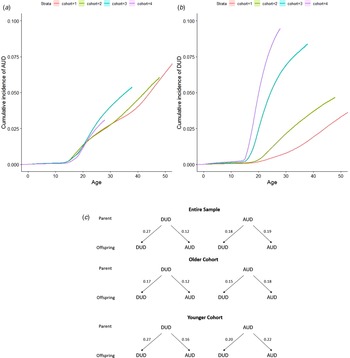
Figures 1a and b present incidence curves for AUD and DUD across the four Swedish birth cohorts which include all individuals in our study: 1960–1969, 1970–1979, 1980–1989 and 1990–1999. Rates were relatively constant for AUD but increased substantially for DUD.
(a) Cumulative incidence curves of first registration for AUD calculated for four different cohorts of individuals born in Sweden: cohort 1 – birth years 1960–1969 (n = 1 079 653); cohort 2 1970–1979 (n = 985 119); cohort 3 1980–1989 (n = 951 668) and cohort 4 1990–1999 (n = 753 088). Follow-up ended on 31 December 2017, death or emigration, whichever came first. (b) Cumulative incidence curves of first registration for DUD calculated for four different cohorts of individuals born in Sweden: cohort 1 – birth years 1960–1969 (n = 1 079 653); cohort 2 1970–1979 (n = 985 119); cohort 3 1980–1989 (n = 951 668) and cohort 4 1990–1999 (n = 753 088). Follow-up ended on 31 December 2017, death or emigration, whichever came first. (c) Weighted estimates of the within-disorder and cross-disorder parent-child tetrachoric correlations for AUD and DUD, that reflect genetic relationships in our entire sample (top), our older cohort (birth years 1960–1970; 1955–1970 for the adopted individuals) (middle) and our younger cohort (birth years 1971–1995) (bottom).

Descriptive statistics for our three family types in our entire sample are shown in the top section of Table 1. NLW-father families had the largest sample of offspring, followed by adoptive families and NLW-mother families. The mean ages of offspring were over age 40 in all family types, so we have captured a substantial proportion of the DUD and AUD onsets.
Sample size, birth year, age and sex distributions across the three family types included in the study

The top panel of Table 2 presents the prevalence rates for AUD and DUD in the parents and offspring of our three informative family types. Rates of both disorders were higher in males v. females. Rates of AUD and DUD were much higher in biological fathers from NLW-father and adoptive families than in the biological fathers from the NLW-mother families who stayed with and raised his own children. A similar pattern is seen for biological mothers.
. Prevalences of AUD (%) and DUD (%) in the relatives and their ratio (AUD/DUD) from the three family types included in this study

The ratios of prevalence rates for AUD to DUD were consistently higher in the parental than in the offspring generation of all our families. In all sons, the AUD/DUD prevalence ratio had a mean across family types of 1.5 while in biological fathers, the parallel mean was 4.6. The differences were somewhat less between daughters (1.1) and biological mothers (2.0) but in the same direction.
Analysis of parent–offspring transmission in the entire sample
The top part of Table 3 presents the parent–offspring tetrachoric correlations for DUD → AUD genetic transmission, separately for mothers and fathers in our three family types. The last two columns of the table depict the weighted estimate of those correlations and a heterogeneity test. We had two estimates for each relationship. For example, for the genes only mother–child relationship, we had estimates from the NLW mothers and the biological mothers in the adoptive family.
. Parent–offspring tetrachoric correlations and 95% CI, weighted estimates and heterogeneity tests

Het test, heterogeneity test with nominal p value.
a Significance threshold after Bonferroni correction for 24 tests was p < 0.002. Significant tests are marked with*.
The three sections of the top part of Table 3 then present parallel analyses for AUD → DUD, DUD → DUD and AUD → AUD transmission. Of the eight heterogeneity tests, only one is significant at Bonferroni-corrected levels.
Table 4 and the top of Fig. 1c then compares and combines the results from the mother–offspring and father–offspring analyses, none of which differed at even a nominal p value. The genetic cross-generational transmission [±95% confidence interval (CI)] from AUD to AUD (+0.19, 0.18–0.20) is nearly identical to, and not statistically different from, that from AUD to DUD (+0.18, 0.17–0.20). By contrast, the genetic cross-generational transmission from DUD to DUD (+0.27, 0.26–0.28) is much larger than the parallel transmission from DUD to AUD (+0.12, 0.10–0.13) (p < 0.001). The genetic cross-generational correlation for AUD and DUD was estimated at +0.70 (0.67–0.73).
Tests of transmission from mothers and fathers using weighted estimates across all family types

a Significance threshold after Bonferroni correction for 12 tests was p < 0.004. No tests in this table met that threshold. .
Division of our sample into an older and younger cohorts
As shown in Figs. 1a and b, over the entire time when our sample was born (1960–1995), rates of DUD were rising rapidly in Sweden while rates of AUD were relatively stable suggesting that compared to alcohol, we can infer that drugs were becoming both widely accessible with reduced social barriers to use. To further investigate the relationship between cross-generational transmissions of substance availability/stigma, we divided our birth cohort into an older sample born 1960–1970 (for adopted individuals 1955–1970) and a younger sample from 1971 to 1995. As shown in Figs. 1a and b, in the older sample – cohort 1 in the figures, rates of AUD substantially exceed rates of DUD across the life cycle. However, in the younger sample (depicted by cohorts 2–4 in the figures), rates of DUD are slightly lower than rates of AUD in cohort 2, but then substantially exceed the AUD of AUD in cohort 3 and especially cohort 4.
The sample sizes of our families, age and gender composition are shown in the bottom two sections of Table 1. The prevalences of AUD and DUD in both the offspring and parents are depicted in the bottom two sections of Table 2. In the older cohort, the mean AUD to DUD ratio in biological fathers, mothers and offspring were 6.9, 2.6 and 1.7. In the younger cohort, the parallel results were 3.4, 1.5 and 0.8. As predicted from our general population results in Figs. 1a and b, relative to AUD, DUD was more common in children than parents in both cohorts, but also considerably more common across both groups of relatives in the younger v. older cohorts. The lower two sections of Table 3 present parallel analyses for DUD → AUD, AUD → DUD, DUD → DUD and AUD → AUD transmission in our younger and older samples. None of the 16 heterogeneity tests were significant.
Table 4 and Fig. 1c then compares and combines the results from the mother–offspring and father–offspring analyses for our two cohorts. None of the heterogeneity tests across biological mothers and fathers were significant even at a nominal p value. In our older cohort, depicted in the middle third of the table, the genetic cross-generational transmission (±95% CI) from AUD to AUD (0.18, 0.16–0.19) is very similar to, and not statistically different from, that from AUD to DUD (0.15, 0.14–0.17) (p = 0.24). The genetic cross-generational transmission from DUD to DUD (0.17, 0.14–0.19) is modestly and significantly larger than the parallel transmission from DUD to AUD (0.12, 0.10–0.15) (p = 0.01). The genetic cross-generational correlation for AUD and DUD in this older cohort equaled +0.83 (0.75–0.91).
In our younger cohort – shown in the bottom third of Table 4 – the genetic cross-generational transmission (±95% CI) from AUD to AUD (0.22, 0.21–0.24) is modestly greater than that from AUD to DUD (0.20, 0.18–0.21) (p < 0.01). The genetic cross-generational transmission from DUD to DUD (0.27, 0.26–0.29) is, however, substantially larger than the parallel transmission from DUD to AUD (0.16, 0.14–0.17) (p < 0.001). The genetic cross-generational correlation for AUD and DUD in this younger cohort equaled +0.73 (0.70–0.77) which was significantly lower than that observed in the older cohort (p = 0.02).
Discussion
Over recent decades, twin studies have been a major method used for the assessment of genetic and familial-environmental effects on risk to SUD. This is a powerful approach, which, by studying individuals of the same age, controls for the availability of substances of abuse and their associated stigma during young adulthood when most drug use habits are acquired. However, this becomes a limitation if we want to understand how the liability of individuals with subtypes of SUD differs as a function of the availability and acceptability of various psychoactive substances. We undertook this study to examine this question, taking advantage of a natural experiment in Sweden where, in recent decades, levels of AUD have been relatively stable while rates of DUD have increased substantially.
We were able to show, through an examination of risk for patterns of SUD in their offspring in our entire sample, that individuals in the parental generation with AUD carried a relatively non-specific genetic vulnerability to SUD while those with DUD had a genetic risk relatively specific for DUD. In interpreting these findings, we propose the following conceptual framework. The familial/genetic risks for AUD and DUD are positively but not perfectly correlated (Bierut et al., Reference Bierut, Dinwiddie, Begleiter, Crowe, Hesselbrock, Nurnberger and Reich1998; Kendler et al., Reference Kendler, Myers and Prescott2007, Reference Kendler, Aggen, Knudsen, Roysamb, Neale and Reichborn-Kjennerud2011, Reference Kendler, Ohlsson, Bacanu, Sundquist and Sundquist2020; Merikangas et al., Reference Merikangas, Stolar, Stevens, Goulet, Preisig, Fenton and Rounsaville1998; Rhee et al., Reference Rhee, Hewitt, Young, Corley, Crowley and Stallings2003; Rounsaville et al., Reference Rounsaville, Kosten, Weissman, Prusoff, Pauls, Anton and Merikangas1991). Therefore, within a population, there will be many people with roughly similar levels of elevated genetic risk for the two disorders. However, there will be others where their risks differ moderately or even in some cases substantially – either being higher for DUD than AUD or the reverse.
We began our analyses examining our entire cohort of children – born from 1960 to 1995 – at time at which rates of AUD were relatively stable and rates of DUD rising rapidly. We expect that for parents of this cohort, on average, alcohol was widely available, and its use relatively normalized while illicit psychoactive drugs were harder to find and much more stigmatized. Therefore, those parents whose genetic risk for AUD was similar to or higher than their risk for DUD would, if they developed SUD, be much more likely to develop AUD than DUD. Among those whose genetic risk was higher for DUD than AUD, many, especially when the difference in risk was modest, would also be more prone to develop AUD than DUD because of differences in substance availability and attitudinal barriers. Only those parents with particularly high risk for DUD that substantially exceeded their risk for AUD would, we hypothesize, have been likely to seek out and abuse illicit substances leading to a DUD diagnosis.
Given the substantial inter-generational and cross-time changes in availability and normalization of illicit substances, this framework would explain our two sets of genetic findings: the relative non-specificity of the genetic risk for SUD inherited from biological and NLW-parents with AUD, and the specificity and higher potency of the DUD risk inherited from biological and NLW-parents with DUD.
To further investigate and potentially confirm our hypotheses, we then subdivided our sample into an older and younger cohort. As shown in Fig. 1b, the offspring in the younger cohort would be exposed to considerably higher levels of DUD than those from the older cohort, likely a result of rising availability and acceptability of illicit drugs over this time period. This expectation is verified by showing that the AUD to DUD ratio was more than twice as high in the offspring of the older than the younger cohort (1.7 v. 0.8 respectively). We showed that the specificity of the transmission of AUD in parents to AUD v. DUD in their children – that is the ratio of the paths from AUD in parents to AUD v. DUD in offspring – actually declined slightly in the older v. younger cohort: from a ratio of 1.20 to 1.10. At the same time, the specificity of the transmission of DUD – the ratio of the paths from DUD in parents to DUD v. AUD in offspring – increased from 1.42 to 1.69. Finally, as predicted, the genetic correlation between DUD and AUD significantly declined from the older to the younger cohort.
Two prior studies provide some additional empirical support for our explanation of our findings. First, the stability of the prevalence and heritability of AUD in Sweden has been previously demonstrated using registrations from Temperance Boards (Kendler, Prescott, Neale, & Pedersen, Reference Kendler, Prescott, Neale and Pedersen1997). For males born from 1902 to 1950, the proportion registered with the Temperance Boards varied only between 12% and 16% and estimates of the heritability and shared environmental component, estimated at 0.54 and 0.14, were constant across those decades (Kendler et al., Reference Kendler, Prescott, Neale and Pedersen1997). Second, a formal age-period-cohort effect model for DUD hospitalization in Sweden showed substantial cohort effects with rates of DUD declining slightly in both males and females for those born from 1950 to 1970, and then increasing substantially from 1970 to 1990 (Giordano et al., Reference Giordano, Ohlsson, Kendler, Winkleby, Sundquist and Sundquist2013).
Our expanded adoption design assumes that NLW fathers and mothers – who neither lived with nor near their offspring after, respectively, conception or birth – are good proxies for biological parents in an adoption design in that both kinds of parents are, to a first approximation, related to their offspring only through genetic effects. Our results permit us to empirically test these assumptions. Of the 24 tests of these assumptions (some admittedly correlation) in Table 3, only one differed significantly at chance corrected levels. Overall, these findings validate of the assumptions of our expanded adoption design.
Our findings suggest the need for a conceptual framework for interpreting the impact of drug availability, in both genetic epidemiological and molecular genetic studies, on the specificity of genetic risk factors for substances of abuse. We know from several multivariate twin studies that genetic risk factors for psychoactive substances are substantially but not perfectly correlated (Kendler et al., Reference Kendler, Myers and Prescott2007, Reference Kendler, Aggen, Knudsen, Roysamb, Neale and Reichborn-Kjennerud2011; Rhee et al., Reference Rhee, Hewitt, Young, Corley, Crowley and Stallings2003; Tsuang et al., Reference Tsuang, Lyons, Meyer, Doyle, Eisen, Goldberg and Eaves1998). Our results raise the question of whether the observed genetic correlations between difference substance classes will differ across countries and/or historical cohorts.
If a population is exposed to only one substance of abuse, it seems likely that the genetic risk to that form of DUD will tend to be relatively non-specific. However, as more and more abusable substances become available and easily accessible in that hypothetical population, those at risk have the opportunity to try multiple substances and select the one that is most rewarding and/or produces the fewest adverse effects. This process would likely increase the specificity of the resulting genetic risk factors for the multiple substances of abuse. Thus, the genetic correlation of the same SUD across populations might drop below one, with the decrease a function of the absence or presence of other competing substances of abuse. Our results and these hypotheses clearly need confirmation from additional empirical studies and also might be well suited for exploration via simulations.
Limitations
These results should be interpreted in the context of six potentially important methodological limitations. First, this study is restricted to Swedish populations, which has rates of DUD and AUD relatively typical of northern European countries (Addiction, 2021). Our results may not extrapolate to other countries within and outside Europe where drinking and drug use cultures may differ (Cook et al., Reference Cook, Li, Sundquist, Kendler, Sundquist and Karriker-Jaffe2021). Second, our findings depend on the overall quality of our diagnoses. In this study, subjects with AUD and DUD were ascertained from medical, criminal or pharmacy registries. Such registry data require neither subject cooperation nor accurate recall. However, it can produce false-negative and false-positive diagnoses, the nature of which is difficult to estimate. Individuals who abuse alcohol or other illicit substances and never come to the attention of the medical or legal system in Sweden for problems related to their substance use will, in particular, escape detection. The validity of the Swedish medical registries in general have been well demonstrated (Ludvigsson et al., Reference Ludvigsson, Andersson, Ekbom, Feychting, Kim, Reuterwall and Olausson2011) and the validity of our definitions of AUD and DUD are further supported by the high rates of concordance for registration observed across our different ascertainment methods (Kendler et al., Reference Kendler, Sundquist, Ohlsson, Palmer, Maes, Winkleby and Sundquist2012, Reference Kendler, Ji, Edwards, Ohlsson, Sundquist and Sundquist2015), and the similarity of genetic epidemiological findings for AUD and DUD in Sweden compared to those in other samples (Kendler, Maes, Sundquist, Ohlsson, & Sundquist, Reference Kendler, Maes, Sundquist, Ohlsson and Sundquist2013; Kendler et al., Reference Kendler, Sundquist, Ohlsson, Palmer, Maes, Winkleby and Sundquist2012, Reference Kendler, Ji, Edwards, Ohlsson, Sundquist and Sundquist2015, Reference Kendler, PirouziFard, Lonn, Edwards, Maes, Lichtenstein and Sundquist2016).
Third, an alternative interpretation of our findings is that the liability to DUD and AUD are on the same continuum with DUD reflecting the more severe condition. However, this hypothesis is not consistent with prior evidence that, in AUD cases, the familial genetic risk score (FGRS) for AUD is substantially higher than the FGRS for DUD while the reverse is seen in cases of DUD (Kendler, Ohlsson, Sundquist, & Sundquist, Reference Kendler, Ohlsson, Sundquist and Sundquist2021).
Fourth, we refer in this paper to drug availability as measured indirectly in rates of DUD and self-report surveys of illicit drug use (e.g. (Sznitman, Reference Sznitman2008)). These are population-level findings and cannot be used to assess the experiences of particular individuals or families in our sample. Furthermore, our indirect measures cannot be equated with more direct measures of availability that are sometimes available for epidemiological surveys, typically for restricted areas and not whole countries, such as ‘street-level’ cost and access for illicit drugs and density of outlets for alcohol.
Fifth, we have previously examined the cross-generational transmission of DUD → DUD and AUD → AUD in the Swedish population using, respectively, a standard (Kendler et al., Reference Kendler, Sundquist, Ohlsson, Palmer, Maes, Winkleby and Sundquist2012) and expanded adoption design (Kendler et al., Reference Kendler, Ji, Edwards, Ohlsson, Sundquist and Sundquist2015). As expected, our results in our entire cohort are similar but not identical to those previously reported. Since those analyses were completed, further years of data have become available, and the addition of a primary care registry has expanded our coverage.
Finally, in our main analyses, we made no attempt to apply a diagnostic hierarchy, so that individuals with both AUD and DUD were assigned both diagnoses in our analyses. As expected, comorbidity between these two disorders was common. For example, among our offspring 42.8% of the DUD cases also had a diagnosis of AUD and 44.9% of the AUD cases also had at least one diagnosis with DUD. There is no uniformly accepted way to ‘correct’ for this in genetic analyses, and some would argue that any correction is counter-productive. While we could apply a ‘hard’ hierarchy forcing all comorbid cases to have only one of the two disorders, this implies that no individual could have both DUD and AUD as two independent disorders, a conclusion inconsistent with clinical experience.
To obtain a sense of what might result from a ‘softer’ diagnostic hierarchy, we took all comorbid cases in our sample where the less frequent disorder had 50% or more the number of registrations as did the more common disorder and continued to assign them both diagnoses. But if the rarer disorder had less than 50% of that number, we only give them the more common diagnosis. We then re-analyzed our sample with a substantial reduction in comorbid cases and present these results in online Supplementary Appendix Tables S5–S7.
Comparing the cross-generational correlations with those observed in our original sample (without hierarchy), little change was seen in the within-disorder results (i.e. AUD → AUD and DUD → DUD). But for the two cross-disorder correlations, moderate reductions were seen for AUD → DUD while the DUD → AUD correlations declined substantially. Our hierarchy corrections resulted in a much weaker transmission from DUD in the parental generation to AUD in the offspring generation, thereby further increasing the specificity of DUD v. AUD cross-generational transmission. The resulting genetic correlations between AUD and DUD were estimated for the entire sample, the older cohort and the younger cohort, at respectively, +0.48 (0.43–0.52), +0.69 (0.57–0.85) and +0.53 (0.47–0.59), substantially lower than that observed in our sample analyzed without a diagnostic hierarchy. One concern in the interpretation of these results is that they were largely driven by the fact that in the comorbid cases, DUD was more often assigned the final diagnosis because DUD was more frequently registered than was AUD. That might be because DUD was the more ‘severe’ of the two disorders, but also could have arisen for a range of methodological reasons in the Swedish registries.
Conclusion
This study was motivated by a desire to understand how the availability of psychoactive substances and their degree of normalization can impact on the specificity or non-specificity of the genetic risk of individuals with particular forms of SUD. Our method for addressing this question was the examination of the cross-generational genetic transmission of risk for SUD in an extended adoption design. We showed that, while population rates of AUD in Sweden were relatively constant over the birth years 1960–1999, rates of DUD were rising rapidly. AUD in NLW and biological parents increased the risk for AUD and DUD nearly equally in their offspring. By contrast, DUD in these parents was much more specific in its effect, impacting far more strongly the risk for DUD in their children than risk for AUD. When we divided our sample into an older and younger cohort of parent–offspring pairs, we found that the specificity of the cross-generational transmission of genetic risk for AUD went slightly down across cohorts while the specificity of the cross-generational transmission of genetic risk for DUD increased, providing further support for our theory. Furthermore, the genetic correlation between AUD and DUD significantly decreased from the older to the younger cohort. These results illustrate how the specificity of the genetic liability to individual forms of SUD can change across generations and historical periods due to changes in the availability and cultural acceptability of various psychoactive substances. These results have potential implications for the analysis of genetic risk to multiple forms of SUD using both genetic-epidemiological and molecular genetic designs.
Supplementary material
The supplementary material for this article can be found at https://doi.org/10.1017/S0033291722002549.
Financial support
This project was supported by grants R01AA023534 and R01DA030005 from the National Institutes of Health, the Swedish Research Council as well as Avtal om Läkarutbildning och Forskning (ALF) funding from Region Skåne.
Conflict of interest
None of the authors have any conflicts of interest to declare.
Ethical standards
The authors assert that all procedures contributing to this work comply with the ethical standards of the relevant national and institutional committees on human experimentation and with the Helsinki Declaration of 1975, as revised in 2008. We secured ethical approval for this study from the Regional Ethical Review Board in Lund (No. 2008/409 with later amendments).
Informed consent
Informed consent was not obtained from individual participants included in the study.