The rapid spread of COVID-19 in early 2020 forced governments in many countries to adopt strict containment policies, including lockdown measures, as well as preventive health behaviors such as social distancing, mask-wearing, and frequent hand-washing. The success of these public health measures is contingent on people's compliance with lockdowns and other safety measures, which are very difficult to enforce. Gaining an understanding of the individual-level factors that drive acceptance of COVID-19 lockdown measures and other public health recommendations is critical for ensuring compliance with these measures (Heap et al. Reference Heap, Koop, Matakos, Unan and Weber2020). In this article, we explore whether there are gender differences in attitudes toward COVID-19 lockdown measures and compliance with public health advice.
We investigate gender disparities in attitudes toward (and compliance with) COVID-19 public health measures in Peru, one of the Latin American countries most severely affected by the pandemic. The Peruvian government implemented sweeping lockdown and public health measures to prevent the spread of the disease and the collapse of the health care system. Despite these measures, the number of cases and deaths spiked, and the economy entered an unprecedented crisis. Lockdown measures had a disproportionate impact on women's lives in developing countries like Peru, where women are constrained by traditional gender roles. Women are more likely to be exposed to domestic violence and sexual harassment in Peru (Bott et al. Reference Bott, Guedes, Goodwin and Mendoza2012; WHO 2006), and gender equality in the distribution of household responsibilities remains elusive (Valladolid and López Reference Valladolid and López2011), even when greater numbers of women hold jobs outside the home (Verick Reference Verick2018). The amplified negative effects suffered by Peruvian women as a result of the pandemic offers a unique opportunity to examine the question of whether women will (or will not) disproportionately endorse government policies designed to protect the vulnerable.
To investigate how gender disparities can affect support for quarantine and compliance with public health recommendations, we implemented a nationally representative survey of 1,490 respondents aged 18 years and older. The telephone survey was conducted by the Instituto de Estudios Peruanos (Institute of Peruvian Studies) from May 21 to 28, 2020, and included a standard battery of sociodemographic and COVID-related questions (details of the sample design can be found in Appendix D in the supplementary material online). To check for gender disparities, we use advancements in optimal matching, which allow us to generate a group of women and men who are not only similar to each other but also similar to the entire sample. Because the main goal of matching is to produce groups that look like each other in terms of observed characteristics, it is a particularly useful tool for making descriptive comparisons between samples (Stuart Reference Stuart2010). Additionally, we implement a sensitivity analysis for hidden biases to assess whether unmeasured factors may affect the main conclusions of the study (Rosenbaum Reference Rosenbaum2010).
We develop a theoretical framework based on the literature on gender roles and policy attitudes. Previous research has shown that the social division of labor and family roles produces notable gender differences in attitudes (Eagly and Steffen Reference Eagly and Steffen1984; Eagly et al. Reference Eagly, Diekman, Johannesen-Schmidt and Koenig2004). In particular, several studies reveal that women are more likely to be altruistic and compassionate (Beutel and Marini Reference Beutel and Marini1995) and to engage in prosocial considerations (Carroll Reference Carroll and Mueller1988). Other works show that women tend to be more risk averse than men (Byrnes, Miller, and Schafer Reference Byrnes, Miller and Schafer1999; Croson and Gneezy Reference Croson and Gneezy2009). We argue that these attitudinal traits help explain why women are more likely to endorse strict lockdown measures and to comply with public health guidance.
This article makes two important contributions. First, it extends previous research on the determinants of compliance with COVID-19 public health measures by focusing on a demographic factor (gender) that has received scant attention in the literature. Second, we contribute to the sprawling literature on gender and policy attitudes by analyzing whether the traditional gender gap in attitudes toward policies that seek to protect the most vulnerable can also be detected in the context of a public health emergency.
GENDER ROLES, VALUES, AND ATTITUDES TOWARD LOCKDOWN MEASURES
Most research on perceptions of COVID-19 health risks and public attitudes toward containment measures has focused on factors such as age, education, psychological traits, ideology, and partisanship (Allcott et al. Reference Allcott, Boxell, Conway, Gentzkow, Thaler and Yang2020; Brouard, Vasilopoulos, and Becher Reference Brouard, Vasilopoulos and Becher2020; Calvo and Ventura Reference Calvo and Ventura2021; Gadarian, Goodman, and Pepinsky Reference Gadarian, Goodman and Pepinsky2021; Utych Reference Utych2020). Other studies have focused on the link between communication frames and support for confinement measures (Carreras, Vera, and Visconti Reference Carreras, Vera and Visconti2020; Deslatte Reference Deslatte2020; Heap et al. Reference Heap, Koop, Matakos, Unan and Weber2020).
This article investigates whether there are gender differences in attitudes toward containment measures. The case of women presents a real conundrum. It is well known that women have been disproportionately affected by the socioeconomic effects of the pandemic (Alon et al. Reference Alon, Doepke, Olmstead-Rumsey and Tertilt2020; Gausman and Langer Reference Gausman and Langer2020; Nichols et al. Reference Nichols, Jalali, Ali, Gupta, Shrestha and Fischer2020). Lockdown measures have had a large negative impact on sectors with a high share of female employment, especially in the informal economy. Given their multiple care responsibilities, women also experience a significant burden on their time as a result of school closures and expectations that they should care for sick family members. Finally, confinement measures have led to an increase in domestic violence against women in many countries (Agüero Reference Agüero2021; UN Women 2021). From a purely self-interest perspective, we might therefore expect women to oppose burdensome containment measures.
However, a large body of literature on gender differences in public opinion suggests that women should be more likely to endorse government interventions to help the disadvantaged, such as the sick and the elderly. As noted earlier, women continue to disproportionately shoulder the caring responsibilities within families (Davies Reference Davies1995). Caring is a concept “encompassing that range of human experiences which has to do with feeling concern and taking charge of the well-being of others” (Waerness Reference Waerness1984, 188), including child care and time devoted to help sick and senior family members. Caring responsibilities are particularly burdensome for low-income women in developing countries, who also have to cope with the deficiencies of the welfare state.Footnote 1
According to social role theory, this social division of labor produces notable gender differences in attitudes and behaviors (Eagly et al. Reference Eagly, Diekman, Johannesen-Schmidt and Koenig2004; Eagly and Steffen Reference Eagly and Steffen1984). In the words of Diekman and Schneider (Reference Diekman and Schneider2010, 489), “to the extent that individuals occupy and are expected to occupy roles that orient them to the care of others, they will develop attributes that fulfill these role requirements.” From an early age, women are socialized into these gender roles, which can result in the internalization of traits that are consistent with these gender stereotypes: altruism, compassion, helpfulness, and kindness (Beutel and Marini Reference Beutel and Marini1995). The gender gap in communion (or compassion) traits has been demonstrated across cultures (Blinder and Rolfe Reference Blinder and Rolfe2018; Hartmann Reference Hartmann2006; Williams and Best Reference Williams and Best1990).
These differences in values are, in turn, linked to a clear gender gap in attitudes toward social welfare policies. Previous research has demonstrated that women are much more likely to support strong government interventions to help the disadvantaged (poor, elderly, sick) and policies that regulate and protect citizens in a variety of contexts (Goossen Reference Goossen2020; Howell and Day Reference Howell and Day2000; Kaufmann and Petrocik Reference Kaufmann and Petrocik1999; Lizotte Reference Lizotte2020). For instance, women constrained by traditional gender roles in Africa and Asia prioritize access to clean water, whereas men prioritize infrastructure investment (Chattopadhyay and Duflo Reference Chattopadhyay and Duflo2004; Gottlieb, Grossman, and Robinson Reference Gottlieb, Grossman and Robinson2016; Olken Reference Olken2010). Women are also more likely than men to favor the state provision of health care (Gidengil et al. Reference Gidengil, Blais, Nadeau, Nevitte, Tremblay and Trimble2003).Footnote 2 Because of women's historically marginalized position and their primary responsibility in caring for children, elders, and the sick, women hold different attitudes toward welfare and social spending than men.
In line with this literature, we expect women to show higher levels of support for the containment measures implemented by governments to slow the spread of the virus. Although it was well known from the start of the COVID-19 crisis that young and healthy individuals were at a much lower risk of serious health outcomes, everyone was asked to stay at home to protect the elderly and individuals with preexisting conditions. According to Carroll's (Reference Carroll and Mueller1988) nurturance theory, women's traditional role as primary caregivers makes them more sensitive than men to the effects that policies have on disadvantaged individuals. If women engage in these types of prosocial considerations more than men, they should be more likely to endorse lockdowns. In fact, previous research at the elite level demonstrates that U.S. states with a female-headed health agency tended to adopt lockdown measures earlier than states with a male administrator (Shay Reference Shay2020). Similarly, Johnson and Williams (Reference Johnson and Williams2020) argue that female political leaders in different countries have enforced strict stay-at-home orders while comforting citizens and displaying feelings of caring and compassion.
We expect women's stereotypical traits and gender roles to shape preferences for COVID-19 lockdown measures at the mass level as well. Algara, Fuller, and Hare (Reference Algara, Fuller and Hare2020) show that higher levels of compassion and prosocial preferences matter because they influence how women incorporate scientific knowledge into their preferences for COVID-19 interventions. Using data from a panel survey in the United States, these scholars show that women's preexisting scientific knowledge (captured in January 2020) is much more likely than men's preexisting scientific knowledge to inform support for a variety of COVID-19 containment measures (captured in March 2020). These findings are entirely consistent with our theoretical expectation that women are more likely to endorse stringent containtment measures in the Peruvian context. Note that the results we report here do not simply replicate the findings of Algara, Fuller, and Hare (Reference Algara, Fuller and Hare2020) in a different context. We analyze support for the most extreme containment measure (lockdowns) more than two months after these strict measures were adopted, whereas Algara, Fuller, and Hare focus on support for containment measures that had just been implemented (or remained hypothetical) in March 2020 in the United States. Moreover, as we discuss in the next section, we go beyond attitudes and assess whether gender shapes compliance with social distancing recommendations.Footnote 3
There is also an emotional component to people's reactions to lockdown measures. Caring is emotionally intense (Davies Reference Davies1995). Women are often responsible for the emotional well-being of the family and have to assume the mental load of worrying about other family members, which can be especially burdensome during a pandemic (Nichols et al. Reference Nichols, Jalali, Ali, Gupta, Shrestha and Fischer2020). Women often develop an emotional bond with the elderly and sick family members they care for. Because of internalized norms, women have a greater sense of responsibility toward the most vulnerable, and they may feel guilt when family members under their care fall ill or die (Davies Reference Davies1995; Power Reference Power2020). Women might therefore react positively to lockdown measures that can slow the spread of the virus and reduce the risk of infection for vulnerable family members.
In sum, although women might be disproportionately affected by long quarantine periods (e.g., child care responsibilities, unemployment, risk of domestic abuse), previous research strongly suggests that women's caring roles and their associated traits (altruism, compassion) will lead to higher female support for lockdown measures. Ultimately, “when tensions exist between the individual interest and the welfare of the group as a whole, women are more likely to make choices that contribute to group welfare” (Anthony and Horne Reference Anthony and Horne2003, 294).
Our point is not that men are completely oblivious to the health risks posed by COVID-19. However, because of their traditional gender role as the primary breadwinners in the family, men might be more concerned about providing for their family financially (Frieze and Li Reference Frieze, Li, Chrisler and McCreary2010), and they are more likely to focus on the economic implications of policies (Gidengil Reference Gidengil1995). Media and elite communications about lockdown measures during the COVID-19 crisis often opposed a public health frame with an economic frame in Peru and elsewhere (Carreras, Vera, and Visconti Reference Carreras, Vera and Visconti2020; Carrieri, De Paola, and Gioia Reference Carrieri, De Paola and Gioia2020; Deslatte Reference Deslatte2020). The economic frame pushed for an end to (or a relaxation of) these measures to alleviate the economic damage associated with lockdowns. This way of communicating about containment policies is likely to reduce support for lockdowns among men, who are primarily focused on keeping their families financially afloat during these difficult economic times. This discussion yields the first hypothesis.
H1: Women are more likely than men to endorse lockdown measures.
GENDER DIFFERENCES IN COMPLIANCE WITH PUBLIC HEALTH GUIDANCE
The gender gap in prosocial orientations can also produce behavioral differences (Beutel and Marini Reference Beutel and Marini1995). In particular, women might be more likely to follow public health recommendations made by governments and adopt precautionary health behaviors to protect themselves and other members of the community from COVID-19.
Public health advice from the Peruvian government was swift and forceful, with the adoption of strict measures to contain the spread of the virus. Mindful of the health care system's weakness, government authorities mandated a nationwide lockdown in mid-March 2020 and instructed the population to stay at home. All nonessential shops and services were closed, and people were only allowed to leave home for short trips to shop for groceries or medicine. In Peru, a country with high levels of labor informality, the lockdown translated into a large proportion of workers immediately losing their jobs and their source of daily income, without access to any type of paid benefits or social security. Although the government distributed emergency cash aid to poor and rural households, the authorities and public health experts realized that public compliance with stay-at-home orders would be difficult to enforce. In this context, they repeatedly urged the population to avoid crowded areas, practice social distancing, and adopt other precautionary health behaviors if leaving home was unavoidable.
The same communion values that lead women to endorse lockdown measures might result in better compliance with public health advice. In addition to gender differences in values, two psychological factors might also result in stronger female adherence to public health recommendations. First, it has been demonstrated that women tend to be more risk averse than men in the vast majority of environments and tasks (Byrnes, Miller, and Schafer Reference Byrnes, Miller and Schafer1999; Croson and Gneezy Reference Croson and Gneezy2009). For instance, in uncertain economic scenarios women are more likely to adopt behaviors that minimize financial risk (Eckel and Grossman Reference Eckel, Grossman, Plott and Smith2008; Powell and Ansic Reference Powell and Ansic1997). COVID-19 poses an obvious risk to people's health. Women's higher risk aversion might result in them being more likely to adopt precautionary health behaviors to prevent the risk of infection.
Second, literature in social and political psychology has shown that women tend to be more rule compliant (Grosch and Rau Reference Grosch and Rau2016; Tom and Granie Reference Tom and Granie2011), cooperative (Chodorow Reference Chodorow1978; Gilligan Reference Gilligan1982), and conscientious (Carreras Reference Carreras2018; Costa, Terracciano, and McCrae Reference Costa, Terracciano and McCrae2001; Schmitt et al. Reference Schmitt, Realo, Voracek and Allik2008). Public health recommendations often tout behavioral changes (e.g., social distancing) as critical for breaking the chain of infection. This strategy played out in Peru, where the government instructed the public to follow public health recommendations in order “to stay safe and protect your family.” They also appealed to feelings of an imperative to cooperate by encouraging the public to “work together to defeat the coronavirus.”Footnote 4 Conscientious and rule-compliant individuals are more likely to alter their behavior in response to these messages. In fact, one study demonstrated that conscientious individuals in France were more likely to abide by COVID-19 public health advice (Brouard, Vasilopoulos, and Becher Reference Brouard, Vasilopoulos and Becher2020). This second psychological mechanism should also lead to higher female compliance with precautionary health behaviors recommended during the COVID-19 outbreak.
By contrast, men might be more likely to engage in risky behaviors during the pandemic (e.g., not wearing a mask and not respecting social distancing guidelines) to signal that they are independent, self-reliant, and tough—stereotypical masculine traits (Palmer and Peterson Reference Palmer and Peterson2020; Reny Reference Reny2020). In fact, public health research has documented that men are much less likely than women to adopt precautionary health behaviors, including during previous health crises (Aguero et al. Reference Aguero, Adell, Gimenez, Medina and Continente2011; Liang et al. Reference Liang, Shediac-Rizkallah, Celentano and Rohde1999; Tang and Wong Reference Tang and Wong2004). The second hypothesis follows from this discussion:
H2 Women are more likely than men to comply with public health recommendations.
GENDER AND CLASS INTERSECTIONALITY
It is important to note that some of the scholarly work that we rely on to build our theoretical framework (in particular work by Eagly and her coauthors) has been criticized for essentialism (see, e.g., Bohan Reference Bohan1993; Stone Reference Stone, Gillis, Howie and Munford2004). Indeed, the social role theory of gender attitudes and behaviors sometimes appears to attribute fixed, intrinsic qualities to all women. This framework thereby risks ignoring important differences across socioeconomic groups (i.e., intersectional differences). We take these criticisms seriously in the analysis that follows. Nonetheless, the combination of a patriarchal social order (Boesten Reference Boesten2012) and underdevelopment creates the socioeconomic conditions that lead Peruvian women of all social strata to engage in the social roles (e.g., caring responsibilities) that are expected to generate compassion traits and prosocial considerations. Only a small minority of women in Peru can afford to escape these burdensome tasks (the “second shift”) by hiring domestic workers. Therefore, we expect that the gender effect on attitudes toward lockdowns and compliance with public health recommendations is present across socioeconomic groups. This leads to the third and final hypothesis:
H3: The relationship between gender and attitudes toward lockdowns/compliance with public health guidelines is not contingent on socioeconomic status.
THE PERUVIAN CASE
The Peruvian government implemented one of the earliest and strictest quarantines in Latin America, but it faced severe compliance limitations. In the first weeks of the lockdown, hundreds of people violating the curfew were arrested and issued fines (El Peruano 2020). There were reports of people congregating in local markets (El Perfil 2020). These compliance concerns were heightened in April, when people began to let their guard down due to fatigue and increasing evidence of the shutdown's economic impact. At this time, the quarantine rules kept changing regularly. For instance, new curfew hours were adopted every two weeks in response to the spread of the virus and forecasts of a massive economic contraction. On March 30, the government implemented region-specific movement restrictions for the first time, imposing tougher curfews on the worst-affected regions than the rest of the country, and it relaxed the national curfew hours on April 10 (Agencia Andina 2020).
After a new attempt to tighten the quarantine rules, the government started a gradual—albeit erratic—process of relaxation of the national quarantine. The most crucial step toward the quarantine's flexibilization arrived on May 2, when the president announced a plan to reopen the economy in four phases. In the weeks following the announcement, the list of commercial and industrial activities allowed to resume increased. Facing the reactivation of the economy, the authorities emphasized the need for people at a high risk to stay home, and medical experts urged the population to adhere to public health guidance by practicing social distancing. By the time the survey was implemented, May 21–28, despite the country still nominally being under a nationwide quarantine, the restrictions on movement had begun to loosen and compliance with public health recommendations was voluntary.
Peru provides an excellent setting for this research for at least two reasons. First, the effectiveness of the strict quarantine policies the Peruvian government adopted early on to prevent a major outbreak appears to have been undermined by the public's weak adherence. Second, Peru's gender relations are characterized by the conditions that are expected to result in a gender gap in compliance with COVID-19 policies. These conditions include the unequal division of household and caring responsibilities and the socialization of women into traditional gender roles that can lead them to internalize stereotypically female attributes. For example, despite an increase in the percentage of Peruvian women participating in the labor force (Verick Reference Verick2018), men continue to be much less involved in domestic work and childcare responsibilities (Valladolid and López Reference Valladolid and López2011).
It is important to emphasize that Peru is not an exceptional case in Latin America in regard to its traditional gender hierarchy and gender relations. The same unequal distribution of household and caring responsibilities is found in other Latin American countries, as women remain responsible for 75% of the hours spent on domestic chores and unpaid care work per household (OIT 2019). Similarly, gender stereotypes about the attributes that distinguish men and women are common throughout Latin America, which leads to the reproduction and legitimization of a patriarchal order in the region (IOP 2014; OECD 2017). Another characteristic that Peruvian women share with other Latin American women is their limited economic autonomy. Significant progress has been made in Latin America during recent decades in closing disparities in access to education (Ferreyra et al. Reference Ferreyra, Avitabile, Botero, Haimovich and Urzú2017) and labor force participation (Verick Reference Verick2018). Yet, Latin American women who join the labor force disproportionally work in low-paying jobs and in the informal sector, where jobs are more unstable and do not guarantee social benefits (INEI 2018). This economically vulnerable position makes women in Latin America more likely to face poverty. In sum, Peru is a typical example of the perpetuation of traditional gender roles in Latin America. Therefore, we expect our findings to be generalizable to other Latin American countries. We elaborate on this point in the conclusion.
RESEARCH DESIGN
We implemented a nationally representative telephone survey in Peru between May 21 and 28, 2020. The survey was conducted by the Instituto de Estudios Peruanos, and it included traditional demographic and COVID-related questions. These data allow us to make direct comparisons between women and men respondents in terms of their attitudes toward COVID-19 policies.
To assess whether there are gender disparities in these attitudes, we rely on developments in optimal matching. While matching tends to be used to answer causal questions,Footnote 5 it can also help illuminate other types of inquiries such as noncausal comparisons between groups (Stuart Reference Stuart2010). Matching helps eliminate observed differences between groups to make them as comparable as possible (Rosenbaum Reference Rosenbaum2010). For example, this strategy has been used to investigate ethnic and racial disparities in access to health coverage (Ayanian et al. Reference Ayanian, Landon, Newhouse and Zaslavsky2014).
There are other adjustment techniques that can help us evaluate disparities between groups, such as traditional regression models. However, as Stuart (Reference Stuart2010) argues, matching offers several crucial advantages when compared with these approaches. First, its conceptual simplicity, where the main goal is to compare things that look alike while keeping the unit of analysis intact (Rosenbaum and Silber Reference Rosenbaum and Silber2001), is particularly useful for assessing disparities between groups. Second, matching methods reduce concerns about extrapolation based on parametric models since we focus on areas with overlap and covariate balance (Imbens Reference Imbens2015). Finally, it facilitates the implementation of a sensitivity analysis for the existence of unmeasured covariates that might bias the comparison between groups (Rosenbaum Reference Rosenbaum2010).Footnote 6
Matching, therefore, can help us equate the distributions of observed covariates between women and men (Cochran Reference Cochran1965). In fact, the primary goal of matching is to improve covariate balance, which can be defined as how much two groups resemble each other (Ho et al. Reference Ho, Imai, King and Stuart2007). As a result, after using matching, we should end up with two comparable samples in terms of their observed characteristics (Rosenbaum Reference Rosenbaum1998).
Propensity score matching, which is based on computing an estimated propensity score and using it to match units, is probably the most common matching technique (Rosenbaum and Rubin Reference Rosenbaum and Rubin1984). Nevertheless, this approach does not guarantee covariate balance (Visconti and Zubizarreta Reference Visconti and Zubizarreta2018), can require multiple iterations and guesswork (Hainmueller Reference Hainmueller2017; Sekhon Reference Sekhon2009), and sometimes can even increase the differences between the groups we want to compare (King and Nielsen Reference King and Nielsen2019).
In addition to the previous shortcomings, matching requires a process of pruning observations in order to obtain covariate balance. When we have groups that are very different from each other, we might end up dropping a large number of units because of the lack of overlap or common support between samples (Visconti and Zubizarreta Reference Visconti and Zubizarreta2018). After implementing matching, the new sample might be balanced across crucial observed covariates, but it might also be very different from the entire or unmatched sample because of all the units that needed to be discarded to obtain balance.
To address these problems, we use cardinality matching, which is an adjustment strategy that helps us find the largest matched sample that meets the balance constraints defined by the researchers (Zubizarreta, Paredes, and Rosenbaum Reference Zubizarreta, Paredes and Rosenbaum2014). In other words, cardinality matching will generate the matched sample with the maximum possible number of units that achieve the balance requirements imposed beforehand. For example, if we tolerate imbalances that are lower than 0.1 standard deviation units, cardinality matching will find the largest sample in which the differences between female and male respondents are not greater than one-tenth of a standard deviation. As a result, this technique allows us to address some of the problems of propensity score matching: since covariate balance is obtained by design and not by chance, we do not require multiple iterations, and the process of maximizing the size of the sample helps us deal with limited overlap issues.Footnote 7
To avoid ending up with a matched sample that is very different from the unmatched sample (even though it is balanced), we construct a representative matched sample by anchoring the matched sample to the unmatched sample, so that female and male respondents are not only similar to each other but also similar to the entire sample (Bennett, Vielma, and Zubizarreta Reference Bennett, Vielma and Zubizarreta2020). As a result, female and male respondents will look alike across several covariates in addition to being similar to the unmatched sample.
We use mean balance constraints for 33 socioeconomic, demographic, and geographic covariates,Footnote 8 with the goal of reducing the standardized differencesFootnote 9 between the female and male groups. We use only binary covariates to achieve covariate balance. As a result, constraining their means is a meaningful exercise (which will not be the case when using nominal covariates, for example). Specifically, we use cardinality matching to limit the standardized differences (1) between the female group and the entire sample and (2) between the male group and all the entire sample to be no larger than one-twentieth of a standard deviation unit. As a result, the pooled standard deviation between the female and male groups cannot be larger than one-tenth, which corresponds to a common threshold for illustrating covariate balance (Pimentel et al. Reference Pimentel, Kelz, Silber and Rosenbaum2015; Zubizarreta Reference Zubizarreta2012). The representative matched sample has 1,160 units, which corresponds to 78% of the original or unmatched sample.
Regarding the outcomes, to measure endorsement for lockdown measures, we ask about support for (the current) quarantine and support for maintaining the quarantine for the upcoming three months. In the case of behaviors, we cannot directly capture how individuals behave, and there might be concerns about a social desirability bias when reporting activities that could violate current health regulations. As a result, we ask people about their willingness to do certain activities in the near future, which functions as a proxy of how risk averse people are and does not necessarily imply the violation of a health guideline since regulations have constantly evolved (i.e., as mentioned before, measures were already relaxing when the survey was implemented). In particular, we ask about individuals’ willingness to meet up with friends, willingness to eat out, willingness to attend a religious service, and willingness to go to the mall in upcoming weeks.Footnote 10
Finally, to estimate gender disparities, we use a difference-in-means to estimate disparities and a (two-tailed) permutational t-test to compute p-values following Rosenbaum (Reference Rosenbaum2015). Subsequently, we implement a sensitivity test for hidden biases (Rosenbaum Reference Rosenbaum2010).
RESULTS
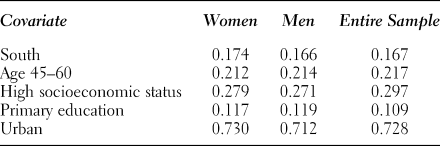
Table 1 presents the means for a small group of selected covariates in the female and male matched groups as well as for the entire sample. In Appendix B, we report the results for all the covariates and include the standardized differences between female and male respondents. The results show that the three groups (i.e., female, male, and entire sample) have similar means (i.e., proportions) for their observed characteristics. As a reminder, that was one of the main goals of generating a matched sample that resembles the unmatched sample.
Covariate balance

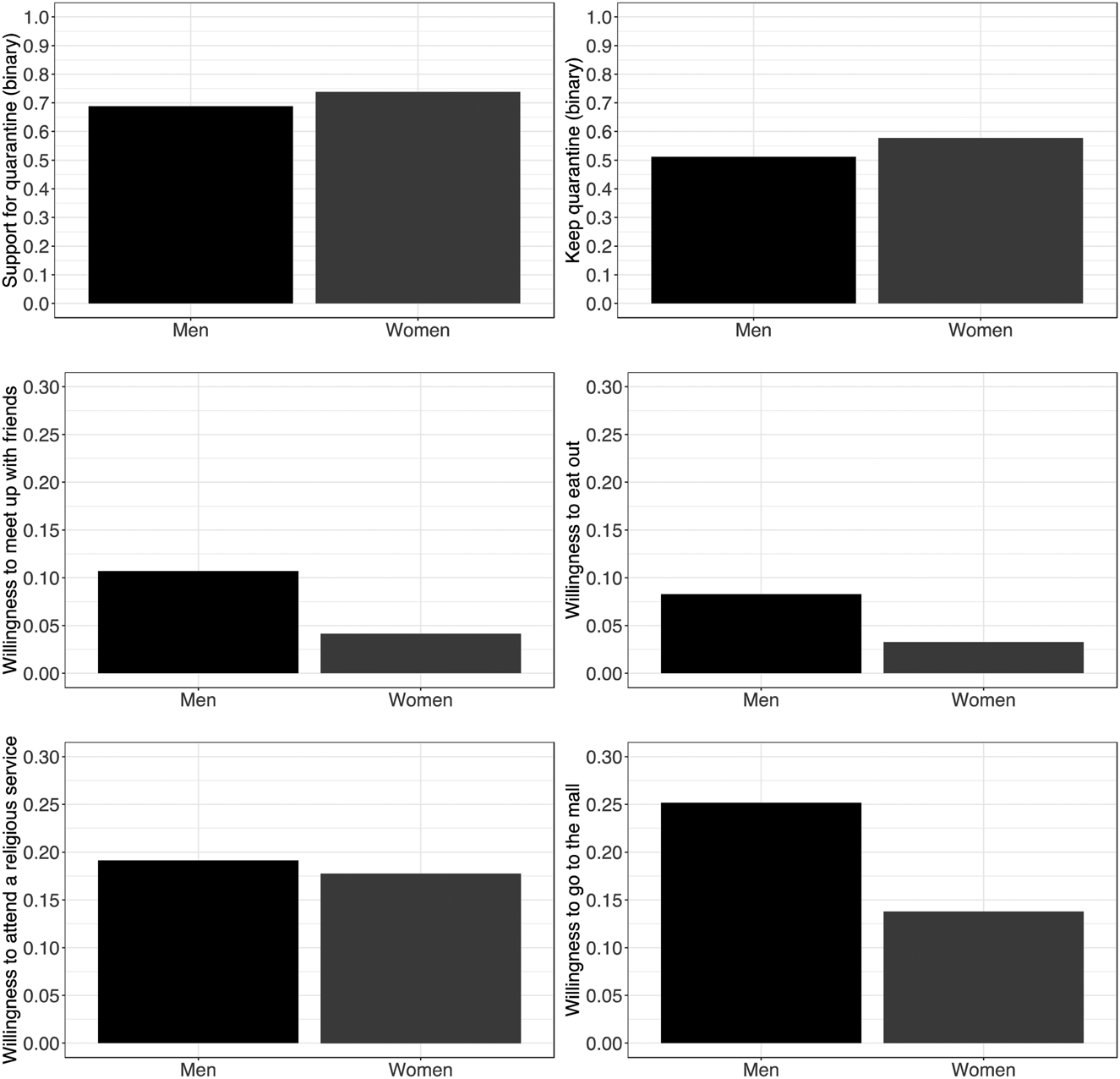
Figure 1 provides a first glimpse of the disparities between women and men across the six outcomes studied in this article. The largest gaps are observed for willingness to meet up with friends, to eat out, and to go to the mall.
Disparities between men and women.

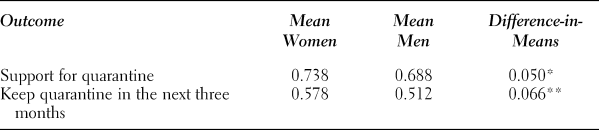
Table 2 reports the means for the female and male groups and the difference-in-means to test H1. The results show that women are more likely than men to support the quarantine and support continuing the quarantine over the next three months. To measure quarantine endorsement, we asked respondents, “To what extent do you agree or disagree with the quarantine that has been adopted to deal with the coronavirus?” To measure support for maintaining the quarantine, we asked, “To what extent do you agree or disagree with continuing the quarantine during the winter months (June, July, August)?” The answers to both questions were recorded following a scale: 1 = strongly disagree, 2 = disagree, 3 = neither agree nor disagree, 4 = agree, and 5 = strongly agree. We use a binary variable as our outcome to improve comparability across outcomes and to avoid removing missing values, where 1 denotes agree or strongly agree and 0 other responses. In Appendix E, we report the results using the original scale and therefore drop some units; the findings are the same.
Gender disparities (H1)

* p < .1; ** p < .05; *** p < .01.
The difference-in-means indicates that women are 5 percentage points more likely than men to support the quarantine. The proportion of women saying that they agree or strongly agree with the quarantine is 73.8%, whereas the proportion of men who are supportive of the quarantine is only 68.8%. When asked about the upcoming three months, women are also significantly more likely than men to report strong support for maintaining the quarantine. The proportion of men supportive of continuing the quarantine is 51.2%, whereas the proportion of women is 57.8%. The difference-in-means indicates a gender gap in quarantine support of 6.6. percentage points.
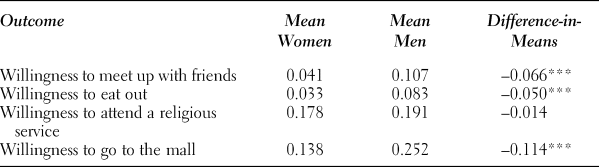
Table 3 reports the gender disparities as the previous table but now to test H2 about the willingness to engage in specific behaviors. The results show, again, that there is a statistically significant gender gap in attitudes toward public health recommendations. Except for attending a religious service, women in general are more compliant than men with COVID-19 preventive measures. Women are 6.6 percentage points less likely to be willing to meet up with friends, 5 percentage points less likely to eat out, and 11.4 percentage points less likely than men to go to the mall. Interestingly, we find no evidence of gender disparities in attending a religious service. While women seem to abide by the government recommendations to avoid social gatherings and crowded places to a greater extent than men, attending church is not an activity that women are willing to give up or postpone, at least not significantly more so than men. The intense religiosity of women in Peru, as in Latin America in general, could explain the lack of differences in religious service attendance by gender. An analysis of LAPOP (Latin American Public Opinion Project) data indicates that women attend church more often than men in every Latin American country.Footnote 11
Gender disparities (H2)

* p < .1; ** p < .05; *** p < .01.
Matching has helped us reduce observed differences between female and male respondents, but there might still be unobserved covariates that are more likely to be present in one of the groups and that could affect the outcomes. To assess the magnitude of this issue, we implement a sensitivity test for unmeasured biases to measure how much hidden bias would need to be present to modify the findings of this study (Rosenbaum Reference Rosenbaum2002).
The analysis relies on the parameter Γ representing the differential odds of being a woman due to the existence of unmeasured covariates. Simply put, Γ = 1.0 means that two individuals with the same observed characteristics will have identical odds of being women or men, while Γ > 1.0 means that one of these two people will have greater odds of being a woman in our study due to a variable that we are failing to adjust for. The test allows us to know the value of Γ at which we stop seeing significant differences between women and men—in other words, what magnitude of hidden biases we are able to tolerate. The largest Γ value is obtained when using the outcome “willingness to meet up with friends.” Specifically, in a pair of two individuals with the same observed characteristics, one of the two may be almost two times more likely than the other to be a woman because of the presence of unobserved biases, and the conclusion will still be that women are significantly less likely to meet up with friends than men. We include the results for each outcome in Appendix F.
MULTIVARIATE ANALYSIS
To evaluate H3, we implement a linear regression with an interaction between female and socioeconomic status using the matched sample. We incorporate into the analysis four key sociodemographic variables—socioeconomic status, education, age, and place of residence—that have been shown to predict attitudes towards COVID-19 containment measures and compliance with public health guidelines in other countries (Brankston et al. Reference Brankston, Merkley, Fisman, Tuite, Poljak, Loewen and Greer2021; Brouard, Vasilopoulos, and Becher Reference Brouard, Vasilopoulos and Becher2020; Saeed, Al-Shahrabi, and Bolarinwa Reference Saeed, Al-Shahrabi and Bolarinwa2021).Footnote 12 We also control for health vulnerability, which is coded 1 if the respondent or someone in their house is older than 60 or suffers from chronic diseases, and 0 otherwise. Although previous studies suggest COVID-19 policy attitudes are filtered through partisan or ideological lenses in other contexts (Calvo and Ventura Reference Calvo and Ventura2021; Gadarian, Goodman, and Pepinsky Reference Gadarian, Goodman and Pepinsky2021; Utych Reference Utych2020), we are not able to include variables such as ideology or partisanship in the regression because these items were not included in our survey. However, we think this should not affect the main results in any way because the party system in Peru has collapsed (Dietz and Myers Reference Dietz and Myers2007; Levitsky Reference Levitsky and Mainwaring2018; Levitsky and Cameron Reference Levitsky and Cameron2003). Political parties in Peru struggle to establish party brands or packages of policy positions, and they can rarely provide cues or shortcuts to citizens.Footnote 13 We use robust standard errors in all our analyses.
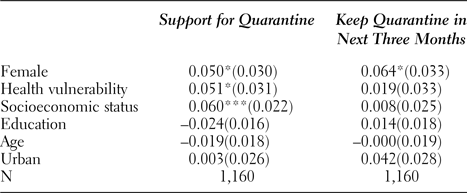
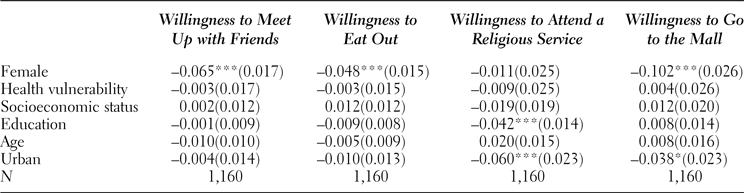
Before testing H3, we use this multivariate analysis using the matched sample and key control variables as a robustness check to show that the conclusions of our study are not contingent on the estimation strategy used to evaluate gender disparities. Tables 4 and 5 again evaluate H1 and H2, but now using a multivariate regression analysis with five controls rather than a permutational t-test. In Appendix G, we report the results of the same regression analyses using the unmatched sample; the main results do not change.
Gender disparities (H1) using regression analysis and matched sample

* p < .1; ** p < .05; *** p < .01.
Gender disparities (H2) using regression analysis and matched sample

* p < .1; ** p < .05; *** p < .01.
The results of these robustness analyses are entirely consistent with the results of the matching analysis reported earlier. The coefficients capturing the gender of the respondent remain statistically significant in all models except the one predicting willingness to attend religious services, and the magnitude of the relationship between gender and our outcomes of interest is very similar to what was reported in the matching analysis. It is also important to note that gender is by far the strongest and most consistent predictor of support for COVID-19 containment measures and compliance with public health recommendations in the early phase of the pandemic, which reinforces our confidence in our conclusions.
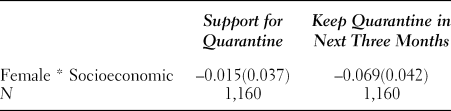
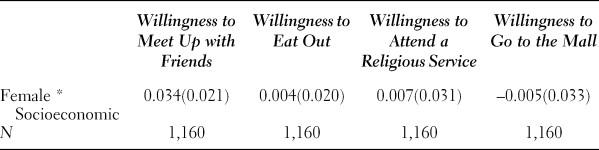
To evaluate H3, we use the same models but adding an interaction between socioeconomic status and gender. We only report the coefficient of interest. As expected, the results in Tables 6 and 7 show that the relationship between gender and attitudes toward lockdowns/compliance with public health guidelines is not contingent on socioeconomic status. In other words, women across different socioeconomic groups are more likely to support quarantines and to comply with public health recommendations.
Gender disparities by socioeconomic status using regression analysis (part 1)

Note: Results not shown: female, health vulnerability, socioeconomic status, education, age, and urban/rural.
* p < .1; ** p < .05; *** p < .01.
Gender disparities by socioeconomic status using regression (part 2)

Note: Results not shown: female, health vulnerability, socioeconomic status, education, age, and urban/rural.
* p < .1; ** p < .05; *** p < .01.
CONCLUSION
The COVID-19 pandemic is a major public health crisis that requires strong government action to slow the spread of the virus. However, most governments (especially in the developing world) lack the capacity to enforce lockdown measures and other public health guidelines. Public compliance with public health measures and recommendations is therefore critical for limiting the spread of COVID-19. Previous research has shown that factors such as age, education, ideology, and partisanship shape compliance with COVID-19 measures (Allcott et al. Reference Allcott, Boxell, Conway, Gentzkow, Thaler and Yang2020; Brouard, Vasilopoulos, and Becher Reference Brouard, Vasilopoulos and Becher2020; Calvo and Ventura Reference Calvo and Ventura2021; Gadarian, Goodman, and Pepinsky Reference Gadarian, Goodman and Pepinsky2021; Utych Reference Utych2020).
In this article, we have provided evidence of a gender gap in attitudes toward COVID-19 public health recommendations. We find that women are more likely than men to endorse lockdown measures and to support the continuation of a nationwide quarantine. We also find that there is a gender gap in willingness to comply with social distancing recommendations (i.e., public health advice to avoid social gatherings and crowded areas).
Why are women more likely to endorse lockdown measures and more willing to comply with public health advice? In line with social role theory, we argue that these attitudinal and behavioral differences are closely connected with the social and family roles occupied by women (especially in developing countries). Women continue to shoulder a disproportionate amount of domestic workload and caring responsibilities. The socialization of women into these gender roles leads to an internalization of traits such as compassion, altruism, and prosocial considerations (Beutel and Marini Reference Beutel and Marini1995; Eagly et al. Reference Eagly, Diekman, Johannesen-Schmidt and Koenig2004; Eagly and Steffen Reference Eagly and Steffen1984). These traits, in turn, explain support for strong government interventions to help the most fragile groups in society. We argue this is the main reason explaining the gender gap in support for lockdown measures.
In addition to the gender gap in compassion and prosocial traits, two psychological factors also contribute to explaining stronger female adherence to public health recommendations. First, women tend to be more risk averse than men in different tasks, as documented in previous research (Byrnes, Miller, and Schafer Reference Byrnes, Miller and Schafer1999; Croson and Gneezy Reference Croson and Gneezy2009). Second, women tend to be more conscientious and rule compliant than men (Grosch and Rau Reference Grosch and Rau2016; Tom and Granie Reference Tom and Granie2011). Therefore, women are more likely to comply with public health recommendations issued by the government, especially if doing so leads to a reduced risk of infection.
Our findings have important policy implications. The results suggest that the way public health recommendations to fight COVID-19 are communicated to the public might need to be reconsidered to maximize compliance by both women and men. Adhering to COVID-19 public health guidelines is sometimes presented as an “act of kindness”Footnote 14 or an “act of love.”Footnote 15 These messages are more likely to increase compliance among women because they appeal to stereotypical female traits. We believe governments should complement these messages with messages that also appeal to men, among whom levels of noncompliance are higher. For instance, public health messages that emphasize a connection between widespread adherence with social distancing measures (or mask-wearing) and a faster (and more complete) economic recovery might resonate with men who identify with the stereotypical role of the breadwinner (Lane Reference Lane2020). Alternatively, messages that present compliance with public health measures as a patriotic act to protect the nation might also appeal more strongly to men (Vazquez, Bash, and Collins Reference Vazquez, Bash and Collins2020). Note that we are not recommending that governments exclusively use economic or patriotic frames in their public health messages, thereby eliminating messages that emphasize caring and kindness. While the exclusive use of male-oriented or female-oriented messaging risks reinforcing traditional gender stereotypes, more targeted messaging based on sound empirical analyses of noncompliance patterns could help increase overall compliance rates.
Finally, we expect our findings to be generalizable to other similar developing countries in Latin America. Gender relations in Peru are not atypical. Many of the patterns of gender inequality we describe in this article (i.e., the unequal division of caring and household responsibilities, disproportional participation of women in low-paying jobs in the informal sector, and violence against women) are present throughout the region. Given that the socialization of women into traditional gender roles can lead them to internalize stereotypically female attributes such as empathy or compassion, we expect this socialization to result in a gender gap in compliance with COVID-19 policies in other Latin American countries as well. Nevertheless, a more definitive understanding of the generalizability of our results undeniably awaits further research. We welcome future studies that assess how gender shapes support for (and compliance with) COVID-19 containment policies in Latin America and other developing countries.
SUPPLEMENTARY MATERIAL
To view supplementary material for this article, please visit https://doi.org/10.1017/S1743923X21000386