1 Introduction
Primary breakup of turbulent liquid jets is subject to multiple influences such as aerodynamic shear, interfacial instabilities and cavitation as well as turbulence within the liquid jet. Various experiments have been performed in order to identify the effects of individual mechanisms. It has proven especially useful to focus on the onset of jet breakup. For high liquid-to-gas density ratios and inlet conditions for which cavitation and aerodynamic shear are negligible, this near-field process is controlled mainly by liquid-phase turbulence.
For this regime, Wu & Faeth (Reference Wu and Faeth1995), here denoted WF, correlate the breakup-onset location
 $x_{i}$
scaled by the jet diameter
 $D$
in terms of the jet Weber number
 $We$
using a theory based on the phenomenology of homogeneous isotropic turbulence (HIT), yielding the prediction
 $x_{i}/D\propto We^{-2/5}$
. They fit a power-law dependence of
 $x_{i}/D$
on
 $We$
to measurements of
 $x_{i}/D$
versus
 $We$
, giving
 $x_{i}/D\propto We^{-0.67}$
, where the range of reasonable agreement with the measurements begins at
 $We=5\times 10^{4}$
. They deem this to be acceptable agreement of the theory with the measurements considering the simplicity of the theory.
Sallam & Faeth (Reference Sallam and Faeth2003), here denoted SF, note that the theory also predicts that the Sauter mean diameter (SMD) of droplets released at the onset location scales as
 $We^{-3/5}$
. They find that the best power-law fit to their measurements is
 $We^{-0.94}$
. They do not consider the deviation from the theoretical prediction to be statistically significant.
Here, a different physical picture of the mechanism of onset is proposed which is based on the flow state at the injector orifice. Prediction of the relevant mean properties of this state is based on classical boundary-layer (BL) phenomenology. It is assumed that the portion of the injector flow that is closest to the injector walls controls the eventual occurrence of breakup onset during the subsequent evolution of the liquid jet. The justification is that this is the region of highest mean shear, which tends to promote breakup. This is a strong assumption because this shear rapidly decays after the flow transitions from no-slip boundary conditions in the nozzle to free-slip boundary conditions (to a good approximation provided that the liquid-to-gas density ratio is large) upon exiting the nozzle. Nevertheless, it is assumed that the jet retains sufficient residual influence of the initial jet state so that scaling analysis based on that state is applicable to the estimation of the parameter dependences of breakup onset.
The BL analysis is used to estimate the local mean shear as a function of distance
 $y$
from the injector wall. The shear is expressed as the inverse of a time scale that is interpreted as the turnover time
 $t$
of the eddy that induces breakup onset, which is adopted as an estimate of the elapsed time from issuance of fluid from the nozzle to the onset of breakup. WF proceed similarly, except that they evaluate the turnover time
 $t$
of the breakup-inducing eddy using inertial-range turbulence phenomenology that does not invoke a mean shear.
The analysis is explained first in terms of
 $t$
without specifying its parameter dependences, and then the parameter dependences of
 $t$
are derived by expressing
 $t$
as a length scale
 $L$
divided by a velocity scale
 $V$
. It is shown that the parameter dependences of
 $L$
and
 $V$
determine the dependences of
 $x_{i}/D$
and the SMD at onset on
 $We$
and
 $Re$
respectively. This allows unambiguous comparisons of the implications of the HIT and BL pictures of the turbulence phenomenology governing breakup onset.
Although the role of liquid-phase BL phenomenology that is proposed here is novel, effects of the gas-phase boundary layer are recognized and understood in the context of air-assisted liquid-jet breakup (Raynal Reference Raynal1997; Varga, Lasheras & Hopfinger Reference Varga, Lasheras and Hopfinger2003; Kourmatzis & Masri Reference Kourmatzis and Masri2014). That regime typically involves liquid injection into a high-speed laminar or turbulent gas stream, in contrast to the liquid jets in still air that have been used to study breakup dominated by liquid-phase turbulence. Since there is a continuous (although not necessarily monotonic) variation of the relative aerodynamic and liquid-phase contributions as the gaseous co-flow is increased, the two contributions are comparable in importance under some conditions. Therefore, a complete theory of breakup onset would need to encompass both contributions, such that the behaviour in the limiting cases of dominance by one or the other contribution is recovered.
In principle, the present study facilitates this synthesis by providing evidence that the liquid-phase contribution to breakup onset might be more analogous to the aerodynamic mechanism than previously supposed. It will be noted, however, that the new BL picture is not fully consistent with observations, so future steps towards the attainment of a fully satisfactory theory of the liquid-phase-dominated regime are recommended, which would establish the foundation for subsequent incorporation of aerodynamic phenomenology to obtain a comprehensive theory.
2 Analysis
Both here and in WF,
 $t$
is a monotonically increasing function of eddy size, so the relevant
 $t$
value is the turnover time of the smallest allowed eddies, whose size is denoted
 $l_{e}$
. It is assumed that
 $l_{e}$
approximates the size of droplets formed by such eddies.
The Rayleigh criterion
 $t_{s}\sim (\unicode[STIX]{x1D70C}l_{d}^{3}/\unicode[STIX]{x1D70E})^{1/2}$
, where
 $\unicode[STIX]{x1D70C}$
is the liquid density and
 $\unicode[STIX]{x1D70E}$
is the surface tension, determines the minimum size
 $l_{d}$
of droplets that can be generated by a given shear
 $1/t_{s}$
. Substituting
 $l_{e}$
for
 $l_{d}$
and
 $t$
for
 $t_{s}$
based on assumptions thus far,
 $$\begin{eqnarray}t\sim (\unicode[STIX]{x1D70C}l_{e}^{3}/\unicode[STIX]{x1D70E})^{1/2}\end{eqnarray}$$
is obtained, establishing a relationship between
 $t$
and the smallest possible eddy size,
 $l_{e}$
, which is not yet known. To evaluate
 $l_{e}$
, modelling is used to obtain another relationship between
 $t$
and
 $l_{e}$
.
For this purpose, WF use HIT phenomenology. To obtain their breakup-onset scaling, the inertial-range scaling of
 $t$
is expressed as
 $t\sim (D/U)(l_{e}/D)^{2/3}$
, where
 $U$
is the jet bulk velocity. This is equivalent to the specialization of equation (2) of WF to the inertial range. Substitution of this into (2.1) gives
 $l_{e}/D\sim We^{-3/5}$
, where
 $We=\unicode[STIX]{x1D70C}U^{2}D/\unicode[STIX]{x1D70E}$
. From this, the inertial-range scaling of
 $t$
is used to obtain
 $t\sim (D/U)We^{-2/5}$
.
Based on the assumption in § 1 that the eddy turnover time
 $t$
approximates the elapsed time until breakup onset, the onset location
 $x_{i}$
scales as
 $Ut$
, so
 $$\begin{eqnarray}x_{i}/D\sim Ut/D.\end{eqnarray}$$
The WF result for
 $t$
then yields
 $x_{i}/D\sim We^{-2/5}$
. The assumption that
 $l_{e}$
approximates the size
 $l_{d}$
of droplets released at onset then gives
 $l_{d}/D\sim We^{-3/5}$
.
The analysis based on the BL picture differs from the foregoing only in the modelling that determines the
 $l_{e}$
dependence of
 $t$
. The first step is to evaluate the shear at the nozzle wall using the Blasius friction law
 $2(u_{\unicode[STIX]{x1D70F}}/U)^{2}=CRe^{-1/4}$
(Schlichting & Gersten Reference Schlichting and Gersten2000), where
 $u_{\unicode[STIX]{x1D70F}}$
is the friction velocity,
 $Re=UD/\unicode[STIX]{x1D708}$
,
 $\unicode[STIX]{x1D708}$
is the kinematic viscosity, and the empirical coefficient
 $C=0.079$
and other numerical factors are henceforth omitted from scaling estimates. Substitution of the definition of
 $Re$
and the definition
 $u_{\unicode[STIX]{x1D70F}}^{2}=\unicode[STIX]{x1D708}(\unicode[STIX]{x2202}u/\unicode[STIX]{x2202}y)$
, where
 $u(y)$
is the streamwise mean velocity profile and its partial derivative is evaluated at the wall, into the friction law gives the wall-shear scaling
 $\unicode[STIX]{x2202}u/\unicode[STIX]{x2202}y\sim (U^{2}/\unicode[STIX]{x1D708})Re^{-1/4}$
and thus
 $$\begin{eqnarray}u_{\unicode[STIX]{x1D70F}}\sim U\,Re^{-1/8}.\end{eqnarray}$$
The mean shear is derived as a function of
 $y$
using the law of the wall, expressed as
 $u(y)/u_{\unicode[STIX]{x1D70F}}=\unicode[STIX]{x1D705}^{-1}\ln (yu_{\unicode[STIX]{x1D70F}}/\unicode[STIX]{x1D708})+B$
, where
 $B$
and the von Kármán constant
 $\unicode[STIX]{x1D705}$
are empirical coefficients. From this,
 $\text{d}u/\text{d}y\sim u_{\unicode[STIX]{x1D70F}}/y$
, corresponding to the time scale
 $t_{s}\sim y/u_{\unicode[STIX]{x1D70F}}$
.
It is assumed that size-
 $l_{d}$
droplets are formed by liquid extending a distance
 $y=l_{d}$
inward from the jet boundary. Combined with the substitution of
 $l_{e}$
for
 $l_{d}$
and
 $t$
for
 $t_{s}$
based on prior assumptions, the expression for
 $t_{s}$
becomes
 $t\sim l_{e}/u_{\unicode[STIX]{x1D70F}}$
. This allows
 $l_{e}$
to be evaluated using (2.1), giving
 $l_{e}\sim \unicode[STIX]{x1D70E}/\unicode[STIX]{x1D70C}u_{\unicode[STIX]{x1D70F}}^{2}$
, which is substituted back into
 $t\sim l_{e}/u_{\unicode[STIX]{x1D70F}}$
to obtain
 $t\sim \unicode[STIX]{x1D70E}/\unicode[STIX]{x1D70C}u_{\unicode[STIX]{x1D70F}}^{3}$
. Then, (2.3) is used to obtain
 $$\begin{eqnarray}t\sim \frac{\unicode[STIX]{x1D70E}}{\unicode[STIX]{x1D70C}U^{3}}Re^{3/8}.\end{eqnarray}$$
Substituting this into (2.2) and using the definition of
 $We$
,
 $$\begin{eqnarray}x_{i}/D\sim We^{-1}Re^{3/8}\end{eqnarray}$$
is obtained. Likewise, (2.3), the scaling of
 $l_{e}$
, the definition of
 $We$
and substitution of
 $l_{d}$
for
 $l_{e}$
give
 $$\begin{eqnarray}l_{d}/D\sim We^{-1}Re^{1/4}.\end{eqnarray}$$
In § 3, it is shown that the
 $We$
dependences predicted by (2.5) and (2.6) are well supported by measurements, but the measurements give no indication of
 $Re$
dependences as strong as predicted. In fact, they do not exclude the possibility that there is no dependence on
 $Re$
.
Formally, the absence of
 $Re$
dependence can be obtained by assuming
 $V=U$
instead of
 $V=u_{\unicode[STIX]{x1D70F}}$
in the relation
 $t\sim L/V$
, which eliminates the
 $Re$
dependences without affecting the
 $We$
dependences. In this regard, note that here and also in the HIT analysis, the dependence of
 $L$
on
 $l_{e}$
(and a power of
 $D$
that maintains dimensional consistency) determines, through (2.1), the
 $We$
dependence of
 $l_{e}/D$
and consequently of
 $x_{i}/D$
and
 $l_{d}/D$
, while the velocity scale
 $V$
that is adopted determines the
 $Re$
dependences of
 $x_{i}/D$
and
 $l_{d}/D$
.
This raises the question of what physical mechanism could explain the dependence
 $t\sim y/U$
. A definitive answer is not yet in hand, but a plausible candidate is the near-field structure of the mean pressure field. In the fully developed nozzle flow that has been implicitly assumed, the mean pressure gradient is constant and axially oriented. Upon exiting the nozzle, the flow becomes transient, and so the mean pressure field also varies radially. Since the flow is subsonic, mean pressure effects extend over large scales, implying possible large-scale adjustments of flow features such as the velocity normalization in the law of the wall. The available large-scale velocity is the bulk velocity
 $U$
. This motivates the hypothesis that such adjustment suppresses the inlet-flow
 $Re$
dependence partially or entirely while preserving the logarithmic cross-stream structure near the jet perimeter. This hypothesis is testable through either measurements or detailed numerical simulations, which are therefore recommended as further steps towards complete understanding of near-field turbulent jet behaviours that affect the onset of breakup.
3 Comparison with measurements
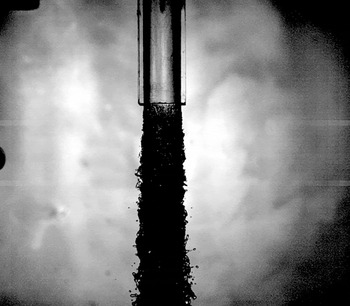
In the published experimental studies whose implications are revisited here, care was taken to assure that the nozzle flow closely approximated fully developed pipe flow, as explained, e.g., by WF and Wu, Miranda & Faeth (Reference Wu, Miranda and Faeth1995). This does not guarantee that the flow state downstream of the nozzle orifice is fully determined by the nozzle flow. The injector tube necessarily has a finite thickness, implying the possible formation of one or more recirculation zones downstream of the end face of the tube. For the high liquid-to-gas density ratios in the experiments, the high inertia of the jet implies that these are gas-phase recirculation zones. This is supported by the image in figure 1, which suggests negligible near-field influence of the ambient air on the jet. Farther downstream, any aerodynamic coupling should be further mitigated by jet-induced gas flow, which tends to reduce interfacial shear that might affect the liquid flow. However, these attributes can be sensitive to details such as the tube thickness and the degree of planarity and smoothness of the tube face. The possibility that some liquid is entrained into the recirculation zones, which would increase their momentum coupling to the jet, cannot be ruled out. These points illustrate that it is difficult to construct a precisely canonical experimental configuration. In this regard, detailed numerical simulations of cases with nominally zero-thickness tubes might be advantageous for obtaining definitive resolution of the ambiguities noted in § 2.
Image of near-field breakup in a 95 % ethanol jet issuing from a 1 cm diameter nozzle at a bulk velocity of
 $15~\text{m}~\text{s}^{-1}$
, corresponding to
 $Re=72\,000$
and
 $We=78\,000$
.

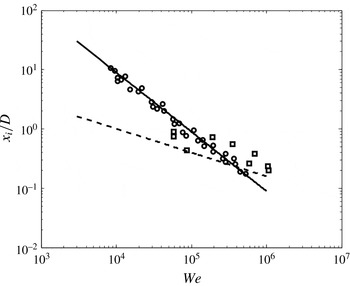
WF presented the results of several experimental studies in a plot of
 $x_{i}/D$
versus
 $We$
. The reported measurements of breakup-onset location are replotted in figure 2, along with line segments representing the HIT prediction
 $We^{-2/5}$
and the BL prediction
 $We^{-1}$
. The BL prediction is in better agreement with the measurements than the HIT prediction.
Measured Weber-number dependence of the normalized breakup-onset location
 $x_{i}/D$
from the data compilation by WF. Data points designated by open squares are deemed to be outliers, as explained in the text. Solid line,
 $We^{-1}$
dependence (BL prediction); dashed line,
 $We^{-2/5}$
dependence (HIT prediction).

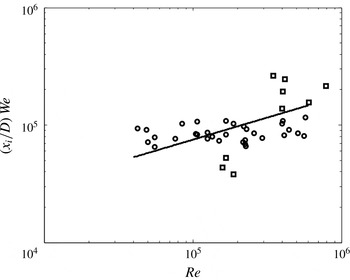
WF do not state the
 $Re$
values corresponding to the data points, but they can be inferred from their plotted data, information in the plot legends and the definitions of
 $We$
and
 $Re$
. On this basis, figure 3 is obtained. The vertical axis is compensated so that any apparent dependence on
 $Re$
cannot be caused by a correlation between the
 $We$
and
 $Re$
values of the chosen experimental cases. The plot gives no definitive indication of
 $Re$
dependence, though it is possible that a mild dependence is masked by the statistical scatter of the data.
Reynolds-number dependence of the
 $We$
-compensated normalized breakup-onset location. The
 $Re$
values of the individual data points are deduced from information provided by WF, as explained in the text. Data points designated by open squares correspond to the similarly designated data points in figure 2. Solid line,
 $Re^{3/8}$
dependence (BL prediction).

To reduce this scatter, selected outlier cases relative to the
 $We^{-1}$
correlation line, designated by open squares in figure 2, are similarly designated in figure 3. The clustering of the outliers in both figures suggests that the cause of their deviations from the overall trends in these figures is systematic rather than statistical. Because these points are farthest from the
 $We^{-1}$
correlation line in figure 2, the compensation factor used in figure 3 is least effective in removing their
 $We$
dependence. This contributes to their deviations from collapse of the data in figure 3 as a function of
 $Re$
. Without these cases, it is seen that a systematic dependence on
 $Re$
can be ruled out with increased precision. On this basis, the
 $Re^{3/8}$
dependence predicted by the BL analysis, shown in the plot, is clearly inconsistent with the measurements, although the data can be plausibly interpreted as indicating a weaker dependence. In what follows, the theoretical interpretation is based on the default assumption that
 $x_{i}/D$
does not depend on
 $Re$
.
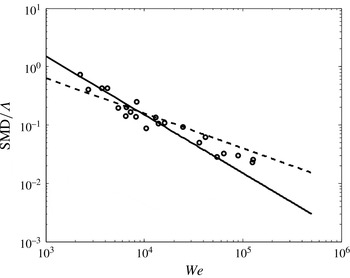
Measurements of the Weber-number dependence of the droplet SMD at onset, normalized by the cross-stream integral scale
 $\unicode[STIX]{x1D6EC}$
, from the data compilation by SF. Solid line,
 $We^{-1}$
dependence (BL prediction); dashed line,
 $We^{-3/5}$
dependence (HIT prediction).

SF report measurements from various sources as well as their own measurements of droplet SMD at onset as a function of
 $We$
. They normalized the SMD using the cross-stream integral scale
 $\unicode[STIX]{x1D6EC}$
, for which they adopted the circular-pipe empirical correlation
 $\unicode[STIX]{x1D6EC}=D/8$
. Their data are replotted in figure 4 with superimposed line segments whose slopes correspond to the HIT and BL predictions.
SF propose that the droplet diameter should correlate with the ligament diameter, for which they obtain
 $We^{-0.94}$
dependence based on a best fit to data. They then show that this empirical dependence likewise fits their droplet SMD data very well. (This procedure is used rather than a direct fit to the droplet data because the ligament data conform to power-law behaviour more closely than the droplet data.) The
 $We^{-0.94}$
dependence that they thus infer is substantially closer to the BL prediction than to their HIT prediction.
Insufficient information is provided to back-calculate
 $Re$
for the individual points, so
 $Re$
dependence cannot be evaluated quantitatively. However, the fairly good collapse of the data as a function of
 $We$
suggests that any
 $Re$
sensitivity is likely to be weak, which does not necessarily exclude the
 $Re^{1/4}$
dependence predicted by the BL analysis.
The correlation lines in figures 2 and 4 serve not only to demonstrate that the BL predictions are more consistent with measured
 $We$
dependences than the HIT predictions, but also to provide improved theory-based inputs to empirical models of jet breakup that might be used in engineering and other applications. For this purpose, the correlations
 $$\begin{eqnarray}x_{i}/D=9\times 10^{4}We^{-1}\end{eqnarray}$$
and
 $$\begin{eqnarray}\text{SMD}/\unicode[STIX]{x1D6EC}=1.5\times 10^{3}We^{-1},\end{eqnarray}$$
corresponding to the solid lines plotted in the respective figures, are recommended.
An additional perspective on the BL analysis is obtained by expressing the typical droplet size at onset in wall units. The BL analysis assumes that the distance from the jet perimeter at which shear acts to form a droplet scales with the droplet size, and that this location is within the log layer of the precursor nozzle flow. For
 $Re=10^{4}$
, the location at which the log layer is deemed to begin is nominally 30 in wall units (Pope Reference Pope2000). The log law shows little
 $Re$
dependence at
 $Re$
values higher than this, so this lower bound on the logarithmic region is a generic high-
 $Re$
value.
Based on
 $\unicode[STIX]{x1D6EC}=D/8$
and the data in figure 4, 0.01 is taken to be a representative value of
 $l_{d}/D$
. The Blasius friction law can be expressed to a good approximation as
 $u_{\unicode[STIX]{x1D70F}}=0.2URe^{-1/8}$
. It follows that
 $l_{+}\equiv l_{d}u_{\unicode[STIX]{x1D70F}}/\unicode[STIX]{x1D708}=0.2(l_{d}/D)Re^{7/8}$
. This exceeds 30 for
 $Re>6\times 10^{5}$
, which is more that four times larger than the high end of the
 $Re$
range of the SF experimental cases. This brings into question the applicability of the BL analysis to the measurements.
There are several ambiguities that obscure the interpretation of this result. One is that the liquid region that is subject to the droplet-forming shear might not be detached in its entirety to form a droplet. Droplet release might involve an action–reaction mechanism in which a portion of the liquid rebounds and thus remains with the jet. Another is that large-scale transients possibly associated with the absence of
 $Re$
dependence of the breakup-onset location might also negate the applicability of standard law-of-the-wall phenomenology to the estimation of the extent of the log layer. These points further motivate future study of the details of breakup onset in order to clarify the governing mechanisms.
4 Discussion
The analysis presented here involves the representation of the turnover time
 $t$
of the breaking eddy in terms of the inverse of a velocity times a power of the eddy size
 $l_{e}$
(and the power of the jet diameter
 $D$
that maintains dimensional consistency). The physical picture on which the modelling is based determines which velocity scale and what power of
 $l_{e}$
are applicable. The choice of velocity scale determines the
 $Re$
dependences of breakup-onset location and SMD at onset, and the power of
 $l_{e}$
determines the
 $We$
dependences of these quantities.
It has been shown that
 $We^{-1}$
dependence of both quantities, which is well supported by the available measurements, is obtained if the dependence of
 $t$
on
 $l_{e}$
is linear. Since droplets are released from the perimeter of the jet, it is assumed that the breaking eddy occurs in a size-
 $l_{e}$
region adjacent to the perimeter. Within this region,
 $t$
is the inverse of a shear that can be estimated as
 $\unicode[STIX]{x2202}u/\unicode[STIX]{x2202}y$
evaluated at a distance
 $y=l_{e}$
from the jet perimeter. To obtain linear dependence of
 $t$
on
 $l_{e}$
, the partial derivative must scale as
 $y^{-1}$
, implying logarithmic dependence of
 $u$
on
 $y$
. This reversal of the derivation in § 2 shows that, starting from the empirical evidence and some plausible assumptions, the logarithmic
 $y$
dependence of
 $u$
can be deduced. It is natural to infer that this dependence is a residual effect of the logarithmic structure of the near-wall nozzle flow.
Proceeding therefore to more systematic (versus empirically driven) reasoning, as in § 2, the
 $Re$
dependences of the onset properties are also predicted, but in this case the results disagree with the available measurements. As noted, the
 $Re$
dependences reflect the choice of velocity scale. Choice of the bulk velocity
 $U$
instead of the friction velocity implied by the BL analysis yields agreement with the observed insensitivity of onset location to
 $Re$
and predicts that SMD at onset is likewise insensitive to
 $Re$
, but the latter result has not yet been stringently tested. A plausible explanation is that transients in the near field of the jet modify the flow structure in a way that changes the velocity scale while preserving the logarithmic
 $y$
dependence of
 $u$
near the jet perimeter. As yet, this hypothesis is not supported by any detailed reasoning or direct evidence.
The partial success of the BL picture suggests both future needs and opportunities. It would be beneficial to measure the liquid-phase flow in order to clarify why the predicted
 $We$
dependences are obeyed but the predicted lack of
 $Re$
dependence is not. Such measurements are challenging. Even in non-breaking jets, well-resolved flow measurements near the jet perimeter have not yet proven feasible (Mansour & Chigier Reference Mansour and Chigier1994; Wolf, Incropera & Viskanta Reference Wolf, Incropera and Viskanta1995). Numerical simulations would be especially suitable for clarifying the flow features that account for the observed parameter dependences, but any resulting modification of the theory would have to be tested experimentally due to the need for parameter variations beyond the range of computationally affordable simulations.
In § 1, it is noted that a sufficiently improved theory of the breakup regime dominated by liquid-phase turbulence could enable further steps towards the unification of this liquid-phase BL treatment and the gas-phase BL treatment that has proven useful for interpreting features of air-assisted jet breakup. It is also noteworthy that studies of the latter regime (Raynal Reference Raynal1997; Varga et al. Reference Varga, Lasheras and Hopfinger2003; Kourmatzis & Masri Reference Kourmatzis and Masri2014) involve coaxial flow configurations in which the speed of the co-flowing air is known and controllable. In contrast, the data used in the present study are from jets into still air, in which details of the jet-induced air flow are typically sensitive to uncontrolled influences such as far-field conditions. This ambiguity is inconsequential for breakup governed solely by the liquid-phase flow, although it does raise the concern that the exclusion of significant aerodynamic effects might not be definitive in the absence of gas flow measurements. Based on these considerations, it would be beneficial to study the liquid-phase-dominated regime using the coaxial configuration because it would enable better control and characterization of aerodynamic effects and it would also allow systematic increase of aerodynamic influence in order to identify the intermediate behaviours that occur as the breakup mechanism transitions to eventual aerodynamic dominance. The ultimate benefit of this investigation would be a more comprehensive theory of breakup onset, although challenges such as the treatment of cavitation effects would remain.
Several conclusions can be drawn from the analysis and results presented here. First, logarithmic flow structure near the jet perimeter provides a straightforward explanation of the experimentally observed
 $We$
dependence of both onset location and SMD at onset. Second, the origins of this flow structure and of the velocity scaling implied by the measured insensitivity of onset location to
 $Re$
can be clarified in the future by measurements and detailed numerical simulations that focus on this question. Third, the HIT picture of breakup onset, heretofore accepted as the definitive interpretation of breakup onset, is now seen to be neither the unique nor the most plausible physical picture of this phenomenon.
Acknowledgements
The authors thank M. Linne for providing the previously unpublished image shown in figure 1. This work was supported by the Knut & Alice Wallenberg Foundation.