Introduction
Difficulties with emotional and social functioning are theorized to play an important role in the development and maintenance of eating disorders (EDs) (Schmidt & Treasure, Reference Schmidt and Treasure2006). The literature in this area has been reviewed recently (Zucker et al. Reference Zucker, Losh, Bulik, LaBar, Piven and Pelphrey2007). Several difficulties have been identified for people with EDs: (1) high levels of insecure and avoidant attachment styles (Ward et al. Reference Ward, Ramsey, Turnbull, Benedettini and Treasure2000), (2) limited social networks (Tiller et al. Reference Tiller, Sloane, Schmidt, Troop, Power and Treasure1997), (3) high levels of submissive behaviour and (4) unfavourable social comparisons (Troop et al. Reference Troop, Allan, Treasure and Katzman2003; Connan et al. Reference Connan, Troop, Landau, Campbell and Treasure2007), which contribute to negative self-evaluation, a predisposing risk factor for all forms of EDs (Fairburn, Reference Fairburn, Mann and Truswell1998). Interpersonal stress forms a central component of a neurodevelopmental hypothesis for the aetiology of anorexia nervosa (AN) (Connan et al. Reference Connan, Campbell, Katzman, Lightman and Treasure2003) and problematic interpersonal relationships are thought to be one of the maintaining factors for AN (Schmidt & Treasure, Reference Schmidt and Treasure2006). The underlying factors that contribute to this problem in social and affective functioning have not yet been defined, although there is interest in attentional processes, emotion recognition and regulation.
Attentional biases
Posner & Petersen (Reference Posner and Petersen1990) describe attentional bias as the propensity to look for, and be attentive to, certain information in the environment. Power & Dalgleish (Reference Power and Dalgleish1997) assert that attentional processes are implicated in the onset and maintenance of emotional disorders. There have been two systematic reviews and meta-analyses that have found attentional biases in participants with EDs of medium effect sizes to food- and body shape-related stimuli (Dobson & Dozois, Reference Dobson and Dozois2004; Johansson et al. Reference Johansson, Ghaderi and Andersson2005). There has been less research on attentional biases to social or emotional stimuli in people with EDs. McManus et al. (Reference McManus, Waller and Chadwick1996) report data that equate to a medium effect size for verbal stimuli relating to threats from others towards the self in a mixed ED group compared to controls. Although other authors have explored a variety of threatening, disorder-salient stimuli/cues (Quinton, Reference Quinton2004; Meyer et al. Reference Meyer, Serpell, Waller, Murphy, Treasure and Leung2005), attentional biases to ecologically valid, pictorial, social stimuli, such as faces, represent a new area of research. Ashwin et al. (Reference Ashwin, Wheelwright and Baron-Cohen2006) developed a pictorial Stroop task that assesses attentional biases to faces (angry and neutral) compared to neutral stimuli (chairs) and found attentional biases to all faces (angry and neutral) in 17 males with Asperger syndrome but not in controls. Using this task in an ED sample could contribute to filling the previously identified gap in the literature. Anger is a highly salient and threatening emotion for individuals with EDs (Fox & Power, Reference Fox and Power2009; Ioannou & Fox, Reference Ioannou and Fox2009) and is reported to contribute to disordered eating (Fox & Froom, Reference Fox and Froom2009). Therefore, we were interested in examining whether people with EDs had an attentional bias to angry faces.
Emotion recognition
A recent review of experimental paradigms investigating emotion recognition in people with EDs (Oldershaw, Reference Oldershaw2009) reported a medium-sized effect. Individuals with AN were found to show difficulties with demanding tasks, such as labelling basic emotions in the absence of verbal cues (Zonnevijlle-Bender et al. Reference Zonnevijlle-Bender, van Goozen, Cohen-Kettenis, van Elburg and van Engeland2002; Zonnevylle-Bender et al. Reference Zonnevylle-Bender, van Goozen, Cohen-Kettenis, van Elburg, de Wildt, Stevelmans and van Engeland2004a, Reference Zonnevylle-Bender, van Goozen, Cohen-Kettenis, van Elburg and van Engelandb), paradigms using verbal stimuli (Kucharska-Pietura et al. Reference Kucharska-Pietura, Nikolaou, Masiak and Treasure2004), forced-choice paradigms (Pollatos et al. Reference Pollatos, Herbert, Schandry and Gramann2008), and those utilizing complex emotions, such as ‘interest’, ‘contempt’ and ‘shame’ (Kucharska-Pietura et al. Reference Kucharska-Pietura, Nikolaou, Masiak and Treasure2004). Individuals with AN (Harrison et al. Reference Harrison, Sullivan, Tchanturia and Treasure2009; Oldershaw, Reference Oldershaw2009; Russell et al. Reference Russell, Schmidt, Doherty, Young and Tchanturia2009) have more difficulty labelling emotional states when restricted to viewing only the eyes in the Reading the Mind in the Eyes task (Baron-Cohen et al. Reference Baron-Cohen, Wheelwright, Hill, Raste and Plumb2001).
Emotional regulation
Family members report that individuals with AN lose their emotion regulation skills and are more irritable, moody and prone to temper tantrums (Smith, Reference Smith2003). Gilboa-Schechtman et al. (Reference Gilboa-Schechtman, Avnon, Zubery and Jeczmien2006), using the Negative Mood Regulation Scale (Catanzaro & Mearns, Reference Catanzaro and Mearns1990) and the Trait Meta-Mood Scale (Salovey et al. Reference Salovey, Mayer, Goldman, Turvey, Palfai and Pennebaker1995), found poorer emotional regulation strategies in their ED group compared to controls. Gratz & Roemer (Reference Gratz and Roemer2004) have developed a multi-dimensional approach to assessing emotion regulation. Their Difficulties in Emotion Regulation Scale (DERS) has shown sensitivity to change after emotion-focused group therapy (Gratz & Gunderson, Reference Gratz and Gunderson2006) in people with borderline personality disorder. We decided to explore this measure in an ED sample because of its multifaceted approach and the high co-morbidity between EDs, particularly bulimia nervosa (BN), and borderline personality disorder (Sansone et al. Reference Sansone, Levitt and Sansone2004).
Ochsner's (Reference Ochsner2008) model of social and emotional processing posits that emotion recognition, regulation and attentional processes are interconnected skill sets, all required for successful social affective functioning. In a previous pilot study, we found that difficulties in emotional recognition in women with AN were associated with difficulties in self-reported emotion regulation (Harrison et al. Reference Harrison, Sullivan, Tchanturia and Treasure2009). In the present study, the aim was to extend this work by measuring attentional biases to faces using a pictorial Stroop task. The research aimed to address emotional functioning, both transdiagnostically (across all EDs) and between diagnostic subtypes.
Based on the previously highlighted social and emotional functioning difficulties reported in people with EDs, the first hypothesis was that the ED group would demonstrate a longer response time (greater attentional bias) to name the colour of social stimuli (all faces) compared to non-social stimuli (chairs) than controls. A second hypothesis was that there would be a stronger attentional bias to angry faces compared to neutral faces in people with EDs. In addition, we predicted difficulties in recognizing emotions from the eyes and in self-reported emotion regulation skills in the ED group, compared to controls.
Method
Participants
All participants were female and were eligible to take part in the study if they were aged between 18 and 55 years and were not colour blind. Participants with EDs, either AN or BN, were recruited from the South London and Maudsley National Health Service (NHS) Foundation Trust Eating Disorder Services, the Institute of Psychiatry Eating Disorders Research Unit's volunteer database, through a circular email sent out to the staff and students at King's College London and through putting up posters in the local community. A DSM-IV (APA, 1994) diagnosis of an ED was obtained either from a clinician or through using the Eating Disorder Examination (EDE) Version 16 (Fairburn, Reference Fairburn2008) on the day of testing. The AN and HC groups are not the same participants reported in our previous publication using similar measures (Harrison et al. Reference Harrison, Sullivan, Tchanturia and Treasure2009).
HCs were recruited from the local community using advertisements, through an email circulated to staff and students at King's College London and through personal contacts. HCs were excluded if they reported a personal or familial history (first-degree relative) of a diagnosed psychological disorder.
Measures and procedure
The study received ethical approval from the NHS Research Ethics Committee (Oxfordshire C) and all participants provided informed consent. Participants completed the following measures.
Measures of emotional functioning
Pictorial Stroop task (Ashwin et al. Reference Ashwin, Wheelwright and Baron-Cohen2006)
This is a computerized task that records response times using DMDX (Forster & Forster, Reference Forster and Forster2003) computer software. The stimuli are presented in three blocks of 48, with two short rest periods. The social stimuli are male and female angry and neutral faces and the non-social stimuli are pictures of chairs. The stimuli are presented randomly on the computer screen in the colours red, yellow, blue or green. The outcome variables are described in detail in the data analysis section.
Reading the Mind in the Eyes task (Baron-Cohen et al. Reference Baron-Cohen, Wheelwright, Hill, Raste and Plumb2001)
In this task the participant is shown a series of 36 sets of eyes on a computer screen. Around each set of eyes are four words and the participant selects which one of the four words most closely matches what the person in the picture is thinking or feeling. A definition booklet is provided. There are no time limits. The outcome variable is the percentage of correct answers, with lower scores relating to greater difficulties with emotion recognition. A control task component is also included, in which the participant is presented with 10 sets of eyes and asked to state whether the eyes belong to either a male or a female. Hallerbäck et al. (Reference Hallerbäck, Lugnegård, Hjärthag and Gillberg2009, p. 139), using the Bland–Altman method to measure the limits of agreement (Bland & Altman, Reference Bland and Altman1986), found the task had ‘fairly good’ test–retest reliability.
DERS (Gratz & Roemer, Reference Gratz and Roemer2004)
The DERS is a 36-item self-report scale measuring emotion regulation. The participant is asked to rate their responses across a five-point scale: 1=almost never (0–10%), 2=sometimes (11–35%), 3=about half the time (36–65%), 4=most of the time (66–90%) and 5=almost always (91–100%). There are six discrete but interconnected subscales and also a total score. Higher scores indicate greater difficulties with emotion regulation. The six subscales are:
(1) Non-acceptance of emotional responses: a tendency towards having negative secondary responses to one's own negative emotions or not accepting emotional reactions to distress.
(2) Difficulties in engaging in goal-directed behaviour: difficulties concentrating and accomplishing tasks when experiencing negative emotions.
(3) Impulse control difficulties: difficulties with remaining in control of behaviour when experiencing negative emotions.
(4) Lack of emotional awareness: difficulties associated with attending to and acknowledging emotions.
(5) Limited access to emotion regulation strategies: a belief that, once upset, little can be done to regulate emotions.
(6) Lack of emotion clarity: how much an individual knows and understands the emotions they are experiencing.
Cronbach's α for this sample for the DERS total score was 0.94, which is comparable to Gratz & Roemer's (Reference Gratz and Roemer2004) score of 0.93. Like Gratz & Roemer, Cronbach's α values for the subscales were in the range 0.80–0.89.
Clinical measures
The 21-item Depression, Anxiety and Stress Scale (DASS-21; Lovibond & Lovibond, Reference Lovibond and Lovibond1995b)
This self-report measure assess levels of depression, anxiety and stress (seven items each), and gives a total DASS score. The DASS-21 uses a three-point scale that ranges from 0 (did not apply to me over the past week) to 2 (applied to me very much or most of the time over the past week). Participants in the HC group were excluded if they scored above the normal range of >5 for depression, >4 for anxiety and >8 for stress. Cronbach's α for this sample was 0.92 for the total score, 0.96 for the stress scale, 0.92 for the depression scale and 0.82 for the anxiety scale, comparable to those published by Lovibond & Lovibond (Reference Lovibond and Lovibond1995a) of 0.90 for stress, 0.91 for depression and 0.84 for anxiety.
The Obsessive Compulsive Inventory Revised (OCI; Foa et al. Reference Foa, Huppert, Leiberg, Langner, Kichic, Hajcak and Salkovskis2002)
This inventory assesses the frequency and associated distress of seven obsessive–compulsive symptom domains: washing, checking, doubting, ordering, obsessing, hoarding and mental neutralization. Participants in the HC group were excluded if they scored above the clinical cut-off score of 18 (Foa et al. Reference Foa, Huppert, Leiberg, Langner, Kichic, Hajcak and Salkovskis2002). Cronbach's α for this sample for the total score was 0.93.
The Eating Disorder Examination Questionnaire (EDE-Q; Fairburn & Beglin, Reference Fairburn and Beglin1994)
This is a 36-item self-report measure focusing on the past 28 days. Items addressing ED attitudes are scored using a seven-point scale. Subscales and a global score are calculated, with scores of ⩾4 on key items considered within the clinical range. HCs scoring in the clinical range of ⩾4 were excluded.
The National Adult Reading Test (NART; Nelson & Willison, Reference Nelson and Willison1991)
In this test the participant is asked to read out loud a list of non-phonetic words. A greater number of incorrect pronunciations relate to an increasingly lower pre-morbid IQ estimation score. The NART IQ estimation correlates positively with full-score IQ, as measured using the British version of the Wechsler Adult Intelligence Scale Revised (WAIS-R; Wechsler, 1981), ranging from r=0.77 (Crawford, 1992) to r=0.81 (Crawford et al. 1989).
Data analysis
Construction of attentional bias variables
The Stroop task yields response times to each of the randomly presented 144 stimuli, which are female angry, female neutral, male angry and male neutral faces, and chairs. To explore the hypothesis that there would be differences in attentional bias to social stimuli between the ED and HC groups, a social attentional bias variable was derived by taking the mean response time (in milliseconds) to colour name all social stimuli (all faces, both male and female, angry and neutral) and subtracting from this the mean response time to colour name non-social stimuli (chairs). A positive number relates to an attentional bias to social stimuli, with higher numbers indicating a stronger attentional bias.
To permit analysis of the hypothesis that there would be a difference in attentional bias to angry faces between the ED and HC groups, an angry-threat attentional bias variable was derived and was calculated by taking the mean response times to colour name the angry faces (both male and female) and subtracting the mean response time to colour name the neutral faces (both male and female). A positive number relates to an attentional bias to angry-threat stimuli, with higher numbers indicating a stronger attentional bias.
Data were explored for assumptions of normality. Kolmogorov–Smirnov tests were significant (p<0.05) and visual inspections of histograms indicated that data were not normally distributed. Transformations were unsuccessful. Therefore, medians are provided, along with the interquartile range (IQR). χ2 tests were used for categorical data and Spearman's ρ was used for correlations. Rosenthal's r (Rosenthal, Reference Rosenthal1991) was used as an estimation of effect size, with 0.10 defined as a small effect, 0.30 a medium effect and 0.50 a large effect (Cohen, Reference Cohen1988, Reference Cohen1992). Hochberg's (Reference Hochberg1988) correction was used to correct conservatively for multiple testing, with corrected values displayed in parentheses. This is a sequential correction thought to provide better power, as it accounts for the fact that the number of comparisons reduces each time a hypothesis is rejected. Hochberg's correction was selected over other sequential methods because we were not concerned about potential dependencies between tests.
Results
The analysis plan was to examine emotional functioning for EDs as a whole, followed by subgroup analysis of the diagnostic subtypes.
Clinical and demographic characteristics
The final sample consisted of 190 participants: 90 HCs and 100 in the ED group. Fifty of the ED group had AN [35 had restricting anorexia nervosa (RAN) and 15 had binge purge anorexia nervosa (BPAN)] and 50 had BN. Of those in the ED group, 6% (n=6) were in-patients, 7% (n=7) were day patients, 72% (n=72) were out-patients and 15% (n=15) were not currently receiving treatment. Of those in the ED group, 38% had a previous hospital admission.
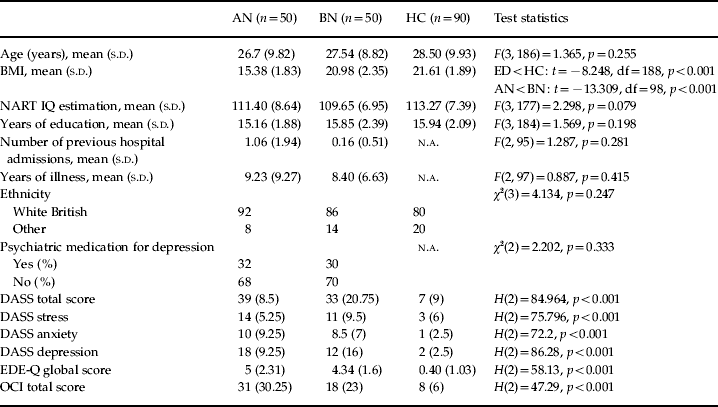
Table 1 provides demographic information and data on the levels of disordered eating, depression, anxiety and obsessive–compulsive traits, all of which were significantly higher in the clinical groups. As Table 1 illustrates, those with an ED had a significantly lower body mass index (BMI) than HCs. Those with BN had a significantly higher BMI than those with AN. There were no differences between the ED and HC groups regarding age, IQ score estimated using the NART, or years of education. The groups did not differ significantly regarding ethnicity. There were no differences within the ED group regarding the use of antidepressants, years of illness, or number of previous hospital admissions.
Demographic and clinical characteristics of the sample

AN, Anorexia nervosa; BN, bulimia nervosa; HC, healthy controls; ED, eating disorder; BMI, body mass index; NART, National Adult Reading Test; DASS, Depression Anxiety and Stress Scale; EDE-Q, Eating Disorders Examination Questionnaire; OCI, Obsessive Compulsive Inventory; df, degrees of freedom; s.d., standard deviation; n.a., not applicable.
For parametric data (age, BMI, NART, years of education, number of previous hospitalizations and years of illness) statistics reported are means, followed by standard deviations in parentheses. For non-parametric data (DASS, EDE-Q and OCI), statistics reported are medians followed by the interquartile range in parentheses. Test statistic column for DASS, EDE-Q and OCI presents Kruskal–Wallis H. For the other measures, χ2 or ANOVAs are used.
Results from the Pictorial Stroop task and the Reading the Mind in the Eyes task
Social attentional bias
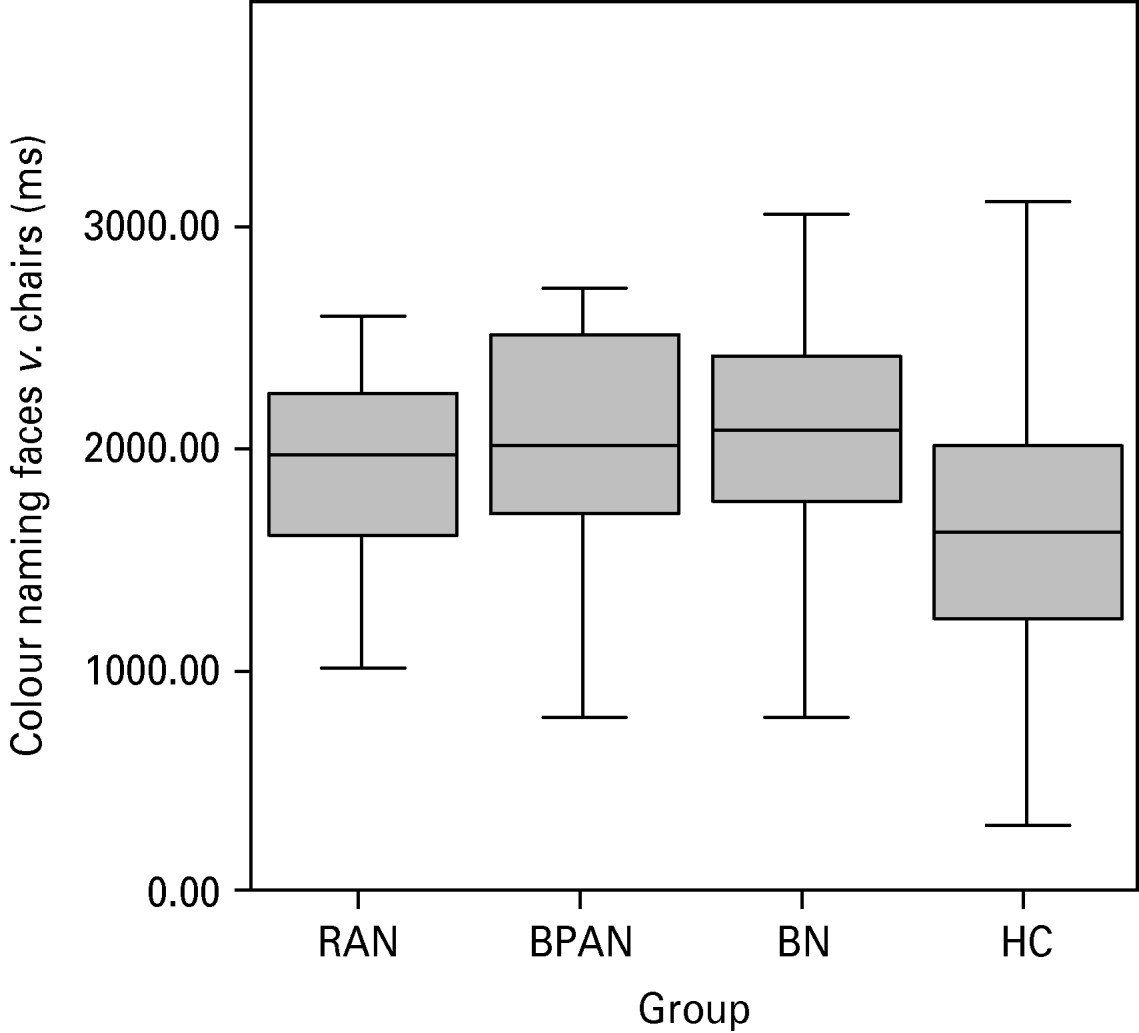
There was a significant main effect of group for the colour naming of social stimuli. The ED group [median=1989.72, interquartile range (IQR)=607.33] compared to HCs (median=1608.64, IQR=789.32) had longer colour naming times [U=2441, p<0.001 (p=0.007 after correction)], with a medium effect size of 0.35. As illustrated in Fig. 1, both AN and BN participants had significantly longer colour naming times than HCs and did not differ significantly from each other [U=874.5, p=0.113 (p=0.113 after correction)]. There were no differences between diagnostic subtypes.
Graph illustrating time taken to colour name social stimuli (all faces) versus neutral stimuli (chairs). RAN, Restricting anorexia nervosa; BPAN, binge purge anorexia nervosa; BN, bulimia nervosa; HC, healthy control.

Angry-threat attentional bias
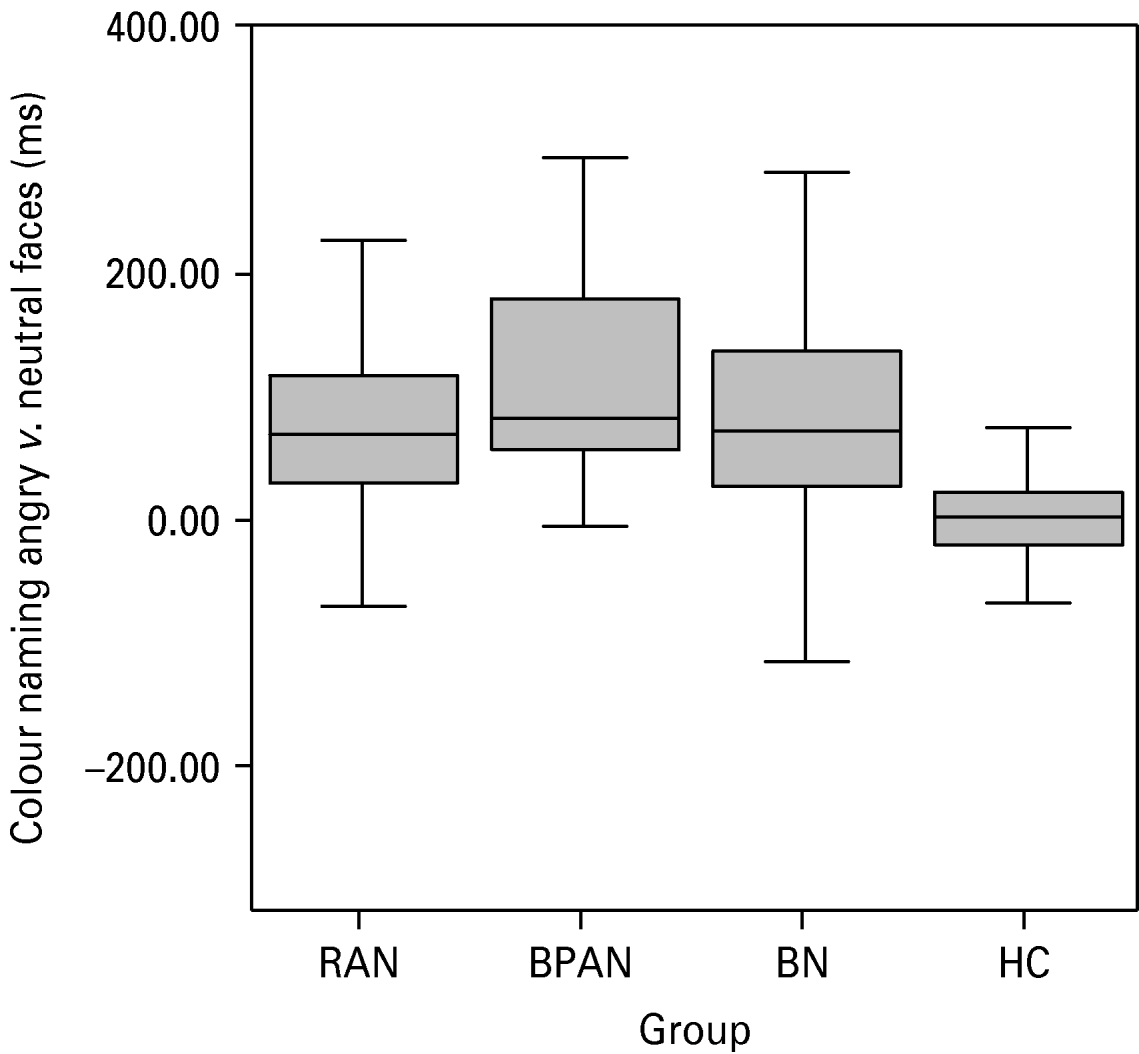
There was a significant main effect of group for the colour naming of angry-threat stimuli. The ED group (median=67.76, IQR=98.04) compared to HCs (median=−0.39, IQR=−2.78) had longer colour naming times for angry faces than neutral faces [U=1726, p<0.001 (p=0.005 after correction)], with a large effect size of 0.5. As illustrated in Fig. 2, both AN and BN participants had significantly longer colour naming response times than HCs and did not differ significantly from each other [U=1115, p=0.923 (p=0.923 after correction)]. There were no differences between diagnostic subtypes.
Graph illustrating time taken to colour name angry-threatening faces versus neutral faces. RAN, Restricting anorexia nervosa; BPAN, binge purge anorexia nervosa; BN, bulimia nervosa; HC, healthy control.

Reading the Mind in the Eyes
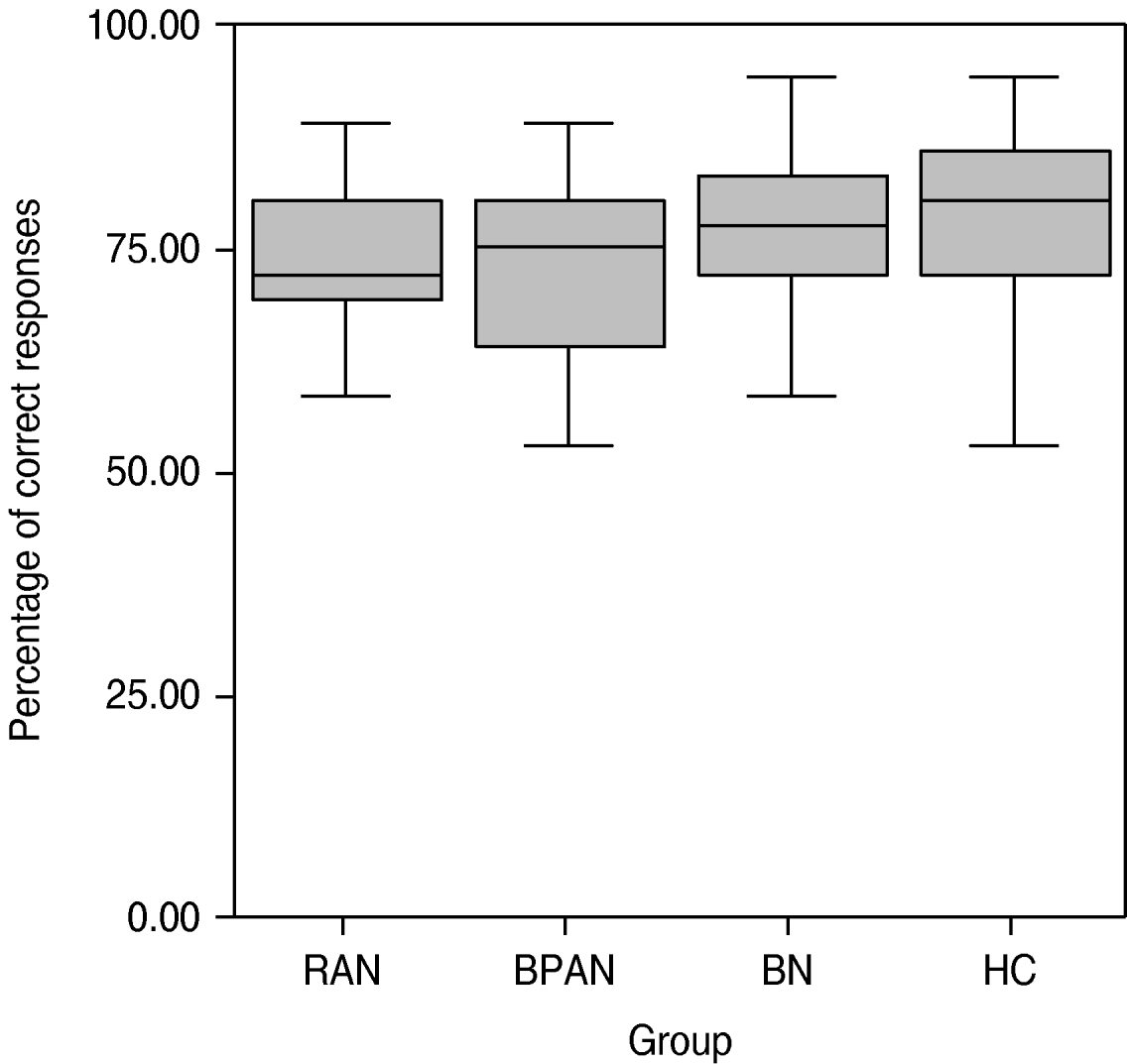
There was a significant main effect of group for the number of correct responses on the Reading the Mind in the Eyes task. The ED group (median=75, IQR=8.31), compared to HCs (median=80.33, IQR=6.93) recognized fewer correct emotions [U=3152, p=0.005 (p=0.04 after correction)], with a small-medium effect size of 0.21. The BN group scored significantly more correct answers than those with AN [U=874.5, p=0.113 (p=0.113 after correction)] and were equivalent to the HCs [(U=1635.5, p=0.083 (p=0.113 after correction)]. Subsequent analysis of AN subtypes revealed that the overall difference between the ED and HC groups was driven by the RAN group, who differed significantly from HCs (U=1037.5, p=0.013), although this difference fell to trend level after the correction was applied (p=0.091). The BPAN and HC groups, however, did not differ significantly [(U=479, p=0.081 (p=0.339 after correction)]. These findings are illustrated in Fig. 3.
Graph illustrating percentage of correct responses on the Reading the Mind in the Eyes task. RAN, Restricting anorexia nervosa; BPAN, binge purge anorexia nervosa; BN, bulimia nervosa; HC, healthy control.

These results did not differ when the ED group was split according to those who were and were not taking antidepressant medication.
Results from the DERS
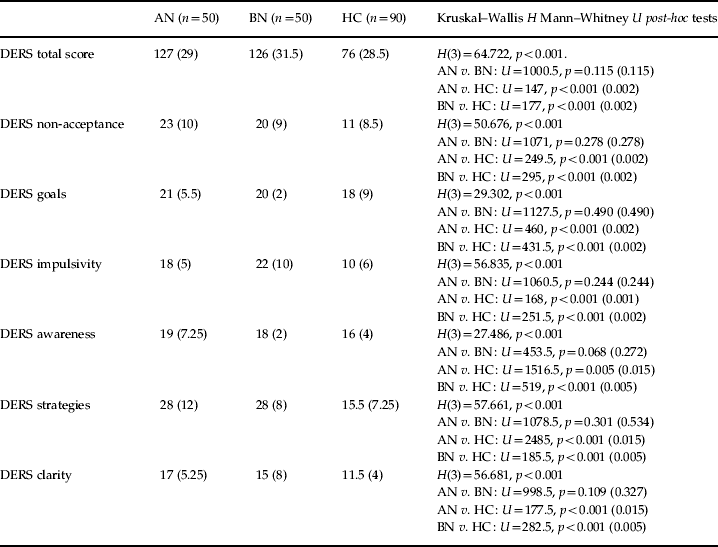
Table 2 presents the results from the DERS. There was a main effect of group for the DERS total score and all of its subscales. Further analysis showed that the ED group had poorer emotional regulation (median=127, IQR=35) than HCs (median=76, IQR=28.5) for the total DERS score [(U=324, p<0.001 (p=0.005 after correction)], with a large effect size of 0.67. Subsequent subgroup analysis revealed no significant differences between diagnostic subtypes.
Results from the Difficulties in Emotion Regulation Scale (DERS)

AN, Anorexia nervosa; BN, bulimia nervosa; HC, healthy control; DERS, Difficulties in Emotion Regulation Scale.
Test statistic column presents main analysis of AN v. BN v. HC groups followed by post-hoc analysis.
Statistics reported are medians, followed by interquartile ranges (IQR) in parentheses.
Analysis of covariance: assessing IQ as a confound
There was a trend for IQ to be lower in the ED group (mean=110.56, s.d.=7.89) than HCs (mean=113.27, s.d.=7.39). Therefore, the analysis for the Reading the Mind in the Eyes task, the Stroop task and DERS was rerun with NART-estimated IQ scores as a covariate. We found that NART-estimated IQ contributed significantly to scores on the Reading the Mind in the Eyes task [F(2, 189)=9.624, p<0.001] and the DERS total score [F(1, 190)=9.624, p<0.001] but was not related to the social attentional bias scores [F(1, 190)=0.004, p=0.950] or to the angry-threat attentional bias scores [F(1, 190)=0.749), p=0.379]. When controlling for NART-estimated IQ, the significant difference between ED and HCs remained for the Reading the Mind in the Eyes task [F(2, 189)=5.306, p=0.006] and the DERS total score [F(2, 189)=54.333, p=0.002].
Associations between ED pathology and emotional functioning within the ED group
Within the ED group, a correlation analysis was carried out to examine associations between the Reading the Mind in the Eyes task, the Stroop social and angry-threatening attentional biases and the EDE-Q global score. There were no associations for the Stroop outcome measures but the Reading the Mind in the Eyes task was significantly and negatively correlated with the EDE-Q global score (r=−0.396, p=0.017), such that a higher global EDE-Q score, suggesting greater eating pathology, was associated with a lower percentage of correct scores on the Reading the Mind in the Eyes task. This correlation remained significant after controlling for anxiety and depression, as measured by the DASS-21 (r=−0.345, p=0.04).
Association between BMI and Reading the Mind in the Eyes task performance
Within the entire sample (ED and HC), there was no correlation between the Reading the Mind in the Eyes task and BMI after controlling for anxiety and depression (r=0.16, p=0.09). Poor performance on the Reading the Mind in the Eyes task was limited to the AN group, particularly RAN. However, across the entire ED group, there was no relationship between BMI and scores from the Reading the Mind in the Eyes task (r=0.15, p=0.142) after controlling for anxiety and depression. The other emotional functioning measures did not correlate with BMI.
The predictors of self-reported emotion regulation difficulties
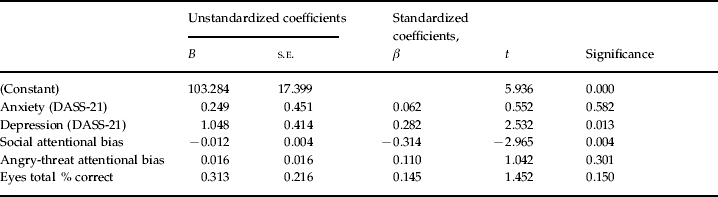
A linear regression (Table 3) was carried out to explore the predictive values of DASS-21 anxiety and depression, social attentional bias, angry-threat attention bias and emotion recognition (Reading the Mind in the Eyes task) on difficulties in emotion regulation (total DERS score). The model was significant [F(5, 82)=−4.662, p=0.001] and predicted 22.1% of the variance. Depression and attentional bias to social stimuli (all faces) significantly predicted difficulties with emotion regulation.
An examination of the impact of emotion variables on emotional regulation difficulties: linear regression analysis

DASS-21, 21-Item Depression Anxiety and Stress Scale; s.e., standard error.
Discussion
The aim of this study was to use a multifaceted approach to emotional functioning to measure emotion recognition, regulation and attentional processes. The findings support the first hypothesis, as the ED group had a greater attentional bias for social stimuli (all faces) (medium effect). This bias was present across all diagnostic subtypes. The findings also support the second hypothesis, as there was a greater attentional bias to angry faces within the ED group, with a large effect. This result was also present across all diagnostic subtypes. The hypothesis predicting emotion recognition difficulties in the ED group was met in part, as people with restricting AN, but not other ED groups, had difficulty recognizing emotions from the eyes (small effect). Poor emotional regulation was reported across the ED group (large effect).
The attentional bias to social stimuli is comparable to the medium-sized effect reported for people with Asperger syndrome using the same paradigm (Ashwin et al. Reference Ashwin, Wheelwright and Baron-Cohen2006) and is perhaps associated with social phobia, which is a common co-morbidity for people with EDs (Halmi et al. Reference Halmi, Eckert, Marchi, Sampugnaro, Apple and Cohen1991; Godart et al. Reference Godart, Flament, Curt, Perdereau and Jeammet2003). The attentional biases for angry faces found in the ED group provide further support for the salience of anger for people with EDs (Fox & Harrison, Reference Fox and Harrison2008; Fox & Power, Reference Fox and Power2009; Ioannou & Fox, Reference Ioannou and Fox2009). The medium-sized effects for these biases are comparable to those reported for food, body, weight and shape stimuli in Johansson et al. (Reference Johansson, Ghaderi and Andersson2005) and Dobson & Dozois' (Reference Dobson and Dozois2004) meta-analyses.
Previous studies have found reduced emotional recognition in ED, as summarized by Oldershaw's (Reference Oldershaw2009) systematic review. This study replicates the findings of Harrison et al. (Reference Harrison, Sullivan, Tchanturia and Treasure2009), Oldershaw (Reference Oldershaw2009) and Russell et al. (Reference Russell, Schmidt, Doherty, Young and Tchanturia2009), who all report significantly lower correct scores for AN participants compared to controls on the Reading the Mind in the Eyes task. Of note, these difficulties are not found across the ED spectrum, in that people with BN were similar to HCs.
The problem in emotional recognition, as measured by the Reading the Mind in the Eyes task, is not specific to AN, as similar findings are reported in a range of other disorders, including autism, schizophrenia and depression (Baron-Cohen et al. Reference Baron-Cohen, Wheelwright, Hill, Raste and Plumb2001; Craig et al. Reference Craig, Hatton, Craig and Bentall2004; Kelemen et al. Reference Kelemen, Keri, Must, Benedek and Janka2004; Hefter et al. Reference Hefter, Manoach and Barton2005; Lee et al. Reference Lee, Harkness, Sabbagh and Jacobson2005; Golan et al. Reference Golan, Baron-Cohen and Hill2006; Havet-Thomassin et al. Reference Havet-Thomassin, Allain, Etcharry-Bouyx and Le Gall2006; Irani et al. Reference Irani, Platek, Panyavin, Calkins, Kohler, Siegel, Schachter, Gur and Gur2006; Losh & Piven, Reference Losh and Piven2006; Murphy, Reference Murphy2006; Kettle et al. Reference Kettle, O'Brien-Simpson and Allen2008). By contrast, Fertuck et al. (Reference Fertuck, Jekal, Song, Wyman, Morris, Wilson, Brodsky and Stanley2009) report that individuals with borderline personality disorder have superior scores on this measure, compared to controls. Performance on the Reading the Mind in the Eyes task was not correlated with BMI, across the entire sample and within the ED group, suggesting that low weight may not entirely explain this finding.
The emotion regulation difficulties in the ED group (median=127) are higher than those reported for subclinical forms of BN (81.52, s.d.=20.34) (Whiteside et al. Reference Whiteside, Chen, Neighbors, Hunter, Lo and Larimer2007) and similar to those reported for borderline personality disorder participants (mean=127.92, s.d.=19.99) (Gratz & Gunderson, Reference Gratz and Gunderson2006). The attentional bias to social cues and depression contributed to emotion regulation difficulties, accounting for 22.1% of the variance.
Limitations
Participants were self-selecting, which may have introduced some sampling bias. However, groups were reasonably matched for IQ, age and years of education. Subdividing the AN group may have resulted in a loss of power and replications with larger sample sizes would be beneficial. The DERS is a relatively new measure and clinical cut-offs are not yet available. Clarifying self-reports by collecting data from patients' carers on emotion regulation strategies and adding an experimental measure of emotion regulation would improve the method. For example, one approach to measure emotion regulation within the anxiety disorder literature has been to show films and use self-report measures (Emotion Regulation Questionnaire; Gross & John, Reference Gross and John2003) alongside objective physiological measures (heart rate, skin conductance level and respiratory sinus arrhythmia) (Campbell-Sills et al. Reference Campbell-Sills, Barlow, Brown and Hofmann2006). Further research could address this.
Clinical implications
The results can help to inform clinical practice, such that we now have improved understanding of the specific difficulties people with EDs may have in emotional functioning.
Conclusions
In summary, the results show that people with AN and BN report greater difficulties with emotion regulation and show greater attentional biases for social affective cues (longer latencies to colour name faces, particularly angry faces) than controls. However, only those with AN, specifically RAN, have difficulties with recognizing emotions from the eyes. Depression and attentional biases to social stimuli significantly predicted difficulties with emotion regulation. These may be state dependent or a trait present in those with a history of EDs.
Acknowledgements
We thank Dr C. Ashwin, Bath University, and Prof. S. Baron-Cohen from the Cambridge Autism Research Centre for providing us with the pictorial Stroop task and the Reading the Mind in the Eyes task and our colleagues Dr M. Roberts and K. Davis from the Eating Disorders Unit who arranged this initial collaboration. Special thanks to A. Oldershaw from the Institute of Psychiatry for her helpful comments on the paper. A. Harrison is supported by a Nina Jackson Research into Eating Disorders (RIED) studentship in collaboration with the Psychiatry Research Trust (registered charity no. 284286). The research was also supported by a Department of Health National Institute for Health Research (NIHR) Programme Grant for Applied Research entitled ARIADNE (Applied Research into Anorexia Nervosa and Not Otherwise Specified Eating Disorders), reference no. RP-PG-0606-1043.
Declaration of Interest
None.