Introduction
Following the end of World War I (WWI), the victorious Allies created a series of new states on the basis of national self-determination. As US President Woodrow Wilson put it in a speech in February 1918, “national aspirations must be respected; people may now be dominated only by their own consent. ‘Self-determination’ is not a mere phrase; it is an imperative principle of action” (quoted in Colby Reference Colby1918, 718). Although it had won universal acceptance, Wilson’s principle of national self-determination was not applied evenly: not all nations attained statehood, and the states that were created, though many had a titular nationality, could hardly be considered nation-states given their heterogeneous demographics. As a result, restive ethnic minorities, many of which harbored resentment over their loss of the right to self-rule, were suddenly coexisting within the borders of newly created countries. Unsurprisingly, tensions emerged and escalated between dominant ethnic groups and disadvantaged minorities throughout the interwar period (Chu Reference Chu2012, 2; MacMillan Reference MacMillan2003; Subtelny Reference Subtelny2000, 85).
The recreated Polish state epitomized the interwar oxymoron of a multiethnic nation-state. Indeed, Poland contained one of the highest percentages of ethnic minorities in all of Europe, yet it was conceived as a “state of, and for, the ethnolinguistically (and ethnoreligiously) defined Polish nation…” (Brubaker Reference Brubaker1996, 85; italics in the original). According to the 1921 Polish census data, about one-third of its 27 million inhabitants were Ukrainians, Jews, Belarusians, Germans, and other non-Poles. The minority or nationality question in interwar Poland has, expectedly, spurred considerable academic interest. Of the larger minority populations, Belarusians are perhaps the least studied. During the interwar years in Poland, Belarusian ethnic identity was ambiguous, national consciousness low, and Belarusians, who were predominantly peasants, remained largely passive in terms of making political demands. Despite the weak sense of Belarusian national consciousness and underdeveloped civil society, however, no fewer than 13 political organizations claimed to represent Belarusian minority interests in interwar Poland. Of these, the largest and most influential Belarusian political organization was the Belarusian Peasants’ and Workers’ Union Hromada (hereafter Hromada). The organization’s swift rise in popularity was unmatched by any other minority ethnic organization in interwar Poland. Yet as quickly as it gained political influence, Polish authorities banned the organization in 1927, less than two years after the group’s inception.
Why was an organization that did not resort to violence and took pains to operate within the legal framework of the Polish constitution banned by the state? Despite the fact that Hromada was the largest and most influential national movement in Belarusian modern history, there is surprisingly very little written about the organization, with no major analysis of the movement to date (Wysocki Reference Wysocki2016). The prevailing assumption in the scant existing literature is that Hromada was persecuted due to its alleged ties with the illegal Communist Party of Western Belarus and relatedly radical ideology, secessionist demands, and perceived fifth column threat (Rudling Reference Rudling2015, 243; Savchenko Reference Savchenko2009, 106–108; Śleszyński Reference Śleszyński2008, 189, 191; Szyc Reference Szyc2013, 55; Vabishchevich et al. Reference Vabishchevich and Kastyuk2006, 398). Social scientific literature on the topic of state management of opposition organizations would predict a similar outcome: secessionist or fifth column organizations with ideology deemed radical by the state are likely to be banned by the state (Capoccia Reference Capoccia2013; Issacharoff Reference Issacharoff2015; Rosenblum Reference Rosenblum2008, 426–428, 448). These explanations, however, are incomplete.
This article argues that Hromada was banned not because of its communist ideology or because it was an antisystem party. Instead, Hromada was banned because it united the Belarusian political front by suppressing organizational pluralism among the opposition; ties to irredentist neighboring states or supposed radical ideology do not always lead to state repression. Indeed, the fight against communism was used largely as a pretext by Polish state authorities to break the united Belarusian opposition—communist ideology per se does not explain why Hromada was considered dangerous to the state and thus was ultimately repressed. Rather, Hromada was threatening to Polish authorities for more tactical—not overtly ideological—reasons because the organization had the potential to unite the Belarusian political opposition. This potential to unite Belarusian political opposition was antithetical to the Polish Interior Ministry’s overall policy of dividing and thereby weakening ethnic minority political life throughout the interwar period (Fedorowycz Reference Fedorowycz2020).
The article proceeds as follows. It first describes the postwar political landscape that motivated Polish policy choices in the Eastern Borderlands, Kresy Wschodnie (Eastern Kresy) or simply kresy in Polish, followed by an outline of the main puzzle of the article and possible explanations for the variety of state policy responses. The next section outlines contours of the Belarusian political movement that operated in interwar Poland before focusing specifically on the Hromada organization. The core of the article then explains how Hromada’s ability to suppress organizational pluralism among the Belarusian opposition, rather than its ideology or classification as an antisystem party, ultimately led state authorities to delegalize the organization. The third section illustrates the impact of the shuttering of Hromada on the Belarusian population in interwar Poland. I conclude by discussing the broader implications of this research.
The Context, the Puzzle, and Possible Answers
The end of WWI brought peace to the Western front, but battles waged on for another two years in East-Central Europe, where collapsed multiethnic empires left territories vacant for political actors to scrimmage over. Wars between Poland, the Bolsheviks, and the newly declared West Ukrainian National Republic ravaged the corridor dividing present day Poland and Ukraine (Dabrowski Reference Dabrowski2014, 384–391). This corridor, known as the Eastern Borderlands or kresy in Polish, was, prior to WWI, a territory like no other—a complex montage of cultures—where standardized notions of nations did not apply. The microlevel demographics were anything but clear-cut; dividing lines between ethnic groups were hazy; identities were ambiguous, constantly in flux and more often locally constructed rather than related to state-imposed or top-down concepts of nationality (Brown Reference Brown2004, 9). In the age of national self-determination, this area presented a uniquely difficult situation for those seeking to govern it (Snyder Reference Snyder2003, 15, 52). Ultimately, the Polish armies emerged victorious in the postwar border wars, and the Treaty of Riga was signed on March 18, 1921, officially ending the Polish-Soviet war and settling Poland’s eastern borders. The Second Polish Republic formed, and Poland emerged as an independent country, for the first time since the partitions of the Polish-Lithuanian Commonwealth at the end of the 18th century.
Poland’s main concern in the ensuing interwar years was therefore consolidating its newly granted independence and (re)claiming the kresy. Indeed, the greatest threat to interwar Poland’s newfound independence, according to the Ministry of Interior (Ministerstwo Spraw Wewnętrznych; hereafter MSW), was the minority Slavic population—the Belarusians and Ukrainians—inhabiting its eastern borderlands. More specifically, Polish authorities expressed concern: “Enemies of the Polish state, and above all Russia [the Soviet Union], will seek to annex the Eastern Borderlands.”Footnote 1 Protection from this danger and incorporating the kresy in Poland was the primary task of Polish politics according to the MSW. Authorities knew, however, that military and state capacity alone would not suffice in warding off internal and external threats. The Polish state had to create strong ties, permanently linking the eastern stretches of the Republic with the rest of the state. To safeguard independence, authorities felt it was imperative that the kresy formed an integral Polish part of Poland. In a letter to the Minister of Interior dated March 1, 1923, the governor of the province of Polesie stated, “In the era of emancipatory national movements and rampant nationalism, [state capacity and force] alone cannot ensure the protection of the nascent Polish state.”Footnote 2 The Ministry of Interior in Warsaw agreed.
The interwar MSW was the most central and complex department of the Second Republic, significantly shaping the sociopolitical situation in Poland (Kozyra Reference Kozyra2009). The MSW’s main task was the overall management of the country, maintaining public order and safety, supervising local government, and compiling administrative statistics. Most relevant to this study is the MSW’s Political Department (Departament Polityczny), which is further broken down into three bureaus: Social and Political (Wydział Społeczno-Polityczny), National Minorities (Wydział Narodowościowy), and Security (Wydział Bezpeczeństwa). More specifically, the National Minorities bureau, formed in 1927, was “responsible for the supervision of the political and social lives of minority groups in Poland, as a means of keeping the government agencies informed, but also was responsible for the preparation of and advisement on laws and other legal measures concerning minorities” (Stach Reference Stach, Kleinmann, Stach and Wilson2016, 158–159). Overall, the MSW’s Political Department and its three divisions formulated, implemented, and extensively monitored minority group policies and their impact on the activities throughout all of Poland (Kozyra Reference Kozyra2009).
So why did the MSW ban Hromada? The historical literature on interwar Polish policy on Belarusians and other minorities stops short at examining group-level dynamics that focus on the relationship between the regime in power and minority groups in general, rather than studying regime policies toward specific organizations (Brubaker Reference Brubaker1996; Chojnowski Reference Chojnowski1979; Horak Reference Horak1961; Iwanicki Reference Iwanicki1993; Papierzyńska-Turek Reference Papierzyńska-Turek1979; Torzecki Reference Torzecki1972). This trend is also found in the social scientific literature, which often points to a minority’s group-level characteristics, such as the ethnic group’s population size, territorial concentration, overall perceived grievances, and their historical ties to the land they inhabit as possible determinants of state minority policies (e.g., Cederman, Gleditsch, and Buhaug Reference Cederman, Gleditsch and Buhaug2013; Toft Reference Toft2003). Other explanations of government policies point to historical power dynamics between the titular and minority groups, or the ties between a minority group and foreign, often kin, states (Mylonas Reference Mylonas2012; Petersen Reference Petersen2002). Though insightful, the arguments expounded in existing scholarship lose much of their explanatory power when the question of subgroup variation is introduced.
By failing to address the significant variation in how states manage their minorities, our current understanding does not explain the more nuanced reality. The reason for this gap is that scholars tend to conflate state policies targeted at minority organizations with ones directed at minority groups, or vice versa. Equating organization-level policies with group-level ones, however, is analytically misleading for several reasons. First, it assumes that the overwhelming majority of individuals belonging to an ethnic group support the organization targeted by the state. In reality, however, many or most individuals are ambivalent, neutral, or hold different or opposing views to that of the organization claiming to represent them (Kalyvas Reference Kalyvas2006). Overwhelming and unequivocal popular support by a group for one organization is atypical; indeed, a state’s action toward a minority group organization is often met with indifference among the minority populace at large. Second, ethnic groups do not act as a cohesive whole: they are fragmented, often containing different, competing factions (Fujii Reference Fujii2009). Thus it is incorrect to assume that, by repressing, for example, one nationalist organization, a state is repressing an entire group; it is not necessarily the group that the state perceives as a threat but rather that specific organization derived from the larger group. Conversely, state authorities can repress an entire ethnic group using discriminatory policies, like forced assimilation, but still allow opposition organizations that represent the repressed minority to operate. Indeed, a state is often more willing to cooperate with one organization over another, even when both organizations claim to represent the same ethnic minority group. The dynamics between states and ethnic minority organizations, however, remains understudied.
A separate body of literature on militant democracy focuses on the dynamics between democratic states and antisystem parties (Sartori Reference Sartori1976), not necessarily ethnic minority organizations. Capoccia defines antisystem parties as “those formations that on the basis of their ‘controlling goals’ are against the fundamentals of pluralist democracy or the territorial unity of the state, or both” (Reference Capoccia2005, 11). Scholars in this subfield research how democratic states prevent politically extreme movements—particularly fascism and communism—from exploiting democratic channels in order to seize political power and, in turn, curtail the liberal democratic freedoms that allowed them to come to power in the first place. Although this literature studies democracies, most of the conclusions drawn from it can also apply to nondemocratic states that ban antisystem parties.
Bourne and Bertoa (Reference Bourne and Bertoa2017) summarize this body of literature and outline several explanations for why, according to scholars, states ban antisystem parties. The overall consensus is that democratic states ban parties that can undermine the legitimacy of the democratic system, or would do so if they had the opportunity to participate in electoral life. Additional conditions that make antisystem parties more susceptible to state repression include the following. First, democracies are more likely to ban smaller parties, simply because it is easier to do so. Because of their numerous supporters, large parties have a more legitimate claim to exist than small parties, and banning a large party is more likely to spur anti-state upheaval from the organization’s supporters than banning a small party with few supporters. Second, newer democracies are more likely to ban parties than established democracies because newer democracies face political challenges associated with consolidating power that make repressing opposition compelling. Further, the democratic institutions that normally prevent such repressive action are not yet fully formed in an unconsolidated democracy. Third, democracies are more likely to ban parties for their antidemocratic behavior, such as violent tactics, than for their antidemocratic ideology or rhetoric. Fourth, secessionist and irredentist parties are likely to be outlawed by the state.
The above arguments do not fully explain Polish policies toward Belarusian political organizations. Explanations that look at group-level dynamics do not elucidate the subgroup variation in how state authorities treated different organizations claiming to represent the same ethnic group. As will be discussed in subsequent sections, several Belarusian minority organizations had secessionist goals, irredentist ties, and adhered to supposed radical ideology, yet they were not banned by Polish authorities. Though organizations that used violent tactics were banned—namely the Communist Party of Western Belarus and the Brotherhood of Belarusian Peasants—Hromada pursued goals through nonviolent and legal means, yet it was banned. Additionally, as will be discussed in the closing section of the article, the MSW banned two additional nonviolent Belarusian organizations. Organization size also apparently did not affect state policies of banning Belarusian organizations: Hromada was by far the largest Belarusian organization, yet the MSW banned it, while allowing several smaller organizations with similar ideological and political goals to operate.
Regime-type arguments or international context also fail to explain the variation in how Polish authorities treated ethnic minority organizations. Broadly speaking, interwar Polish nationality policies are represented by two contrasting approaches. The first, developed by the leader of the National Democrats, Roman Dmowski, defined the Polish nation in ethnic terms and implemented policies on that basis during the National Democrat’s hold on power until 1926. Accordingly, the National Democrats favored a policy of national assimilation to convert the eastern Polish borderlands and those inhabiting them, from Ukrainians and Belarusians, to ethnolinguistically Polish citizens (asymilacja narodowa). On the other hand, Józef Piłsudski and his supporters (Sanacja regime) understood the Polish nation as an inclusive concept, according to which all citizens of the state, regardless of their ethnic or religious background, belonged to the national body. It was not until after Piłsudski’s coup in May 1926 and the overthrow of the National Democrats that Piłsudski’s more inclusive concept of nationhood set the tone for the arrangement of minority policies (asymilacja państwowa).
Ideological shifts that accompanied the changing governments in interwar Poland were indeed significant and undoubtedly influenced nationality policies, but they cannot fully explain the treatment of minority political organizations. Indeed, before the 1926 coup, the National Democrats pursued discriminatory policies aimed at curtailing Belarusian political freedoms, with the ultimate goal of assimilating Belarusians into the titular Polish nation. Yet, despite these discriminatory policies directed at the Belarusian ethnic group as a whole, more Belarusian political organizations were tolerated under the National Democrats than after the May 1926 coup, when Piłsudski’s government pursued a supposedly more tolerant minority policy, despite his authoritarian tendencies. And although the reshaping of Polish political life in 1926 arguably gave Polish authorities more political power to suppress minority organizations (Rudling Reference Rudling2015, 244), this does not explain why a larger number of organizations with similar profiles were not banned (Fedorowycz Reference Fedorowycz2020). Similarly, though the international context is important in understanding domestic conflicts (Jenne Reference Jenne2015), the variation in Polish state repression of communist organizations tied to the Soviet Union does not reflect the broader diplomatic relations between Poland and the Soviet Union during the interwar period (Fedorowycz Reference Fedorowycz2020).
Beyond Ideology
The subsequent sections reveal that Hromada was not banned strictly due to what the Polish government considered its radical ideology or that it was an antisystem party, but rather it was banned for its ability to suppress organizational pluralism among Belarusian organizations. Indeed, it was the organization’s unique abilities to represent Belarusian interests consistently and to orient itself coherently in a chaotic political environment, and to use parliament to legally fight the Polish government, that alarmed Polish officials and attracted Belarusian followers.
To develop this argument, I begin with a cursory comparative look at the three other largest minority groups in interwar Poland: the Ukrainians, the Jews, and the Germans. I then turn to the Belarusian Hromada as an in-depth case study to illustrate this argument and to better understand the state’s management of minorities in interwar Poland.
The Ukrainian organization Sel-Rob was banned in 1932, presumably for its ties to communism and irredentist goals. However, it was no secret to the MSW that Sel-Rob was a front organization for the illegal Communist Party of Western Ukraine—a subversive organization that propagated a radical ideology—several years before it was banned (Mędrzecki Reference Mędrzecki1988, 100). Further, the two organizations that originally merged to form Sel-Rob, the Party of National Freedom and Sel Sojuz, though known communist sympathizers, were not outlawed. In other words, the explanation that Sel-Rob was banned because it was a communist organization is partial at best: the MSW knew about the organization’s ties with the illegal Communist Party of Western Ukraine several years before it was banned in 1932. The MSW banned Sel-Rob because, like Hromada, it had the ability to unite the opposition in the Ukrainian-inhabited province of Volhynia (Fedorowycz Reference Fedorowycz2020).
Tellingly, although Poland possessed the state capacity (Cramsey and Wittenberg Reference Cramsey and Wittenberg2016) and motive to take repressive action, it held back in cracking down on other minority political organizations, despite their seemingly radical ideology. For example, Polish authorities did not ban the Jungdeutsche Partei für Polen (Young German Party for Poland; hereafter JDP), a fifth column organization committed to uniting the entire German minority by spreading Nazi ideology among Germans in Poland. While the MSW restricted other, more moderate German organizations, such as the Germandom League for the Protection of Minority Rights (1921–1923) from operating beyond specific provinces, the JDP was free to operate as a national, Pan-German minority organization. Again, ideology does not suffice in explaining the state’s action: if radical ideology merits repression, the JDP should have been outlawed, yet instead it was authorized to operate across Poland, while other German organizations were confined to specific regions within Poland. As with the Belarusian and Ukrainian cases, the MSW banned any German organization that was able to form a united, national, Pan-German front in Poland. The JDP, however, was not banned because the organization fueled considerable intra-ethnic conflict among German minority organizations. Allowing the JDP to operate broke any potential unity among the Germans.Footnote 3 Indeed, Reich officials suspected that Poland’s support of the JDP was meant to undermine German unity (Blanke Reference Blanke1993, 179). Tolerating or even encouraging the JDP, however, was a very costly move on the part of Polish state actors because it intensified the Nazification of Germans living in Poland (Chu Reference Chu2012, 183).
We can also look at the Jewish minority for similar examples. The MSW labeled the leftist Jewish organization Bund an “anti-state, subversive revolutionary organization that threatened Poland’s national security”; the Bund’s activities were “directed against the unity of the Polish state,” which we would expect to spur state repression.Footnote 4 Indeed, the Bund was the most vocal of Jewish organizations demanding cultural and political autonomy for Jews in Poland. In 1924, however, when the Bund began openly opposing both communism and Zionism, Polish authorities saw the benefit of allowing the organization to operate, since it diminished the likelihood that unified action would emerge from the Jewish community and hampered the spread of communism among the Jewish proletariat (Fedorowycz Reference Fedorowycz2019). Further, with the Bund operating, there would “always be a split in the Jewish front” (Kozyra Reference Kozyra2009, 280). As a result, the group was active throughout the entire interwar period. Indeed, no other Jewish political organization was as determined to charge their claims, and no other party was as fiercely opposed to entering into even temporary alliances with other political movements, Jewish or otherwise (Brumberg Reference Brumberg and Gutman1989, 78). Jewish political culture was thus plagued with extreme divisiveness and factionalism, playing directly into the hands of the MSW’s overall strategy of divide and rule.
Whereas other minority groups had a more lively political culture and their organizations tended to be stronger, the Belarusian movement produced only one strong and uniting political organization. Beyond Hromada, there was no single political organization that posed a serious threat to Polish authorities, and the organization’s ability to politicize an indifferent minority group and unite the Belarusian front ultimately led to its repression. In its very short existence, Hromada gained unprecedented membership numbers at a rate unmatched by any other minority organization in interwar Poland, Belarusian or otherwise; its rise in popularity forced competing Belarusian organizations either to merge with Hromada (all leftist organizations) or liquidate because the high number of members defecting to Hromada shattered the support base of competing organizations, effectively eliminating organizational pluralism among Belarusians. But it was not only organization size that mattered: the largest Ukrainian opposition organization in interwar Poland, the Ukrainian National Democratic Alliance (UNDO), for example, was not repressed. Hromada’s banning also therefore demonstrates that size does not make repression less likely—Hromada was a large organization by any standards. The fact that Hromada achieved this unifying support among the Belarusian elite and masses through legal means, and without the use of violence, made the organization all the more threatening to Polish authorities. As a result, Hromada was banned in 1927, less than two years after its founding. The rest of the article elaborates on this point, beginning by outlining the political context of the early interwar years in Poland.
An Overview of the Belarusian Political Movement in Interwar Poland
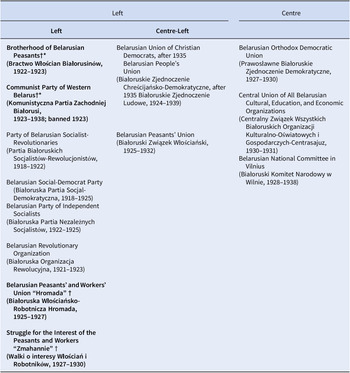
Broadly, the Belarusian political movement in interwar Poland fell into two camps: the first and by far most influential was the socialist movement. At a distant second was the Christian Democratic movement, which was, when compared to other Christian Democratic movements around the world, decidedly more left leaning. A small number of nationalist organizations and nascent peasant movements also emerged in the early interwar years, but they were generally short-lived and disjointed. In total, at least 13 political organizations claimed to represent the Belarusian minority in interwar Poland (see table 1). Their years of activity ranged from one to 17 years. On average, a Belarusian political organization lasted for 6.2 years over the 20-year interwar period, with a median lifespan of only three years. The early years of Belarusian organizational life were particularly chaotic: ten organizations were formed in the initial postwar years, four of which, by 1926, had already either merged with other organizations or splintered and created new ones.
Belarusian Political Organizations in Interwar Poland

*organization used violent tactics; †organization was banned; ‡ organization was pacifist/loyalist.
Over half of the organizations (eight organizations) were leftist, with the remainder center-left (two organizations) and center (three organizations). It is important to note that, although traditional right-wing parties were absent in the Belarusian political movement, most Belarusian minority organizations included a nationalist agenda. Indeed, national self-determination and the unification and creation of an independent Belarusian state were popular claims among all Belarusian organizations; the difference between them lay in how those slogans for independence were interpreted. Centrist organizations opted for the unification of Belarusian lands, which they understood as complete independence while maintaining good relations with neighboring countries, or alternatively in the sense of annexing Belarusian territory from the USSR and connecting it to a resurrected Polish-Lithuanian Commonwealth (Iwanicki Reference Iwanicki1993, 100). Leftist organizations, particularly those adhering to communism, called for the transfer of ethnically inhabited Belarusian lands from Poland to the Soviet Union, thereby unifying West Belarus with the Belarusian Soviet Socialist Republic. Most noncommunist socialist organizations rallied for a Belarusian state independent of the Soviet Union that would be governed by Belarusian peasants and workers.
In terms of ideology, as mentioned above, socialism and Christian Democracy dominated the Belarusian political landscape. The Christian Democratic movement emerged in 1907 with the founding of the Belarusian newspaper Krynica, but it gained wider support in western Belarusian lands only after 1919. In 1924, the Belarusian Union of Christian Democrats (Białoruskie Zjednoczenie Chreścijańsko-Demokratyczne; hereafter BZChD), the largest and most influential organization that represented the Belarusian Christian Democrat movement, was officially formed (Holzer Reference Holzer1974, 253–254, 554–555). In November 1927, the Orthodox Belarusian Democratic Union (Prawosławne Białoruskie Zjednoczenie Demokratyczne; hereafter PBZD) was created, and in 1930 it merged with BZChD. After 1935, the BZChD changed its name to the Belarusian People’s Union (Białoruskie Zjednoczenie Ludowe) following its tilt to the left of the political spectrum.
Overall, the Belarusian Christian Democratic movement, as represented by the BZChD, characterized itself as the party of nationally conscious Belarusian Catholics. Its ideology was a combination of “liberalism, nationalism, and Christian idealism, mixed with socialist ideas of cooperatives and land redistribution” (Rudling Reference Rudling2015, 183). While it published materials promoting the idea of an independent, democratic Belarus, the BZChD remained loyal to Lithuania, which provided substantial financial aid to the organization. The goal of the BZChD, as outlined at its party congress on October 24, 1926, was “to create an independent, democratic, united Belarusian state on ethnically inhabited Belarusian lands” (Holzer Reference Holzer1974, 554). For some time, the party program advocated “an independent Belarus in federation with its neighbors” (Rudling Reference Rudling2015, 185). The movement was thus generally anti-Polish and staunchly anti-Soviet (Iwanicki Reference Iwanicki1993, 101).
The more popular ideological movement among Belarusians came from the radical left, which skillfully linked the issue of national advancement with “the improvement of the social situation of the poor and often landless Belarusian peasants” (Rudling Reference Rudling2015, 190). This phenomenon of left-wing nationalism, which merged national rights with a class narrative to demand various forms of people’s socialism, was not unique to Belarusians. (Ukrainians, for example, also had successful political movements based on left-wing nationalism; see Rudling Reference Rudling2015, 190). The Belarusian socialist movement dates back to 1903 with the creation of the Belarusian Revolutionary Hromada (Białoruska Rewolucyjna Hromada; hereafter BRH), which, from 1905, was known as the Belarusian Socialist Hromada (Białoruska Socjalistyczna Hromada; hereafter BSH). In the ensuing years, the socialist movement produced several new organizations, many of which splintered, merged, or fragmented and dissolved. A brief but dizzying description of the initial organizational years of Belarusian socialism conveys this organizational chaos and gives us good reason to understand why the MSW felt that intervention in the early years was unnecessary.
During WWI, part of the BSH joined forces with the Russian Bolsheviks. A second faction of the BSH splintered and created the Party of Belarusian Socialist Revolutionaries (Partia Białoruskich Socjalistów-Rewolucjonistów; hereafter PBSR) in 1917. A third group created, at the end of 1918, the Belarusian Social-Democratic Party (Białoruska Partia Socjal-Demokratyczna; hereafter BPSD). In 1922, a splinter group of the PBSR created the Belarusian Revolutionary Organization (Białoruska Organizacja Rewolucyjna; hereafter BOW), which, in 1923, joined the Communist Party of Western Belarus (Komunistyczna Partia Zachodniej Białorusi; hereafter KPZB). In January 1924, part of the BPSD, along with PBSR activists, created the Belarusian Party of Independent Socialists (Białoruska Partia Niezależnych Socjalistów; hereafter BPNS) (Holzer Reference Holzer1974, 256). The PBSR, BSDP, and BPNS all had similar party platforms. In fact, it is difficult to differentiate them—they were, in short, all socialist and advocated for the unification of Belarusian lands, as well as radical social reforms, especially in the agriculture sector and in terms of land redistribution (Holzer Reference Holzer1974, 256). The PBSR positioned itself toward cooperation with Lithuania, whereas the BSDP stood in opposition to the Polish state yet believed that compromise was possible. The BOW, on the other hand, called for the unification of Western Belarus with Soviet Belarus. Though initially skeptical of or outright hostile to the USSR, by 1924, the Belarusian socialist movement in general began looking more favorably toward Minsk and Moscow (Holzer Reference Holzer1974, 256–257). It must be kept in mind, however, that, although the socialist movement resonated among Belarusians, only a very small portion of the population supported it. In relative terms, Belarusian political organizations in the early interwar years were weak, and their membership numbers were negligible. Belarusian minority politics was run by a handful of intelligentsia, whose numbers were also small, with the majority of the Belarusian population disinterested.
A Broken Front: Maintaining Organizational Pluralism in Early Interwar Years
The unstable and fragmented initial years of Belarusian political activity described in the previous section, coupled with the Belarusian population’s general indifference to the claims of the dozen organizations fighting to represent them, gave little reason for the MSW to ban any Belarusian organizations in the early interwar years. So long as the organizations did not resort to violence, they did not present any plausible danger to the MSW or Polish government. Thus, despite their anti-state rhetoric, irredentist political goals, foreign ties, and so-called dangerous socialist ideology—all perilous characteristics that the literature would have us believe merit repression—Belarusian political organizations were largely left alone. Further, notwithstanding their small, weak, and fragmented nature—characteristics that make organizations less resilient to government crackdown—the MSW still chose not to outlaw most Belarusian organizations. Instead, the MSW preferred to maintain organizational pluralism among the minority group. It was not until Hromada appeared on the scene in 1925 and threatened this pluralism that Polish authorities took a keen interest in Belarusian political organizations. The subsequent section elaborates on this change in behavior of the Polish authorities.
Hromada: Forming a United Belarusian Opposition
After an intensely fragmented beginning, Belarusian political life finally crystalized in 1925—a year of significant restructuring among Belarusian political organizations. Hromada was formed in 1925, resulting from a split in the Club of Belarusian Deputies in the Sejm (Iwanicki Reference Iwanicki1993, 99). Its founding members—Bronisław Taraszkiewicz, Szymon Rak-Michajłowski, Piotr Miotła, and Paweł Wołoszyn—left the Club of Belarusian Deputies on June 24, 1925, due to “ideological disagreements in regards to social and national policies” (Rudling Reference Rudling2015, 99). One year later, on June 1, 1926, Hromada was registered as a legal political party. It described itself as a “revolutionary socialist” movement yet aimed to achieve its goals through “a legal, law-abiding struggle”; that is, the organization sought to further Belarusian interests only through government institutions and legal channels (Rudling Reference Rudling2015, 191). Within just a few months of its inception, Hromada became the largest and most influential political force representing Belarusians, proclaiming itself a “mighty, unbreakable organization” (Iwanicki Reference Iwanicki1993, 101; Holzer Reference Holzer1974, 259; Rudling Reference Rudling2015, 198).
Not all Belarusian parliamentarians supported the new political organization, however. On November 10, 1925, the remaining Belarusian parliamentarians formed a rival organization, the Belarusian Peasants’ Union (Białoruski Związek Włościański; hereafter BZW). With this restructuring resulting from Hromada’s creation, all other preexisting socialist parties effectively ceased to exist. As a result, by 1926, the organizational pluralism that had previously kept state intervention out of Belarusian political affairs was threatened. Whereas in the early interwar years there were eight organizations, by 1926 only three legal Belarusian political organizations were operating: Hromada, its rival the Belarusian Peasants’ Movement, and the Christian Democratic BZChD. The Communist Party of Western Belarus continued to operate covertly.
Of all these Belarusian minority organizations, Hromada was by far the most influential. Hromada’s rhetoric to unite Belarusian opposition was backed by the organization’s ability to gain an unprecedented number of Belarusian members in a short period of time and to politicize an otherwise indifferent population. It wasted little time in uniting the Belarusian front, significantly decreasing organizational pluralism by merging all leftist Belarusian organizations and pushing out the remaining competing organizations. Additional cause for concern among MSW authorities was that the organization achieved a united Belarusian front through legal channels and institutions set up by the Polish state.
Hromada “adhered to the principle of self-governance of the Belarusian people” and strove for a united, independent Belarusian republic ruled by workers and peasants (Holzer Reference Holzer1974, 257–258). Its party platform aspired to establish a close-knit socialist union of the European peoples, calling for a socialist transformation of Europe. Hromada fought “for the full freedom of assembly, press, and the printed word, for freedom for political and economic organizations of the peasants, workers, and the laboring intelligentsia” (Rudling Reference Rudling2015, 191–192). As a mass movement, it represented a variety of outlooks. For some Hromada activists, Belarusian independence was interpreted as detachment from Poland and unification with Soviet Belarus, whereas others called for a sovereign Belarus independent of the Soviet Union. The organization merged nationalism with radical leftism and democracy with revolution. As outlined in the final point of their official party platform, Hromada waged its battle against the state only through legal methods based on the Polish Constitution and the rule of law.
Because some of its organizers were also members of the illegal Communist Party of Western Belarus, however, Hromada is still condemned in existing literature as a Communist puppet organization, whose sole purpose was to recruit partisans for the Soviet Union (Savchenko Reference Savchenko2009, 107–108). In light of newly available materials, however, Rudling points out that such an interpretation lacks nuance. Hromada leadership was not a blind servant of Minsk and Moscow; rather, the movement represented significant diversity and developed its own ideological doctrine, influenced by national communism but also imbued with distinct local features. Hromada’s “leaders were agents with their own agendas and ambitions, some of which—but far from all—coincided with those of Minsk and Moscow” (Rudling Reference Rudling2015, 199). Indeed, it was not necessarily Hromada’s irredentist political goals, or even its alleged ties to the Soviet Union, that threatened the state—it was instead the organization’s unprecedented ability to politicize and unite the Belarusian political landscape at the elite and local level. The Belarusian masses, were, as reported by the MSW, “captivated by the organization’s promises of material benefit.”Footnote 5 Mass rallies helped Hromada attract popular support, while the participation of its activists in all major legal Belarusian cultural organizations, namely, the Society of Belarusian Schools (Towarzystwo Szkoły Bialoruskiej; hereafter TSB), as well as their presence in various publishing houses and charities, helped it garner support. Hromada was primarily responsible for the success of the TSB, which, by the end of 1926, had 3,500 members, organized nine community centers, opened 35 rural libraries, and inspired a number of local reading groups throughout Belarusian-inhabited territories in Poland (Iwanicki Reference Iwanicki1993, 102). The TSB became the most important and influential Belarusian cultural organization in interwar Poland.
Whereas all other Belarusian organizations struggled to keep afloat, Hromada attracted supporters from all walks of life. In June 1926, it had 950 members, in September 1926, 45,000 members, in November 1926, 68,000 members, January 1927, 100,000 members, in February 1927, 117,000 members, and in April 1927, shortly before its takeover by the government, Hromada had over 150,000 members.Footnote 6 By mid-1927, Hromada had about 1,800 local party cells in the eastern provinces, particularly in Nowogródek and Polesie.Footnote 7 In just over six months in 1926, Hromada expanded from just 19 local level organization cells (hurtki) with 569 members to over 1,700 with almost 70,000 members. This rapid development in membership was unmatched by any other minority ethnic organization in interwar Poland.
Hromada also attracted significant numbers of Belarusian supporters who had previously been members of other organizations, such as the Polish Socialist Party (Polska Partia Socjalistyczna; hereafter PPS) and the Polish People’s Party “Wyzwolenie” (Polskie Stronnictwo Ludowe “Wyzwolenie”; hereafter PSL Wyzwolenie). The phenomenon of Belarusians defecting from other organizations to join Hromada was not uncommon throughout Belarusian-inhabited territories in Poland. The PPS affiliate in Navahrudak, for example, ceased to exist due to mass defections of its members to Hromada (Iwanicki Reference Iwanicki1993, 99). Indeed, Hromada was an all-encompassing organization that attracted peasants and the (undersized) intelligentsia alike. Based on the Polish census of 1921, which lists 1,041,700 Belarusians in Poland, in its short history Hromada was able to mobilize over 15 percent of an otherwise passive Belarusian minority. This unparalleled accomplishment did not go unnoticed by Polish authorities, and Hromada’s rapid pace of development elicited fear among members of the Polish population. Media outlets warned of a possible armed Belarusian uprising and civil war. Fear mongering moved from the streets to parliament, where Hromada deputies attempted, sometimes unsuccessfully, to repel accusations of conspiracy and terrorist planning (Iwanicki Reference Iwanicki1993, 99). Despite the tense political environment, Hromada’s deputies kept their promise of relying only on legal means to advance the rights of the Belarusians whom it claimed to represent. The group used every opportunity to present its demands publicly and challenge the state.
Alternative explanations in the literature do not fully explain Hromada’s banning. First, Hromada’s political platform, created in 1925, remained consistent, although the government’s stance toward it changed dramatically (Holzer Reference Holzer1974, 558). Polish authorities initially allowed Hromada activists to use the parliament to sharply criticize the government and did not prevent the organization from presenting its plight to an international audience, particularly the League of Nations. Organizational demands alone therefore do not explain the timing of Hromada’s outlawing. As the organization’s influence and popular support grew, however, so too did government concern about Hromada. Most importantly, the group’s rapid expansion pushed out rival Belarusian organizations from the political arena, resulting in a decrease in Belarusian organizational pluralism, from eight to three. This decrease in organizational pluralism is a key element in understanding the MSW’s response to Hromada. Indeed, Hromada sought to be the sole organization representing Belarusians in interwar Poland, and it became increasingly evident that attaining this political goal was realistic. As Hromada’s popularity and influence grew, the already weak and relatively unpopular rival Belarusian organizations began to fall by the wayside.
When the organization began uniting the Belarusian intelligentsia and the increasingly nationally conscious masses, Polish authorities recognized that, without state intervention, Hromada would become a serious political risk. In his final speech in the Parliament on November 16, 1926, the leader of Hromada, Bronisław Taraszkewicz, was straightforward in addressing the Polish government: “You raise fears of a planned armed uprising. But you, gentlemen, members of Parliament, are not afraid of an armed uprising, because these are not our tactics; Hromada does not propagate this. You are frightened because the [Belarusian] people have awakened, have demonstrated their strength, and created a mass movement. It frightens you that we accomplished this through legal means” (Iwanicki Reference Iwanicki1993, 102). In the months following, the MSW led an active campaign to suppress Hromada and to break the Belarusian front that was rapidly uniting.
Breaking the Belarusian United Opposition: The MSW Banning of Hromada
As quickly as the organization rose to power, its political life abruptly ended. On November 13, 1926, the Popular National Union (Związek Ludowo-Narodowy; hereafter ZLN), a Polish conservative and right-wing party, submitted the following motion to parliament: “Parliament calls on the government to immediately liquidate the Belarusian Peasant-Workers Hromada and counteract the effects of its vicious activities” (Iwanicki Reference Iwanicki1993, 102). With this motion, the wheels were set in motion for Hromada’s repression. Just a year and a half after Hromada’s establishment, the MSW liquidated the party. On the night of January 15, 1927, mass arrests were carried out in 20 counties (powiaty) of the northeastern provinces of Poland, where Belarusians resided, alongside searches of all local organization and cultural organizations affiliated with Hromada, namely, the Society of Belarusian Schools. Hromada had come to be regarded by authorities as an illegal organization (though it was not yet officially banned). Among the some 800 arrested were Hromada’s leaders, Taraszkiewicz, Rak-Michajłowski, Miotła, and Wołoszyn. These arrests were intensely debated in parliament, where fellow socialist and Belarusian deputies, in addition to MPs with other ideological links, opposed the crackdown on Hromada. The debate mostly focused on the unconstitutionality of the revocation of Hromada MPs’ parliamentary immunity, which led to their arrest. Several deputies declared that no evidence was provided and that no facts were put forward to justify these actions; there was no basis on which the state could revoke their parliamentary immunity, and no precedent for such action. Although there were in fact no preparations for an armed uprising or collective rebellion to be planned, and, despite the lack of incriminating evidence, the majority of parliamentary deputies approved of the liquidation of Hromada and the mass arrests of its members (Iwanicki Reference Iwanicki1993, 102–103).
Hromada was officially banned on March 21, 1927, with 56 of its members detained from February 23 to May 22, 1928. After one year of investigations in 1928, a political trial put 56 of Hromada’s staunchest activists on the stand, convicting most of so-called subversive anti-Polish activities. The trial against Hromada, held in the Vilnius district court from February to May 1928, became known as the “Trial of the 56.” Bronisław Taraszkewicz, perhaps the most important defendant and leader of Hromada, used his concluding remarks to explain the rationale for his actions and used the court as a platform to outline his vision. He explained to the court that the Polish government and its discriminatory minority policies had convinced him of the need for a Belarusian mass party that united national and social issues: “The program of Hromada is not borrowed from the Comintern; it is not a transmission of a resolution of the Communist Party of Western Belarus, but an empirical program. All Hromada slogans are found in the programs of other radical parties. The Hromada program speaks of the unity of the people” (Rudling Reference Rudling2015, 267–268). It was precisely this unity that Hromada achieved among the Belarusian minority population, and not its radical slogans, that ultimately caused its demise. The Vilnius District Court sentenced Hromada leaders to 12 years in prison, but the Court of Appeal later decreased the sentence to six years.Footnote 8 Officially, authorities justified banning Hromada by invoking article 21 of the Polish constitution, labeling Hromada a threat to parliamentarianism (Rudling Reference Rudling2015, 260).
Overall, according to the MSW, Hromada’s liquidation was carried out relatively peacefully. The vast majority of the rural population, who until then were “captivated by the organization’s promises of material benefit,” reacted “quite passively” toward Hromada’s repression, and most of them voluntarily abandoned the organization.Footnote 9 In many cases, even Hromada members themselves voluntarily liquidated their local organizational branches, handing in their membership cards en masse. Just weeks after the crackdown began, in the county of Nieśwież, 20 local branches voluntarily liquidated their organization without direct orders from the state—notably, following the arrest of Hromada’s main activists but before the organization was officially banned. Resistance to liquidation was rare, reported the MSW, and occurred primarily in the Grodno and Wolkowysk counties (powiaty). The youth influenced by communist methods were the most resistant to repression.Footnote 10 At one mass protest in Kosów, with over 3,000 peasants, police shot and killed four people and wounded 15 (Iwanicki Reference Iwanicki1993, 103). Such violence was an exception, however, to an overall peaceful process. If Hromada and its significant support base were capable of instigating an armed uprising—as purported by its critics—the relative infrequency of violence provoked by state repression was indicative of its lack of violent tendencies or intentions, and, ultimately, a testament to the Belarusian peasant’s relative political indifference.
The Aftermath of a Broken Belarusian Front
In this section I briefly discuss the aftermath of Hromada’s banning, which is helpful for several reasons. First, it demonstrates the efficacy of the MSW’s policy of banning Hromada and breaking the united Belarusian opposition. Second, the MSW’s desire to maintain disjointed organizational pluralism within the Belarusian political opposition is bolstered by the fact that remaining political organizations were largely left alone by the MSW because, although some possessed similar profiles and political goals to Hromada, they were not able to amass broad-based support. On the other hand, organizations that sought to continue Hromada’s legacy as the sole representation of Belarusian opposition to Polish state-building policies, such as Hromada’s alleged successor organization Zmahannie or cultural organizations that were able to unite Belarusian opposition around the demand for Belarusian-language schooling, were outlawed.
A March 1927 report by the Ministry of Internal Affairs reads,
The most significant event in the life of the Belarusian society was the repression of the Belarusian Peasant-Workers “Hromada” and the arrest of its members. This, together with the Ministry of Interior Regulation of March 21, 1927, deeming Hromada an illegal organization, provoked a very strong impression as well as a change in the mood among the Belarusian masses. First of all, it wrecked, in the eyes of the masses, the conviction of the legality of “Hromada” and impunity proclaimed by its rulers, which were previously strongly emphasized by party agitators.Footnote 11
The rural population, previously attracted to Hromada’s slogans of “social and material benefits,” due to fear of reprisals, backed away from active participation in political life after the organization’s banning. This dynamic greatly weakened Hromada’s rapidly developing local party cells and resulted in the decline of political life in Belarusian villages and the collapse of Hromada activists’ influence in the countryside. Repressing Hromada, noted the MSW, “dealt a severe blow to the national consciousness and development of Belarusian society,” creating “widespread depression among members of Hromada and mass abandonment of its ranks by the rural population.”Footnote 12 Hromada activists accused the state of “breaking the united front of workers” in the eastern borderlands.Footnote 13
Although the Belarusian People’s Republic government in exile (Białoruska Rada Narodowa; hereafter BRN) welcomed state repression of Hromada, maligning the organization’s activities as imported by provocateurs and harmful for the interest of the Belarusian people, most other political organizations, even those in conflict with Hromada, were opposed to its forced liquidation. They viewed the crackdown as a state campaign to discredit the Belarusian movement and an attempt to persecute it under the pretext of combatting communism. All Belarusian press outlets jointly condemned Polish authorities, deeming their actions illegal, particularly the arrests of MPs who were stripped of their legal immunity, a calculated move to discredit the Belarusian movement and its political activists.Footnote 14
The scandal surrounding Hromada’s repression and arrests of its members acted “as a springboard which led to the break in the Belarusian Club of Deputies [in the Polish Parliament] and in the national [Belarusian] front.”Footnote 15 Although both the Belarusian Peasants’ Union and Christian Democratic BZChD, rivals of Hromada, condemned state repression against the organization, this unified position did not translate into broader unity in the Belarusian community. Instead, the MSW reported that, according to Hromada, the Belarusian Peasants’ Union and BZChD used this opportunity to denounce the Polish government but did not genuinely “seek to defend the unified Belarusian front” because such a unified front among Belarusian organizations “did not exist due to the significant difference in social programs.”Footnote 16 Instead, rival organizations were pleased that Hromada’s influence over the Belarusian minority was being neutralized by the state and sought to capitalize on this opportunity by filling that power vacuum left by Hromada. These and other Belarusian organizations’ attempts at attracting supporters of the banned Hromada ultimately failed, however. The Belarusian People’s Republic government in exile, which responded to the arrests by issuing an official proclamation condemning the activities of Hromada as puppets of the Comintern, organized a number of rallies to win over supporters in the Nowogródek province dominated by Hromada sympathizers. The organization failed to fill the void left by Hromada by not gaining support from the masses and from suffering internal fragmentation. In fact, a local branch of the BRN formed in January already disbanded on February 15 “due to internal friction,”Footnote 17 an illustrative example of Belarusian political life post-Hromada.
Similarly, in 1930 the Central Union of All Belarusian Cultural, Educational, and Economic Organizations (Centralny Związek Wszystkich Białoruskich Organizacji Kulturno-Oświatowych i Gospodarczych—Centrasajuz; hereafter Centrasajuz) was created as a means of uniting the fragmented Belarusian front. Formed of the remnants of a few organizations, Centrasajuz aimed to become an all-encompassing Belarusian political party, yet it ultimately succumbed to internal conflicts and fragmentation. The organization voluntarily dissolved between 1931 and 1932 (Holzer Reference Holzer1974, 561).
The remaining Belarusian political organizations after the Hromada crackdown failed to unite the Belarusian population in the way Hromada had and suffered from significant interorganizational and intraorganizational divides. According to a MSW report from 1935, “The ongoing internal antagonisms that have long been present in Belarusian society continue to deepen.” Belarusian civil society was, at that time, “barely surviving.”Footnote 18 By 1935, the MSW reported that the only active Belarusian political party was the Christian Democrat BZChD. Its only sign of life was its press outlet, Belaruska Krynica, which the MSW reported likely survived only because it received subsidies from the Lithuanian government. In addition to its regular newspaper, the BZChD printed monthly magazines, also likely with the financial help of Lithuania.Footnote 19 Interestingly, even though it allegedly received funds from a foreign state with which Poland had very hostile relations, the MSW did not ban the BZChD. Indeed, Poland and Lithuania fought militarily over the city of Wilno (Lithuanian Vilnius) post-WWI, with Poland winning, subsequently severing all diplomatic ties and remaining officially at war over contested territories throughout the interwar period. Still, the circulation of the apparently subsidized BZChD press was “negligible” and its content “deficient.” Beyond producing newsletters, the only “lively manifestations” of the BZChD were in defense of the use of the Belarusian language in church and during religious classes in public schools. Other Belarusian groups spoke out in relative “unanimity” on this issue, and the MSW took note of this unity, though a crackdown was not yet in order. Already by 1936 the MSW reported that the effort “quickly lost its momentum, yielding minimum results, even in a democratic sense.”Footnote 20
Preventing the Resurgence of Belarusian Unity
The MSW took pains to prevent the resurgence of a united Belarusian front. In December 1927, leading activists of Hromada who had managed to escape arrest sought to reorganize the remnants of the movement into the Struggle for the Interests of the Peasants and Workers (Walka o Interesy Włościań i Robotników, “Zmahannie”; hereafter Zmahannie, meaning “Strife”). This new organization quickly became popular among Belarusians, who viewed it as the continuation of Hromada. Zmahannie received 71,000 votes in the 1928 parliamentary elections and sent three deputies to the Sejm (Savchenko Reference Savchenko2009, 108). Polish authorities, concerned with a newly united Belarusian front, responded harshly to any attempts to reorganize the remnants of Hromada and banned Zmahannie from public space and from holding legal mass activities; in 1930, it liquidated the organization.
The Society of Belarusian Schools (Towarzystwo Szkoły Bialoruskiej; hereafter TSB) was the only Belarusian organization that managed to have any lasting presence after Hromada’s demise. It was no secret to MSW authorities that the TSB was under the “overwhelming influence” of Hromada, and, upon Hromada’s liquidation, activists decided to focus their efforts on building up the TSB. This relationship explained, according to MSW reports, “the [strong] development of this organization, which by January in the eastern provinces had 250 branches with over 4000 members. The organization’s territorial development coincided completely with the location of Hromada branches.”Footnote 21 Mainly, the TSB organization focused on the development of Belarusian culture and education. In the immediate years following Hromada’s liquidation, the MSW reported that the TSB created six new schools in Polesie province, nine in Nowogródek, and 14 in Wilno county (powiat).
By 1935, the “broken and warring groups” in Belarusian political life achieved “solidarity” on one issue—demand for Belarusian-language instruction. This issue quickly gained more attention in the second half of 1935, leading to “intense agitation to submit petitions demanding school in the Belarusian language.”Footnote 22 The campaign was led by a specially formed School Committee (Komitet Szkolny), comprising individuals from the TSB and the other Belarusian cultural organization, the Belarusian Institute of Economy and Culture (Białoruski Instytut Gospodarki i Kultury; hereafter BIGK), but it was effectively led by the TSB. The issue of Belarusian education spurred a united front: “Because of the openly hostile anti-state nature of this campaign, which among other things confirmed that it was inspired by subversive factors, local authorities in Wilno Province were compelled to liquidate the School Committee, as well as the TSB and the BIGK.”Footnote 23 Repression was carried out in early December and very significantly affected the success of the Belarusian school campaign. The school campaign was “clearly political” in nature, and so in December the BIGK and TSB were suspended by state authorities. With the liquidation of the TSB and BIGK, the Belarusian school campaign and its School Committee quickly dissolved and no united Belarusian political opposition could form around the school campaign.Footnote 24
Once Hromada was out of the picture, the Belarusian movement never recovered. The remaining organizations were weak, fragmented, quarrelling, and unable to pose a challenge to the state—as they were in the initial interwar years before Hromada’s rise to power. Even when organizations such as the BZChD were known to receive funding from hostile foreign powers, in that case from Lithuania, the MSW did not ban the organization. For one, doing so would decrease the pluralism of remaining Belarusian organizations, and, second, the organization’s influence was so negligible that state repression could only backfire by giving a reason for the Belarusian opposition to rise against a discriminatory regime. This way, Polish authorities chose to watch as the Belarusian movement petered away after Hromada’s repression, only interfering when attempts to reunite the front become formidable; indeed, any subsequent attempts to pick up the pieces and reunite the Belarusian front were quashed by Polish authorities, as demonstrated with the Zmahannie organization and the Belarusian Society of Schools. The MSW succeeded in quelling their national movement.
Conclusions
Existing academic literature argues that threatened governments often respond with force. This intuitively correct finding is robust across space, time, and context, and it has come to be known as the “Law of Coercive Responsiveness” (Davenport Reference Davenport2007). Although authorities tend to respond to threats by banning the offending organizations, it largely remains unclear how this process works. What precisely do authorities perceive? What (imagined or real) threat are they responding to? This article offers one possible answer by explaining why the Polish Ministry of Interior banned Hromada. Contrary to claims expounded in existing scholarship that Hromada was banned because it was a communist, antisystem, and irredentist party, this article demonstrated that Hromada was banned because of its ability to unite the Belarusian political opposition. Belarusian political unity challenged Poland’s state-building efforts, and, more specifically, it was antithetical to the Ministry of Interior’s broad strategy of dividing and thereby weakening ethnic minority political opposition in interwar Poland. To better understand these and similar dynamics in other cases beyond interwar Poland, future research should continue to shift away from analyzing the dynamics between a state and an ethnic group as a whole and instead disaggregate the level of analysis to focus on minority political organizations.
The Ministry of Interior’s banning of Hromada was undoubtedly consequential. Belarusian political life never reached the same level of unity as it did during Hromada’s peak. In the first half of the 1930s, following Hromada’s demise, the Belarusian question was considered far less politically important than it had been in years prior. After the liquidation of Hromada, the united anti-state movements among Belarusians were largely halted. A Ministry of Interior report from 1935 summarizes the general atmosphere of the post-Hromada years: “The low pulsating life of the Belarusian minority in Poland passed without any major events this year. Attempts at reviving political activity resulted in nothing, and, in fact, in the majority of cases it even spurred a negative reaction, revealing the indifference of masses to the actions of its so-called leaders.”Footnote 25 Only economic issues affected the “mood of the masses,” which at times radicalized Belarusian villages. These sentiments, however, were isolated events and “rarely occurred in an organized form,” and instead they were reported as “sporadic impulses.”Footnote 26
The long-term legacy of Hromada’s banning on Belarusian political development has not yet been studied, but it deserves attention. Hromada was the largest and most influential national movement in Belarusian modern history, and its banning by Polish authorities undoubtedly had lasting legacies on Belarusian society. Compared to its neighbors, Belarus has developed quite differently: it was one of the last regions in east-central Europe to have its borders defined, language codified, national symbols and traditions invented, and its inhabitants socialized into identifying with a nation-building project (Rudling Reference Rudling2015, 2–3). As a result, few recognize Belarus’s individuality, including those living within its borders. Even to this day, while neighboring Ukraine experiences waves of mass revolutions, overthrowing governments in an effort to shed its past and start anew, Belarus remains “the last dictatorship in Europe,” obstinately clinging to its Soviet past, conflicted over its current national identity, its culture seldom differentiated from its neighbors, and its language spoken only by a small minority of its citizens (Wilson Reference Wilson2011). In 1927, Polish authorities squelched an emerging Belarusian united front. As a result, the “low pulsating life of the Belarusian minority” continued, unremarkably, for the remainder of the interwar period. The effects of this banning, arguably, continue to this day.
Disclosure
Author has nothing to disclose.
Archival Sources
Archiwum Akt Nowych (AAN), Warsaw, the archival fond: Ministerstwo Spraw Wewnętrznych (Ministry of Interior, or MSW), Wydział Narodowościowy (Department of National Minorities, WN).