In an interesting and thought-provoking paper in Britannia 51, Adam Sutton explored factors that might have led to the potters of one PRIA tradition in an area centred on Silchester to continue to produce their flint-tempered coil-built pots into the early years of the Roman occupation, well after wheel-thrown ceramics from other sources had appeared.Footnote 1 However, there is one group of stakeholders who are conspicuously absent from his analysis – the potters’ customers. Customers, i.e. those acquiring the pottery for use, occupy a significant place in its life-cycle.Footnote 2 If we factor them in too, a new range of possibilities starts to open up.
When we look at the assemblage from the point of the consumer, the first question to be answered is this: what use would he or she have in mind when seeking to acquire a pot of this type? The extreme coarseness of the fabric would seem to rule out anything other than a utilitarian purpose, especially as much finer vessels were available, so the options would seem to be limited to storage, cooking or some other common behind-the-scenes processing activity. Sutton draws on speculation by Timby and Bird that Silchester ware pots were primarily valued as storage jars or brewing vats, although conceding on the basis of carbonised residues in some that they might be also used for cooking.Footnote 3 Two of these functions call for the pot and its contents to be boiled over the fire, an essential part of the brewing process as well as well as being fundamental for cooking. The amount of ale that could be brewed in the outsize jar from Insula IX (see below) can be calculated at some 70–100 litres;Footnote 4 a Tudor household, whose consumption of beverages (water and home-brewed ale, with additional imported wine for the reasonably well-to do) is likely to have been similar to its Romano-British counterpart, is estimated to have needed to brew something in the order of 12–20 gallons (55–90 litres) of ale per week.Footnote 5 While use for storage is entirely plausible, the purpose of this paper is to explore the implications of Sutton's model of interpreting Silchester pots as primarily designed for use over the fire.
Research over the last few decades has established that the potters who manufactured ancient cookware were highly sophisticated in their use of materials and techniques, in order to ensure that their products could cope with the demanding conditions of cooking over direct heat.Footnote 6 Detailed studies undertaken on tempers in archaeological pottery have shown that lower proportions of temper make for a mechanically stronger pot, which would have been an advantage in a storage vessel, whereas a higher proportion, such as that used in Silchester ware, increases the ability of a pot to withstand the stresses of repeated heating required of a cooking pot. The value of such inclusions lies in the effect they have on opening up the structure of the fabric, creating voids which absorb the energy of the micro-cracks generated by thermal stress and prevent them from propagating into a size that would disrupt the integrity of the vessel walls.Footnote 7 While this is helpful in the kiln during firing, many other ceramic types can be fired perfectly effectively without temper, bearing in mind also that adding it decreases the strength of the finished pot because of the disruption it introduces to the structure of the clay.Footnote 8 Where such inclusions really come into their own is in cookwares. Pots used for cooking are subjected to thermal stress not only initially during firing, but also repeatedly through their lifetimes, every time they are used, with the stresses being particularly acute for those designed to be used over a single-point heat source – a stovetop or a hearth. Suitable tempers help to provide protection from thermal shock, with larger-sized fragments being more beneficial.Footnote 9
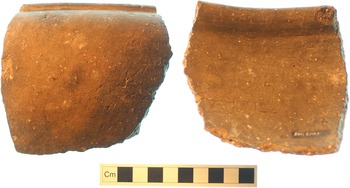
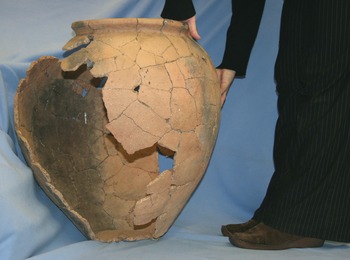
Probably the most distinctive visual feature of the Silchester pots, as they appear from the photographs of sherds published by Sutton, is the high proportion of flint temper visible both in the break and on the outer surface (fig. 1).Footnote 10 Flint is a form of quartz, and quartz has been found experimentally to be an efficient form of temper.Footnote 11 For quartz sand, the optimum proportion has been established as about 20 per cent by volume,Footnote 12 but I am not aware of any specific research that has been carried out on the thermal properties of pottery tempered with inclusions of crushed flint, either in terms of resistance to thermal shock or of thermal conductivity. However, the fact that the enormous jar incorporated as an oven into a hearth of Phase 3 in Masonry Building 1, Silchester Insula IX, was of Silchester ware (fig. 2)Footnote 13 suggests that the builders had the confidence that it would provide a suitable performance in this situation. A further characteristic of this pottery that is of value in cookware is the burnishing of the internal surfaces that was present in approximately half of the sherds analysed by SuttonFootnote 14 and which would have been of assistance not only towards waterproofing the pots and making them easier to clean, but also in helping prevent anything sticking to the surface in the first place.
Detail of Silchester ware vessel 1/SIX-015 (reproduced from Sutton Reference Sutton2020, fig. 10).

Silchester ware storage jar SF 2377 reconstructed (reproduced from Clarke and Fulford Reference Clarke and Fulford2011, fig. 13).

There are, therefore, reasonable grounds for postulating that Silchester ware pots could well have been designed specifically for cooking, but is there any more direct evidence that they actually served this purpose? Sutton refers to the remains of carbonised food in some of their Iron Age predecessors but does not mention any in connection with the Roman-period examples.Footnote 15 However, my experience in cooking with replica Roman ceramic cookware on an open hearth leads me to conclude that having to discard a pot because food had stuck and burned on the inside is likely to have been a rare occurrence: the most common cause of failure in pots is thermal shock. Its effects can range widely from explosive ejection of a part of the pot at one extreme, through the opening-up of a hairline crack that creates a leak, right up to the accumulation of flaws within the body of the fabric which eventually build up to the extent that the even a gentle knock which would have had no effect on the pot when new will cause it to fall to pieces.Footnote 16
A marker that is more commonly used in pottery studies to determine if pots have been used for cooking is whether the outside surface is sooted. What is not more generally appreciated is that this sooting is not actually caused by exposure to an open fire per se: rather, it is created only when the pot is licked by yellow, orange or red flames. These flames are produced at lower temperatures when there is incomplete combustion of fuel, with the colouration due to the incandescence of the fine particles of soot they contain as a result (a concept that should be familiar from school chemistry lessons with a Bunsen burner). When the fire consists only of live embers with no visible flames, it is burning at a high enough temperature for complete combustion to occur and no soot is produced.Footnote 17 Experiments exposing earthenware pots to fires of varying temperatures have demonstrated that no sooting is caused by a hot fire of live embers only; they also show that such a fire can also remove soot deposited earlier by visible flames by oxidation, creating a unique palimpsest of marks of varying intensity caused by both the soot and the oxidation.Footnote 18 In his discussion of surface treatment and firing, Sutton writes, ‘Silchester vessels are typically fired to mottled greys, blacks and browns’,Footnote 19 following Timby: ‘The colour of the paste varies from shades of brown to red, dark grey or black, sometimes on one vessel, the typical result of bonfire firing’.Footnote 20 However, the appearance of the external surface of the sherds shown in the photographs forming Sutton's figures 9 and 10 is equally consistent with the typical marks of light sooting and oxidation created by use over an open fire.Footnote 21
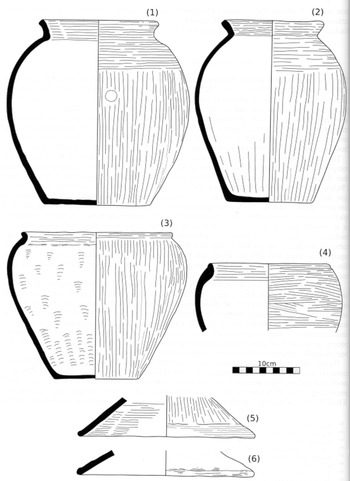
The pottery drawings in Sutton (Reference Sutton2020)Footnote 22 (see my figure 3) depict two basic forms, which he characterises as everted-rim jars and bead-rim jars, together with lids sized to fit them. More important from the point of view of the user is that the everted-rim jars illustrated have an opening that is constricted, but not so significantly that it would unduly limit what could be placed in the jar, whereas the openings of the bead-rimmed jars are only slightly narrower than the widest point of the pot's diameter, allowing much freer access to the contents. While both of these forms would be useful as storage vessels, they are also strongly connected with culinary use. The first is the classic ‘cooking pot’ well known from all periods, and widely through the Roman empire, which is particularly suitable for boiling food since the constricted opening helps to reduce evaporation. If cooking in a water-based medium from which there is no significant evaporation, it is not necessary to disturb it until the food is done; whereas the second, somewhat less common, form has been identified as one that is more suited to operations requiring active management of the food during cooking, particularly when stirring is required to incorporate additional ingredients.Footnote 23
Silchester vessels (reproduced from Sutton Reference Sutton2020, fig.7).

To a cook, the most important determinant when acquiring a new pot is performance on the hearth. However, as this cannot be tested directly until the pot has been bought and taken home, it is necessary to use proxies in order to select which pot to buy. The obvious proxy to use first is appearance. The customer is likely to target a pot that looks like ones that are known from previous experience to perform well in use. It can then be picked up and explored further, for instance by pinging with a fingernail or rapping with the knuckles to check that it rings true, showing that it has not developed a fault in the firing.Footnote 24 In this closer examination, the customer can also check to see whether there are variations from the norm in its appearance, which might indicate that it was an imitation that was not made by a trusted producer. Sutton's photographs indicate that Silchester ware has a distinctive outward appearance, which could have provided a guarantee of its authenticity. While neither the potters nor their customers would have had any inkling of the mechanism protecting their wares from thermal shock, the value of effective tempering would have been apparent from a greater resistance to cracking in use, and its visibility would have provided a message about its reliability.
We can assume that the reason why pots in Silchester ware continued to be produced into the Flavian period was because there was still a market for them.Footnote 25 We are then left with the problem of explaining the circumstances in which they eventually went out of production. One reason for a change-over to more mainstream first-century a.d. pottery types might be that some individuals, probably those with least to lose if the pots failed and spoiled the dinner or the latest batch of ale, were prepared to try the new types of cookware and satisfaction with its reliability spread by word of mouth. The consensus is that Silchester ware did not continue in production beyond the Flavian period. Where it is found in later contexts sherd size, proportion of EVEs (Estimated Vessel Equivalent) and association with other first-century pottery have led to the conclusion that it, too, is likely to be residual, the result of debris from breakages decades earlier.Footnote 26 However, the presence in Period 3 of the Insula IX excavations at Silchester, dated to c. a.d. 125–150–c. 200, of two substantially complete vessels, the ‘storage’ jar oven noted above and a much smaller bead-rimmed jar, indicates that these pots are likely to have survived complete into this period.Footnote 27 While ethnographic studies have shown pots used for cooking have a shorter life span than storage vessels due to their greater exposure to stresses, such studies have also shown that storage vessels are unlikely to have survived for more than a decade or so of use,Footnote 28 so being used for storage rather than cooking would only have had a limited effect. They may therefore have spent the time in storage themselves before being turned out and either put to use or discarded.
Silchester ware was gradually displaced at Silchester itself by wheel-made reduced ware from the Alice Holt kilns. The history of this industry resembles other Iron Age potting traditions that survived for some decades beyond the Roman occupation of Britain, such as Malvernian rock-tempered wareFootnote 29 or South Essex early shell-tempered ware.Footnote 30 Sutton sees the demise of Silchester ware in the reluctance or inability of the potters, constrained by sociological factors, to embrace technological change. This is in itself a reasonable hypothesis, but as an explanation it does not go far enough to explain its fate. The trajectory of the Silchester industry differs markedly from that arch-survivor from pre-Roman times, the Black Burnished industry of Poole Harbour. Both industries retained not only their traditional clay-processing techniques, but also the craft of coil-building, into a world where throwing on a wheel had become the standard potting technique. Yet despite its perceived technical backwardness the Dorset Black Burnished industry, far from going into decline, managed to establish itself as a market leader very widely in western Britain. There has been speculation for over twenty years that at least some of its success may have been due to its thermal properties.Footnote 31 This may well be part of the answer for the success of BB1, though other factors that we are unlikely to be able to identify must have played a part (determined marketing? the exertions of an influential patron? aesthetic appeal? connections with the salt trade?),Footnote 32 particularly when it came to supplying the army. Whatever these drivers were in Dorset, it is clear that they must have been missing in the Silchester area, and in the west Midlands and east Essex too.
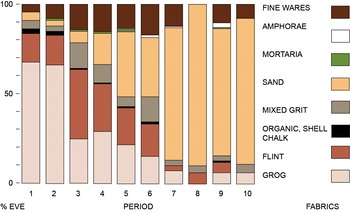
Replacing one type of pottery with another depends on there being an available alternative. What other pottery was reaching Silchester? The very useful histogram provided by TimbyFootnote 33 (see my Fig. 4) charts the relative proportions of different fabrics over time on the forum-basilica site with the coarsewares grouped by their temper. In the first two phases, dated to the late first century b.c. and the first half of the first century a.d., grog-tempered wares predominate, accounting for two-thirds of all pottery by weight, the remaining third being split roughly equally between flint-tempered wares on the one hand and all other fabrics on the other. By Period 3 (mid first century a.d.) the proportion of grog-tempered wares had shrunk dramatically and the coarsewares were dominated by flint tempered fabrics (specifically Silchester ware) which formed 45 per cent of all potteryFootnote 34 charts the relative fortunes of these two types of pottery in more detail. Other fabrics on the rise in Period 3 were those tempered with grit (varying combinations of grog, flint and sand) and with sand, sand-tempered wares accounting for 14 per cent of the total assemblage. Over the course of Periods 4, 5 and 6 the proportions of flint-tempered and grit-tempered wares decreased overall (although grit-tempered wares went into temporary reverse in Period 6), and from Period 7 onwards it is sand-tempered wares that totally dominated the assemblages.Footnote 35
Proportions of the principal fabric groups through the sequence of the forum-basilica at Silchester (reproduced from Timby Reference Timby2000, fig. 144).

These are the data, but what meaning should be attached to them? Was the variation over time driven by changes in supply, changes in demand, or a combination of the two? And if demand is the answer, or part of the answer, what factors drove the demand?Footnote 36 I would put forward the hypothesis that in the decades leading up to the Roman occupation there was an increasing demand in the Silchester area for flint-tempered pottery because its performance as cookware was more reliable than that of grog-tempered pottery, a suggestion that is supported by some experimental data.Footnote 37 Its reputation for reliability continued into the Roman period when it is reflected by the continued use of Silchester ware in the face of increasing competition from sand-tempered pottery, until the latter had time to establish itself as a suitable substitute. And the Alice Holt kilns, which replaced the Silchester ware potters as the main supplier to Silchester, were turning out products of more refined appearance that would have been more attractive as hearth-to-table ware. They were also producing a wider range of forms that would have facilitated a wider choice of cooking styles, suggesting either an influx of migrants or increasing creolisation of local foodways, or quite possibly both. But as the repertoire still included the same basic forms that we see in Roman-period Silchester ware, it does not seem likely that the latter was abandoned because the cooking styles it represented had become obsolete.
Like all hypotheses, this needs to be tested. Research on the effects of different clays and tempers used in archaeological pottery in Britain lags well behind that in the Mediterranean and America. More analysis to investigate any traces of the contents of vessels would also be useful in helping to determine what demands might have been made on them in use. Greater knowledge would enhance our understanding of the choices made by potters and the people who acquired their wares. ‘Distribution has nearly always been reviewed through the supply, hardly any attention has been paid to the demand’:Footnote 38 Ikäheimo was writing of importation of pottery around the Mediterranean, but the same holds true of the internal market in Roman Britain.
ACKNOWLEDGEMENTS
Joyce Compton and Peter Webster read earlier drafts of this paper and I would like to thank them and the anonymous reviewer for their helpful comments. Any remaining errors are my own.