Implications
This review analyses the strengths and weaknesses of published models of livestock farming systems to support farmers in redesigning their whole systems. It is a first step towards building more efficient tools to help farmers to switch towards more sustainable livestock farming systems.
Introduction
Livestock farming has recently come under close scrutiny, in response especially to environmental issues (Steinfeld et al., Reference Steinfeld, Gerber, Wassenaar, Castel, Rosales and De Haan2006). There is increasing societal pressure for more sustainable livestock practices prompting, for example, the European Common Agricultural Policy (CAP) to impose penalties for environmentally damaging practices, along with incentives for more sustainable ones. Parallel to ongoing technological and structural development, which has caused a substantial rise in productivity for half a century, but which is also partly responsible for the current sustainability problems, there is a countertrend towards a more natural, sustainable and locally based agriculture (Alrøe and Kristensen, Reference Alrøe and Kristensen2002).
In such a context, stockbreeders may decide to convert their systems to new forms of operation that they judge more sustainable. In this case they are faced with what we can call ‘systemic innovations’, by contrast with ‘genetic innovations’ (e.g. new animal or plant genotypes) and ‘technological innovations’ (e.g. new tools to calculate animal diets or fertiliser levels; Meynard et al., Reference Meynard, Aggeri, Coulon and Habib2006). Genetic innovations are based on genetic engineering, whereas systemic innovations are based on agroecology. Genetic engineering and agroecology can be described as two different technological paradigms (Vanloqueren and Baret, Reference Vanloqueren and Baret2009). These two technological paradigms have not been equally successful in influencing agricultural research, which favoured genetic innovations (Vanloqueren and Baret, Reference Vanloqueren and Baret2009). However, systemic innovations have recently been encouraged by various institutions and expert panels. For example, since 2006 the French National Institute for Agronomic Research has significantly developed its research effort on designing innovative farming systems (Meynard et al., Reference Meynard, Aggeri, Coulon and Habib2006). More recently, the International Assessment of Agricultural Science and Technology for Development has recommended a reorientation of agricultural science and technology towards more holistic approaches, after a 4-year process involving over 400 international experts (IAASTD, 2008).
Undertaking systemic innovation by switching to new forms of operation in farming systems requires certain transition processes. In converting to organic farming for instance, such transition processes, the importance of which is often minimised in the literature, would benefit from being addressed in terms of system redesign rather than in terms of simple input substitution (Lamine and Bellon, Reference Lamine and Bellon2009). Both expressions ‘system redesign’ and ‘input substitution’ stem from the ESR model (Hill and McRae, Reference Hill and McRae1995). According to this model, there are three ways of managing a transition from conventional to sustainable agriculture: (i) improving input Efficiency (E), such as in precision agriculture: improving the efficiency of conventional practices without reducing dependence on external inputs; (ii) input Substitution (S): replacing chemical inputs by biological inputs, thus replacing conventional practices by more environmentally friendly ones; (iii) system Redesign (R) so as to achieve fertility, productivity and resilience of the farming system thanks to a new ecological balance: preventing problems rather than curing them. A more holistic view of the farming system's operation may support such redesigning processes (Niggli, Reference Niggli1999).
Modelling can be seen as a relevant way of addressing such holistic questions. To study crop and livestock farming systems, modelling has proved an efficient tool to gain an understanding of how the systems operate, to identify knowledge gaps, to predict evolution and to assist the systems’ managers in their decision processes (Malézieux et al., Reference Malézieux, Trébuil and Jaeger2001). In the domain of crop systems, modelling has been significantly investigated for the purpose of designing innovative farming systems, either alone or combined with other research methodologies such as experimenting and/or prototyping (Kropff et al., Reference Kropff, Bouma and Jones2001; Sterk et al., Reference Sterk, Van Ittersum, Leeuwis and Wijnands2007; Jeuffroy et al., Reference Jeuffroy, Bergez, David, Flénet, Gate, Loyce, Maupas, Meynard, Reau and Surleau2008). As regards livestock farming systems, research efforts to combine modelling with designing or redesigning innovative farming systems have been less intense (Novak, Reference Novak2008).
Livestock farming systems are particularly complex insofar as they are made of interacting entities (vegetal and animal), the production cycles of which do not refer to the same time scales, for instance the annual campaign for crop production or the several-year lifetime of a productive animal. A high degree of management skill is therefore required (Russelle et al., Reference Russelle, Entz and Franzluebbers2007): a livestock farming system relies on specific and complex consistencies in the management of animal and vegetal resources so as to serve farmers’ goals. Redesigning a livestock farming system requires redefining these consistencies and may have strong implications at the farm scale and in the long term. Supporting these redesigning processes using models would therefore require to be able (i) to model at the farm scale, (ii) to address the long-term perspective and (iii) to address in-depth changes that may question the system's consistencies. Furthermore, as the considered changes may have large consequences on the farm and its consistencies, it would be particularly relevant to directly support the farmers in these redesigning processes. We will therefore focus on one particular way of supporting changes in livestock farming practice, that is, supporting farmers in redesigning their livestock farming systems, although others could be considered, such as supporting agricultural policy-makers’ decisions (Bontkes and Van Keulen, Reference Bontkes and Van Keulen2003). In the models, this choice requires to include terms that are relevant for the farmers to decide.
There are many existing models designed to represent the operation of livestock farming systems (Gibon et al., Reference Gibon, Sibbald, Flamant, Lhoste, Revilla, Rubino and Sørensen1999; Dedieu et al., Reference Dedieu, Faverdin, Dourmad and Gibon2008); but to our knowledge, none of them was explicitly built to support farmers in redesigning their whole system. However, all of them produce knowledge about the operation of livestock farming systems, including dynamic aspects, and they are often presented as contributions to supporting changes in livestock farming practice.
Livestock modelling concerns systems defined by different boundaries, from an animal to a production unit or even a whole farm. These systems can be analysed from different disciplinary viewpoints, resulting in different ways of analysing and supporting the changes. The targeted users may differ between models, and there can be different ways of conceiving an intervention intended to support actors, so that it is possible to formalise different typologies of models according to the way they operate as support tools (Girard and Hubert, Reference Girard and Hubert1999; Keating and McCown, Reference Keating and McCown2001). The hypotheses made about the farmers’ decision-making processes can also vary greatly among models, as described by Mathieu (Reference Mathieu2004) with a focus on crop systems. For example, farmers can be seen as entrepreneurs willing to maximise their profit, or at least to find an economically satisfying solution, or they can be considered as actors who implement livestock practices, the consistencies of which can only be analysed ex post. Lastly, the place given to the targeted users in the design process of the model can vary among models, from no actors’ involvement to a participation that dictates the very structure of the model. Moreover, there is an increasing concern in the agricultural sciences about the users’ participation, which can make the models more appropriable (Newman et al., Reference Newman, Lynch and Plummer2000; McCown, Reference McCown2002; Cerf et al., Reference Cerf, Mathieu, Béguin and Thiery2008; Woodward et al., Reference Woodward, Romera, Beskow and Lovatt2008).
Our objective here is to draw up a state of the art for the existing livestock farming system models in order to see whether some published models meet the four requirements defined above to support farmers in the redesigning processes of their livestock farming systems and, if not, how they can still contribute to support changes in livestock farming. The analysis first focuses on the different ways of addressing the question of supporting changes in livestock farming and on their inherent consistencies. These ways will then be discussed so as to highlight their respective strengths and weaknesses in answering the specific question of supporting farmers in redesigning their farming systems.
Exploring the existing models of livestock farming systems
We have based our literature review on a selection of 79 models of livestock farming systems published between 2000 and mid-2009. Models published before 2000 were not retained in our collection as designing and redesigning livestock farming systems with farmers by using a modelling process are quite recent research questions. After defining our selection criteria, we will describe the grid devised to analyse each model, and how we finally defined our typology of models for the purpose of gaining a better understanding of the different modelling rationales to support changes in livestock farming.
Criteria for selecting models
A livestock farming system is a set of dynamically interacting entities managed by humans to transform resources via domestic animals in various outputs (milk, meat, wool, work, organic matter) or to serve some other goals (Landais, Reference Landais1987). In accordance with this definition, we chose models from the literature according to the following criteria:
(i) The model had to explicitly represent the system as managed by the human; models representing only biotechnical phenomena were excluded.
(ii) The model had to deal explicitly with farm animals; models that only referred to crop systems, or in which the ‘animal part’ was poorly defined (Keating et al., Reference Keating, Carberry, Hammer, Probert, Robertson, Holzworth, Huth, Hargreaves, Meinke, Hochman, McLean, Verburg, Snow, Dimes, Silburn, Wang, Brown, Bristow, Asseng, Chapman, McCown, Freebairn and Smith2003), were excluded.
Livestock farming systems can be defined with different boundaries (Landais, Reference Landais1987), from production units within the farm (Coléno, Reference Coléno2002) to communities of farmers making use of a common pool of resources over a given territory (Badini et al., Reference Badini, Stockle, Jones, Nelson, Kodio and Keita2007). Forage system models (Andrieu et al., Reference Andrieu, Poix, Josien and Duru2007), herd models (Cournut and Dedieu, Reference Cournut and Dedieu2004) and animal waste management models (Guerrin, Reference Guerrin2001) do not address the whole-farm level, but the management of such subsystems has direct consequences for the operation of the whole-farm system. We therefore decided to focus on models designed at the farm level, at the forage system level, at the herd level or at the animal waste management level. Models designed to answer questions asked at scales larger than the whole farm were removed from the collection, as these processes involved many decision makers. Such broader questions might be, for example, collectively managing rangelands (Janssen et al., Reference Janssen, Walker, Langridge and Abel2000), defining breeding objectives for a local breed (Rewe et al., Reference Rewe, Indetie, Ojango and Kahi2006) or designing preventive strategies at the territory scale to control the spread of a veterinary disease (Hopp et al., Reference Hopp, Webb and Jarp2003).
A ‘model’ can be broadly defined as a finalised representation of reality (Legay, Reference Legay1997). Both conceptual (i.e. theoretical) and implemented (i.e. software-integrated) models were considered for this analysis, as both can be used to support changes in livestock farming. Statistical models were judged to be beyond our present scope.
We selected one publication per model, that is, we paid special attention to avoid taking several publications presenting the same model. When submodels were published separately from the whole published model of which they were a part, they were retained in our collection only if some characteristics of the submodels, according to our analysis grid, differed significantly from those of the whole model. This was the case for the models presented by Van Calker et al. (Reference Van Calker, Berentsen, de Boer, Giesen and Huirne2004) and Van Calker et al. (Reference Van Calker, Berentsen, de Boer, Giesen and Huirne2007), which were submodels of another published model (Van Calker et al., Reference Van Calker, Berentsen, Giesen and Huirne2008). When available, publications presenting the model were preferred to those aimed at evaluating this model or at presenting original results obtained from using this model. Publications had to be in journals referenced in the Journal of Citations Report, written in English or French, and published between 2000 and mid-2009. We aimed to be exhaustive in the list of models matching all our selection criteria.
Analysis of the models
We devised a grid to analyse how each model addressed the question of supporting changes in livestock farming practice, according to three considerations:
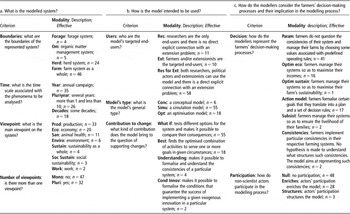
(i) What is the modelled system? This is the result of modellers’ choices to answer a particular question as relevantly as possible. We decided to define the system on the basis of its boundaries, the time scale associated with the phenomena to be analysed and the types of viewpoints on the system. For example, four possible viewpoints on a livestock farming system were suggested by Bonnemaire and Osty (Reference Bonnemaire and Osty2004): biotechnical, economic and technological, ecological and geographical and finally societal. We decided to define one main viewpoint per analysed model, and we also assessed whether the model allowed more than one viewpoint.
(ii) How is the model intended to be used? As support is more a matter of process than of content, the type of use of the model is essential to understanding how the model can contribute to supporting changes in livestock farming. We therefore needed to assume the model's final users; the general type of the model, that is, whether it is a conceptual or an implemented model, and in the second case what kind of implemented model it is (a simulation or an optimisation model) and finally the type of contribution the model can make to the question of change (Does it enable the user to compare different options for the system? To find the best solution? To understand the system better?).
(iii) How do the modellers consider the farmers’ decision-making processes and their involvement in the modelling process? If farmers are to be supported, the support process will differ according to the hypotheses made by the modellers about the farmers’ decision-making processes. Such hypotheses had therefore to be investigated for our analysis. However, they were not always explicit in the papers, so we decided to describe the way modellers represented the farmers’ decision-making processes, which is not necessarily the same thing as their implicit hypotheses. Six modalities were defined (Table 1). The farmers can be represented as rational agents willing to optimise either their income (modality ‘Optim eco’) or a given ‘sustainability score’ (modality ‘Optim sustain’). Their behaviour can also be represented as guided by the objective of ensuring the livelihood of their families, which requires jointly representing the dynamics of livestock production and of family needs (modality ‘Subsist’). Farmers can also be represented as all doing more or less the same things while choosing a set of specific parameter values of management (modality ‘Param’), or as individually building their own specific consistencies by planning their action according to a set of general objectives, as described in the ‘action model’ defined by Sebillotte and Soler (Reference Sebillotte and Soler1990)(modality ‘Action model’). Last, some authors focus on formalising certain system consistencies without referring to any planning activity and with no a priori hypothesis about what guides these consistencies; they are rendered intelligible ex post (modality ‘Consistencies’). We also considered the different ways of integrating farmers’ viewpoints in the modelling processes, as we assumed that this factor provided relevant information about the modellers’ rationale for supporting changes in livestock farming.
Table 1Analysis grid


The analysis grid we obtained was composed of nine criteria with two to seven modalities per criterion (see Table 1). The modalities were not defined a priori using existing typologies; they were iteratively defined as the literature was read. All 79 models were characterised according to these nine criteria.
Building a typology
We wanted to understand how the different models could be used as tools to support changes in livestock farming, so we first analysed criterion ‘Contribution to change’ (Table 1) as this criterion was directly connected with this question. Of the four modalities of this criterion, modality ‘What if’ and modality ‘Best’ largely were the most represented: 92% of the models in the whole collection were concerned by one of these two modalities (Table 1), which meant that the models made it possible either to test different options for the system or to define optimised combinations of activities. Modalities ‘What if’ and ‘Best’ were very closely linked to, respectively, modalities ‘Simu’ and ‘Opt’ of criterion ‘Model's type’ (Table 1). We decided to analyse these two groups of models separately, as they relied on quite different rationales and modelling techniques, so that they may have differentiated strengths and weaknesses with regard to supporting farmers in redesigning their livestock farming systems.
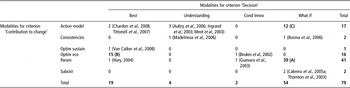
Criterion ‘Decision’ was also far from being independent of criterion ‘Contribution to change’ (Table 2). Out of the 19 models concerned by modality ‘Best’ of criterion ‘Contribution to change’, 15 were concerned by modality ‘Optim eco’ of criterion ‘Decision’ (combination B in Table 2). As far as the models classified in modality ‘What if’ were concerned, they could be divided into two main subgroups: 12 of them classified in modality ‘Action model’ of criterion ‘Decision’ (combination C in Table 2), 39 others in modality ‘Param’ (combination A in Table 2). Representing farmers as all doing more or less the same things (modality ‘Param’) or as building their own specific consistencies on the basis of particular objectives (modality ‘Action model’) would probably lead to different ways of reasoning a model-based intervention aimed at supporting farmers in redesigning their livestock farming systems. As a consequence, here again, we decided to analyse these two subgroups separately. To sum it up, combinations A, B and C in Table 2 represented three different groups of models we wanted to analyse separately. A total of 65 models were concerned, which represented 83% of the whole collection. The remaining 13 models were distributed among nine other different combinations.
Distribution of the models among the different modalities of criteria ‘Contribution to change’ and ‘Decision’

See Table 1 for the descriptions of the criteria and modalities.
A: type ‘Simulating according to a set of parameters’.
B: type ‘Finding the economically optimal solution’.
C: type ‘Action model to simulate the system's dynamics’.
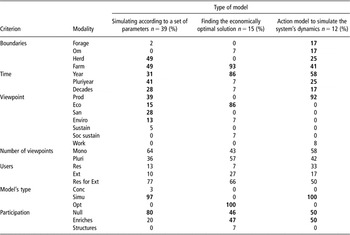
Handling data both with visual (Bertin, Reference Bertin1977) and quantitative methods (i.e. characterising nominal variables by the modalities of other nominal variables) showed us that quite specific combinations of modalities of all criteria listed in Table 1 could be defined for each of these three groups, so that consistent modelling rationales could be analysed for each one. The following analysis therefore aimed at describing these modelling rationales and assessing whether they made it possible or not to consider in-depth changes that may question the very consistencies of the livestock farming systems. Then, analysing the distributions among modalities of all criteria listed in Table 1 (see Table 3) made it possible, mainly via criteria ‘Boundaries’, ‘Time’, ‘Viewpoint’ and ‘Participation’, to determine whether the models could address (i) the farm scale, (ii) the long-term perspective and (iii) with terms that would be relevant for the farmers to decide. The results from these analyses are described in the next sections.
Distributions of modalities within each type of model. The main characteristics of each type are printed in bold

See Table 1 for the descriptions of the criteria and modalities.
Three main ways of supporting changes in livestock farming using models
‘Simulating according to a set of parameters’
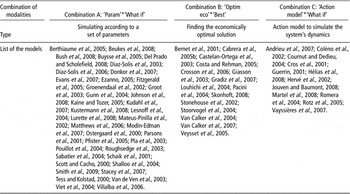
Combination A in Table 2 is the most widely represented combination of modalities concerning the criteria ‘Decision’ and ‘Contribution to change’. In the 39 corresponding models (Table 4), the consistencies of the farming system are represented in a fixed way. The represented decisional behaviour is that of farmers who do not question the consistencies of their systems and who manage their farm by choosing certain values associated with predefined operating rules, as an operator turns dials to calibrate a machine (see modality ‘Param’ for criterion ‘Decision’ in Table 1). For example, in Villalba et al. (Reference Villalba, Casasus, Sanz, Bernues, Estany and Revilla2006), the model, designed at the herd scale, represents a beef cattle system to assess the effects on production and reproduction of a feeding restriction in winter. The reproduction process is represented by a single breeding period during which a bull is present in the batch of cows, and all cows are assumed to be fed the same diet in the same quantities. Therefore, farmers’ choices are represented by a set of parameter values of management, for example entry and exit dates of the male in the group, number and type of feeds and the daily supply of dry matter.

These models belonging to combination A also all contribute to the question of supporting changes by testing different options for the system and by comparing their consequences (see modality ‘What if’ for criterion ‘Contribution to change’ in Table 1). Taking the same example as above (Villalba et al., Reference Villalba, Casasus, Sanz, Bernues, Estany and Revilla2006), the model enables the user to test different types of winter feeding restriction and to compare their consequences for production and reproduction.
Consistent with the ‘What if’ criterion, all models belonging to the type ‘Simulating according to a set of parameters’, except one (Van de Ven et al., Reference Van de Ven, de Ridder, Van Keulen and Van Ittersum2003), are simulation models. Van de Ven's model (2003) model is a conceptual model that uses concepts in production ecology to analyse and design production systems. Although this model is conceptual, the way it can be used fits the ‘What if’ criterion well: some production conditions are explored and their results are analysed using a hierarchy in growth factors, designated the production ecological concept (Van Ittersum and Rabbinge, Reference Van Ittersum and Rabbinge1997). For example, this makes it possible to explore the relationships between N application rate, net herbage yield, milk production and nitrate loss for various grassland utilisation methods in dairy farming in the Netherlands (from zero grazing to day + night grazing). The ‘Param’ criterion also applies well to this model, as it is assumed that ‘an optimum management regime is practised’, leading to ‘the potential production situation for animal production’, while the particular conditions of that optimum regime are beyond the scope of the analysis.
Approximately 50% of such models are designed at the farm scale and the remaining 50% at the herd scale, which is significantly different from the whole collection of models, where the herd scale is less widely represented. The larger proportion of models designed at the herd scale can be explained by the fact that all the models adopting a sanitary viewpoint (n = 11), which are all except one (Stacey et al., Reference Stacey, Parsons, Christiansen and Burton2007) designed at the herd scale, belong to this type. For example, in Viet et al. (Reference Viet, Fourichon, Seegers, Jacob and Guihenneuc-Jouyaux2004), the herd model BVDSim makes it possible to simulate the spread of the bovine viral-diarrhoea virus (BVDV) within a dairy herd, while taking into account herd management factors that influence BVDV spread, such as movements of animals between different subgroups of the whole herd.
Apart from this sanitary viewpoint, the ‘Simulating according to a set of parameters’ type can be characterized by a wide diversity of other possible viewpoints on the system (Table 3). These models make it possible to assess different systems according to their main viewpoints. Such assessments are realised by external observers: farmers’ viewpoints on their systems are not taken into account. The targeted users of such models can be researchers only, for example when assessing stability, resilience and sustainability of a given pasture-based beef production system (Kaine and Tozer, Reference Kaine and Tozer2005), or researchers, extensionists and political actors, which is often the case with the environmental viewpoint: for example, greenhouse gas emissions can be modelled and compared between organic and conventional systems (Kustermann et al., Reference Kustermann, Kainz and Hulsbergen2008). Such models may also be conceived as decision support tools for farmers, especially when the main viewpoint is productive (Diaz-Solis et al., Reference Diaz-Solis, Kothmann, Hamilton and Grant2003; Pla et al., Reference Pla, Pomar and Pomar2003) or economic (Schaik et al., Reference van Schaik, Nielen and Dijkhuizen2001; Bush et al., Reference Bush, Windsor, Toribio and Webster2008).
Models of this type were less often conceived at the year scale than in the whole collection of models. They consequently more often concern longer time scales (from several years to decades). For instance, the model from Scott and Cacho (Reference Scott and Cacho2000) simulates the economic impact of investing in pasture fertiliser in the long term (25 years), taking into account both the benefits on grass production and the constraints of family expenditure. The ‘Simulating according to a set of parameters’ models were also more frequently conceived with no form of participation of non-scientist actors than the whole collection of models.
‘Finding the economically optimal solution’
Combination B in Table 2 is represented by 15 publications, listed in Table 4. In these, the represented decisional behaviour is based on an economic rationale. The decision-making processes are simplified by assuming that farmers seek an economically optimal solution to a set of constraints (see modality ‘Optim eco’ for criterion ‘Decision’ in Table 1). The models contribute to the question of supporting changes by finding the optimal combination of activities that serves one or more goals in given circumstances (see modality ‘Best’ for criterion ‘Contribution to change’ in Table 1). All of these models are based on optimisation techniques, such as classical linear programming methods, as for example in Van Calker et al. (Reference Van Calker, Berentsen, de Boer, Giesen and Huirne2004), Veysset et al. (Reference Veysset, Bebin and Lherm2005) or Crosson et al. (Reference Crosson, O'Kiely, O'Mara and Wallace2006). The model can also contain an optimisation module coupled with simulation modules, as is the case for instance for the Dynamic North Florida Dairy farm model (DyNoFlo dairy; Cabrera et al., Reference Cabrera, Breuer, Hildebrand and Letson2005b), or for a model that compares two different modalities of beef cow–calf production systems in Japan: specialised systems and integrated systems with sugarcane production, each modality being economically optimised (Gradiz et al., Reference Gradiz, Sugimoto, Ujihara, Fukuhara, Kahi and Hirooka2007).
To take a standard example of the ‘Finding the economically optimal solution’ type, the Opt'INRA model (Veysset et al., Reference Veysset, Bebin and Lherm2005) makes it possible to optimise the follow-up of farmers’ decisions, so as to maximise their incomes, given certain political (CAP) and farm constraints (structure, labour, buildings): allocation of the available area for cash crops or fodder area, herd size and livestock feed requirement satisfaction, grain sold or home-consumed as animal feed and type of animals to be sold.
The great majority of the models of this type focus on economy as a priority, the final aim being to optimise an economic objective function. Two models take a different position. The first one (Van Calker et al., Reference Van Calker, Berentsen, de Boer, Giesen and Huirne2007) focuses as a priority on social sustainability and on worker physical health. The purpose of the corresponding publication was to describe certain indicators of worker physical health and of social sustainability that had been selected for incorporation into an existing linear programming model (Van Calker et al., Reference Van Calker, Berentsen, de Boer, Giesen and Huirne2004), so as to build a multicriteria model. This pioneer work relied on an intense participation of experts and stakeholders who suggested the attributes to be translated into indicators and who ranked them (Van Calker et al., Reference Van Calker, Berentsen, de Boer, Giesen and Huirne2007). This model is therefore the one in the group that is structured by non-scientist actors’ participation. The second model in the group that is not purely focused on economy is the DyNoFlo dairy model (Cabrera et al., Reference Cabrera, Breuer, Hildebrand and Letson2005b), in which the optimisation module can deal with either an economic or with an environmental objective function.
More than half of the models of this type allow the users to adopt more than one viewpoint on the system, which is not the case in the whole collection of models (Table 1) and in the two other main types (Table 3). These models make it possible to assess the values of some ‘non-economic’ indicators for each economically optimised solution. The ‘non-economic’ indicators are either environmental or productive. For example, in Pacini et al. (Reference Pacini, Wossink, Giesen and Huirne2004), these indicators include nitrogen leaching, soil erosion, surface water balance, herbaceous plant biodiversity, hedge length and manure surplus.
The ‘Finding the economically optimal solution’ type contains models that are more often designed at the farm scale and at the year scale than in the whole collection of models. Typically, the goal of such models is to optimise a list of activities designed at the farm scale for a given year.
In half of these models, non-scientist actors’ participation enriches the model's structure. For instance, the Opt'INRA model (Veysset et al., Reference Veysset, Bebin and Lherm2005) was built with a deep knowledge of the suckler farms of Central France acquired through the participation of nearly 90 Charolais farmers in a monitoring process carried out for more than 20 years. This monitoring made it possible to list all the existing activities in the area, to state the constraints and to determine the coefficients for the construction of Opt'INRA.
The ‘Finding the economically optimal solution’ models are intended to be used in a wide variety of situations. They can be designed as standard decision support tools to be used by advisors to discuss the decisions to be made with farmers (Stonehouse et al., Reference Stonehouse, Vos and Weersink2002; Castelan-Ortega et al., Reference Castelan-Ortega, Fawcett, Arriaga-Jordan and Herrero2003; Cabrera et al., Reference Cabrera, Breuer, Hildebrand and Letson2005b; Veysset et al., Reference Veysset, Bebin and Lherm2005; Crosson et al., Reference Crosson, O'Kiely, O'Mara and Wallace2006). They may also be conceived as tools for a participatory discussion among stakeholders of agricultural development questions in different production contexts (Bernet et al., Reference Bernet, Ortiz, Estrada, Quiroz and Swinton2001), or as prospective tools to support policy-making (Pacini et al., Reference Pacini, Wossink, Giesen and Huirne2004). They may also be used as research tools to gain a better understanding of farmers’ behaviour, for example to explore why Brazilian beef farmers, assumed to be guided by economic rationales, tend to practice overgrazing even though it can compromise pasture perennity (Costa and Rehman, Reference Costa and Rehman2005).
‘Action model to simulate the system's dynamics’
Combination C in Table 2 is represented by 12 publications, listed in Table 4. In these, the represented decisional behaviour is largely based on intention and planning. The decision-making processes are assumed to follow the farmers’ ‘action model’ described by Sebillotte and Soler (Reference Sebillotte and Soler1990): they require one or more guiding objectives to be defined by the farmer, as well as a plan and a set of decision rules (see modality ‘Action model’ for criterion ‘Decision’ in Table 1). For example, in the Management and Productivity of Sow Herd (MaProSH) model (Martel et al., Reference Martel, Dedieu and Dourmad2008), the productive performance, the periodic task event distribution and the capacity to maintain a minimum number of sows at farrowing are considered to be the farmers’ objectives. The strategic decisions to serve those objectives are the type of batch farrowing system, the duration of lactation, the scheduling of periodic tasks and the maintenance of a minimum number of sows at farrowing. Tactical decision rules concern the rules for the culling of sows at each step of the reproductive cycle.
The other characteristic of such models is that they contribute to accompany changes by making it possible to test different options for the system and to compare them (see modality ‘Best’ for criterion ‘Contribution to change’ in Table 1). In the latter example (Martel et al., Reference Martel, Dedieu and Dourmad2008), the MaProSH model makes it possible to represent the herd dynamics and performance and to predict the number of events workers will have to deal with according to the farmer's strategy, especially the batch farrowing system. In consistence with this type of modality for accompanying change, every model belonging to the group ‘Action model to simulate the system's dynamics’ is a simulation model.
Models of this type can be designed at different scales. The distribution is well balanced between whole-farm models, forage system models (Coléno et al., Reference Coléno, Duru and Soler2002; Andrieu et al., Reference Andrieu, Poix, Josien and Duru2007), herd models (Cournut and Dedieu, Reference Cournut and Dedieu2004; Rotz et al., Reference Rotz, Buckmaster and Comerford2005; Martel et al., Reference Martel, Dedieu and Dourmad2008) and models of organic matter management system (Guerrin, Reference Guerrin2001; Hélias et al., Reference Hélias, Guerrin and Steyer2008), with a slightly higher proportion of whole-farm models. The time scale considered is the year scale in more than half of the models of this type. Except for the model of Romera et al. (Reference Romera, Morris, Hodgson, Stirling and Woodward2004), every model designed at the farm scale (Cros et al., Reference Cros, Duru, Garcia and Martin-Clouaire2001; Hervé et al., Reference Hervé, Genin and Migueis2002; Vayssières et al., Reference Vayssières, Lecomte, Guerrin and Nidumolu2007; Jouven and Baumont, Reference Jouven and Baumont2008) or at the forage system scale (Coléno et al., Reference Coléno, Duru and Soler2002; Andrieu et al., Reference Andrieu, Poix, Josien and Duru2007) concerns the temporal scale of an annual campaign. The model of Romera et al. (Reference Romera, Morris, Hodgson, Stirling and Woodward2004) simulates the operation of the farm by decision rules entered by the user to study the long-term dynamics (30 years) of complete cow–calf production systems in Argentina. Models of organic matter management systems (Guerrin, Reference Guerrin2001; Hélias et al., Reference Hélias, Guerrin and Steyer2008) represent phenomena associated with a pluriannual time scale, and herd models can concern either one year when focusing on feeding strategies (Rotz et al., Reference Rotz, Buckmaster and Comerford2005), or many years when focusing on reproduction management (more than 20 years; Cournut and Dedieu, Reference Cournut and Dedieu2004).
Every model of the type ‘Action model to simulate the system's dynamics’ focuses as a priority on a productive viewpoint, except for the MaProSH model (Martel et al., Reference Martel, Dedieu and Dourmad2008), which also focuses on the farmer's work organisation. In the first type (‘Simulating according to a set of parameters’), only 39% of the models focus on this productive viewpoint, and in the second type (‘Finding the economically optimal solution’), 86% of the models focus on an economic viewpoint, with no model focusing on a productive viewpoint (Table 3). In half of the models, the participation of non-scientist actors, especially farmers, in the design of the model enriches its structure. Such participation is often useful to obtain a better representation of the decisional subsystem of the livestock farming system. For instance, in Vayssières et al. (Reference Vayssières, Lecomte, Guerrin and Nidumolu2007) the decisional subsystem of a whole-farm model was built according to a multi-step, multi-tool methodology mixing the following methods involving farmers: immersion, visits and meetings. The biotechnical subsystem of this whole-farm model was more classically built on the basis of already existing models and some new implementations by researchers. More frequently, the decision rules implemented in the model can be defined with the help of agricultural experts and on the basis of on-farm surveys. For instance, experts from research institutes and extension services and surveys of three beef suckler farms representative of the local systems helped to build the whole-farm simulation model SEBIEN (Jouven and Baumont, Reference Jouven and Baumont2008).
Approximately one-third of the ‘Action model to simulate the system's dynamics’ models are research models aimed at a better understanding of farm operations and their consequences (Hervé et al., Reference Hervé, Genin and Migueis2002; Cournut and Dedieu, Reference Cournut and Dedieu2004; Rotz et al., Reference Rotz, Buckmaster and Comerford2005; Andrieu et al., Reference Andrieu, Poix, Josien and Duru2007). Two models of this type can be used as decision support tools (Guerrin, Reference Guerrin2001; Hélias et al., Reference Hélias, Guerrin and Steyer2008). Although they were not designed to be used directly by farmers and their advisors, the remaining models were built to address well-identified extension problems, for example, trade-offs between production and floristic diversity (Jouven and Baumont, Reference Jouven and Baumont2008) or work organisation (Martel et al., Reference Martel, Dedieu and Dourmad2008).
Limits of the typology
Classifying the models from our collection into different modalities of different criteria was subject to some limitations as some part of the necessary information was sometimes missing in the papers. Consequently, there might be some approximations in the modalities we retained for each model. For example, many of the papers we worked on focused on the content of the model rather than its intended use and some of them described the models as elements to be used in larger extension processes, which sometimes made it difficult to classify the models in the different modalities of criterion ‘Users’. Furthermore, the data used for the model development (experimental data, data from case studies, observational data, data built with farmers and extensionists, or any other kind of data) were not always described with much detail. As a consequence, it was not always easy to know if some non-scientist actors had been involved in the model development and to classify the models in the different modalities of criterion ‘Participation’.
In all cases, the classifications we retained were based on what we could assume on the only basis of what was written in the papers; so as to treat every model in a comparable way, we did not use the additional knowledge we had about some particular models we knew better, nor did we do extra investigation with some authors. As the amount of details provided could greatly vary between the different papers, model classification was not realised on the same basis for every model. For example, as far as criterion ‘Decision’ was concerned, some models that may not differ in principle in the way farmers’ decision-making processes were represented might have been classified into different modalities because the models were not described in the papers with the same level of precision. In particular, it was sometimes difficult to make the difference between modality ‘Param’ and modality ‘Action model’. We classified the models in modality ‘Action model’ when authors explicitly referred to ‘farmers’ objectives’, to ‘decision rules’, ‘strategic and tactical rules’ and/or to the ‘action model’ (Sebillotte and Soler, Reference Sebillotte and Soler1990), but we agree that some authors might have used the same kind of representation principles without mentioning them. As a consequence, the classification of some models in the first type (‘Simulating according to a set of parameters’, modality ‘Param’) v. the third type (‘Action model to simulate the system's dynamics’, modality ‘Action model’) might be subject to some debate.
In spite of these several uncertainties, our typology made it possible to elicit three main types of modelling rationales concerning the question of supporting changes in livestock farming. The models that belong to a given type share some common traits, so that they form a consistent group with similar modelling objectives and characteristic combinations of modalities. What is to be retained from our typology is rather these consistencies within each of the three types than the classification of the particular models into one type or another.
Some emerging modalities to overcome new modelling challenges
A limited number of well-established modalities for each of our criteria listed in Table 1 are largely represented within the three main types. However, some other modalities occur, although they are less widely represented in the whole collection of models, and even less in the three main types. Nevertheless, some of them are promising insofar as they are closely linked to new challenges of agricultural research and development, such as sustainability, innovation and participation.
For example, models concerned by one or several modalities linked to sustainability as a whole or to social sustainability are relatively scarce. Three models have their main focus on social sustainability (Thornton et al., Reference Thornton, Galvin and Boone2003; Cabrera et al., Reference Cabrera, Hildebrand and Jones2005a; Van Calker et al., Reference Van Calker, Berentsen, de Boer, Giesen and Huirne2007) (modality ‘Soc Sustain’ of criterion ‘Viewpoint’), of which two represent the decision-making processes as guided by the objective of ensuring the livelihood of the family (modality ‘Subsist’ of criterion ‘Decision’; Thornton et al., Reference Thornton, Galvin and Boone2003; Cabrera et al., Reference Cabrera, Hildebrand and Jones2005a). Out of the 79 models of the whole collection, four models focus as a priority on sustainability as a whole, that is, address social, economic and environmental questions (Kaine and Tozer, Reference Kaine and Tozer2005; Bosma et al., Reference Bosma, Phong, Kaymak, Van den Berg, Udo, Van Mensvoort and Tri2006; Del Prado and Scholefield, Reference Del Prado and Scholefield2008; Van Calker et al., Reference Van Calker, Berentsen, Giesen and Huirne2008; modality ‘Sustain’ of criterion ‘Viewpoint’). Last, the model of Van Calker et al. (Reference Van Calker, Berentsen, Giesen and Huirne2008) optimises the livestock farming system so as to maximise its overall sustainability (modality ‘Optim sustain’ of criterion ‘Decision’).
Concerning the type of contribution the model brings to the question of change (criterion ‘Contribution to change’), the modalities ‘What if’ and ‘Best’ have been largely explored and they form the basis of our three main types of models. Two other modalities were nevertheless identified in our collection of models. The first one consists in defining the conditions that would make it profitable to implement an external innovation (modality ‘Cond Innov’), and it concerns two models. In Beukes et al. (Reference Beukes, Cowling and Higgins2002), the external innovation is a multi-camp infrastructure for the South-African rangelands, whereby most of the available forage within a camp is removed non-selectively, so as to create an environmental buffer of forage reserves outside the camps. The corresponding model simulates the economic merits of such an investment and enables the user to estimate the economically optimal number of camps. In Guevara et al. (Reference Guevara, Silva Colomer, Estevez and Paez2003), the innovation to be tested is fodder shrub plantations as a supplement for goat production in Argentina. The corresponding model can assess both the biotechnical benefits and the establishment costs of the investment in different situations.
The other original way of contributing to the question of change is represented by the modality ‘Understanding’ of the criterion ‘Contribution to change’, and it concerns four models (Ingrand et al., Reference Ingrand, Cournut, Dedieu and Antheaume2003; Meot et al., Reference Meot, Hubert and Lasseur2003; Aubry et al., Reference Aubry, Paillat and Guerrin2006; Madelrieux et al., Reference Madelrieux, Dedieu and Dobremez2006). In these models, supporting changes are made possible by eliciting some understanding of the system's operation while using a comprehensive viewpoint on the system. These four models belong to the five conceptual models of the whole collection, the fifth being the model of Van de Ven et al. (Reference Van de Ven, de Ridder, Van Keulen and Van Ittersum2003) discussed above. The conceptual structures of these four models themselves make it possible to gain a better understanding of the systems considered. Such structures may also be used for further implementation to build simulators, which can be a deliberate prospect (Ingrand et al., Reference Ingrand, Cournut, Dedieu and Antheaume2003; Aubry et al., Reference Aubry, Paillat and Guerrin2006) or not (Meot et al., Reference Meot, Hubert and Lasseur2003; Madelrieux et al., Reference Madelrieux, Dedieu and Dobremez2006). In the latter case, the conceptual model is in itself sufficient to serve all the modellers’ objectives.
The latter model (Madelrieux et al., Reference Madelrieux, Dedieu and Dobremez2006) is also original insofar as it is concerned by the scarce modality ‘Consistencies’ of the criterion ‘Decision’. It aims at formalising certain system consistencies, in this case work organisation, but without referring to any planning activity that would serve formalised objectives, as is the case for the modality ‘Action model’, characteristic of our third type of modelling rationales (the ‘Action model to simulate the system's dynamics’ type). The consistencies are rendered intelligible by an ex post viewpoint on the strategic pattern of the farm as already experienced by Girard and Hubert (Reference Girard and Hubert1999).
A strong participation of experts is observed for such models concerned by the modality ‘Consistencies’ (Bosma et al., Reference Bosma, Phong, Kaymak, Van den Berg, Udo, Van Mensvoort and Tri2006; Madelrieux et al., Reference Madelrieux, Dedieu and Dobremez2006). To be able to represent the specific consistencies of given farming systems, a strong involvement of farmers (Bosma et al., Reference Bosma, Phong, Kaymak, Van den Berg, Udo, Van Mensvoort and Tri2006) or agricultural experts (Madelrieux et al., Reference Madelrieux, Dedieu and Dobremez2006) is necessary to support the modelling process. Consequently, in these cases, actors’ participation does not only enrich the model (modality ‘Enriches’ of criterion ‘Participation’) but also truly structures it (modality ‘Structures’). The latter modality is scarce, being represented by only three models (Bosma et al., Reference Bosma, Phong, Kaymak, Van den Berg, Udo, Van Mensvoort and Tri2006; Madelrieux et al., Reference Madelrieux, Dedieu and Dobremez2006; Van Calker et al., Reference Van Calker, Berentsen, de Boer, Giesen and Huirne2007). Some arguments (Cambell and Salagrama, Reference Cambell and Salagrama2001) nevertheless suggest that participatory approaches could (i) increase the efficiency and effectiveness in research and development, (ii) empower local actors and (iii) make it possible to explore the understanding of knowledge and knowledge systems between formal science and indigenous culture and to foster greater interaction between them.
Interests and limits of the three main types to support farmers in redesigning their whole livestock farming systems
In our third section, three types of models were described to show how each type can contribute to supporting changes in livestock farming. In this fifth section, we want more precisely to examine the question of supporting farmers in the redesigning of their livestock farming systems. Our analysis of the strengths and weaknesses of each of the three types for supporting redesigning processes will be based on the data presented in Table 3.
When redesigning a livestock farming system, a farmer needs to question the consistencies of the whole system. Supporting this redesign process using models would therefore as a priority require models built at the farm scale. Within our third type of model (‘Action model to simulate the system's dynamics’), the models quite often represent subsystems of the whole-farm system: herd, forage system or organic matter management system. When conceived at the farm scale, except for the model of Romera et al. (Reference Romera, Morris, Hodgson, Stirling and Woodward2004), these models always result from the aggregation of submodels conceived to answer questions asked at a smaller scale than the farm scale, sometimes combined with new implementations. This fact questions the relevance of the final aggregated model as a sound support for a discussion of the redesigning of the whole system. The management questions to be addressed concern the whole system more often than its constituent parts, which argues for prioritising realism and relevance rather than the precision offered by numerous existing submodels (Guerrin, Reference Guerrin2007). Partly as a consequence of such difficulties in designing integrated models at the farm scale, models that properly represent crop–livestock interactions are few, although many farming systems worldwide revolve around such interactions (Thornton and Herrero, Reference Thornton and Herrero2001).
Conversely, the models of the second type (‘Finding the economically optimal solution’) most often operate at the farm scale. They make it possible to formulate the best configuration of a system to serve the farmers’ objectives in a given set of constraints, provided that the farmers’ objectives can be summarised by the idea of profit maximising. However, although the hypothesis of profit maximising has proved its operational efficiency by giving the users of the models a better understanding of some aspects of farmers’ behaviour, or supporting proposals for changes for the farmers in a counselling perspective, its non-reality has been pointed out by some authors, who suggest that an economic rationale may not be the only one that influences farmers’ action (Fiorelli et al., Reference Fiorelli, Dedieu and Pailleux2007). The ‘optimal’ nature of the proposed solution therefore needs to be qualified, as also the farmers’ willingness to receive such prescriptive decision support (Magne and Ingrand, Reference Magne and Ingrand2004). Outside these considerations, such tools do not address the question of how to reach this ‘optimal’ solution, nor do they predict the long-term consequences of implementing the recommended combination of activities. Furthermore, they can be seen as ‘black boxes’ that deliver the ‘best’ solution without helping the user to understand why that solution should be the best, which offers no learning perspective, unlike simulation models (Guerrin, Reference Guerrin2007, p. 24).
As it implies in-depth changes, redesigning a livestock farming system requires questioning the long-term operation of the new system, to ensure its sustainability. Within the ‘Simulating according to a set of parameters’ type, as numerous simplifications are made concerning the farmers’ decision-making processes, the resulting decreased complexity of the model makes simulation at the farm scale and in the long term quite easy compared with the ‘Action model to simulate the system's dynamics’ type. The framework of the farmer's ‘action model’ (Sebillotte and Soler, Reference Sebillotte and Soler1990) used in this type was initially conceived to represent decision-making processes during an annual agricultural campaign. Consequently, most models of this type simulate the system operation on an annual basis, with an interesting level of realism and precision. However this realism needs to be qualified when models of this type aim at representing longer term strategies (simulations of the system operation for several years up to some decades); according to Sebillotte and Soler (Reference Sebillotte and Soler1990), further theoretical elements would be needed to realistically represent farmers’ decision-making processes on longer periods than the annual agricultural campaign.
Despite its strength for easy simulation at the farm scale and in the long term, the ‘Simulating according to a set of parameters’ type presents two important weaknesses. First, as the represented decisional behaviour is that of farmers who do not question the consistencies of their systems, the leeway for new practices and consistencies to be tested is restricted. What can be tested are new values of management factors or new modalities of isolated practices. Such tests do not make it possible to truly question the system's consistencies, as would be required for redesigning the farming system. Second of the three types, the ‘Simulating according to a set of parameters’ type presents the lowest degree of farmers’ participation in the modelling process. There is more farmers’ participation in the other two types, but given the scarcity of the highest modality of participation (modality ‘Structures’ of criterion ‘Participation’; Table 1), the situation could be improved in these two types also.
Models belonging to the ‘Simulating according to a set of parameters’ type make it possible to assess the livestock farming systems from different viewpoints: economy, production, animal health, the environment or sustainability. However, these viewpoints are generally not mixed within the same model. Furthermore, they do not necessarily match what the farmers would themselves want to assess in order to decide what changes to implement in their systems: the vision of the system endorsed by the model is external to that of the farmers. By contrast, within the ‘Action model to simulate the system's dynamics’ type, the representation focuses on the farmers’ own general objectives and on the different ways of serving them. However, such general objectives are characterised by focusing on a productive viewpoint, and exceptionally on work organisation. No model of this type makes it possible to focus on economy, animal health, the environment or sustainability, even though these can be real matters of concern for the farmers.
Conclusion
Three main kinds of modelling rationales have been identified for supporting changes in livestock farming practice. For each one, the models present some common traits that are consistent with the modelling objectives within the group. Outside these three main types, some original modalities of modelling livestock farming systems have been devised to address the current challenges of sustainability, innovation and participation. These modalities have not yet become as well established as the modelling modalities of the three main types.
In the models from our database that were not specifically designed to support redesigning processes of livestock farming systems, the following four conditions are never all perfectly met: (i) modelling at the farm scale, (ii) addressing the long-term perspective, (iii) considering in-depth changes that require questioning the system's consistencies and (iv) including terms that are relevant for the farmers to decide. Meeting these four conditions would require progress in integrating different time scales, different subsystems and different viewpoints within the same model. This is one of the great challenges addressed to modellers so as to support farmers in redesigning their whole livestock farming systems. Another challenge is to build models that will easily be appropriable by farmers and that will allow them to consider in-depth changes. Building them in a participatory way with farmers could be one way of making them more appropriable (Newman et al., Reference Newman, Lynch and Plummer2000; McCown, Reference McCown2002; Woodward et al., Reference Woodward, Romera, Beskow and Lovatt2008; Cerf et al., Reference Cerf, Mathieu, Béguin and Thiery2008). Besides, outside the strict domain of farming systems research, it has been shown, on the basis of a case study around a model to support upland water catchment management, that participatory modelling with people who interact with the systems in reality is relevant to gain a more integrated view of the modelled systems (Prell et al., Reference Prell, Hubacek, Reed, Quinn, Jin, Holden, Burt, Kirby and Sendzimir2007).
Consequently, we advocate including farmers in the conceptual modelling process of livestock farming systems, using a participatory approach. To better support the farmers in their redesign processes, such conceptual models should be conceived at the farm scale and take the long term into account. No a priori hypothesis should be made concerning the farmers’ decision-making processes, except that each farming system comprises specific consistencies. Such consistencies should be represented by the conceptual models so as to gain a better understanding of the operation of the livestock farming systems. The viewpoints on the system should be those that appear relevant to farmers to redesign their systems optimally. Such a modelling project would require a large methodological investment but would probably be of great interest to help farmers to switch towards more sustainable livestock farming systems.
Acknowledgements
The authors thank Thomas Pacaud (ENITA, Clermont-Ferrand) for his preliminary work on collecting models.