Introduction
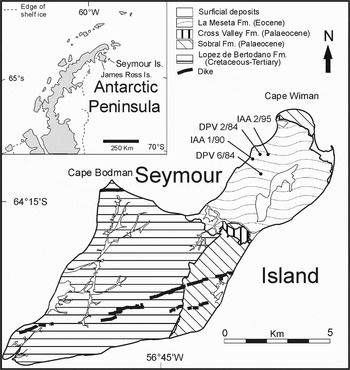
Late in the last century, Woodburne & Zinsmeister reported the first discovery of an extinct Antarctic mammal from the La Meseta Formation (Woodburne & Zinsmeister Reference Woodburne and Zinsmeister1982, Reference Woodburne and Zinsmeister1984). This is a late early Eocene to probably early Oligocene unit that crops out in the northern third of Seymour (Marambio) Island, at some 100 km off the northern Antarctic Peninsula (Fig. 1) (Elliot & Trautman Reference Elliot, Trautman and Craddock1982, Woodburne & Zinsmeister Reference Woodburne and Zinsmeister1982, Marenssi et al. Reference Marenssi, Santillana, Rinaldi and Casadio1998, Ivany et al. Reference Ivany, Van Simaeys, Domack and Samson2006). The La Meseta Formation is divided in six allomembers (Marenssi et al. Reference Marenssi, Santillana, Rinaldi and Casadio1998), among which the Cucullaea I Allomember contains most of the fossil mammals so far described. These include an alleged gondwanatherian, several marsupials, native ungulates, one xenarthran, and an enigmatic mammal of uncertain affinities (Woodburne & Zinsmeister Reference Woodburne and Zinsmeister1982, Reference Woodburne and Zinsmeister1984, Case et al. Reference Case, Woodburne, Chaney, Feldmann and Woodburne1988, Vizcaíno et al. Reference Vizcaíno, Reguero, Goin, Tambussi, Noriega and Casadio1998, Reguero et al. Reference Reguero, Marenssi and Santillana2002, Goin et al. Reference Goin, Zimicz, Reguero, Santillana, Marenssi and Moly2007).
Map of the Antarctic Peninsula and Seymour Island indicating the location of the studied localities.

The first extinct mammal from the La Meseta Formation was referred to a polydolopid marsupial, similar to Polydolops but, besides some differences in the molar structure, lacking a p2 and with “more elongate proportions of the molars” (Woodburne & Zinsmeister Reference Woodburne and Zinsmeister1982, p. 284). Subsequently, Woodburne & Zinsmeister (Reference Woodburne and Zinsmeister1984) recognized the new taxon Antarctodolops dailyi, on the basis of a dentary with p3-m2, as well as a few additional specimens. Later Case et al. (Reference Case, Woodburne, Chaney, Feldmann and Woodburne1988) reported on the presence of yet another polydolopid from the same formation and levels: Eurydolops seymourensis. The new taxon was based on an isolated P3 which, according to the authors, was too small to be assigned to Antarctodolops dailyi. The referral of the Antarctic polydolopids to two different genera was challenged by Candela & Goin (Reference Candela and Goin1995), who synonymized both species with Polydolops. They stated that the differences between them and specimens of Polydolops were not enough to recognize different genera, though they agreed with the previous authors in keeping both species as valid.
Here we report on new polydolopid materials from the La Meseta Formation. The new specimens led us to a review of the Antarctic polydolopid marsupials, and to challenge previous hypothesis on their affinities and significance.
Abbreviations and conventions
UCR, University of California at Riverside (materials now housed at the Museum of Paleontology, University of California, Berkeley); MLP, Museo de La Plata; MACN-A, Colección Ameghino, Museo Argentino de Ciencias Naturales “Bernardino Rivadavia”; P, M, upper premolars and molars, respectively; p, m, lower premolars and molars, respectively. The time scale followed here is that of Gradstein et al. (Reference Gradstein, Ogg and Smith2004). For the molar nomenclature and terminology, see Goin et al. (Reference Goin, Candela and De Muizon2003) and below. All measurements are in millimetres.
Stratigraphy, age and palaeoclimate
The La Meseta Formation (Elliot & Trautman Reference Elliot, Trautman and Craddock1982, Marenssi et al. Reference Marenssi, Santillana, Rinaldi and Casadio1998, Ivany et al. Reference Ivany, Van Simaeys, Domack and Samson2006) is a 710 m thick clastic unit which records sedimentation in a deltaic and estuarine environment, within an incised valley filled by shallow marine deposits composed of sandstones, mudstones, and shell banks that accumulated in a variety of inner shelf environments (Sadler Reference Sadler, Feldmann and Woodburne1988, Marenssi et al. Reference Marenssi, Santillana, Rinaldi and Casadio1998, Porębski Reference Porębski2000). Different authors have variously stressed the estuarine, deltaic, and channel or valley fill nature of the different deposits (e.g. Elliot & Trautman Reference Elliot, Trautman and Craddock1982, Sadler Reference Sadler, Feldmann and Woodburne1988, Stilwell & Zinsmeister Reference Stilwell and Zinsmeister1992, Marenssi et al. Reference Marenssi, Santillana, Rinaldi and Casadio1998, Porębski Reference Porębski2000).
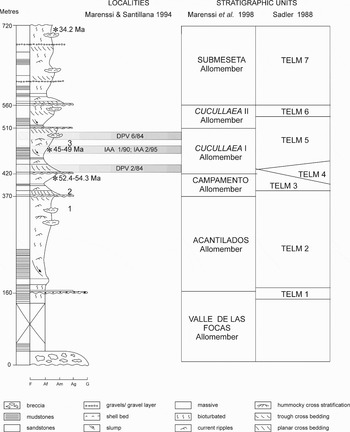
The La Meseta Formation was subdivided in six allomembers. All fossils studied here come from lower, middle, and upper levels of the Cucullaea I Allomember (Marenssi et al. Reference Marenssi, Santillana, Rinaldi and Casadio1998) or TELMs 4 and 5 (Elliot & Trautman Reference Elliot, Trautman and Craddock1982), cropping out at different localities (Fig. 2). The mammal-bearing levels are composed of thick shelly conglomerates, well-sorted sands and interlaminated sand/mud channel-fills with thin shelly conglomeratic intervals. The bioclastic fraction comprises mainly gastropods (naticids) but marine and land vertebrate remains, plant fragments and other marine invertebrates also occur. Marenssi et al. (Reference Marenssi, Santillana, Rinaldi and Casadio1998 and references therein) considered these beds as reworked, moderate to high-energy facies of a subtidal shallow marine environment. Three horizons within the Cucullaea I Allomember of the La Meseta Formation produced polydolopid specimens (Fig. 2). Known as the “Ungulate Site” (Marenssi et al. Reference Marenssi, Santillana, Rinaldi and Casadio1998), the locality IAA 1/90 is the richest Antarctic mammal-bearing locality known to date (Reguero et al. Reference Reguero, Vizcaíno, Goin, Marenssi, Santillana and Casadio1998, Reference Reguero, Marenssi and Santillana2002, Vizcaíno et al. Reference Vizcaíno, Reguero, Goin, Tambussi, Noriega and Casadio1998), and also produced some of the new specimens described here.
Terrestrial mammal-bearing horizons and stratigraphy for the La Meseta Formation, Seymour Island after Marenssi & Santillana (1994). DPV 6/84 is equivalent to RV-8200 of Woodburne & Zinsmeister (Reference Woodburne and Zinsmeister1984). 1, 2, 3: fossil plant localities A/88, B/88, C/88 of Gandolfo et al. (Reference Gandolfo, Marenssi, Santillana and Casadio1998). Radiometric dates are based on 87Sr/86Sr isotopic ratios after Reguero et al. (Reference Reguero, Marenssi and Santillana2002), Dutton et al. (Reference Dutton, Lohmann and Zinsmeister2002), and Dingle & Lavelle (1988).

Mollusc faunas support an Eocene age for this formation, with a struthiolariid gastropod from Cucullaea I Allomember (formerly, TELMs 4 and 5 of Sadler Reference Sadler, Feldmann and Woodburne1988) being indicative of the late Eocene (Stilwell & Zinsmeister Reference Stilwell and Zinsmeister1992). Hall (Reference Hall1977) used dinoflagellate assemblages to suggest a late Eocene to early Oligocene age for the top of the formation, and Fordyce (Reference Fordyce and Crame1989) concurred based on the presence of a cetacean skeleton with mysticete affinities. More recently, workers have used strontium isotope stratigraphy. Dutton et al. (Reference Dutton, Lohmann and Zinsmeister2002) offered strontium isotope ratios from a limited number of mollusc shells from Acantilados, Cucullaea I and Submeseta allomembers that suggest early, middle, and late Eocene ages, respectively. Reguero et al. (Reference Reguero, Marenssi and Santillana2002) concurred with strontium data from the lower horizons of La Meseta Formation (Acantilados Allomember) that yield an early Eocene age. Dingle et al. (Reference Dingle, Marenssi and Lavelle1998) and Ivany et al. (Reference Ivany, Van Simaeys, Domack and Samson2006) reported strontium isotope ratios from shells at the top of the formation that are consistent with ages at or just below the Eocene–Oligocene boundary (Fig. 2). Here we follow Dutton et al. (Reference Dutton, Lohmann and Zinsmeister2002) in assigning an early middle Eocene age for the mammal-bearing levels of the Cuccullaea I (including the TELM 5 unit) Allomember. A new mammal association coming from Paso del Sapo, in western Patagonia (Tejedor et al. in press) has been recently related to the La Meseta fauna on the basis of faunal similarities. This Patagonian assemblage is no older than 49.5 Ma, thus suggesting a latest early–earliest middle Eocene age for it and, by extension, also for the La Meseta mammal-bearing levels.
Apart from mammals, the Cucullaea I Allomember has also provided the largest collection of leaves from the Eocene of Antarctica (Gandolfo et al. Reference Gandolfo, Marenssi, Santillana and Casadio1998), as well as most of the wood remains collected to date from the entire La Meseta Formation. It has been inferred that all the terrestrial remains were transported and deposited in a shallow marine setting, being concentrated by means of sedimentological processes and mixed with a normal marine macrofauna (Marenssi et al. Reference Marenssi, Santillana, Rinaldi and Casadio1998).
Clay mineral and geochemical data show that the northern Antarctic Peninsula (Seymour Island) experienced a climatic deterioration from very warm, non-seasonal wet conditions in the early Eocene to a cold, frost-prone and dry regime at the end of the late Eocene (Dingle et al. Reference Dingle, Marenssi and Lavelle1998). Physiognomic analysis of the leaves collected from the Cucullaea I Allomember indicate a temperate to cool-temperate and seasonally moist climate, with mean annual temperatures between 11° and 13°C (Gandolfo et al. Reference Gandolfo, Marenssi, Santillana and Casadio1998). In short, by middle Eocene times, the Seymour Island climate was already experiencing a rapid cooling from very warm to cold through a strongly seasonal period (Dingle et al. Reference Dingle, Marenssi and Lavelle1998).
Polydolopid taxonomic and phylogenetic context
During most of the last century, polydolopids were thought to be part of the “pseudodiprotodont” marsupial radiation, a supposed monophyletic group including the living caenolestids and their extinct relatives, together with the extinct argyrolagids, groeberiids, bonapartheriids, prepidolopids, and polydolopids (see a review in Goin et al. in press, table 2). The Polydolopidae were thought to include two sister groups: the Polydolopinae (Polydolops and allies), and the Epidolopinae (Epidolops spp., Pascual & Bond Reference Pascual and Bond1981). On the basis of their molar morphology, Goin & Candela (Reference Goin and Candela1995) argued that polydolopines and epidolopines did not constitute a natural group. Goin et al. (Reference Goin, Candela and De Muizon2003) suggested that Roberthoffstetteria nationalgeographica, an early Palaeocene taxon previously regarded as caroloameghiniid “didelphimorphian”, was sister to the polydolopine radiation. Later, Goin & Candela (Reference Goin, Candela and Campbell2004) discussed the content and extent of the Order Polydolopimorphia, considering two major clades within this group: Bonapartheriiformes (Bonapartherioidea + Argyrolagoidea), and Polydolopiformes, the latter restricted to the Polydolopidae; Epidolopinae was included within the Bonapartherioidea, as a subfamily of Bonapartheriidae. Case et al. (Reference Case, Goin and Woodburne2005) offered a similar classification, down to generic level, of all the Polydolopimorphia, and included within Polydolopiformes not only polydolopines and Roberthoffstetteria but also the late Cretaceous, North American Ectocentrocristus foxi Rigby & Wolberg (but see Beck et al. Reference Beck, Archer, Godthelp, Mackness, Hand and Muirhead2008). Finally, Goin et al. (in press) added further arguments in a phylogenetic review of all “pseudodiprotodont” marsupials, and sustained the sister-group relationship between Roberthoffstetteria and polydolopines. In this context, our concept of Polydolopidae equals that of Polydolopinae sensu Pascual & Bond (Reference Pascual and Bond1981).
Origin and homologies of the polydolopid molar pattern
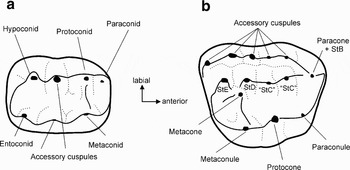
The polydolopid molar pattern is one of the most aberrantly derived among extinct or extant metatherians. Thus, it should not be surprizing that few attempts have been made in homologizing their cusps and crests with those of the generalized tribosphenic pattern. Two of the most striking features in the polydolopid molars are: 1) the presence of at least two rows of cusps which are anteroposteriorly oriented (sometimes three rows on the upper first molar), and 2) the existence of three major cusps on the lingual edge of the upper molars (Fig. 3). Because of these features, Ameghino (e.g. Reference Ameghino1897) compared them not only with cenolestoid marsupials, but with multituberculates and mastodonts as well, though he never stated the homologies of their cusps. Other authors that worked on polydolopid taxonomy also restrained from stating their cusp homologies (e.g. Simpson Reference Simpson1948, Marshall Reference Marshall1982).
Schematic representation of polydolopine molars: a. lower m2, b. upper M1.

Describing Antarctodolops, Woodburne & Zinsmeister (Reference Woodburne and Zinsmeister1984) were the first to attempt a cusp homologization among polydolopids. They nominated two cusps of the M1: the protocone, the cusp located in the anterior lingual lobe, and the “hypocone”, the largest cusp of the posterolingual corner of the posterior lobe of this molar. In turn, they recognized three cusps in the m2: the anterolabial cusp (the protostylid), the protoconid, placed posterior to it, and an anterolingual cusp on the (broken) edge of the only known m2 (the holotype from Antarctodolops dailyi), the paraconid. Regarding the latter, however, in more complete specimens studied by us it can be seen that there is no cusp in this position, but instead a subhorizontal crest belonging to the large, lingual cusp. The latter, aligned with the protoconid, was regarded as the metaconid.
Goin et al. (Reference Goin, Candela and De Muizon2003), attempted a comprehensive scheme of homologies for the polydolopid molar cusps. They compared them with the molar pattern of Roberthoffstetteria nationalgeographica (formerly assigned to Caroloameghinidae by Marshall et al. Reference Marshall, de Muizon and Sigé1983), and suggested that the latter had several derived features in common with polydolopids. According to them, the large lingual cusp in the m2 is, as previously stated by Woodburne & Zinsmeister (Reference Woodburne and Zinsmeister1984), the metaconid; labial, and anterior to it there is a very small paraconid, and posterior to the paraconid is the protoconid, bigger than the paraconid, but smaller than the metaconid. Posterior to these cusps lie accessory ones, and on the distal margin, the m2 has two cusps: lingually an entoconid, and labially a (much larger) hypoconid. Regarding the upper molars, Goin et al. (Reference Goin, Candela and De Muizon2003) argued that the three basic lingual cusps (there also can be present some accessory ones) were homologous to the paraconule (anterior), the protocone (central), and the metaconule (posterior). The metacone is labially placed, but still recognizable as a small cusp lingual to the stylar row, closely attached to StD and StE. In turn, the paracone is quite anterior and even more labially placed, almost completely fused to the StB. They also stated that upper molars in polydolopids had, at least on M2, a full set of stylar cusps (StA, StB, StC, StD, StE). Finally, they gave no homologies for the small cusps that in some polydolopids are placed labially to the stylar ones, regarding them as neomorphs.
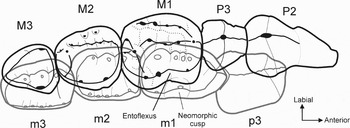
In this work we follow the cusp homologies proposed by Goin et al. (Reference Goin, Candela and De Muizon2003). Further observations on the Antarctodolops molar pattern (Figs 3 & 4) are the following:
Molar occlusion in Polydolopinae. Upper molar occlusal profiles in black; lower molar occlusal profiles in grey.

1) The entoflexus of the first upper molar engages with the large lingual cusp of the m1 talonid. Because such an entoflexus is unknown in other marsupials, it can be deduced that it, as well as the large lingual cusp of the lower m1, are neomorphs exclusive to polydolopids.
2) In a generalized tribosphenic dentition, the paracone occludes against the anterolabial face of the hypoconid, and posterior to the protoconid - see Kielan-Jaworowska et al. (Reference Kielan-Jaworowska, Cifelli, Luo, Kielan-Jaworowska, Cifelli and Luo2004, fig. 11.3) for a comparison with tribosphenic dentitions. In polydolopids, the anterolabial cusp of the M1 occludes posterior to the large anterior cusp of the trigonid of the m1. Thus, it is possible that this last cusp is the paracone and the large anterior cusp of the m1 is the protoconid. Taking in account that in other polydolopids (such as Polydolops thomasi, see Goin et al. Reference Goin, Candela and De Muizon2003, fig. 2B) the paracone is closely appressed with the stylar cusp B, it can be assumed that in Antarctodolops and other polydolopids the paracone is fused with the StB.
3) In addition to the set of stylar cusps present in other polydolopids (e.g. Polydolops thomasi), the species of Antarctodolops have two (A. dailyi) or even four (A. mesetaense sp. nov.) cusps in the StC position. Concordantly, the lower molars of Antarctodolops also have multiple accessory cusps in the labial margin of the talonid.
Formal taxonomy
1988 Eurydolops Case, Woodburne & Chaney, p. 508
1995 Polydolops Candela & Goin, p. 55 (partim.)
Emended diagnosis
Differs from all other polydolopids except Amphidolops in that the lower molars (and, to a lesser degree, also the upper ones) are considerably longer than wide, and more than four labial cusps are present in the m1. Differs from species of Amphidolops in having a large lingual cusp at the anterior end of the talonid in the m1; at least one, and up to three, vertical furrow(s) that bound the talonid cusps on the labial face of the crown; and two distinct labial rows of cusps in the M1 (i.e. the stylar row and the accessory cusp row; in Amphidolops both rows are almost fused in a single row). Differs from species of Eudolops in being smaller in size and in having a larger p3, with more distinct labial and lingual ribs; upper and lower molars have smaller and less distinct cusps; M1 has a greater difference in width between the anterior and the posterior lobes (the latter being wider); m3 is proportionally smaller. Differs from species of Polydolops in the absence of p2. Differs from Pseudolops in its smaller size; in that the P3 is proportionally shorter and has more marked labial ribs, and in having higher and flatter labial and lingual faces of P3.
Remarks
Woodburne & Zinsmeister (Reference Woodburne and Zinsmeister1984) questioned whether the differences between Antarctodolops and Polydolops were generic or specific. Comparing Polydolops with Amphidolops, they concluded that Antarctodolops has more affinities with the former, and, within this genus, with P. serra. Goin & Candela (1995) considered those differences as minimal, and therefore regarded Antarctodolops as a junior synonym of Polydolops.
With the benefit of a larger sample, here we recognize Antarctodolops as a valid genus, similar in some features to some Polydolops species, like P. serra, but also sharing some attributes with species of Amphidolops, like the presence of a very long, multicusped m1.
1984 Antarctodolops dailyi Woodburne & Zinsmeister, p. 916, figs 1 & 2.
1988 Eurydolops seymourensis Case, Woodburne & Chaney, p. 508, figs 3 & 4.
1995 Polydolops dailyi Candela & Goin, p. 55.
1995 Polydolops seymourensis Candela & Goin, p. 55.
Holotype
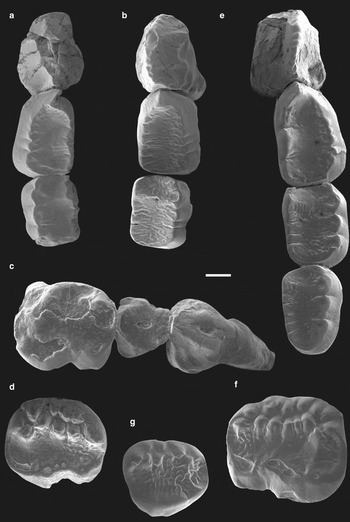
UCR 20910, a left dentary with p3-m2 (Fig. 5a).
Referred specimens
UCR 20911, a right dentary with p3-m1; MLP 89-III-2-1, a right m2; MLP 94-III-15-254, a right dentary with p3-m2 (Fig. 5b); MLP 95-I-10-3, an isolated left p3; MLP 96-I-5-1, a right m2; MLP 96-I-5-2, a right m3; MLP 96-I-5-3, a right dentary with p3, MLP 88-I-1-2, a left dentary with a broken m2; UCR 20912, an isolated left M1; MLP 87-II-1-1, a right maxilla with P2-M1 (Fig. 5c); MLP 88-I-1-4, an isolated right M1 (Fig. 5d), UCR 22355, an isolated left P3 (type of E. seymourensis).
Distribution
The specimens were collected from three localities of the La Meseta Formation, Seymour Island, Antarctic Peninsula: IAA 2/95 (MLP 94-III-15-254, MLP 95-I-10-3, MLP 96-I-5-1, MLP 96-I-5-2, MLP 96-I-5-3, MLP 96-I-5-4), DPV 2/84 (MLP 89-III-2-1), DPV 6/84 (MLP 87-II-1-1, MLP 88-I-1-4, MLP 88-I-1-2, UCR 22355, UCR 20910, UCR 20911, UCR 20912).
Emended diagnosis
Differs from A. mesetaense n. sp. in the following features: smaller size; the anteriormost talonid cusp of the m1 is divided by a deep, and buccolingually oriented groove; labially, the m1 has up to three labial grooves that run vertically, from almost the crown base up to the occlusal surface; in the m2, the central, labial cusp is divided by a deep groove; the lingual cusps are more bulbous (i.e. they are not so buccolingually compressed as in A. mesetaense); p3 is narrower and with a rounded apex; P2 is larger and extremely long (not known in A. mesetaense); P3 is small, with its crown proportionally higher than that of any other known polydolopid (with L/W ratio almost 1); M1 has at least five lingual cusps; labially, it has two rows of cusps, except at the anterior end, where there is a large, single cusp (also known in Polydolops serra). In M1, the labial-most row of accessory cusps is straighter.
Measurements
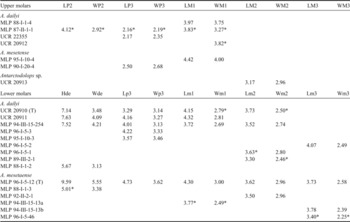
See Table I.
Teeth measurements (in millimetres).

* no accurate measure could be taken because of the incompleteness of the material.
Description
This species includes the smallest polydolopids from the La Meseta Formation. A thorough description of the specimens then available was made by Woodburne & Zinsmeister (Reference Woodburne and Zinsmeister1984). Here we describe new, much less worn upper molars referable to this same species. Several dentary fragments and isolated lower teeth have also been preserved, so that various aspects of its intraspecific variability can be noted.
All molars have strong enamel wrinkles on their occlusal surface. The p2 is absent (contrary to species of Polydolops, but similar to those of Eudolops). The p3 is small when compared with that found in A. mesetaense and species of Polydolops. Its anterior crest is subvertical, while the posterior one is subhorizontal. The apex is blunt and low. Both anterior and posterior crests bear distinct and proportionally large cuspules. The roots of this tooth are uneven, the posterior one being larger than the anterior one, the latter projected anteriorly and implanted more ventrally in the alveolus (a feature shared with Polydolops, but not with Eudolops; unknown in Amphidolops). Labially, the p3 exhibits an anteriorly convex rib that runs parallel and close to the anterior margin of the tooth, where it curves downwards, ending at the anterior margin of the posterior root. The lingual margin shows an anterior rib, straighter than the labial one, and ending at a middle point above the anterior root.
The m1 is clearly longer than the p3, and is almost quadrangular in occlusal view. This is so because, even though the trigonid (i.e. the protoconid) is laterally compressed, as in other polydolopids, it is very wide at its base. Labially, it presents six cusps, the posterior one (the hypoconid) being the largest. Two subequal cusps lie anterior to the hypoconid. Both cusps are framed by deep, vertical anterior and posterior grooves at the labial face of the crown. In the holotype, these grooves are less distinct. Anterior to them lie three smaller cusps which successively decrease in size. Lingually, the talonid has five to six cusps, the first one being the largest, as in all species of Polydolops, but it differs in that this cusp is furrowed by a well-developed groove; this groove can still be seen in moderately worn molars, as is the case of the holotype, but cannot be observed in very worn ones (as in UCR 20911). Unworn molars show a small cusp in front of, and two behind, the large talonid cusp. The well-preserved specimen MLP 94-III-15-254 has a lingual supernumerary root. This root is absent in other specimens of this species, therefore we interpret it as an individual variation. A supernumerary root is seen in the labial margin of the m1 of MACN A 10334, holotype of Propolymastodon (=Eudolops) caroliameghinoi; we regard this feature as convergent with that of MLP 94-III-15-254, as no other specimen of that species or even the family shows this feature.
The m2 is rectangular in occlusal view and is shorter than the m1. Labially, the tooth is divided in three lobes: the anterior one has two cusps (a small paraconid and the protoconid; Goin et al. Reference Goin, Candela and De Muizon2003); the second lobe may have an undivided cusp (as in MLP 92-II-2-1), an incompletely divided cusp (MLP 96-I-5-1), or a completely divided cusp (all other specimens preserving this tooth); the third posterior lobe has in all cases a single, large cusp: the hypoconid.
Lingually, the m2 has a large metaconid; MLP 92-II-2-1 stands out in this feature. Posterior to this cusp the specimens exhibit two (MLP 92-II-2-1, MLP 94-III-15-254, UCR 20910) or three (MLP 96-I-5-1) cusps. In MLP 96-I-5-1 there is a lateral groove which divides the last one of them, in such a way that it gives the appearance of two cusps. The presence of a third cusp is variable among the examined specimens.
The only m3 preserved from this species is the MLP 96-I-5-2. It is a typical polydolopid m3: longer than wide and rather triangular in occlusal view, as the posterior margin is narrower than the anterior one. Labially, it has three lobes: the first, anterior-most one has two cusps (paraconid and protoconid); the second lobe has a large, subdivided cusp, the anterior portion being the narrowest; finally, the third lobe has two well-defined cusps, the posterior one being the largest. Lingually, this tooth has a large metaconid which has a small cuspule at its posterior end. Posterior to it there are three cusps furrowed by wide grooves, the second one being the smallest.
Specimens preserving the upper teeth are a maxillary fragment with broken crowns of P2-M1 (MLP 87-II-2-1), a well-preserved M1 (MLP 88-I-1-4), a posteriorly broken M1 (UCR 20912) and a worn P3 (UCR 22355, holotype of Eurydolops seymourensis).
As in Polydolops, the P2 is much larger than the P3. Its anterior root is anteriorly projected, giving the tooth the appearance of being very long. On the contrary, the posterior root is extremely short and wide.
The P3 is much wider than long. It has three cuspules: the main one is centrally placed and is usually worn at the apex. The anterior crest is serrated and ends in a tiny cuspule. The posterior crest is not serrated and ends in a larger cuspule which, nevertheless, is not larger than the main one. Labially, the P3 has two blunt ribs. The anteriormost is longer and curved backwards, ending posterior to the anterior border of the distal root; the posteriormost, smoother rib is subparallel to the posterior margin of the tooth. All examined specimens preserving a P3 are so worn that the single, central lingual rib is almost invisible; apparently, it was straighter than the main labial rib.
The M1 is longer than wide. Lingually, two distinctly-sized lobes are apparent: the anterior one (homologous to the paraconule; see Goin et al. Reference Goin, Candela and De Muizon2003) is the smallest; in turn, the posterior lobe has four cusps, of which the posteriormost (the metaconule) is the largest; immediately anterior to the metaconule there is a reduced protocone, while two remaining, minute, cusps anterior to the protocone are here regarded as neomorphs. Labially, the M1 has two rows of cusps which are more or less parallel to the molar axis. The lingual-most of these rows includes five cusps: 1) anteriorly, the paracone (fused to the StB in our interpretation), 2) in the StC position, two subequal cusps, 3) a somewhat smaller StD, and 4) the largest stylar cusp of the row, StE. Lingual to StD and StE there is the metacone, which is almost aligned with StE. The second row, the labial one, has five accessory cusps, of which the first four are small and constitute a crenulation, and the last one being larger, almost as large as the stylar cusps; it is placed between and more labial to StD and StE, but connected with StD.
Remarks
Here we refer specimen UCR 22355 (an isolated left P3) to Antarctodolops dailyi. UCR 22355 was previously recognized by Case et al. (Reference Case, Woodburne, Chaney, Feldmann and Woodburne1988) as the type, and only known specimen, of Eurydolops seymouriensis. Central to the arguments of Case et al. (Reference Case, Woodburne, Chaney, Feldmann and Woodburne1988) were the length/width/height proportions of the isolated premolar. Among the new specimens here referred to Antarctodolops dailyi there is a maxillary fragment (MLP 87-II-1-1, Fig. 5c) including P2, P3, and M1. Even though part of the crown of the P2 of this specimen is not preserved, in all other comparable parts and proportions we cannot appreciate any significant distinction between it and UCR 22355 (Table I). For this reason we refer this last specimen to A. dailyi.
SEM photograph of upper and lower molars of Antarctic polydolopids. a.-d.Antarctodolops dailyi. a. UCR 20910 (holotype), a left dentary with p3-m2. b. MLP 94-III-15-254, a right dentary with p3-m2. c. MLP 87-II-1-1, a right maxilla with P2-M1. d. MLP 88-I-1-4, an isolated right M1. e.-f.Antarctodolops mesetaense. e. MLP 96-I-5-12 (holotype), a right dentary with p3-m3. f. MLP 95-I-10-4, an isolated left M1. g.Antarctodolops sp. UCR 20913, an isolated left M2. Scale bars are 1 mm.

Etymology
A. mesetaense, from the La Meseta Formation.
Holotype
MLP 96-I-5-12, a right dentary with p3-m3 (Fig. 5e).
Hypodigm
MLP 88-I-1-3, a right dentary with m2; MLP 92-II-2-1, an isolated left m2; MLP 94-III-15-13a, an isolated left m1; MLP 94-III-15-13b, an isolated left m3; MLP 96-I-5-46, an isolated right m3; MLP 95-I-10-4, an isolated left M1 (Fig. 5f).
Tentatively referred specimen
MLP 90-I-20-4, an isolated P3.
Distribution
Specimens were collected from the localities IAA 1/90 (MLP 90-I-20-4, MLP 92-II-2-1, MLP 94-III-15-13a and b, MLP 95-I-10-4, MLP 96-I-5-12, MLP 96-I-5-46, MLP 96-I-5-46) and DPV 6/84 (MLP 88-I-1-3) of the La Meseta Formation, Seymour Island, Antarctic Peninsula.
Diagnosis
Largest species of the genus. Differs from A. dailyi in that the first talonid cusp of the m1 is not subdivided; it has a groove that separates the hypoconid from the more anterior labial cusps, the latter being more distinguishable than in Amphidolops species, but less than in A. dailyi; the lingual cusps of the m2 are buccolingually compressed, forming a serrated margin; p3 is relatively longer than that of A. dailyi, with a more quadrangular outline in lateral view; M1 is proportionally longer, with only one lingual accessory cusp in the posterior lobe, and four cusps in the position of StC in the stylar row; the labialmost cusp row is multicuspate, almost continuous, and very close to the stylar row.
Measurements
See Table I.
Description
The holotype of this species (Fig. 5e) is considerably larger than any of the specimens referable to A. dailyi, both in its teeth and in its jaw dimensions and proportions. It shows a large diastema anterior to the p3 (p2 is absent in species of Antarctodolops). The anterior end of the dentary, even though broken, shows the laterally compressed root of an incisor. The molars are furrowed by enamel wrinkles but, perhaps due to the more worn condition of the type specimen, are less marked than in A. dailyi.
The p3 is a large, asymmetrical tooth; its posterior margin is subhorizontal (but less so than in A. dailyi) and the anterior one falls abruptly. The roots are unequal in size, the anterior one being more ventrally implanted; they are more bulbous than in the other species of the genus. Labially, the tooth exhibits a rib which is anteriorly convex, even though straighter than in A. dailyi. This rib ends between the anterior and posterior roots. This species, as seen above, shares with A. dailyi the presence of a labial convexity in its posterior half, even though it is less well defined than in the other species.
The m1 is similar to that of A. dailyi, but has a few differences: labially, it has five instead of six cusps, and there is only one deep furrow anterior to the hypoconid. The three small cusps anterior to it are subequal in size and are separated by very shallow grooves (similar to those present in Amphidolops specimens, but deeper than those of Polydolops). A fifth, anteriormost cusp is also present. Lingually, m1 has a large anterior cusp, also present in A. dailyi and other polydolopids. However, it is proportionately larger than the one present in A. dailyi and is not divided. Behind this supernumerary cusp is placed the entoconid, which is quite compressed bucolingually.
The m2 is labially divided into three lobes, as also seen in A. dailyi; in contrast, however, the middle lobe has no groove edging it. Lingually, there is a large metaconid which has two cuspules: one at its anterior end, and another at the posterior one. Behind the metaconid there can be seen three buccolingually-compressed cusps, forming a cutting edge similar to the one present in Polydolops serra. As in the other species of Antarctodolops, the hypoconid and the entoconid are aligned, and the former does not shape a notch at the posthypocristid, as it does in some species of Polydolops (e.g. P. rothi).
The m3 also has three labial lobes, each with two cusps. Lingually, m3 has a large metaconid with a cuspule at its posterior end, behind which there are four buccolingually-compressed cusps, similar to the pattern seen in the m2. Specimen MLP 92-II-2-1, an isolated left m2, differs from the type in that its third labial lobe has a more anteriorly displaced hypoconid and, in consequence, a shorter labial margin.
The m3 is similar to that of A. dailyi, differing from the latter in that the labial cusps are more distinct; also, the metaconid is smaller and has its posterior crest ending in a variably developed cusp. Posterior to it, four bucolingually-compressed cusps can be seen.
The upper dentition is represented by a M1 and a tentatively referred P3. The isolated left M1, MLP 95-I-10-4 (Fig. 5f), is the largest upper molar of a polydolopid exhumed from levels of the La Meseta Formation. It is longer than wide and lingually has two lobes: an anterior one (smaller), and a posterior one (larger). Even though cusps belonging to both lobes are worn, it can be inferred that the anterior one had only one cusp: the paraconule. The posterior lobe had two cusps, the anteriormost being the large protocone and the posteriormost the metaconule; the latter is connected with the metacone by a faint crest. Between both lobes there is a very small, accessory cuspule. Labially, there are two rows of cusps; the most lingual one includes the paracone, which we interpret is fused with StB. Posteriorly, the remaining stylar cusps are present, but, strikingly, there are four cusps in the StC position. The three posterior-most cusps include two more labial ones in the position of StD and StE, and one between and more lingual to them: the metacone, the widest cusp of this row. Finally, the second, or external labial row, has eight irregularly spaced and variously sized accessory cuspules.
We tentatively refer an isolated left P3 (MLP 90-I-20-4) because of its relative size, which is considerably larger than the type of “Eurydolops seymouriensis” (here synonymized with Antarctodolops dailyi). This tooth is wider than longer and has a main central cusp, which is worn. The anterior edge is subhorizontal and ends in a small cuspule, while the posterior edge runs downwards ending in a more distinct cuspule. The labial wall is not even but instead bears four ridges; the first three of which are very smooth and subequal, while the fourth one, medially placed, is larger and extends straight up to the anterior (broken) root. Lingually this tooth is worn; that is why its central rib is not easily observable. The lingual rib is more curved and runs more horizontally than the labial central rib.
Remarks
This species has the peculiarity of having four supernumerary stylar cusps in the StC position. The presence of several cusps in the StC position is not a unique feature of this species, as it can also be found in A. dailyi. However, the latter has “only” two cusps in the StC position, while specimen MLP 95-I-10-4 has four.
Referred specimen
UCR 20913, an isolated left M2.
Distribution
This specimen was collected from locality DPV 6/84 of the La Meseta Formation, Seymour Island, Antarctic Peninsula.
Description
We interpret this molar as an M2. It is rather triangular in occlusal view, the anterior margin being wider than the posterior one. Lingually, it has the three cusps: paraconule (the largest), protocone, and metaconule. Labially, it has a well-defined stylar row, with six small cusps. Lingually and between the last two (presumably, StD and StE) a large metacone is present. Labial to this row, there are at least two small cuspules.
Remarks
Based on its dimensions, this molar is more likely to be referable to A. dailyi than to A. mesetaense. However, proportions in the upper molars of polydolopids vary greatly; thus, it is very difficult to assign this isolated molar to either Antarctodolops species, or even to a third, still unknown species.
Discussion
Affinities of Antarctodolops
Woodburne & Zinsmeister (Reference Woodburne and Zinsmeister1984) first compared Antarctodolops with Polydolops mayoi, due to their temporal interpretation of La Meseta Formation. At that time, the fossil mammals from La Meseta were thought to be late Eocene–early Oligocene (Mustersan SALMA) in age. They recognized striking differences among these taxa, such as the absence of several cusps in P. mayoi and a much larger number of them in A. dailyi (particularly on the talonid of the m1). Thus, they considered the Antarctic polydolopids as representative of the new genus Antarctodolops. Later, Case et al. (Reference Case, Woodburne, Chaney, Feldmann and Woodburne1988) recognized a new genus (Eurydolops) based on an isolated P3, here synonymized with Antarctodolops (see above). Goin & Candela (1995) argued against the assignment of the Antarctic species to new genera, stressing that the molar differences with other species of Polydolops were not enough to separate them.
Our review of the original materials, as well as several new, unworn, polydolopid molars from the same levels, led us to: 1) revalidate Antarctodolops for the Antarctic polydolopids, 2) regard Eurydolops seymouriensis as a junior synonym of Antarctodolops dailyi, and 3) recognize a new species of this same genus: A. mesetaense. Species of Antarctodolops share a few features with species of Amphidolops: similar proportions of the m1 (much longer than wide), large number of cusps in upper and lower molars, and abundant enamel wrinkles and crenulations, especially in the lower molars. Most similarities, however, lie with species of Polydolops: in the lower molars, the lingual row shows a large talonid cusp posterior to the protoconid; M1 in A. dailyi has two aligned and very closely set labial cusp rows; upper premolars have similar proportions to those of Polydolops. Unfortunately, no premolars are known for Amphidolops, and so cannot be compared with those of Antarctodolops. This mixed set of features was already noted by Woodburne & Zinsmeister (Reference Woodburne and Zinsmeister1984), who hypothesized that Polydolops and Amphidolops were more closely related to each other than to Eudolops. We agree with them and consider that the combination of features presents in A. dailyi and A. mesetaense resemble more closely those of Polydolops and Amphidolops than any other polydolopid. We also agree that the combination of derived features in Antarctodolops justifies its generic validity.
In our view, Antarctodolops is not a generalized polydolopid, and the origin of polydolopids should be traced back to early Palaeocene or even late Cretaceous times (see Woodburne & Case Reference Woodburne and Case1996 for further discussion). Goin et al. (Reference Goin, Candela and De Muizon2003) argued that the early Palaeocene Roberthoffstetteria nationalgeographica from Tiupampa, Bolivia, was structurally ancestral to the polydolopid molar pattern. They stated that a key derived feature of R. nationalgeographica is the lingual location of the paraconule and metaconule, almost aligned with the protocone, in the upper molars. Consequently, they regarded the anterior and posterior lobes in the lingual face of polydolopids as homologous to the paraconule and metaconule, respectively. A later phylogenetic study argues in favour of these observations (Goin et al. in press). Case et al. (Reference Case, Goin and Woodburne2005) argued that Ectocentrocristus foxi, from the Judithian (late Campanian) of Montana, North America, was an early polydolopimorphian with several features anticipatory of those of Roberthoffstetteria, (see Beck et al. Reference Beck, Archer, Godthelp, Mackness, Hand and Muirhead2008 for a different view on this matter). Late Cretaceous–earliest Palaeocene mammals from southernmost South America or Antarctica are still unknown, with the single exception of Cocatherium lefipanum, a probable polydolopimorphian from the earliest Palaeocene of western Patagonia (Goin et al. Reference Goin, Pascual, Tejedor, Gelfo, Woodburne, Case, Reguero, Bond, Cione, Udrizar Sauthier, Balarino, Scasso, Medina and Ubaldón2006). Unfortunately, the fragmentary nature of the type and only known specimen of Cocatherium (an isolated, worn lower molar) precludes further speculation on polydolopimorphian origins and early radiation.
The Antarctic polydolopid radiation
Until the first discovery of a polydolopid, no other extinct mammal had been found in Antarctica. Because of this, previous statements about mammalian interchanges between South America and Australia had been largely hypothetical. In those inferences, the Antarctic continent was regarded as a bridge between the Americas and Australia (e.g. Keast Reference Keast, Keast, Erk and Glass1972). The presence of polydolopids in Antarctica did not solve the question of the origin of Australian marsupials: polydolopids are a highly endemic group of marsupials, extremely derived in their molar morphology, known only from Patagonia (Argentina), Central Chile and Antarctica. However, their discovery in Antarctica gave rise to new questions regarding the chronology of metatherian dispersals between southern continents. According to Woodburne & Case (Reference Woodburne and Case1996), these dispersals must have occurred already between the late Cretaceous and the late Palaeocene.
As interpreted by Woodburne & Zinsmeister (Reference Woodburne and Zinsmeister1984) Antarctodolops was already endemic to Antarctica, the first polydolopids having arrived in this continent some 10 Ma earlier. This and further discoveries in levels of the La Meseta Formation (Goin et al. 2007) led other authors (e.g. Vizcaino et al. 1998) to argue for the possibility of Antarctica having been a point of departure for the evolution of many species. Woodburne & Case (Reference Woodburne and Case1996) hypothesized that some derived forms from Antarctica gave rise to the Australian marsupials, and they went further arguing that an Andinodelphys-like taxon evolved in Antarctica, giving rise, on one side, to the ancestors of the Peramelina, Dasyuromorphia, and Diprotodontia, which travelled eastwards to Australia; on the other, to the Microbiotheria, which by Palaeocene times migrated into South America (that is why Khasia was represented in the Tiupampa Palaeocene fauna of Bolivia).
According to Marenssi et al. (Reference Marenssi, Santillana, Rinaldi and Casadio1998), the mammals from Antarctica may have arrived at least by Palaeocene or early Eocene times; these authors suggested that the latter was the case for the polydolopids. Even though the morphology of the Antarctic polydolopids is specialized for the group (they have two rows of cusps in upper molars, and several compressed cusps in the lower ones), recent discoveries (Chornogubsky personal observation) from the Las Flores Formation (late Palaeocene or early Eocene, Chubut Province, Argentina) show that this specialized pattern was already present in Palaeocene times.
Goin et al. (Reference Goin, Zimicz, Reguero, Santillana, Marenssi and Moly2007) gave an alternative scenario on the problem of metatherian trans-Antarctic relationships. Following Morrone (e.g. 2002), they argued that, in considering late Cretaceous times, it is misleading to refer to Antarctica and South America as distinct units. Northern and central South America seem to have belonged to one major biogeographical unit (the Neotropical Region of the Holarctic Kingdom, Morrone Reference Morrone2002), while southernmost South America and Antarctica pertained to another (the Andean Region of the Austral Kingdom). Considering that the Drake Passage was not completely open until well-advanced Cenozoic times, it is irrelevant to argue about southern South American or Antarctic origins for the Polydolopidae. On the contrary, the polydolopid radiation should be regarded, as a whole, as an Austral Kingdom event. Similar conclusions were advanced by Goin et al. (Reference Goin, Zimicz, Reguero, Santillana, Marenssi and Moly2007) on the origins and radiation of the Microbiotheria. Polydolopids never dispersed north of Patagonia and central Chile, as may be the case for the microbiotherians.
Regarding the timing of the polydolopid radiation, Woodburne & Case (Reference Woodburne and Case1996) already suggested that it could have occurred by the late Cretaceous (see also Goin et al. Reference Goin, Zimicz, Reguero, Santillana, Marenssi and Moly2007). Polydolopid origins have been related to the radiation of the Nothofagus flora (Reguero et al. Reference Reguero, Vizcaíno, Goin, Marenssi, Santillana and Casadio1998), whose first expansion event has been dated as old as late Campanian–Maastrichtian (Hill & Dettman Reference Hill, Dettmann, Veblen, Hill and Read1996). It is highly probable that these radiations were related to a global cooling event that occurred by the late Campanian–early Maastrichtian. Specifically, among the Southern Hemisphere shallow marine waters, this cooling event is coincident with an expansion of the Weddellian Province (sensu Zinsmeister Reference Zinsmeister, Gray and Boucot1979), northwards to the Neuquén Basin, in northern Patagonia (Aguirre Urreta et al. Reference Aguirre Urreta, Casadío, Cichowolski, Lazo and Rodríguez2008). For surface marine waters, such a cooling event was dated between 70 and 67 Ma (Aguirre Urreta et al. Reference Aguirre Urreta, Casadío, Cichowolski, Lazo and Rodríguez2008 and references therein). Accordingly, we propose such a temporal interval for the origin of the polydolopid radiation.
Habitat of Antarctic polydolopids
Much has been said about the links between the Nothofagus flora and the southern South American marsupial radiation (e.g. Hershkovitz Reference Hershkovitz1999). Hershkovitz (Reference Hershkovitz1999) suggested that the only possible habitat for microbiotherian marsupials was the Nothofagus-Chusquea association present in central Chile and western Argentina. Interestingly, a floral association, frequently including Nothofagus, existed in the Palaeogene of Patagonia and Antarctica, as well as a very distinctive marsupial fauna, with bonapartheriiforms and polydolopids as their main participants. No Nothofagus mega- or pollen fossil material has been yet recovered north of Patagonia in South America (e.g. Moreira-Muñoz Reference Moreira-Muñoz2004).
The mammal fossils from La Meseta Formation include several marsupial groups, such as Polydolopidae, Derorhynchidae, and Microbiotheriidae, as well as an alleged gondwanatherian and some ungulates (Reguero et al. Reference Reguero, Marenssi and Santillana2002, Goin et al. Reference Goin, Zimicz, Reguero, Santillana, Marenssi and Moly2007). The floral families found in the same Cucullaea I Allomember include Dilleniaceae, Myrtaceae, Lauraceae, and Grossulareaceae, and the assemblage is particularly dominated by the Nothofagaceae Nothofagus (Case Reference Case, Feldmann and Woodburne1988, Gandolfo et al. Reference Gandolfo, Marenssi, Santillana and Casadio1998). These families are indicative of a seasonal, cool-temperate, rainy climate (mixed mesophytic sensu Gandolfo et al. Reference Gandolfo, Marenssi, Santillana and Casadio1998). In fact, some of the wood-based taxa from this formation have affinities with the ones present in Argentina and Chile, in the regions mentioned above. Vizcaíno et al. (Reference Vizcaíno, Reguero, Goin, Tambussi, Noriega and Casadio1998) even suggested that the Antarctic fauna could represent the equivalent of the one present today in southernmost Argentina (i.e. Tierra del Fuego Province). Furthermore, the La Meseta taxa most closely resemble species of extant plants growing in the Valdivian (Chile and Argentina) and New Zealand forests. All these findings are concordant with the hypothesis of a relationship at least between microbiotherians and the Nothofagus forests, and could argue in favour of another one between the latter and polydolopids.
Even though a correlation between the temporal and spatial distribution of Nothofagus and polydolopids is widely accepted, it is currently impossible to determine any specific trophic relation between them. Vizcaíno et al. (Reference Vizcaíno, Reguero, Goin, Tambussi, Noriega and Casadio1998) suggested that the polydolopid diet was probably frugivorous specialized on hard items, with some degree of insectivory, but this is not necessarily an argument in favour of polydolopids feeding on Nothofagus seeds. An example of that occurs in the living microbiotherian Dromiciops gliroides (Aizen et al. Reference Aizen, Vázquez and Smith-Ramírez2002), a marsupial currently living in Nothofagus forest but usually feeding on items other than Nothofagus seeds or fruits.
Acknowledgements
We are grateful to M.O. Woodburne and R.M.D. Beck whose critical reviews improved the manuscript. The research has been funded in part by the Argentinian Agencia Nacional de Investigaciones Científicas y Técnicas (PICT 1860; project “Las Edades-Mamífero del Paleógeno de la Argentina”). Sergio Marenssi, from the Instituto Antártico Argentino, and Juan Jose Molly, from the Museo de La Plata leaded most of the fieldwork in Antarctica that led to the recovery of the new polydolopid specimens. Alejandro Kramarz was helpful while studying the marsupial collection at the MACN. Viviana Barreda and Luis Palazzesi were very helpful while studying palaeofloral reconstructions. Marcela Tomeo helped as with the illustrations.