





No CrossRef data available.
Article contents
Individual Differences in Bilingual Child Language Acquisition: A plunge into a Complex and Dynamic Network
Published online by Cambridge University Press: 03 February 2023
Extract
Large individual differences in language skills are well documented in monolingual children (e.g., Kidd, Donnelly & Christiansen, 2018). In bilinguals, the broad variation is even more pronounced. Interestingly, some bilingual children might be weak in their Heritage Language (HL, also labeled as Minority Language, Home Language, Community Language), to which they have naturalistic exposure from birth. Others might be weak in their Societal Language (SL), the language of the surrounding and educational environment. Large individual differences are observed in neurotypical bilingually exposed children as well as in their bilingually raised peers with developmental language disorder, autism spectrum disorder, and hearing impairment (see also Armon-Lotem & Meir, 2016; Meir & Novogrodsky, 2020). Figure 1 visualizes individual differences in morphosyntactic skills of monolingual and bilingual children with typical language development aged 5;5–6;8 as indexed by the LITMUS Sentence Repetition tasks (the data are drawn from Armon-Lotem & Meir, 2016; Meir, 2018). While monolingual preschool children (MonoRU and MonoHE) show little variation, bilinguals with different levels of dominance (balanced bilinguals: BB; HL dominant: HL-D; SL dominant: SL-D) as determined by standardized tests exhibit large individual differences within each language and across their two languages.
Information
- Type
- Invited Commentary
- Information
- Journal of Child Language , Volume 50 , Issue 4: Special Issue on Individual Differences in Bilinguals , July 2023 , pp. 827 - 831
- Copyright
- © The Author(s), 2023. Published by Cambridge University Press
References
Armon-Lotem, S., & Meir, N. (2016). Diagnostic accuracy of repetition tasks for the identification of specific language impairment (SLI) in bilingual children: Evidence from Russian and Hebrew. International Journal of Language & Communication Disorders, 51(6), 715–731. https://doi.org/10.1111/1460-6984.12242CrossRefGoogle ScholarPubMed
Epskamp, S., Borsboom, D., & Fried, E. I. (2018). Estimating psychological networks and their accuracy: A tutorial paper. Behavior Research Methods, 50(1), 195–212. https://doi.org/10.3758/s13428-017-0862-1CrossRefGoogle ScholarPubMed
Epskamp, S., Cramer, A. O. J., Waldorp, L. J., Schmittmann, V. D., & Borsboom, D. (2012). qgraph: Network Visualizations of Relationships in Psychometric Data. Journal of Statistical Software, 48(4), 1–18. https://doi.org/10.18637/jss.v048.i04CrossRefGoogle Scholar
Freeborn, L., Andringa, S., Lunansky, G., & Rispens, J. (2022). Network analysis for modeling complex systems in SLA research. Studies in Second Language Acquisition, 1–32. https://doi.org/10.1017/S0272263122000407Google Scholar
Gullifer, J. W., & Titone, D. (2020). Characterizing the social diversity of bilingualism using language entropy. Bilingualism: Language and Cognition, 23(2), 283– 294. https://doi.org/10.1017/S1366728919000026CrossRefGoogle Scholar
Hiver, P., Al-Hoorie, A. H., & Evans, R. (2021). Complex dynamic systems theory in language learning: A scoping review of 25 years of research. Studies in Second Language Acquisition, 44(4), 913– 941. https://doi.org/10.1017/S0272263121000553CrossRefGoogle Scholar
Hulk, A., & Marinis, T. (Eds.) (2011). Internal and external factors in child second language acquisition. Linguistic Approaches to Bilingualism, 1, 3.Google Scholar
Kałamała, P., Chuderski, A., Szewczyk, J., Senderecka, M., & Wodniecka, Z. (2022). Bilingualism caught in a net: A new approach to understanding the complexity of bilingual experience. Journal of Experimental Psychology: General. https://doi.org/10.1037/xge0001263Google Scholar
Kidd, E., Donnelly, S., & Christiansen, M. H. (2018). Individual differences in language acquisition and processing. Trends in Cognitive Sciences, 22(2), 154–169. https://doi.org/10.1016/j.tics.2017.11.006CrossRefGoogle ScholarPubMed
Meir, N. (2018). Morpho-Syntactic abilities of unbalanced bilingual children: A Closer Look at the Weaker Language. Frontiers in Psychology, 9. https://doi.org/10.3389/fpsyg.2018.01318CrossRefGoogle Scholar
Meir, N., & Novogrodsky, R. (2020). Syntactic abilities and verbal memory in monolingual and bilingual children with High Functioning Autism (HFA). First Language, 40(4), 341–366. https://doi.org/10.1177/0142723719849981CrossRefGoogle Scholar
Paradis, J. (2023). Sources of individual differences in the dual language development of heritage bilinguals. Journal of Child Language, 50(4), 793–817. https://doi.org/10.1017/S0305000922000708Google Scholar
R Core Team. (2020). R: A language and environment for statistical computing. R Foundation for Statistical Computing, Vienna, Austria. http://www.r-project.org/Google Scholar
Sun, H., Cheong, S. A., Yen, T. W., Koh, E., Kwek, D., & Tan, J. (2020). Network Science Approaches to Education Research. International Journal of Complexity in Education, 1(2), 121–150. https://complexityineducation.com/index.php/ljce/VOLUME1Google Scholar
Sun, H., Steinkrauss, R., van der Steen, S., Cox, R., & de Bot, K. (2016). Foreign language learning as a complex dynamic system: a microgenetic case study of a Chinese child EFL learner. Learning and Individual Differences, 49, 287–296. https://doi.org/10.1016/j.lindif.2016.05.010CrossRefGoogle Scholar
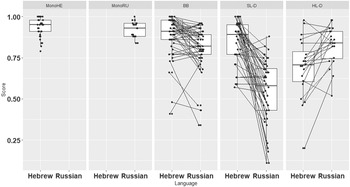
Figure 1. Visualization of individual differences on the LiTMUS Sentence Repetition tasks across monolinguals and bilinguals, and between the two languages (SL-Hebrew vs. HL-Russian) in bilinguals. Two connected dots represent one bilingual participant, one dot represents one monolingual participant.
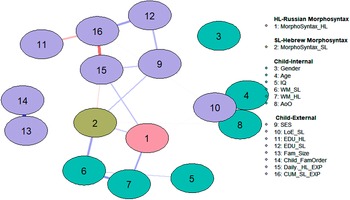
Figure 2. A network model of the HL-Morphosyntax, SL-Morphosyntax and child-internal and child-external factors.Note1. Each node represents an index (as per background questionnaire or task): HL-Morphosyntax and SL-Morphosyntax are indexed by LITMUS Sentence Repetition tasks; Gender (Male/Female); Age: chronological age; IQ: nonverbal IQ (Raven); WM_SL and WM_HL are indexed by Forward Digit Spans in the respective languages; AoO: Age of Onset of Bilingualism, SES: Socio-economic status as indexed by the mother`s years of education; LOE_SL: Length of Exposure to SL; EDU_SL and EDU_HL: education in HL and SL as indexed by the period of attending HL and SL educational settings, Daily_HL_EXP: Daily exposure to HL; Cum_SL_EXP: Cumulative exposure to SL.Note2. The strength of the relationship between the nodes is indicated by line thickness and color density: the thicker the line, the stronger the relationship. Positive relationships are purple, negative relationships are red.
 You have
Access
- 7
- Cited by
Commentary
Large individual differences in language skills are well documented in monolingual children (e.g., Kidd, Donnelly & Christiansen, Reference Kidd, Donnelly and Christiansen2018). In bilinguals, the broad variation is even more pronounced. Interestingly, some bilingual children might be weak in their Heritage Language (HL, also labeled as Minority Language, Home Language, Community Language), to which they have naturalistic exposure from birth. Others might be weak in their Societal Language (SL), the language of the surrounding and educational environment. Large individual differences are observed in neurotypical bilingually exposed children as well as in their bilingually raised peers with developmental language disorder, autism spectrum disorder, and hearing impairment (see also Armon-Lotem & Meir, Reference Armon-Lotem and Meir2016; Meir & Novogrodsky, Reference Meir and Novogrodsky2020). Figure 1 visualizes individual differences in morphosyntactic skills of monolingual and bilingual children with typical language development aged 5;5–6;8 as indexed by the LITMUS Sentence Repetition tasks (the data are drawn from Armon-Lotem & Meir, Reference Armon-Lotem and Meir2016; Meir, Reference Meir2018). While monolingual preschool children (MonoRU and MonoHE) show little variation, bilinguals with different levels of dominance (balanced bilinguals: BB; HL dominant: HL-D; SL dominant: SL-D) as determined by standardized tests exhibit large individual differences within each language and across their two languages.
Visualization of individual differences on the LiTMUS Sentence Repetition tasks across monolinguals and bilinguals, and between the two languages (SL-Hebrew vs. HL-Russian) in bilinguals. Two connected dots represent one bilingual participant, one dot represents one monolingual participant.
What causes this large variation in language skills among bilingual children in their HL and SL? The most recent keynote by Johanne Paradis (Reference Paradis2023, this issue) addresses this important question and provides a thought-provoking review on potential sources triggering individual differences in bilingual children in their two languages. First, the review by Paradis solidifies a shift in the recent approach to bilingualism calling for the investigation of broad individual differences in bilinguals, rather than comparing bilinguals to monolinguals. Second, Paradis meticulously discusses multiple sources driving individual differences in multilingual child language skills, including child-internal (e.g., age of onset of bilingualism, cognitive abilities, socioemotional wellbeing) and child-external factors (exposure-related factors, such as quantity and quality of exposure, parental language proficiency, and family identity).
Notably, as shown by Paradis (this issue) the role of these multiple factors on the development of bilingual language capacity has been mainly addressed in isolation. Therefore, I contend that our current knowledge on bilingual child language acquisition is fragmented. As a result, little is known about how different factors interact and collectively shape language acquisition outcomes in bilingual children with typical and atypical language development. Paradis (this issue) rightfully notes that the
“relations among attitudes/identity, input and interaction, and perhaps social adjustment and wellbeing, are likely to be complex; therefore, more complex analytic techniques are needed to understand the path(s) between family attitudes about the HL on one hand, and children’s HL outcomes on the other”.
I fully agree with the call by Paradis that our field needs to seek alternative ways to gain insights into bilingual language capacity in the HL and in the SL by referring to several factors simultaneously and considering the fact that these factors form complex non-linear relationships and change over time.
Thus, building on the thorough review by Paradis (this issue), I propose that bilingual child language acquisition can benefit from multifaceted and interdisciplinary approaches attempting to model bilingual language development. One option to address the nature of the relationships between various child-internal and child-external factors is by adopting theories of change processes which have been used extensively in a variety of different disciplines, for example the Complex Dynamic System Theory (CDST) framework (Freeborn, Andringa, Lunansky & Rispens, Reference Freeborn, Andringa, Lunansky and Rispens2022; Hiver, Al-Hoorie & Evans, Reference Hiver, Al-Hoorie and Evans2021; Sun, Steinkrauss, van der Steen, Cox & de Bot, Reference Sun, Steinkrauss, van der Steen, Cox and de Bot2016). The CDST framework has been used for more than a decade to provide evidence on how second/foreign language acquisition unfolds in adults (Hiver et al., Reference Hiver, Al-Hoorie and Evans2021). As demonstrated by Paradis (this issue), language skills are shaped by numerous factors: thus, they form a complex system. Furthermore, language skills in bilinguals change over time: at some point one language is stronger and more favored, but at another point in life this language might be even lost, especially in the case of the HL. Therefore, bilingual language acquisition is undoubtedly a dynamic system. The CDST framework approach looks promising to describe the complexity and dynamicity of bilingual child language acquisition, but, surprisingly, the framework has not yet been systematically applied to model bilingual child language acquisition (see a recent scoping review summarizing the application of the CDST framework; Hiver et al., Reference Hiver, Al-Hoorie and Evans2021). Only 2.5% (4 out of 158) of studies used this framework with children younger than the age of 7 years old to model their acquisition of the second language. Furthermore, only a small fraction of studies applied the CDST framework for modelling adult HL acquisition (0.6%, 1 out of 158) and/or the acquisition of both languages in tandem in adult bilinguals, 5.6% (9 out of 159) (ibid).
Thus, building on the thorough keynote by Paradis (this issue), our field could adopt the CDST framework as a steppingstone to gain insights into the system’s growth across multiple languages, addressing potential interconnectedness and reciprocity between language skills and child-internal/child-external factors. Recently, modelling of a complex network of direct, indirect and reciprocal effects in bilinguals has been attempted (e.g., Freeborn et al., Reference Freeborn, Andringa, Lunansky and Rispens2022; Gullifer & Titone, Reference Gullifer and Titone2020; Kałamała, Chuderski, Szewczyk, Senderecka & Wodniecka, Reference Kałamała, Chuderski, Szewczyk, Senderecka and Wodniecka2022; Sun, Cheong, Yen, Koh, Kwek & Tan, Reference Sun, Cheong, Yen, Koh, Kwek and Tan2020). Adult bilingualism is concluded to arise from complex relationships between language history acquisition, language skills, and language use (Kałamała et al., Reference Kałamała, Chuderski, Szewczyk, Senderecka and Wodniecka2022). Yet, child bilingualism awaits its turn to be modelled in this way, addressing the complex and dynamic nature of multiple factors.
As an illustration, I will attempt to apply the CDST framework to model complex relations between language skills, child-internal and child-external factors by re-analyzing the data for the LITMUS Sentence repetition tasks in HL- Russian and SL-Hebrew for typically developing multilinguals (see Armon-Lotem & Meir, Reference Armon-Lotem and Meir2016; Meir, Reference Meir2018). The network model presented in Figure 2 was generated using R-packages of the open-source software R (R Core Team, 2020), qgraph (Epskamp, Cramer, Waldorp, Schmittmann & Borsboom, Reference Epskamp, Cramer, Waldorp, Schmittmann and Borsboom2012) and bootnet (Epskamp, Borsboom & Fried, Reference Epskamp, Borsboom and Fried2018).
A network model of the HL-Morphosyntax, SL-Morphosyntax and child-internal and child-external factors.
Note1. Each node represents an index (as per background questionnaire or task): HL-Morphosyntax and SL-Morphosyntax are indexed by LITMUS Sentence Repetition tasks; Gender (Male/Female); Age: chronological age; IQ: nonverbal IQ (Raven); WM_SL and WM_HL are indexed by Forward Digit Spans in the respective languages; AoO: Age of Onset of Bilingualism, SES: Socio-economic status as indexed by the mother`s years of education; LOE_SL: Length of Exposure to SL; EDU_SL and EDU_HL: education in HL and SL as indexed by the period of attending HL and SL educational settings, Daily_HL_EXP: Daily exposure to HL; Cum_SL_EXP: Cumulative exposure to SL.
Note2. The strength of the relationship between the nodes is indicated by line thickness and color density: the thicker the line, the stronger the relationship. Positive relationships are purple, negative relationships are red.
Figure 2 demonstrates complex relationships between morphosyntactic skills in the two languages of bilinguals and child-internal (gender, age, non-verbal IQ, working memory in HL and SL, age of onset of bilingualism) and child-external factors (socio-economic status, length of exposure to SL, length of education in HL and SL, family size, child’s birth order, daily HL exposure and cumulative SL exposure). For the current dataset, the results indicate that HL and SL morphosyntactic skills are interrelated and are shaped by a number of interconnected child-external factors: daily language input, cumulative language exposure and the amount of time spent at the educational HL setting. Interestingly, family size and the child’s order in the family did not affect HL and SL morphosyntactic development. The visualization in Figure 2 shows that child-internal factors such as working memory capacity in the HL and in the SL, as well as nonverbal IQ, were related to grammatical development. Neither age, nor age of onset of bilingualism or length of exposure to SL – the three highly interrelated variables – were founded to be associated with the grammatical skills of bilinguals with typical language development at the preschool age.
The dataset re-analyzed here did not include any socio-emotional and well-being factors as suggested by Paradis (this issue), nor did it look into different language domains in the two languages of bilinguals. Future studies should also include these indices to gain better insights into the complex system shaping language abilities of bilingual children. Furthermore, it might also be useful to reach a consensus regarding which factors are considered child-internal and which ones are child-external given the lack of agreement on the definitions (see the 2011 special issue in Linguistic Approaches to Bilingualism; Hulk & Marinis, Reference Hulk and Marinis2011).
In summary, building up on the most comprehensive keynote by Paradis (Reference Paradis2023, this issue), I believe that our field can gain crucial insights on the nature of the relationships between various factors triggering individual differences in bilingual children`s two languages by adopting network analysis within the CDST framework. This would enable us to obtain a fuller picture of the complex and dynamic nature of relations between the two languages of a bilingual child as well as child-internal and child-external factors.