Can Historical Trauma Be Theatrically Experienced?
After Chiang Kai‐shek (蔣介石)’s Kuomintang (中國國民黨), also known as the Chinese Nationalist Party, was defeated by Mao Zedong (毛澤東) and relocated to Taiwan in 1949, the democratization of Taiwan went through a decades‐long process of compromises and sacrifices.Footnote 1 Due to skyrocketing political pressure from China, which has risen fiercely in recent years, activist movements have raised awareness and stimulated discussion about “transitional justice” and the social wounds inflicted during the White Terror (白色恐怖, 1949–1992) — the 42‐year‐long brutal suppression of political dissidents by the Kuomintang‐led government in response to the 228 Incident (二二八事件), an uprising against the government.Footnote 2 The Taiwan Association for Truth and Reconciliation (台灣民間真相與和解促進會) defines transitional justice as “rectifying and mending the political, ethnic, and racial schisms caused by the political persecution of the authoritarian regime in the period after the democratization of a society” (TRC 2018). According to this definition, finding ways to rectify and make amends for inequities and to redistribute resources fairly is of the utmost importance within the practice of transitional justice. After the Act on Promoting Transitional Justice (促進轉型正義條例) was passed in Legislative Yuan (立法院)Footnote 3 in 2017, the independent Transitional Justice Commission (促進轉型正義委員會) was established the next year (TJC n.d.).Footnote 4 Against this background, transitional‐justice theatre, supported by the ruling Democratic Progressive Party (民主進步黨),Footnote 5 has emerged as a vibrant genre.
In 2017, The Soul Can’t Be Imprisoned (無法囚禁的心靈) by Island Stage (海島演劇) used a sentimental story to retell the history of the White Terror and received a lot of attention in Taiwan. Other examples include A Wall Inside a Play (戲中壁, 2020) by Assignment Theatre (差事劇團); Millennium (在世紀末不可能發生的事, 2020) by Genesis Ensemble (創劇團); The Spring of Bayhops (馬鞍藤的春天, 2019) by Taiwanese Opera Troupe (台灣歌仔戲班劇團); White Clear Song (明白歌, 2019) and Book of Lost Words (逝言書, 2019), with adopted folk music and sound art, by Against Again Troupe (再拒劇團); White Noise (白噪音, 2019), which included dance, by The Gluttons Assemblage (饕餮聚集); and Dialogue in Vain (無/法/對/白, 2019) by Untitled Co‐Workspace (未指稱共作場) using forum theatre. While these works employed a range of styles and forms, none were metatheatrical, about the theatrical process itself.
Dark Eyes Performance Lab (黑眼睛跨劇團)’s Too Many Dreams in One Night (夜長夢多:異境重返之求生計畫), which premiered on 29 November 2018 in the Jing‐Mei White Terror Memorial Park (白色恐怖景美紀念園區), is the only piece that examines transitional justice by exposing the theatrical operation, arguing that transitional‐justice theatre must reflexively deconstruct its means of production. Inspired by Pier Paolo Pasolini’s play Calderón (1973), the 100‐minute Too Many Dreams in One Night, curated by Yen Hung‐ya (閻鴻亞) and codirected by Chou Yi‐cheng (周翊誠), Fangas Nayaw (陳彥斌), and Tan Yu‐chiao (譚鈺樵), used dance, installation art, and immersive theatre to recall Taiwan’s historical trauma (Hu Reference Hu2019; Lo Reference Lo2020; Tao Reference Tao2018). Jing‐Mei White Terror Memorial Park originally housed the Military Law Office of the Taiwan Garrison Command (台灣警備總司令部軍法處) as well as the Military Law Bureau of the Ministry of National Defense (國防部軍法局), where military personnel who committed crimes, felons, and political criminals were detained, tried, and imprisoned. Too Many Dreams in One Night did not alter the space, using only necessary props and lights (Sun Reference Sun2021). Walking through the two‐storied cement buildings surrounded by dense trees, one participant described the experience: “I was scared and didn’t have the nerve to move around when reminded that this place was used to jail and execute dissidents.”Footnote 6 The setting maintained the space’s somber, pallid, cold, and empty ambience.
The participants of Too Many Dreams in One Night were required to follow the orders of the performers. Before entering, participants were told: “The following performance contains nudity, violent torture, unpleasant loud noise, and audience participation. To prevent discomfort caused by the content, participant discretion is advised, and please sign the entrance agreement before participating in the production.”Footnote 7 Only nine spectators were admitted per performance,Footnote 8 led through the park by performers dressed in military uniforms. For the first half of the performance, the spectators were divided into groups of three, each in turn experiencing a torture scene, a marionette scene, and other intermezzos. Most of the time, the spectators wore either headphones or VR headsets, or were blindfolded. In the latter half of the performance — what I am calling “the electrocution scene” — the spectators were assembled as a single group. Each was given one minute to decide whether to press a button that would activate an electric chair to “legally punish the intelligence agent who was judged guilty by reason of false imprisonment in the Luku Incident (鹿窟事件).”Footnote 9
The torture scene had begun with a warning from a performer portraying the warden: “In the following interactive scene, what you do, choose, or say will determine how the story goes. Discretion is advised.” While the statement indicated the impact of audience participants on the dramatic action of immersive theatre, it was clearly devoid of the life‐threatening urgency of the political persecution depicted. The warden also asked participants to sign an “Agreement Relating to the Temporary Suspension of Rights to Liberty and Security” that committed the participants to bearing physical and verbal violence from the performers. If a participant refused to sign this second agreement, they could not enter this scene and had to wait for the next. However, in his “warning,” the warden also emphasized that the violence was rehearsed and tested; it would not cause permanent harm.
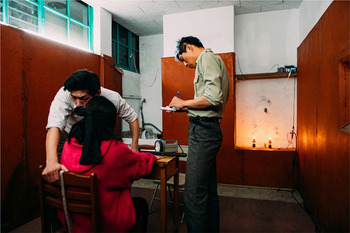
After the papers were signed, the participants were led down the historic prison corridor located by the park. First, they were asked to watch agitated caged birds in a cell, flapping their wings under uncomfortably bright lights, symbolizing the political criminals imprisoned during the White Terror. Then the participants were called one by one into different small, moldy‐smelling chambers, eyes covered by black linen, handcuffed to wooden chairs, and bound by hemp ropes. Each participant was then “tortured” as if a political dissident suspected of participating in a communist organization. At the end of the torturing, the participant was told that they had been betrayed and accused of being a Communist by other participants. During the process, the torture included being asked to read a fabricated confession, nonstop repetitive interrogation, slapping, kicking, forceful removal from the chair, hair‐pulling, blindfolding, etc. These techniques were designed to incite fear in the victim, but the promise of safety effaced the fear, even transformed it into excitement. One participant, whose ankles were grazed during the torture scene, said that the performance was “violent but a lot of fun.” Similarly, another participant stated: “I liked to be tortured. It was like BDSM and it was fun, and I couldn’t help laughing.” No matter how diligently performers tried to create a realistic experience of the White Terror, they would inevitably fail. Everyone knew, always, that this was “just” a performance, an artwork. Indeed, the tortured were consumer‐participants who had agreed to enter, while the performers had no option except to carry out the performance. The immersive power relation was the opposite of the historical power relation they were trying to depict. The “torturers” were really offering a service, a theatre work. Given this paradoxical power relation, spectators could not actually relive the experience of the oppressed.
The torture scene from Too Many Dreams in One Night. Curated by Yen Hung‐ya, directed by Chou Yi‐cheng, Fangas Nayaw, and Tan Yuchiao. Jing‐Mei White Terror Memorial Park, Reference Chou, Nayaw and Tan2018. (Photo by Etang Chen [陳藝堂]; courtesy of Dark Eyes Performance Lab)

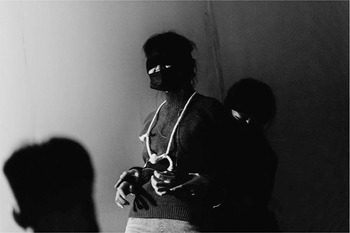
Led by the military‐dressed performers, the participants then entered another small room with walls covered by soft cushions. Each participant was blindfolded, with their ears covered by headphones and wrists handcuffed to those of a performer. As soon as the performer moved, the participant, whose back was to the performer, was manipulated like a marionette. Through the headphones, they heard first‐person narratives, conversations, and other sounds that (re)enacted the scenarios of multiple imagined and historical events. Each narrating “I” was the character that a participant was meant to represent: Lin Tsong‐liang (林宗良), the political activist for Taiwan independence; Vietnamese immigrant worker Nguyen Quoc Phi (阮國非); oppressed locals Cheng Nan‐jung (鄭南榕), Wu Hsin‐rong (吳新榮), Wu Le‐tian (吳樂天), Ke Qi‐hua (柯旗化), Tsai A‐Lee (蔡阿李), Yeh Yung‐chih (葉永鋕), Chen Wen‐chen (陳文成), Chen Su‐chen (陳素貞), Tang Ying‐shen (湯英伸), Chiang kuo‐ching (江國慶), and Chiang Wei‐shui (蔣渭水); participants in the Nong‐An Street Incident (農安街事件); participants of the Sunflower Student Movement (太陽花學生運動); comfort women, and others.Footnote 10 As each participant was moved through all of these characters, the swiftly shifting narratives and conversations prevented the participants from engaging with any specific character; their understanding was so fragmented that they were confused about whether they were playing the oppressed, the families of the oppressed, or the oppressors. This fragmented characterization complicated and problematized the binarization of the oppressor and the oppressed. Because the participants’ and the performers’ wrists were linked, the sense of uncertainty was mutual; no one could be identified simply as the oppressor or the oppressed.
A participant is handcuffed to a performer in the marionette scene from Too Many Dreams in One Night. Curated by Yen Hung‐ya, directed by Chou Yi‐cheng, Fangas Nayaw, and Tan Yu‐chiao. Jing‐Mei White Terror Memorial Park, Reference Chou, Nayaw and Tan2018. (Photo by Etang Chen [陳藝堂]; courtesy of Dark Eyes Performance Lab)

During this scene the participants were knocked on their heads, pinched on their faces, sanitized with alcohol swabs on their arms, and dragged around by the performers. They were also subjected to other overwhelming sensory stimulation: nonstop annoying noises, metallic clinking and clanking, dripping sounds, unpleasant smells of frying food and bodily odors, liquid spills, verbal abuse, constant spinning, swaths of darkness and blinding white lights, recurring stinging pain when ropes or handcuffs scratched the skin…some more invasive than others. One participant recalled: “It was such a chaotic situation that I sometimes felt protected by the performer bound with me and yet sometimes tortured by the same performer. Because my wrists were attached to the performer, it almost felt like being protected and tortured by myself” (Chu 2018). As one of the first‐person narrators heard through the headphones said: “As far as I can recall, I couldn’t see from the beginning. I didn’t know why they brought me here. It was like a sightless nightmare.”
Immersive theatre has been popular in the US and Europe for many years, but with Too Many Dreams in One Night, it was new to Taiwan. The production aroused intense debate about transitional‐justice policy. Theatre director Chung Chiao (鍾喬) questioned the validity of equating simulated pain with actual pain and doubted the efficacy of transitional‐justice theatre that follows the Western paradigm (Reference Chung2018). Critic Anniel Hao (郝妮爾), however, thought the mental distress that occurred when participants realized they were betrayed by other audience members in the torture scene allegorized the historical trauma (Reference Hao2019). Journalists Chang Ju‐hsien (張如嫻), Chen Guan‐da (陳冠達), Yuan Muxian (袁沐嫻), and Chen Tzu‐Hsuan (陳子萱) pointed out the impossibility for participants to actually be immersed (in Chang and Chen Reference Chang and Guan-da2020).
The Acting Chair of Taiwan’s Transitional Justice Commission, Yang Tsui (楊翠), also the granddaughter of the prominent writer and activist Yang Kui (楊逵) who had suffered during the White Terror, attended the rehearsal and press conference on 26 November 2018. News footage shows Yang blindfolded, wearing headphones, her wrists handcuffed with those of a performer. Deprived of her liberty, Yang appeared to panic to the point of tears. “In the past, we intellectually experienced history through archival, documentary, and other historical materials,” Yang said afterward to the press (in Wang 2018). “This production, however, offers a sensed and corporeal path to experience history. When it comes to reconciliation, the first step is empathy, even the mutual experience of pain and trauma. We may not know every era, every event, and every issue portrayed in the production, but from our feelings, we will be inspired to look for material to deepen our understanding” (in Wang Reference Wang2018). As one of the leading promoters of transitional justice and a descendant of a victim of the White Terror, Yang’s response was obviously different from other participants’ reactions. Are the “empathy” and “mutual experience of pain and trauma” Yang refers to wishful thinking and only possible when the participant has a direct connection to the White Terror? Wasn’t Too Many Dreams in One Night merely a service that offered a safe commercial experience?
The Jing‐Mei White Terror Memorial Park is a site commemorating injustice, terror, and trauma, but for Too Many Dreams in One Night it was a safe theme park. The transitional justice that the performance wished to embody and reenact via immersive theatre in fact paradoxically confirmed that the performing arts cannot faithfully reproduce the power asymmetry of perpetrator and victim. Although such dramatic works can stimulate the audience’s critical thinking, it is also likely that they will render the terror simplistic, entertaining, mediocre, and homogeneous. The “bare life” of one who has lost civil and human rights, rejected by law and therefore beyond legal prohibition (Agamben [1995] Reference Agamben and Heller-Roazen1998) is represented by performers and spectators who emerge safely from the pretended precarious life of the performance, ironically distanced from any transitional justice.Footnote 11 However, something significant was gained. The unpredictable interactions and the sensory experiences created by immersive theatre reflected the mutually vulnerable relations between the oppressor and the oppressed. At a metatheatrical level, the performance significantly urges the audience to consider the ethical issue of what theatre can and cannot accomplish.
The Paradox of Ethics
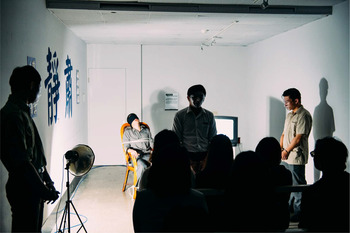
While theatre of transitional justice cannot reproduce actual political violence, the stagecraft it employs in its attempts is very likely to breed unwanted ethical consequences. In Too Many Dreams in One Night, participants were first arranged in different groups outside before they were reassembled indoors for the electrocution scene. In the indoor space were three rows of wooden chairs and blue signs that read “SILENCE” and “EVERYONE IS RESPONSIBLE FOR REPORTING COMMUNISTS.” In the front was a TV, showing red characters against a white background: “EVERYONE IS RESPONSIBLE FOR TRANSITIONAL JUSTICE (轉型正義人人有責).” Next to the TV was a performer portraying an intelligence agent during the White Terror, tightly tied to a chair, identity unknown.Footnote 12 The performer’s entire face was completely covered by plastic sheets, his mouth hardly capable of moving — offered as an object for abuse and insult. The intelligence agent was asked by another performer portraying the transitional justice staff to recite a written confession: “In 1952, under the orders of the Special Intelligence Workforce of the National Bureau of Investigation and Statistics (軍統局特別情務組), with Squad One (第一分隊), I illegally incarcerated and tortured the activists found at Luku headquarters. With remorse and shame, I am willing to receive the penalty by humane electrocution according to the Act on Promoting Transitional Justice so as to fulfill transitional justice and defend human rights.” When the recitation was finished, a series of directions appeared on the TV screen: “Before you sits the perpetrator who oppressed the people on behalf of the state./ Please press the button in front of you./ Carry out the humane execution by electrocution./ Justice is in your hands.” Each participant was given one minute to come up to the stage, facing the perpetrator, and decide whether or not to press the button. If the participant chose not to press the button, a performer shook hands with him or her and expressed gratitude. If the participant pressed the button, the tied person’s body shook and thrashed as if being electrocuted while the screen displayed a round of applause and the staff sang a militaristic rendition of the tune “When Will You Return?” (何日君再來), a locally renowned love song banned by the Kuomintang because of its decadent implication that was against the patriarchal and patriotic ideology during the White Terror.Footnote 13 After all the participants finished, they heard an audio replay of some of them being sold out and accused of being involved with communism by each other during the earlier torture scene. Then the participants were led out of the room.
The audience participants decide the fate of the performer in the electrocution scene from Too Many Dreams in One Night. Curated by Yen Hung‐ya, directed by Chou Yi‐cheng, Fangas Nayaw, and Tan Yu‐chiao. Jing‐Mei White Terror Memorial Park, Reference Chou, Nayaw and Tan2018. (Photo by Etang Chen [陳藝堂]; courtesy of Dark Eyes Performance Lab)

Using electrocution in Too Many Dreams in One Night as a way to achieve transitional justice was highly controversial. The scene made torture into a public spectacle, an ostensibly long‐abandoned practice in democratic societies. Responding to the explicit ethical dilemma of the scene, most participants refused to press the button. They stared at the covered face of the perpetrator, listened to the confession, and stepped away. However, if refusing to press the button was a politically correct ethical decision, it does not follow that those few who chose to press the button advocated for torture. During the postshow discussion, one of the participants stated that his decision to press the button was based on curiosity: “Exactly because using an electric chair to achieve transitional justice is problematic, I was curious to know what would happen if I pressed the button.” Yet, when the theatre artists explained that the electric chair used in the production was not a prop, but an actual electrically charged chair that uses a minimum level of electricity that does no serious harm on the performer’s body, the participant was enraged: “If I had known that was a real electric chair, I would never have pressed the button. My life is now scarred by the memory of electrocuting a person. What you claimed about transitional justice was a total scam!” This participant accused the performers of setting up participants to make an unethical choice. Indeed, participants did not expect the chair to be electrified; common sense told them that the objects onstage were props. They thought the writhing of the performer was acting. Ironically, the power asymmetry under the White Terror that could not be reenacted in the previous scenes instead emerged in this scene. The electrocution scene was designed to be ethically dubious and sparked emotions the White Terror might also have elicited — not through the retelling of history but rather through the operative structure of the performance itself. The accusations of “deception,” “framing,” and “traumatizing” reenacted the dread of past political violence. Moreover, though the performers were prepared, they could not predict whether the participants would press the button, nor for how long, or how many times. Therefore, both the participants and the performers experienced the terror of political violence, albeit to a much lesser degree.
The exit procedure of Too Many Dreams in One Night was no less controversial. According to the performers’ instructions, participants could exit immediately at any point during the show only if they shouted “Long Live the Republic of China (中華民國萬歲)!” three times. Unlike common safe words used in BDSM practices, usually agreed upon by both parties, the safe words here, which carry strong Kuomintang ideology, were set by the artists. As with the electrocution scene, this ethically dubious exit procedure forced participants to “perform or else” (McKenzie Reference McKenzie2001).Footnote 14 If using aestheticized violence to represent actual political violence is ethically dubious, how can theatre, even immersive theatre, do its job? The conflicts that arose during Too Many Dreams in One Night accurately reproduced the actuality of political terror: participants unknowingly became both victims and perpetrators; the aftermath comprised resentment and traumatic memory. The performance has to be evaluated in its entirety, including the communication beforehand, the performance itself, and the discussion and debates that followed the performance.
The Aftermath
In “On Aesthetics and Limitations (論美學與限制),” Too Many Dreams in One Night curator Yen Hung‐ya — who has worked in Taiwan’s theatre scene for more than 30 years — wrote, “I hope audience members can personally experience those oppressions that Taiwanese people have suffered. When bodies are constrained and even hurt, they may resonate even more […] People can project themselves on certain figures, and assume ‘I may be him/her’ in the past. I hope to deliver this effect like they are possessed” (in Huang and Liu 2020). Can theatrical experiences effectively support democracy and justice in Taiwan, even if they successfully “possess” participants?
After the performance, participants spoke up. “In the theatre, political persecution in the past may become too dreamy and fun. When tragedies are turned into games, public misunderstandings may get worse,” explained VR designer Huang Chueh‐heng (黃瑴恒) (Reference Huang2018). Artist Wu Ning (吳寧) offered similar feedback: “Because I am not familiar with the Luku Incident, I felt very disconnected from the interrogation scene, and burst into laughter multiple times. I later felt guilty for being disrespectful of the historical events” (2018). On the other hand, two anonymous participants stated that this was their first visit to the Jing‐Mei White Terror Memorial Park. They were shocked by the dreariness and gloom of this historical site of injustice. After the performance, they could better imagine the horrors of political persecution, and they were more willing to participate in related discussions in the future.
It would be absurd to assert that a theatrical experience has the essential capacity to achieve democracy and justice, but it is exactly the paradox within transitional‐justice theatre that performs the core goal of transitional justice: to sustain and achieve long‐term democracy and equality by taking proactive measures in the present and for the future. The ethical issues raised by Too Many Dreams in One Night demonstrate that the theatre of transitional justice is always entangled in an unresolved paradox: if the theatre of transitional justice tries to evade ethical predicaments, then the true power asymmetry under political terror cannot be reenacted. Too Many Dreams in One Night emphatically underscored the necessary reflexivity of realizing transitional justice through performing arts.
This doesn’t mean that the physical and emotional injury and trauma inflicted by this production is acceptable. Ethical issues remain unresolved. Be that as it may, Too Many Dreams in One Night is significant for its efforts to participate in constructing contemporary transitional justice discourses and methods in Taiwan, and creating a convergence of civil politics and performing arts.