Introduction
The adoption of children from out-of-home care, typically from foster care, represents an attempt to address the challenges of children who drift in and out of the care system, together with the goal to provide stability in care for vulnerable children and adolescents (Moye & Rinker, Reference Moye and Rinker2002). While other countries, such as the USA and UK, have viewed and implemented adoption as a placement option for children in out-of-home care decades earlier, Australia has only recently placed emphasis on adoption from out-of-home care, primarily in the state of New South Wales (NSW). There are also differences in legislation and adoption practices among the jurisdictions. For instance, US legislation favours adoption over other placement options (Sargent, Reference Sargent2003). On the other hand, in the UK, adoption is perceived as a last resort when it is determined that a child cannot be placed in a kinship or long-term foster placement (Sloan, Reference Sloan2013).
The overall numbers for adoption in Australia have been steadily declining in the past 25 years. This is partly due to the continuing decline of intercountry adoptions, which is attributable to improvements in the economic and social development of sending countries as well as the tightening of eligibility criteria for prospective adoptive parents. However, known child adoptions (i.e., where the child already knows or has an established relationship with the adoptive parent/s) have been gradually increasing since 2012–2013 and comprised nearly three-quarters of all adoptions during 2017–2018 (Australian Institute of Health and Welfare, 2018), with adoption by foster carers the most common (63%). This increase has been largely driven by policy and practice changes in NSW that aim to provide permanent and stable homes to children in out-of-home care. Compared to other countries, the rate of adoptions relative to the number of children in out-of-home care in Australia is relatively low. Considering NSW alone, the rate of adoptions from out-of-home care was less than 1% in 2017–2018, whereas it is estimated to be 6% in England (Department for Education, 2017) and 13% in the USA (Adoption and Foster Care Analysis and Reporting System Data, 2017).
Historical adoption practices have contributed to the comparatively low numbers of adoption in Australia. During the 1900s, Aboriginal and Torres Strait Islander children were forcibly removed from their families and placed with non-Indigenous families as a result of protectionist and child welfare policies and practices (Australian Human Rights Commission, 2012). Such removals were attempts to merge, absorb or assimilate Aboriginal children into non-Indigenous society. In addition, during the decades leading to the mid-1970s, when minimal support services were available for single mothers, there was significant pressure on pregnant unwed girls and women to relinquish their babies at birth so they could be adopted by married couples (Higgins, Reference Higgins2010, Reference Higgins2012). To the present day, it is apparent that the children, parents and families affected by these practices continue to suffer lifelong negative consequences due to the trauma of separation and experience of unresolved grief and loss (Australian Human Rights Commission, 2012; Kenny, Higgins, Soloff, & Sweid, Reference Kenny, Higgins, Soloff and Sweid2012).
From the 1970s and onwards, there were shifts in adoption practices, coinciding with a reduction in the number of adoptions. Fewer children were relinquished for adoption due to greater availability of family planning services and sole-income parent support, as well as less negative attitudes towards unwed mothers. Adoption was viewed as being less about a service for couples wishing to adopt and more as a service for children, with their welfare being the key priority (Australian Institute of Family Studies, 1992). Furthermore, there was greater recognition of the rights and interests of the various parties, particularly with respect to the adopted person’s informational needs. Within Australian states and territories, laws were amended to allow sealed adoption records to be opened and for contact between birth parents and their children to occur. Adoption practices became more open, emphasising the needs of the adopted child and the open exchange of information (Ferrerira, Reference Ferrerira2014).
Despite these shifts in societal attitudes and practices, however, the history of adoption practices in Australia still contributes to a reticence among practitioners to consider open adoption as a permanency option for children in out-of-home care (Tregeagle, Moggach, Cox, & Voigt, Reference Tregeagle, Moggach, Cox and Voigt2014). Cashmore (Reference Cashmore2014) suggested possible reasons for the low numbers of children being adopted from out-of-home care in Australia. First, the severance of legal ties between child and biological family is viewed as highly inappropriate in light of past adoption practices. Child, family and community peak Aboriginal organisations continue to strongly oppose the permanent removal of Aboriginal children from their families by statutory child protection systems in any form as it bears a resemblance to the Stolen Generations (SNAICC, 2018). From the perspective of Aboriginal people, continuing to remove children will not mitigate the long-term and intergenerational trauma of historical child removal (AbSec, 2018). Second, the process for adoption is seen to be complex and long, and there is a lack of workers who are skilled in taking the application through the Supreme Court. Finally, there are concerns about the level of financial and non-financial support after the adoption, which is often necessary if the child has had early adverse experiences. Despite these challenges, NSW is undertaking concerted efforts to increase the numbers of open adoptions from out-of-home care (Smith, Reference Smith2018).
The NSW context
In late 2014, the Children and Young Persons (Care and Protection) Act 1998 (hereafter referred to as the Care Act) was amended to emphasise the importance of permanency for children for whom there is no realistic chance of restoration to their birth family and attempted to prioritise other permanency options above that of parental responsibility to the Minister (i.e., long-term foster care). The amendments specify the following placement options for non-Indigenous children who cannot be restored to their birth parents: (1) guardianship by a relative, kin or other suitable person; (2) open adoption and (3) parental responsibility of the Minister until 18 years of age. In acknowledgement of past practices during the period of the Stolen Generations, the order of preferences for Aboriginal and Torres Strait Islander children is different, reflecting the Aboriginal Child Placement PrincipleFootnote 1 (Tilbury, Burton, Sydenham, Boss, & Louw, Reference Tilbury, Burton, Sydenham, Boss and Louw2013). When guardianship and long-term foster care are not practicable nor in the best interests of the child, the last preference is for an open adoption. This only occurs following extensive consultation and cultural planning.
In NSW, to adopt a child from out-of-home care, the prospective adoptive parent(s) must first be the authorised long-term carer(s) of the child (i.e., their foster carer). The route from foster care to adoption in NSW is a two-step process, regulated by two courts. First, the Children’s Court makes a finding under the Care Act that there is no realistic possibility for the child to be restored to their parents, and then decides the appropriate placement in accordance with the order of placement principles. Second, if the child’s foster carers wish to pursue adoption, an application is made to the Supreme Court, under the Adoption Act 2000. As part of the adoption application, prospective adoptive parents are expected to demonstrate effort and capacity to facilitate direct contact with birth relatives as a means to support the child’s relationships with them and to inform identity formation.
It is important to note that the legislative reforms in NSW are recent and have had little time to take effect compared to those in the USA and UK (Ross & Cashmore, Reference Ross and Cashmore2016). Given the NSW government’s policy efforts to increase the number of adoptions from out-of-home care, part of that effort will require identifying, recruiting and retaining people who are suitable and willing to become prospective adoptive parents. As adoption from out-of-home care is a two-stage process, in which the prospective adoptive parent must first be the authorised long-term carer of the child, there is a need to understand what motivates or prevents people from deciding to adopt: (1) before they become foster carers and (2) when they are a foster carer. The current study focuses on the former by exploring what factors are related to general interest in adopting children from out-of-home care, while a separate study examines the latter (e.g., Luu, Collings, Wright, Pope, & Spencer, Reference Luu, Collings, Wright, Pope and Spencer2018). Findings could be used to inform the framing of messages for the recruitment of foster carers who intend to adopt. Despite differences in policy and practice across different jurisdictions, research from the USA and UK, and limited Australian research, can provide some insight into the general public’s motivation to adopt, as detailed in the next section.
Literature on motivation to adopt
Prior research has attempted to map the influence of specific demographic characteristics on motivations to adopt, although no clear consensus has been reached. For example, the association between motivation to adopt with factors such as age, education, employment status, marital status and family income is not straightforward (Bausch, Reference Bausch2006; Dave Thomas Foundation for Adoption, 2013; Scott & Duncan, Reference Scott and Duncan2013; Van Laningham, Scheuble, & Johnson, Reference Van Laningham, Scheuble and Johnson2012). However, considerations of adoption are often more prevalent among 18–35-year-olds, which intuitively makes sense given that it is an age when childbearing decisions are likely to be made. Overall, it is difficult to fully unpack the influence of specific demographic characteristics on motivations to adopt, and it may be unique to the type of adoption or the specific jurisdiction being studied.
One factor that has consistently been associated with considering adoption, however, is personal experience with adoption or knowing someone (e.g., family member, close friend) who was adopted, has adopted a child or has placed a child for adoption. For example, those who have adopted or fostered, or know someone who has, are more likely to view adoption and fostering positively and consider doing it (Scott & Duncan, Reference Scott and Duncan2013). Bausch (Reference Bausch2006) also found that, after accounting for a range of factors (e.g., age, gender, employment status), willingness to adopt was higher for those who were themselves adopted or knew family members or relatives who were adopted. Therefore, having exposure to other individuals who have had personal adoption experiences can influence a person’s motivation to adopt.
Research studies also indicate that there is an intersection between intentions to foster and intentions to adopt. For example, in a large-scale US survey by Malm and Welti (Reference Malm and Welti2010) of adoptive parents (including adoptions from foster care, private adoptions and intercountry adoptions), primary motivations for adoption were to provide a permanent home for a child, which was followed by a chance to expand their family. However, adoptive parents who knew the child prior to the adoption were less likely to cite infertility as their primary motivation for adopting, instead providing other reasons, such as the fact that they had a pre-established bond with the child. Such findings are consistent with prior studies which suggest that those who are motivated to adopt a child from foster care are those who are currently fostering a child or had prior experience (Beek & Schofield, Reference Beek and Schofield2002; Denby, Alford, & Ayala, Reference Denby, Alford and Ayala2011). The results of a survey conducted by Tyebjee (Reference Tyebjee2003) showed that the main motivations to adopt or foster tend to be child-focused: that it would make a positive difference in a child’s life and that there were many children in need.
Personal barriers to adopting from foster care have also been extensively documented in the literature (Evan B. Donaldson Adoption Institute, 2002; Khanna & Killian, Reference Khanna and Killian2015; Scott & Duncan, Reference Scott and Duncan2013). There are common themes in terms of barriers for those considering adoption from out-of-home care. These include (1) a lack of knowledge and understanding of the steps prior to applying to adopt; (2) concerns about the child and the impact the adoption will have on the child and the adoptive parent and (3) the lack of information about, or availability of, post-adoption financial and non-financial supports. Clearly then, many of the barriers appear to be related to knowledge or informational needs, which can be systematically addressed through proper information channels. In line with this notion, a marketing proposal by Scott and Duncan (Reference Scott and Duncan2013), commissioned by the Department of Education in England on the recruitment of foster carers and adoptive parents, noted that messaging about the kinds of children in need, the criteria for applicants, details of the application process and available supports should be clear and simple.
Limited research has been conducted in Australia about people’s motivation to adopt children from care. To date, most studies have focused on the motivation and barriers for people to become foster carers. For example, Ciarrochi, Randle, Miller, and Dolnicar (Reference Ciarrochi, Randle, Miller and Dolnicar2012) found that people who sought information about foster care and expressed an interest or intention towards becoming foster carers were more likely to have high social support from friends as well as empathy, hope and a problem-solving orientation. Randle, Miller, Dolnicar, and Ciarrochi (Reference Randle, Miller, Dolnicar and Ciarrochi2014) explored the potential barriers to becoming a foster carer in a panel survey. Even though personal circumstances and the amount of commitment needed to be a carer were main concerns, three of the top five reasons for choosing not to foster included the fact that: (1) nobody had ever asked them to foster a child, (2) the opportunity never arose and (3) they did not know anything about foster care. Such findings point to an initial solution in Australia: addressing the need for more information for those who may be interested in becoming foster carers. Given that motivations to adopt and foster are often similar (Tyebjee, Reference Tyebjee2003), messaging may also include information about the possibility of later adopting the children in their care.
A recent study conducted by Adopt Change (2015) examined Australian perceptions and attitudes towards adoption. The findings of a survey of 1014 respondents revealed that few Australians have heard about adoption or fostering (about 39%), and that as much as 60–75% did not think they will likely adopt in the future nor would ever consider it. However, adoption in general is viewed positively with over 83% agreeing that adoption provides children with a loving home with someone who wants them, opportunities they would not otherwise have, a better life and that it also brings joy to a family. Over 80% of respondents also indicated that an adopted child should still have knowledge and links to their birth family and culture. When respondents were provided with actual statistics for Australian children in out-of-home care (e.g., how many stayed in out-of-home care for two or more years, and how many were adopted within the past year), they expressed concern and over half were motivated to sign a petition or support change in adoption legislation. Such findings suggest that improving awareness and knowledge is an important task for motivating the public to consider adoption.
Study aims and research questions
This study was funded by a state government department and conducted by an independent research institute hosted within a university. The aim of this study was to investigate factors that may facilitate or prevent people from considering adoption from out-of-home care in NSW. There is variability in legislation and practices across Australia, with many other state and territory policies promoting parental responsibility (also known as guardianship) orders rather than adoption when a child is in permanent care. The focus of this study was the NSW context, which has an increasing number of carer adoptions each year as well as clear government initiatives that attempt to increase the number of children who are adopted from out-of-home care. A representative sample of over 1000 respondents completed an online survey designed to assess their understanding of NSW adoption practices and their willingness to consider adopting from out-of-home care. The research questions for this study were
1. What are the facilitators and barriers to adopting a child from out-of-home care as perceived by the NSW general public? Are there specific concerns about adopting a child from out-of-home care?
2. What are the characteristics of people more likely to consider adopting a child from out-of-home care?
Methodology
Participants
A total of 1030 respondents completed the online survey in October–November 2017. An online research panel firm was asked to recruit a general sample from NSW that was representative of the population for age and sex. The firm is an established market research sample provider which recruits respondents by partnering with leading global brands. With each completed survey, panel members earn points that can be used to redeem vouchers or rewards. After the launch of the survey, there were difficulties in reaching the target quota for 18–24-year-old males. As a result, 25–34 and 35–44 age groups of both genders were targeted, given that these age groups are more likely to be making family and child-rearing decisions when compared to 18–24-year-olds and those beyond 45 years of age.
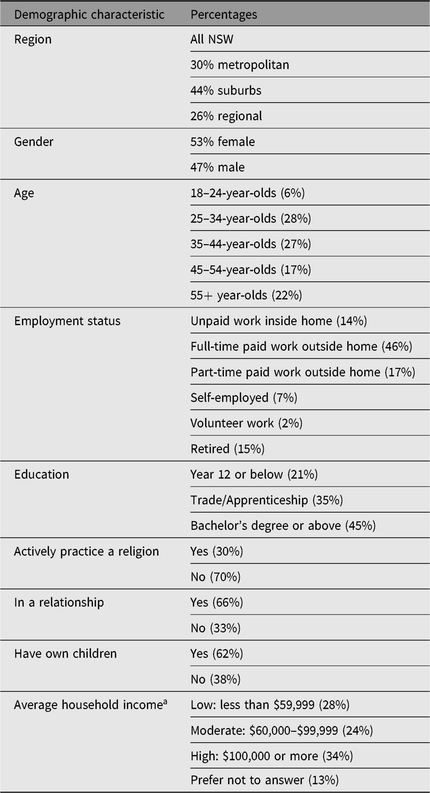
The final sample consisted of 1030 respondents with age breakdown as follows: 18–24-year-olds (6%), 25–34-year-olds (28%), 35–44-year-olds (27%), 45–54-year-olds (17%) and 55 years and over (22%). Further characteristics of the final sample are presented in Table 1.
Demographic characteristics of respondents to general public survey

a Determined by splitting the groups into three: low, moderate and high.
Instrument and measures
The survey instrument was designed to explore and understand respondents’ views of open adoption and the adoption of children from foster care. Questions for the survey were drawn and adapted from surveys that were used in other research studies, including Randle, Miller, Dolnicar, and Ciarrochi (Reference Randle, Miller, Dolnicar and Ciarrochi2014) and surveys conducted by NSW Family and Community Services that have not been publically released. Prior to data collection, the questionnaire was pilot-tested by three members of the general public to ensure questions were clear and being interpreted as intended. Measures for the key constructs are outlined below.
Understanding of open adoption
Respondents were asked if they had a sibling, family member or friend who was adopted as a child. They were then asked to indicate if they knew what open adoption is and, for those who indicated ‘Yes’, to use a free-form text box to define the term in their own words.
Consideration and motivation to adopt
Respondents were asked whether they had ever thought about adopting a child (‘Yes’ or ‘No’), and to indicate how likely they would be to consider adopting a child now or in the future on a 5-point Likert scale (‘very likely’ to ‘very unlikely’).
To further explore what might facilitate respondents’ likelihood of adopting from foster care, a list of factors was provided (e.g., if the application process was simple, if financial support was available) and respondents were asked whether any of the factors would encourage them to consider adopting a child from foster care.
Specific concerns about adopting from foster care
Respondents were provided with a list of statements regarding concerns about adopting a child from foster care (e.g., ‘I am concerned I would not be accepted by the child I wish to adopt’) and asked to indicate their level of agreement on a 5-point Likert scale.
Social support
The Multidimensional Scale of Perceived Social Support (Zimet, Dahlem, Zimet, & Farley, Reference Zimet, Dahlem, Zimet and Farley1988) was used to assess the perceived adequacy of support from family, friends and significant other for all respondents. It consists of a 7-point Likert scale from ‘very strongly disagree’ to ‘very strongly agree’. Respondents rated their level of agreement in response to a series of statements (e.g., ‘there is a special person who is around when I am in need’).
Life satisfaction
The Satisfaction with Life Scale (Diener, Emmons, Larsen, & Griffin, Reference Diener, Emmons, Larsen and Griffin1985) was used to capture global life satisfaction for all respondents. On a 5-point Likert scale from ‘strongly disagree’ to ‘strongly agree’, respondents indicated their level of agreement with a series of statements (e.g., ‘in most ways, my life is close to my ideal’).
Demographics
The final part of the survey asked respondents about general demographics including gender, age group, marital status (married, de facto or same-sex relationship, single, separated, widowed, divorced), region (e.g., living in city, suburban or regional area), employment status (unpaid work inside home, full-time paid work outside home, part-time paid work outside home, self-employed, volunteer work, retired), education level (year 12 or below, trade/apprenticeship, Bachelor’s degree or above), actively practicing religion (active, not active), have own children (yes, no) and average household income per annum.
Analysis
Results were largely quantitative and descriptive, comprising the number of respondents who, for instance, agreed or disagreed with specific statements. These are presented as percentages. Qualitative data relating to respondents’ written definitions for the term open adoption were compiled and examined using an inductive approach. Similar responses were grouped with a theme identified for each group. Correct definitions of open adoption included references to the exchange of information and/or opportunities for contact between adoptive and birth families. Other definitions were identified as follows: incorrect or not enough information (e.g., ‘like foster care, not permanent’, ‘good’); general definitions of adoption (e.g., ‘looking after someone’s child who is not your own biologically’, ‘taking a child in to your family permanently’); believing that open refers to the expansion of criteria for the suitability of prospective adoptive parents (e.g., ‘being allowed to adopt any child without restriction’, ‘anyone can adopt’) or emphasising infant relinquishments without mention of information exchange or contact (e.g., ‘adoption means taking responsibility by taking someone’s abandoned child’, ‘taking over as parent for someone else’s child they do not want for whatever reason’).
Finally, to explore associations between likelihood of considering adoption and specific variables, General Linear Model univariate analyses were conducted with likelihood of considering adoption as the dependent variable and knowledge of open adoption, knowing someone who had been adopted, perceived social support, satisfaction with life and each demographic variable as the independent variable. Bonferroni-corrected post-hoc comparisons were conducted to further examine any significant effects that emerged. Finally, stepwise regression analysis was conducted to identify the best subset of variables that predicted respondents’ likelihood of considering adoption.
Results
Understanding of open adoption
A third of respondents (33%) indicated that they had a sibling, relative or friend who was adopted as a child. When asked to self-report whether they knew what open adoption is, 46% of respondents reported that they did know. These respondents were then asked to provide a written definition for open adoption. On exploration of the definitions provided by those who claimed to be knowledgeable, only 43% were aware that open adoption involves an exchange of information between adoptive and birth families, and/or opportunities for contact with birth family members. In other words, only 20% of the overall total of respondents could provide an accurate definition for open adoption.
Consideration and motivation to adopt
When asked whether they had ever thought about adopting a child, 60% of respondents indicated they had not. In addition, when asked about how likely they would consider adopting a child now or in the future, 19% were ‘somewhat likely’ and 6% were ‘very likely’. On the other hand, 16% indicated that they were ‘somewhat unlikely’ and 35% were ‘very unlikely’. One-quarter of respondents (25%) were neither likely nor unlikely to consider adopting a child now or in the future.
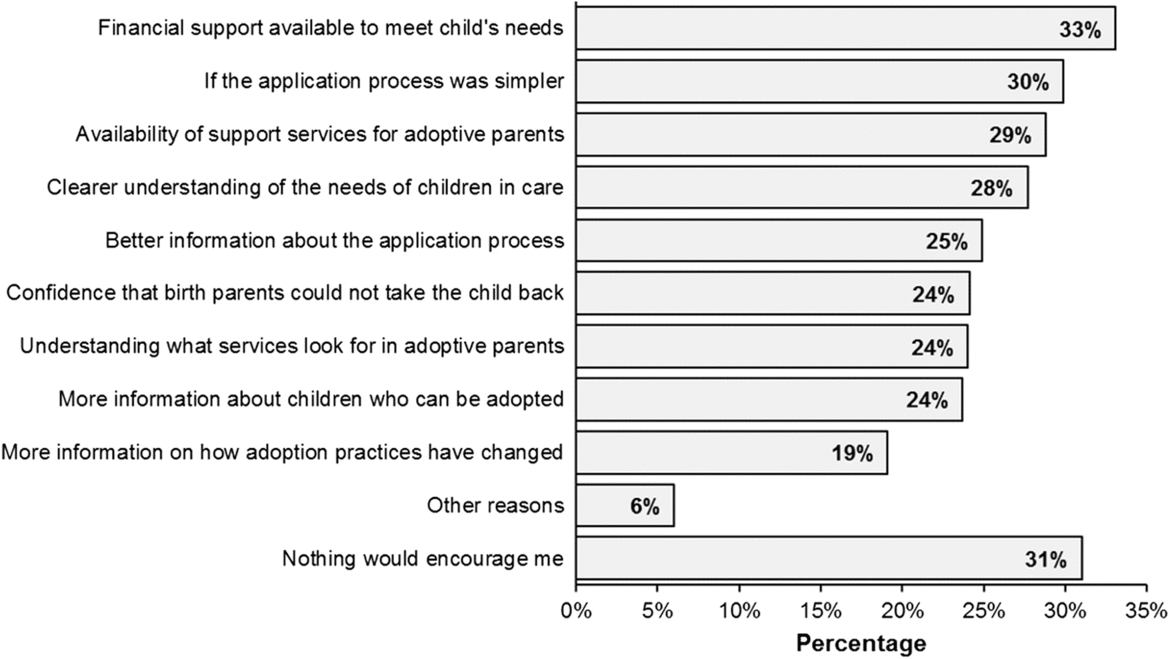
Respondents were presented with a list of potential factors and asked what factors would encourage them to consider adopting from foster care. The factors selected by respondents were largely about financial and non-financial supports (see Figure 1). One-third of participants (33%) noted that availability of financial support to meet the child’s needs would motivate them to consider adopting a child from foster care. Availability of support services for adoptive parents was also a motivating factor, noted by 29% of respondents. Respondents also noted that they would be encouraged to adopt a child from foster care if they perceived the application process to be simpler (30%) and if there was better information on the application process (25%). Interestingly, around a quarter of respondents (24%) would be encouraged to adopt if they could have confidence that the birth parents could not take the child back. For 31% of respondents, however, nothing would encourage them to adopt a child from foster care.
Factors that would encourage the public to consider adoption from foster care.

Specific concerns about adopting a child from foster care
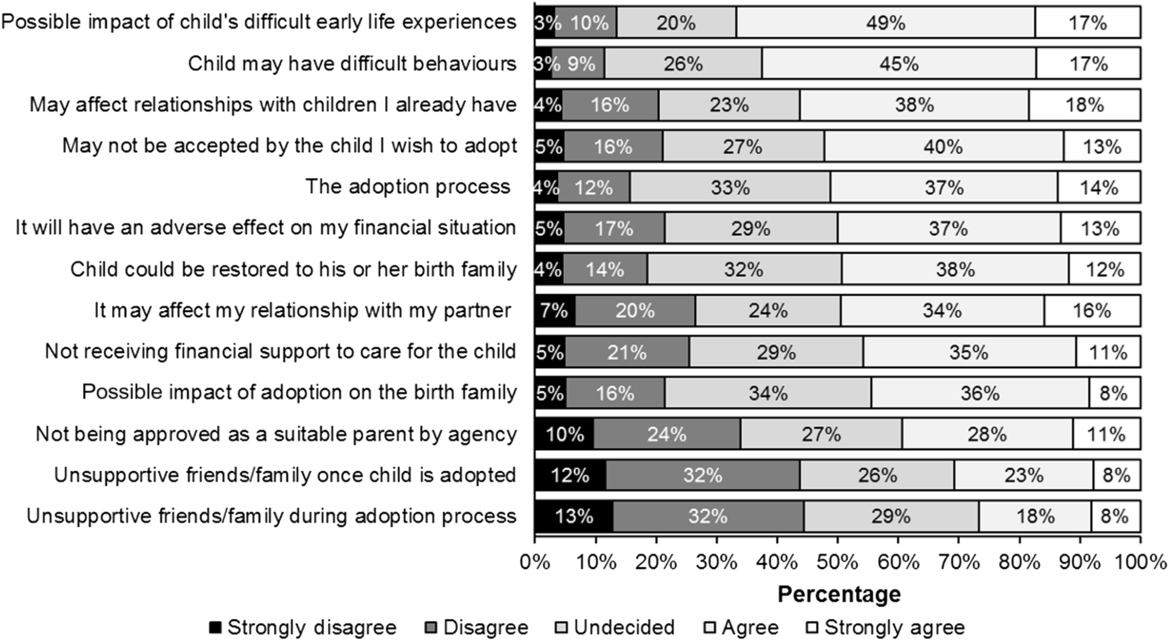
Respondents indicated the extent to which they agreed or disagreed with a list of statements relating to concerns about the impact of adopting a child from foster care (Figure 2). It appears that the public’s key concerns about adopting a child from foster care were centred on characteristics of the adoptive child, including the potential for the child to exhibit difficult behaviours, the impact of the child’s early life experiences and being accepted by the child. Respondents were also concerned about how an adoption may affect the relationships with children they already had, the adoption process and the impact of the adoption on their financial situation. It is also interesting to note that there were concerns that the child might be restored to his or her birth family, with 12% strongly agreeing and 38% agreeing with this statement. Finally, there appeared to be a low level of concern about whether respondents’ friends or family would be unsupportive during or after the adoption process.
Specific concerns held by the public about adopting a child from foster care.

Factors relating to likelihood of considering adoption
To understand the characteristics related to a greater likelihood of considering adoption, several variables were examined. These included respondents’ knowledge of open adoption (as determined by their written definitions rather than their self-reported knowledge), knowing someone (sibling, relative or friend) who had been adopted, perceived overall social support and satisfaction with life. Several demographic variables were also examined including gender, marital status, age, region, employment, level of education, income, actively practicing religion and whether they had any children.
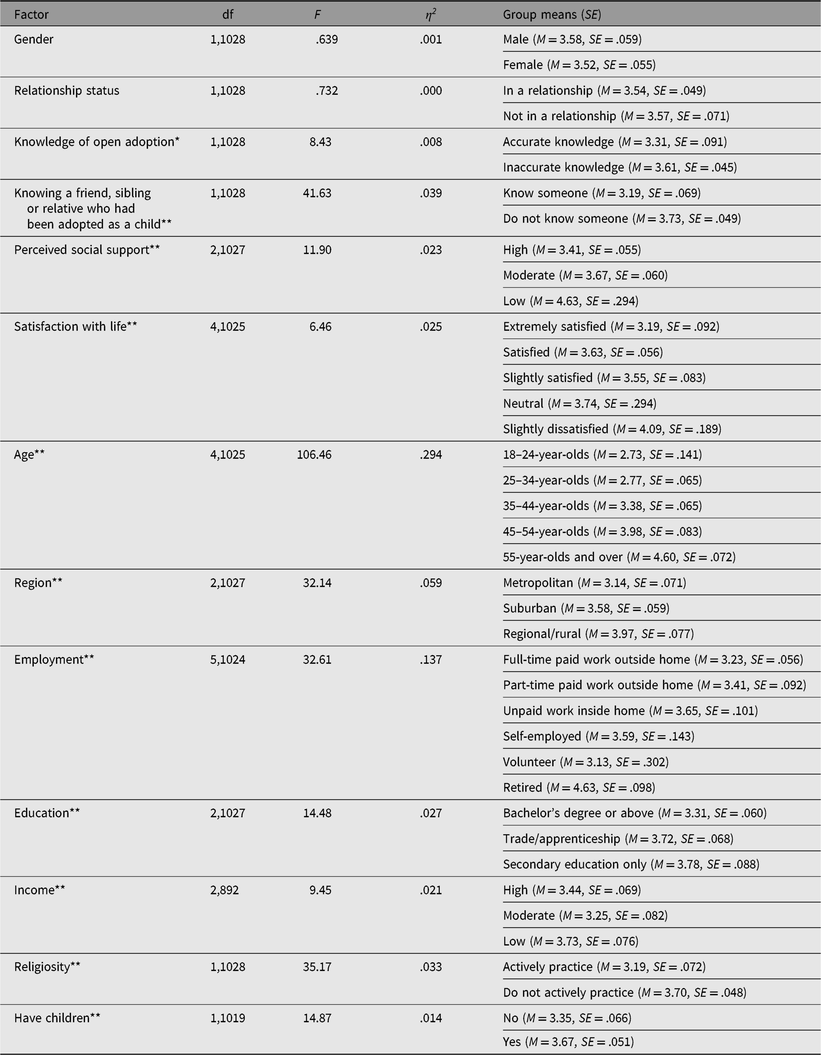
In exploring the link between likelihood of considering adoption and these variables, General Linear Model univariate analyses were conducted with likelihood of considering adoption as the dependent variable and knowledge of open adoption, perceived social support, satisfaction with life or each demographic variable as the independent variable. Analyses revealed that there were no significant effects for gender and marital status. However, significant effects were found for the other variables. Bonferroni-corrected post-hoc comparisons were conducted to further examine these effects, as summarised in Table 2.
Results of General Linear Model univariate analyses for factors associated with likelihood of considering adoption

Significant differences between groups at *p < .01 and **p < .001. Lower scores indicate higher likelihood of considering adopting a child now or in the future.
To summarise, likelihood of considering adoption was higher among respondents who could correctly define open adoption and knew someone who had been adopted as a child. Respondents were more likely to consider adopting if they had a high level of social support than moderate or low levels of social support, and more likely if they had a moderate level of social support than a low level. For satisfaction with life, respondents who were extremely satisfied with their life were more likely to consider adopting a child than those who were satisfied, slightly satisfied or slightly dissatisfied with their life.
There was a clear trend with respect to age, with older respondents less likely to consider adopting when compared with their younger counterparts. For example, respondents who were aged 55 years and over were less likely to consider adopting when compared to 45–54-year-olds, 35–44-year-olds, 25–34-year-olds and 18–24-year-olds. Similarly, 45–54-year-olds were less likely to consider adopting than younger age groups, and the same pattern was observed for 35–44-year-olds. The two youngest age groups, 18–24 and 25–34-year-olds did not differ significantly from each other in motivation to adopt.
Respondents living in metropolitan areas were more likely to consider adopting a child than those who lived in suburban or regional areas, and those living in suburban areas were more likely to consider adopting than those who lived in regional areas. In relation to form of employment, retired respondents were significantly less likely to consider adopting when compared to all other forms of employment status (i.e., full-time paid work outside home, part-time paid work outside home, unpaid work inside home, self-employed and volunteer work). Furthermore, those in full-time paid work outside home were more likely to consider adopting than those who did unpaid work inside the home.
Education, income and having own children also had an effect. Respondents who held a Bachelor’s degree or above were more likely to consider adopting than those who had completed a trade/apprenticeship or who had completed secondary education only. Respondents with low income were less likely to consider adopting a child than those who had moderate or high income classified as high or moderate. In addition, respondents who did not have children were more likely to consider adopting than those who had children.
Finally, respondents who actively practice a religion were more likely to consider adopting a child than those who did not. Further analyses revealed that there were differences by denomination: F(6, 306) = 4.55, p < .001, η 2 = .082, with those who actively practiced Christianity (M = 3.41, SE = .089) being more likely to consider adoption than those who actively practiced Hinduism (M = 2.52, SE = .236) or Islam (M = 2.48, SE = .244). However, such results should be interpreted with caution due to small sample sizes (e.g., between 3 and 30 respondents for denominations other than Christianity).
As a final analysis, the unique contribution of respondents’ knowledge of open adoption, knowing someone who had been adopted, perceived overall social support and satisfaction with life, as well as the demographics variables included above, on respondents’ likelihood of considering adoption was examined. A stepwise regression was conducted to identify the subset of variables that best predicted respondents’ adoption consideration. In this procedure, the predictor with the smallest probability of F is first entered if the value is smaller than .05 (i.e., the strongest predictor). As the next strongest predictors are added, previously entered predictors may no longer remain significant. At each step, all variables in the model are again examined and previously entered predictors are removed if their p-value is greater than .1. The process continues until no predictors in the equation can be removed and none of the excluded variables fulfill the requirement for entry into the model (Keith, Reference Keith2006; Meyers, Gamst, & Guarino, Reference Meyers, Gamst and Guarino2006).
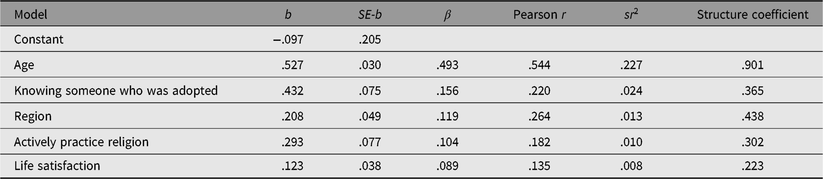
The prediction model contained five predictors and was reached in five steps with no variables removed. The model was statistically significant, F(5, 886) = 101.63, p < .001, and accounted for approximately 36% of the variance of likelihood of considering adoption (R 2 = .364, adjusted R 2 = .361). Likelihood of considering adoption was primarily predicted by younger age, knowing someone who had been adopted as a child, actively practicing religion, living in the city and higher life satisfaction. Table 3 details the regression coefficients, associated correlations and structure coefficients of the predictors (Courville & Thompson, Reference Courville and Thompson2001). Age had the strongest weight in the model followed by knowing someone who had been adopted as a child, and region, while religious practice and life satisfaction received the lowest weights. The unique variance accounted for by each of the predictors, as indicated by the squared semi-partial correlations, was highest for age at 23%, whereas it was 2% for knowing someone who was adopted, 1% for region and less than 1% for religion and life satisfaction. From examining the structure coefficients, it appears that age is a strong predictor and region is a moderate indicator of likelihood of considering adoption.
Regression coefficients, correlations and structure coefficients of predictors in the stepwise regression

The dependent variable was the likelihood of considering adoption. R 2 = .364, adjusted R 2 = .361. sr 2 is the squared semi-partial correlation.
Discussion
The aim of this study was to understand the facilitators and barriers to adoption from out-of-home care in NSW and to identify the characteristics of people who are more likely to adopt. Findings highlighted three key points which warrant further discussion. The first relates to educating the general population, which has a poor understanding of open adoption. Few people are aware that adopted children are likely to still have contact with their birth families. There is also a misconception that children adopted from out-of-home care can be restored to their birth parents. Providing accurate information about the realities of open adoption would be valuable in educating the general population about this relatively new and unknown concept. For example, the fear of losing the child to their birth parents has been identified as a key barrier to people becoming foster carers, and so this misconception is also likely to prevent people from becoming adoptive parents (Randle et al., Reference Randle, Miller, Dolnicar and Ciarrochi2014).
The specific concerns identified in the present study regarding adoption from out-of-home care are consistent with existing literature (e.g., Dave Thomas Foundation for Adoption, 2013). There were concerns about children’s difficult behaviours, whether they would be accepted by the child, as well as the impact the adoption would have on finances and the existing family. These concerns are indicative of a public perception that children in foster care are, in some way, troubled or damaged (Adopt Change, 2015). Given these findings, marketing strategies would need to address these specific concerns by providing reliable information about the diverse range of children who end up in foster care and the reasons why they are in foster care, together with the benefits of adopting a child from foster care both for the child and their adoptive parents.
The second finding worthy of discussion relates to systematic changes that would make the prospect of adoption more appealing to people. While some key barriers to adopting cannot be controlled or reduced, others could potentially be addressed through changes to policy and administrative procedures. Perhaps the most difficult barrier to overcome relates to the segment of the population that has never thought about adoption in the past and would not consider it in the future. This result supports a 2015 survey conducted by Adopt Change which showed that between 60% and 75% of Australians are unlikely to consider adopting in the future. The fact that this ‘non-interested’ segment exists in the population supports the use of targeted communications campaigns that avoid wasting resources on this group who would never consider adopting. Broad-brush marketing campaigns aimed at reaching the entire population, including the ‘not interested’ group, effectively waste resources on this half of the population.
However, other systematic factors can be changed. For example, the current system is perceived to provide inadequate support for adoptive parents, especially compared to foster carers, as indicated in the findings of focus groups conducted with NSW foster carers regarding their motivation to adopt the children in their care (Luu et al., Reference Luu, Collings, Wright, Pope and Spencer2018). Specifically, there can be substantial disadvantages to people transitioning from being foster carers to adoptive parents, including the loss of financial support, ongoing caseworker support, access to training and specialists, and assistance with managing birth family contact. These disadvantages could be seen to outweigh the benefits of adopting from out-of-home care (which include autonomy of decision-making for the child and legal permanence).
As of July 2017, adoptive parents in NSW are eligible to receive: (1) an out-of-home care Adoption Annual Payment, a yearly payment of $1500 paid to the adoptive parents from the time the final adoption order is made to the time the child turns 18; (2) an Adoption Transition Support Payment, a one-off payment of $3000 paid in the first year, intended to further help families with costs likely to arise in the first years after the adoption and (3) an out-of-home care Adoption Allowance, a fortnightly payment based on the child’s age and subject to the adoptive family’s eligibility for Family Tax Benefit Part A (i.e., means-tested; NSW Family and Community Services, 2018). While there should be efforts to ensure the public is informed about the financial supports available to adoptive parents, there is also a need for policy changes that reflect the need for non-financial post-adoption supports.
To adopt a child from out-of-home care in NSW, the adoptive parent(s) must first be the authorised long-term carer(s) of the child. It is not uncommon for carers to start out in respite or emergency roles, which involve a relatively low-level commitment, before becoming short-term and, finally, long-term foster carers. It may be that the pathway to adoption follows a similarly stepped approach, in which an individual starts as a foster carer and then transitions to an adoptive parent. The transition may be a result of the carers’ increased confidence in their own parenting skills and abilities, or experiencing the rewards of being a foster carer which are intrinsic and often difficult to describe to new carers until they have experienced it for themselves. It would be important to communicate this stepped approach, and the gradual increase in commitment, to potential carers and adoptive parents so they know the full range of options and understand that there is flexibility to have as much or as little commitment as they are comfortable with. This would give potential carers and adoptive parents assurance that they have autonomy over their caring journey, which has been highlighted as a key concern of potential foster carers (Randle et al., Reference Randle, Miller, Dolnicar and Ciarrochi2014) and was also revealed as a concern of participants in the present study.
The third point for discussion relates to the distinctive characteristics of people who would consider adopting a child, and the need for customised marketing campaigns to reach them. Age was a predictor of likelihood of considering adoption, with younger people more likely to consider adopting than older people. Other factors associated with higher consideration of adoption included having knowledge of open adoption or knowing someone who had been adopted, greater social support and life satisfaction, higher education, higher income, being in full-time paid-employment, living in urban-city regions, actively practicing a religion and not currently having any children of their own. Segments of the population that have distinctive characteristics make them suitable for customised target marketing campaigns. Knowing that those likely to consider adopting are younger, employed and have a religious affiliation means that communicating messages through professional publications, through religious groups or at venues likely to be attended by younger people (e.g., adult sporting clubs) have a higher chance of reaching people with these attributes. Knowing they have higher levels of social support and higher life satisfaction means that these messages can also be incorporated into targeted marketing campaigns such that they attract the attention of people who also share these psychological and social characteristics.
Limitations and future research
While attempts were made to find a sample representative of the NSW population in age and gender, it is important to note that the study is limited by selection bias. For example, nearly half of the sample held at least a Bachelor’s degree and were in full-time employment outside of their home. On the other hand, the census findings from the Australian Bureau of Statistics (2017, 2018) indicate that more people are in full-time employment (64%) and fewer people have a minimum educational level of Bachelor’s degree (27%) in NSW. Despite this, however, it is apparent that even among a relatively well-educated sample, understanding of open adoption is still quite low. Another limitation of the study is that the survey omitted questions about the cultural background of respondents. The NSW Adoption Act notes that, in determining whether an adoption should be made for a child, prospective adoptive parent(s) must demonstrate a capacity and willingness to support the child to develop a healthy and positive cultural identity. Given the multicultural nature of the Australian population and the requirement for prospective adoptive parents to maintain children’s links to their heritage, future studies can explore motivation to adopt within different cultural groups.
The findings of the current study suggest several other avenues for further research. For example, future studies can examine the differential recruitment of carers and better understand the kinds of people who may be interested in different forms of care (e.g., emergency, short-term, or long-term care and prospective adoptive parents). Moreover, research is needed to identify effective marketing messages that will appeal to those who are interested in adopting from out-of-home care. In addition, future research can follow those who apply to become prospective adoptive parents to explore the factors that influence their decisions to continue or terminate the adoption process.
In conclusion, adoption from out-of-home care is a relatively new practice in Australia and is predominately used in NSW. Increased numbers of children entering and remaining in care over the last decade suggest the need for stable, permanent forms of care, including open adoption. The findings of this study strongly suggest that the general public lacks knowledge about current adoption practices, the application process and the availability of post-adoption support. Public education and targeted messaging may encourage greater interest in open adoption from out-of-home care, by clarifying the process of adoption and the availability of financial support for adoptive parents. Policy should also ensure adoptive parents receive adequate non-financial post-adoption supports when they adopt a child from out-of-home care.
Acknowledgements
The authors would like to thank Suzanne Pope for providing technical support for the implementation of the survey. This research was funded as part of a grant from the New South Wales government. We acknowledge that this manuscript is an original work that has not been submitted to nor published anywhere else.
Conflicts of interest
None.