In an ambitious treatment of gender differences in expressive behaviors, Vigil's target article outlines a two-dimensional model of social relationships according to which people evaluate their relationships on two fundamental dimensions: trustworthiness and capacity. These dimensions are related to inferring the intentions (e.g., potential harm) and the ability of the relationship partner to implement these intentions (e.g., means to inflict harm). This model converges with a number of dimensional models that have been empirically derived from the study of specific domains of social perception. These include Wiggins's model of interpersonal perception (Wiggins Reference Wiggins1979; Wiggins et al. Reference Wiggins, Philips and Trapnell1989), Fiske's model of inter-group perception (Fiske et al. Reference Fiske, Cuddy and Glick2007), and Todorov's model of evaluation of faces on social dimensions (Oosterhof & Todorov Reference Oosterhof and Todorov2008; Todorov et al. Reference Todorov, Said, Engell and Oosterhof2008).
All these models use a similar data-driven approach. Groups, people, or faces are initially characterized on a number of specific attributes (e.g., trustworthiness, competence, aggressiveness), and then the judgments on these attributes are submitted to statistical analyses that identify and model the common variance among these judgments. The final objective is to identify a simple model that accounts for most of the variance in these judgments and, ultimately, provide an explanatory framework for the domain of study. Using this approach, Fiske et al. (Reference Fiske, Cuddy and Glick2007) have argued that the primary dimensions of perceiving social groups are warmth and competence and that these dimensions are related to competition and status. Wiggins et al. (Reference Wiggins, Philips and Trapnell1989) have argued that the primary dimensions of perceiving other people are affiliation and dominance. Todorov et al. (Reference Todorov, Said, Engell and Oosterhof2008) have argued that the primary dimensions of evaluating faces are valence/trustworthiness and power/dominance.
I use our own approach to illustrate the data-driven character of these methods. To outline the structure of perception of faces on social dimensions (Oosterhof & Todorov Reference Oosterhof and Todorov2008; Todorov et al. Reference Todorov, Said, Engell and Oosterhof2008), we first identified trait attributes that are spontaneously used to characterize unfamiliar faces. Then, we asked participants to rate faces on these attributes. Not surprisingly, judgments of these attributes were highly correlated with each other. In fact, it is almost impossible to find a social judgment that is uncorrelated with judgments of trustworthiness. A Principal Component Analysis of the trait judgments identified a simple two-dimensional solution that accounted for more than 80% of the variance of these judgments. The first dimension was interpreted as valence evaluation of faces and the second dimension as dominance evaluation. Trustworthiness judgments were the best approximation of valence evaluation, and dominance judgments were the best approximation of power evaluation.
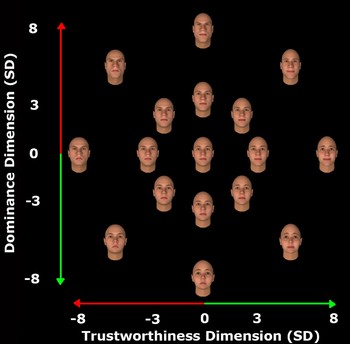
Computer modeling of judgments of trustworthiness and dominance showed that whereas cues signaling correspondent approach/avoidance behaviors were important for the valence/trustworthiness dimension, cues signaling physical strength were important for the power/dominance evaluation. As shown in Figure 1, whereas faces on the extreme positive end of the trustworthiness dimension were perceived as happy and slightly surprised, faces on the extreme negative end were perceived as angry. Whereas extremely dominant faces were perceived as extremely masculine and mature faced, extremely submissive faces were perceived as extremely feminine and baby-faced (Fig. 1).
A data-driven computer model of variation of faces on the dimensions of valence/trustworthiness depicted on the x-axis and power/dominance depicted on y-axis. The variation of faces is in standard deviation units. The details of the modeling are described in Oosterhof and Todorov (Reference Oosterhof and Todorov2008).

These findings converge nicely with the model proposed by Vigil: that relationship partners are evaluated on trustworthiness and capacity; that is, intentions and the ability to implement these intentions. Moreover, given the commonalities between these dimensions and the dimensions in the models of Fiske et al. (Reference Fiske, Cuddy and Glick2007) and Wiggins et al. (Reference Wiggins, Philips and Trapnell1989), models that were empirically derived in different domains of social perception, it may be argued that these dimensions are universal dimensions of social perception (Fiske et al. Reference Fiske, Cuddy and Glick2007).
Yet, although these models can provide a powerful explanatory framework for a set of phenomena, their parsimony can come with a price. Specifically, these models may be insufficient to explain and predict social behaviors in specific contexts. In the data-driven methods, the general approach is to model common variance and discard variance that is unique to the specific input variables (e.g., non-error variance that is specific for trustworthiness per se and is not shared with general valence evaluation of faces). While this approach is justified to the extent that the objective is to arrive at a general framework that can account for a variety of specific effects, it may miss important effects that are not easily attributable to common variance. For example, perceptions of trustworthiness and dominance are sufficient to account for perceptions of threat (Oosterhof & Todorov Reference Oosterhof and Todorov2008) but not perceptions of competence. In decision contexts (e.g., voting) where competence is the primary dimension of evaluation, cues specific to competence, and not trustworthiness or dominance, predict social decisions (Olivola & Todorov, in press; Todorov et al. Reference Todorov, Mandisodza, Goren and Hall2005). The weight of attributes or importance of dimensions can also change as a function of the specific context. Whereas masculine-looking leaders, with the associated perceptions of leadership and dominance, are preferred in wartime, feminine-looking leaders, with the associated perceptions of trustworthiness and likeability, are preferred in peacetime (Little et al. Reference Little, Burriss, Jones and Roberts2007).
To what extent the socio-relational framework of expressive behaviors (SRFB) model would sacrifice specificity of prediction is an empirical question. As a general descriptive framework, this model is certainly supported by independent evidence from other dimensional approaches to social perception. Moreover, as outlined by Vigil, the descriptive framework of the model can be best understood in the context of social interaction. That is, displays of social cues are in the service of social interaction.