INTRODUCTION
Congenital heart disease (CHD) is the most common birth defect worldwide, affecting approximately 1% of live births (Hoffman & Kaplan, Reference Hoffman and Kaplan2002; Reller et al., Reference Reller, Strickland, Riehle-Colarusso, Mahle and Correa2008; Van Der Linde et al., Reference Van Der Linde, Konings, Slager, Witsenburg, Helbing, Takkenberg and Roos-Hesselink2011). Approximately one-quarter of individuals with CHD are born with a critical form that requires intensive medical/surgical intervention (Oster et al., Reference Oster, Lee, Honein, Riehle-Colarusso, Shin and Correa2013). Fortunately, improvements in early detection and medical and surgical treatment strategies have allowed many of those with even the most severe forms of CHD to survive well into adulthood (Spector et al., Reference Spector, Menk, Knight, McCracken, Thomas, Vinocur and Kochilas2018; Warnes et al., Reference Warnes, Liberthson, Danielson, Dore, Harris, Hoffman and Webb2001). Therefore, it has become increasingly important to understand the determinants of their quality of life and longer range functional outcomes (Wilson et al., Reference Wilson, Smith-Parrish, Marino and Kovacs2015). In the present study, we evaluated the developmental significance of Rey–Osterrieth Complex Figure (ROCF) performance assessed in childhood for academic outcomes assessed in adolescence in a large sample of children born with dextro-transposition of the great arteries (d-TGA) who participated in the Boston Circulatory Arrest Study (BCAS). Participants in the BCAS were treated surgically early in life and followed longitudinally from birth through adolescence for both medical and developmental/neuropsychological outcomes (Bellinger, Rappaport, Wypij, Wernovsky, & Newburger, Reference Bellinger, Rappaport, Wypij, Wernovsky and Newburger1997; Bellinger et al., Reference Bellinger, Jonas, Rappaport, Wypij, Wernovsky, Kuban and Strand1995, Reference Bellinger, Wypij, Kuban, Rappaport, Hickey, Wernovsky and Newburger1999, Reference Bellinger, Wypij, DuPlessis, Rappaport, Jonas, Wernovsky and Newburger2003, Reference Bellinger, Wypij, Rivkin, DeMaso, Robertson, Dunbar-Masterson and Newburger2011; Newburger et al., Reference Newburger, Jonas, Wernovsky, Wypij, Hickey, Kuban and Ware1993).
D-TGA is a form of critical CHD in which the pulmonary artery and aorta are transposed or switched and must be surgically repaired early in life, most often with the arterial switch operation. D-TGA provides an excellent model for studying cardiac neurodevelopmental outcomes because of low rates of genetic disorders and usually definitive surgical repair within the first weeks of life. However, despite this fairly straightforward early medical/surgical course, neurological and neuropsychological risks threaten both short- and longer range quality of life among individuals with d-TGA. Decreased total brain volume and abnormalities in neuronal/axonal health have been documented in this population as early as the third prenatal trimester (Limperopoulos et al., Reference Limperopoulos, Tworetzky, McElhinney, Newburger, Brown, Robertson and du Plessis2010) and related to decreased fetal cerebral oxygen delivery (Sun et al., Reference Sun, Macgowan, Sled, Yoo, Manlhiot, Porayette and Seed2015). At birth, brain maturation among full-term newborns with d-TGA more closely resembles that of preterm infants born at 36 weeks gestation (Licht et al., Reference Licht, Shera, Clancy, Wernovsky, Montenegro, Nicolson and Vossough2009); and persisting atypicalities in neural structure and neural network typology have been reported throughout childhood and adolescence (Rivkin et al., Reference Rivkin, Watson, Scoppettuolo, Wypij, Vajapeyam, Bellinger and Newburger2013; Rollins et al., Reference Rollins, Watson, Asaro, Wypij, Vajapeyam, Bellinger and Rivkin2014; Schmithorst et al., Reference Schmithorst, Panigrahy, Gaynor, Watson, Lee, Bellinger and Newburger2016; Watson et al., Reference Watson, Asaro, Wypij, Robertson, Newburger and Rivkin2016, Reference Watson, Stopp, Newburger and Rivkin2018).
In the context of these prominent neurological abnormalities, mounting research attests to the far-reaching neurobehavioral and psychosocial risks associated with d-TGA as well. In addition to deficits involving attention, executive function, and social cognition skills development (Calderon et al., Reference Calderon, Bonnet, Courtin, Concordet, Plumet and Angeard2010, Reference Calderon, Jambaqué and Bonnet2014; Cassidy et al., Reference Cassidy, White, DeMaso, Newburger and Bellinger2015), as well as increased risk for Attention-Deficit Hyperactivity Disorder (DeMaso et al., Reference DeMaso, Labella, Taylor, Forbes, Stopp, Bellinger and Newburger2014), weaknesses in aspects of complex visual-spatial processing are also commonly reported in children with critical CHD (Cassidy et al., Reference Cassidy, Ilardi, Bowen, Hampton, Heinrich, Loman and Wolfe2018), including in several studies from our group (Bean Jaworski et al., Reference Bean Jaworski, White, DeMaso, Newburger, Bellinger and Cassidy2017; Bellinger, Bernstein, et al., Reference Bellinger, Bernstein, Kirkwood, Rappaport and Newburger2003). Looking specifically at findings from the BCAS, at 8 years of age, children completed the copy and recall conditions of the ROCF, which was scored using the Developmental Scoring System (Bernstein & Waber, Reference Bernstein and Waber1996). As a group, these children demonstrated marked difficulties with this task. Moreover, poor performance was associated with poorer concurrent math (but not reading) skills as well as a greater need for academic support services (Bellinger, Bernstein, et al., Reference Bellinger, Bernstein, Kirkwood, Rappaport and Newburger2003). This finding is consistent with studies that document associations between executive function and mathematics skills (e.g., Allan, Hume, Allan, Farrington, & Lonigan, Reference Allan, Hume, Allan, Farrington and Lonigan2014; Bull & Lee, Reference Bull and Lee2014; Miller & Hinshaw, Reference Miller and Hinshaw2010), and those documenting similar associations between visual-spatial processing abilities and mathematics skills (Xie et al., Reference Xie, Zhang, Chen and Xin2019).
When these same individuals were 16 years of age, they again completed the ROCF and concurrently completed measures of academic achievement (Bellinger et al., Reference Bellinger, Wypij, Rivkin, DeMaso, Robertson, Dunbar-Masterson and Newburger2011). Bean Jaworski et al. (Reference Bean Jaworski, White, DeMaso, Newburger, Bellinger and Cassidy2018) examined the relationship of ROCF performance with academic outcomes at this time point. In this study, they applied Dennis et al.’s (Reference Dennis, Landry, Barnes and Fletcher2006) conceptualization of academic outcomes in terms of complexity: lower order, discrete/associative skills (i.e., single-word reading, phonetic decoding, and math calculation) versus higher-order and assembled skills (i.e., reading comprehension, applied math problem-solving). This model captures an important distinction that may be especially relevant with regards to any relationship between the ROCF and academic skill development. Indeed, whereas visual-spatial organization was associated with both lower- and higher-order academic outcomes, visual-spatial integration (i.e., “Style;” the degree to which connections and relationships between visual-spatial elements are appreciated) accounted for unique variance in predicting higher-order, assembled academic competencies (Bean Jaworski et al., Reference Bean Jaworski, White, DeMaso, Newburger, Bellinger and Cassidy2018).
Thus, findings to date from children/adolescents with d-TGA have highlighted concurrent associations between (a) the ability to perceive, organize, and reproduce complex visual-spatial information in an integrated way and (b) the ability to master age-appropriate academic skills and concepts at two developmental time points. It is reasonable to inquire, therefore, to what extent childhood complex visual-spatial problem-solving abilities as measured by the ROCF predict academic performance during adolescence in this well-characterized sample of children/adolescents with d-TGA. We hypothesized that ROCF Organization and Style, assessed at 8 years of age, predict academic outcomes in adolescence, and that children whose productions were both disorganized and part-oriented at the age of 8 are at the greatest risk for academic deficits during adolescence. We further predicted that while 8-year Organization is associated with all adolescent academic composites, 8-year Style (i.e., integration) accounts for unique variance in higher order (Assembled) academic outcomes.
METHODS
Current Sample and Procedures
Data for this study were drawn from the 8-year (Bellinger, Wypij, et al., Reference Bellinger, Wypij, DuPlessis, Rappaport, Jonas, Wernovsky and Newburger2003) and 16-year (Bellinger et al., Reference Bellinger, Wypij, Rivkin, DeMaso, Robertson, Dunbar-Masterson and Newburger2011) time points of the BCAS. Briefly, the BCAS was a prospective randomized trial investigating longitudinal outcomes of infants diagnosed with d-TGA who underwent the arterial switch operation by 3 months of age after being randomized to receive, as the method of vital organ support during the arterial switch operation, either predominant deep hypothermic circulatory arrest or predominant low-flow bypass during surgery. Infants with birth weight less than 2.5 kg, a recognized genetic syndrome, an extracardiac anomaly of greater than minor severity, prior heart surgery, or cardiovasculature requiring reconstruction of the aortic arch or other open-heart surgical procedures were excluded during initial recruitment. Participants were invited to return at 1-, 4-, 8-, and 16 years of age for follow-up evaluations consisting of medical examination, imaging studies, psychiatric evaluation, and neuropsychological assessment.
The arterial switch operation was performed in 171 infants. Of these, 165 were alive at 8 years of age. Five children (3%) were living outside the United States of America and were considered ineligible. Of the remaining 160 children, parents of 155 (97%) agreed to participate in the evaluation at the 8-year point (Bellinger et al., Reference Bellinger, Wypij, DuPlessis, Rappaport, Jonas, Wernovsky and Newburger2003). At the 16-year point, of the 165 known to be alive, 6 lived outside North America. Of the remaining 159 children, 16 (10%) declined or were unable to return in the study period and 4 (3%) were lost to follow-up. The remaining 139 (87%) returned, at a mean (SD) age of 16.1 (0.5) years. At that time, no child had received a diagnosis of a genetic abnormality since enrollment (Bellinger et al., Reference Bellinger, Wypij, Rivkin, DeMaso, Robertson, Dunbar-Masterson and Newburger2011). The neuropsychological assessment completed at the 8- and 16-year time points involved a fixed battery of tasks administered by a licensed psychologist or supervised research assistant. The battery took approximately 4 h to complete, with rest breaks provided for participants as needed.
This study was approved by the Institutional Review Board of Boston Children’s Hospital and conducted in accordance with the Helsinki Declaration.
Design
The design of the present study was longitudinal, with a focus on the extent to which ROCF performance at 8 years of age-predicted academic performance at 16 years. However, ROCF performance at 8 years predicted academic performance at 8 years, which in turn is likely to predict academic performance at 16 years. We, therefore, examined the longitudinal association, adjusting for 8-year academic scores, to determine to what extent 8-year ROCF performance predicts growth in academic scores over and above academic scores at 8 years. Finally, given the well-known association between socioeconomic status (SES) and academic achievement (Farah, Reference Farah2017; Sirin, Reference Sirin2005), we included an indicator of SES in all models.
Measures
Complex visual-spatial problem-solving
Complex visual-spatial problem-solving at 8 years was evaluated with ROCF (Osterrieth, Reference Osterrieth1944). Clinically rich, the ROCF is a sensitive, but nonspecific measure of cognition that requires a child to mobilize and integrate a range of domain-general and domain-specific functions to complete the task in an accurate and well-organized manner. Domain-general functions include those usually categorized as executive, including focus and concentration, integration of complex multimodal information, reasoning, problem-solving, and organization. Domain-specific visual-spatial functions relevant to ROCF performance include the activity of early developing pre-semantic perceptual processes that represent elemental features of visual patterns (see, e.g., Tulving & Schacter, Reference Tulving and Schacter1990). The quality of perceptual information influences subsequent conceptual processing and sensory-motor integration. As noted above, children with d-TGA commonly evidence neurobehavioral profiles that point to atypical development of these very systems (Cassidy et al., Reference Cassidy, Ilardi, Bowen, Hampton, Heinrich, Loman and Wolfe2018). Less is known, however, about the longer term functional significance of the likely combination of visual-spatial weaknesses operating in concert with higher order executive skills that are themselves vulnerable to disruption by complex medical conditions. The ROCF samples from among these diverse abilities, which are known to develop over time within the child, become more relevant with age to the tasks required of the child by their environment, and be associated with functional outcomes that matter for other groups of children with neurodevelopmental disorders (e.g., Miller & Hinshaw, Reference Miller and Hinshaw2010). The ROCF was, therefore, selected for inclusion in current analyses.
We evaluated participants’ performance on the ROCF with the Developmental Scoring System for the Rey–Osterrieth Complex Figure (DSS-ROCF; Bernstein & Waber, Reference Bernstein and Waber1996). The DSS-ROCF evaluates a child’s copy and subsequent reproductions of the complex figure in terms of Organization, Style, and Accuracy. This study analyzed the Organization score and Style rating from the Copy trial. The Organization score reflects the precision with which a child was able to reproduce the various intersections and alignments of figure elements. Organization scores range from 1 to 13, with higher numbers reflecting higher levels of figural organization. For our analyses, participants were grouped as “organized” or “disorganized” using a median split procedure.
Style ratings reflect the approach of the child, specifically the degree of integration applied to the ROCF task, which was classified as part-oriented, intermediate, or configurational. A part-oriented style indicates that the child did not appreciate the broader organizing structures and focused, instead, on the component details when drawing the figure. A configurational style indicates that the child appreciated the broader organizing structures and patterned their reproductions with this understanding in mind; they may or may not have effectively integrated the finer details. An intermediate style of reproduction captures a quality of performance that is somewhere between a part-oriented or configurational approach to the task. Because we aimed to distinguish part orientation from relatively more configurational approaches, intermediate and configurational styles were collapsed into a holistic category.
Academic achievement
Academic achievement was assessed at 16 years with the Word Reading, Reading Comprehension, Numerical Operations, and Math Reasoning subtests from the Wechsler Individual Achievement Test, Second Edition (WIAT-II; Psychological Corp., 2002). Age-referenced standard scores were included in analyses.
Academic achievement scores were combined to yield four composite scores. Word Reading and Reading Comprehension scores were averaged to create a Reading composite score; Numerical Operations and Math Reasoning scores were averaged to create a Math composite score. Word Reading and Numerical Operations scores were averaged to create an Associative (relatively basic, rote) composite; Reading Comprehension and Math Reasoning scores were averaged to create an Assembled (higher-order) composite.
Socioeconomic status
Parental SES was defined using the Hollingshead Four-Factor Index of Socioeconomic Status (Hollingshead, Reference Hollingshead1975), a widely used tool that operationalizes SES as a total score summing ratings of marital status, retired/employed status, parent education, and type of parent employment.
General cognitive ability
Eight-year intelligence quotient (IQ) was assessed using the Full-Scale IQ score from the Wechsler Intelligence Scale for Children, Third Edition (Wechsler, Reference Wechsler1991).
Statistical Analysis
IBM SPSS Statistics Version 24 was used for data analyses. Descriptive statistics were computed to characterize the demographics of the sample, as well as demographics of subgroups created on the basis of ROCF-DSS performance (Organized vs. Disorganized). Two-way univariate analyses of covariance (ANCOVAs) were conducted to examine the associations between childhood complex visual-spatial processing abilities (ROCF-DSS Organization × Style) and academic achievement outcomes in adolescence. An additional set of ANCOVA models was conducted adjusting for 8-year academic scores to examine growth/change in academic abilities between 8 and 16 years. In addition, binary logistic regression analyses were used to estimate the odds of earning a score in the impaired range on academic tasks. For purposes of these analyses, academic scores were dichotomized such that scores >1.5 SD below the mean were denoted as “impaired.”
Given well-established associations between SES and academic outcomes, 8-year SES was included as a covariate in all ANCOVA analyses. In line with recommendations from Dennis and colleagues (Reference Dennis, Francis, Cirino, Schachar, Barnes and Fletcher2009), IQ was not included as a covariate in this study. However, descriptive statistics for IQ are reported in Table 1.
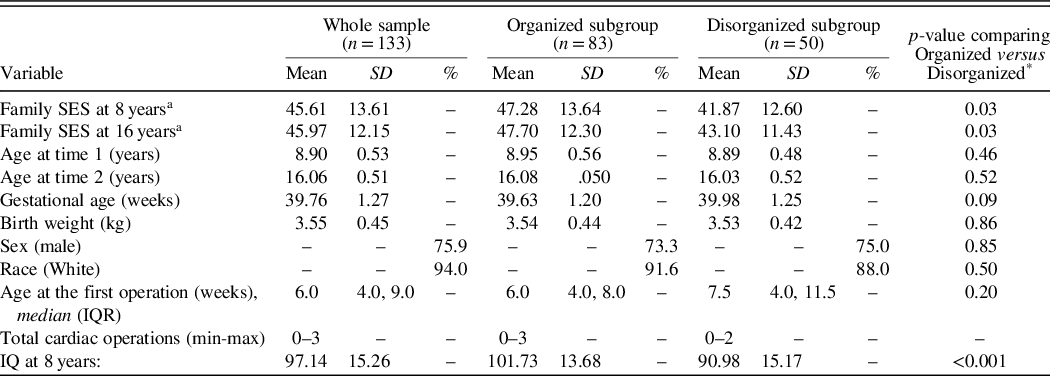
Sociodemographic and medical/surgical characteristics, and academic achievement outcomes for the whole sample and by Organization subgroup

SES = socioeconomic status.
a Hollingshead (Reference Hollingshead1975). Four-factor index of social status. Unpublished manuscript, Yale University, New Haven, CT, USA.
* Determined by one-way analysis of variance test for continuous variables, Kruskal–Wallis test for age at the first operation, and Pearson’s chi-square test for categorical variables.
Results
Participants
A total of 133 youth with d-TGA had complete data and were included in the analyses. Demographic, IQ, and medical/surgical characteristics are displayed in Table 1 for the sample as a whole and by Organization subgroup (Organized vs. Disorganized). Participants classified as Organized came from higher SES backgrounds at 8 years, F(1, 131) = 5.00, p = .03, and 16 years of age, F(1, 131) = 4.60, p = .03, and had lower Full-Scale IQ scores at 8 years, F(1, 131) = 15.39, p < .001, than those participants who were classified as Disorganized. Demographic and medical/surgical characteristics were otherwise similar across subgroups.
Associations Between Childhood Complex Visual-Spatial Problem-Solving and Adolescent Academic Achievement
Mean academic composite scores and ANCOVA results are shown in Table 2. The interaction of Organization × Style was not statistically significant, nor was the main effect of Style on academic scores. There were significant main effects of Organization. Better Organization at 8 years of age was associated with higher scores at 16 years of age for Reading, Math, Associative, and Assembled academic skills.
Means, standard deviations, one-way analysis of covariance, and effect sizes for academic achievement outcomes for the whole sample and by Organization subgroup

ηp 2 = partial eta squared.
*p < .05, **p ≤ .01.
aDetermined by one-way analysis of covariance test, controlling for 8-year family SES.
The logistic regression analyses further indicated that children whose ROCF performance at the age of 8 was classified as Disorganized were 3–4 times more likely to have 16-year scores in the impaired range on Math, OR = 3.3, p = .053, 95% CI [1.0–10.8], the Associative composite, OR = 4.2, p = .013, 95% CI [1.4–13.2], and the Assembled composite, OR = 3.7, p = .051, 95% CI [1.0–13.8], controlling for SES. The odds of impairment for Reading were also greater among Disorganized participants; however, this was not statistically significant, OR = 2.8, p = .096, 95% CI [0.8–9.6].
Associations Between Childhood Complex Visual-Spatial Problem-Solving and Growth/Change in Academic Achievement over Time
In these ANCOVAs, 8-year academic achievement scores were added in as covariates, effectively modeling predictive associations between childhood complex visual-spatial problem-solving and growth/change in academic skills over 8 years, from childhood to adolescence. Eight-year visual-spatial processing skills were not predictive of change over time in math, F(1, 127) = .08, p = .78, ηp 2 = .001, associative, F(1, 127) = 1.73, p = .19, ηp 2 = .01, and assembled, F(1, 127) = 1.08, p = .30, ηp 2 = .01, academic outcomes. There was, however, an unexpected and small but statistically significant Organization × Style interaction effect for Reading, F(1, 127) = 4.65, p = .03, ηp 2 = .04. Simple effects analyses, run separately by Style category, showed a marginally significant main effect of Organization on growth/change in reading among children characterized as Holistic, F(1, 59) = 3.94, p = .052, ηp 2 = .06, with the small subgroup of children whose productions were categorized as Disorganized/Holistic (n = 11; M = 92.8) scoring lower on the 16-year Reading composite than those whose productions were Organized/Holistic (n = 52; M = 99.9). Sixteen-year Reading composite scores were comparable for Disorganized/Part-oriented (n = 39; M = 97.7) and Organized/Part-oriented (n = 31; M = 96.2) subgroups, F(1, 66) = .45, p = .51, ηp 2 = .007. We also examined 16-year Reading composite subtests (i.e., Word Reading and Reading Comprehension) in separate models, each controlling for analogous 8-year reading subtests. No significant interaction or main effects of complex visual-spatial problem-solving on individual reading subtests were detected (p’s ≥ .06).
DISCUSSION
Adolescents with d-TGA who had produced better-organized copies of the ROCF at 8 years of age performed better on standardized tests of math, reading, associative, and assembled academic skills at the age of 16 than did those whose copy productions had been more poorly organized. Although both Organized and Disorganized groups as a whole scored within the broadly defined “Average” range for age, as would be expected based on prior reports from the BCAS cohort (Bellinger et al., Reference Bellinger, Wypij, Rivkin, DeMaso, Robertson, Dunbar-Masterson and Newburger2011; Bellinger, Wypij, et al., Reference Bellinger, Wypij, DuPlessis, Rappaport, Jonas, Wernovsky and Newburger2003), those who had approached the ROCF in a disorganized fashion at 8 years of age were three–four times more likely than their counterparts whose productions were better organized to achieve scores within the impaired range on most academic tests at 16 years of age. Moreover, associations between ROCF performance and academic skills established by the age of 8 appear to be relatively stable through the age of 16.
Despite the increasing appreciation of the need to understand the longer range neurobehavioral and psychosocial outcomes of children, adolescents, and young adults with CHD, longitudinal studies remain limited. At 8 years of age, children in this study demonstrated relative deficits in performance on the ROCF, and these relative deficits were significantly related to poor performance in mathematics but not reading (Bellinger, Bernstein, et al., Reference Bellinger, Bernstein, Kirkwood, Rappaport and Newburger2003). The longitudinal data reported here, however, document that the long-range developmental significance of poor performance on the ROCF extends more broadly to include math, reading, associative, and assembled academic competencies.
Considering the increasingly complex nature of academic skills development over time, it is perhaps not surprising that children who are better able to organize and manage complex materials are better equipped to achieve success in their educational endeavors both concurrently and in the future. The organizational skills demanded by the ROCF-DSS may more closely reflect domain-general, largely executive function-related, competencies rather than domain-specific visual-spatial skills evoked by this complex task. This could account for their relevance to academic competencies across the curriculum, even in language-based domains such as reading, for which phonological models have been favored (Peterson & Pennington, Reference Peterson and Pennington2015).
We did not, however, confirm our hypothesis that children’s ability to integrate complex visual-spatial information at the age of 8, as captured by the Style score, would predict their assembled academic skills at the age of 16. We had previously found in this cohort that ROCF integration assessed at the age of 16 concurrently predicted assembled (higher-order) but not discrete (lower-order) academic skills (Bean Jaworski et al., Reference Bean Jaworski, White, DeMaso, Newburger, Bellinger and Cassidy2018). Taken together and viewed from a bioecological systems perspective, these findings likely reflect the functional outcome of the interaction between (a) increased ability to integrate complex information with maturation and (b) increased relevance of this skill to academic achievement during adolescence, as curricular demands come to emphasize the orchestration of information into comprehensive and meaningful conceptual “wholes,” rather than the mastery of discrete skills. Interventions geared toward improving integration and organizational capacities should be further explored as they will likely be of particular importance for children with d-TGA, especially if instantiated early and linked deliberately to real-world tasks at home and at school.
It is worth noting that children classified by the ROCF as Disorganized had lower Full-Scale IQ scores (at 8 years of age) and were on average of lower family SES (at 8- and 16 years of age) than those children classified as Organized. These IQ differences are not unexpected and may be due, in part, to collinearity between the ROCF and visual-spatial processing tasks on the WISC-III (e.g., Block Design). Moreover, though we did attempt to account for SES differences in our statistical analyses, the primacy of SES as a key driver of developmental outcomes must be acknowledged. Indeed, our findings are in line with substantial evidence attesting to the broad-based impact of SES on neurobehavioral and psychosocial outcomes among both typically developing and medically complex individuals (Farah, Reference Farah2017), including children and adolescents with CHD (Bucholz et al., Reference Bucholz, Sleeper and Newburger2018; Davey et al., Reference Davey, Sinha, Lee, Gauthier and Flores2020); and, thus, SES remains an important risk factor to further examine in future studies.
These findings may have implications for children with other medical and neurodevelopmental disorders affecting brain development as well. Visual-spatial processing difficulties are indeed among the most common neurobehavioral findings in children and adolescents with a range of complex medical and neurogenetic conditions, such as spina bifida (Dennis et al., Reference Dennis, Landry, Barnes and Fletcher2006), 22q11.2 deletion syndrome (Duijff et al., Reference Duijff, Klaassen, de Veye, Beemer, Sinnema and Vorstman2012), and neurofibromatosis type 1 (Lehtonen et al., Reference Lehtonen, Garg, Roberts, Trump, Evans, Green and Huson2015), as well as in children/adolescents born very preterm and/or very low birth weight (Baron & Rey-Casserly, Reference Baron and Rey-Casserly2010). Weaknesses in childhood complex visual-spatial problem-solving abilities may be a harbinger of later academic struggles in other medical populations, as they seem to be among children with CHD.
This study is part of a single-center investigation of youth with d-TGA who underwent surgery two decades ago. This investigation has proven uniquely informative, but it remains to be determined whether these findings will generalize to children with other forms of CHD. It is also important to note that the current sample is majority male and predominantly White, and thus is not representative of the population as a whole, which potentially limits the generalizability of the findings. Regarding study design, we elected to operationalize “organization” and “style” in a straightforward, dichotomous fashion using a widely recognized and accessible clinical measure. Although we consider these to be strengths from a clinical utility standpoint, it nonetheless remains important that future studies evaluate both of these constructs in a more precise and more tightly controlled fashion, ideally combined with neuroimaging techniques capable of modeling underlying differences in neural structure and function that may mediate individual performance patterns. Additionally, future studies would benefit from the inclusion of measures of cognition that cover the range of complexity within a domain to more comprehensively define constructs of interest. In this study, for example, it would be interesting to know how including measures of more basic visual-spatial and visual-motor processes as covariates may have influenced the results (e.g., judgment of line orientation, gestalt perception, visual-motor integration at lower levels of figural complexity).
In conclusion, our findings indicate that in school-age children with a history of d-TGA, performance on the ROCF, a complex visual-spatial problem-solving task, can forecast academic performance nearly a decade later. Early identification of risk is generally considered critical for intervening to promote more adaptive development in the future. It is important, therefore, for children with critical CHD to undergo comprehensive neuropsychological assessments during the elementary and middle-school years, and these assessments should address complex visual-spatial processing. Weaknesses in complex visual-spatial problem-solving, thus identified, should be viewed as indicators of potential risk for persisting academic troubles across academic domains, with implications for educational intervention, and children evidencing such deficits in childhood should be followed closely over time for the indication of emerging learning difficulties.
Acknowledgments
This research was supported in part by Grants HL41786, HL77681, and P30-HD18655 from the National Institutes of Health; the Farb Family Fund; and RR02172 from the National Center for Research Resources. We thank the children and families who participated in the Boston Circulatory Arrest Study.
Conflicts of Interest
The authors have no conflicts of interest to disclose.