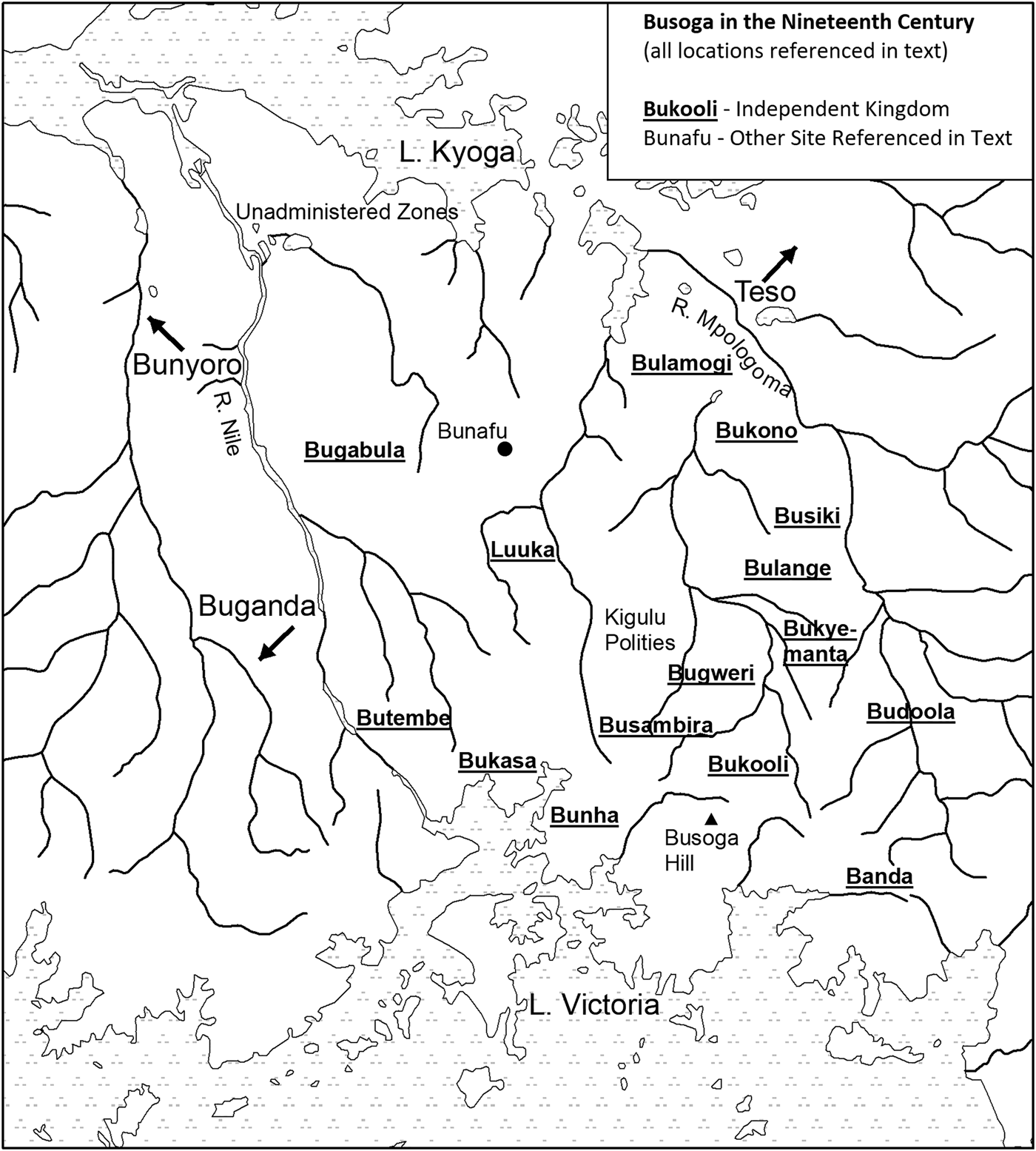
Throughout Uganda's long nineteenth century, the region of Busoga on Lake Victoria's northern shore was home to more than fifty autonomous kingdoms, each averaging about one hundred and twenty-five square miles in area (Fig. 1). Individual political units expanded, contracted, came and went, but none achieved regional hegemony. Military work drove these political histories, their particular shapes emerging from competition between two broad groups. Royal family members comprised the first group. Kings mobilized armies to enforce claims over territory and people, but princes sought to wrest authority over Soga mitala (village areas, sg. mutala) from those kings to establish their own rule. The second group was composed of non-royal soldiers, including both full-time military specialists and part-time farmers. They found material gain and masculine honor through participating in the wars generated by royal competition. To be sure, these men, strengthened by wives and families, competed with one another on the battlefield. But their military services were also competed over by kings and princes jockeying for power. However, war aims of royals and commoner soldiers were rarely aligned, and the latter's political loyalties were always contingent and impermanent. As such, the multi-polar distribution of military power in Busoga was routinely destabilized as local mutala leaders swapped kingly allegiances or declared for secessionist princes, and as skilled professional soldiers crisscrossed the region switching between royal employers. This routine destabilization in turn generated the apparent stability of Busoga's granular political form. In other words, the consistency of Soga ‘political smallness’ spanning more than a century was not a consequence of historical stasis, but was rather the ongoing effect of political instability largely caused by militarized competition involving many sectors of society.
Nineteenth-century Soga kingdoms and neighbors referenced in text (created by author, 2017). For more detailed information on locations and dates of Soga kingdoms, see D. W. Cohen, ‘The cultural topography of a “Bantu borderland”: Busoga, 1500–1850’, The Journal of African History, 29:1 (1988), 57–79.
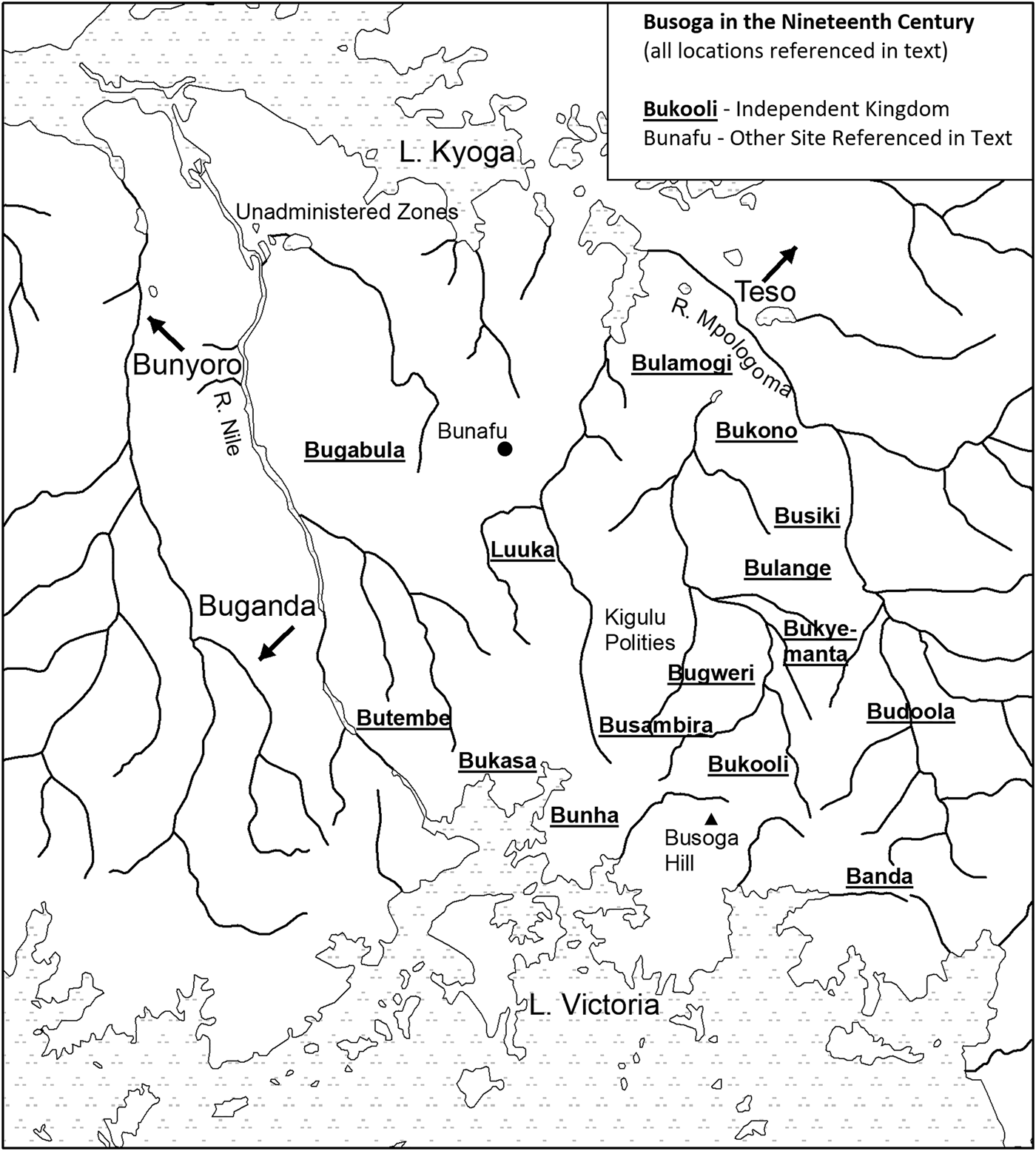
Busoga's enduringly small-scale monarchies contrast sharply with their expansionist neighbors Buganda and Bunyoro across the Nile to their west, and also with the more strictly decentralized, or ‘acephalous’, societies such as Teso found to their east. Busoga's kingdoms interacted closely with their western and eastern neighbors, seeking trading partners and military allies, while also becoming embroiled in conflict with them. These external relationships deeply influenced the strategies through which kings and commoners in Busoga pursued their interests, but the effects of external forces were articulated through the existing framework of Soga political smallness.Footnote 1 In particular, the kingdom of Buganda supported the expansionist, centralizing projects of favored Soga kings in an effort to amalgamate and control Soga politics, but these efforts did not fundamentally alter Busoga's fragmented political topography. Neither did individual Soga rulers seeking to assert centralized authority over the region achieve their aim.
Historians of precolonial Africa often look to military conflict to help explain the birth and growth of large centralized states. Busoga's long nineteenth century highlights a different story in which military work constituted small-scale politics, undermining rather than contributing to processes of territorially expansive centralization. Close engagement with a rich corpus of recorded oral traditions from Busoga, buttressed by reference to early colonial documents and royal traditions from nearby states, reveals overlapping cultural, economic, and tactical aspects of royal and commoner martial practice that constructed a political landscape with no durable center.Footnote 2 Such work departs from the well-known story of militarized state formation in nineteenth-century eastern Africa, offering new perspectives on the interplay between military history and the growth of political systems in precolonial Africa more generally.Footnote 3
Military considerations are usually among the most important and straightforward factors marshalled by scholars to explain the origins and growth of centralized states in precolonial Africa. In cases of ‘peer polity interaction’ such as those modeled in Vansina's ‘chain reaction thesis’ for the Congo basin, increasing waves of centralizing reforms and counter-reforms led to the creation of states where none previously existed.Footnote 4 In other instances the military contribution to state formation was the result of elite control over key war technologies such as horses, guns, or powerful shrines.Footnote 5 In addition, where states already existed military conflict fostered further centralization because states were able to raise larger armies from wider areas in order to annex or subdue neighbors. However, these formulas explain little about the development of the multiplicity of non-centralized ‘small’ political systems – be they age-sets, fragmented miniature kingdoms, city-states, independent ‘Houses’, ‘segmentary states’, or otherwise – which predominated in the early history of the continent. The exploration of causal relationships between military conflict and change in political institutions has primarily been the purview of state-centric scholarship, despite a growing trend to highlight non-centralizing historical trajectories in Africa and beyond in other contexts.Footnote 6
A small number of scholars have addressed the military history of precolonial Africa outside of the state context, although there are no standalone books published on the topic. Outside of East Africa, valuable studies of the Balanta and Igbo have shown how mobile war canoes and city fortifications could bolster resistance to centralizing pressures as well as help defend against slave raids.Footnote 7 In East Africa, special attention has been paid to age-set systems adopted by stateless Eastern Nilotic-speaking populations such as Maasai, Jie, Turkana, and Teso, through which these societies achieved the rapid conquest of extensive territories after 1500.Footnote 8 Aside from age-sets, a range of other cultural, social, and economic factors broadly shared by these groups also contributed to their particular military histories, including a strong pre-existing commitment to political autonomy of independent families, benefits for men demonstrating bravery, and cattle-centered social reproduction practices that incentivized small-scale raiding. Like the canoe-borne Balanta, the high mobility of transhumant pastoralism enabled herders to concentrate forces on the offense while evading enemies and avoiding pitched defensive battles.Footnote 9 Notably, the expansion of Western and then Eastern Nilotic speakers into eastern Africa represents a powerful historical counterpoint to the parallel growth of centralized states in the Great Lakes region such as Buganda, Bunyoro, Rwanda, and Nkore, and accentuates the value of military-historical theories which can explain political smallness.
Lying along the northern shore of Lake Victoria, and bounded by the River Nile, Lake Kyoga, and the Mpologoma River, the kingdoms of Busoga were birthed in the confluence of both Great Lakes state formation and Nilotic migration. This dual inheritance contributed to a unique tradition of political smallness reflected in a political topography of numerous small-scale competing peer polities.Footnote 10 Migrants speaking an early version of the Lusoga language were firmly established in the region by 1500, where cultivation practices privileging bananas generally restricted them to life in Busoga's wetter southern half.Footnote 11 By the seventeenth century, these southern populations increasingly interacted with Western Nilotic Lwo-speaking migrants who entered the drier, densely forested north. As hunters, cattle-keepers, and cereal-growers, these Lwo-speakers had better access to drought-resistant foods, which likely enabled them to develop patron-client relationships with southern Bantu-speakers during difficult times.Footnote 12 A number of Lwo-speaking lineages combined clientelism, some degree of military conquest, and – if royal traditions are consulted – their mystique as hunters, to found small kingdoms in north and east Busoga. Concurrently, Lusoga-speaking elites founded smaller, more densely populated kingdoms in the south, where bananas often thrived.
By 1750, the long-standing practice of royal Lwo men of marrying into and raising children with Lusoga-speaking families strengthened Lwo royal families’ interests through local alliances, while also causing the eclipse of the Lwo language by Lusoga.Footnote 13 By the second half of the eighteenth century, Busoga's political topography was defined by a shifting array of politically autonomous small polities – self-styled ‘kingdoms’ – each with its own unique title for ‘king’, its own mbuga (royal capital), and a varying number of mitala under its control.Footnote 14 Each kingdom articulated its own principles of internal governance addressing questions, for example, on whether to devolve power through royal princes or meritorious commoners. Few of these kingdoms were larger than Western Nilotic ‘chiefdoms’ to Busoga's north and east, and none exceeded the average county of Buganda in area or population.Footnote 15 This distinct mixture of small polity size with kingship ideology had its origin in the political alliances formed between incoming Lwo migrants and already-present Soga families.
After 1750, Soga kingdoms engaged in increasingly complex political and economic relationships with their neighbors. To the west, the militarized centralization and competitive expansion of the Buganda and Bunyoro kingdoms created new political dangers and opportunities for the Soga, while to the east the increasing prevalence of Teso communities across the Mpologoma River provided a new source of skilled military allies. Trade along the northern shore of Lake Victoria connecting Buganda to the Swahili coast increased, while growing Teso demand for salt and iron from Bunyoro amplified the volume of trade on the southern shore of Lake Kyoga.Footnote 16 This period also saw an overall uptick in the frequency and severity of wars, as Soga kingdoms competed over trade revenue and as Ganda and Nyoro violence spilled across the Nile.
The close of the eighteenth century marks the period for which historical sources begin to offer greater resolution on the region's military history. One early crucial event from this period occurred c. 1800 when Mukoova, an ambitious prince from the southwestern Bukooli kingdom, formed an alliance with Buganda to overthrow the sitting wakooli (king) and conquer other Soga kingdoms as a Ganda client. Tellingly, however, this militarily powerful Bukooli-Buganda alliance ultimately failed to annex significant territory under centralized authority and it never sparked a chain reaction of centralizing reforms among peer Soga kingdoms. In an era of eastern Africa's history generally known for militarized state formation, interlocking commoner and royal martial practices in Busoga instead undermined large-scale political projects such as that of the prince Mukoova. Those practices and the political history they influenced occupy the sections below.
MILITARY IDEOLOGIES AND PRACTICES OF POLITICAL SMALLNESS
Three elements of Soga royal military culture that jointly contributed to political smallness can be distilled from royal traditions. First, in the early nineteenth century, royals considered one another's lives sacrosanct, and kings or princes were rarely killed in war, a fact that incentivized low-intensity conflict within a structural status quo. Second, royal traditions devalued armed conquest of other kingdoms, legitimating rule instead through remembrances of royal generosity towards commoner populations. Finally, belief in an in-born ‘fitness to rule’ held equally by all kings and princes created an elite ethic that treasured absolute political autonomy, making princely secessions endemic.Footnote 17 Together, these three elements incentivized frequent small wars with limited objectives causing minimal risk to elites, conflicts that in turn established a tendency towards political fracturing.
Meanwhile, commoner publics keenly discerned their own interests, and while these interests diverged from those of royal elites, they nonetheless dovetailed neatly in support of political smallness. First, commoners compounded kingly difficulties by readily joining secessionist princes who promised greater largesse, either by migrating or by simply remaining in place and declaring new allegiances. Moreover, commoner publics could help to determine the shape of royal politics by championing the ‘fitness’ of any particular prince in order to pursue collective well-being outside of established kingdoms, such as in the semi-autonomous northern frontier community that developed around the child prince Womunafu, described by Cohen.Footnote 18 Second, for individual warriors, most of whom were primarily farmers and only part-time soldiers, valorous actions on the battlefield were often the main point of warfare and the criterion by which they received material rewards and found pathways to renown through masculine bravery. A battle's actual outcome or its strategic political implications could be of secondary importance to these other considerations; indeed, one could plausibly say it was better to lose a well-fought battle than win while fighting poorly. Motivated by their own interests, commoner military practice and ideology subverted ‘big’ political projects of ambitious royals.
ROYAL MILITARY PRACTICE AND IDEOLOGY
Charter myths can often illuminate the logic underlying political values. When asked why precolonial Busoga did not have a single king, Soga historian Y. K. Lubogo explained that ‘when (the mythic foundational figures) Mukama and Kintu gave their sons land (on which to build kingdoms), they did not put one over another’.Footnote 19 The timing of the kingdoms’ geneses precludes their founders being literal brothers, but this myth still informed royal politics by imagining kings to be symbolic brothers of equal status.Footnote 20 This shared ancestry undergirded a civic creed of family-feeling and mutual respect among Soga royals. For these rulers, the personal risks inherent in fragmented politics were dampened by a taboo against spilling ‘fraternal’ royal blood.
While fictive royal kinship did not prevent Soga kings from attacking each other to seize territory, steal livestock, avenge insults, or influence secessionist disputes, it did generate a common ethos protecting both the safety and status of kings and princes. The apparently rare violations of this ethos were punished. For example, in the only remembered case of regicide during the eighteenth century, oral traditions recall that Wakauli, an allegedly tyrannical king of Bukono, was assassinated by his advisors.Footnote 21 In response, Wakauli's senior wife, who was originally from neighboring Busiki, rallied her extended family to send an army in retribution.Footnote 22 A contrast is found across the Nile in the Ganda state, where most final authority over state violence was hierarchically nested in the single kabaka (king), and princes were occasionally slaughtered en masse to preempt threats from usurpers.Footnote 23 This precaution was not unfounded: out of seven kabakas who reigned during the eighteenth century, only two died naturally in office, while four were murdered and one was forced into exile.Footnote 24 Putting the cases of Busoga and Buganda side by side, a stable benefit of being a small ruler in a small society emerges. The ready availability of secession as an option to resolve disputes between kings and princes lowered the personal stakes of royal competition, which in turn likely increased the overall frequency of low-level military conflict without undermining the basic structural facts of Soga politics.
As organized warfare increased throughout the nineteenth century, the taboo against killing royals became less strictly observed. From 1800 to 1892, at least 13 Soga kings were either killed or violently driven from office by political rivals, while potential retribution against the offenders became less severe. For example, in the 1880s a high-serving commoner of the Luuka kingdom named Muziramulungi was found guilty of killing the king's brother-in-law over a land dispute. Ignoring his sister's demands for revenge, the king declined to execute his valuable officer. After a symbolic act of approbation, Muziramulungi was reinstated.Footnote 25 In response to the general dampening of this taboo, Soga kings increasingly obsessed over their own safety, hiring highly trained bodyguards, avoiding large public gatherings, changing residences to fool potential assassins, arming their wives with daggers as they slept, and avoiding dangerous moments in battle.Footnote 26 Rather than moving Busoga towards political centralization, therefore, the slow abandonment of this component of ‘political smallness’ drove rulers to adapt by enhancing personal security measures.
Charter myths also provide a window onto the ideals that influenced earlier political discourse. In Busoga, it is noteworthy that stories of conquest held little cachet. Myths pertaining to the Bukooli kingdom's origins are among the most contested and detailed in this regard. AbaiseWakooli clan histories claim that the first wakooli, a distinguished Lwo hunter named Okali, founded his kingdom on uninhabited land.Footnote 27 Through his generosity with land and meat and the justness of his rule, so the story goes, Okali was able to quickly and peacefully attract immigrants to his new kingdom.Footnote 28 However, Cohen suggests a different scenario, arguing it is more likely that an earlier wave of migrants from the abaiseNaminha clan was already settled in the region when the abaiseWakooli clan arrived, and that the abaiseWakooli displaced the previous residents, perhaps by force.Footnote 29 Both clans later claimed that they were ‘first-comers’ who graciously allowed the other to settle nearby and participate in joint government, only to be disappointed after learning that their guest exhibited cruel, despotic tendencies toward commoners.Footnote 30 In the abaiseWakooli version, it was after this realization that Okali expelled the abaiseNaminha clan from his land in order to protect other inhabitants. In the abaiseNaminha version, on the other hand, they fled only because Okali conquered their land and subjected them to unending abuses.Footnote 31
Importantly, the issue at stake between these competing traditions is not who was a greater conqueror, but instead who is remembered as either defending commoners against cruelty or distributing material largesse. This stands out when compared to contemporary Ganda traditions that revel in tales of conquering kabakas.Footnote 32 In fact, the ideals reflected in charter myths from Busoga and Buganda increasingly diverged during the eighteenth and nineteenth centuries. In Buganda, stories about the founding Kintu figure were re-tooled to emphasize Kintu's alleged role as the heroic conqueror.Footnote 33 Rulers and publics in Busoga moved in an opposite creative direction, de-emphasizing violent conquest in favor of protective alliances between royals and commoners. By telling such myths, royals sought to emphasize instead their forefathers’ generosity and just rule.
In wars between kingdoms, the Soga did not typically pursue a goal of completely defeating an enemy or annexing entire polities. For example, in a famous tradition dating to c. 1800–10 the king of Bugabula, named Nadiope, sought to expand his territory by attacking the northeastern kingdom of Bulamogi, ruled by Isoba. In this battle, Nadiope is remembered by both sides as having vanquished Bulamogi's army and overtaken territory within miles of Isoba's mbuga.Footnote 34 However, rather than attempt to depose Isoba, Nadiope chose to secure manageable territorial gains and return to Bugabula with his army and his loot. These plans were derailed when, during the return march, a warrior loyal to Isoba assassinated Nadiope in a carefully planned ambush, allowing Isoba to regain much of his lost territory. Rather than rewarding the ambusher, however, Isoba ordered his execution for regicide.Footnote 35 Here, two components of Soga political smallness were manifested in a military context. First, Nadiope chose to distribute largesse when he could have conquered extra territory, and by turning back he respected his fellow ruler's political autonomy. Second, Isoba, by executing his own warrior, confirmed his commitment to the sanctity of royal life, even against his kingdom's immediate interests.
Norms and logics governing Soga warfare buttressed a political system of distributed and small-scale political autonomy held by socially equal kings. Soga royals fiercely guarded political autonomy even at the expense of wealth, population, or territory. An ethic of autonomy animated decisions among most of the Soga population, from secessionist princes to peasant farmers, well-captured in the proverb, ‘even if your home does not look nice, it is better because you have a say over it’.Footnote 36 Commitment to small-scale political autonomy proved to be the most durable and powerful political force in nineteenth-century Busoga, and it was manifested most visibly in the process of princely secession.
Princely secession was a live and dangerous issue for individual rulers in the eighteenth and nineteenth centuries. As members of a royal lineage, a king's sons, brothers, and nephews were steeped from childhood in a political ideology that celebrated autonomy and in a philosophy that claimed all royal lineage members had an inborn ‘fitness to rule’. Tempering or containing princes was the single greatest internal political problem for Soga kings, and kings paid attention to strategies others employed to solve it.Footnote 37 Kingdoms generally followed one of two policies. Some, including Busiki, Bugweri, and Bulamogi, frequently tried to appease unruly princes by offering them control and taxation rights over mitala on the kingdom's periphery. Others, including Bugabula, Luuka, and Bukooli, usually tried to prevent princes from governing mitala, and instead either employed them at their mbuga or sent them to live in another kingdom's mbuga as student-ambassador.Footnote 38 Strategies could change over time, and Bulamogi shifted away from princely devolution later in the nineteenth century for reasons discussed below.
Neither strategy was highly successful. In the first case, princes with control over outlying mitala could develop their own patron-client relationships with mutala chiefs and local commoner clans. Through such relationships, princes mobilized warriors locally and asserted secessionist autonomy. The success of secessions depended, of course, on the relative military strength of the parent and child kingdoms, and both sides would seek outside allies and recruit the best available commanders. In his reconstructive work, Cohen identifies 11 autonomous kingdoms that emerged through this process.Footnote 39
In the nineteenth century, kings looked outside Busoga for allies to help quell secessions. The northeastern kingdoms Bulamogi and Bukono sought out anti-secessionist alliances in Teso across the Mpologoma River. King Kisira of Bulamogi faced a massive secessionist rebellion c. 1860 from a powerful prince named Muyodi, who had declared independent control over as many as twenty of Kisira's mitala.Footnote 40 Kisira ultimately defeated Muyodi thanks to the assistance of nearby Teso leaders, who lent armies in an agreement that ultimately led to closer relationships between both groups.Footnote 41 Following this war, later Bulamogi rulers watered down the policy of princely devolution, choosing meritorious commoners rather than princes to hold positions of authority over mitala in tactically important locations.Footnote 42
The second containment strategy – confining princes to their own mbuga – was likely more successful in the eighteenth century. Princes stuck in the mbuga could not build support among mitala to mobilize an army. One potential drawback, from a king's point of view, was that his court would be filled with stifled and resentful princes undermining his authority as they jockeyed to succeed him. Regardless, this strategy became increasingly unsuitable as the nineteenth century progressed, because Buganda's willingness to lend armies to rebellious princes in exchange for promises of future fealty meant that it became less necessary for a prince to build patron-client relationships in nearby mitala before overthrowing an incumbent king in his own mbuga. A prince who was forcibly confined to the mbuga and willing to overlook social taboos against deposing his own father, brother, or uncle had a new option, through Buganda, for asserting his ‘fitness to rule’ without courting mitala – as happened in Bukooli, c. 1800.
If neither of the two options above was feasible, a third way to ameliorate tension between princes and kings – especially in the sparsely populated north – was for the prince to leave the governed area altogether. Around 1800, perhaps in response to concerns prompted by the coup in Bukooli, Wambuzi of Luuka tacitly encouraged his wives to raise princes outside of Luuka, settling in what Cohen labels the ‘unadministered zones’ nearer Lake Kyoga.Footnote 43 Such colonies could either grow into full kingdoms or become re-absorbed by a parent kingdom. Cohen's microhistory of one such colony founded by Womunafu, a son of Wambuzi born c. 1830, chronicles a child prince sent to live outside Luuka. Prince Womunafu, believed by many to have an exceptional spiritual connection with the Mukama figure, served even in childhood as a rallying point for his own maternal family alongside various disaffected lineages around Luuka.Footnote 44 Over the next sixty years, Womunafu steadily accumulated followers migrating from southern Busoga, perhaps fleeing Bukooli expansionism or attracted by the open space. A child prince's ‘fitness to rule’ became, in this case, a resource that marginal populations leveraged to create their own more powerful community. Over the decades Womunafu's effective political autonomy waxed and waned inversely in relation to the organizational military strength of the central Luuka kingdom. Cohen's study reminds us that the politics of autonomy and power, despite some recognizable patterns, were usually very complicated and that the line between autonomy and subservience was often blurry.Footnote 45
COMMONER MILITARY PRACTICE AND IDEOLOGY
Non-royals who actually fought the wars in Busoga participated in a warrior culture that contributed to ‘political smallness’ by emphasizing individual bravery and material reward over any grand political sentiments. Commoner soldiers generally fit into two categories: first, skilled military leaders, or ‘captains’, and second, part-time farmer-soldiers who filled out the rank and file.Footnote 46 Captains were typically men of commoner origin who were promoted to leadership positions after demonstrating one or more of the attributes that made a Soga fighter ‘brave’: physical courage, battlefield competence, or tactical cunning.Footnote 47 Depending on his reputation, a captain could be asked to command anything from a small unit of fighters to an entire army. As organized warfare increased in both frequency and tactical complexity during the nineteenth century, kings and princes eagerly sought the services of skilled captains and rewarded them handsomely. It was probably not unusual for a well-respected middle echelon captain and his household to subsist mostly on income from fighting.Footnote 48 Overall, the renown and prosperity of professional warriors increased significantly during the nineteenth century.
The exceptional warrior Muziramulungi – mentioned above – epitomized a career trajectory that became, at a more modest level, a very real possibility for many talented warriors. A commoner born in Bugabula, Muziramulungi was first noticed by the young Luuka prince Inhensiko II in the 1870s when he was fighting in a war against Luuka on the side of Bugabula.Footnote 49 Notwithstanding his enemy allegiance, Muziramulungi impressed Inhensiko because he ‘fought bravely and distinguished himself by killing a person’. When Inhensiko ‘saw that Muziramulungi was a brave man … he gave him a place (i.e. a mutala)’.Footnote 50 A few years later, Muziramulungi was granted more mitala by the Luuka prince in recognition of his ‘good advice during a question of suspected sorcery’. When Inhensiko became king in 1878 and went to war with Bugabula again over a boundary grievance, Muziramulungi found himself fighting this time for Luuka against the kingdom of his birth. Muziramulungi's elderly son proudly described the decisive battle to Cohen some eighty years later:
In the midst of war, Muziramulungi was hit on the forehead by a stone and was taken to the rear to be treated. When he recovered he returned to combat. He was shot by a gun but fortunately the bullet only penetrated his flesh of this thigh and he survived. In the battle Muziramulungi was wearing a leopard skin, but he cleverly took it off and lay it on the grass. Enemy soldiers kept shooting at the leopard skin, but when they advanced he fired his gun at them and drove them back.Footnote 51
Having demonstrated courage, cunning, and skill, Muziramulungi was promoted to a very high level. Similar opportunities also existed in smaller kingdoms. For example, in the mid-nineteenth century, a skilled captain from Bugweri named Isumwa was offered a generous mutala by Bugweri's much smaller neighbor, Busambira, after Isumwa agreed to lead Busambira's army as it defended itself from attack. Like Muziramulungi, Isumwa was eventually made a top minister in Busambira, his adopted kingdom.Footnote 52
Cohen suggests that, like Muziramulungi and Isumwa, thousands of Soga families traversed northern Busoga in search of economic and social opportunity during the nineteenth century, and that at least many hundreds of these itinerant migrants were skilled military entrepreneurs.Footnote 53 And this activity was not limited to Busoga. Zimbe describes the career of one Soga man called Badankayine who was named as a general by kabaka Mutesa and fought campaigns in Busoga, perhaps being especially valuable because of his familiarity with the land.Footnote 54 The northeastern kingdom of Bulamogi likewise appointed a Teso man named Muloki as a military commander, taking advantage of his background to organize temporary alliances with Teso armies.Footnote 55
As these stories of shifting allegiances suggest, it would be anachronistic and misleading to think about a Soga captain's participation in armed conflict as a matter of ‘patriotism’ in the modern sense. However, it would also be inaccurate to see it as merely a temporary exchange of goods for services. Instead, the relationships between rulers and captains drew upon an older notion of reciprocal obligations attested to throughout the region.Footnote 56 This was a semi-durable relationship that was built on a mutual assumption of continued exchanges that would benefit both parties in the long term. But the mutability of such arrangements, in combination with the sheer volume of them across the region, had significant implications for Soga military history. In an environment of parity in military technology, leaders with tactical skill and charisma were a critically important military resource, and the marketplace for talent which sent military captains crisscrossing Busoga for new opportunities made monopolization of this resource by a single centralized power all the more difficult.Footnote 57
When allocated land by a mutala chief, part of the typical package of reciprocal obligations incurred by a full-time male Soga farmer was his agreement to participate in war when needed ? usually whenever he heard a specific drumbeat indicating mobilization. Indeed, one key reason for a chief to be seen as generous with land was to have ready access to men for fighting.Footnote 58 As is seen in this passage from Lubogo, failure to honor this obligation could lead to loss of property as well as public humiliation:
In case of wars, every man was expected to offer his services. Whenever a war broke out, men were collected from every part of the country to go and fight. There was a drum sounded to summon everybody whenever danger was imminent … If any man failed to respond at the sound of this drum, he was in danger of losing his property or even being sent into exile. If he escaped exile he was tortured in many other ways. He was looked down upon by his fellow men who refused to have any dealing with him. And his wives were equally tortured by other women; the man and his wives automatically lost every right in the country.Footnote 59
Those who did respond to the war drum's call, however – and especially those who fought well – could expect to be rewarded with public esteem, assets such as land or livestock, and socially well-placed wives.Footnote 60
These militarized social systems were deeply gendered, and women played an important role. The rewards bestowed on a man and his entire household for battlefield valor could be great, just as a man's perceived cowardice or neglect of his military duties could prove disastrous for the social and economic well-being of both the man in question and his wife or wives. Wives, whose fate was thus inextricably linked with men's military honor, had a strong incentive to participate in a culture celebrating bravery. As it turns out, women did not passively wait to see if their husbands would succeed in gaining martial honor. By the nineteenth century, women played complex and complementary roles in promulgating the bravery complex in Soga military culture. Lubogo claims it was a duty of women to ‘cry bitterly for the dead’.Footnote 61 Women also sang songs celebrating tales of martial valor and naming dead heroes, and they brewed beer and prepared feasts to honor living heroes while participating in practices designed to ridicule or deny food and beer to men who were unwilling to go fight.Footnote 62 Women furthermore may have played an important role in transporting weapons to the front lines.Footnote 63
The discourse of bravery, although defined with reference to the actions of men, intrinsically included women and cannot be understood without reference to them. This was true for royals as well. A royal man's public reputation for bravery was often a key factor enabling him or his sons to achieve kingship and providing women relatives with the potential to attain the status of queen mother.Footnote 64 ‘Bravery’, then, is perhaps better understood as a component not primarily of a man's honor, but of a household's honor, in which women were also fully implicated. But this should not obscure the fact that from the viewpoint of Soga men, armed combat was still very much an exercise in creating a masculine identity – as John Iliffe has argued in other contexts.Footnote 65 Nothing in Lubogo's text or Cohen's collected traditions looms larger when judging a man's character than his demonstration of martial bravery, and nobody comes across as more despised than a man who was ‘afraid to fight’.Footnote 66 The residual effects of this bravery complex lasted well into the twentieth century, and in both Fallers’s 1956 ethnography and in Cohen’s mid-1960s interviews, some Soga men appear still to be struggling with the cultural shock of rapid demilitarization during the colonial era.Footnote 67
Whether they were captains or temporarily mobilized farmers, most Soga warriors fought primarily for three things: their own masculine honor; the well-being and defense of their household; and material reward. With a few exceptions, they did not fight because of patriotic duty to their king. However, contrary to the aspersions cast by early British observers, precolonial Soga never ‘failed’ to collectively organize as a group, precisely because they did not subscribe to the kind of centralizing, pan-ethnic discourse such a proposition implies to begin with.Footnote 68 This parochial Soga view of warfare at the household-level was an important component of political smallness. It would have been difficult, after all, to embark on a long-term project of militarized centralization using warriors who did not value such corporate political goals. And as will be seen below, Bukooli is the exception proving the rule, because it could only build a centralizing project on the shoulders of a foreign army.
CHALLENGES TO POLITICAL SMALLNESS: NORTHERN KINGDOMS AND BUKOOLI
Throughout the nineteenth century, increased external trade and foreign political involvement expanded the range of possibilities for political and military entrepreneurs in Busoga, just as denser local networks strengthened an emerging condition of Soga cultural, but not political, cohesiveness. Socioeconomic structures and political traditions undergirding political smallness still retained their influence across Busoga, but manifested differently as the Soga faced divergent political and military challenges in the north and south.
Lubogo's collected oral traditions recall that the northeast Soga kingdoms – principally Busiki, Bukono, and Bulamogi – entered the nineteenth century beset with attacks by Teso and other neighbors from across the Mpologoma River, who were perhaps motivated by famine conditions which struck eastern Uganda during this period.Footnote 69 By the mid-century, Bulamogi especially had parlayed these conflict-ridden relationships into military alliances, taking advantage of Teso's effective age-based military organization.Footnote 70 Teso fighters recruited by Bulamogi's king were critical to the defeat of a major mid-century princely secessionist movement (described above), enabling Bulamogi to remain among the geographically most expansive kingdoms during this period. High rates of intermarriage attested to in both Soga and Teso sources, evidence from Teso traditions that Bulamogi implemented elements of Teso military organization, and early missionary reports describing the adoption of Eastern Nioltic material culture by the leaders of Bulamogi all attest to this relationship.Footnote 71
Bukono and Busiki, more than Bulamogi, became embroiled in military conflicts in central and southern Busoga.Footnote 72 As the century progressed Busiki slowly victimized Bukono, and simmering enmity occasionally flared into larger battles during which Bukono often lost territory.Footnote 73 Among all Soga kingdoms, Busiki may have been the most militarily powerful between 1800 and 1850, bolstered by consecutive strong leaders and naval supremacy in the Mpologoma River and Lake Kyoga.Footnote 74 However, Busiki's policy of placing princes in control of territorial peripheries eventually fueled a divisive succession dispute leading to the kingdom's fragmentation.Footnote 75
In Busoga's northwest kingdoms – the most notable being Bugabula and Luuka – a separate collection of forces challenged the integrity of political institutions. Both kingdoms spent the better part of the century engaged in low-level conflict with one another and with Bulamogi over boundary disputes. More significant was the extent to which they found themselves fighting in an ongoing war between their larger neighbors, Buganda and Bunyoro.Footnote 76 Bugabula drew close to Bunyoro, becoming its ally and even forcibly occupying Ganda territory at one point. Bugabula's storytellers tweaked their origin myths to tie themselves more closely to Bunyoro's founding Babiito dynasty, while the kingdom's merchants increased their involvement in the salt and iron trade by investing in the Nyoro market for slaves captured in various Soga wars.Footnote 77
The death of kabaka Ssuuna and his succession by Mutesa in the late 1850s ushered in a policy shift on Buganda's northern frontier away from endemic warfare and towards peace agreements with newly installed, more favorable foreign leaders in Bugabula, Luuka, and Bunyoro. Mutesa took power just after the death of Bugabula's powerful king Kagoda, who had been an aggressive ally of Bunyoro against Buganda. Lubogo records that Kagoda's successor quickly agreed to peace with Mutesa, and that following an agreement to collect customs on trade from Bugabula into Buganda, Mutesa ‘instructed his men never to attack Bugabula again’.Footnote 78 Around the same time, punctuating his new pro-Bugabula policy, Mutesa murdered the king of Luuka, allegedly because he had placed human feces in a basket of gifts and subsequently cultivated a closer relationship with his successor. Shortly afterwards, Mutesa successfully backed Kabalega in his quest to become king in Bunyoro, leading to a break in hostilities between these two large kingdoms.Footnote 79 While Mutesa's machinations won Buganda temporary reprieve on the northern border, they did little to fundamentally transform the structural military logic of northwestern Busoga. Indeed, by weakening kings in Bugabula and Luuka, Buganda likely enabled opportunist princes such as Womunafu (discussed above) to claim greater degrees of de facto autonomy.
The kingdoms in southern Busoga, lying near Lake Victoria's northern shore, shared a distinct political experience during the nineteenth century. Especially for those occupying useful harbors, proximity to Buganda's powerful war-canoe navy drove some Soga rulers to reach accommodations with Buganda, for example by agreeing to temporarily house soldiers en route to wars elsewhere.Footnote 80 As trade with the Swahili coast intensified, the region became more strategically important to Buganda, and towards the end of the century an influx of Europeans using this route raised the stakes once again.Footnote 81 Nonetheless, the most profound political event in nineteenth-century southern Busoga – Bukooli's expansion – started at the very beginning of the century before the onset of these external forces. And, although Bukooli certainly struggled to navigate the world of Swahili caravans, Islam and Christianity, ivory and slaves, firearms, and the scramble of European colonizers, none of these forces was a root cause for the ultimate collapse of Bukooli's centralizing project. Instead, the cause was something more familiar and local: secessionist princes raised their mitala to arms and declared independence, while commoner populations resisted central authority by building fortifications, setting ambushes and traps for Bukooli officials, and voting with their feet by seeking new fortunes in the north.
Around 1800, prince Mukoova of the Bukooli kingdom asserted his ‘fitness to rule’ by challenging the political authority of the sitting wakooli, his uncle Kisangirizi, and seizing control of the kingdom's mbuga. Although not the first to challenge a king, Mukoova's strategy of overthrowing and replacing the ruler in the center rather than seceding on the periphery was unusual. He enlisted military support from Buganda in his quest.Footnote 82 Buganda dispatched an army across the northern shore of Lake Victoria to link up with the rebellious Mukoova and attack Kisangirizi. The first attack failed, but a second attempt dislodged Kisangirizi and installed Mukoova as the new wakooli.Footnote 83
Whether he intended it at the time or not, the moment and method of Mukoova's victory opened a seventy-year period of militarized conquest of southeastern Busoga by the Bukooli kingdom. Mukoova (c. 1800–20) and his two longest-serving successors, Kibubuka (c. 1825–55) and Kaunhe (c. 1855–92), each oversaw a new way of conducting politics that rejected ‘smallness’ in favor of a centralizing conquest ideology resembling that of Buganda.Footnote 84 The basic agreement between Bukooli and Buganda initiated during Mukoova's coup was fairly simple: Bukooli offered material tribute and political loyalty (as well as looting opportunities) to Buganda in exchange for military and political assistance.Footnote 85 This agreement represented a profound break with a centuries-old tradition of political smallness. Each wakooli offered the one thing that most Soga kings would not give up – his absolute political autonomy – to gain something others rarely sought: total political dominance over fellow royal ‘sons’ of Mukama or Kintu. In making this transition, Bukooli was an outlier within Busoga; only the wakooli consciously sought to call himself the ‘kabaka’ of all Busoga.Footnote 86
The first significant expansionist campaign launched by Bukooli was against its historically more powerful northern neighbor Busiki during the reign of the ‘brave’ and ‘bloody’ kisiki (king) Muinda c. 1810.Footnote 87 As Bukooli's allies in the conflict, Lubogo records that ‘the Baganda did a lot of havoc’.Footnote 88 Mukoova attacked Muinda around the same time that Muinda launched an attack on Bukono to recover mitala lost during the regicide-induced conflict referenced above. Based on the timing, we might speculate that Mukoova attacked Busiki to seize an opportunity to force Busiki to fight on two fronts. We cannot know for sure that the wars were simultaneous, but even if they were not, some of Busiki's armies may have been diverted from consolidating territorial gains after Muinda's victory in Bukono. Evidence that Busiki was forced into a two-front war can be found in a tradition remembering that Muinda ordered prince Kalange, his son and a skilled commander, to move from Busiki's northern border with Bukono in order to defend the southern border with Bukooli.Footnote 89 Ultimately, Busiki's armies – fighting in defense – successfully repelled the joint Bukooli-Buganda alliance.
Near this time, Bukooli also turned its attention to conquering and annexing weaker kingdoms to its south and east. An early nineteenth-century attack on a nearby hilltop called ‘Busoga’ marks a significant moment in the evolution of Bukooli conquest ideology.Footnote 90 Whereas offers of protection and largesse had typically been the key to any larger Soga kingdom exercising power over outlying areas, a tradition from the conquered abaiseMusoga recalls a different strategy employed by Bukooli: ‘Busoga hill is our butaka (ancestral clan land) but now belongs to Wakooli … because whenever you are a poor man, he who is stronger takes away your property … they (Bukooli) found us here.’Footnote 91 That Bukooli, whose royal clan had Lwo origins, began by targeting Busoga and then a nearby hilltop called Bugulu, both of which were Bantu cultural heartlands with ritual significance, suggests that Bukooli was likely seeking to appropriate spiritual or cultural power.Footnote 92
Bukooli expansionism appears to have paused c. 1820 amid a confusing period of succession struggles. By c. 1825, however, once Kibubuka became wakooli, militaristic expansion began again in earnest. This timeline matches accounts by Ganda historian Apolo Kaggwa, who characterizes the 1820s as a decade when kabaka Kamaanya renewed military operations against ‘the Soga’.Footnote 93 This period was also remembered by descendants of the once-independent Budoola kingdom: ‘(The wakooli) went to Buganda and brought Baganda and made war with us. He killed the father of our grandfathers … He conquered this area and became the [king] of all this area.’Footnote 94 Here, Bukooli used Ganda soldiers not only to subjugate another kingdom, but also to take the life of its royal ruler – another deviation from tradition.
One can get an idea of the list of conquest victims by looking at the names of subordinate positions to which Bukooli's princes were appointed. Styling themselves with names like ‘Mudoola’ and ‘Isoga’ – titles used previously by the rulers of Budoola and Busoga – these princes governed once-autonomous territories.Footnote 95 But these titles illustrate another key difference between Bukooli's conquest ideology and the ‘smaller’ military objectives of other Soga kingdoms. In most kingdoms challenged by pressure from princes, kings usually gave princes mitala, either taking them from other kings by force or encouraging commoner migration and settlement into a new territory. Princes typically took those mitala, however small, and turned them into fully autonomous polities of their own. In Bukooli, the new conquest ideology meant that princes expected to be provided with entire former polities instead of a few mitala, but in exchange they agreed to recognize that ultimate political authority was vested in the wakooli. Just as Bukooli had done vis-à-vis Buganda, princes of Bukooli abandoned political smallness and agreed to exchange autonomy for more wealth in land, people, and tribute. This agreement allowed a single political authority to encompass a larger total land area than had been seen in Busoga before, but it would not last.
Bukooli could not have been successful without Buganda – a fact recalled with every tribute payment.Footnote 96 When interviewed by Cohen, the hereditary wakooli explained how his ancestors had provided Buganda with ivory, cows, sheep, goats, and hens.Footnote 97 The missionary Alexander Mackay noted in 1881 that ‘Wakoli’ visited kabaka Mutesa and had ‘brought some ivory to beg for a large army to aid him’ – a request that Mutesa met by granting him a ‘great force ’.Footnote 98 Beginning in the 1850s or 1860s, Bukooli was the only Soga kingdom to receive a steady supply of guns, both from Buganda and through direct trade with Arabs, although these older models were likely used mostly for psychological effect.Footnote 99 Bukooli tried to position itself as an intermediary between other Soga states and the kabaka, and in some cases the wakooli was authorized to hear disputes or enforce ‘tax collections’ on the kabaka's behalf.Footnote 100 Bukooli was also a key partner in promoting Buganda's foreign policy elsewhere in Busoga, for example contributing soldiers and logistical aid in support of efforts between 1878 and 1892 to unify a multiplicity of fiercely autonomous micro-kingdoms in Busoga's central Kigulu region under one Ganda client king.Footnote 101 Bukooli elites also emulated their counterparts in Buganda – some portion of Bukooli's chiefs converted to Islam starting with Mutesa's reign in the 1860s, and by 1893, visiting Europeans found that Luganda was widely spoken in elite Bukooli society.Footnote 102 The kabaka even introduced European missionaries to the wakooli as (perhaps optimistically) ‘chief of Usoga’ as if Busoga were one entity under the control of the wakooli.Footnote 103
An ideology of veneration grew around the wakooli more than any other Soga king. One informant remembered that ‘there are many songs about wakooli, about (his) remarkable deeds, about bravery, about funny things’, while another emphasized with awe the wakooli’s absolute power to have any subject executed for any reason.Footnote 104 Warriors would line up in front of wakooli Kaunhe and declare, ‘I am a male goat because I may die tomorrow’, while the ‘most distinguished’ warriors were promoted to be the wakooli’s personal bodyguards – warriors who appear in British missionary Robert Ashe's account as fanatical in their devotion.Footnote 105 Ashe also notes that princes in ‘Usoga’ (he means Bukooli) had small and rundown houses so as to not appear competitive or disrespectful to the wakooli.Footnote 106 This observation contrasts with Cohen's architectural analysis of Prince Womunafu's various compounds in Luuka – each of which intentionally replicated royal designs, and one of which was actually bigger than the king's.Footnote 107 Some subjugated non-royal clan members also bought into the conquest ideology of the Bukooli kingdom. Many traditions collected from commoners in the Bukooli region about their ancestors proudly emphasized that ‘they were his (wakooli's) warriors and they went to war whenever a war started’, or bragged about gaining the favor of the wakooli as a clan because of their fighters who were ‘brave and feared nothing’.Footnote 108 Although it is undoubtedly an exaggeration, one informant from the abaiseMuganga clan succinctly captured this ideology when he explained to Cohen that, beginning with Mukoova, ‘every settler who settled (in Bukooli) had to become a warrior’.Footnote 109
Elsewhere, fiercely autonomous Soga fought to resist Bukooli expansionism on many occasions. Members of the abaiseNhyikodo clan dug deep trenches around their village and posted scouts in treetops to warn of approaching enemies, allowing them to successfully defend against Ganda soldiers working for Bukooli.Footnote 110 Conquered subjects in Buswaale dug ditches along paths with camouflaged openings to trap soldiers and avoid paying tribute to Bukooli.Footnote 111 Banda, a kingdom to the far southeast, also dug trenches to resist ‘constant attacks’ from Bukooli, but was not as successful, its former subjects lamenting that ‘in the past we were independent’, but later ‘the wakooli was like the kabaka’.Footnote 112
Perhaps to evade annexation by Bukooli, some small polities occupying strategic territories offered themselves as client states to Buganda directly, including Butembe, located on a key Nile crossing, as well as Bukasa and Bunha, on Lake Victoria's coast. The descendants of Butembe's ruling lineage explained to Cohen how they transported Baganda across the Nile whenever needed.Footnote 113 For the lakeside port of Bukasa, ‘when representatives from Buganda came to plunder Busoga, they would stay the night’, and ‘they would also stay on their way back’. In return, ‘Bukasa was not at all plundered by Baganda because … of lodging them’. One ruler of Bukasa, Nsaiga, gained favor by denouncing enemies of Buganda.Footnote 114 Bunha first responded to Bukooli's expansionism by recruiting skilled captains from competing Soga states with generous offers of mitala and other gifts, but as the colonial era dawned, Bunha played an active role as a supporter of Buganda.Footnote 115 The famous Bishop Hannington was killed on kabaka Mwanga's orders while he was in Bunha's custody, for example.Footnote 116 No later than 1885, Mackay noted that the wakooli had lost official favor within Buganda and was being replaced by the king of Bunha, which may help to explain wakooli Kaunhe's secret intimation to Lugard in 1890 suggesting an Anglo-Bukooli alliance against Buganda.Footnote 117 By supplicating themselves to Buganda, Bunha, Butembe and Bukasa each undermined Bukooli's most potent weapon, which was borrowing armies from the kabaka.
Bukooli's expansionary project appears to have slowed in the 1850s after the immediate east and south had been conquered, while the process just described stymied western expansion along the lake. This geography helps explain why, in c. 1855–65, Bukooli forces under the prince Kalende re-invaded Busiki.Footnote 118 The attack was likely timed to take advantage of a succession crisis and civil war raging in Busiki. After the kisiki Nabongo died, many expected his brother Kalange – the hero who had defeated Mukoova's first attack on Busiki as a young man – to succeed him. Instead, Nabongo's son Dhatemwa secretly arranged a deal with the neighboring Bugweri kingdom to help him seize Busiki's mbuga. Furious, Kalange and Dhatemwa's two other brothers each mobilized their mitala and declared political autonomy, refusing to recognize Dhatemwa as kisiki. In the aftermath, Bukooli's prince Kalende attacked Kalange's newly independent kingdom, called Bulange, but again Kalange repelled Buganda-Bukooli forces. Rather than return to Bukooli a defeated prince, however, Kalende retained his army, established his own mbuga, and declared an autonomous new kingdom called Bukyemanta. Bukyemanta's struggle for autonomous recognition continued for decades, and as late as 1890 Kaunhe asked British officer (and future colonial governor) F. J. Jackson for support against Bukyemanta.Footnote 119 Thus, in an incident that had started out looking like an invasion of one kingdom (Busiki) by another (Bukooli), the final result was not one single larger kingdom, but rather, six smaller ones. Aspiring leaders drew on the available tradition of political smallness by mobilizing local mitala, prioritizing defense, and seeking autonomy through secession rather than conquest. In this case, there was no ‘chain reaction’ escalation of political centralization, but instead a reinforcement of and return to political smallness.
In the last decades of the nineteenth century wakooli Kaunhe stopped conquering territory. He focused more attention on consolidating gains, enhancing the imperium of his office and kingdom, and continuing to participate in the rapidly changing world of externalized trade, new religions, and European politics. In these arenas, however, Bukooli was edged out by both Bunha and then Buganda directly. In the early 1890s kabaka Mwanga and his prime minister Apolo Kaggwa increasingly eschewed the use of proxies in Busoga in favor of using Ganda armies directly, and Ganda general Semei Kakungulu established a permanent Anglo-Ganda fort at Bukaleba.Footnote 120 Finally, in 1892, Kaunhe was killed while trying to participate in the same forces that were edging his kingdom off center stage. In an almost unbelievable incident, the Swahili porter of an English missionary accidentally shot Kaunhe dead with a rifle he was trying to use to properly salute the elderly ‘chief of all Usoga’.Footnote 121
CONCLUSION
The ‘Bukooli rising’ story is seductively familiar once it is uncovered and dusted off, but it is by no means another example of violent political centralization in nineteenth-century eastern Africa. Even though political centralization and military prowess are often conflated, this example shows the two ideas to be severable. In Busoga, warfare was understood and conducted in effective and sophisticated ways for more than a century, while politics – measured in territory and population – remained ‘small’. At a macro-historical level, the maintenance of this status quo (war without ultimate conquest) makes sense: low-intensity conflict among many kingdoms with no one side ultimately ‘winning’ could allow for a thriving military culture available when needed for defense without leading to either widespread destruction or political centralization. The particular balance struck between numerous kingdoms roughly equal in size and military capacity consistently blocked trends toward further political centralization.
The implications of this argument are far-reaching, suggesting new ways of thinking about political smallness in precolonial Africa as an indigenous configuration that could generate its own instrumental power. ‘Neo-evolutionary’ or otherwise teleological theories about African political complexity and centralization are deeply troubling to scholars in no small part because they fail to explain the durability of small-scale political arrangements. But they have nonetheless been difficult to dismiss, in part because of the persuasive simplicity of models linking military power to centralization. Close attention to military history in a context like nineteenth-century Busoga opens the door to potentially more satisfying explanations of political smallness. It is possible to identify a number of historical factors – localized mobilization, an empowered and pragmatic commoner class, mutually respectful social contracts between ruling elites, a military culture celebrating bravery above all else – which could enable military capacity without concomitant expansive centralization. Ultimately the Busoga case demonstrates how the durability of small-scale politics in precolonial Africa can be explained to a great extent by recognizing that such political arrangements could and did really work in an instrumental military sense.