Introduction: The politics of sustainable eating
In December and January 2019–2020, over fifteen million acres of land burned across Australia. While drought is ongoing and bushfires are annual occurrences for the country, the intensity of this particular heat season was widely attributed to the effects of human-induced climate change. Indeed, much of the popular media has been dominated by discourses concerning this contemporary crisis (Hersher Reference Hersher2020). Time Magazine's (in)famous ‘person of the year’ for 2019 was sixteen-year-old climate activist Greta Thunberg, the Swedish teenager whose public pleas for action are now well-known around the world. And likewise, in May 2019 the New York Times food section ran a feature titled, ‘What to cook in a changing climate’, which included several articles on the topic as well as an instructional, multi-page graphic designed to help readers make planet-friendly dining choices (Sifton Reference Sifton2019). We mention these details from the outset to illustrate the important intersection of discourses concerning responsible eating and environmental welfare. However, this is not an article about climate change per se. Rather, we are interested in how contemporary performances of status hinge on the democratic ideals of environmental equity and community responsibility, and how these in turn interact with cutting-edge sociolinguistic scholarship concerning normativity and class inequality (e.g. Thurlow Reference Thurlow2016; Hall, Levon, & Milani Reference Hall, Levon and Milani2019).
As a case in point, we examine a dataset comprised of 150 Instagram posts, drawn from three different acclaimed chefs’ personal and public accounts, each from geographically disparate locations (the US, Australia, and Sweden). These chefs (and associated restaurants) are known for emphasizing local and sustainable eating, including the humane and responsible sourcing of ingredients. Additionally, much of their multimodal positioning on Instagram aligns quite squarely with what Mapes (Reference Mapes2018) calls ‘elite authenticity’, or the tendency in food discourse for stakeholders to appeal to notions of genuineness, naturalness, egalitarianism, and tradition—all of which are rooted in and made possible by privilege and socioeconomic advantage. Following the work of Crispin Thurlow and Adam Jaworski (e.g. Reference Thurlow and Jaworski2017a), Mapes argues that ‘elite’, while certainly a socioeconomic demographic, is also discursively and rhetorically accomplished moment-to-moment. Importantly, it is not just the easily identifiable ‘one percenters’ who engage in this sort of status competition, but also those of us who think of ourselves as ‘progressive’, ‘populist’, and even ‘ethical’—but who are nonetheless privileged (although perhaps less markedly so). Ultimately, these claims to egalitarian ideals work paradoxically to diminish people's elitism, while simultaneously elevating their social prestige (cf. Kenway & Lazarus Reference Kenway and Lazarus2017). It is thus necessary to resist the popular dichotomies associated with the ‘haves’ and ‘have-nots’ and instead be open to critiquing those who might be better defined as ecumenically oriented ‘have-enoughs’ (cf. Jaworski & Thurlow Reference Jaworski and Thurlow2017; Burrows & Knowles Reference Burrows and Knowles2019).
With these things in mind, in the current study we use the general principles of multimodal critical discourse analysis (e.g. O'Halloran Reference O'Halloran, Hyland and Paltridge2011) to elaborate on the nuanced displays of status and virtue which have been observed by various others of late (e.g. Cotter & Valentinsson Reference Cotter and Valentinsson2018; Thurlow Reference Thurlow2020; Mapes Reference Mapes2020). In particular, we orient to the rhetorical strategies encapsulated by the discourse of elite authenticity that Mapes (Reference Mapes2018) identified, and to locality/sustainability as the prominent means by which the chefs in our dataset simultaneously perform ‘elite’ (i.e. through displays of ingenuity, rarity, and skill) but not elitist (i.e. an appeal to distinction through superiority) (see Thurlow Reference Thurlow2016, Reference Thurlow2020). In what follows we first discuss the various theoretical trajectories which are pertinent to our argument, namely, research concerning normativity and neoliberalism, and food and social media. Next, we explain our data collection and methodology. In the proceeding analysis section, we document three general tactics the chefs in our data rely on to highlight their status-producing sustainable food practices. These are (i) plant-based emphasis, (ii) local/community terroir, and (iii) realities of meat consumption. We conclude by exploring the complex and implicit ways in which these data are implicated in cycles of class inequality, despite their clear prioritizing of community and environmental welfare.
Theoretical framework
Normativity and neoliberalism
In his recent consideration of ‘normative critique’ in discourse studies research, Herzog (Reference Herzog2016) interrogates the ways in which academic scholarship is entrenched in ideals that are nonetheless normative, despite their supposed universality. He cites Foucault (Reference Foucault2007:280), noting that ‘even concepts such as liberty, autonomy, democracy and emancipation can become instruments of repression, power and/or governance’. Indeed, ‘norms’ in and of themselves hinge on troubling conceptions of a stigmatized ‘other’, resulting, more or less, in social exclusion and/or inequality. In other words, normativity can be conceptualized as the unmarked, widely held opinions of dominant social groups. More powerful still are what Motschenbacher (Reference Motschenbacher2016:58) calls ‘prescriptive norms’ which serve to ‘stipulate what people are normatively expected to do’ and are subsequently ‘taken as yardsticks for acceptable behavior’. All of this is certainly context-dependent—normativity and antinormativity cannot be viewed as dichotomous entities but are rather unstable, and continuously negotiated (see also Hall et al. Reference Hall, Levon and Milani2019). If particular normativities have clout in specific localities, their frequent (re)enactment might give rise to more macro-social significance. So, for example, while eating local, sustainable, and seasonal was at one point isolated to a small community of eaters (e.g. so-called hippies in the 1970s), this sort of ‘responsible’ eating is much more mainstream nowadays, given the current climate crisis and various other sociopolitical conditions. In fact, it represents a shift of sorts from ‘hippie’ to the more mainstream ‘hipster’. But importantly, and as Hall (Reference Hall2019:511–12) brilliantly illustrates in her study concerning ethnic humor and sexual modernity, these sorts of modern or progressive discourses constitute themselves against normativity, yet ‘this constitution cannot escape the hierarchizing semiotics of normative life’. Seemingly innocuous ideals might still be imbricated in regimes of power. It is precisely this oxymoronic conundrum (i.e. idealism/egalitarianism simultaneously producing social status/inequality) that undergirds this article. Admittedly, much of the complexity we have begun to unpack here is expected—and integral—to a functioning neoliberal nation-state.
Many have discussed the significance and implications of neoliberalism in contemporary society (e.g. Block Reference Block2017). To very briefly sum up, mass privatization and ‘accumulation by dispossession’ (Harvey Reference Harvey2003) have resulted in a concentration of wealth in the hands of few. Thus, neoliberal societies are characterized by increasing socioeconomic inequality, despite all their claims to individual prosperity, liberty, and choice (e.g. Chun Reference Chun and Preece2016). So while ‘elite’ is certainly discursively performed and achieved, neoliberalism is indicative of the ways in which economic capital separates people into different class categories of material wealth. In line with Harvey's (Reference Harvey2006:145) thinking, however, we also understand neoliberalism to be ‘hegemonic as a mode of discourse’ in the sense that ‘it has become incorporated into the common-sense way we interpret, live in and understand the world’. Thus, neoliberalism is not just an especially modern version of capitalism, but rather a normative, and therefore supposedly ‘rational’ way of being. It is both a socioeconomic reality, as well as an ideological phenomenon. And importantly, neoliberal ideology dictates that success can be reflexively achieved by virtually anyone. In their edited volume on ‘neoliberal governmentality’ Martín Rojo & Del Percio (Reference Martín Rojo, Del Percio, Rojo and Percio2020:11) remark that ‘individuals, as entrepreneurs of the self… attempt to make themselves profitable by the application of self-reflection, self-knowledge and self-examination’. In this sense, a so-called ‘responsible’ preference for local, sustainable food is more or less demanded by successful neoliberal subjects, who can appropriately self-regulate and adapt. Crucially, part of this ‘self-surveillance’ (see Adams Reference Adams2006) is facilitated via social media like Instagram.
Food discourse and social media
A large portion of the increased public interest that food discourse has experienced in recent years can be attributed to the advent of social media platforms, which Matwick & Matwick (Reference Matwick and Matwick2019:2) argue represent a site where ‘the language of food is a particularly ripe topic to be ground, boiled, and brewed together for research’. Social media platforms, with Instagram being particularly relevant due to its tendency towards what Pennell (Reference Pennell2018) terms ‘foodtography’, facilitate a connectedness between local and broad networks, and commercial and individual interests (see also Mapes Reference Mapes2021 on ‘food porn’). This in turn permits the spread of more information about food to more people (Rousseau Reference Rousseau2012), and promotes an increased investment in the people and relationships behind what we consume (Pennell Reference Pennell2018). In this vein, social media also seem to create opportunities for engagement between celebrity chefs and their audiences. It is here that one of the most important characteristics of social media can be understood in relation to celebrity chefs; where traditionally television provided the platform for these chefs to connect with the public, the rise of social media has provided ‘unique opportunities for chefs to expand their presence beyond kitchen advice’ (Clarke, Murphy, & Adler Reference Clarke, Murphy; and Adler2016:85) and into more significant social issues such as ethical consumption and environmental sustainability.
In considering the role that social media play in the domain of food discourse, we find ourselves orienting towards the late-modern notion of ‘wild publics’, which Heyd & Schneider (Reference Heyd and Schneider2019:437) explain as being built on ‘the assumption that the inherent “wildness” of current public discourse, with its new digital, complex, and convergent linguistic practices of participation and involvement, may act as a catalyst for the transgression of traditional voices of power in publics’. In other words, social media can be viewed as central to this wildness, allowing the bypassing of traditional media channels in favor of more direct engagement between chefs, producers, and consumers, for example. Heyd & Schneider also point out, however, that while these late modern publics are potentially emancipatory, in many ways they simply reorganize and reinforce traditional hierarchical orders (Reference Heyd and Schneider2019:437–38). Thus, as others have also established (e.g. Marwick Reference Marwick2013), social media ultimately (re)produce social boundaries, despite its claims to populism and egalitarian participation. As such, while chefs may seem to treat social media—and Instagram in particular—as something of a ‘wild place’ free of the formality and structure of traditional media, they are simultaneously able to utilize the platform to reinforce and reinvigorate their own claims to moral/social superiority.
It is from this perspective that we approach our study, with Instagram representing an important, ‘democratized’ avenue for these celebrity chefs to not only display their work, but also authoritatively communicate a variety of ideological and sociopolitical positions.
Methodology
Data
The dataset for the study comprises 150 Instagram posts from three different, highly acclaimed ‘celebrity’ chefs, well-known in contemporary food discourse and specifically in relation to the context of what can be termed ‘haute cuisine’. The chefs and their restaurants are Ben Shewry (Attica, Melbourne, Australia), Magnus Nilsson (Fäviken, Jämtland, Sweden), and Dan Barber (Blue Hills at Stone Barns, Pocantico Hills, New York, US). The decision to focus on these chefs in particular was guided by their being featured on season one of the Netflix series ‘Chef's table’, each episode of which ‘focuses on a single chef and gives a unique look at their lives, talents and passion from their piece of culinary heaven’.Footnote 1 The series has featured numerous renowned chefs including Massimo Bottura (Osteria Francescana, Italy), Grant Aschatz (Alinea, US), Virgilio Martánez (Centrál, Peru) and Gaggan Anand (Gaggan, Thailand), to name a few. As such, we found the series to be useful for guiding us to chefs who might be appropriate for analysis. When looking at the featured chefs, we based our selection on four main criteria.
(i) The chefs had an Instagram account.
(ii) The Instagram account was public.
(iii) The posts were primarily related to their work.
(iv) The profiles had a minimum of 200 posts.
Based on these criteria, we settled on Shewry, Nilsson, and Barber. Details of their Instagram activity and profiles can be found in Table 1.Footnote 2 It should be noted that the captions of the posts are written exclusively in English, despite this not being a requirement for inclusion in the dataset.
Overview of the chefs’ Instagram profiles.

Once these chefs had been finalized, we then collected the most recent fifty posts from each chef, which made up the complete dataset. Our choice here was supported by other studies on Instagram discourse which utilized datasets of a similar size for the purpose of conducting qualitative, exploratory analyses (e.g. Lamont & Ross Reference Lamont and Ross2019; Ross & Zappavigna Reference Ross and Zappavigna2020).
Procedure
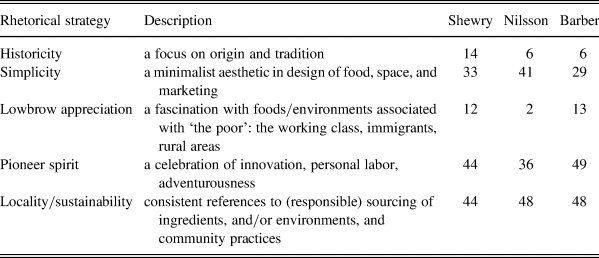
The analytical procedure began with the coding of the posts, and this was conducted on two levels. In orienting to ‘elite authenticity’ as explained by Mapes (Reference Mapes2018), the first round of coding focused on the rhetorical strategies she outlined (see Table 2 for descriptions). As a recent framework for examining contemporary, ‘elite’ eating specifically, we found it to be a useful starting point. Each researcher conducted the coding individually first, and then resulting codes were compared to produce a final set, which can be seen in Table 2—note that many posts were coded as demonstrating more than one rhetorical strategy.
Mapes’ (Reference Mapes2018) rhetorical strategies of ‘elite authenticity’.

The most frequent rhetorical strategy observed was Locality/Sustainability, evidenced by an emphasis on horticultural processes and growth, and sourcing of ingredients. Included in these posts were consistent references to the personal labor invested by the chefs and their teams of staff alongside innovative practices; this explains why the rhetorical strategy of Pioneer Spirit was also observed in the vast majority of the posts.
Guided by these results, the second level of coding involved an explicit focus on Locality/Sustainability as well as Pioneer Spirit. Although Simplicity was also coded significantly within many of the posts, those demonstrating this rhetorical strategy tended to focus purely on the visual of ‘plated dishes’ rather than giving insight into other aspects of the discourse. For this reason, we decided to orient specifically to Locality/Sustainability and Pioneer Spirit. After independently coding these posts and comparing results, we confirmed three key tactics: (i) plant-based emphasis, (ii) local/community terroir, and (iii) realities of meat consumption. The analysis in the following section focuses on selected representative posts from each of these three categories. The analysis itself is guided, broadly speaking, by multimodal critical discourse analysis (MCDA), an analytical approach to discourse concerned primarily with the ‘analysis of semiotic resources and the semantic expansions which occur as semiotic choices combine’ (O'Halloran Reference O'Halloran, Hyland and Paltridge2011:121). Put more simply, we are concerned with the combined use of language (in the captions of the posts) and the content depicted in the images. This in turn connects with the Faircloughian view of discourse where any analysis must attend to a given text in terms of the social processes that produce it (Fairclough Reference Fairclough2013). In other words, it is important to look at ‘the relationships between what is communicated and the social realities tied to that communication’ (Milner Reference Milner2013:2362).
In the following section we apply the analytical principals of MCDA to explore the combination of text and image as semiotic resources in these chefs’ Instagram posts. For the sake of space, we have selected just two posts within each of the three main tactics—each is especially representative of the dataset, and also of Barber, Shewry, and Nilsson's enacted identities as chefs and Instagram users. Ultimately, we explore their performances of elite authenticity, as well as their relationships to the normativities entangled with contemporary social life.
Analysis
Plant-based emphasis
The first of the strategies to emerge from our analysis of the dataset is that of ‘plant-based emphasis’, which we broadly define as showcasing the innovative use of plant-based foods, often in a way suggestive of meat-replacement potential. This emphasis is attached to numerous motives and perspectives inclusive of the biopolitics of food (e.g. what to eat and for what reasons; how food is produced; where it comes from, and so on; see Goodman, Johnson, & Cairns Reference Goodman, Johnston; and Cairns2017), with a specific focus on sustainability combined with terroir, a concept we elaborate on in the subsequent section. The manner in which the chefs present their plant-themed posts (among others) reflects what Bush (Reference Bush2019:22) refers to as the need for contemporary chefs to ‘defer to more palatable (i.e. enlightened, progressive, feminist) approaches all the while maintaining some sense of rawness’. A key characteristic of the posts in Figures 1 and 2 (as well as numerous others from our dataset) is the deployment of processes of recontextualization, an oft-discussed strategy across a broad range of approaches to discourse. According to Kryżanowski (Reference Kryżanowski2016:314), recontextualization is a ‘description of a certain movement of various elements of language and discourse across different social loci’, and this occurs to the greatest extent between various productive and receptive sites of discourse (Van Dijk Reference Van Dijk, Bruhn-Jensen and Jankowski1991). In our study we associate the notion not with ‘texts’ per se, but rather with the ways in which an idea or a material object carries new meaning-making potential when depicted in a context different to where it might traditionally appear. In other words, the posts demonstrate how an element of food and dining can be removed from the context it is typically associated with and transplanted into a new one. This process of recontextualization acts as a tool for the chefs to highlight their battle against perceived normativities, and the journey towards new ones.
Ben Shewry's ‘just a spud’.

Dan Barber's fried ‘chicken’ sandwich.

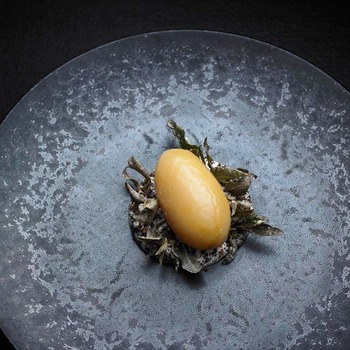
In extract (1), from an August 2018 post, Ben Shewry (of Attica restaurant) presents a historical recount of the development of one of his restaurant's signature dishes, ‘Potato Cooked in Earth’ (see Figure 1 for the post's accompanying image).
(1)
1 In 2009 the development of this dish represented a turning point at Attica. It was as
2 personal of a dish as I'd created up to that point and perhaps the most individual. It's
3 hard to believe now that both creatively and financially the restaurant was on a knife
4 edge during that time and this small piece of work brought change and good fortune
5 to a business that should have failed. I never considered it at the time as the reaction
6 to serving ‘just a spud’ wasn't exactly a positive one. More than once I've been
7 asked ‘where's the meat mate?’. Goes to show how quickly attitudes can change as
8 today people think nothing of seeing vegetables play a central role on menus. For
9 many years I turned my back on this dish but a free mind these past few months
10 have allowed me to revisit it in a new and interesting way. Looking forward to
11 sharing it with you soon. #spuds #longwindeddishnames
The potato's recontextualization is evident in both the caption and the image. Potatoes traditionally have associations with the working class (e.g. Gazeley & Newell Reference Gazeley and Newell2013), and are relatively simple to cultivate. However, in Figure 1, this vegetable is lifted into the domain of ‘haute cuisine’ and fine dining through its presentation in an aesthetically simple and pleasing manner with ample ‘white space’ (albeit black, in this case). The potato's modern and minimalist plating serves to increase its status as an ingredient, and likewise allows those who consume it to claim elevated status as a result. In this regard, irony abounds; historically, this is an ingredient upon which the poor would often rely as a staple, but it is now visible in a context where few could comfortably afford to eat it.Footnote 3 Further, in line 6, Shewry refers to the reactions of his diners when he served ‘just a spud’. The juxtaposition of the slang term ‘spud’ as well as the adverb ‘just’ on the one hand, against the image and the reputation of Shewry and Attica on the other, adds to this ironic tone: a working-class staple of simple household cooking is described as the ‘savior’ of an expensive, fine-dining restaurant. That is, Shewry's description reminds us of the potato's origins and can therefore be seen as a tactic to diminish eliteness; however, at the same time its presentation within this high-status context elevates it out of such traditional connotations. Here, it is clearly not just a spud.
Shewry more explicitly highlights his progressive embracing of plant-based foods by drawing attention to the shifting attitudes towards vegetables within the context he operates. In lines 6–8 he alludes to the occasions he has been questioned over the absence of meat—normally seen as an essential component of fine dining menus. He goes on to state that it ‘goes to show how quickly attitudes can change as today people think nothing of seeing vegetables play a central role on menus’. Shewry's discourse here represents what Mapes (Reference Mapes2018) terms ‘pioneer spirit’, which is characterized by an emphasis on innovation and improvement—and is a key element of elite authenticity. Although the instigation of the creative practice of making a simple vegetable the hero ingredient of a dish in the ‘haute cuisine’ context cannot be attributed to Shewry personally, he nonetheless seems to claim that he transformed this formerly antinormative practice (he describes the dish as ‘personal’ and ‘individual’, line 2, and as initially eliciting ridicule) into an acceptable, mainstream one. Indeed, this potato is more or less credited with the development of Shewry's identity as innovative and adventurous, as it seems to have paved the way for his featuring plant-based foods within a fine dining context. Additionally, he adopts a reflexive (and mildly self-congratulatory) tone throughout the post, asserting that this dish ‘brought change and good fortune’ to the restaurant when it was in a time of financial and creative peril (lines 3–5). As we discussed earlier, this sort of personal self-awareness is a significant feature of neoliberal ideology and logic (Binkley Reference Binkley, Cahill, Cooper, Konings and Primrose2018). By highlighting the risk he took in advancing a plant-based, environmentally-friendly menu, Shewry also confirms his status as a successful neoliberal competitor.
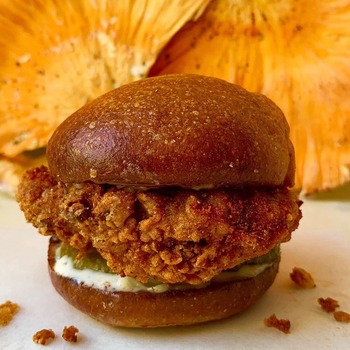
Among other posts reflecting a plant-based emphasis is extract (2), a caption of Dan Barber's from September 2019 (accompanied by the image in Figure 2). The post features a ‘chicken mushroom’ sandwich, which is visually almost identical to a traditional fried chicken sandwich one might find at fast food chains (like Popeyes) in the United States. The ‘chicken mushroom’ is one of numerous names for a species of edible mushroom found in most parts of the world.
(2)
1 Dear Popeyes,
2 No doubt you'll soon follow your record breaking chicken sandwich with a vegetarian, fake
3 meat substitute. But before going with a genetically modified, industrially processed, plant-
4 based and yet fully patented food substance called ‘a meat alternative’, what about this: a
5 chicken mushroom chicken sandwich—made with foraged chicken mushrooms, a golden
6 crust and a 100% whole wheat bun. (Swipe) Good enough for sous chef Cam's pre-service
7 snack. #chickensandwichwars @popeyeslouisianakitchen
The recontextualization here is obvious, but only through the support offered by the caption; on first look most would indeed assume this to be a fried chicken sandwich. Visually it aligns with its fast food counterpart. However, the recontextualization is confirmed by the caption, which states that the chicken has been used as a conduit for plant-based, sustainably acquired ingredients. In other words, what looks like a typical, unhealthy fried sandwich is actually now positioned within the context of more sustainable, healthy eating with ‘foraged’ mushrooms and a ‘whole wheat’ bun (lines 5–6). What we find most interesting, however, is how Barber positions himself against the neoliberal normativities of large, corporate restaurant franchises. First, in lines 2–4 Barber predicts that Popeyes will ultimately pursue a nonmeat sandwich as a menu item. He then takes on a pre-emptive, accusatory tone, presuming that the restaurant will opt only for a meat substitute that is ‘genetically modified’, ‘industrially processed’, and ‘fully patented’ (lines 3–4). This positions Popeyes, in catering to anticipated customer dietary requirements (e.g. vegetarian/vegan), as aligning with more neoliberal tendencies towards nonorganic products, unsustainability, and profitability. It is also not insignificant that the caption concludes in line 7 with the ‘#chickensandwichwars’ hashtag (and by tagging Popeyes’ official Instagram account). While on the surface this is seemingly an in-jest reference to a war between Barber's faux chicken sandwich and Popeyes, the hashtag carries an intertextual reference to the widely reported ‘chicken sandwich war’ between Popeyes and Chik-Fil-A (see Ciment Reference Ciment2019). This, in turn, was a contemporary iteration of the ‘burger war’ between McDonald's, Burger King and Wendy's in the 1980s.Footnote 4 Thus, in adopting this hashtag, Barber intertexually (and playfully) inserts his high-end restaurant into the discourse domain of more low-brow fast food. In so doing, he also simultaneously injects his sustainable views into the domain of more neoliberal motives and ideology—despite attributing these more ‘corporate’ qualities to Popeyes.
Nevertheless, in direct contrast to the franchise's popular, mass-produced fried chicken, the ‘chicken mushroom’ sandwich featured in Barber's post is comprised of a locally ‘foraged’ ingredient, sourced directly from nature; this sustainable practice seems to be representative of a kind of ‘ethical capital’ (Lewis & Huber Reference Lewis and Huber2015), itself a derivative of what Bourdieu (Reference Bourdieu and Nice1984) would term ‘symbolic capital’ in the sense that it ‘operates in specific relation to the acquisition, performance and recognition of expertise in matters of ethical concern’ (Lewis & Huber Reference Lewis and Huber2015:290). When applied to this post, it acts as a demonstration of Barber's commitment to ethical and local modes of food provenance. Additionally, in terms of elite authenticity, the specific emphasis on the chicken mushroom and its recontextualization into a variant of fried chicken serves to mitigate Barber's eliteness. His sustainable, health-oriented ideals do not preclude him from enjoying lowbrow ‘fast food’, but rather simply elevate his experience—they allow him to be simultaneously virtuous and ‘common’ (cf. Bourdieu Reference Bourdieu, Thompson, Raymond and Adamson1991 and Mapes Reference Mapes2018 on ‘playing’ with low culture). Thus, while Barber claims patently antinormative, ethical (and symbolic) capital for himself and his restaurant, these environmentally progressive stances are at the same time ways of subtly—indeed, acceptably—engaging in contemporary status competition.
Local/community terroir
A second tactic that seems to demonstrate the simultaneous (dis)avowal of distinction is the chefs’ continual emphasis on locality as it relates specifically to community involvement/awareness and terroir—both literally, and metaphorically. Terroir has been discussed at length by various scholars in the context of food and language alike (e.g. Cavanaugh Reference Cavanaugh2007; Silverstein Reference Silverstein, Lacoste, Leimgruber and Breyer2014). While it typically refers to the explicit connection between place and taste (grapes grown in particular regions produce particular sorts of wine, for example), the term has also come to symbolize and index the relationship between humans and the earth (cf. Trubek Reference Trubek2008), as well as the relationships between the various stakeholders involved in producing ‘local’ goods (see Cavanaugh Reference Cavanaugh2007 on Bergamasco salami production). But across these different connotations, terroir operates as a means of attributing morality, value, and good taste to food practices. These arguably naturalized indexicalities emerge routinely in our Instagram dataset. In extract (3), for example, chef Magnus Nilsson praises his restaurant Fäviken's local produce and suppliers in a post from September 2017.
-
(3)
1 I don't think I have ever worked in a restaurant where more exceptional produce roll
2 through the doors than it does @faviken For soon to be ten years we have been looking
3 for the most passionate new suppliers in our region at same time as we have been
4 cultivating our existing relationships carefully. For us to start buying food from someone
5 is to enter an intimate relationship of mutual learning in the pursuit of perfect raw
6 material. We are not satisfied to just buy stuff from anyone, we want to get to know the
7 people behind the products, we want to learn from them, and we want to help figure out
8 ways to improve things when we can. I am so proud of the supplier network we have
9 built, they are truly the foundation of everything Fäviken is today. This pine mushroom
10 came in a moment ago. A truly perfect specimen. I will grill it and a few others of similar
11 quality tomorrow. #matustake #wonderwhatthisonewouldcostinjapan
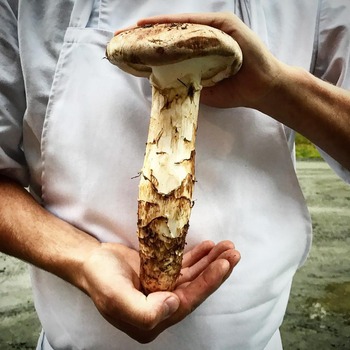
Note that the chef's emphasis at both the beginning of the caption and the end is on quality. Nilsson first uses ‘exceptional’ (line 1) to describe the restaurant's produce, and then goes on to call the featured mushroom ‘a truly perfect specimen’ (line 10), which is notably accompanied by others of ‘similar quality’ (lines 10–11). These book-end evaluations are perhaps indicative of what Tannen (Reference Tannen1989/2007:77) calls ‘bounding episodes’ in conversation. This sort of device speaks to the ritualized nature of openings and closings in discourse, and how repetition might serve to emphatically delineate these moments in Instagram captions. Additionally, the focus on quality from the outset also seems to align with the corresponding photograph (Figure 3), in which the sheer size of the mushroom is the most striking feature; while ‘bigger is better’ is a contested (and arguably normative) mantra, it does still proliferate in popular culture. This image therefore reinforces the chef's claims to exceptionalism and ‘perfect raw material[s]’ (lines 5–6), while at the same time calling into question the real semantic meaning of words like ‘quality’, and their ubiquitous use across all types of food discourse (cf. Thurlow & Jaworski Reference Thurlow, Jaworski, Cavanaugh and Shankar2017b on ‘elite’ as a floating signifier). However, Nilsson's followers do receive some clues regarding this particular mushroom's worthiness; it is a ‘pine’ (line 9) or ‘matsutake’ (line 11) mushroom which is a rare species native to northern Europe and parts of North America and Asia. With specific growth requirements, this mushroom is difficult to cultivate and typically quite expensive—especially in Japan.Footnote 5 In the case of Nilsson's restaurant, it is only available because of Sweden's distinctive climate and landscape. Thus, it is arguably this mushroom's unique terroir that lends it value.
Magnus Nilsson's pine mushroom.

At the same time, Fäviken's ‘exceptional’ produce here also discursively hinges on small-scale production chains and local relationships. The chef begins in line 2 to refer to his restaurant's history of working with regional suppliers who are ‘passionate’ (line 3). Importantly, it is not just that they continue to buy produce from trusted sources, but they are also continually seeking new ones. Once again, local and sustainable eating is routinely touted as a pioneering endeavor requiring hard work and discernment. These go hand in hand with neoliberal ideals, which resolutely prioritize individual responsibility over external conditions (e.g. Harvey Reference Harvey2003). In this vein, Nilsson asserts his restaurant's particular commitment to—and aptitude for—determining what is worthy of consumption, noting that they ‘are not satisfied to just buy stuff from anyone’ (line 6). Rather, they want to ‘know the people behind the products’ (lines 6–7), and ‘enter an intimate relationship’ (line 5). These are all, on the one hand, indications of environmentally responsible consumerism. Be that as it may, on the other, they also covertly point to more status-producing notions of expertise and good taste. As Meneley (Reference Meneley2004) reveals in her study concerning ‘Slow food’ and extra virgin olive oil, seemingly populist preferences for local terroir and community relationships can still be steeped in complicated class anxieties.
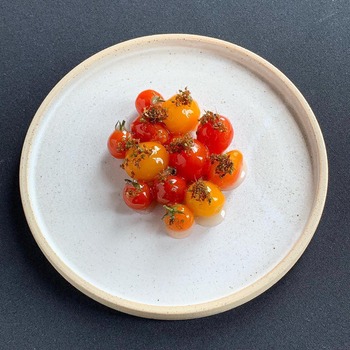
At times, a chef's emphasis on locality/sustainability might also be directly linked to authentic language practices. Indeed, successful competition in late capitalism often entails adding material and symbolic value to products that might otherwise be uninteresting (see Duchêne & Heller Reference Duchêne and Heller2012; also Mapes Reference Mapes2020). The prevalence of foods from rural peripheries is one example of these systems at work. For instance, extract (4), a post of Ben Shewry's from January 2019, demonstrates the chef's focus on indigenous Australians’ language and ingredients. Not only does he elaborate on the particularities of the native ingredient featured in this dish (as seen in Figure 4), but he also instructs followers on the pronunciation of its name in the Gurr-Goni language.
-
(4)
1 Ngerdi means green ant in Gurr-Goni language. These green ants come from lands
2 surrounding Maningrida, West Arnhem Land, Northern Territory, where Gurr-Goni is
3 one of 12 completely different languages spoken. Ngerdi is pronounced by saying NG the
4 same as the NG in sing or singer (but not as in anger or danger) so it is said Ng-er-di.
5 Phonetically I like to remember it as ‘nerdy’ but I hold the Ng a little at the start.
6 Tomatoes picked from our garden each day (never refrigerated) are tossed with pineapple
7 and Green Ant gin dressing (thank you @somethingwildaus) and finished with a liberal
8 amount of Ngerdi. Thank you to our friends at the Bawinanga aboriginal corporation who
9 provide us with this exceptional ingredient but more than that we are grateful for gift of
10 culture and language context that connects this food to its people.
Ben Shewry's Ngerdi tomatoes.

The caption in its entirety exemplifies epistemic stancetaking (e.g. Jaffe Reference Jaffe and Jaffe2009); Shewry's claims to knowledge dominate most of the extract, including the geographical origin of this particular language (‘West Arnhem Land, Northern Territory’, line 2), the number of neighboring languages (line 3), as well as /ŋ/ pronunciation of ‘ngerdi’, which he describes in some detail (lines 4–5). It is his painstaking emphasis on this word's pronunciation that is striking to us, not least because we suspect Shewry's followers are less interested in the correct way to pronounce this dish than in the actual ingredients that comprise it—this information is withheld until line 6, however. By distinguishing between the ‘ng’ used in ‘singer’, ‘anger’, and ‘danger’ (line 4), Shewry demonstrates specific, specialized knowledge and thereby establishes his relative authority. He even goes as far as to suggest a trick for producing ‘ngerdi’ correctly, admitting he remembers it as ‘nerdy’ but holds ‘the Ng a little at the start’ (line 5). This additional anecdote seems to strategically mitigate his (potentially overbearing) expertise, but at the same time serves as proof of his actual, physical production of the indigenous word. In this sense, ‘ngerdi’ does dual work: it lends credibility and value to the local terroir of the dish itself, while also elevating Shewry for possessing the linguistic knowledge (and ‘humanitarian’ willingness) to call the green ants by their indigenous name. Indeed, as Heyd & Schneider (Reference Heyd and Schneider2019:445) point out regarding translingual practices, it is worthwhile to ask who actually ‘profits’ from this sort of ‘flexible, non-standardized, “wild” [use] of language’. In this particular case, it is Shewry, and most probably not the people to whom this food and language belong (see line 10). Thus, a valuing of local terroir—in terms of both ingredients and language—is not so simply environmentally-friendly and forward-thinking/inclusive. Rather, this blurring of democratic ideals with normalized notions of ‘good taste’ serves to complicate and obscure people's elite eating.
Visually, however, this dish is certainly reminiscent of more typical ‘haute cuisine’ (see Figure 4). The tomatoes with ‘pineapple and Green Ant gin dressing’ (line 7) are centered on a pristine plate, surrounded by status-producing (white) space (cf. Thurlow & Jaworski Reference Thurlow, Jaworski, Jaworski and Thurlow2010). This style of minimalist plating is common for this caliber of restaurant (cf. Mapes Reference Mapes2021); however, the plate itself appears to be hand-crafted stoneware instead of the delicate porcelain typically used in traditional fine dining (e.g. note the ridge, and the subtle speckling). And in fact, elsewhere in the dataset Shewry explicitly references using Australian-made pottery in his restaurant. While this locally oriented update to a classic convention showcases the chef's commitment to his community, it also represents the virtue-signaling required of those who are both progressive and privileged (Kenway & Lazarus Reference Kenway and Lazarus2017). This practice is displayed also in Shewry's emphasizing the ‘tomatoes picked from our garden each day (never refrigerated)’ (line 6), as well as the ‘ngerdi’ themselves—these green ants are perhaps the ultimate example of sustainable food sourcing, as they are an environmentally-friendly meat alternative. In this way, Shewry's discourse here demonstrates the careful, hedged, ‘omnivorous’ performances of appropriate eliteness (see Khan Reference Khan, Birtchnell and Caletrío2014).
Realities of meat consumption
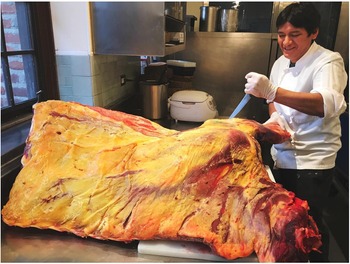
The ethics of humane, controlled meat production have long been a topic of popular interest—perhaps even since Upton Sinclair's (Reference Sinclair1906/1985) famous book The jungle, which exposed not only the plight of immigrant working conditions in Chicago in the early twentieth century, but also the abysmal health and sanitation violations of the meat industry. While health and safety regulations have obviously evolved since the 1900s, current environmental and sociopolitical conditions have led to a public interest in factory farming practices, including animal welfare, use of antibiotics and growth hormones, water contamination, and methane production (e.g. Pollan Reference Pollan2006; Weiss Reference Weiss2016). These concerns have, in turn, fueled the rise of so-called ethically produced meat products based in small-scale, local farming; humane treatment of animals; grass-fed and/or organic diets; and using butchered animals in their entirety (see Mapes Reference Mapes2020 for a case study of this sort of meat production in Switzerland). It is no surprise that the chefs in our dataset emphasized these sorts of meat products in their Instagram posts. However, they often did so using striking images of animal/fish carcasses, and lengthy captions explaining particular nuances of the meat industry. Extract (5), from December 2018, demonstrates how Dan Barber uses a photograph of a butchered steer (and butcher Jose Morquecho) to educate his followers on the perils of standard meat production practices in the US.
(5)
1 I can't explain this. I'm not talking about Blue Hill butcher Jose Morquecho's smile,
2 which is as rare to see as that carpet of yellow fat covering the 30 month old grass-fed
3 steer. We've seen unbelievable yellow fat like this before—always from an animal on a
4 grass fed diet—but usually a much older animal, 5+ years. The bright yellow hue is from
5 years of chomping on beta-carotene rich pasture—excess amounts of it get stored in the
6 animal's fat, especially at this time of year. Very few sources of protein are as nutrient
7 dense as what you're looking at. We've never seen anything like this from a cow that's
8 just 30 months. Here's why it matters; USDA rules require that all cows OVER 30
9 months get certain parts removed before human consumption like spinal cord, vertebral
10 column, skull, and eyes. Collectively these are called Specified Risk Material (SRM) and
11 they are classified as a ‘risk’ because scientists say mad cow disease is more likely to
12 develop in central nervous system tissue in cattle over 30 months. That is, when the
13 cow is given contaminated feed—usually with other animal parts. The ‘over 30 month
14 rule’ is hugely expensive, not to mention debilitatingly unfair to a grass fed farmer who
15 is trying to compete in a crowded, grain fed marketplace. If this cow had been any older,
16 Jose would have had to toss his best cuts (T-bone and porterhouse are just two that
17 include the cow's backbone). But somehow it just 30 months, it produced this fatty gold.
18 How? Genetics? (yes) Good grass management? (yes) A particularly happy cow (yes
19 again) Dumb luck (probably) or New Year's miracle (definitely). @seansfarmwagon
Aside from a clear display of specialized knowledge (much like extract (4) in the previous section), Barber's lengthy caption here is marked by its use of conversational ‘involvement strategies’ (Tannen Reference Tannen1989/2007), which in turn serve to colloquialize the caption. For instance, the chef opens the extract with ‘I can't explain this’ (line 1), a phrase that seems relatively dialogic—as if Barber were face-to-face with his audience, discussing the photograph together. And he continues in line 1 with ‘I'm not talking about…’, a verb choice that explicitly implies he views his caption as a somehow audible practice. There are moments throughout the rest of the extract that accomplish the same effect, in which Instagram followers’ physical presence and potential responses to the content are seemingly directly acknowledged: the phrase ‘what you're looking at’ (line 7), ‘here's why it matters’ (line 8), and the series of rhetorical questions (which the chef answers himself) in lines 18–19. While the content is highly instructional and demonstrates rather extreme expertise, because of Barber's use of involvement strategies it is also seemingly friendly, and relatable. As Tannen argues, dialogic writing of this kind can help readers feel like active participants—arguably, social media enhances this sort of co-collaborative mentality (e.g. Squires Reference Squires, Georgakopoulou and Spilioti2016). Thus, Barber's colloquial phrasing seems to discursively construct his followers as like-minded peers who nonetheless still need to be schooled in the real merits (and realities) of grass-fed beef (cf. Mapes Reference Mapes2018).
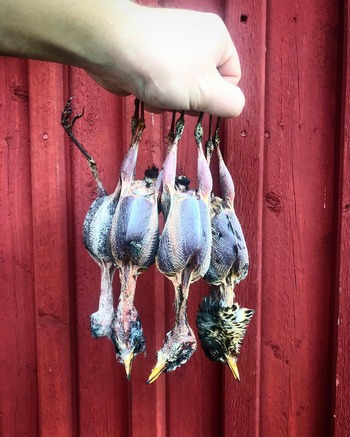
While the bulk of the written caption provides instructional information concerning USDA regulations for meat production/consumption (which Barber obviously finds problematic), the accompanying image could perhaps be viewed as a lesson in and of itself (see Figure 5). Indeed, when we examined the data we were both struck by the number of posts which featured animal and fish carcasses in the various stages of hunting/butchering (see also Figure 6). The ethic here, we presume, is that if people are going to eat meat, they should be comfortable with its origins, and with the process of an animal's death and preparation (as one commenter on Barber's post explicitly stated). Interestingly, none of the chefs address the potentially disturbing nature of these images for laypeople (in other words, Instagram users who are not farmers, butchers, or chefs), suggesting that this sort of familiarity is commonplace. However, most of us meat eaters (and certainly vegetarians/vegans) do not encounter our eventual meals at this stage of butchering. In essence, it seems that part of Barber's goal in posting this photograph is to provide his followers with an ‘authentic’ glimpse of meat preparation done right—he states emphatically that this was a ‘particularly happy cow’ with superb genetics, which was raised on appropriately managed grass crops (line 18). All of which, presumably, justify the cow's butchering and eventual consumption in his restaurant. Mapes (Reference Mapes2021) also observes in interviews with Brooklyn restaurant owners that stakeholders in humane meat production oftentimes reframe their own practices as dichotomously opposed to the heightened commodification of factory-farmed animals in neoliberal economies. Thus, it appears that by highlighting the real labor behind meat eating (for example, in Figure 5 the butcher Jose Morquecho is in the process of actively cutting a slab of flesh off the cow), Barber attempts to distinguish his own restaurant from the sort of mindless consumption practiced by those who do not prioritize locality/sustainability (i.e. ‘the crowded, grain fed marketplace’, line 15). But in so doing, he is simultaneously afforded status and prestige for his ‘humane’ (and populist) behavior.
Dan Barber's butchered steer.

Magnus Nilsson's fieldfare.

Barber's discourse is not without more explicit claims to distinction, however. He focuses specifically on the unique yellow color of the cow's fat, which apparently renders the carcass picture-worthy. In fact, Barber refers to it is as ‘fatty gold’ (line 17; see Thurlow & Jaworski Reference Thurlow and Jaworski2006 on the metallic markers of eliteness) and emphasizes its exceptionality throughout the post, using words like ‘rare’ (line 2), ‘unbelievable’ (line 3) and the phrase, ‘we've never seen anything like this from a cow that's just 30 months’ (lines 7–8). This atypical characteristic of the meat is thus deployed as a particular marker of quality, along with its ‘nutrient dense’ (lines 6–7) and ‘beta-carotene rich’ (line 5) attributes; these additional health-oriented details elevate the prestige of the meat as it is not only environmentally-friendly, but also nutritionally beneficial to the consumer. As Johnston & Baumann (Reference Johnston and Baumann2009) note regarding ‘foodie’ media, discourses of local and sustainable eating tend to prioritize the needs of eaters (e.g. taste) above concerns for the environment, animals, or the local economy. Thus, for all of Barber's egalitarian involvement strategies and antinormative preferences for the realities of meat consumption/production, he still seems to strategically engage in the normative hierarchies of classic status competition.
So too does Magnus Nilsson in his photographs depicting animal carcasses. A post from September 2016, for example, features a striking image of a dead moose hanging from a helicopter, soaring above the tree line. Nilsson explains in the caption that the animal was shot in an ‘inconvenient spot’ and thus needs extra effort to be transported to the restaurant for butchering and serving. While the post certainly accentuates the realities of local meat sourcing for this Scandinavian restaurant, its rather extreme depiction of the actual labor involved serves as a reminder of the real expense incurred for providing particularly hard-to-get meat products. Extract (6), which Nilsson posted in September 2018, is another example of this sort of positioning.
(6)
1 One of the very yummiest of game birds. Fieldfare. Rare occasion. #gameseason
While ‘game’ connotes the natural wilderness, seasonality, and rural eating, Nilsson takes pains here to highlight the prestige of these otherwise simple and down-to-earth ‘fieldfare’. They are the ‘very yummiest’ and ‘rare’, both of which reinforce Fäviken's elite status—here diners experience ingredients that might be local, but are nonetheless not easily accessible. It is this tension that allows for the simultaneous (dis)avowal of privileged eating. The social status-quo is maintained not necessarily by those who demonstrate excessive wealth, but rather by progressive people who find ways of implicitly claiming superiority. Further complicating matters, however, is the corresponding image (Figure 6), which features four birds held upside down. First, the photograph reminds followers that these animals must be killed, plucked, and otherwise prepared for ‘elite’ consumption (cf. Thurlow & Jaworski Reference Thurlow, Jaworski, Birtchnell and Caletrío2014 on visible-invisible labor). Additionally, they are held in front of what seems to be the classic ‘falu red’ or falu rödfärg of Swedish cottages. Originally comprised of copper found in the soil, falu red paint is strongly associated with Swedish terroir, rurality, and tradition (see Andersson Reference Andersson2020 for an example of the use of falu red in Swedish food packaging). Thus, these prized game birds take on additional qualities of locality in their visual depiction, becoming (literally and figuratively) part of the historical/physical landscape. According to Duchêne & Heller (Reference Duchêne and Heller2012:10), their value is based partly on the ‘Romantic idea that nature confers authenticity, whether on things that come from it or on people who live close to it’. Once again, while chefs like Nilsson are pioneering (and certainly well-intentioned) in their attempts to highlight the realities of meat consumption, they continue to rely on the typical tenets of niche marketing in neoliberal economies to attribute value and prestige to their local/sustainable practices. In this way, these ‘progressive’ eaters are perhaps not truly transgressive or antinormative in their practices, but rather finding new, covert ways of claiming good taste and distinction.
Conclusion: Normative sustainability as ‘palatable’ privilege
Ultimately, the posts we have examined showcase the very complicated ways in which the environmental ethics of responsible eating are entangled with various other discourses—those pertaining to quality, class/status, authenticity, nation and politics, and popular culture, among others. As Hall et al. (Reference Hall2019:485) observe in the introduction to their special issue on normativity and sexuality, we must ‘avoid overly simplistic dichotomies between what is “normative” and what is “antinormative”, and instead…illustrate the various strategies individuals adopt to negotiate multiple, dynamic, overlapping, and, at times, contradictory normativities’. It is precisely this sort of complexity that we have sought to uncover in our analysis.
Overall, the data demonstrate Mapes’ (Reference Mapes2018) aforementioned discourse of elite authenticity, in which normalized rhetorics of historicity, simplicity, lowbrow appreciation, pioneer spirit, and locality/sustainability are multimodally deployed in the service of a simultaneous (dis)avowal of distinction. In particular, these chefs rely on appeals to the local and humane sourcing of ingredients, community welfare, and environmental equity in ways which both mitigate and paradoxically elevate their individual (and their restaurants’) social prestige. By visually and linguistically centering plant-based dishes, Shewry and Barber take ethical stands against corporate, meat-focused eating while at the same time relying on popular notions of neoliberal competition based on innovation and personal labor. Similarly, Nilsson and Shewry highlight local terroir as a means of engaging in small chains of production and indigenous communities—but these egalitarian efforts are not without more explicit claims to a superior, moral high ground. Lastly, Barber and Nilsson demonstrate the fraught dynamics of meat eating in their posts featuring deceased animals in various stages of preparation for diners. While they justifiably remind Instagram users of the real toil required for their carnivorous preferences, their written discourse and visual depictions are still rooted in more normative concepts such as quality, rarity, and distinction. Thus, their eating and cooking practices might be in accordance with environmental and community ethics, but these chefs’ principles are simultaneously caught up in the politics of class and social privilege.
To be sure, the sort of self-reflection and reflexivity present in our data is demanded of everyone nowadays. And importantly, self-discipline in consumerist choices is continually recontextualized as ‘progress’ (of society and individuals), or even as ‘lifelong learning’; as Herzog (Reference Herzog2016) notes, ‘truths’ that might be idealistic in their inception can still serve to maintain structures of power and inequality. In this regard, and according to Adkins (Reference Adkins2002:130), reflexivity is ‘not necessarily transformative or detraditionalizing’ but is rather often implicated in the maintaining of the status quo. Because of the compulsion to dissociate with privileged class positions, people pursue what they think of as individualist preferences for egalitarianism. But this (and these) are all inculcated in the neoliberal self ‘as reflexive manager’ (Gershon Reference Gershon2011:540). Thus, to borrow once again from Heyd & Schneider (Reference Heyd and Schneider2019:437–39), while social media like Instagram provide users the potential to self-stylize as ‘counter-publics’, it is perhaps more accurate to characterize our chefs here as ‘voices from nowhere’, representing dominant social groups in spite of their undoubtedly progressive and humanitarian motivations. This is not to say they are not admirable for their pursuit of environmentally-friendly eating. In fact, this is precisely the crux. In a world that relies heavily on dichotomous notions of ‘us’ and ‘them’, ‘good’ and ‘bad’, and ‘local’ and ‘global’, how do we, as social scientists, grapple with the ways in which our own ethical, knowledgeable politics is at the same time an apparatus for status competition and class maintenance? We raise this question not as an attack, but as a call for more critical engagement with the multifarious (and seemingly beneficial) discourses that are implicated in perpetuating social inequality.