The comprehension and production of relative clauses (RCs; e.g., Eckman, Bell, & Nelson, 1988; Gass, 1979; Hamilton, 1994; Izumi, 2003; O'Grady, Lee, & Choo, 2003; Pavesi, 1986; Wolfe-Qintero, 1992) has received considerable attention in second language (L2) acquisition (SLA) research. Most of the work on SLA provides robust evidence indicating that subject relative (SR) clauses such as Example 1a are easier to produce and comprehend than are direct object relative (OR) clauses such as Example 1b:
1. a. the man who loves the woman
b. the man who the woman loves
Studies on agrammatism also provide similar evidence for the comprehension of SRs and ORs (e.g., Grodzinsky, 1989). However, most of these studies are on languages like English, in which RCs follow the head noun. There are few studies on the languages where RCs precede the head noun such as Korean (O'Grady et al., 2003). The aim of this study is to discuss the levels of comprehension difficulty of subject and object RCs in Turkish, a left-branching language. In addition, superficial similarities between the linguistic performance of L2 speakers and those of agrammatic aphasic patients are compared.
In SLA literature, much work on the relative difficulty of processing and acquiring different types of RCs has been influenced by the work on the typology of RCs by Keenan and Comrie (1977; e.g., Eckman et al., 1988; Gass, 1979; Pavesi, 1986; Wolfe-Qintero, 1992). This typology is based on the markedness obtained from an extensive comparative study of RC structures in various typologically different languages. It focuses on the positions of the noun phrase (NP) that can be relativized, which vary among different languages of the world in a systematic way. According to this typology, if a language permits relativization of NPs of a particular type, for example indirect object, then those NPs of the type that are located higher in the hierarchy (in this case, direct object and subject) may also undergo relativization, as illustrated in the following:
2. subject > direct object > indirect object > oblique > genitive
In line with Keenan and Comrie's hierarchy, there have been efforts to explain the relative difficulty of acquiring different types of RCs. For instance, Tarollo and Myhill (1983) and Hawkins (1989) have hypothesized that the relative difficulty of acquiring different types of RCs is not because of the relational status of the NP extraction site. Rather, it is because of the proximity of the head of RC to that extraction site from the wh-phrase. In other words, according to these researchers, this hierarchy results from the linear distance between the gap and head noun. For example, in Example 3a, there is only one word between the gap and head noun, whereas in Example 3b there are four words between the gap and head noun.

The way of calculating the linear distance between the gap and head noun is not simply to count the number of intervening words. Another way is to calculate only the elements that introduce new discourse referents (e.g., Babyonyshev & Gibson, 1999, pp. 425–426). Such a calculation would leave no discourse referents between the gap and head noun in Example 4a, and only two in Example 4b. Following O'Grady et al. (2003), this hypothesis is called the linear distance hypothesis (LDH), which is formulated as follows: the difficulty of an RC is determined by the number of elements (words or words with discourse referents) that intervene between the gap and the head. Thus, the LDH brings a similar prediction to Keenan and Comrie's hierarchy in that SRs should be easier to comprehend than ORs in English.
Although Tarollo and Myhill (1983) and Hawkins (1989) propose that the difficulty of RC is determined by the number of words that intervene between the gap and the head, in another proposal, called the structural distance hypothesis (SDH), this difficulty is determined by structural distance, which is the number of phrasal boundaries that intervene between the gap and the head (e.g., Collins, 1994; O'Grady, 1997; Hawkins, 1999). This hypothesis offers different ways to determine the structural distance between the gap and the head. One possibility is to count the nodes intervening between the gap and the head of the RC. As shown in Example 4, the structural distance between the gap and the head is larger in a direct object RC than in an SR clause. In contrast, Collins counts X′ projections as well as XP projections. However, all approaches within the SDH exhibit the same predictions for English RCs, namely, that SRs will be easier to comprehend than ORs. Thus, following O'Grady et al. (2003), the SDH can be formulated as follows: the difficulty of an RC is determined by the depth of the gap corresponding to the relativized element.

It is interesting that there is evidence that SRs are easier to comprehend than are ORs, not only in the SLA literature but also in the literature about agrammatic1
It is generally understood that paragrammatics, whose linguistic deficits are connected with Wernicke syndrome, exhibit fluent and grammatical speech but numerous substitutions, whereas agrammatics, whose linguistic deficits are connected with Broca aphasia, have severely impaired syntactic processing. In this article, we will concentrate on agrammatism.
5. a. Trace deletion: traces in theta positions are deleted from agrammatic representation.
b. R-strategy: assign a referential NP a role suited to its linear position if and only if it has no theta role.
According to TBA, there is no trace in agrammatism, and therefore, the syntactic relations cannot be computed by the linguistic system of the agrammatic. Assignment of theta roles to such moved referential NPs, which are normally transmitted through the trace, cannot take place. Therefore, assignment of theta roles to moved referential NPs occurs in accordance to linear position:
6. a. the man who loves the woman
AGENT
b. *the man who the woman loves
AGENT
Even though obvious similarities between L2 learners and agrammatic aphasic patients are noticeable, to our knowledge, no research has been pursued directly comparing these groups in terms of their use of RCs, even though there are studies that focus on the similarities between L1 acquisition and Broca aphasia. According to Ouhalla (1993), there are missing functional categories and projections of these categories both in language acquisition and in Broca aphasia. In a study that compares very early first language (L1) learners, children with specific language impairment (SLI), adult L2 learners, and patients with Broca aphasia, Platzack (2001) argues that all these groups are able to produce the syntax of the inflectional domain, a domain that refers to IP and lower phrases, licensing thematic relations (argument structure, specific theta roles) and licensing grammatical properties (case, agreement, verbal morphology) in a targetlike way, whereas their production of the complementizer domain, a domain that is the highest structural level, licensing discoursal dependencies (topic, focus, wh-, clause typing, etc.) related phenomena, is not fully targetlike.
TURKISH RCs IN RESPECT TO SLA AND AGRAMMATIC DATA
An overview of Turkish RCs
In Turkish, RCs are right headed, and there is no overt complementizer or any overt wh-element in RCs.2
It should be noted that there are also some left-headed patterns with overt complementizer in Turkish, which are borrowed from Persian:

Turkish also has RCs with resumptive pronouns. In Turkish, the reflexive pronoun kendi (self) can be used as a resumptive pronoun, but this use of it is restricted to the third person singular or plural pronoun forms. According to Meral (2004), the resumptive pronouns in Turkish are optional in some syntactic positions and obligatory in some others.
7. [eikadın-ı sev-en] adami
woman-ACC LOVE-SPart man
“the man who loves the woman”
8. [kadın-ın eisev-diğ-i] adami
woman-GEN LOVE-OPart-3s man
“the man who the woman loves”
The two types of relativization in Examples 7 and 8 differ from each other with respect to their internal morphology. The subject is relativized by the suffix -An added to the predicative complement without any agreement morphology. A nonsubject element, in contrast, is relativized by adding the suffix -DIK on the predicative complement, which requires conjugation in accordance with subject agreement morphology.4
It is to be noted that -An and -DIK suffixes are used for nonfuture tense. The other nominalization suffix -AcAk is used in RCs with the future tense. However, in this study, this suffix will not concern us.
The first observation in generative grammar literature about two different types of RC constructions belongs to Underhill (1972). Hankamer and Knecht (1976) also develop an analysis of RC constructions in Turkish. According to Hankamer and Knecht, relativization of a nonsubject requires the agreeing -DIK form of the participle whereas relativization of the subject of the participle requires the nonagreeing -An form.

In deriving SRs (Example 9), the subject DP, adam (man), moves to [Spec, tense phrase (TP)] to satisfy the extended projection principle (EPP) and is extracted from the TP. Conversely, in the derivation of ORs, as shown in Example 10, the object determiner phrase (DP), adam is extracted from the VP, and the subject DP, kadının (woman) moves to [Spec, TP] to satisfy EPP.6
The common understanding of RCs says that they contain a null operator movement chain (Chomsky, 1977). A null operator is base generated in the position that is relativized and then moved to [Spec, CP]. However, Cagri (2005) claims that the DP itself moves all the way to [Spec, CP] to satisfy the EPP on C0, rather than there is operator movement.
Studies of RC acquisition in Turkish
Findings indicating the fact that SRs are easier to comprehend than ORs, and the hypotheses mentioned above that explain the relative difficulty hierarchy are based on studies that take the English language as their basis. There are also findings in the literature, however, that indicate a hierarchy of relative difficulty in the acquisition of RC types in Turkish, where RCs precede the head noun. Although no research has been carried out on the comprehension of Turkish RCs in L2 speakers, the issue of comprehension of Turkish RCs has been the subject of much recent work in L1 acquisition (e.g., Aarssen, 1996; Ekmekçi, 1990; Slobin, 1986; Özcan, 1997). Slobin (1986) compares the development and use of RCs in the speech of English-speaking and Turkish-speaking children. He argues that acquisition of RCs in Turkish is much slower, and happens later when compared to English. He mentions 19 RCs used by 2- to 4-year-old Turkish monolingual children in his study. This number is about half the number of RCs used by English children in the same age group. This difference is explained by the fact that there are two psycholinguistic processing problems in Turkish, the first one being the nonfinite verb forms in Turkish that are not recognized as interpretable verbs by children. The second problem is that the construction of SRs and ORs is not uniform in Turkish. Slobin (1986) claims that the genitive marking of the subject of the ORs is quite distant from the canonical clause structure in Turkish (see Example 11). Therefore, he argues that use of ORs is more difficult and problematic than that of SRs in Turkish (Slobin, 1986, p. 282).
11. Lama-nin elle-diğ-i kaz kedi-yi ısır-sın.
llama-GEN touch-OPart-3s goose cat-ACC bite OPT7
The abbreviations used for Japanese, Korean, and Turkish data are the following: 3s (third personal suffix), ABL (ablative case), ACC (accusative case), DAT (dative case), GEN (genitive case), NEG (negative), OPart (object participle), OPT (optative), Part (participle), PAST (past tense), PRES (present tense), SPart (subject participle).
“The goose that the llama touches should bite the cat.”
Another study supporting the appearance of SRs before ORs in child speech is Ekmekçi (1990). Ekmekçi investigates the nature of children's production and imitation of RCs in Turkish. She demonstrates that children show a better performance in the production of SRs than in the production of ORs.
Conversely, Aarssen (1996) and Özcan (1997) investigate four specific types of RCs, namely, SS, SO, OS, and OO, depending on the grammatical function of NPs within the given statement. The first letters of the abbreviations (S/O) represent the syntactic function of the head NP in the main clause, and the second letters stand for that of the head NP in the RC.8
For instance, for the “SO” type sentences, “S” indicates that the head noun of the RC is the subject in the main clause, whereas “O” indicates that it is the object in the RC. This and the other types are exemplified here:

Turkish RCs in respect to LDH and SDH
As discussed earlier, the SR is acquired and processed more easily in languages such as English, no matter if this is because of the number of intervening words or because of phrasal boundaries between the gap and the head. However, predictions of the two suggestions differ in languages with a different typology, as O'Grady et al. (2003) displayed with Korean data. Unlike English and similar to Korean, Turkish is also a case in point. In Turkish, a direct object gap is linearly closer to head than to subject gap (Example 12), but the subject gap is structurally closer to the head than is the direct object gap (Example 13).
12. linear distance

13. phrasal boundaries

The LDH that determines the difficulty of RCs by the number of words that intervene between the gap and the head suggests that OR should be easier to comprehend than SR in Turkish. In contrast, the SDH, which determines the difficulty of RCs by the number of phrasal boundaries that intervene between the gap and the head, suggests that SR should be easier than OR in Turkish. As can be seen above, although the two hypotheses generate the same predictions for English RCs, these predictions diverge in Turkish. With the combination of these features, Turkish makes a challenging language that will possibly provide appealing results in terms of LDH and SDH.
Turkish RCs in respect to agrammatic data
The facts arising from the right-headed nature of Turkish RCs can be accounted for by Grodzinsky's (1995) proposal, which asserts the difficulty of different types of RCs for agrammatic aphasic patients. With reference to this proposal, Turkish patients cannot access the theta roles carried by traces. Instead, they use the R-strategy and linearly assign an agent role in SRs to the first NP they encounter, as shown in Example 14. However, if the sentences are ORs, as in Example 15, the R-strategy can be successfully used to determine the correct theta role. In other words, because patients use the R-strategy, they fail to assign the correct theta role to constituents in SRs but not in ORs.
14. *kadın-ı sev-en adam
woman-ACC LOVE-SPart man
AGENT
“the man who loves the woman”
15. kadın-ın sev-diğ-i adam
woman-GEN LOVE-OPart-3s man
AGENT
“the man who the woman loves”
Based on this background information, this study addresses the following research questions in relation to SLA data and agrammatic data.
- Does the hypothesis that purports that the processing of SRs is easier than that of ORs have any relevance for Turkish, a right-branching language? Is it possible to determine such a hierarchy with respect to the LDH or to the SDH?
- What is the relation between the RC comprehension performances of agrammatics and that of various levels of L2 speakers in terms of trace deletion and R-strategy?
METHOD
Participants
The L2 data was collected from a total of 32 participants who were enrolled in Turkish L2 programs at Ankara University TÖMER Language Teaching Center and at the Active Languages Turkish Teaching Center. All participants took the Ankara University TÖMER Placement Test consisting of vocabulary and grammar sections. This test contains 120 questions in which some words or suffixes had been removed. The subjects were asked to fill in the blanks with the most appropriate words or suffixes in the context. The results of the test are scaled as Basic 1, Basic 2, Intermediate 1, Intermediate 2, Advanced 1, and Advanced 2. Participants' scores ranged from 9 to 70%. Based on the scores of this test, the participants were divided into two levels: intermediate (Group 1) and basic (Group 2) level. Twenty participants were classified as Group 1 (61–70% correct) and 12 as Group 2 (9–14% correct).
In Group 1, participants were native speakers of English (n=10), Korean (n=5) and Japanese (n=5).9
Like Korean, Japanese is a right-headed language, also in contrast to English. This is why the L1 Japanese and L1 Korean speakers were especially involved in the study as well as the L1 English speakers. This feature of the two languages is obvious in the Korean (a) and Japanese (b) equivalents of the Turkish examples in Examples 7 and 8.
a. i. [tiyeca-lul cohaha-nun] namcai
woman-ACClove-Part man
“the man who loves the woman”
ii. [yeca-ka ticohaha-nun] namcai
woman-NOMlove-Part man
“the man who the woman loves”
b. i. [tionna-o ai-suru] otokoi
woman-ACClove-Part man
“the man who loves the woman”
ii. [onna-ga tiai-suru] otokoi
woman-GENlove-Part man
“the man who the woman loves”
Agrammatism data, that of Group 3 was collected from five patients who were under treatment for Broca aphasia at the department of FRT, Medicine Faculty of Ankara University. The participants' mean age was 61.5. Their literacy levels are as follows: three of them were illiterate, one had attended secondary school, and one of them had attended primary school.
Task
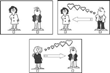
The picture selection task used in this study was adapted from O'Grady et al. (2003). Participants were given a booklet with three panels for each sentence on each page (see Figure 1). At the beginning of the booklet, there exist written instructions in English and Turkish. This task also included an English and a Turkish sample of practice sentences. The task items included 15 sentences: four SRs, four ORs, and seven items irrelevant to the study.10
All test items in the picture selection task were an NP that consisted of RCs and a head noun, not embedded sentences in the matrix clause (see Note 8). The aim of this experimental study is not to investigate a relationship among different types of RCs that differ in the positioning in the matrix clause. Therefore, in line with O'Grady et al. (2003), we wanted to minimize the extraneous complications that might arise from having to process a matrix clause, with its additional lexical items and syntactic structure.

An example page from the booklet
The task was administered individually. The participants listened to a tape-recorded voice describing a person or animal in one of the three pictures. Immediately after listening to each item they were required to put a check mark in the square under the picture of the person or animal described in the sentence. Therefore, participants were required not to move onto the next page before completing the previous task.
As shown in Figure 1, the second panel shows a man (agent) who loves a woman (patient) and the third panel shows a woman (agent) who loves a man (patient). And the purpose of the distracter panel, which is the first panel in Figure 1, was to identify responses in which participants select an individual named in the test item regardless of his or her role in the action denoted by the verb. The panels varied, so that participants could not employ the left-to-right order of the figures within each panel as clues as to who the agent was and who the patient was. Participants who correctly understood RCs would put a check mark in the square under the right-hand figure in the second panel in response to a SR such as kadını seven adam (“the man who loves the woman”). Participants who correctly understood an OR such as kadının sevdiği adam (“the man who the woman loves”) would put a check mark in the square under the right-hand figure in the third panel.
Scoring
Following O'Grady et al. (2003), we call the erroneous interpretations “reversal errors” and “head errors.” If the participants' response for the sentence in Example 7 is the right-hand figure (the man) in the third panel in Figure 1, we call such erroneous interpretations “reversal errors in SR.” This means that the SR was analyzed erroneously as an OR (see Example 16a), whereas the head was correctly identified. If the participants' response for the sentence in Example 7 is the left-hand figure (the woman) in the third panel in Figure 1, it is labeled as “head errors in SR.” This erroneous interpretation shows that the word kadını (the woman) was interpreted as the head of the RC in the sentence (see Example 16b). Here, the initial NP was interpreted as the agent. We refer to all other kinds of erroneous interpretation as “other errors in SR,” excluding the correct choice presented to the participants.
16. a. reversal errors in SRs
correct interpretation: “the man who loves the woman”
misanalysis: “the man who the woman loves”
b. head errors in SRs
correct interpretation: “the man who loves the woman”
misanalysis: “the woman who loves the man”
Similarly, same probability of erroneous interpretations in ORs may occur as illustrated in Example 17. If the participants' response to the sentence in Example 8 was the right-hand figure (the man) in the second panel in Figure 1, their erroneous interpretation is referred to as a “reversal error in OR.” This means that the OR was analyzed erroneously as an SR (see Example 17a). The head is correctly identified in this type of error. If the participants' response to the sentence in Example 8 was the left-hand figure (the woman) in the third panel in Figure 1, then the error is called a “head error in OR.” Such erroneous interpretations occur when the participants interpret the word kadının (the woman), which is agent, as the head of the RC (see Example 17b). We call all other types of erroneous interpretations as “other errors in OR.”
17. a. reversal errors in ORs
correct interpretation: “the man who the woman loves”
misanalysis: “he man who loves the woman”
b. head errors in ORs
correct interpretation: “he man who the woman loves”
misanalysis: “the woman who loves the man”
RESULTS
The results of Group 1
The Wilcoxon signed ranks test, which is a nonparametric test that compares two paired groups, was used to compare SR and OR performances. Conversely, to compare L1 factors concerning SR and OR performances and to determine the differences between the performances for the groups, the Mann–Whitney U test, which is a nonparametric test that compares two unpaired groups, has been utilized. The α level set for all of the tests in this study is 0.05.
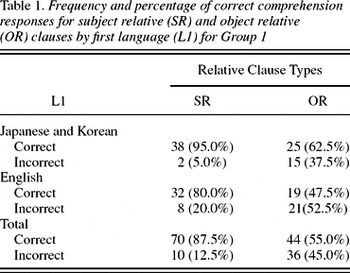
Table 1 summarizes the mean correct identification scores of two types of RCs for Group 1. The total score is 80 for each language group (eight test items [four SR and four OR items] × 10 participants). Shown in the bottom row of the Table 1 are the results pertaining to each type of RC regardless of the distinctions among L1 variables.

Table 1 shows that the participants did far better on SRs than on ORs, with scores of 87.5% correct on the former whereas they scored only 55.0% for the latter. The Wilcoxon signed ranks test revealed significant effects for the RC type, Z(−3.342), p=.001. The performance of individual participants also shows that they did far better on SRs than on ORs: 11 participants out of 20 answered all of the four questions related to SRs correctly, but none of the participants could answer the four questions related to ORs correctly.
When we consider the scores of the Japanese, Korean, and English speakers separately, we can see that all of the participants scored much better with the questions related to SRs, and there is a significant difference between their performances in SRs and in ORs. The observed values in the Wilcoxon signed ranks test indicate that the Japanese and Korean speakers' performance on types of RCs is significantly different, with the score of Z(−2.919), p=.004. Similarly, English speakers' performance is also noteworthy, with the score of Z(−2.081), p=.037. The Mann–Whitney U test was applied to compare scores obtained from native speakers of Korean and Japanese, and those of English. According to this test, the difference between these two groups in terms of either SR scores or OR scores is not significant: the scores for SRs are Z(−1.125), p=.261, and the scores for ORs areZ(−1.463), p=.143.
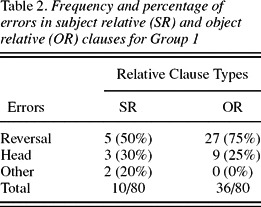
Focusing on the issue of errors, Table 2 shows that reversal errors are much greater in number than head errors in OR in Group 1. The high rate of reversal errors in ORs shows that ORs are generally interpreted in the same way as SRs are, as illustrated in the following:
18. a. Correct interpretation:
[kadın-ıneisev-diğ-i] adami
woman-GEN LOVE-OPart-3s man
“the man who the woman loves”
b. Participants' interpretation (reversal error):
*[eikadın-ın sev-diğ-i] adami
woman-GEN LOVE-OPart-3s man
commonly misinterpreted as kadın-ı sev-en adam ‘the man who loves the woman’

The results of Group 2
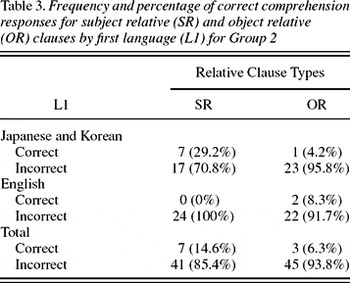
Results of mean correct identification scores for two types RCs for Group 2 are displayed in Table 3. The total score is 48 for each language group (eight test items [four SR and four OR items] × six participants). The results pertaining to each type of RC without distinguishing between L1 variables are shown in the bottom row of Table 3.

As Table 3 shows, the distribution of OR and SR performances of Group 2 is rather different from that of Group 1. There are more errors in Group 2 than in Group 1, and in Group 2 there are no significant differences between OR and SR performance, Z(−0.707), p=.480. The SR and OR performance of individual participants of Group 2 are also similar: in both SRs and ORs, there is only 1 participant able to score three out of four. Three participants out of 12 could answer only one question correctly in the SRs. Similarly, there are 3 participants out of 12 who could give the correct answer for only one question in the ORs. Eight participants gave wrong answers to all four of the SRs, and 9 of them recorded false answers for all four ORs.
When the Japanese/Korean and English speakers are considered as two groups separately, there is no significant difference between their performance in SRs and ORs, as indicated by the results of Wilcoxon signed ranks test: Japanese and Korean participants scored of Z(−1.633), p=.102, and English scored Z(−1.414), p=.157.
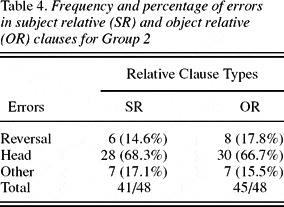
The RC error frequency and percentage of Group 2 is given in Table 4. Table 4 shows that head errors are much greater in number than reversal errors in SRs and ORs.

The results of Group 3
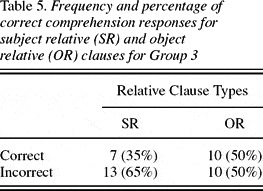
Table 5 illustrates the rates of correct and incorrect answers for the two types of RCs in Group 3. The total score is 40 (eight test items × five participants, 20 of 40 for SRs and 20 of 40 for ORs). It is crucial that the Wilcoxon signed ranks test indicates that there is no significant difference between the agrammatic speakers in terms of their performances for ORs and SRs, Z(−1.134), p=.257. The individual performance of Group 3 participants also shows that there are no differences between their comprehension of SRs and ORs: no participants scored four out of four or three out of four SRs questions correctly. Only two participants out of five could answer four OR questions out of four correctly.

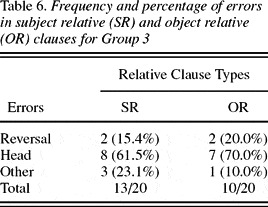
Table 6 illustrates the percentage of incorrect answers for RC questions of Group 3 participants. Similar to the results of Group 2, Group 3 participants, who are agrammatic subjects, scored high SR head error rates and high OR head error rates.

The fact that agrammatical participants display higher rates of head errors in SRs and ORs indicates that they interpret the NP as the agent. As can be seen in Example 19, the NP kadın (woman) in SRs is interpreted as the agent, and this has led to misinterpretation. In Example 20, however, it is observed that the NP kadın in ORs is interpreted as the agent. Although the NP kadın in these structures has been interpreted correctly as the agent, participants have marked the wrong choice in the picture selection task because they have failed to interpret the NP adam (man) as the head noun.
19. a. Correct interpretation:
[eikadın-ı sev-en] adami
“the man who loves the woman”
b. Participants' interpretation of SRs
*kadın-ı sev-en adam
AGENT
20. a. Correct interpretation:
[kadın-ıneisev-diğ-i] adami
“the man who the woman loves”
b. Participants' interpretation of ORs
kadın-ın sev-diğ-i adam
AGENT
Comparison of the results
When we compare the performances of these three groups, we observe that Group 1 displays the highest performance, with 87.5% in SRs and 55% in ORs. Comparison of the results of Groups 1 and 2 reveals striking findings. In terms of the comprehension of SRs, Group 1 displays a better performance than Group 2 with scores of Z(−4.166), p=.000. Similarly, Group 1 did much better than Group 2 in the comprehension of ORs, with scores of Z(−4.357), p=.000. The OR error results of Group 1 and Group 2 show that there is a significant difference between them in terms of reversal errors, Z(−2.502), p=.012, and head errors, Z(−2.129), p=.044. Although the values for SR head errors, Z(−4.240), p=.000, show a significant difference between Group 1 and Group 2, SR reversal error results, Z (−1.083), p=.279, do not.
Likewise, the difference between Group 1 and Group 3 is noteworthy in terms of the errors they made. There is a significant diversity between Groups 1 and 3 with respect to OR reversal errors, Z(−2.343), p=.019, and OR head errors, Z(−2.538), p=.011. Moreover, the difference with respect to SR head errors is also expressive, Z(−3.315), p=.001.
In the results of a comparison between Group 2 and Group 3 is the very similar performance is striking. The observed scores in the Mann–Whitney U test indicate that there is no significant difference between these groups in terms of the kinds of errors including OR reversal errors, Z(−0.681) p=.496, and OR head errors, Z(−1.658), p=.097. In contrast, the SR reversal error scores, Z(−0.560), p=.575, and SR head error scores, Z(−1.078), p=.281, of both groups are not divergent. In general, Group 2 and Group 3 display similar scores, whereas the results of both these groups are distinct from that of Group 1 participants. These results are analyzed in detail in the following Discussion and Conclusion section.
DISCUSSION AND CONCLUSION
This study presented experimental data on RCs from two groups of L2 learners of different degrees of proficiency, and from a group of agrammatics. We tested the hypothesis that the processing of SRs is easier than that of ORs in Turkish, a right-branching language, and investigated whether easier comprehension of SRs can be explained by linear distance factors or by structural factors in Turkish as a second language. Furthermore, we compared L2 data with data from agrammatics. There were several limitations to the design and data collection. Specifically, in the test items for the study, only such RC types as SRs and ORs were taken into consideration. The task items included 15 sentences: four SRs, four ORs, and seven items irrelevant to the study. In addition, we need to mention the fact that the number of participants, especially the number of agrammatical participants, was rather low. Although the L2 data were collected from a total number of 32 participants, agrammatism data were collected from only five patients. Because of these limitations, generalizations from the results must be made with caution.
As stated earlier, studies of languages like English in which RCs come after the head NP do not give support to the hypothesis presented here, because the distance between the gap and the head are similar both in LDH and in SDH. However, in languages where RCs precede the noun, we are allowed to circumvent this problem, given that a structurally more proximate subject gap is linearly more distant from the head, whereas a linearly closer direct object gap is structurally more distant.
In short, in a language like Turkish where RCs precede the noun, that SRs are comprehended easier than ORs are will support the SDH, whereas the reverse will support the LDH. In this context, the results obtained from Group 1, who are intermediate level L2 learners, are significant. Group 1 participants, in line with Keenan and Comrie's (1977) hierarchy, found it easier to comprehend SRs than ORs. Therefore, these results on L2 Turkish support the SDH.
The SRs are comprehended more easily, as are the participants' errors, which both present evidence that supports the SDH. When we examine Group 1 participant errors, we observe that the rate of those reversal errors where ORs have been misinterpreted as SRs is quite high. Conversely, the rate of those reversal errors where SRs have been misinterpreted as ORs is rather low. That participants mainly misinterpreted ORs as SRs (see Example 18) is seen as important evidence that supports the SDH. These results further indicate that it is the structural distance that determines the comprehension of SRs and ORs, which obviously confirms the SDH claim.
As mentioned earlier, the native languages of the participants varied with respect to RC structure. Both Korean and Japanese RC structures resemble the Turkish relevant construction, whereas the English RC construction is considerably different. Although these facts point to the possibility of transfer, our findings do not establish that there is a significant difference between the performance in SRs and ORs with respect to the L1 variable. When we consider the results of Group 1 with respect to the L1 variable, we also see that structural distance is the determining factor for all the participants among Korean, Japanese, and English speakers separately.
When the results are compared taking L1 acquisition into consideration, it is seen that there are similarities between adults learning Turkish as an L2 and children learning Turkish as an L1 with regard to comprehension of RCs. Coinciding with our results, Slobin (1986) and Ekmekçi (1990), who study Turkish language acquisition as L1, indicate that it is easier to find SRs than ORs. This similarity can be used as evidence against a fundamental L1–L2 difference hypothesis.
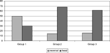
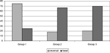
Although Groups 2 and 3 do not differ from each other in terms of their performance in ORs and SRs, both Groups significantly differ from Group 1 in terms of their rate of correct answers. Both Groups 2 and 3 have a lower performance in RC comprehension when compared to Group 1. At this point, we can turn our attention to the distribution of the rates of incorrect answers for SRs and ORs, rather than to the rates of correct answers. Strikingly, both Groups 2 and 3 have higher rates of head errors in SR and OR, as illustrated in Figures 2 and 3.

Comprehension of error rates in SR of the three groups

Comprehension of error rates in OR of the three groups
The similarity between the error data of Group 2 and Group 3 is highly significant. Nonetheless, the low number of participants, and their educational background and age differences make it difficult to draw precise conclusions. Still, it is possible to make some further discussion in terms of Grodzinsky's hypothesis (1985). In the light of our restricted data, Group 3, the group of agrammatics, use trace deletion and R-strategy, as expected. Both in SRs and in ORs, those errors that we call “head error” are actually not errors that stem from participants' misinterpretation of the head, but errors that stem from their interpreting the first NP in the clause as agent (see Examples 19 and 20).
Another interesting outcome of the tests is that Group 2 participants, who are early-stage L2 speakers, produce similar errors to those of the agrammatics. This brings to mind that they make use of the same strategy.11
As noted by an anonymous Applied Psycholinguistics reviewer, participants in Group 2 have resorted to a guessing strategy that is even more primitive than Grodzinsky's proposed strategy. Although this is a possibility to be considered, the similarity between the error data of Group 2 and that of Group 3 indicates that these groups make use of the same strategy.
APPENDIX A
TEST ITEMS
SR clauses
1. adam-ı sev-en kız
man-ACClove-SPart girl
“the man who loves the girl”
2. kız-ı bekle-yen adam
girl-ACCwait-SPart man
“the man who is waiting for the girl”
3. adam-dan kaç-an köpek
man-ABLrun away-SPart dog
“the dog that is running away from the man”
4. adam-a bağır-an kadın
man-DATshout-SPart woman
“the woman who shouts at the man”
OR clauses
1. kadın-ın kork-tuğ-u kedi
woman-GENafraid of-OPart-3s cat
“the cat that the woman is afraid of”
2. kadın-ın düşün-düğ-ü adam
woman-GENthink about-OPart-3s man
“the man who the woman thinks about”
3. çocuğ-un öp-tüğ-ü kız
boy-GENkiss-OPart-3s girl
“the girl who the boy kisses”
4. adam-ın bak-tığ-ı kadın
man-GENlook-OPart-3s woman
“the woman who the man looks at”
A preliminary version of the results of this study was presented at the 16th Linguistics Conference in Hacettepe University, Ankara. The author thanks Leyla Uzun, Ümit Deniz Turan, Zeynep Erk Emeksiz, and Hakan Gür for their helpful discussion and comments on this paper; Murat Akyildiz for his help on statistical analyses; anonymous Applied Psycholinguistics reviewers for insightful comments; and Ankara University TÖMER Language Teaching Center and Active Languages Turkish Teaching Center and the Department of FRT, Ankara University Medicine Faculty, for their help in the data collecting process.