

In Australia, as in other markets, the structural discipline of public transport routes in the first half of the twentieth century produced unplanned, organic retail development, as traders were drawn together by the clustering effect of transport stops and stations. Conversely, the fragmented maze of roads representative of the private transport city in the post-war years began to generate pre-planned, tightly structured retail sites. The shopping centre was the principal urban form that evolved to inhabit this new retail landscape. It provided an avenue for city department stores to decentralize and supermarket chains to expand store networks in growing suburban markets. In this disrupted environment, Australia's largest retailers found ways to maintain dominance, but space also opened up for entrepreneurial developers providing specialized services for established firms. A by-product was the emergence of a distinctive Australian shopping centre form.
Considerable work has been undertaken in the United States on the development of suburban retailing and shopping centres there,Footnote 1 while internationally there is a growing body of research demonstrating the spread of the American shopping centre form and the methods by which it has been introduced and adapted to different locales.Footnote 2 Work in Britain has demonstrated the ways that planning shaped development to a considerable degree and limited the spread of out-of-town shopping environments.Footnote 3 Research in Australia has explained the broad trends influencing development,Footnote 4 the activities of individual firms,Footnote 5 the adaptation of American designs by local architectsFootnote 6 and the impact of shopping centres on surrounding retail and urban development.Footnote 7
This article extends work both in Australia and internationally by demonstrating how numerous interconnecting factors can shape development timelines and the diffusion of new retail forms during periods of disruption. As the automobile reconfigured Australian shopping behaviour, numerous local influences including entrepreneurial activity, firm decision-making, retail competition and the activities of public authorities all conditioned patterns of development in a variety of ways. Exploring these forces helps explain variations in development across the country, but also reveals intersections between urban geographies, business innovation and retail hierarchies. Case-studies of early shopping centre development between the late 1950s and early 1960s, in four Australian state capital cities – Brisbane, Sydney, Adelaide and Melbourne – provide an opportunity to examine these dynamics.
Suburban retail geographies
The arrival of the motorcar transformed Australian retail geographies.Footnote 8 The public transport city had encouraged a centralized model of retail distribution. In the late 1940s, small areas in the central business districts (CBDs) of Australia's state capital cities still dominated metropolitan trade. In 1947/48, the retail heart of Sydney, Melbourne, Adelaide and Perth held, respectively, 56 per cent, 47 per cent, 63 per cent and 72 per cent of metropolitan trade. City and suburban retail sales in Brisbane were not measured in 1947/48 but in 1952/53 the inner city still accounted for 68 per cent of the metropolitan area's trade.Footnote 9 Over the proceeding years, retail sales in the centre of these major cities stagnated while suburban sales boomed. This corresponded with suburban population growth and rapid increases in car ownership. The number of cars and station wagons registered in Australia grew from 1,372,630 in 1955 when the first motor vehicle census was conducted, to 2,303,730 in 1962, to 3,990,938 in 1971.Footnote 10 Figure 1 indicates the impact of car ownership and suburbanization on suburban retail sales as a percentage of overall metropolitan retail sales.
Suburban retail sales as a percentage of metropolitan retail sales, Australian mainland capital cities, 1947/48–1961/62.

The stagnation of city sales caused considerable angst within the big city department stores, which at the time were largely family-operated firms operating individual stores. Cars not only moved residential populations away from city stores, they also caused traffic congestion that impeded shopper mobility and shopping amenity in the city itself.Footnote 11 Individually and collectively, the big stores lobbied for improvements in public transport and city parking provisions, but despite some public and private investment in parking, the trend to suburban retail continued apace.Footnote 12 Strategies turned, then, to servicing the new market. At the same time, the country's two largest variety store chains, Coles and Woolworths, which had recently moved into food retailing, were avidly seeking sites on which to locate supermarkets. With traffic congestion now also identified as a problem in growing suburban retail precincts, the American shopping mall, which included car-parking stations as an intrinsic element of its design, presented as an ideal solution for retailers seeking suburban expansion opportunities.Footnote 13
Brisbane: retail competition and the push for growth
The first large-scale shopping centre to open in Australia was developed by Brisbane department store firm, Allan & Stark. It opened at Chermside, seven miles north of Brisbane, Queensland, on 30 May 1957. Allan & Stark was influenced by the J.L. Hudson Company's strategy of encircling its home city with shopping centres. In the early 1950s, Hudson's dominated Detroit retailing from its six-storey city store, but faced with a decentralizing urban population the firm pursued suburban branch store development through shopping centre construction. Its first centre, Northland, was designed by Victor Gruen and opened in 1954 as the world's largest mall and the first to have central heating and air-conditioning.Footnote 14 Other Hudson centres followed, equidistantly spaced, approximately 10–12 miles from downtown Detroit, and named by the compass points. Hudson's formula influenced the thinking of Australian capital city department stores, although the Myer department store firm in Melbourne was the only retailer to implement it successfully.
Seven miles north of Brisbane's CBD, Chermside was well located for both public and private transport. It was situated adjacent to a tram terminus and on the intersection of two major roads, one of which channelled four lanes of traffic through a growing residential belt. Although a major development at the time, it was comparatively modest in size when compared with international and later Australian retail centres. But it was possibly the first large-scale drive-in shopping centre to be developed outside of the United States,Footnote 15 and as an Australian first, drew considerable interest from other retail firms and public authorities across the country.Footnote 16
Chermside's layout was typical of the early wave of Australian regionals that followed it, employing an open-air mall design and devoting almost half of the total retail area to Allan & Stark's 40,000 square foot department store. It also included a supermarket, operating under the Woolworths – BCC brand (following Woolworths’ acquisition of the Brisbane Cash and Carry chain). Parking problems had plagued a nearby BCC supermarket. The new shopping centre offered better parking, gave Allan & Stark a second anchor for the centre and aligned with Woolworths’ strategy of using shopping centre sites to broaden its reach across the country. Both Coles and Woolworths had faced relatively few problems gaining approvals for high street variety store construction, but supermarkets of around 20,000 square feet with parking facilities required sites of up to four acres that were more difficult to locate and develop.Footnote 17 By undertaking the difficult and time consuming work involved in gaining zoning and development approval, shopping centre developers seeking anchor tenants offered one avenue through this process.
Shopping centres also reimagined shopping, with marketing pitched to a new type of consumer. Promotions, beginning at Chermside, but echoed with modifications across the country, emphasized the ‘relaxed and friendly suburban atmosphere’ of the new centres that were ‘keyed to a casual way of life’.Footnote 18 Consumer research at the time reported a customer drift away from the formality of city retailing, where a woman shopper without her best hat and gloves could be patronized by salesgirls for her appearance.Footnote 19 While the city stores were open to all classes, special areas such as hairdressing salons, restaurants and even art galleries were clearly designated for elite and account holding customers.Footnote 20 Shoppers visiting suburban shopping centres were encouraged instead to ‘come as you are [and] shop in comfort’ in a ‘gay, casual atmosphere, where you'll feel quite at home in your slacks or casual clothes’.Footnote 21 Such marketing underscored the growing disconnect between city retailers and their decentralizing customer base.
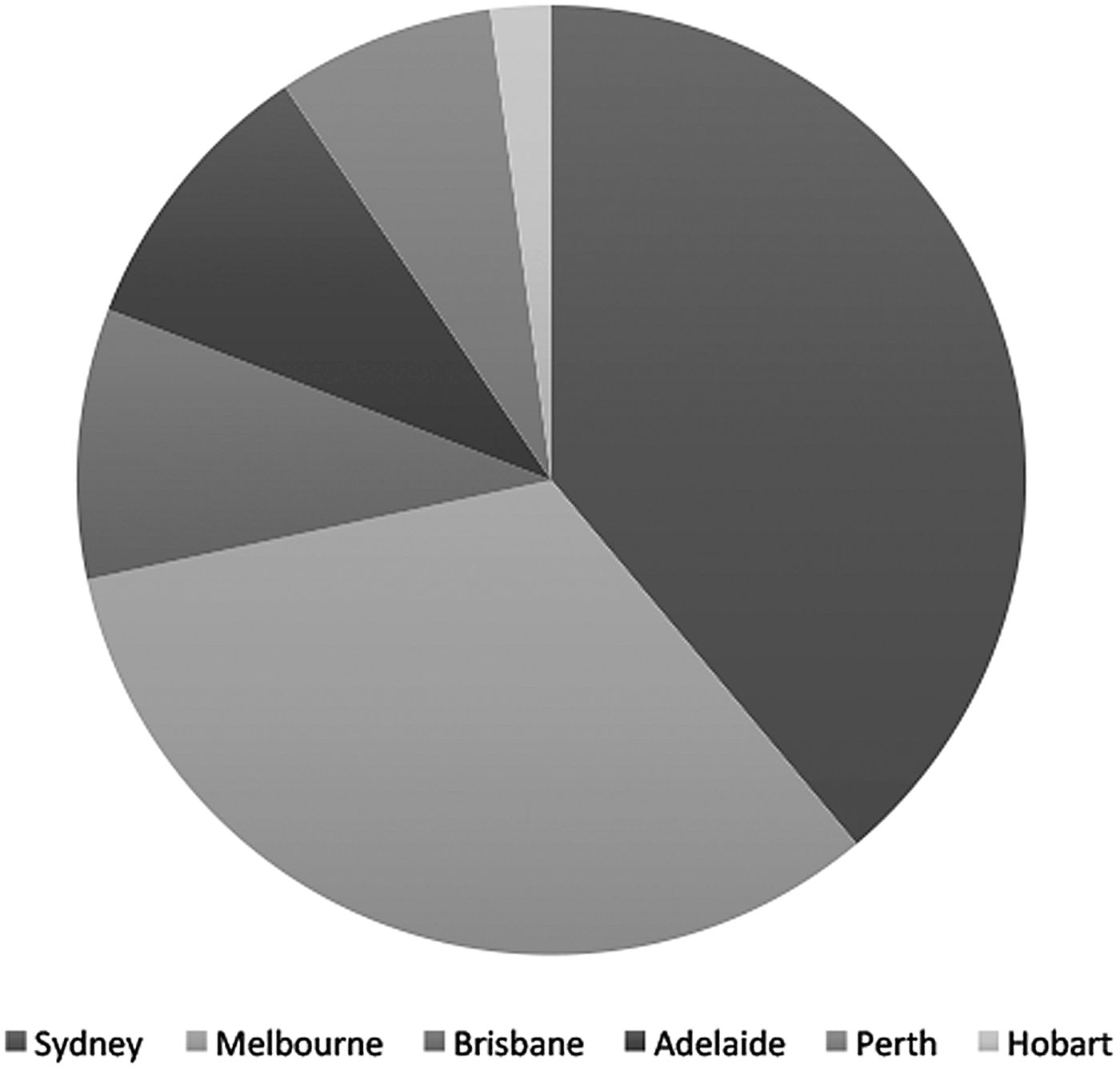
This divide, though, was less clear in Brisbane than in Sydney and Melbourne, demonstrating the causal complexity of Australia's early shopping centre development. In the late 1950s, Brisbane's market was smaller than the southern mainland capitals (Figure 2), city traffic congestion was not as marked, metropolitan retailing remained highly concentrated (Figure 1) and the stores that did exist in the suburbs garnered far lower sales revenue per store than their counterparts in the larger metropolitan markets.Footnote 22 Such data marks Brisbane as an unlikely site for Australia's first shopping centre, although the relative under-development of its suburban retailing in a decentralizing market did offer opportunities for a firm that saw American trends as the future, and a gap that a competitor might fill if Allan & Stark did not. As the only capital city with a single metropolitan government, development and planning for shopping centres was also more straightforward than in other cities that harboured the competing interests of local government authorities.Footnote 23
Metropolitan retail sales, Australian mainland capital cities, 1956/57.
The key driver for Allan & Stark's move to the suburbs, however, arose from the competitive matrix of Australian retailing at the time: the firm harboured a prescient concern that it would be taken over by one of the big department store firms from the larger Sydney and Melbourne markets. Sydney's David Jones was avidly expansionist in the 1950s and 1960s and, amongst other takeovers, acquired Brisbane's Finney Isles & Co. department store in 1955.Footnote 24 Myer had also absorbed a number of smaller department stores in the 1950s.Footnote 25 In 1955, the firm acquired McWhirters, Brisbane's largest retail store, and declared in its annual report that it was ‘constantly alert … and very strongly placed both financially and in terms of personnel to take advantage of any opportunities’ for takeovers that presented.Footnote 26
As Allan & Stark expanded into the suburbs, the general manager and director, T.J. Weedman, declared that ‘today in business you have to be either very large or remain small’.Footnote 27 In the same year, commentators questioned the outlook for single store department store firms, arguing that chains would prove more resilient in the future.Footnote 28 The move into suburban retailing by the big city stores was thus not only the result of declining CBD sales, but part of corporate growth strategies aimed at expanding market share.Footnote 29 Myer strategists at the time also noted that more stores added brand value by disseminating and promoting a firm's name ‘over as wide a cross-section of the population as possible’.Footnote 30 So while Chermside was an attempt by Allan & Stark to grow their own market share, it likely made the firm even more attractive to Myer because of their own desire for growth and their assessment, by the late 1950s, of the opportunities shopping centres held in the Australian market. Myer acquired Allan & Stark in 1959, taking control of Chermside and another site at Coorparoo 2.5 miles south-east of the CBD that became a second Brisbane shopping centre in 1960.Footnote 31
Sydney: established retailers and emergent developers
As Allan & Stark were planning Chermside, department stores in Sydney faced the question many of their American peers had been grappling with since the 1930s. With booming suburban retail sales and sluggish or negative growth in the inner city, the dilemma was not so much whether to decentralize, but how best to do so. Pre-planned shopping centres were one possible strategy, but they did not fit neatly into Sydney's well-established suburban retail landscape. In America, freeways provided access to cheap land that could be developed for retail sites. In Sydney, land accessible to consumers was harder to find. Former golf courses, swamps and quarries sit beneath some of Sydney's most iconic retail centres. Other shopping centres were built over numerous smaller parcels of land that were acquired piecemeal through the purchase of existing buildings that could be razed.
If this topography was discouraging, and initially pushed the city's department stores to pursue stand-alone construction, the sheer size of the market created substantial incentives to pursue larger developments. In the mid-1950s, Sydney and Melbourne dwarfed the retail markets of Australia's other capital cities. In 1956–57, they respectively garnered £522,738,000 and £440,372,000 in retail sales (excluding motor vehicles), with Brisbane and Adelaide each accounting for less than £130,000,000 (Figure 2).Footnote 32 In the smaller, less-developed city markets, sales growth for some department stores was still increasing in the mid-1950s, reducing the imperative for suburban expansion.Footnote 33 It was logical, then, not withstanding Allan & Starks’ initial foray, that Australia's two largest cities would attract the bulk of early shopping centre investment. The patterns of development in each varied, though, reflecting different urban geographies as well as strategic decisions made by individual firms.
Sydney had the largest suburban market in the country, but was still proportionally more dependent on city retailing than Melbourne (Figure 1). Sydney also had more large department stores than Melbourne, which was dominated by Myer. In 1962, Myer's massive city operation accounted for more than 27 per cent of all Melbourne's inner-city retail trade.Footnote 34 In contrast, Sydney's largest stores, David Jones and Grace Bros., respectively garnered 13 and 9 per cent of CBD retail sales.Footnote 35 In Melbourne, this resulted in lower levels of suburban investment by decentralizing city firms in both stand-alone stores and, later, shopping centres.
By the mid-1960s, every one of Sydney's 11 full-line inner-city department stores had opened a suburban branch store, with a total of 69 such stores in operation.Footnote 36 Research conducted for Myer, which was scoping Sydney for opportunities, suggested that this ‘oversupply’ of stores, combined with those then in development, would ‘more than adequately service the present population’, and that there were ‘no large unexploited areas remaining’ in Sydney's metropolitan area.Footnote 37 This steady opening of individual department stores, combined with the difficulty of finding suitable sites for large-scale centres, explains to some degree the fact that it was not Sydney's largest stores that led the initial foray into suburban shopping centre development. Executive decision-making was also a key factor: in Melbourne, the Myer board was the reluctant recipient of earnest entreaties by board member Kenneth Myer to embrace shopping centre construction.Footnote 38 Other Myer board members shared the reserve of Sydney's largest stores, which also, at least initially, preferred less ambitious developments.Footnote 39
Many of Sydney's larger, established shopping precincts were also centrally located in densely populated trade areas. Department store branch decentralization further activated such precincts, which provided broad retail mixes in relatively compact areas. The form and location of these shopping precincts reduced the imperative for investment in large-scale shopping centre construction.Footnote 40 So while Brisbane and Melbourne saw two of their largest city retailers lead suburban shopping centre development, in Sydney innovation was driven by smaller developers and lesser department stores. Suburban department store firm A.J. Benjamin opened Sydney's first shopping centre, Top Ryde, shortly after Chermside in November 1957. Like Chermside, it was significant for its introduction of the shopping centre form, rather than the scale of its development. With 110,000 square feet of retail space, the entire centre was small in comparison to the larger city department stores and was only just over half the size of the biggest suburban branches these firms were developing in the same period.Footnote 41
In another echo of Chermside, Top Ryde did not provide lasting success for its owner. The big city-based Sydney firm, Grace Bros., sent A.J. Benjamin bankrupt in the early 1960s by opening a large branch near the smaller firm's original suburban store. Top Ryde was subsequently acquired by one of the country's largest developers, Lend Lease, with Grace Bros. taking the department store space in the centre. Lend Lease was to become a major developer of shopping centres, both in Australia and internationally. Its rise, alongside that of other Australian developers such as Westfield – now one of the largest retail property developers in the world – marked a shift in the retail industry in which development, ownership and management of retail environments became specialty fields of business knowledge and operation.
The entry of specialist retail property developers marked a recognition that customer shopping traffic could be monetized. Retail has long been agglomerative: clusters of retail outlets have been observed in a wide range of social and cultural contexts since the ancient world, feeding off the combined trade they collectively generated.Footnote 42 Shopping centres captured the value of such agglomeration in a way that single stores could not, because they could both improve and sell it. When tenants rented space in a shopping centre, they essentially purchased customer traffic. The landlord created this traffic by convincing anchor stores to locate in a centre, adding a mix of retailers attractive to the surrounding market, building in a location accessible to this market, providing sufficient parking, and investing in the amenity of the overall environment.
While Lend Lease was a large national firm, many of the early developers in Australia were much smaller, entrepreneurial operators.Footnote 43 Such firms frequently approached chains and large retailers to enter into anchor tenancies.Footnote 44 The size and stability of these retail firms operated as a form of guarantee for small developers when obtaining finance, and they attracted specialty stores that wanted access to the customer traffic they generated.Footnote 45 In turn, developers helped facilitate the expansionist strategy of big retail at the time. The supermarkets, in particular, needed sites that provided parking near growing populations.
A useful example of this dynamic is provided by Westfield, which began as a partnership between two eastern European holocaust survivors, Frank Lowy and Jeno Schwarcz (later John Saunders). After operating a delicatessen in Sydney's western suburbs, the pair moved into residential and then retail property development, opening a small ‘American style’ shopping centre in Blacktown, 25 miles west of Sydney's CBD in 1959.Footnote 46 The centre generated considerable publicity for the firm, which began receiving offers to construct small shopping centres and stand-alone stores for established retailers. Westfield subsequently developed a relationship with the Coles supermarket chain when the retailer acquired a grocery firm, Matthews Thompson, in one of its new centres.Footnote 47
Prior to its purchase of Matthews Thompson, the Victorian-based Coles had struggled to gain a foothold in NSW. The acquisition provided them with ‘a very large part of the grocery business in New South Wales’, but the store network was largely comprised of small, variously sized shops run on traditional, labour-intensive lines.Footnote 48 So while Matthews Thompson gave Coles a presence and buying power, it needed to construct large-scale, modern retail stores to implement its supermarket strategy. By the mid-1960s, Westfield had built 17 supermarkets for Coles. Westfield's self-published company history regards the affiliation as ‘a mutually beneficial relationship’, noting that ‘Westfield played a major role in getting Coles established in New South Wales, and Coles contributed greatly to getting Westfield launched in Australia.’Footnote 49
Westfield quickly built an in-house team capable of planning, designing and developing retail stores and shopping centres. It acted as a consultant to retailers and, to further capture value in the assets it produced, set an objective to become an investor builder – holding and managing the centres it built to produce an ongoing revenue stream. Westfield's in-house development model drove efficiencies and ensured high levels of quality control. By retaining the centres it built in an investment portfolio, it obtained cash flow, security for finance and ‘live’ assets that could be upgraded through expansion and redevelopment. As the portfolio grew, Westfield's negotiating power with major retailers also solidified, giving it greater control over the form and location of its developments. By the mid-1960s, it was constructing and managing regional centres anchored by the country's largest retailers.Footnote 50
Table 1 lists selected shopping centres constructed by Westfield during the 1960s.Footnote 51 It shows that the firm established a strong base in NSW before expanding interstate. It developed capabilities and capital by building neighbourhood centres before moving into larger construction and more ambitious projects later in the decade. It maintained a consistent relationship with Coles and demonstrated an early ability to attract mid-size retail firms as general merchandise anchors. Westfield eventually cemented a relationship with Myer, which opened a 200,000 square foot, full-line department store at Doncaster, in Melbourne's eastern suburbs in 1969.
Selected Westfield shopping centres, 1959–69
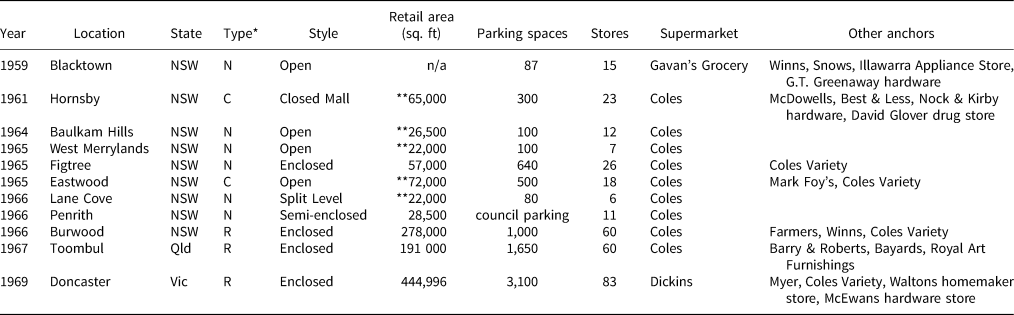
* N = Neighbourhood, C = Community, R = Regional.
** Gross floor area of the shopping centre is indicated because retail floor area was not available in extant sources.
Source: MMM, Shopping Centres – Australia, n.p.
Coles’ deal with Westfield was neither exclusive nor unique. The major retail chains, especially the supermarkets, had in-house property development teams, and property managers scouring the country for high traffic sites: they bought pubs, picture theatres, existing shops and residential properties that were demolished to make way for modern stores.Footnote 52 Relationships were also localized. Coles’ growth in South Australia was aided to a significant degree by another developer, Jack Weinert, who possessed a sound understanding of the Adelaide market, was experienced in gaining approvals from government authorities and was skilled in obtaining finance for projects.Footnote 53 Weinert built several shopping centres in South Australia for Coles, in the process forming a financial partnership in which he retained a share of ownership in the developments.Footnote 54
South Australia: public development and the idea of community
Developers such as Westfield and Jack Weinert seized the opportunities available in a nascent industry, during a boom economic period, at a time when retailers required rapid, efficient development. In the same period, public authorities in Australia also exhibited an interest in pre-planned shopping centre construction to provide retail services to public housing residents. The most substantial early public development of shopping centres occurred at Elizabeth in South Australia under the auspices of the South Australian Housing Trust (SAHT). The SAHT was the first of the state public housing authorities to be established, starting operations in 1936. It differed from authorities in other states in that, more than just providing low-cost housing, it was tasked with facilitating the industrialization of South Australia. By building affordable housing and other infrastructure, including shops, in newly developed areas underserviced by the private sector, it aimed to generate an employment base for large-scale industry.Footnote 55
When envisaging the shape of such towns, Australian planners looked to British models. This influence was particularly strong in South Australia where planners were more directly derivative than some of their eastern state peers.Footnote 56 Elizabeth subsequently shared many similarities with British ‘Mark I’ towns, which utilized ‘spacious garden city lines with distinct neighbourhoods served by local shops and a school, together with a town centre and single industrial areas’.Footnote 57 To these, the SAHT added leisure facilities such as theatres and churches, providing some parallels with earlier American developments such as the J.C. Nichols Country Club.Footnote 58
In all, nine neighbourhood shopping centres were constructed in Elizabeth between 1957 and 1965. Each was intended to serve around 5,000 to 6,000 people.Footnote 59 A town centre was situated close to the geographical heart of Elizabeth with ready access to both the main road and railway station. Its architects noted the complexity of the planning process in developing the town centre, and expressed what was by then a common refrain about the necessity of accommodating vehicular and pedestrian traffic in modern retail environments.Footnote 60
The Elizabeth shopping centres were the largest and most comprehensive public retail facilities developed in Australia, and were notable for their inclusion of community facilities. Medical services, post offices, banks, SAHT offices, public libraries and baby health centres were placed in shopping centres across Elizabeth. A dance hall, billiard saloon and theatre provided centralized social infrastructure in the town centre.Footnote 61 The concept of the shopping centre as a community hub did not begin in Australia at Elizabeth – both Chermside and Top Ryde included a child minding service with the latter also providing a baby health clinic – but it set a benchmark, and helped channel European influences into the market.
The provision of community facilities distinguished early Australian shopping centres from most of those constructed in the United States, with the flow of ideas into Australia about such integrated design coming largely via Britain and Europe. In 1963, Myer store architect, Donald C. Ward, wrote that ‘in English and Swedish new towns, architectural expression of community life in retail centres, offers fresh inspiration in the layout of Australian shopping centres’. He argued that a closer tie between centre and community was evident in, particularly, the British new town model and regretted the lack of public private partnerships to this end in Australia. His comments are indicative of Australia's broad interest in retail developments: while there was a general acknowledgment within the Australian industry that American influences predominated, notice was still taken of innovations in Britain and other markets. Ward noted that there was ‘much to be seen in England with regard to the relationship between a centre and its community’.Footnote 62
Elizabeth attracted widespread attention, with trade journals providing considerable detail on its community facilities. One noted that the project ‘must be of interest to all Australian retailers, who will recognize that planned shopping will be the rule, not the exception, in the future’.Footnote 63 By integrating the ideals of British planning reformers, Elizabeth influenced the marketing of shopping centres as well as the types of community facilities that private developers included in their complexes, often at the behest of public authorities seeking to wring more public value out of developments. Despite their substantive role in the earliest wave of development, however, the Elizabeth shopping centres marked the end of an idea rather than a beginning.Footnote 64 Public authorities developed a small number of shopping centres in the eastern states and the national capital, Canberra, in the 1960s and 1970s. But amongst planners and governments, fealty to the concept of publicly funded retail property development faded in the post-war years.Footnote 65
Echoing their counterparts in the United Kingdom, retailers were also not always enthusiastic about public designs.Footnote 66 While the captive market of local residents initially proved a good customer base, Elizabeth's architects and planners lacked retail experience and the size and layout of shops did not always suit the requirements of the larger operators.Footnote 67 Further, estimating future consumption practices and shopping behaviour proved a predictive task beyond the capabilities of government authorities.Footnote 68 But although the public development model of Elizabeth was not widely adopted, as a high-profile Australian urban design project it promoted the idea of planned retail as a cornerstone of community development and offered an argument for the inclusion of community facilities in other early 1960s centres.Footnote 69
Melbourne: the modern Australian shopping centre at scale
While the Victorian housing trust also experimented with retail development, the majority of shopping centre construction there, as with Australia more broadly, was private. In Melbourne, Myer was the driving force. The firm's acquisition of Alan & Stark in Brisbane provided it with its first operating shopping centre at a time when plans to develop its own flagship centre were coming to fulfilment. It opened Chadstone, the largest and most comprehensive shopping centre in Australia in October 1960, and in time became one of the country's largest developers of regional centres – a strategic move that helped maintain its position near the top of Australia's retail hierarchy across much of the post-war era. The move into shopping centres, though, was a decade in the making and was by no means a smooth transition for a firm entrenched and dominant in the heart of Melbourne's CBD.
In 1949, Kenneth Myer, the eldest son of founder, Sidney Myer, and himself a director of the Myer Emporium, met a number of developers engaged in the construction of regional shopping centres in the United States.Footnote 70 He returned to Australia convinced that his firm should decentralize from its city base, and use large-scale shopping centre construction as the means of doing so.Footnote 71 He was, though, unable to convince the Myer board under the chairmanship of his older cousin Norman Myer. Norman was 24 years older than Kenneth with a retail outlook embedded in the urban core. Further, shopping centres in the United States still stood on the cusp of innovation. For a man that one favourable obituary described as ‘no reckless experimenter’, it was too soon to follow the trend.Footnote 72 The board instead opted for an acquisition-based expansion strategy.Footnote 73
Kenneth Myer made three more research trips to the United States in 1953, 1955 and 1958, meeting with industry professionals including Gruen, his economic research partner Larry Smith and architects at Welton Becket & Associates.Footnote 74 The latter would later be appointed to design Chadstone, although their role was reduced in favour of a more hands-on local firm early in the development process.Footnote 75 Frustrated with the recalcitrance of the board, and convinced that Australia must inevitably follow the American trend, Kenneth and his brother Sidney Baillieu Myer privately engaged economic consultant George Connor to scope for suitable sites in Melbourne's suburbs. Connor was the first widely employed economic research consultant in Australia. He had informal relationships with Larry Smith and other economists in the United States, and followed their lead in setting up a consultancy practice in Melbourne.Footnote 76 Drawing on Connor's research, the Myer brothers went as far as purchasing a prospective site, although it remained undeveloped and was later sold to the Coles chain.Footnote 77
The death of Norman Myer in December 1956 reduced board opposition to the proposed shopping centre strategy, and by 1957 solid plans were being formulated to develop the firm's first regional centre.Footnote 78 Myer publicly announced that it was seeking a site of at least 30 acres and combed the city for suitable locations.Footnote 79 Analysis was undertaken on population growth, spending patterns, transportation networks and the relative intensity of Myer customers in given areas. Research was approached with the view that the site should be able to attract customers from both outlying and inlying suburbs in a ratio of approximately two to one. Melbourne's south-eastern suburbs, then experiencing substantial growth, were identified as the preferable area for development.Footnote 80 Myer eventually acquired 28 acres of land from the Convent of the Good Shepherd in East Malvern, 8 miles south-east of Melbourne. The site was situated on the corner of Chadstone Road and a new four-lane highway leading to expanding industrial suburbs, with research indicating that 216,000 people lived within a 15-minute drive.Footnote 81
Chadstone opened in October 1960 to voluminous public attention, much of which declared it a new form of shopping in Australia.Footnote 82 Such claims masked the importance of prior developments in establishing the shopping centre form, including the public development at Elizabeth, as well as Myer's own experience gained through its acquisition of Chermside the previous year. The ways in which Chadstone was marketed also continued rather than reinvented the positioning of other early centres. It too, although with more supporting evidence, claimed to bring the best of the city to the suburbs, and like its predecessors was heavily marketed as a ‘housewife's wonderland’. As Davison has noted, this included the provision of parking spaces on 45-degree angles to cater to the perceived frailties and skill level of women drivers, as well as a driving instructor service to help them obtain licences, a child minding play centre and floor coverings said to be friendly to stiletto heels.Footnote 83
To acknowledge continuities with prior developments, though, is not to understate the significance of Chadstone itself, which represented a milestone in post-war retail development. When opened, it was by far the largest shopping centre in Australia.Footnote 84 No other Melbourne city retailer had the resources or brand to build on such a scale, and the big Sydney firms, David Jones and Grace Bros., had yet to launch flagship centres. Chermside and Top Ryde had provided a one-stop-shop for a broad range of goods, but were limited in size and scope. Myer's 150,000 square foot store at Chadstone, in contrast, was the country's first full-line shopping centre department store, far larger than the junior department stores anchoring earlier centres.Footnote 85
Further, Myer convinced other major retailers to take tenancies in the centre. Where Chermside and Top Ryde offered a single department store, Chadstone incorporated branches of a number of city-based competitors and general merchandise chains. Significantly, a number of these stores – ‘many of Melbourne's oldest and best-known retailers’ – had long competed with Myer's massive CBD store: the Buckley & Nunn department store, for example, adjoined Myer in both the city and Chadstone.Footnote 86 This echoed the experience in America where the disadvantages of competing from separate stand-alone sites were recognized, and as many as five department stores shared space in some early regional centres.Footnote 87 While Chadstone's other department store outlets, at a tenth the size of the centre's Myer store, operated more as ‘twigs’ than ‘branches’ of their city parent stores, their co-location with one another established a precedent for later Australian regional shopping centre developments. The inclusion of numerous fashion chains indicated the cache of a Myer-led development and can also be seen as a forecast of future retail landscapes in which Australian fashion brands and other specialty retailers utilized shopping centres as a means to expand rapidly across the country.Footnote 88 More broadly, the scope of Chadstone's retail agglomeration, the level of investment in a project that was the largest ever undertaken by an Australian retail firm and the size of the Myer anchor store were unmistakable signals of the city's retail recession and the geographic shift occurring in Australian retailing.
Conclusion
A major impetus for shopping centre development in Australia derived from the needs of large retail firms, which required new sites, with space for car parking, in geographically shifting markets. The case-studies above show that opportunities were available in these disrupted environments, but that some firms were better positioned or were able to adapt more effectively to seize long-term advantage. These included small start-up innovators. As established patterns of development broke down, new (often immigrant) entrepreneurs found space to operate by solving problems for the large established retailers. The latter held sufficient capital and operational retail knowledge to maintain market dominance, but lacked internal expertise to efficiently develop outposts in the new landscapes of consumption. The rapidly growing consumer economy, the relocation of retail distribution to the suburbs and the needs of large retail firms enabled these burgeoning entrepreneurs to develop expertise, business networks and capital from which some built national and international enterprises.
At the same time, Australia's largest retailers, including Myer, Coles and Woolworths, imported or acquired expertise to become developers in their own right. The internal dynamics of these firms sits beyond the scope of this article, but their embrace of the shopping centre form provides evidence of their capacity to innovate in the face of technological, demographic, geographic and economic change – a strength they continued to display, not withstanding mistakes and costly errors of judgment, for much of the post-war period.Footnote 89 This capacity, combined with the scale of their operations, enabled the big three firms to remain at the top of Australia's retail hierarchy for the remainder of the century. Myer continued to expand through takeovers, acquiring interstate department store firms that had also developed interests in shopping centres such as John Martin & Co. Ltd in South Australia and Boans Ltd in Perth.
The heavy involvement of the major supermarket chains as both tenants and developers holds significance beyond the firms themselves. Their presence at all scales of development helped to create a shopping centre form distinct from the American regional shopping centre model, which often excluded food retail and was positioned as a leisure destination built around fashion and department store chains.Footnote 90 In Australia, the deployment of shopping centres as a means of supermarket store network expansion served to create a utilitarian retail format more resilient than the American mall, which relied heavily on discretionary expenditure.Footnote 91
To this local adaptation, ideas from Europe were also added – most influentially through the construction of Elizabeth in South Australia. While public shopping centre development did not last, experiments were trialled in all of Australia's southern and eastern state capital cities, signalling to the private sector and approval authorities the value of community facilities for shoppers and residents. Numerous early shopping centres in Australia thus contained baby health clinics, child minding services, libraries and community halls. By the 1970s, these were less likely inclusions, highlighting the shift towards corporatized development models. But in the early 1960s, the community was an important frame of reference for designers and retailers in conceptualizing their relationship with customers, while the facilities provided helped to drive adoption by embedding centres in their locales.
This article has shown, then, that while broad structural forces surrounding suburbanization explain the introduction of shopping centres to Australia, fine-grained analysis is required to understand the patterns, timing and forms of development that occurred. This contributes to studies of retail development more broadly, suggesting that there are productive outcomes to be gained by unpacking the interplay of factors across national markets such as firm decision-making, competitive frameworks, urban demography and public policy. Doing so complicates causation, contextualizes business strategy and renders the timing and patterns of retail diffusion in urban settings more understandable. It also enhances understandings of longer-term retail trends: in Australia, leading and nascent firms responding to suburbanization and the disruption caused by the automobile established a unique Australian adaptation of the globalized shopping centre form in the early post-war period, with some able to set foundations that cemented their dominance of the country's retail landscape for the remainder of the century.
Author ORCIDs
Matthew Bailey, 0000-0002-0625-3821.



