After having assessed the presence of a significant genetic distance between Italian Alpine settlements of South Tyrol (Marroni et al., Reference Marroni, Pichler, De Grandi, Beu Volpato, Vogl and Pinggera2006), it was argued that the Venosta Valley (the Western part of the region) could be classified as a ‘secondary isolate’ (Pattaro et al., Reference Pattaro, Marroni and Riegler2007). The valley borders to the North Tyrol region of Austria and to the Grisons region of Switzerland. Venosta was part of the county of Tyrol belonging to the Habsburg Empire until 1919, when it was annexed to Italy together with the rest of South Tyrol. Both its geographical location and political situation made the Venosta Valley an isolate where biological and sociological behaviour could, to some extent, be unique in respect to the bordering countries. While assessing the historical roots of this isolation, it was recently demonstrated that four villages of the Venosta Valley were characterized by particular marriage patterns (Riegler et al., Reference Riegler, Marroni, Pattaro, Gueresi and Pramstaller2008). In the same framework, fertility pattern and family structure could also be expected to provide additional explanation for the observed genetic homogeneity. Indeed, together with socioeconomic aspects, fertility is a key component in explaining the evolution of a population over the centuries. In the present work, the development of marriage behaviour in relation to marital fertility, and related demographic conditions, was investigated for Curon, Martello and Stelvio, three Venosta villages that were included in the MICROS study, a large survey on the genetics of Mendelian and common disorders (Pattaro et al., Reference Pattaro, Marroni and Riegler2007). With the exception of Curon, the villages are located in side valleys at an altitude of between 1100 and 1900 m. Additional details on the history, economy and geography of these villages are given in Riegler et al. (Reference Riegler, Marroni, Pattaro, Gueresi and Pramstaller2008).
Starting from the participants of the MICROS study, complete pedigrees were reconstructed extending from the 17th century until the present day by means of church records and municipality lists. For this study, all the marriages celebrated between 1750 and 1949 were considered: this long time span enabled a thorough assessment of the temporal evolution of fertility. The criteria for including a marriage in the analysis were those used in previous analytical work: the precise marriage date, the precise birth date of the wife and the children, and the precise death date of at least one of the spouses (Knodel, Reference Knodel1988). After all the selection criteria were satisfied, 3203 married couples were included in the study: from 53% of all marriages in Curon to 82% in Stelvio. The majority of excluded marriages were celebrated prior to 1800 and exclusion was due to a lack of information in the parish registers.
Data were combined into 5-year groups by woman's age at marriage (20–24, 25–29, 30–34, 35–39 and ≥40) and into seven marital cohorts. The average number of children was differentiated into children ‘non-calculable’ (i.e. only birth date available), died during childhood, and children achieving adulthood (i.e. with known marriage or death date or still living). The latter ones were subdivided into married and unmarried offspring (Netting, Reference Netting1981). The modified version of the index of marital fertility, I g′, was estimated after excluding births within eight months of marriage (Knodel, Reference Knodel1988).
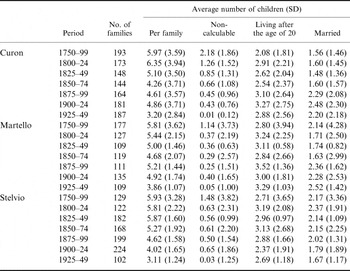
A complete overview of family structure is given in Table 1. The number of children per family was about 6 in 1750–99 and 3 to 4 in 1925–49. In Curon and Martello, a temporary rise of family size was observed at the end of the 1800s. In Stelvio, a high number of children per family persisted for a longer time and declined constantly afterwards.
Family structure by year of marriage and village

In 1750–99, the percentage of ‘non-calculable’ children was high. As a consequence, the number of ≥20-year-old children could be underestimated. In Curon, the number of ≥20-year-old children decreased to 2.5 children in 1850–74 and rose afterwards. In Martello and Stelvio, the situation was relatively stable during the 19th century: the number of survivors stayed at about 3 children per family, with the exception of Martello in the period 1875–99 when 3.5 children survived. In 1925–49, 85–90% of the children survived infancy and childhood, ranging from 2.7 per family in Stelvio to 3.3 in Martello.
In all the marriage cohorts at least a quarter of the surviving offspring remained single. The most difficult situation was observed in Curon and Martello in the period 1800–74. The percentage of children who never got married reached or exceeded 45%. In Stelvio the trend was different: only in 1850–99 was a higher percentage (about 30%) of unmarried offspring reported, and the mean number of married offspring was never smaller than two until 1924.
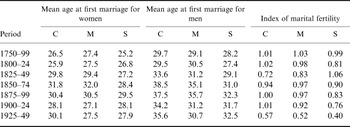
All villages achieved high age at first marriage for both sexes (Table 2). In Curon and Martello women's age at marriage rose to 32 years (1850–74), with a subsequent decline to 28 and 27 years, respectively. In 1925–49, a new rise was observed in Curon, while in Martello the age at marriage was lower. In Stelvio, marital age increased slowly but steadily during the 19th century and lay in the range of the other two villages in 1900–49. The trend was similar for males: the age at first marriage rose to 38 (Curon), 35 (Martello) and 32 (Stelvio) in the second half of the 19th century. In Curon and Martello, in 1900–49 men's age at marriage was lower than in the previous decades. However, in Curon, the marital age of both sexes was still very high. In Stelvio the level remained unchanged compared with 1875–99.
Mean age at first marriage for both sexes and marital fertility by year of marriage in Curon (C), Martello (M) and Stelvio (S)

For the index of marital fertility I g′, Hutterite women married in 1921–30 (I g′=1) were used as the reference population (Knodel, Reference Knodel1988).
In the second half of the 18th century, marital fertility rates similar to the reference population of the Hutterite women were observed in all villages (Table 2). A temporary drop happened in the first half of the 19th century. Afterwards, in Curon and Martello, I g′ was of a similar extent as before; in Stelvio marital fertility sank continuously, after a peak in 1825–49, until 1900–24. After 1925, with more common family limitation (family planning; birth control), a steep drop occurred in all villages.
The overall picture of the three villages resembles the Alpine marriage patterns described by Viazzo (Reference Viazzo1989), especially the Swiss model, which describes a population with very high marital fertility, late marriage and a high proportion of unmarried individuals. Over a long time period the area under investigation was a region of pronounced poverty (Ortmayr, Reference Ortmayr and Rudolph1995). In the 19th century, the productivity of agriculture, the most important economic sector, lost ground compared with non-Alpine regions and no additional occupation in the secondary sector came into existence. As a response, population growth widely ceased and migration became common (Dietrich, Reference Dietrich1994). The degree of the agro-economic crisis was of different intensity in different villages. In Curon the impact was the most evident, and its number of inhabitants declined (Fischer, Reference Fischer1974). In Martello the population remained static, while Stelvio experienced constant population growth during the 19th century. The relatively large proportion of inhabitants in Stelvio not occupied in agriculture possibly had a positive influence both on marital age and population evolution (Roser, Reference Roser1967).
Stelvio was also the village with the earliest indication of demographic transition, in contrast to Martello which was the most conservative regarding declining family size. Winkler (Reference Winkler1973) observed for the mountain farmers of Martello, even in the 1960s, a conservative attitude and the attempt to have a high number of children.
The high age at marriage, especially during the second half of the 19th century, was the result of the low level of market interdependence and of the difficulty of transferring farm ownerships to children (Viazzo, Reference Viazzo1989; Ortmayr, Reference Ortmayr and Rudolph1995). Childbearing was mainly limited to late-marrying women, resulting in very high marital fertility. A large proportion of the population was excluded from reproduction: they had to emigrate or lived in permanent celibacy. The reduced number of individuals getting married, added to the high geographic endogamy rates reported by Riegler et al. (Reference Riegler, Marroni, Pattaro, Gueresi and Pramstaller2008) and to the null population expansion observed over the centuries, reinforce the hypothesis of the pronounced genetic homogeneity of these villages which holds until a few decades ago.