Increasingly, older adults are making the decision to relocate to retirement communities that offer independent living in close proximity to facilities and services (Stimson & McCrea, Reference Stimson and McCrea2004). While declining physical health or functioning is often a primary motive for relocation (Crisp, Windsor, Anstey, & Butterworth, Reference Crisp, Windsor, Anstey and Butterworth2012), feelings of social isolation are a significant driving force, particularly following loss (e.g., widowhood) in later life (e.g., Bekhet, Zauszniewski, & Nakhla, Reference Bekhet, Zauszniewski and Nakhla2009; Sergeant & Ekerdt, Reference Sergeant and Ekerdt2008). However, despite the increasing trend of residential relocation to retirement communities, there is limited quantitative research investigating individual characteristics associated with the experience and the specific impact on friend, family and neighbour social networks. This study investigates the impact of relocation on contact in each social network domain and overall perceived loneliness.
Social networks play an important role in maintaining positive health and wellbeing in late life. In particular, social engagement (close contact with friends and family) has beneficial effects on maintaining functional physical health and independence, and facilitating physical activity (Cherry et al., Reference Cherry, Walker, Brown, Volaufova, LaMotte, Welsh and Frisard2011; Pin, Guilley, Spini, & Lalive d'Epinay, Reference Pin, Guilley, Spini and Lalive d'Epinay2005). Moreover, an extensive social network could help to protect against cognitive ageing by providing emotional and intellectual stimulation, and practical support, and by enabling an elderly person to more easily compensate for cognitive impairment (Fratiglioni, Wang, Ericsson, Maytan, & Winblad, Reference Fratiglioni, Wang, Ericsson, Maytan and Winblad2000). Conversely, individuals with poor social support networks have been found to experience poorer physical health (e.g., impaired immune functioning) and an acceleration in the appearance of cognitive decline and dementia (Fratiglioni et al., Reference Fratiglioni, Wang, Ericsson, Maytan and Winblad2000; Pressman et al., Reference Pressman, Cohen, Miller, Barkin, Rabin and Treanor2005). Often reported as a significant cause of loneliness, small social networks are also associated with increased psychological stress and negative affect, and reduced positive affect in older adults (e.g., Pressman et al., Reference Pressman, Cohen, Miller, Barkin, Rabin and Treanor2005).
The community friendly design of many retirement villages and perceived social isolation that may accompany changes in social networks in later life represent important factors that influence relocation to a retirement community in mid to late adulthood (Gardner, Reference Gardner1996; Sergeant & Ekerdt, Reference Sergeant and Ekerdt2008). Research suggests that relocation is often motivated by social considerations, particularly when elderly persons live alone or do not live in close proximity to family (Bekhet et al., Reference Bekhet, Zauszniewski and Nakhla2009; Sergeant & Ekerdt, Reference Sergeant and Ekerdt2008). However, research examining the impact of relocation to a retirement community on friend, family and neighbour social networks is limited. Interviews conducted with retirement community residents have found some support for retirement community living promoting the development of new social networks and reducing social isolation (Buys, Reference Buys2001; McDonald, Reference McDonald1996), in part through increased informal social interactions with other residents as a function of the condensed housing environment (Percival, Reference Percival2001; Sugihara & Evans, Reference Sugihara and Evans2000). One cross-sectional survey study (Gardner, Browning, & Kendig, Reference Gardner, Browning and Kendig2005) found residents retrospectively reported greater satisfaction with friendships and their social life following relocation compared to persons who had considered relocation but remained in the community.
In contrast, Buys, Miller, and Barnett (Reference Buys, Miller and Barnett2006) found that the utilisation of formal services (e.g., for shopping or other household tasks) among retirement community residents resulted in reduced contact with family who would have previously fulfilled these instrumental support needs. With further investigation into this area required, the present study aimed to examine the longitudinal changes in family and friend networks across the transition into a retirement community. In addition, changes to social networks comprised of neighbours were investigated.
Small social networks are often considered indicative of loneliness in late life (Savikko, Routasalo, Tilvis, Strandberg, & Pitkälä, Reference Savikko, Routasalo, Tilvis, Strandberg and Pitkälä2005). However, while declines in social network size are reported with increasing age, ratings of satisfaction with social interactions appear to increase (Lansford, Sherman, & Antonucci, Reference Lansford, Sherman and Antonucci1998) and older adults are less likely to report being lonely (Stevens & Van Tilburg, Reference Stevens and Van Tilburg2011). Therefore, it is important to also examine the differential impact of relocation on perceived loneliness, particularly given it is a motive for relocation (Bekhet et al., Reference Bekhet, Zauszniewski and Nakhla2009; Sergeant & Ekerdt, Reference Sergeant and Ekerdt2008), and that the quality and satisfaction with social relationships may be most strongly related to physical and mental health and wellbeing in later life (Antonucci, Reference Antonucci, Birren and Schaie2001; Pressman et al., Reference Pressman, Cohen, Miller, Barkin, Rabin and Treanor2005).
Predictors of Variability in Social Network Outcomes
While past research suggests that relocation to a retirement community may impact the social networks of older adults, little focus has been placed on examining personal characteristics that may explain the variability in the reactions of individuals to this transition (Rossen & Knafl, Reference Rossen and Knafl2003; Smider, Essex, & Ryff, Reference Smider, Essex and Ryff1996). Research has shown that individuals high in extraversion typically demonstrate attributes reflecting good social skills, larger social networks and greater perceived social support (Digman, Reference Digman1990; Russell, Booth, Reed, & Laughlin, Reference Russell, Booth, Reed and Laughlin1997), and as such may be more successful in expanding their social networks in a new environment. Similarly, agreeableness, characterised by qualities of warmth, generosity and friendliness (Costa & McCrea, Reference Costa and McCrea1992), may be associated with increased social interaction. Important in the context of a relocation transition, agreeableness and conscientiousness are positively associated with adaption to different life events and new environments (Bardi & Ryff, Reference Bardi and Ryff2007). In contrast, people high in neuroticism are somewhat less sociable and report fewer positive social relationships and lower levels of social support (Kalish & Robins, Reference Kalish and Robins2006; Russell et al., Reference Russell, Booth, Reed and Laughlin1997). Therefore, they may be less successful in expanding their social networks in a retirement community environment.
Examining the relocation of a sample of women aged 55 and over to a retirement community environment, Kling, Ryff, Love, and Essex (Reference Kling, Ryff, Love and Essex2003) found neuroticism and openness to experience were associated with increased depressive symptoms over the course of the transition (change from time prior to relocation to 8 months post relocation). Across this same period, extraversion and openness were associated with increased self-esteem. However, we are not aware of any other studies that have examined the role of personality traits in moderating adjustment to relocation, particularly in relation to the social networks of older adults during this major life event.
Physical health may also facilitate the formation of new social networks, or maintenance of existing networks, following relocation. Physical health research has demonstrated a complex reciprocal relationship with social networks (e.g., Pressman et al., Reference Pressman, Cohen, Miller, Barkin, Rabin and Treanor2005). Following relocation, older adults with poor health may have functional limitations that create barriers to participation in activities that promote the formation of new social contacts. Alternatively, the retirement community environment may serve to counteract issues associated with declining functionality and therefore social exchanges may increase to a greater extent for individuals with poor physical health. Currently, there is a paucity of research examining this aspect of the social network–physical health relationship.
The Present Study
The present study investigated the experience of relocation to a retirement community and the longitudinal changes to friend, family and neighbour social networks, and perceived loneliness across the transition. In addition, it evaluated personality, physical health and contextual factors associated with the move (pressure to move and time in prior residence) as moderators of social network change following relocation.
Currently, research in this area is limited. Few studies include a comparison group of older people living in the community, which is needed to comprehensively assess adaptation and change over time. Furthermore, most empirical studies have used retrospective data to investigate the consequences of relocation to retirement communities: an approach prone to errors in reporting. Finally, few studies have comprehensively investigated changes to the different social network domains following relocation.
The examination of social network change in later life, particularly in respect to the impact of significant life events, highlights the need to consider individual differences. Retirement community living may not be an ideal housing option for all older adults. Not only can an examination of personality characteristics help identify who is most attracted to this style of housing, it may subsequently indicate the type of person who will adapt most successfully to the new environment.
It was hypothesised that: (1) consistent with past research and the ethos of many retirement communities, increases in social networks, specifically neighbour networks, and reduced loneliness would be observed following relocation; (2) personality characteristics would moderate changes to social networks. Specifically, it was anticipated that (in light of their relatively better developed social skills) individuals high in extraversion and agreeableness would report larger neighbour networks following relocation relative to those lower in extraversion and agreeableness.
Methods
Participants
The study comprised two samples of respondents recruited from the Australian Capital Territory (ACT) as part of the TRAnsitions In Later Life study (TRAILLs). A Relocation Sample comprised 83 older adults (aged 57–90 years) in the process of relocating to a newly developed retirement community. All 258 prospective residents who had placed a deposit with the village provider in the 12-month period between June 2009 and June 2010 were invited to participate in the study. A total of 87 participants were initially recruited to the study (response rate of 33.7%); however, four participants did not relocate and were consequently excluded from the study.
The retirement community studied contained 150 independent living units. The village provides a variety of services and facilities for the benefit of residents including: a chapel/reflection room, community centre, croquet lawn, gym, hairdresser, outdoor barbecue area, indoor and outdoor swimming pools, a village bus, and a café. Landscaping, general maintenance and village security services are all provided to residents as required. In addition, residents also have the option (for extra charge) of receiving domestic and cleaning services, personal care support, physiotherapy and transport services. The retirement community offered residents a variable pricing structure, with residents purchasing independent living units with an ingoing contribution fee dependent on premises and price option (being either percentage retention or fully refundable on departure) chosen.
A Community Comparison Sample comprised 549 community-dwelling older adults (aged 55–94 years) residing in private/non-institutional housing during the same time period. Initially, a random sample of 1,973 persons aged 55 and over, obtained from the Australian Electoral Roll, were mailed invitations to participate. A total of 561 participants were recruited to the study (response rate of 28.4%); however, 12 participants were subsequently removed from the study following notification that they were residing in a retirement community. Comparisons between the community sample and the Australian Bureau of Statistics (ABS) 2006 census data indicated the community sample was representative of the ACT population on age and gender demographic characteristics (ABS, 2007; Pilkington, Windsor, & Crisp, Reference Pilkington, Windsor and Crisp2012).
The combined sample was predominantly of Caucasian/European descent (72.5%), married or in a de-facto relationship (72.5%), home owners (90.7%), identified themselves as having enough money to meet their needs (95.6%), and on average held a secondary level of education (M = 13.9 years of schooling, SD = 2.9). Data on the relocation sample indicated relocation to the retirement community was largely voluntary with little pressure to move reported (M = 1.75, SD = 0.59, range 1–6). Both samples also comprised a proportion of people who had a partner or spouse also participating in the study. This was accounted for in the analysis of results. The number of participants with a spouse in the study equated to n = 40 (48.2%) within the relocation sample and n = 10 (1.8%) within the community sample.
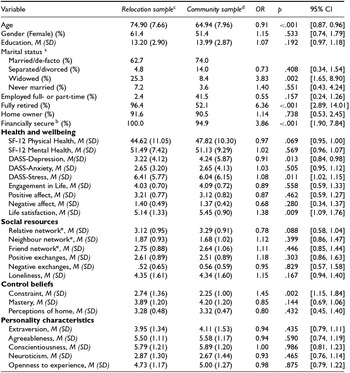
Prior to analysing change in social networks over time, baseline group differences in demographic characteristics, mental and physical health, subjective wellbeing, social resources, control beliefs and personality characteristics were investigated using a random-effects logistic regression procedure. A conservative p value of .002, based on a Bonferroni correction (p = .05/31 predictors), was used in light of the large number of predictors. The results indicated few differentiating characteristics between the groups. The relocation sample was on average 10 years older, more likely to be retired and widowed, had enough money to meet their needs, and were experiencing a greater level of constraints (lower control) at baseline, compared to the community sample. A summary of participant characteristics and model estimates for the logistic regression are presented in Table 1.
Logistic Regression Analysis Examining Differences Between Community-dwelling and Relocating Older Adults

Note: aReference category for marital status = married/de-facto;bFinancial security reflects ‘enough money to meet needs’; c n = 83; d = 549; eMeasure reflects the strength of respondents' social network comprising the number of network members and the strength of support obtained (network quality).
Data from 628 respondents (relocation sample = 83, community sample = 545) also indicated no significant difference between the relocation (M = 20.68, SD = 13.38) and community (M = 19.58, SD = 18.99) groups in the length of time (years) they had lived in their current residence, t(626) = −.505, p = .614. Participants in the community group were significantly more physically active (M = 8.7 hrs, SD = 10.8) than those in the relocation group (M = 4.3 hrs, SD = 4.6), t(249.2) = 3.622, p < .001.
Measures
Social networks
Family, friend and neighbour networks were assessed using the 18-item Lubben Social Network Scale (LSNS-18; Lubben & Gironda, Reference Lubben, Gironda, Berkman and Harootyan2003). The scale assesses the size, closeness and frequency of contact within a respondent's different social networks. Items are responded to on a 6-point scale from 0 (none/never) to 5 (nine or more/always); higher scores indicate stronger social networks. The subscales reported good internal consistency within the present sample (Friend α = 0.73–0.88; Family α = 0.84–0.94; Neighbour α = 0.85–0.90).
Perceived loneliness
Perceived loneliness was assessed using the Three Item Loneliness Scale developed by Hughes, Waite, Hawkley, and Cacioppo (Reference Hughes, Waite, Hawkley and Cacioppo2004). The three-item scale assesses how often the respondents feel isolated or lack companionship. Items are responded to on a 3-point scale from 1 (often) to 3 (hardly ever or never); higher scores indicate greater perceived loneliness. The scales showed good internal consistency within the present sample (α = 0.76–0.90).
Sociodemographic characteristics and covariates
Sociodemographic information was obtained at baseline relating to gender, age, marital status, education, employment and retirement status, and residential status (renter or owner-occupier) prior to moving. A single item (‘Over the past 12 months have you had enough money to meet your needs?’) assessed financial status. Perceived pressure to move into the retirement complex was assessed using nine items developed by Smider and colleagues (Reference Smider, Essex and Ryff1996). Items are responded to on a 6-point scale from 1 (not at all) to 6 (very much); higher scores indicate greater pressure to move. Information pertaining to the amount of time an individual had lived in a residence and their date of relocation was also obtained. Control beliefs (e.g., the extent to which individuals feel there are obstacles beyond their control that interfere with the attainment of goals) prior to moving were assessed using 10 items developed by Lachman and Weaver (Reference Lachman and Weaver1998). Items are responded to on a 6-point scale from 1 (strongly disagree) to 6 (strongly agree), a higher score indicating a greater degree of perceived constraints.
Physical health
Self-rated physical health was assessed using the physical health component score (PHC) of the RAND-12 (Hays, Reference Hays1998). The six-item scale provides a total score of physical health standardised to a mean of 50 with a standard deviation of 10 based on United States' population data. Higher scores are indicative of better physical health. Physical activity was assessed using the eight-item Active Australia Survey (Australian Institute of Health & Welfare, 2003). The scale assesses both the frequency and duration spent engaged physical activities (walking, moderate and vigorous physical activities) during the previous week.
Personality characteristics
Personality traits based on the Big-Five personality dimensions were assessed using the Ten-Item Personality Inventory (TIPI; Gosling, Rentfrow, & Swann Jr, Reference Gosling, Rentfrow and Swann2003). Items are responded to on a 7-point scale from 1 (disagree strongly) to 7 (agree strongly), a higher score indicating greater endorsement of the characteristic assessed.
Procedure
Ethics approval was obtained for the study from the Australian National University Committee for Ethics in Human Research Protocol 2009/041. The study followed a longitudinal design with data collected via self-report questionnaires administered across four time points for the relocation sample: baseline (prior to relocation), 1, 6, and 12 months post relocation. The community sample completed questionnaires at baseline and 12 months. The relocation sample completed the baseline assessment, on average, 11 weeks prior to their date of relocation. Questionnaires were mailed to participants. It is estimated that the questionnaires took 30–40 minutes to complete.
Statistical analyses
Data analysis was conducted using PASW 19 (IBM SPSS Statistics, Version 19, 2010) and STATA Version 10. Missing data (<10% across the variables) were imputed using maximum likelihood estimation via the SPSS EM algorithm (Schafer & Graham, Reference Schafer and Graham2002). Longitudinal modelling to investigate the relocation experience over time was conducted within a multilevel framework. Both samples comprised a proportion of people with a partner or spouse also participating in the study. Random coefficients models accounted for the dependent nature of data obtained from repeated measures designs, enabled the nesting of individuals within couples (i.e., repeated assessments at level 1 nested within individuals at level 2, nested within couples at level 3), and allowed the estimation of model parameters using available data, accounting for participants not assessed at the same number of time points (Hedeker & Gibbons, Reference Hedeker and Gibbons2006). All models were fitted using an unstructured correlation matrix and by maximum likelihood estimation. Models are reported with robust standard errors.
Time was defined by fixed time points representing the intervals of testing (baseline, 1 month post relocation, 6 months post relocation, 12 months post relocation). The treatment of time as a categorical variable allowed for comparisons to be made between baseline and subsequent discrete points in time following relocation. The 1-month assessment was excluded from the analyses of neighbour networks due to a high proportion of missing data. As the retirement community was not completed at the time of relocation for many participants, they were unable to comment on questions that assumed the opportunity for interactions with neighbours at this time.
To investigate overall change across the 12-month follow-up period, comparisons were first made between changes reported in the relocation and community samples over the 12-month period. These models controlled for differences identified between the groups at baseline (i.e., age, marital status, retirement status, baseline physical activity and perceived constraints). Change in social networks and perceived loneliness were then examined in greater detail, within the relocation sample, utilising the data obtained from the four time points. These models investigated the impact of perceived pressure to move, time in previous residence, physical health and personality characteristics on change over time, and controlled for gender, marital status, age and education. The impact of within-person change in friend and neighbour network domains on perceived loneliness over time was also examined. The dependent variable and scale level predictors in each analysis were standardised to baseline (z scores) to allow for comparisons to be made in the magnitude of effects found. Where the complete sample is used, standardisation was conducted across the sample. A series of models containing cross-product terms with time were used to test interactions indicating moderation effects. In light of the large number of comparisons made, a conservative p value of .01 was employed to indicate significant effects.
Results
The Impact of Relocation: Comparison Between Relocation and Community-Dwelling Samples
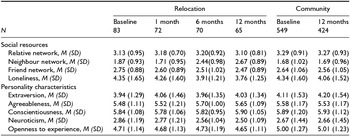
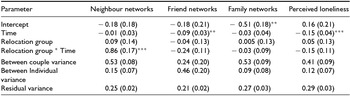
Descriptive statistics for outcome and time-varying predictors for both the relocation and community samples over time are presented in Table 2. Comparisons between the community and relocation groups for each social network domain and perceived loneliness were investigated over the 12-month period (see Table 3).
Descriptives for Relocation and Community Groups Over Time

Fixed Effects and Variance-Covariance Estimates for Models Predicting Change in Social Supports Over 12 Months: Relocation and Community Samples

Note: Robust standard errors are in parentheses. Models are adjusted for age; marital, retirement, and financial status; physical activity; and perceived constraints.
**p < .01, ***p < .001
Friend, family and neighbour networks
Analyses indicated an overall decline in friend support networks over time for both the relocation and the community sample. Although respondents in the relocation sample showed a smaller decrease in friend networks over time (B = −0.09, SE = 0.03) than those in the community group (B = −0.33, SE = .11), the test of interaction indicated this difference between groups over time was not significant. For neighbour support networks, a significant interaction of group by time indicated the relocation group reported a greater increase in neighbour networks at the 12-month assessment compared to no change in the community sample. No significant change was found over time for either the relocation or community samples in family supports.
Perceived loneliness
A comparison of perceived loneliness across the relocation and community groups showed a significant decline in loneliness (averaging .15 of a SD) between the baseline and 12-month assessment across both groups. Although respondents in the relocation sample showed a greater decrease in loneliness over time (B = −0.31, SE = .11) than those in the community group (B = −0.15, SE = 0.04), the test of interaction indicated this difference between groups over time was not significant.
The Impact of Relocation: Investigating Change Over Time Within the Relocation Sample
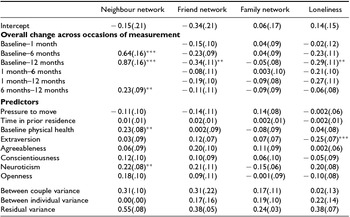
Investigation of the impact of relocation on social networks, within the relocation sample only, was then conducted using data from each of the four time points. Further analyses investigated if changes in social networks over time were associated with the perceived pressure to move, the amount of time one had resided in their current residence, or were moderated by physical health or personality characteristics; and if change in perceived loneliness was associated with change in social networks. Table 4 presents the main effects.
Fixed Effects and Variance-Covariance Estimates for Models Predicting Change in Social Networks and Loneliness Over 12 Months Within the Relocation Sample.

Note: Robust standard errors are in parentheses. Models are adjusted for age, gender, marital status and education.
**p < .01, ***p < .001
Neighbour, friend and family networks
Results indicated that, within the relocation sample, neighbour networks increased over the relocation period, with significantly greater networks reported at the 6- and 12-month assessments compared to baseline. Although physical health was associated with greater neighbour network size at baseline (indicating a between-person association), no effect of this over time was found. In contrast to expectations, high neuroticism was also associated with a greater neighbour networks at baseline; and associated with an increase in neighbour networks at 12 months post relocation.
Our analysis of friend networks indicated a significant decline in friend support networks over the relocation period. While no significant main effects were found, a significant moderating effect was found for neuroticism, indicating instability in friend networks throughout the transition for those individuals reporting high levels of neuroticism (Neuroticism × Time [1 month to 6 months] B = 0.32, SE = 0.09, p < .001).
Finally, our analysis of family networks indicated no significant change in family support over the relocation period. Interestingly, while physical health was not associated with family supports at baseline, a significant moderating effect was found in the early stage of the transition such that better physical health was associated with a decrease in family supports at the 1-month assessment, while poorer physical health was associated with an increase in family supports (Physical health × Time [baseline to 1 month] B = 0.18, SE = 0.06, p = .005). In addition, high openness was associated with a decrease in family networks at the 6-month assessment compared to baseline levels (Openness × Time [baseline to 6 months] B = −0.21, SE = 0.07, p = .001).
Perceived change in social networks
To further determine if residents perceived their social contacts to have changed following relocation, participants were asked at the 1-month assessment if they had maintained their social ties with friends and neighbours they had prior to moving. The majority of residents (67.5%) indicated they had maintained these ties, a further 7.2% of participants indicating that they had not as yet, but expected to.
Perceived loneliness
Our analyses indicated a significant decline in loneliness by the 12-month assessment in comparison to baseline levels. At baseline, higher extraversion was associated with less loneliness. Furthermore, the investigation of personality by time interactions indicated a significant moderating effect. Persons high in extraversion reported an increase in perceived loneliness at the 12-month assessment compared to baseline (Extraversion × Time [baseline to 12 months] B = 0.24, SE = 0.10, p = .01). No other moderating effects were found. Further analyses to investigate if change in friend and neighbour social networks was associated with change in perceived loneliness found no significant effect (change in friend network: B = −0.04, SE = 0.07, p = .497; change in neighbour network: B = −0.14, SE = 0.10, p = .155).
Discussion
Supporting one of the key advantages promoted as characteristic of retirement community living (i.e., companionship), the present study indicated that retirement community residents experienced a significant increase in their contact with neighbours in the year following relocation. Consistent with this, the perceived loneliness of residents also significantly declined. While we acknowledge that a decline in loneliness was also evident in our non-relocating community sample, it was more pronounced for the new retirement community residents. The present study found no significant change in family social networks over time; however, a significant decline was observed in contact with friend networks at the 12-month assessment.
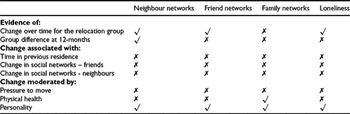
Our investigation of factors moderating these social changes over the transition indicated contextual factors, being the pressure individuals felt to move and the amount of time they had resided in their previous residence, had little effect on changes in social networks. However, baseline physical health appeared to moderate changes in family support networks. Our hypothesis that personality characteristics would be associated with adjustment was not supported. Although extraversion was associated with loneliness at baseline, the moderating effect was not in the expected direction. Persons high in extraversion reported increased loneliness at the 12-month assessment. Agreeableness did not moderate social network change following relocation. However, openness appeared to moderate changes in family networks, and neuroticism was significantly (albeit inconsistently) associated with friend network changes. A summary of results is provided in Table 5.
Summary of Results

The Impact of Relocation on Neighbour, Friend and Family Networks
The prospect of expanding one's social network is a fundamental characteristic of retirement community life that attracts many residents to retirement community living (Sergeant & Ekerdt, Reference Sergeant and Ekerdt2008). Therefore, the investigation of neighbour networks in the present study provided an important indicator of whether this retirement community delivered on this proposed benefit. The substantial increase in neighbour networks found in the present study, especially when compared to the community comparison sample, corroborates reports from past research (e.g., Percival, Reference Percival2001) that the social environment and contact with neighbours can be an outcome of relocation.
The maintenance of existing networks is also particularly important following relocation to a retirement community as it should not be observed as segregation from the wider community. The initial reports from residents following relocation indicated that the majority (67.5%) of residents had maintained their social ties with friends and neighbours they had prior to moving. However, our results suggest that there was a small although significant reduction in contact with friends in the year following relocation to the retirement community. Differences here between reports of maintained connection and the measures of network contact may reflect the nature of the contact measured. While residents may have experienced a reduction in the frequency of contact with friend networks, networks may remain strong and friendships were retained. Further investigation is therefore required to establish the nature of any network loss and to further determine if this is best described as a temporary fluctuation during the relocation and adjustment period.
In considering the impact of relocation on social networks it is important to note that participants were largely relocating within the same city. As such, the desire for closer proximity to family was unlikely to be the motive for relocation. Therefore, the consistency in family network support observed over the course of the study may be reflective of a successful transition. While concerns may be held for retirement communities replacing family contact through providing instrumental supports and services (Buys et al., Reference Buys, Miller and Barnett2006), the present study moves to alleviate this fear as family contact appears to have remained stable across the transition. However, further long-term follow-up is required.
Loneliness
Perceived loneliness is a primary motive for relocation (Sergeant & Ekerdt, Reference Sergeant and Ekerdt2008) and therefore reductions in perceived loneliness represent an important indicator of a positive transition. Although not reflecting a significant difference to the community sample 12 months post-relocation, a consistent decline was observed in perceived loneliness across the study period within the relocation sample. However, in contrast to expectations, this decline in loneliness was not associated with the increase in neighbour networks. As explanation we propose that the reduction in loneliness may be a function of the incidental contact between residents that is often reported to be more prevalent in retirement communities than other neighbourhood environments, partially as a result of community spaces (Percival, Reference Percival2001). Furthermore, it may be that the wider increase in social networks and acquaintances, including staff, may buffer feelings of social isolation beyond the neighbour contacts identified. Finally, it is possible that the adjustment period, as characterised by downsizing, familiarising oneself with a new environment, and engagement in new activities, results in individuals being too busy to feel lonely. However, given the lack of a statistically significant difference to the community sample at 12 months, further investigation is required.
The reduction in perceived loneliness also observed in the community-dwelling sample of older adults over the 12-month period is somewhat puzzling. While the trajectory of the decline within the community sample is not as pronounced, supporting the likelihood that the relocation transition may have had some impact on the relocation group, other factors may have influenced change over time. In part, it may be a reflection of normal ageing processes. Past research suggests that older adults become more positive in their social relationships over time and report better relations with children, partners and friends (e.g., Carstensen, Reference Carstensen1992). While over a 12-month period substantial normative change would not be expected, the decline in perceived loneliness for our community sample represents only a small effect (.1 of a standard deviation change).
Contextual Factors Associated With the Move
Previous studies have highlighted the importance of investigating contextual factors (e.g., pressure to move, relocation difficulties) on post-move outcomes. However, in the present study, pressure to move and embeddedness in one's prior environment, reflected by time in residence prior to moving, had little effect on social exchanges following relocation. Feeling pressured to move can significantly impact the relocation transition through creating added stress (Smider et al., Reference Smider, Essex and Ryff1996). However, no effect was found in the present study. Indeed, many participants in the present sample did not report high levels of pressure to move, indicating the decision to relocate was largely voluntary, therefore further research may be required to investigate adequately the impact of pressure to move.
It may be predicted that the longer an individual has resided in a neighbourhood, the more friends they identify and the greater contact and availability of networks they report. Consequently, this may then have implications for the magnitude of the impact of relocation. In the present study, relocating individuals had resided anywhere from a few months to 59 years in their residence prior to moving. However, time in residence was not associated with baseline social networks or change over time. The absence of a significant effect is important as it indicates that for those older adults strongly embedded in their home or neighbourhood environment, the experience may not be a substantially greater challenge than it is for those who may have moved residence on a more regular basis.
Physical Health and Adjustment to the Retirement Community
In light of physical health also being a primary motive for relocation, alongside social isolation (Crisp et al., Reference Crisp, Windsor, Anstey and Butterworth2012), the present study sought to investigate if the transition experience was impacted by the physical health of individuals. While no significant moderating effect was found in relation to friend and neighbour networks, a significant moderating effect was found with family networks such that good physical health was associated with a decrease in family supports at the 1-month assessment, while poor physical health was associated with an increase in family supports. It is possible that this reflects differing levels of involvement of family in the transition. Although all participants were relocating to independent living units, it may be that for individuals in poorer health, family is more involved in the initial transition. However, further research is required to establish the true nature of these increases and decreases in contact.
The Role of Personality in Moderating Positive Outcomes
The way in which individuals deal with stressors and adjust to major life events is suggested to be closely linked to personality characteristics (e.g., Bolger & Zuckerman, Reference Bolger and Zuckerman1995). Consistent with existing cross-sectional and life-span research (e.g., Isaacowitz & Smith, Reference Isaacowitz and Smith2003; Russell et al., Reference Russell, Booth, Reed and Laughlin1997), the present study found that at baseline, high extraversion was associated with less loneliness. However, a number of unexpected results were found. Although some research has indicated that high extraversion is associated with larger social networks and greater perceived support as a function of their propensity toward seeking social engagement and interaction (Digman, Reference Digman1990; Russell et al., Reference Russell, Booth, Reed and Laughlin1997), extraversion was not associated with family, friend and neighbour supports in the present study. While they perceived themselves to be less lonely, persons high in extraversion did not report greater support networks. Our hypothesis that individuals high in extraversion and agreeableness would report larger neighbour networks following relocation relative to those lower in extraversion and agreeableness was also not supported. Interestingly, high extraversion was associated with an increase in loneliness at the 12-month assessment. While this requires further investigation, it may be that the environment does not adequately support the need for social engagement sought by these individuals.
In addition, openness moderated change in family networks over time. The present study found that high openness was associated with a decrease in family supports following relocation. It may be that as openness is associated with a willingness to try new things, the initial adjustment period may naturally be characterised by reduced contact with family as the individual explores the new opportunities available to them. Finally, change in friend social networks was moderated by neuroticism, which demonstrated an unstable pattern of network change, consistent with the emotional instability associated with this trait (Costa & McCrea, Reference Costa and McCrea1992).
Overall, while personality may influence perceptions of social interactions, it does not appear to substantially influence actual change in network composition. Instead, it may be that a more complex interaction of characteristics form the basis for associations between personality and social network change, rather than any consistent association. While the present study attempted to extend the literature to investigate the way in which personality influences change in networks over a major life event, further investigation is required to examine classes of older adults that display a stronger affinity for this type of housing.
Limitations and Future Directions
While this study provides a much needed longitudinal investigation of immediate and short-term outcomes following relocation, and the mechanisms underlying adjustment, the results of the present study should be interpreted in the context of several limitations. Our study was restricted to a single, newly established, retirement community in the ACT and this example of relocation is therefore recognised as a potentially different experience to that of many older adults moving to an established retirement complex. Further research needs to detail the impact of relocation on the social networks of older adults moving to a range of established (and other new) retirement communities to gain a full understanding of this aspect of adjustment.
Second, the measurement of social networks is a limitation extending across research in this area. Highlighted explicitly in our study, individuals can find the delineation of social networks in different domains (e.g., friends and neighbours) challenging. In much the same way that subjectivity may exist in the classification of long-standing neighbours as friends, there is also uncertainty in the classification of new acquaintances as neighbours. Certainly, anecdotal feedback from participants in the present study concerning social network questions asked at 1 month indicated the difficulties arising in categorising new contacts as ‘neighbours’ and the assessment of support they provide. In the present study it was therefore considered necessary to withdraw the assessment of neighbour networks at the 1-month assessment. Future research may address this through less subjective measures of domain-specific social network composition. In addition, further research should also examine if those individuals who have relocated to a retirement village report having maintained contact with their social networks prior to moving over the longer term.
The present study supports the notion that in the short term, the decision to relocate to a retirement village may have at least some positive implications for social relationship quality. An investigation of mechanisms underlying successful transition highlights the complexity of this major life event. This investigation of the impact of relocation to a retirement community on the social networks of older adults provides an important contribution to our understanding of the experiences of our ageing community. Positive social relationships contribute to health and wellbeing through providing support and cultivating a sense of meaning in life. For older adults, social relationships and engagement in social activities are particularly important in promoting belongingness, companionship and control (Fiori, Antonucci, & Cortina, Reference Fiori, Antonucci and Cortina2006). Extending this evaluation, future research may highlight further important consequences for adjustment to retirement community living. Through identifying the experiences of our older population, along with the factors characterising successful transition, we can strive to ensure that relocation performed either out of preference or necessity is a positive experience and a step toward continued healthy ageing.
Acknowledgments
This research was supported under the Australian Research Council's Linkage Projects funding scheme (project number LP0989584) in partnership with National Seniors Australia and the Illawarra Retirement Trust. The findings and views reported are those of the authors and not necessarily those of the supporting agencies. Tim Windsor is the recipient of an Australian Research Council Future Fellowship (#FT100100228). Kaarin Anstey is funded by an NHMRC Fellowship (# 1002560).