1. Introduction
The Series 2 – Series 3 transition in the Cambrian System coincides with the first biotic crisis of the Phanerozoic, which saw major losses amongst the archaeocyathid sponges and two major trilobite groups, the redlichiids and olenellids (Palmer, Reference Palmer1998; Zhu et al. Reference Zhu, Zhang, Li and Yang2004; Zhu, Babcock & Peng, Reference Zhu, Babcock and Peng2006; Guo et al. Reference Guo, Strauss, Liu, Zhao, Yang, Peng and Yang2010; Fan, Deng & Zhang, Reference Fan, Deng and Zhang2011; Wang et al. Reference Wang, Hu, Yao, Chen and Xie2011; Zhang et al. Reference Zhang, Shi, Jiang, Tang and Wang2013; Ishikawa et al. Reference Ishikawa, Ueno, Shu, Li, Han, Guo and Komiya2014). Around the same time, a series of major carbon isotope oscillations have been recorded including a major negative δ13C excursion thought to coincide with the trilobite extinctions (Montañez et al. Reference Montañez, Osleger, Banner, Mack and Musgrove2000; Zhu et al. Reference Zhu, Zhang, Li and Yang2004; Zhu, Babcock & Peng, Reference Zhu, Babcock and Peng2006; Wang et al. Reference Wang, Hu, Yao, Chen and Xie2011; Peng, Babcock & Cooper, Reference Peng, Babcock, Cooper, Gradstein, Ogg and Schmitz2012). The event has therefore been termed the Redlichiid–Olenellid Extinction Carbon Isotope Excursion (ROECE) (Zhu et al. Reference Zhu, Zhang, Li and Yang2004; Zhu, Babcock & Peng, Reference Zhu, Babcock and Peng2006; Álvaro et al. Reference Álvaro, Bauluz, Subías, Pierre and Vizcaïno2008; Guo et al. Reference Guo, Strauss, Liu, Zhao, Yang, Peng and Yang2010; Fan, Deng & Zhang, Reference Fan, Deng and Zhang2011; Wang et al. Reference Wang, Hu, Yao, Chen and Xie2011).
The ROECE is also contemporaneous with a major regression–transgression couplet responsible for the boundary between the Sauk I and Sauk II supersequences of the Laurentian continent (Sloss, Reference Sloss1963; Palmer & James, Reference Palmer and James1980; McKie, Reference McKie1993; Raine & Smith, Reference Raine, Smith, Derby, Fritz, Longacre, Morgan and Sternbach2012). However, this sea-level change does not have an expression outside of Laurentia and, thus, has no apparent effect in Gondwana (Pratt & Bordonaro, Reference Pratt and Bordonaro2014) or South China (Zhu et al. Reference Zhu, Zhang, Li and Yang2004). In contrast, its Laurentian expression is a major hiatus in shelf locations, whilst down-dip a thick lowstand package is seen, such as the Hawke Bay Formation of Newfoundland; the regression has therefore been referred to as the ‘Hawke Bay event’ (Palmer & James, Reference Palmer and James1980).
The relationship between extinctions, sea-level change and carbon isotope excursions is a common theme in studies of environmental crises, but their interplay at this time in the Cambrian Period is unclear. Originally it was suggested that there were two crises: the Sinsk event (Zhuravlev & Wood, Reference Zhuravlev and Wood1996), named after the widespread development of black shales in Siberia, which especially affected archaeocyathans; and a later, severe extinction of redlichiid and olenellid trilobites coinciding with the regressive Hawke Bay event (Palmer & James, Reference Palmer and James1980; Zhuravlev & Wood, Reference Zhuravlev and Wood1996). However, others have also related this second crisis to the spread of anoxic waters and a negative shift of carbon isotope values (Zhu et al. Reference Zhu, Zhang, Li and Yang2004).
The Cambrian carbonate carbon isotope record experienced multiple oscillations, and correlating these excursions provides potentially the best approach for intercontinental correlation (e.g. Maloof et al. Reference Maloof, Porter, Moore, Dudás, Bowring, Higgins, Fike and Eddy2010; Peng, Babcock & Cooper, Reference Peng, Babcock, Cooper, Gradstein, Ogg and Schmitz2012; Smith et al. Reference Smith, Macdonald, Petach, Bold and Schrag2015). At least two negative excursions occur in the uppermost Cambrian Series 2: the Archaeocyathan Extinction Carbon isotope Excursion (AECE) (Brasier et al. Reference Brasier, Corfield, Derry, Rozanov and Zhuravlev1994; Zhu, Babcock & Peng, Reference Zhu, Babcock and Peng2006) and the ROECE. What remains unclear about both of these isotopic events is their relationship to the extinction events. For example, whilst it is well established that archaeocyathans suffered a major decline at the Sinsk event (Zhuravlev & Wood, Reference Zhuravlev and Wood1996), their final disappearance remains unconstrained. In some instances, archaeocyathans are thought to extend closer to the Series 2 – Series 3 boundary (Perejón et al. Reference Perejón, Moreno-Eiris, Bechstädt, Menéndez and Rodríguez-Martínez2012), with a few putative occurrences even known from the Cambrian Series 3 (Debrenne, Rozanov & Webers, Reference Debrenne, Rozanov and Webers1984). If the archaeocyathans persisted to the Series 2 – Series 3 boundary, the ROECE event may well be coeval with the last occurrence of the archaeocyathans as well as that of the redlichiid and olenellid trilobites.
In Series 3, the base of the Drumian Stage is defined by the first appearance datum (FAD) of the agnostid trilobite Ptychagnostus atavus, which, in the Great Basin (USA), is associated with transgression and the Drumian negative carbon isotope excursion (DICE) (Babcock et al. Reference Babcock, Rees, Robison, Langenburg and Peng2004, Reference Babcock, Robison, Rees, Peng and Saltzman2007; Zhu, Babcock & Peng, Reference Zhu, Babcock and Peng2006; Howley & Jiang, Reference Howley and Jiang2010). The onset of the excursion commonly coincides with the FAD of P. atavus (Montañez et al. Reference Montañez, Osleger, Banner, Mack and Musgrove2000; Babcock et al. Reference Babcock, Robison, Rees, Peng and Saltzman2007) and has an amplitude of around −3‰ in the Great Basin and Canadian Rockies (Montañez et al. Reference Montañez, Osleger, Banner, Mack and Musgrove2000; Howley & Jiang, Reference Howley and Jiang2010). Elsewhere, however, the excursion is substantially less pronounced. Thus, in the carbonate record of South China (Wang et al. Reference Wang, Hu, Yao, Chen and Xie2011) and the organic carbon record of Sweden the DICE is only ~1‰ (Ahlberg et al. Reference Ahlberg, Axheimer, Babcock, Eriksson, Schmitz and Terfelt2009).
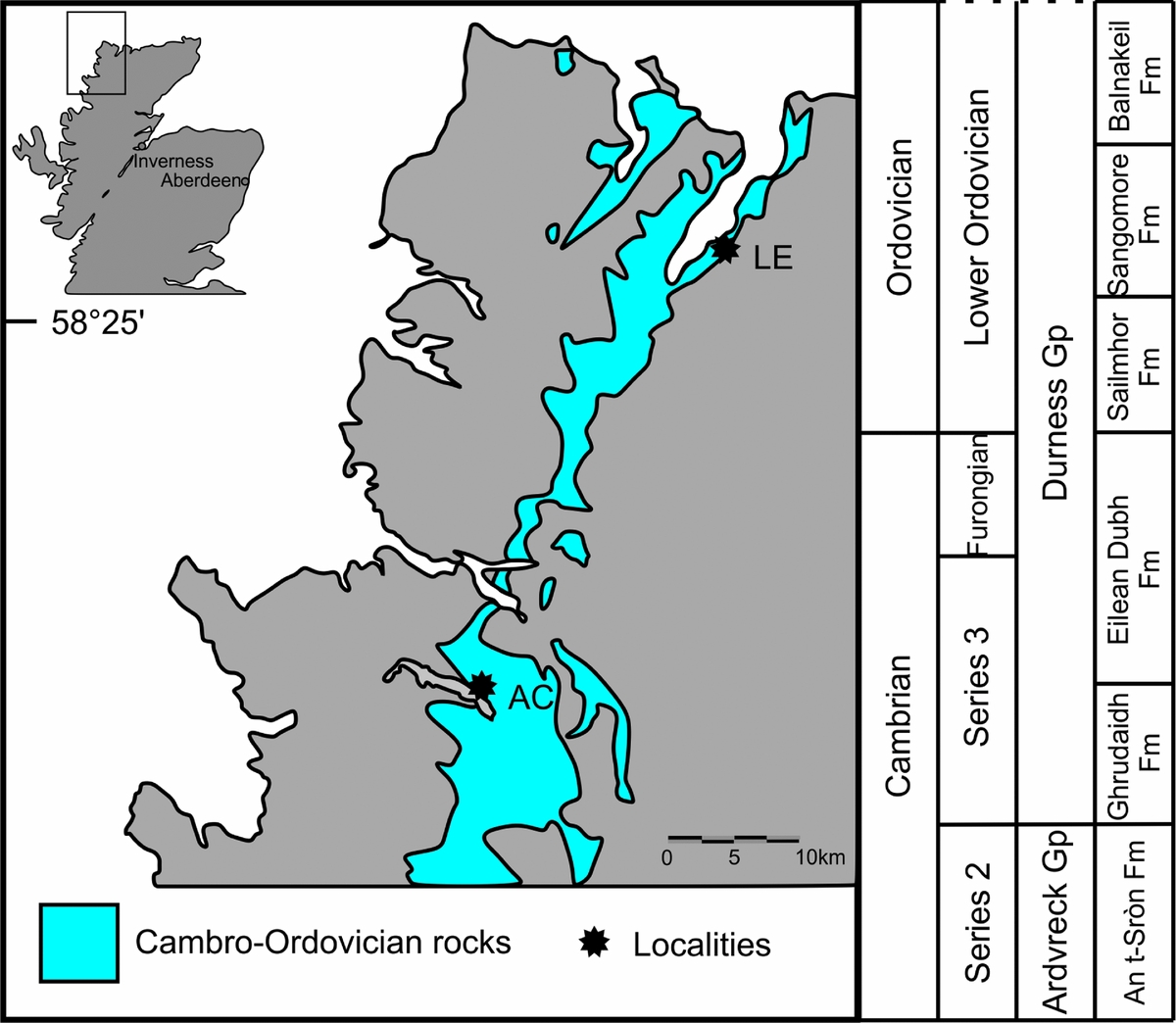
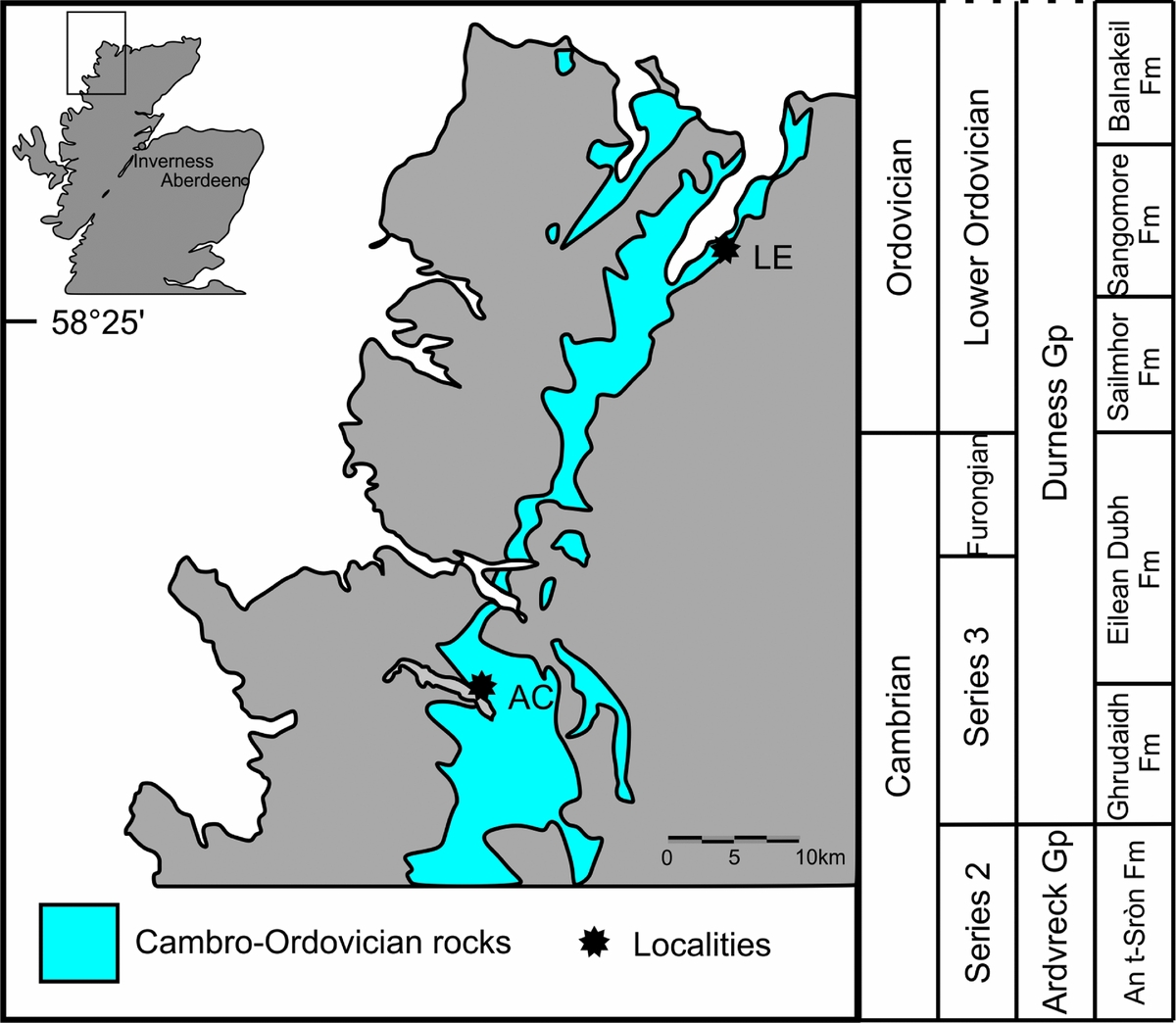
In order to further evaluate events around the Series 2 – Series 3 boundary we have conducted a facies and sequence stratigraphical analysis of the transition between the An t-Sròn and Ghrudaidh formations in NW Scotland (Fig. 1). Facies analysis of the Scottish strata shows a major lithological change at this level and recent sequence stratigraphic study has suggested that the formational boundary also correlates with the Sauk I – Sauk II supersequence boundary of North America (Raine & Smith, Reference Raine, Smith, Derby, Fritz, Longacre, Morgan and Sternbach2012). To further aid correlation, and in an attempt to identify the δ13C changes associated with the ROECE and DICE, carbonate and organic carbon isotope results are presented here.
Locality map of the study locations (LE – Loch Eriboll; AC – Ardvreck Castle) in NW Scotland, modified from Raine & Smith (Reference Raine, Smith, Derby, Fritz, Longacre, Morgan and Sternbach2012), and summary of Lower–Middle Cambrian stratigraphic units in the region.
2. Geological setting and study locations
An almost continuous belt of Cambro-Ordovician rocks crop out along the Caledonian foreland within the Moine Thrust Zone of northwestern Scotland, from Loch Eriboll in the north to the Isle of Skye in the southwest (Fig. 1; Raine & Smith, Reference Raine, Smith, Derby, Fritz, Longacre, Morgan and Sternbach2012). These strata record deposition on the southeastern Laurentian margin and are characterized by the predominance of marine sandstones of the Ardvreck Group and limestones and dolostones of the Durness Group. The Salterella Grit Member of the An t-Sròn Formation forms the uppermost part of the Ardvreck Group and consists of Skolithos-bioturbated cross-stratified, quartz arenitic sandstones (McKie, Reference McKie1989, Reference McKie1990). The transition to the Ghrudaidh Formation of the Durness Group marks the establishment of a thick succession of dolostone and limestone beds that formed in a range of supratidal, peritidal and shallow-marine carbonate platform deposits (Raine & Smith, Reference Raine, Smith, Derby, Fritz, Longacre, Morgan and Sternbach2012). Quartz sand grains persist for a few metres in the basal Ghrudaidh Formation but their disappearance at higher levels has been attributed to an abrupt transgression causing the sediment hinterland to become far distant (Raine & Smith, Reference Raine, Smith, Derby, Fritz, Longacre, Morgan and Sternbach2012).
2.a. Loch Eriboll (58°28′56.64″N, 4°40′01.01″W)
A promontory on the western shore of Loch Eriboll is one of the few localities in NW Scotland in which the An t-Sròn, Ghrudaidh and the lower portion of the Eilean Dubh formations are well exposed without a significant tectonic break (Raine & Smith, Reference Raine, Smith, Derby, Fritz, Longacre, Morgan and Sternbach2012). The outcrop spans the upper Pipe Rock Member of the Eriboll Formation through the Fucoid and Salterella Grit members, and the Ghrudaidh Formation to a level above its boundary with the Eilean Dubh Formation.
2.b. Ardvreck Castle (58°10′12.51″N, 4°59′55.00″W)
A road cutting along the eastern shore of Loch Assynt exposes the upper sections of the Salterella Grit Member, and the transition into the lowest beds of the Ghrudaidh Formation.
3. Methods
Detailed sedimentary logging and sample collection was conducted at Loch Eriboll through a 52m thick section of siliciclastic and carbonate rocks of the Ardvreck and Durness groups. At Ardvreck Castle, a 10m section spanning the same boundary was also logged. Bed numbers were allocated, and field observations and petrographical analyses were used for lithofacies and fossil identification. SEM analysis (secondary and backscattered imaging and EDX elemental mapping) was undertaken to examine more detailed petrographic features including the nature of the pyrite content.
The δ13Ccarb and δ18Ocarb were analysed at the GeoZentrum Nordbayern of the FAU Erlangen-Nürnberg, Germany. Carbonate powders were reacted with 100% phosphoric acid at 70°C using a Gasbench II connected to a ThermoFisher Delta V Plus mass spectrometer. All values are reported in per mil relative to the VPDB (Vienna Pee Dee Belemnite) by assigning δ13C and δ18O values of +1.95 and −2.20‰ to international standard NBS19, and −46.6 and −26.4‰ to international standard LSVEC, respectively. Reproducibility monitored by replicate analyses of laboratory standards calibrated to NBS19 and LSVEC was ± 0.07 (1sd) for δ 13C and ± 0.05 (1sd) for δ 18O.
4. Facies analysis
4.a. Loch Eriboll
4.a.1. Salterella Grit Member
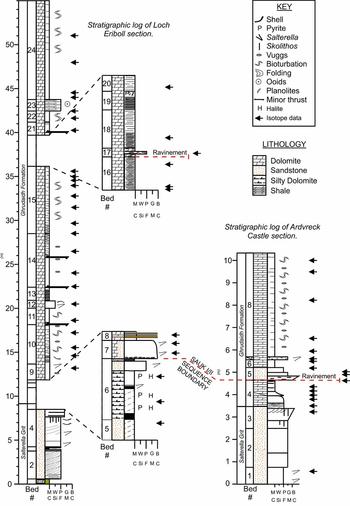
The 11m thick Salterella Grit Member consists of beds of medium-grained, cross-bedded and planar and parallel laminated quartz arenites together with strongly bioturbated quartz arenites (‘pipe rock’) with abundant Skolithos burrows (Fig. 2). The cross-sets are stacked on low-angle bounding surfaces and in some beds the intensity of Skolithos burrows is sufficient to obliterate the bedding, especially in the uppermost levels where the abundance of Salterella also increases. Petrographic examination shows the original quartz grains are well sorted and range from well-rounded to sub-rounded (Fig. 3g, h). Also present are thin interbeds of laminated mudstones and fine siltstones that display a cleavage. The contact between these finer beds and overlying sandstone beds commonly displays small gutter casts.
Sedimentary logs of the Loch Eriboll and Ardvreck Castle sections showing the correlation of a ravinement surface near the base of the Ghrudaidh Formation and a second surface ~27m above the base of the formation at Loch Eriboll.

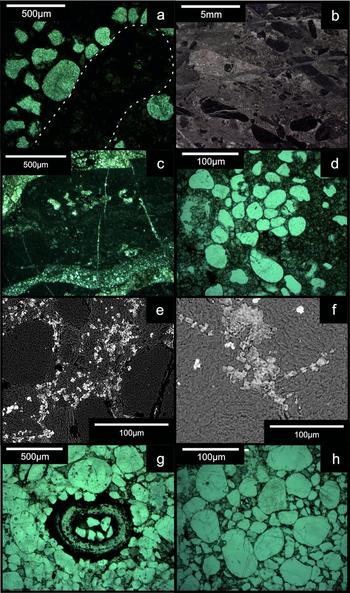
Photomicrographs of Ghrudaidh Formation facies. (a) Dolosparite pebble (highlighted with dotted line) in a sandy dolomicrite matrix, LE17. (b) Scan of slide of rudaceous limestone, exhibiting well-rounded, micrite clasts in a dolosparite matrix. (c) Rudaceous limestone of bed LE17 showing irregularly shaped, sparry bioclasts in an intraclast. (d) Photomicrograph of sandy/silty dolomite from the base of the Ghrudaidh Formation at Ardvreck Castle consisting of equal portions of rounded (aeolian) quartz grains and dolomite microspar (AC3). (e, f) Backscatter SEM images of LE6 lagoonal facies. Bright white cubes are halite, mid grey is a fine dolomite matrix and the largest, dull grey grains in (e) are aeolian quartz silt and fine sand. (g) Photomicrographs from Ardvreck Section. Salterella shell amongst well-rounded quartz grains of the Salterella Grit (bed AC1). (h) Rounded silt and fine sand grains, a relatively poorly sorted lithology from bed AC1.

4.a.2. Ghrudaidh Formation
The Ghrudaidh Formation consists of massive, burrow-mottled and well-bedded dolomite beds that frequently display small vugs. The vugs have been interpreted to record the former presence of gypsum and anhydrite (Raine & Smith, Reference Raine, Smith, Derby, Fritz, Longacre, Morgan and Sternbach2012), although they are now partly filled with dolomite rhombs. In the absence of evaporitic pseudomorphs in the vugs, it is also feasible that these features are a remnant of volume reduction during dolomitization. Finely laminated white and dark grey dolomite is also present notably around 27m above the base of the formation. Towards the top of the section is a ~1m thick (bed LE23) oolitic grainstone bed, a rare coarse-grained horizon. In thin-section the majority of the dolomite beds consist of a mosaic of interlocking dolomite rhombs of silt to sand grade, which have mostly obliterated primary depositional fabrics. Thus, even apparently fine-grained, laminated dolomites seen in the field are found to be dolosparites when seen in thin-section.
Salterella is the only identifiable fossil in this section of the Ghrudaidh Formation, although other shell hash is also present (e.g. in LE9). The common burrows are mostly Planolites but there are also some branching Thalassinoides-like trace fossils.
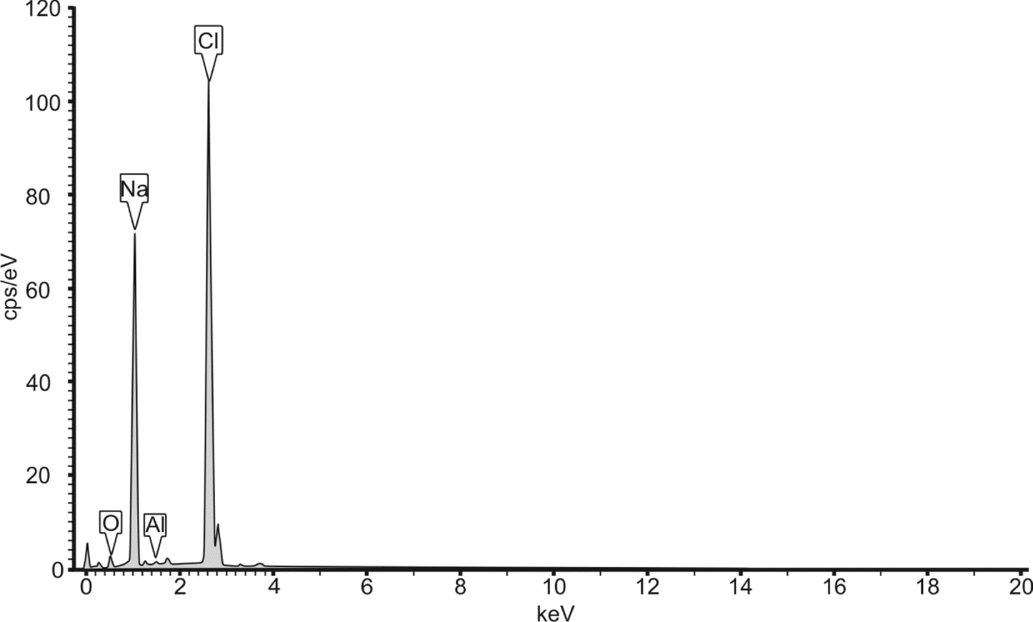
The base of the Ghrudaidh Formation is taken at the sharp base of bed LE6 that marks the first appearance of carbonate. It is a dark, pyritic dolomite bed containing carbonate nodules, which in turn is succeeded by cleaved, pyritic, vuggy dolomite with Salterella and echinoderm fragments. SEM analysis of samples from LE6 reveals common pyrite microcrystal agglomerations (≤10µm), scattered microcrystals and rare pyrite framboids that range in size from 5µm to 25µm diameter. A sample from the uppermost 8cm of LE6 also revealed the presence of abundant tiny halite cubes, around 10µm in diameter (Figs 3e, f, 4).
Representative EDS spectra taken from a halite cube in bed LE6.

Bed LE7 is a microconglomerate bed that sits on a sharp, slightly erosive base. It grades upwards into a dolomite with common well-rounded, quartz sand grains. The well-rounded lithoclasts are up to 1cm in diameter and consist of dolosparite. Another rudaceous horizon occurs ~25m above the base of the Ghrudaidh Formation (LE17) where three thin (<10cm thick) erosive-based microconglomerates occur. The well-rounded equant pebbles are up to 1cm in diameter and are composed of biomicrite (Fig. 3b). This clast lithology is not seen in the underlying beds, which are recrystallized dolostones (although they appear finer-grained and laminated in the field).
4.b. Ardvreck Castle
4.b.1. Salterella Grit Member
Like the strata in the Loch Eriboll section, the upper Salterella Grit Member at Ardvreck Castle is dominated by quartz arenite beds with trough cross-sets and abundant Skolithos burrows.
4.b.2. Ghrudaidh Formation
The contact between the Salterella Grit and Ghrudaidh Formation is sharp and is overlain by a bed (AC3) consisting in equal amounts of well-rounded quartz grains and sparry dolomite that grades upwards into less quartz-rich dolomite (AC4). This basal 1m of the Ghrudaidh Formation is a transitional lithology that sees a decline in siliciclastic content and a transition to the pure dolomites that form the remainder of the formation. SEM examination reveals no halite crystals in these beds. The quartz-sand-bearing dolomite beds are sharply truncated by a thin microconglomerate (bed AC5) composed of small (~5mm), well-rounded pebbles of dolomite in a matrix dominated by well-rounded quartz grains. The succeeding Ghrudaidh strata are dominated by beds of vuggy, burrowed, massive dolomite that dominate the remainder of the formation.
4.c. Interpretation
The Salterella Grit Member has been interpreted to be a tidal sandbank facies formed during a shallowing phase of deposition (McKie, Reference McKie1990, Reference McKie1993). Conditions alternated between periods influenced by strong tidal currents and more quiescent intervals when intense burrowing occurred. The subsequent sharp transition to the fine-grained strata at the base of the Ghrudaidh Formation at Loch Eriboll indicates a considerable decrease in depositional energy. This observation, combined with the abundant occurrence of halite and small pyrite framboids at Loch Eriboll, suggests a restricted, evaporitic lagoonal setting and low-oxygen conditions. The persistence of the well-rounded quartz grains that dominate the Salterella Grit Member, in these basal beds of the Ghrudaidh Formation, shows that the source terrain (probably aeolian dunes on the adjacent Laurentian craton) was still nearby.
The basal Ghrudaidh strata at Ardvreck Castle differs from that at Loch Eriboll because it has a higher proportion of quartz grains and lacks evidence (such as pyrite framboids and halite) for lagoonal deposition. It is possible that this is an intertidal facies developed immediately adjacent to aeolian dunes. However, contrasting facies are seen 0.9km to the north of the Ardvreck locality at Lochan Feòir [NC23672520], where very thinly bedded, black dolomitic mudstones containing abundant Salterella and articulated Olenellus aff. reticulatus Peach occur in the basal Ghrudaidh Formation (Huselbee & Thomas, Reference Huselbee and Thomas1998). The Lochan Feòir strata are similar to those found at Loch Eriboll suggesting that high-energy and low-energy strata show rapid lateral changes.
The sharp truncation of the basal Ghrudaidh lagoonal/intertidal facies by a microconglomerate at both study locations is interpreted to record the passage of a zone of erosion (see sequence stratigraphic discussion in Section 6 below) and heralded the establishment of persistently well-oxygenated conditions, as shown by the bioturbation and shelly fossils in the overlying fine-grained dolostones (now mostly recrystallized). The gradual loss of rounded quartz grains upsection indicates an increasingly more distant source terrain (Raine & Smith, Reference Raine, Smith, Derby, Fritz, Longacre, Morgan and Sternbach2012). The low-energy conditions were occasionally punctuated by much higher energy conditions recorded by the rare oolitic strata. The frequent vuggy appearance of the strata suggests replacement of secondary evaporites as a result of concentrated pore-fluid brines. The elevated salinity is interpreted to have occurred late in the deposition of the Ghrudaidh Formation.
The bedset LE16–18 records a shift in conditions as the intensely burrowed strata is replaced by laminated dolomites and then a thin, erosive-based microconglomerate. This succession is similar to the strata that are seen at the base of the Ghrudaidh Formation where lagoonal beds were truncated during transgression.
5. Chemostratigraphy
This study presents the first δ13C and δ18O chemostratigraphic data for the Durness Group. A total of 20 samples from Ardvreck Castle were analysed, of which two samples from the Salterella Grit had insufficient carbonate content to yield a signal. In addition 40 samples from Loch Eriboll were analysed, and three were found to be too carbonate poor to yield a reliable value.
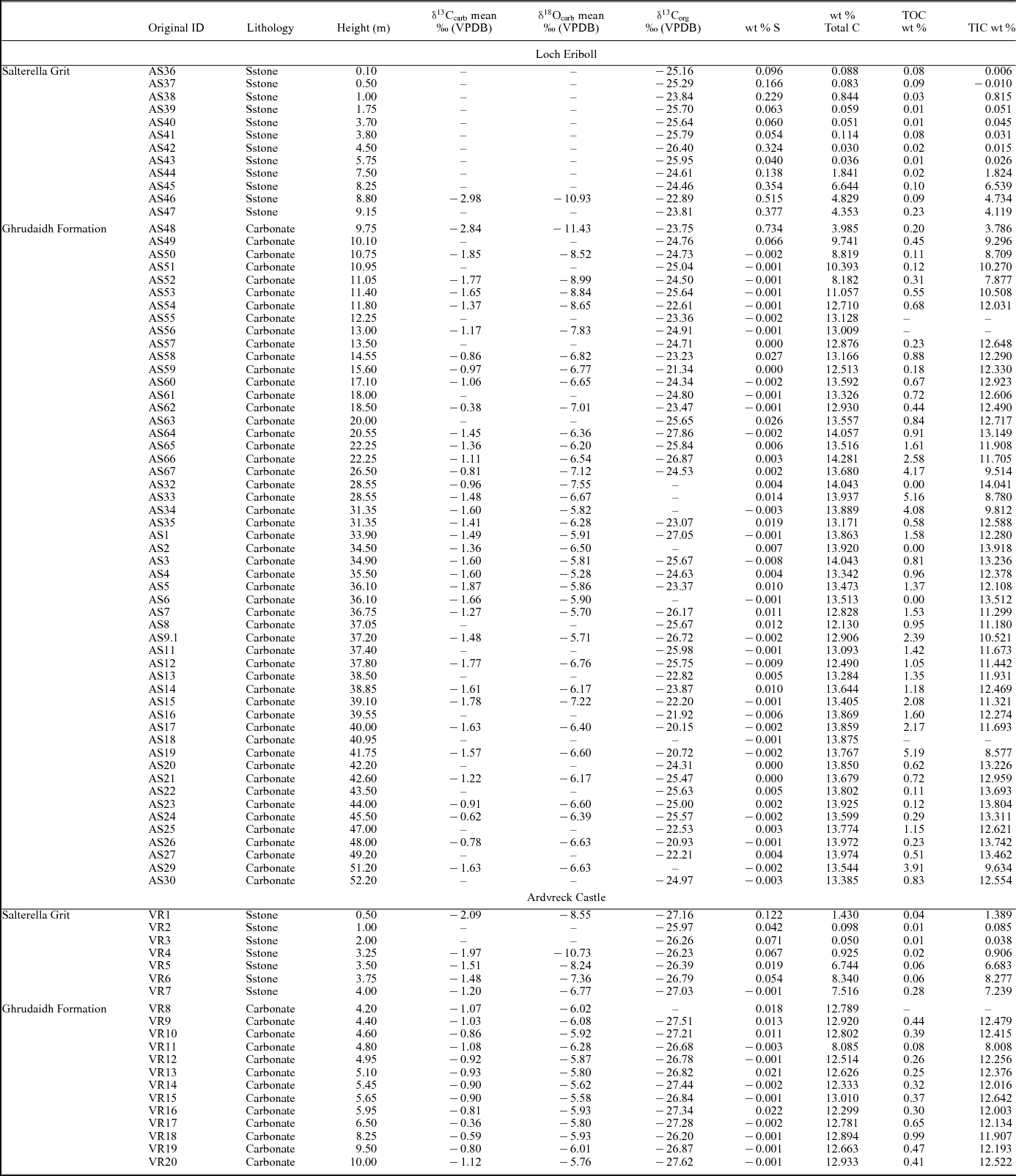
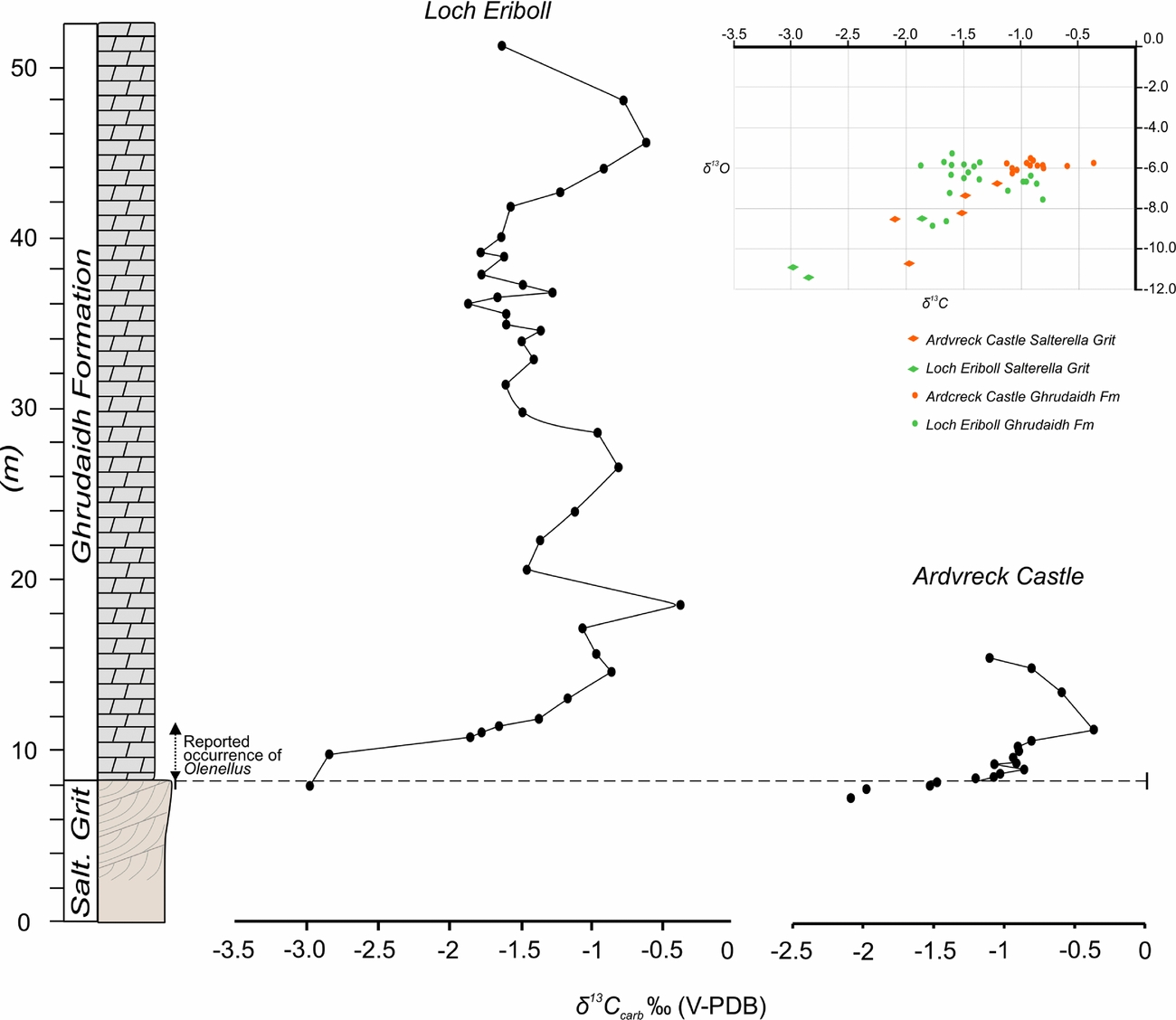
At Loch Eriboll, the lowest δ13Ccarb value is returned from the Salterella Grit Member, sample AS46, with a total inorganic carbon (TIC) of 4.5wt% returned from Salterella shells. Although this is found in a sandstone we interpret the organic source of the carbonate to represent an original environmental signal. Above this, δ13Ccarb values of −3.0‰ occur in the silty dolomites immediately above at the base of the Ghrudaidh Formation (Fig. 5). These were followed by an increase in the overlying 10m culminating in peak positive values of −0.4‰ before a decline to a broad lowpoint of −2‰ around 30m above the base of the formation. The curve then swings to heavier values of −0.6‰ and then falls to −1.6‰ at the top of the Loch Eriboll section. The shorter Ardvreck Castle δ13Ccarb record (Fig. 5) shows a rapid increase across the Salterella Grit – Ghrudaidh boundary to a positive peak 2m above before declining. The two lowest values measured from the Salterella Grit Member at the base of the section come from sandstones in which the main carbonate content is the shells of Salterella (carbonate content ranges from 1 to 7wt%, see Table 1). The positive hump of δ13Ccarb values is seen at both locations and is considered to record the same chemostratigraphic event. However, at Ardvreck Castle this excursion occurs over a shorter interval (Fig. 5), an observation we attribute to a more condensed section at this location.
Geochemical data from both Loch Eriboll and Ardvreck Castle locations. Height is measured from the base of logged sections (Fig. 2).

TOC – total organic carbon; TIC – total inorganic carbon.
The δ18Ocarb values at both the Loch Eriboll and Ardvreck Castle locations show slight covariance with δ13Ccarb values only in samples taken from the Salterella Grit Member (Fig. 5 inset). The two lightest δ18Ocarb values that also correspond with the lightest δ13Ccarb values (Fig. 5) are from the sandstones of the Salterella Grit at Ardvreck Castle (see Table 1). In this member the main source of carbonate is the shells of Salterella and the carbonate content is significant enough (1–8wt% TIC) to measure a carbonate carbon isotope signal. Whilst it is possible that this slight covariation is a reflection of an early diagenetic signal, at Loch Eriboll the strong similarity between Salterella Grit δ13Ccarb values (−2.98‰) and basal Ghrudaidh Formation values (−2.84‰) suggests that the Salterella Grit lowest data point at Loch Eriboll is in accordance with a reliable primary isotopic signal from the Ghrudaidh Formation. This observation suggests that δ13Ccarb values have not been affected by significant diagenesis and that the returning limb of the ROECE recorded within the Salterella Grit and immediately above in the Ghrudaidh Formation is a primary record of oceanic carbon isotope fluctuations.
The δ13Corg record we obtained (Table 1) shows frequent oscillations with no consistent trends between the sections nor any similarity with the δ13Ccarb curve. This variability probably relates to the extremely low total organic carbon values (mostly < 0.5 %) and the likelihood that values are influenced by factors such as reworked, detrital organic carbon.
δ13Ccarb chemostratigraphic curve from Loch Eriboll and Ardvreck sections. Top right inset is a cross-plot of C and O data with samples from the Salterella Grit Member and Ghrudaidh Fm from each location delineated by respective symbols. The reported occurrence of Olenellus is from Huselbee & Thomas (Reference Huselbee and Thomas1998); the precise location of the specimen is unknown but is indicated by dashed line.

5.a. Interpretation
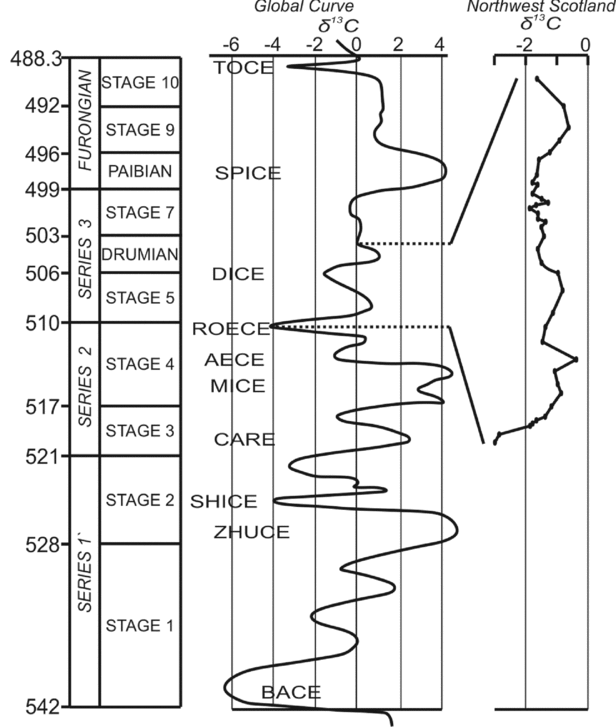
Global oscillations in the Cambrian δ13Ccarb record include the ROECE, a major negative excursion developed around the Series 2 – Series 3 boundary during which values drop to −4‰ followed by a rapid recovery to heavier values (Montañez et al. Reference Montañez, Osleger, Banner, Mack and Musgrove2000; Guo et al. Reference Guo, Strauss, Liu, Zhao, Yang, Peng and Yang2010). From the Scottish data, we interpret the abrupt rise of δ13Ccarb at the base of the Ghrudaidh Formation to record this recovery phase. The amplitude of the ROECE varies considerably between regions. Laurentian values are around 4.5‰, in China it can reach 7‰ but in Siberia it is only 1.5‰ (Wang et al. Reference Wang, Hu, Yao, Chen and Xie2011). In Scotland the excursion is 3‰, but this is likely not the full amplitude because the lowpoint of the curve is not recorded in the carbonate-free clastic sediments of the lower Salterella Grit.
The oscillations of δ13Ccarb values within the higher levels of the Ghrudaidh Formation (only studied at Loch Eriboll) can be closely matched with the global curve (Fig. 6) and they suggest that the prolonged lowpoint of values ~30m above the base of the Ghrudaidh Formation (beds LE16–18) could be the DICE, an excursion that marks the Stage 5 – Drumian Stage age. As with the ROECE, the DICE varies considerably in magnitude. In South China it ranges from 1.0 to 2.5‰ but in the Great Basin of the western United States it is present as a 3.5‰ negative excursion (Zhu et al. Reference Zhu, Zhang, Li and Yang2004; Howley & Jiang, Reference Howley and Jiang2010). The larger values in the USA may reflect the exacerbation of the excursion by regional factors such as upwelling of deep oceanic waters and/or erosion from newly uplifted mountains (Howley & Jiang, Reference Howley and Jiang2010). The amplitude of the DICE in Scotland is towards the lower end of this reported range, with a magnitude of ~1‰.
Global Cambrian carbon isotope curve (Zhu, Babcock & Peng, Reference Zhu, Babcock and Peng2006) showing the proposed correlation with the Scottish sections.

Our chemostratigraphic age assignment for the Ghrudaidh Formation is also supported by the modest biostratigraphic data that is available. The single Olenellus reported from basal beds of the Ghrudaidh Formation (Huselbee & Thomas, Reference Huselbee and Thomas1998) indicates a late Series 2 age. The presence of Salterella up to 10m above the base of the formation also indicates a Series 2 age (Fritz & Yochelson, Reference Fritz and Yochelson1988; Wright & Knight, Reference Wright and Knight1995). No other biostratigraphically useful fossils occur but Wright & Knight (Reference Wright and Knight1995) argued that the higher levels of the Ghrudaidh Formation correlated with the Bridge Cove Member of the March Point Formation in western Newfoundland. This age assignment places the Scottish strata above the 10m level in our logs within the early part of Series 3. This is in agreement with our recognition of the DICE 30m above the base of the Ghrudaidh Formation at Loch Eriboll.
6. Sequence stratigraphy
The sequence stratigraphy of the Cambro-Ordovician succession of NW Scotland was discussed by Raine & Smith (Reference Raine, Smith, Derby, Fritz, Longacre, Morgan and Sternbach2012) who placed the boundary between Sloss's (Reference Sloss1963) Sauk I and Sauk II supersequences at the An t-Sròn–Ghrudaidh formational boundary. In North America, this supersequence boundary is a major hiatal surface that formed during the Hawke Bay event (Wright & Knight, Reference Wright and Knight1995), but it is not clearly manifested outside of Laurentia (e.g. Álvaro & Debrenne, Reference Álvaro and Debrenne2010; Pratt & Bordonaro, Reference Pratt and Bordonaro2014). NW Scotland lay on the Laurentian margin and so this shallow-water setting might be expected to show a well-developed sequence boundary. However, the effect of the Hawke Bay event was surprisingly subdued. The formational boundary marks the culmination of prolonged shallowing and sees the transition from open, inner shelf conditions of the uppermost Salterella Grit to the restricted, lagoonal and intertidal facies of the basal Ghrudaidh Formation. This base-level shift, from inner shelf to lagoon, is probably no more than 10m. A few metres higher a ravinement surface marks the onset of flooding and modest deepening; again, base-level changes are only of the order of a few metres. There are two options for the placement of a sequence boundary in this succession. The first would place it at the formational contact. This would imply that the overlying lagoonal/intertidal facies are a thin development of a lowstand systems tract with its top boundary being an initial flooding (ravinement) surface. The second option would consider the ravinement surface to be amalgamated with a sequence boundary and with the formational boundary only recording a facies change. Given the overall inner platform setting of the Scottish outcrops it is perhaps unlikely that any lowstand strata would be developed, because such sediment packages are typically found distally in offshore/shelf margin locations. Therefore, we consider the second option to be the most probable. Thus, the sequence boundary is developed low in the Ghrudaidh Formation and not at its base. It is likely to record a major hiatus. The halite crystals developed immediately below the surface at Loch Eriboll may have grown during this non-depositional episode in a supratidal setting. The succeeding 20m thick succession of dolomicrites do not record major facies changes but the significant upsection decline of terrigenous material suggests continued transgression and flooding of the hinterland.
The next major facies change is centred on another thin microconglomerate (bed LE17). It is similar to the lower examples, and is also interpreted to have formed during ravinement. By comparison with the basal Ghrudaidh Formation, the finely laminated strata that underlie this bed (LE16) may be highstand lagoonal facies. Thus, this succession of beds (LE16–18), chemostratigraphically correlated with the Stage 5 – Drumian boundary, probably records the regressive–transgressive couplet seen elsewhere in the world at this level (e.g. Montañez et al. Reference Montañez, Banner, Osleger, Borg and Bosserman1996; Babcock et al. Reference Babcock, Rees, Robison, Langenburg and Peng2004; Álvaro et al. Reference Álvaro, Ahlberg, Babcock, Bordonaro, Choi, Cooper and Jago2013).
7. Conclusions
The NW Scotland sections reveal a clear sequence of events across the Series 2 – Series 3 boundary and help evaluate some of the cause-and-effect relationships of this dynamic interval.
The later part of the ROECE is preserved in the δ13Ccarb record of the basal Ghrudaidh Formation with the lowpoint of this excursion probably occurring earlier during deposition of the Salterella Grit Member. Sequence boundary formation (perhaps the equivalent of the Hawke Bay event in North America) led to the development of an erosive surface by ravinement processes that is mantled by a thin conglomerate near the base of the Ghrudaidh Formation. The overlying strata records transgression with an increasingly distal hinterland supply. No lowstand facies are developed because of the proximal setting on this Laurentian platform. The formational boundary, 2m below the sequence boundary, is interpreted to be simply a facies contact that marks coastal progradation with inner shelf tidal clastic facies replaced by intertidal clastic sediments and dolomitic lagoonal facies.
The Stage 5 – Drumian boundary, identified from carbon isotope oscillations (DICE), is found within the upper Ghrudaidh Formation and this too records an amalgamated sequence boundary/flooding surface with lagoonal facies transgressed by a conglomerate developed on a ravinement surface. The base of the Drumian in Gondwana is marked by the spread of anoxic facies by marine transgression (Álvaro et al. Reference Álvaro, Ahlberg, Babcock, Bordonaro, Choi, Cooper and Jago2013). This level is also associated with trilobite turnover but the lack of fossils in the Scottish strata does not permit evaluation of this event. However, elsewhere in the world the earliest Drumian saw a major transgression and spread of anoxic facies, especially in Gondwanan sections (Álvaro et al. Reference Álvaro, Ahlberg, Babcock, Bordonaro, Choi, Cooper and Jago2013). From our section at Loch Eriboll the dark grey, laminated dolomites (LE18) could be a Laurentian development of this transgressive anoxic phase.
Olenellus occurs in the basal Ghrudaidh Formation within the highstand facies, but below the sequence boundary. Thus, the ROECE extinctions, which removed the olenellids, may have post-dated the peak negative values of the ROECE. A similar post-excursion extinction of redlichiid trilobites is also seen in South China (Montañez et al. Reference Montañez, Osleger, Banner, Mack and Musgrove2000; Zhu et al. Reference Zhu, Zhang, Li and Yang2004; Peng, Babcock & Cooper, Reference Peng, Babcock, Cooper, Gradstein, Ogg and Schmitz2012). This has a bearing on proposed extinction mechanisms. Montañez et al. (Reference Montañez, Osleger, Banner, Mack and Musgrove2000) argued that the incursion of deep anoxic waters (with a light carbon isotope signature derived from remineralized organic matter) into shallower waters may have triggered a biomass crash and trilobite extinction. The mistiming of the ROECE and extinctions in Scotland (and also in China, e.g. Zhu et al. Reference Zhu, Zhang, Li and Yang2004) does not support this scenario. However, trilobites are exceptionally rare in the Ghrudaidh Formation and it is possible that the occasional Olenellus fossils are holdovers that post-date the main extinction. Further collecting is required in more fossiliferous sections worldwide to fully evaluate this extinction event.
Acknowledgements
This research was made possible by a NERC postgraduate studentship and a postgraduate Student Bursary grant (March 2014) from the Mineralogical Society of Great Britain and Ireland and the use of the Stable Isotope Laboratory at Friedrich-Alexander University, Erlangen-Nürnberg. We thank two anonymous reviewers for their feedback.