A main goal of developmental psychopathology research is to identify early risk factors for later behavioral problems. In the same vein, developmental psychopathology aims to elucidate the mechanisms of equifinality and multifinality in order to identify individuals at greatest risk for psychopathology and to aid early intervention and prevention. How children attend to social information may be associated with behavioral problems and help explain variations in the developmental pathways from early risk. The current study examines relations between children's propensity to attend toward positively valenced stimuli (i.e., attention bias to reward) and behavioral problems in the externalizing domain. Moreover, we examine the role of attention bias to reward on the longitudinal relations between known early risk factors of externalizing and attention problems.
Behavioral problems in the externalizing domain include aggressive, disruptive, or conduct problems, as well as attention problems. Although they are often separated into specific disorders (e.g., oppositional defiant disorder, conduct disorder, and attention-deficit/hyperactivity disorder), they frequently co-occur and are believed to share similar developmental antecedents, such as temperamental traits that indicate high approach tendencies and/or lack of regulation (Faraone et al., Reference Faraone, Rostain, Blader, Busch, Childress, Connor and Newcorn2018; Tackett, Reference Tackett2010). For instance, developmental research has identified an early behavioral profile marked by positive affect, high activity levels, and high approach toward novelty, called exuberance (Fox, Henderson, Rubin, Calkins, & Schmidt, Reference Fox, Henderson, Rubin, Calkins and Schmidt2001). Exuberance is thought to be driven by a motivational state of heightened sensitivity to reward and reward expectancy, leading to bold approach to novelty and impulsivity (Degnan et al., Reference Degnan, Hane, Henderson, Moas, Reeb-Sutherland and Fox2011; Polak-Toste & Gunnar, Reference Polak-Toste, Gunnar, Marshall and Fox2006). Exuberance is considered a risk factor for behavioral problems as it often predicts later externalizing and attention problems (Morales, Beekman, Blandon, Stifter, & Buss, Reference Morales, Beekman, Blandon, Stifter and Buss2015; Nigg, Goldsmith, & Sachek, Reference Nigg, Goldsmith and Sachek2004; Putnam & Stifter, Reference Putnam and Stifter2005; Tackett, Reference Tackett2010). For instance, Putnam and Stifter identified a group of exuberant children, characterized by increased positive affect and behavioral approach in toddlerhood, and found that exuberance was associated with higher levels of externalizing problems at age 2 (Putnam & Stifter, Reference Putnam and Stifter2005) and at age 4 (Stifter, Putnam, & Jahromi, Reference Stifter, Putnam and Jahromi2008). Similarly, Morales, Beekman, et al. (Reference Morales, Beekman, Blandon, Stifter and Buss2015) found that exuberance in toddlerhood was predictive of a composite of externalizing and attention problems during preschool.
Self-regulatory abilities, such as effortful control, are also known early risk factors for externalizing and attention problems. Effortful control is commonly defined as the ability to control behavior by inhibiting a prepotent response (inhibitory control) and/or to activate an alternative, subdominant response (Kochanska & Knaack, Reference Kochanska and Knaack2003; Rothbart & Bates, Reference Rothbart, Bates, Damon and Lerner2006). In other words, effortful control refers to the general ability to volitionally modulate, inhibit, or activate behavior and attention. As such, effortful control allows individuals to meet societal demands, and early deficits in effortful control are a strong marker of maladaptive trajectories, including later externalizing and attention problems (Eisenberg et al., Reference Eisenberg, Valiente, Spinrad, Cumberland, Liew, Reiser and Losoya2009; Lemery, Essex, & Smider, Reference Lemery, Essex and Smider2002; Moffitt et al., Reference Moffitt, Arseneault, Belsky, Dickson, Hancox, Harrington and Caspi2011; Morales, Pérez-Edgar, & Buss, Reference Morales, Pérez-Edgar and Buss2016). For instance, Lemery et al. (Reference Lemery, Essex and Smider2002) found that poorer effortful control in early childhood (3.5–4.5 years) predicted externalizing and attention problems 1 year later (5.5 years).
In sum, exuberance and effortful control are significant early risk factors for externalizing and attention problems; however, they are far from perfect indicators of these later problems. Several studies fail to find significant direct associations between these early risk factors and later behavioral problems (e.g., Degnan et al., Reference Degnan, Hane, Henderson, Moas, Reeb-Sutherland and Fox2011; Murray & Kochanska, Reference Murray and Kochanska2002; Rhoades, Greenberg, & Domitrovich, Reference Rhoades, Greenberg and Domitrovich2009). From a developmental psychopathology perspective, the term multifinality describes different developmental pathways from a common early individual trait. Multifinality implies that there may be unexamined processes that account for variable developmental trajectories from early risk. Social information processing is a more proximal risk factor and potential moderator that could explain the heterogeneity of developmental pathways from early exuberance and effortful control. Specifically, the way individuals attend to different environmental cues shapes their interpretation of the situation, causing them to react or behave accordingly (Crick & Dodge, Reference Crick and Dodge1994). Further, the emotional salience of cues plays a crucial role in social information processing (Lemerise & Arsenio, Reference Lemerise and Arsenio2000) as documented by the large literature on the impacts of affect-biased attention on psychopathology.
Affect-biased attention is the tendency to selectively attend to environmental cues that are pertinent to the individual's psychological state, shaping how individuals interpret and ultimately respond to their environment (Derryberry & Reed, Reference Derryberry and Reed1996, Reference Derryberry and Reed2002; Todd, Cunningham, Anderson, & Thompson, Reference Todd, Cunningham, Anderson and Thompson2012). As such, cognitive models of psychopathology propose that affect-biased attention impacts, potentially in a causal manner, individuals’ thought, emotion, and behavior (e.g., Bar-Haim, Lamy, Pergamin, Bakermans-Kranenburg, & van IJzendoorn, Reference Bar-Haim, Lamy, Pergamin, Bakermans-Kranenburg and van IJzendoorn2007; Morales, Fu, & Pérez-Edgar, Reference Morales, Fu and Pérez-Edgar2016). Moreover, affect-biased attention may help identify and explain the different developmental pathways stemming from a common early risk factor (i.e., exuberance or effortful control). Although most of this evidence comes from the internalizing literature, in which the link between attention bias toward negative or threatening stimuli and anxiety has been extensively studied, it has recently been proposed that affect-biased attention acts as a general mechanism that influences thoughts and behavior across several socioemotional domains (Morales, Fu, et al., Reference Morales, Fu and Pérez-Edgar2016).
As reviewed in Morales, Fu, et al. (Reference Morales, Fu and Pérez-Edgar2016), an attention bias toward reward-related stimuli is associated with approach-oriented emotions in several different domains of functioning (e.g., extraversion, drug addiction, and obesity). Support for the role of attention biases in approach-oriented emotions comes from studies examining biases toward positively valenced stimuli (i.e., happy faces). Happy faces are considered to be social rewards as viewing happy facial expressions typically activates reward-related areas (e.g., striatum and orbitofrontal cortex; Cremers, Veer, Spinhoven, Rombouts, & Roelofs, Reference Cremers, Veer, Spinhoven, Rombouts and Roelofs2015; Luking, Pagliaccio, Luby, & Barch, Reference Luking, Pagliaccio, Luby and Barch2016; Monk et al., Reference Monk, Klein, Telzer, Schroth, Mannuzza, Moulton and Ernst2008; O'Doherty et al., Reference O'Doherty, Winston, Critchley, Perrett, Burt and Dolan2003). As such, attention biases to these positive stimuli are commonly conceptualized as attention bias toward reward (Frewen, Dozois, Joanisse, & Neufeld, Reference Frewen, Dozois, Joanisse and Neufeld2008; Morales, Pérez-Edgar, et al., Reference Morales, Pérez-Edgar and Buss2016; Shechner et al., Reference Shechner, Britton, Pérez-Edgar, Bar-Haim, Ernst, Fox and Pine2012). Studies in adults find that attention bias to reward is positively related to positive affect (Tamir & Robinson, Reference Tamir and Robinson2007) and extraversion (Derryberry & Reed, Reference Derryberry and Reed1994), and negatively related to anxiety and depression (Frewen et al., Reference Frewen, Dozois, Joanisse and Neufeld2008; Shechner et al., Reference Shechner, Britton, Pérez-Edgar, Bar-Haim, Ernst, Fox and Pine2012). In addition, training adults to attend toward reward increases positive affect (Grafton, Ang, & MacLeod, Reference Grafton, Ang and MacLeod2012; Taylor, Bomyea, & Amir, Reference Taylor, Bomyea and Amir2011) and reduces anxiety in children and adults (Britton et al., Reference Britton, Bar-Haim, Clementi, Sankin, Chen, Shechner and Pine2013; Heeren, Reese, McNally, & Philippot, Reference Heeren, Reese, McNally and Philippot2012; Waters, Pittaway, Mogg, Bradley, & Pine, Reference Waters, Pittaway, Mogg, Bradley and Pine2013). Finally, attention bias to reward moderates the relation between early temperamental risk and later anxiety, such that early temperamental risk predicted later anxiety only for children who displayed a reduced attention bias to reward (Shechner et al., Reference Shechner, Britton, Pérez-Edgar, Bar-Haim, Ernst, Fox and Pine2012; White et al., Reference White, Degnan, Henderson, Pérez-Edgar, Walker, Shechner and Fox2017). In sum, attention bias to reward is related to increased positive affect and may serve as a protective factor against the risk of internalizing problems.
However, an attention bias to reward may not be adaptive in all contexts. Several studies highlight the role of reward processing in the development and maintenance of externalizing behavior problems. Specifically, children with externalizing and attention problems are more sensitive to rewards as they persevere toward rewards even in the presence of adverse outcomes and prefer immediate rewards over larger but delayed rewards, compared to children without these problems (Frick et al., Reference Frick, Cornell, Bodin, Dane, Barry and Loney2003; Gatzke-Kopp et al., Reference Gatzke-Kopp, Beauchaine, Shannon, Chipman, Fleming, Crowell and Johnson2009; Luman, Oosterlaan, & Sergeant, Reference Luman, Oosterlaan and Sergeant2005; Luman, van Meel, Oosterlaan, & Geurts, Reference Luman, van Meel, Oosterlaan and Geurts2012; O'Brien & Frick, Reference O'Brien and Frick1996). As such, it is possible that high levels of attention bias to reward, although protective in some contexts, may be maladaptive in other contexts, particularly among children who are already at increased risk for externalizing and attention problems (e.g., children high in temperamental exuberance or low in effortful control).
Supporting this notion, prior work in community samples of children has found that attention bias to reward was concurrently related to a composite measure of externalizing and attention problems (He, Li, Wu, & Zhai, Reference He, Li, Wu and Zhai2017; Morales, Pérez-Edgar, et al., Reference Morales, Pérez-Edgar and Buss2016) and higher attention-deficit/hyperactivity disorder symptoms (Cremone, Lugo-Candelas, Harvey, McDermott, & Spencer, Reference Cremone, Lugo-Candelas, Harvey, McDermott and Spencer2018). Moreover, Morales, Pérez-Edgar, et al. (Reference Morales, Pérez-Edgar and Buss2016) found that attention bias to reward at age 6 was predicted by parent reports of temperamental exuberance at age 2. In addition, the longitudinal relation between toddler exuberance and later attention bias toward reward was mediated by effortful control at age 4, suggesting that effortful control is one of the underlying processes accounting for the relation between early exuberance and attention bias toward reward. A concurrent relation between increased attention bias to reward and lower effortful control was recently reported in another sample of 6-year-old children (Cole, Zapp, Fettig, & Pérez-Edgar, Reference Cole, Zapp, Fettig and Pérez-Edgar2016). Together, these findings suggest that attention bias to reward may be a marker of high approach and, coupled with low levels of effortful control, may predict behavioral problems marked by impulsive behavior such as externalizing and attention problems.
The current study aims to support and extend this literature in multiple ways. In order to assess the robustness and generalizability of the relations of attention bias to reward with externalizing problems and effortful control, the current study attempts to replicate them. This is especially important given the reproducibility crisis psychological science (Open Science Collaboration, 2015) and the lack of replication studies in developmental science (Duncan, Engel, Claessens, & Dowsett, Reference Duncan, Engel, Claessens and Dowsett2014). To better understand attention bias to reward as a risk factor, more work is needed exploring the relations between attention bias to reward, behavioral problems, and known risk factors for externalizing and attention problems (e.g., low effortful control and exuberance). For instance, to better understand the direction of effects, it is important to evaluate whether attention bias to reward is associated with behavioral problems both concurrently and longitudinally. Moreover, most of the studies to date have relied on parent reports of exuberance and effortful control (for an exception, see He et al., Reference He, Li, Wu and Zhai2017). Parental reports are only one source of information on children's temperament, and utilizing other methods, such as behavioral measures, provides unique and complementary evidence (Kagan & Fox, Reference Kagan, Fox, Damon and Lerner2006). As such, it is of interest to evaluate whether attention bias to reward is associated with behavioral measures of early exuberance and effortful control.
Moreover, paralleling the findings from the internalizing literature (e.g., White et al., Reference White, Degnan, Henderson, Pérez-Edgar, Walker, Shechner and Fox2017), in addition to examining direct associations, it is important to examine whether attention bias to reward exacerbates early risk factors to predict later externalizing and attention problems. Most studies examining the relation between attention bias and early temperament do not find a direct relation, but rather find that attention bias moderates the relation between early temperament and later behavioral problems (Cole et al., Reference Cole, Zapp, Fettig and Pérez-Edgar2016; He et al., Reference He, Li, Wu and Zhai2017; Morales, Pérez-Edgar, & Buss, Reference Morales, Pérez-Edgar and Buss2015; Pérez-Edgar et al., Reference Pérez-Edgar, Reeb-Sutherland, McDermott, White, Henderson, Degnan and Fox2011; White et al., Reference White, Degnan, Henderson, Pérez-Edgar, Walker, Shechner and Fox2017). As such, it is possible that attention bias to reward, beyond predicting behavioral problems, may also help to specify the pathways from early risk to later behavioral problems.
Finally, another important extension of the previous findings is to explore whether gender impacts the effect of attention bias to reward on externalizing behavior problems. Gender differences in externalizing and attention problems have been extensively documented, with males being more likely to display externalizing and attention problems when compared to females (e.g., Bongers, Koot, Van der Ende, & Verhulst, Reference Bongers, Koot, Van der Ende and Verhulst2003; Offord et al., Reference Offord, Boyle, Szatmari, Rae-Grant, Links, Cadman and Woodward1987). Males are also more likely to display higher levels of exuberant behavior and lower levels of effortful control compared to females (Else-Quest, Hyde, Goldsmith, & Van Hulle, Reference Else-Quest, Hyde, Goldsmith and Van Hulle2006), suggesting that they may be at greater early risk for externalizing and attention problems. Moreover, some studies suggest different developmental pathways to externalizing problems for males and females (Buss, Kiel, Morales, & Robinson, Reference Buss, Kiel, Morales and Robinson2014; Hay et al., Reference Hay, van Goozen, Mundy, Phillips, Roberts, Meeuwsen and Perra2017; Miller, Degnan, Hane, Fox, & Chronis-Tuscano, Reference Miller, Degnan, Hane, Fox and Chronis-Tuscano2018; Morales, Beekman, et al., Reference Morales, Beekman, Blandon, Stifter and Buss2015; Rubin, Burgess, Dwyer, & Hastings, Reference Rubin, Burgess, Dwyer and Hastings2003; Vidal-Ribas, Pickles, Tibu, Sharp, & Hill, Reference Vidal-Ribas, Pickles, Tibu, Sharp and Hill2017). Specifically, these studies suggest that risk factors such as exuberance and effortful control act in a gender-specific manner (Buss et al., Reference Buss, Kiel, Morales and Robinson2014). For instance, Buss et al. (Reference Buss, Kiel, Morales and Robinson2014) found that boys with low levels of inhibitory control and high levels of approach to novelty were at particularly high risk for externalizing and attention problems, compared with boys high in effortful control and girls. As such, in order to identify for which children attention bias to reward is most predictive of risk for behavior problems, it is of interest to examine whether the role of attention bias to reward differs by gender.
Current Study
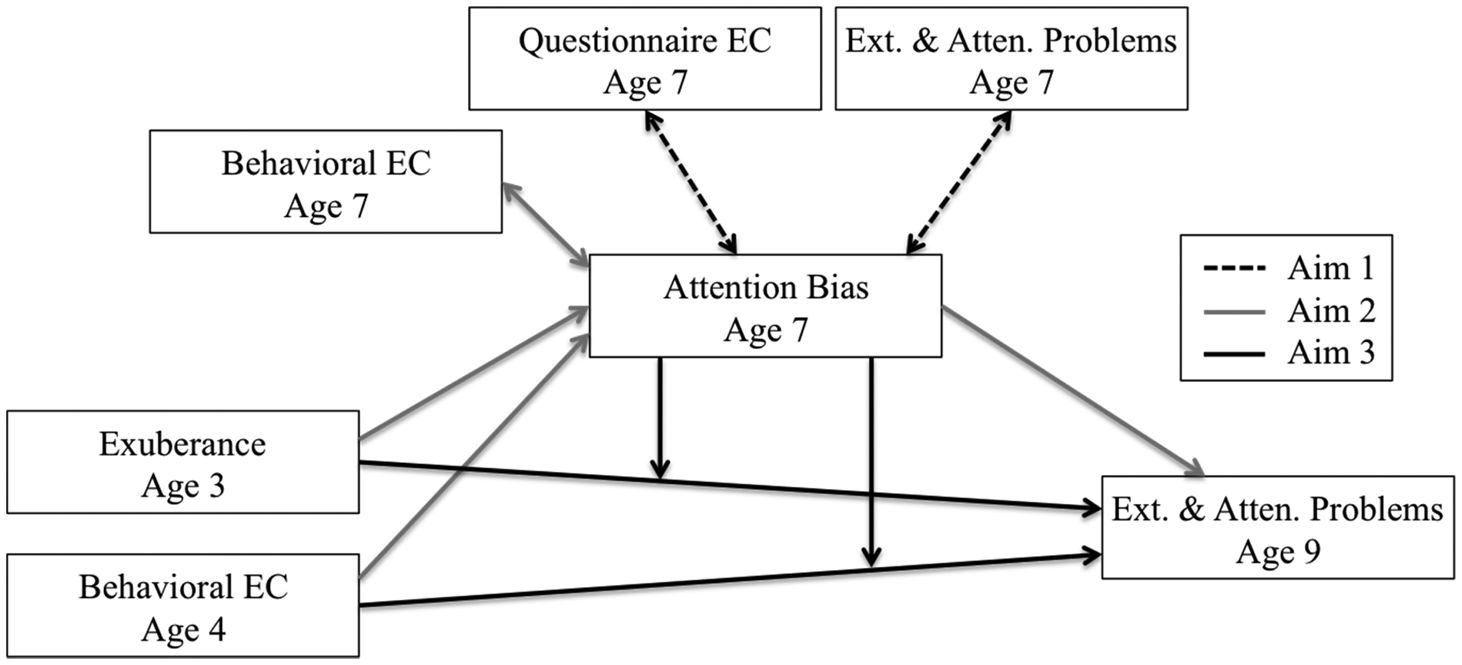
In sum, as shown in Figure 1, the current study has three goals. First, it aims to replicate the concurrent relations between attention bias to reward, externalizing problems and attention problems, and parent-reported effortful control—all measured at age 7. We focus on externalizing and attention problems during school age as behavioral problems often emerge during school years and can be highly impairing to the individual (e.g., DuPaul, Morgan, Farkas, Hillemeier, & Maczuga, Reference DuPaul, Morgan, Farkas, Hillemeier and Maczuga2016). Although many children display moderate to high levels of externalizing behaviors during toddlerhood and preschool, there is a normative decrease in these behaviors with age. However, children who maintain high levels of these behaviors upon school entry often experience impairments across multiple domains (e.g., peer relationships and academics) and are at increased risk for later maladjustment (Campbell, Spieker, Burchinal, Poe, & NICHD Early Child Care Research Network, Reference Campbell, Spieker, Burchinal and Poe2006). Based on previous studies, we hypothesized that attention bias to reward would be positively related to externalizing and attention problems, and negatively related to parent-reported effortful control.
Conceptual representation of the aims of the paper. EC, effortful control. Aim 2 is tested as zero-order relations.

Second, we extend these findings by examining the relations between attention bias to reward (age 7) and behavioral measures of early exuberance (age 3), early effortful control (age 4), and concurrent effortful control (age 7). Moreover, we examine the longitudinal prediction of attention bias to reward (age 7) to externalizing and attention problems 2 years later (age 9). Building on Morales, Pérez-Edgar, et al. (Reference Morales, Pérez-Edgar and Buss2016), we hypothesized that attention bias to reward would be predicted by early exuberance (age 3) and effortful control (age 4). Moreover, we hypothesized that attention bias to reward would longitudinally predict externalizing and attention problems.
Third, the present study examines the moderating role of attention to reward in the longitudinal pathways between early exuberance and early effortful control to predict later externalizing and attention problems at age 9. We expected that the effects of these known predictors of externalizing and attention problems (exuberance and low effortful control) would be stronger for children with a large attention bias to reward. In addition, given gender differences in the incidence of behavioral problems and the developmental pathways from early predictors to later externalizing and attention problems (Buss et al., Reference Buss, Kiel, Morales and Robinson2014; Hay et al., Reference Hay, van Goozen, Mundy, Phillips, Roberts, Meeuwsen and Perra2017; Miller et al., Reference Miller, Degnan, Hane, Fox and Chronis-Tuscano2018; Morales, Beekman, et al., Reference Morales, Beekman, Blandon, Stifter and Buss2015; Rubin et al., Reference Rubin, Burgess, Dwyer and Hastings2003; Vidal-Ribas et al., Reference Vidal-Ribas, Pickles, Tibu, Sharp and Hill2017), we explore the role of gender as a moderator of these relations. In sum, we expected that the effects of these known predictors of externalizing and attention problems (namely, exuberance, low effortful control, and being a male) would be stronger for children with an enhanced attention bias to reward.
Method
Participants
Participants were part of a larger longitudinal study on temperament and socioemotional development conducted in a large metropolitan area the United States (for a detailed description of the recruitment and screening procedures for the larger longitudinal study, see Hane, Fox, Henderson, & Marshall, Reference Hane, Fox, Henderson and Marshall2008). Two hundred ninety-one children (53.6% females) were selected in infancy. Based on the initial sample demographics, mothers were 69.4% Caucasian, 16.5% African American, 7.2% Hispanic, 3.1% Asian, 3.4% other, and 0.3% missing. Information on family income was not collected for the sample; however, mothers in the sample reported on their level of education: 35.7% were graduate school graduates, 41.9% were college graduates, 16.2% were high school graduates, 5.5% reported other forms of education, and 0.7% were missing.
Of the original sample (N = 291), 218 had data at the 3-year visit; 205 had data on the behavioral effortful control composite at the 4-year visit; 174 had attention bias data at the 7-year visit; 169 had behavioral effortful control data at the 7-year visit; 190 had parent reports of externalizing, attention problems, and effortful control at 7 years; and 184 had parent reports of externalizing and attention problems at 9 years. Examining the patterns of missing data revealed that mother's ethnicity (non-Hispanic Caucasian vs. other minority groups) was associated with missing data on exuberance, χ2 (1) = 9.28, p = .002, and questionnaire measures at the 7-year visit, χ2 (1) = 8.99, p = .003, such that children with data on these measures were more likely to have non-Hispanic Caucasian mothers. Because of this, maternal ethnicity was included as a covariate on the structural equation model analyses. Missing data on all other variables was not associated with children's gender, mother's ethnicity, maternal education, or temperament during the screening procedure (ps > .10). In addition, participants were further removed from the analyses due to poor performance in the behavioral tasks and after deleting outliers (see details below).
Measures
Age 3 exuberance
At the 3-year assessment, children were assessed for exuberant affect and behavior during a behavioral inhibition paradigm (Fox et al., Reference Fox, Henderson, Rubin, Calkins and Schmidt2001), as well as a positive affect/risk-taking paradigm (Pfeifer, Goldsmith, Davidson, & Rickman, Reference Pfeifer, Goldsmith, Davidson and Rickman2002; Putnam & Stifter, Reference Putnam and Stifter2005). The behavioral inhibition paradigm included the following tasks: free play, stranger approach, robot, and tunnel. For more details on these tasks, see Fox et al. (Reference Fox, Henderson, Rubin, Calkins and Schmidt2001). As described in Degnan et al. (Reference Degnan, Hane, Henderson, Moas, Reeb-Sutherland and Fox2011), the exuberance/risk-taking tasks included asking children to put on a blood pressure cuff, jump on a trampoline, touch a gorilla mask, climb up steps toward the wall, touch a realistic-looking snake, touch an unpredictable mechanical dragon toy, and sit close to the experimenter to read a book. For each of these tasks, children were asked by the experimenter to approach or perform each activity. If they did not approach, the experimenter prompted them. Once they approached/performed the task, or it was clear that they were refusing to participate, the experimenter moved on to the next set of stimuli. Throughout the risk-taking episodes, the experimenter maintained a neutral tone, except while reading the book, when the experimenter was permitted to try to engage participants as much as possible. Each task was coded for latency to touch/approach the stimuli, latency to vocalize, proportion of time spent in proximity to the mother, proportion of time spent in proximity to the experimenter, number of experimenter prompts, activity level (range: 0–3), and degree of approach toward stimuli (range: 0–3). Interrater reliability (intraclass correlations across 20% of the cases) for these continuous measures ranged from .78 to .98 (M = .87). Each task was also coded in 30-s epochs for the presence of smiling, positive vocalizations, talking to the experimenter, smiling at the experimenter, gesturing to the experimenter, verbal initiations to the experimenter, and willingness to perform each task. Interrater reliability (κs) for these measures ranged from .60 to .82 (M = .70).
All scores were standardized and averaged across tasks. Average scores that were highly skewed were dichotomized as 0 (not present) and 1 (present). Average codes were then combined into three subscales: positivity, approach, and sociability. The positivity subscale included smiling and positive vocalizations (α = 0.81). The approach subscale included latencies to touch/approach the stimuli (reverse-scored), proximity to the mother (reverse-scored), latency to vocalize (reverse-scored), activity level, number of prompts (reverse-scored), degree of approach, and willingness to perform each task (α = 0.83). The sociability subscale included all of the codes with reference to the experimenter: proximity, talking, smiling, gesturing, and verbal initiations (α = 0.86). Finally, an exuberance measure was computed by averaging the positivity, approach, and sociability subscales (M = 0.10, SD = 0.29, α = 0.71, intercorrelations: .24 to .57). Exuberance scores were inspected for outliers (>2.5 SD from the mean) and three scores were removed.
Age 4 behavioral effortful control
At the 4-year assessment, a behavioral composite of effortful control was created from the mean of the standardized scores of the following tasks: Day–Night Stroop, Grass–Snow Stroop, and a Go/No-go task. All tasks were significantly correlated with each other (rs >. 22, ps < .005). Children with at least one score were included in the composite. A similar composite has been previously used in this sample (White, McDermott, Degnan, Henderson, & Fox, Reference White, McDermott, Degnan, Henderson and Fox2011).
The Day–Night Stroop requires children to actively inhibit a prepotent response and give a subdominant response (Gerstadt, Hong, & Diamond, Reference Gerstadt, Hong and Diamond1994). This task has been used in previous studies to assess individual differences inhibitory control (Carlson & Moses, Reference Carlson and Moses2001). The task requires children to say the word “day” when presented with a picture of the moon and “night” when presented with a picture of the sun. After the initial training, there were several practice trials (up to a maximum of 10). There was a total of 16 test trials, with the sun and moon pictures presented eight times each in a pseudorandom order. Children who did not get one of each trial type correct during practice trials or who completed less than half of the test trials were excluded from analyses (n = 12). Moreover, data from four children were excluded due to experimenter error, and one outlier score was removed (>2.5 SD from the mean). The outcome of interest was children's response accuracy, or percent correct, on the test trials, reflecting a child's ability to inhibit a prepotent response. Reliability was estimated as the Spearman–Brown corrected correlation between the percent accuracy scores of two random halves of the test trials (r = .84).
The Grass–Snow Stroop, akin to the Day–Night Stroop, required children to inhibit a dominant response and give an alternative, subordinate response (Carlson & Moses, Reference Carlson and Moses2001). The Grass–Snow task has been used in previous studies to assess individual differences in inhibitory control (Carlson & Moses, Reference Carlson and Moses2001; White et al., Reference White, McDermott, Degnan, Henderson and Fox2011). The primary difference between the Day–Night and Grass–Snow Stroop tasks is the reduction in verbal load on the Grass–Snow by asking children to respond by pointing rather than speaking. A large board had a white card attached to the upper-left corner, a green card attached to the upper-right corner, and two foam cutouts shaped like hands centered below the colored cards. The child was told to point to the white card when the experimenter said “grass” and to point to the green card when the experimenter said “snow.” After the initial training, children were given several practice trials (up to a maximum of 10). There was a total of 16 test trials, with the white and green picture cards presented 8 times each in a pseudorandom order. Children who did not get one of each trial type correct during practice trials or who completed less than half of the test trials were excluded from analyses (n = 6). Moreover, data from one child were excluded due to experimenter error, and four outlier scores were removed (>2.5 SD from the mean). The outcome of interest was children's response accuracy on the test trials, or percent correct, reflecting a child's ability to inhibit a prepotent response. Reliability was estimated as the Spearman–Brown corrected correlation between response accuracy of two random halves of the test trials (r = .94).
The Zoo Game is a computer-based Go/No-go task based on Durston et al. (Reference Durston, Thomas, Yang, Ulug, Zimmerman and Casey2002). Children were told that animals from the zoo have escaped from their cages and that the zookeeper needed help catching the animals. Children were further told to not catch the monkey because it was the zookeeper's assistant helping him catch the animals. Children were instructed to press a button to catch all of the animals (go trials), and to not respond for the monkey who helped the zookeeper catch the animals (no-go trials). On each trial, an animal stimulus was presented on the screen for 700 ms, followed by a blank screen for 2300 ms or until the child responded; the intertrial interval was 500 ms. Children were given 12 practice trials and a total of 120 test trials, presented in two blocks of 60 trials each. The task consisted of 75% go trials and 25% no-go trials. All go and no-go data were cleaned to remove anticipatory responses (response times; RTs < 200 ms) prior to the computation of accuracy measures. Response accuracy was calculated on both go and no-go trials. Children who did not have correct scores on at least 60% of the task were excluded from the analysis (n = 18). As in previous studies (He et al., Reference He, Degnan, McDermott, Henderson, Hane, Xu and Fox2010), the percent correct on the no-go trials served as the index of inhibitory control, with greater percentage correct indicative of greater inhibitory control. Scores were examined for outliers (>2.5 SD from the mean), and no scores were removed. Reliability for the no-go accuracy scores was calculated as the Spearman–Brown corrected correlation between two random halves (r = .94).
Age 7 attention bias
A variation of the dot-probe task (MacLeod, Mathews, & Tata, Reference MacLeod, Mathews and Tata1986) was used to assess attention bias to reward at the 7-year assessment. The task consisted of a fixation cross presented in the center of the screen (1000 ms) followed by a display of a pair of horizontally aligned facial expressions (500 ms). One of the faces was replaced by an arrow, oriented either up or down, that appeared for 300 ms. Children were asked to indicate the probe's orientation via button press and had up to 1700 ms to respond. For each face pair a neutral facial expression was always matched with an angry, happy, or another neutral facial expression modeled by the same actor. Facial images were taken from the NimStim face stimulus set (Tottenham et al., Reference Tottenham, Tanaka, Leon, McCarry, Nurse, Hare and Nelson2009). There were 64 angry–neutral, 64 happy–neutral, and 32 neutral–neutral trials. A subset of children (n = 38) completed a longer version of the task containing 240 trials. For these children, the first 160 trials were selected to be comparable with other children. The current study examined the happy–neutral trials, which were presented in two different conditions: congruent trials, in which the happy–neutral face pair was followed by an arrow in the same position as the happy face; or incongruent trials, in which the probe appeared on the opposite side of the happy face.
As detailed in White et al. (Reference White, Degnan, Henderson, Pérez-Edgar, Walker, Shechner and Fox2017), dot-probe RT and accuracy data were processed using standard cleaning methods (Eldar, Ricon, & Bar-Haim, Reference Eldar, Ricon and Bar-Haim2008). Incorrect trials, trials with RTs < 200 ms, and trials with RTs +/–2 SD of each condition from the individual's mean were excluded from analyses. Children who had poor task performance (indexed by accuracy rates <65%: n = 63) were excluded from the current analyses. Similar accuracy cutoffs have been used in previous dot-probe studies (Pérez-Edgar et al., Reference Pérez-Edgar, Bar-Haim, McDermott, Chronis-Tuscano, Pine and Fox2010). Children excluded due to poor accuracy were more likely to be males, χ2 (1) = 7.51, p = .006, and had lower behavioral effortful control at age 4, t (162) = 2.08, p = .04, and age 7, t (164) = 3.31, p = .001. The cleaned RTs were used to create attention bias to reward scores by subtracting the average RT from congruent happy trials from the average RT from the incongruent happy trials. Positive scores indicate an attention bias to reward; negative scores indicate an attention bias away from reward. Finally, bias scores were examined for outliers (>2.5 SD from the mean), and three scores were removed from the data. Reliability for the attention bias to reward scores was estimated as the Spearman–Brown corrected correlation between two random halves (r = .50).
Age 7 behavioral effortful control
Children completed a similar version of a Go/No-go task (Zoo Game) described above. The differences between the tasks at the two ages were that instead of one monkey, five different orangutans appeared in the no-go trials (one orangutan per trial) and children completed more trials. Children completed four blocks of 70 trials (280 trials total). Participants completed 12 practice trials. On each trial, an animal stimulus was presented on the screen for 500 ms, followed by a blank screen for 900 ms or until the child responded; the intertrial interval was jittered between 200 and 300 ms. Stimuli were presented using E-Prime Software (Schneider, Eschman, & Zuccolotto, Reference Schneider, Eschman and Zuccolotto2002).
All go and no-go data were cleaned to remove anticipatory responses (RTs < 200 ms) prior to the computation of accuracy measures. Data were excluded from analysis if the participant did not achieve at least 60% accuracy during the task (n = 0). Parallel to the 4-year measure, percent correct on the no-go trials served as the index of inhibitory control. Finally, one score was removed due to outlier status (>2.5 SD from the mean). Reliability for the no-go accuracy scores was estimated as the Spearman–Brown corrected correlation between two random halves (r = .91).
Age 7 parent-reported effortful control
The effortful control factor from the short form of the Child Behavior Questionnaire (CBQ; Putnam & Rothbart, Reference Putnam and Rothbart2006) was used as a measure of children's effortful control. The effortful control factor includes the scales of attention focusing, inhibitory control, low-intensity pleasure, and perceptual sensitivity. In the CBQ, the primary caregiver responded to whether statements were true about their child on a scale ranging from 1 (extremely untrue) to 7 (extremely true). The CBQ effortful control factor is a valid and reliable measure of effortful control, with adequate reliability in our sample (α = 0.80).
Age 7 and Age 9 externalizing and attention problems
Children's externalizing and attention problems were assessed by parent-report on the rule-breaking behavior, aggressive behavior, and the attention problems scales of the Child Behavior Checklist at both age 7 and age 9 assessment periods. The Child Behavior Checklist is a well-validated parent-report questionnaire used to assess the socioemotional functioning of young children (Achenbach & Rescorla, Reference Achenbach and Rescorla2001). For each item in the checklist, the child's primary caregiver rated from 0 to 2 how well each item describes the child (0 = not true to 2 = very/often true). Because we wanted to examine relations with the externalizing spectrum, we took a transdiagnostic approach and created a composite of externalizing and attention problems by summing the ratings from the rule-breaking behavior, aggressive behavior, and the attention problems scales. This is a similar approach used in previous studies examining attention bias to reward and externalizing using the Health Behavior Questionnaire (e.g., Morales, Pérez-Edgar, et al., Reference Morales, Pérez-Edgar and Buss2016), which combines externalizing and attention problems (Armstrong, Goldstein, & MacArthur Working Group on Outcome Assessment, Reference Armstrong and Goldstein2003; Essex et al., Reference Essex, Boyce, Goldstein, Armstrong, Kraemer, Kupfer and Group2002). The rule-breaking behavior scale is composed of 17 items describing transgressive and disobedient behaviors. The aggressive behavior scale is composed of 18 items describing combative and oppositional behaviors. The attention problems scale is composed of 10 items describing impulsive and inattentive behaviors. All scales were significantly correlated with each other (rs >.45, ps < .001). Because the composite score was positively skewed at both ages (skewage7 = 1.22, kurtosisage7 = 1.61; skewage9 = 1.31, kurtosisage9 = 1.73), scores were transformed by taking the square root to improve normality (skewage7 = 0.05, kurtosisage7 = –0.25; skewage9 = 0.23, kurtosisage9 = –0.51).
Analyses
The first two goals, examining direct relations with attention bias to reward, were evaluated using zero-order correlations. The third goal, examining the moderating role of attention bias to reward on the relations between early risk factors and later externalizing and attention problems, was evaluated by performing a path model using full information maximum likelihood estimation to handle missing data to reduce potential bias in the parameter estimates (Enders & Bandalos, Reference Enders and Bandalos2001). This allowed the inclusion of all participants with data on one or more variables (as opposed to list-wise deletion). Moreover, due to the missing data and to correct for any departures from multivariate normality, the model was estimated using a robust maximum likelihood estimator and a scaled test chi-squared statistic (Satorra & Bentler, Reference Satorra and Bentler2001). The model predicted externalizing and attention problems at age 9 using early exuberance, early effortful control, and attention bias to reward. In addition, to examine if attention bias to reward moderated the predictive effects of early exuberance and early effortful control, we examined the two-way interactions between exuberance and attention bias as well as effortful control and attention bias. Interactions were created by centering the predictors of interests and computing their cross-product. Significant two-way interaction effects were probed using simple slope analysis (Aiken, West, & Reno, Reference Aiken, West and Reno1991). Specifically, the effects of the predictor variable (i.e., exuberance or effortful control) on externalizing and attention problems were examined at different levels of attention bias, representing attention bias away (–1 SD), no attention bias (mean), and attention bias toward (+1 SD).
To examine if the main or interactive effects of the model differed by gender, separate models were performed for males and females. We compared the chi-square value from a model in which the regression coefficients were constrained to be equal across gender groups, to the chi-square value from a model that allowed regression coefficients to vary across males and females. A significant difference between the chi-square values demonstrates that the regression coefficients significantly differ between males and females. Because children excluded from the dot-probe task due to poor accuracy performance were more likely to be males and had lower effortful control, the model controlled for performance accuracy during the dot-probe task as in previous studies with this sample (Nozadi et al., Reference Nozadi, Troller-Renfree, White, Frenkel, Degnan, Bar-Haim and Fox2016; White et al., Reference White, Degnan, Henderson, Pérez-Edgar, Walker, Shechner and Fox2017). Finally, preliminary analyses suggested that maternal education, r = .17, p = .018, and maternal ethnicity, r pb = .21, p = .003, were related to effortful control at age 4, such that children of mothers with higher levels of education and children of non-Hispanic Caucasian mothers had higher levels of effortful control. Given these relations, maternal education and maternal ethnicity were also included as covariates in the analysis.
All analyses were performed in R (R Development Core Team, 2008) using the psych (Revelle, Reference Revelle2017) and lavaan (Rosseel, Reference Rosseel2012) packages. Figures were created using the ggplot2 package (Wickham, Reference Wickham2016).
Results
Aim 1: Replicating the concurrent relations between attention bias to reward, externalizing problems and attention problems, and parent-reported effortful control at age 7
As predicted by our first set of hypotheses, directly replicating previous studies, attention bias to reward at age 7 was concurrently related to higher externalizing and attention problems, r (100) = .22, p = .03, and lower effortful control as reported by the parent, r (100) = –.21, p = .03.
Aim 2: Examining relations between attention bias to reward (age 7) and behavioral measures of early exuberance (age 3), early effortful control (age 4), effortful control (age 7), and externalizing and attention problems (age 9)
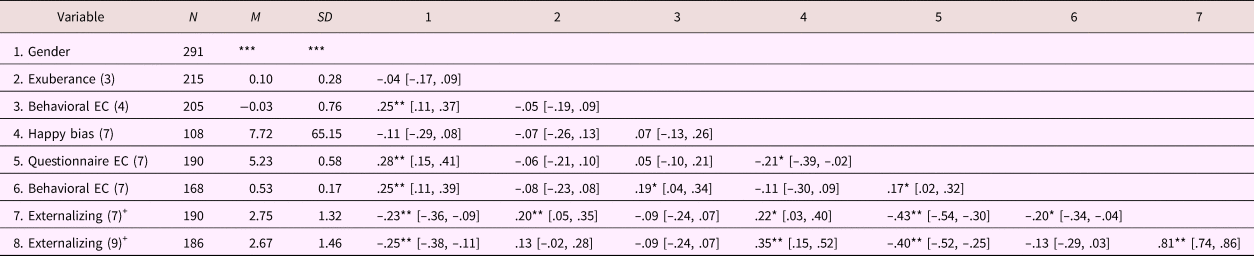
In line with our second set of hypotheses, attention bias to reward was longitudinally associated with externalizing and attention problems 2 years later (9 years), r (88) = .35, p < .001. However, contrary to our expectations, attention bias to reward was not related to age 3 exuberance, r(99) = –.07, p = .50, age 4 effortful control, r (96) = .07, p = .50, or behavioral measures of concurrent effortful control, r (97) = –.11, p = .29. As shown in Table 1, we observed several gender differences. As expected, females were lower in externalizing at age 7, r pb = –.23, p = .001, and age 9, r pb = –.25, p < .001, and higher in parent-reported effortful control, r pb = .28, p < .001, as well as behavioral effortful control at age 4, r pb = .25, p < .001, and age 7, r pb = .25, p < .001, compared to males. However, there were no gender differences in attention bias to reward, r pb = –.11, p = .27, or exuberance, r pb = –.040, p = .56.
Means, standard deviations, and correlations with confidence intervals

Note: *p < .05. **p < .01. ***1 = female and 0 = male. +Square-root transformed. N, number of participants. M, mean. SD, standard deviation. EC, effortful control. Values in square brackets indicate the 95% confidence interval for each correlation.
Aim 3: Examining the moderating role of attention to reward in the longitudinal pathways between exuberance (age 3) and effortful control (age 4) to externalizing and attention problems (age 9)
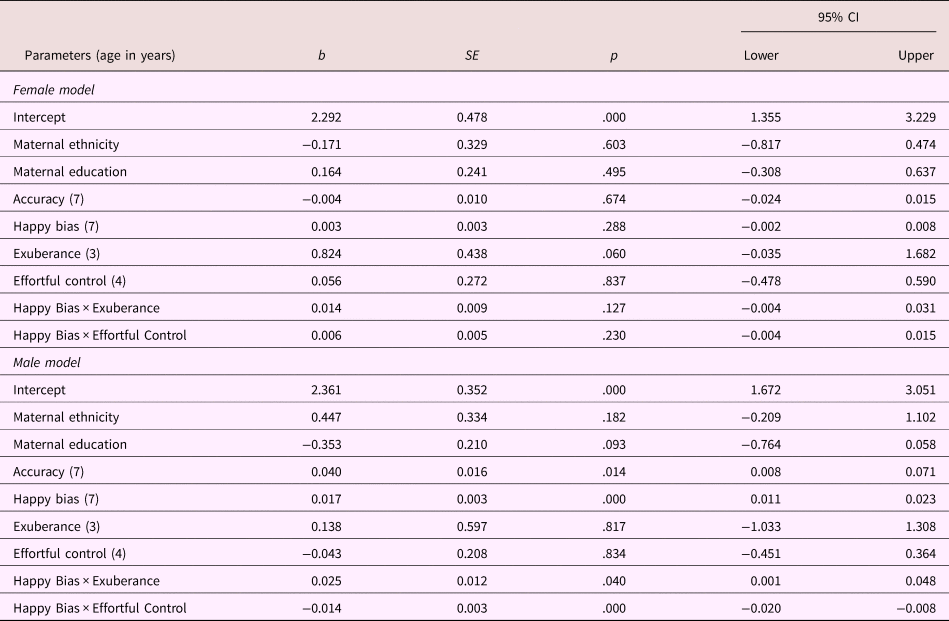
When evaluating if the early effects of early exuberance and effortful control were moderated by attention bias, results revealed that the model for males was different from the model for females, as evidenced by significantly poorer fit when constraining regression coefficients to be equal across groups, ∆χ2 (8) = 28.31, p < .001, supporting separate models by gender. Table 2 includes the model parameters for both males and females. In the model for females, the model explained 11.6% of the variance, and none of the main effects or interactions were statistically significant.
Results of the regression model predicting externalizing and attention problems at 9 years for females and males separately

Note: Maternal ethnicity was coded as non-Hispanic Caucasian = 1 and other = 0. Maternal education was coded as high school graduate = 0, college graduate = 1, graduate school graduate = 2, and other = missing.
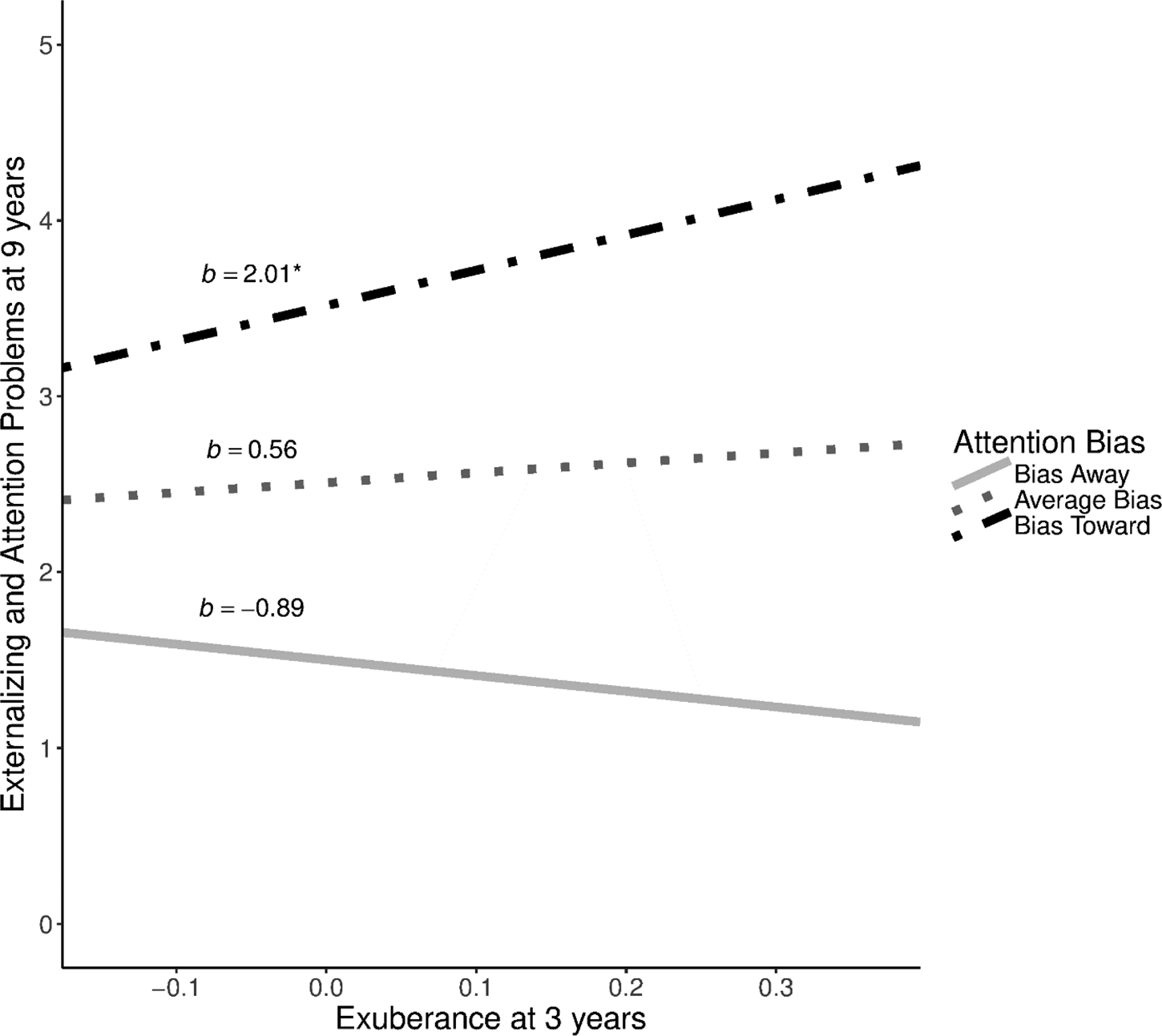
In contrast, the model for males explained 53.7% of the variance and revealed significant interactions between exuberance and attention bias, b = 0.03, p = 0.04, as well as effortful control and attention bias, b = –0.01, p < .001. As shown in Figure 2, probing the first interaction of the model involving early exuberance and attention bias to reward using simple slope analysis revealed that the predictive effect of early exuberance was only significant for males who displayed a large attention bias to reward, b = 2.01, p = .02; it was not significant for males with an average attention bias to reward, b = 0.56, p = .31, or a small attention bias from reward (i.e., bias away), b = –0.89, p = .32. These results were consistent with our prediction and indicated that males who were high in exuberance and with a large bias to reward displayed the highest externalizing and attention problems later in childhood.
Simple slopes for the interaction between attention bias to reward and early exuberance predicting externalizing and attention problems for males. Bias away was defined as –1 SD and bias toward as +1 SD from the mean.

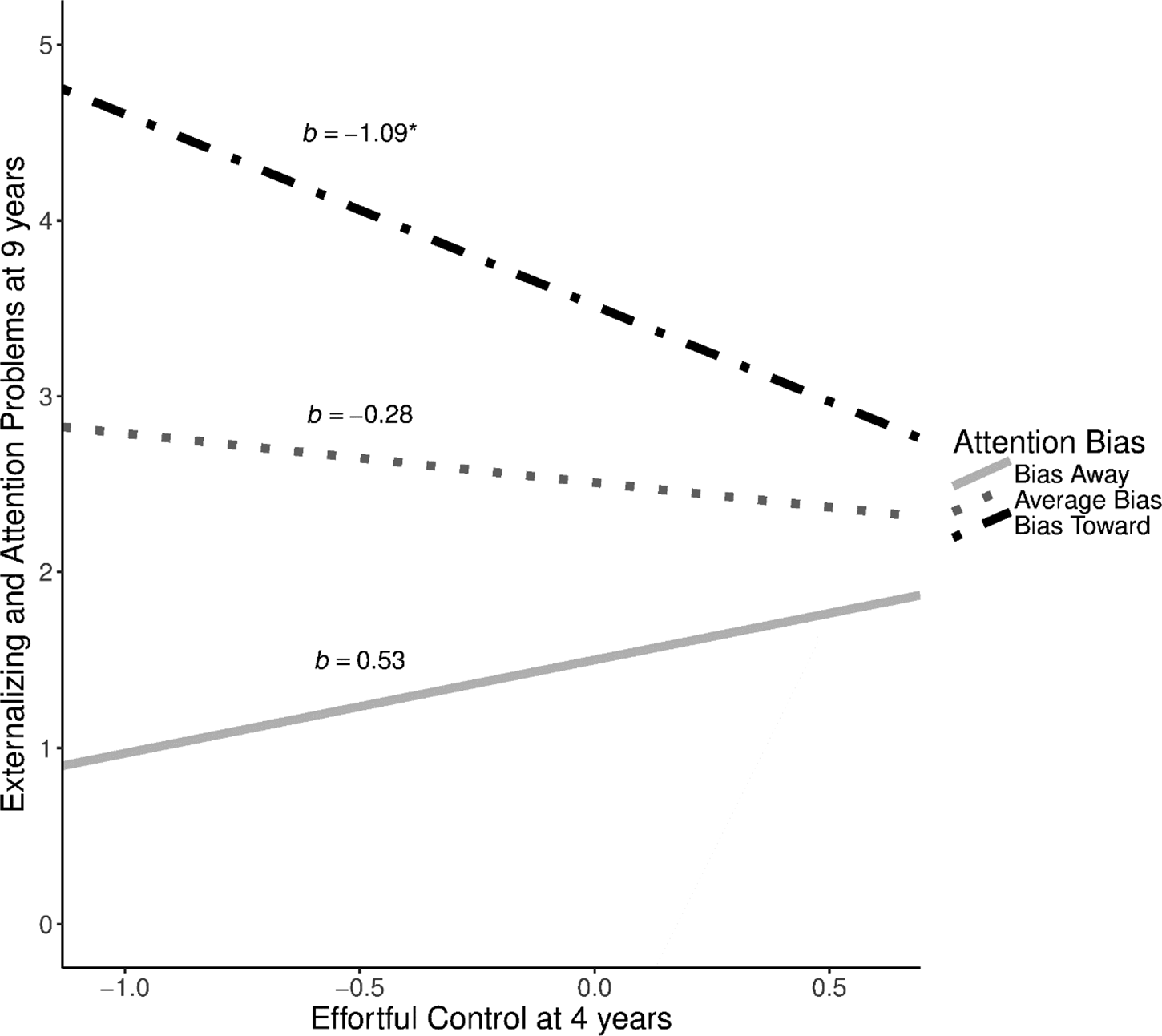
As displayed in Figure 3, probing the second interaction of the model involving early effortful control and attention bias to reward indicated that the negative effect of early effortful control on externalizing and attention problems was only significant for males who displayed a large attention bias to reward, b = –1.09, p < .001, while it was not significant for males with an average attention bias to reward, b = –0.28, p = .14, or a small attention bias from reward (i.e., bias away), b = 0.53, p = .07. In other words, consistent with prediction, males with the highest levels of externalizing and attention problems at age 9 were the ones who displayed low effortful control at age 4 and a large attention bias to reward in childhood.
Simple slopes for the interaction between attention bias to reward and early effortful control predicting externalizing and attention problems for males. Bias away was defined as –1 SD and bias toward as +1 SD from the mean.

Discussion
The current study examined the relations between attention bias to reward and its relation to behavioral problems in the externalizing domain. This was done by evaluating three sets of questions (Figure 1). First, we replicated the direct concurrent relations between attention bias to reward and externalizing and attention problems. Second, we extended these findings by testing the relations between attention bias to reward and behavioral measures of early exuberance, early effortful control, and concurrent effortful control, as well as later behavioral problems. Third and finally, we examined the role of attention to reward in the longitudinal pathways between early exuberance and effortful control to predict externalizing and attention problems at age 9. Generally, results suggest that attention bias to reward is positively related to behavioral problems marked by impulsive behavior such as externalizing and attention problems. In addition, results suggest that attention bias to reward may act a moderator of early risk in males, aiding the identification of children at the highest risk for later behavioral problems.
The first goal of the current study was to replicate previous reports of concurrent associations between attention bias toward reward, externalizing problems and attention problems, and parent-reported effortful control. Results were in line with our hypotheses such that attention bias to reward was concurrently related to greater externalizing and attention problems and lower levels of parent-reported effortful control. These findings replicate previous studies that find that attention bias to reward is related to greater externalizing and attention problems (Cremone et al., Reference Cremone, Lugo-Candelas, Harvey, McDermott and Spencer2018; He et al., Reference He, Li, Wu and Zhai2017; Morales, Pérez-Edgar, et al., Reference Morales, Pérez-Edgar and Buss2016), and lower parent-reported effortful control (Cole et al., Reference Cole, Zapp, Fettig and Pérez-Edgar2016; Morales, Pérez-Edgar, et al., Reference Morales, Pérez-Edgar and Buss2016).
The second goal of the current study was to extend these findings. This was done in two ways: (a) we examined longitudinal associations with attention bias by testing its relation with later behavioral problems, and (b) we evaluated if similar relations held when using different sources of evidence (i.e., behavioral measures), as well as whether early risk factors are longitudinally associated with attention bias to reward. When testing longitudinal relations, as hypothesized, higher levels of attention bias to reward were associated with more externalizing and attention problems 2 years later. These results imply, for the first time, that attention bias to reward is longitudinally related to externalizing and attention problems.
In contrast, contrary to our expectations, we did not find relations between behavioral measures of concurrent effortful control, early exuberance, early effortful control, and attention bias to reward in middle childhood. These results do not support previous studies (Cole et al., Reference Cole, Zapp, Fettig and Pérez-Edgar2016) and our concurrent findings with parent-reported effortful control in middle childhood. Similarly, these results do not support a previous study that found that parent reports of early exuberance and effortful control were longitudinally associated with attention bias to reward (Morales, Pérez-Edgar, et al., Reference Morales, Pérez-Edgar and Buss2016). It is possible that method differences (e.g., behavioral measures or parent report) may have contributed to divergent findings across studies as different sources of evidence provide unique information (Kagan & Fox, Reference Kagan, Fox, Damon and Lerner2006). For instance, parents may provide a unique view of the child across multiple occasions and contexts (Rothbart & Bates, Reference Rothbart, Bates, Damon and Lerner2006). However, parent reports may be subject to systematic biases such as parents’ interpretations of observed behavior, which may vary by parents’ characteristics (Kagan & Fox, Reference Kagan, Fox, Damon and Lerner2006). The reason for the differences observed with attention bias is beyond the scope of the current study. However, future studies should continue to use multiple sources of information in order to better understand when these sources converge or diverge.
In addition, it is not uncommon to fail to find longitudinal predictions from early behaviors to outcomes of interest several years later. For instance, the often-reported longitudinal predictions between early exuberance and early effortful control to later externalizing and attention problems were not significant in several previous studies, especially if the early predictors are behavioral observations and not parent reports (e.g., Degnan et al., Reference Degnan, Hane, Henderson, Moas, Reeb-Sutherland and Fox2011; Murray & Kochanska, Reference Murray and Kochanska2002; Rhoades et al., Reference Rhoades, Greenberg and Domitrovich2009). It is possible that unexamined moderators may also account for this heterogeneity. This fact highlights the importance of examining how different (risk) factors may interact with each other to create developmental trajectories of risk and/or resilience.
Our third aim tested if attention bias to reward in middle childhood moderated the effects of early exuberance and early effortful control on later outcomes. Results revealed that significant effects were found only for males. Specifically, attention bias to reward moderated the longitudinal relations between known early risk factors for behavioral problems, exuberance and effortful control, and later externalizing and attention problems, such that these early risk factors were most predictive of behavioral problems for males with a large attention bias to reward. This suggests that attention bias to reward, as a proximal risk factor for behavioral problems, may help with the identification of children at the highest risk for later behavioral problems. Moreover, it implies that different risk factors such as gender, early temperament, and attention bias may interact to predict the highest risk.
Overall, the findings support perspectives of behavioral problems in the externalizing domain that highlight the role of distinct reward processing in externalizing and attention problems (Frick et al., Reference Frick, Cornell, Bodin, Dane, Barry and Loney2003; Gatzke-Kopp et al., Reference Gatzke-Kopp, Beauchaine, Shannon, Chipman, Fleming, Crowell and Johnson2009; Luman et al., Reference Luman, Oosterlaan and Sergeant2005, Reference Luman, van Meel, Oosterlaan and Geurts2012; O'Brien & Frick, Reference O'Brien and Frick1996). Specifically, individuals high on the externalizing spectrum have a heightened attention bias to reward, which by selectively processing the positive and rewarding cues may interpret situations as better, more pleasurable and attractive. This could lead to the observed behavioral and neural findings that individuals high in externalizing and attention problems tend to be more impulsive by persevering toward rewards even in the presence of adverse outcomes as well as displaying a preference toward immediate rewards over larger delayed rewards (Frick et al., Reference Frick, Cornell, Bodin, Dane, Barry and Loney2003; Gatzke-Kopp et al., Reference Gatzke-Kopp, Beauchaine, Shannon, Chipman, Fleming, Crowell and Johnson2009; Luman et al., Reference Luman, Oosterlaan and Sergeant2005, Reference Luman, van Meel, Oosterlaan and Geurts2012; O'Brien & Frick, Reference O'Brien and Frick1996).
It is worth noting that our data also provide further evidence for the possible dissociation of the effects of attention bias to rewards, depending on different factors such as the individual's predispositions and experiences. On the one hand, the findings of the current study along with previous studies (Cole et al., Reference Cole, Zapp, Fettig and Pérez-Edgar2016; Cremone et al., Reference Cremone, Lugo-Candelas, Harvey, McDermott and Spencer2018; He et al., Reference He, Li, Wu and Zhai2017; Morales, Pérez-Edgar, et al., Reference Morales, Pérez-Edgar and Buss2016) suggest that within normative samples, attention bias to reward may be associated with impulsive tendencies (i.e., low effortful control and high approach tendencies) and, at the extreme, behavioral problems in the externalizing domain.
On the other hand, attention bias to reward is related, potentially causally, to increased positive affect and reduced internalizing problems (Britton et al., Reference Britton, Bar-Haim, Clementi, Sankin, Chen, Shechner and Pine2013; Grafton et al., Reference Grafton, Ang and MacLeod2012; Heeren et al., Reference Heeren, Reese, McNally and Philippot2012; Shechner et al., Reference Shechner, Britton, Pérez-Edgar, Bar-Haim, Ernst, Fox and Pine2012; Taylor et al., Reference Taylor, Bomyea and Amir2011; Waters et al., Reference Waters, Pittaway, Mogg, Bradley and Pine2013; White et al., Reference White, Degnan, Henderson, Pérez-Edgar, Walker, Shechner and Fox2017). Moreover, infants abandoned to institutional care, but randomly assigned into high-quality foster care displayed a bias toward reward in middle childhood, compared to postinstitutionalized children not in foster care (Troller-Renfree, McDermott, Nelson, Zeanah, & Fox, Reference Troller-Renfree, McDermott, Nelson, Zeanah and Fox2015; Troller-Renfree et al., Reference Troller-Renfree, McLaughlin, Sheridan, Nelson, Zeanah and Fox2017). Within postinstitutionalized children, attention bias toward reward was concurrently related to better outcomes such as more social engagement and prosocial behavior, fewer externalizing and internalizing problems, and less social withdrawal (Troller-Renfree et al., Reference Troller-Renfree, McDermott, Nelson, Zeanah and Fox2015, Reference Troller-Renfree, McLaughlin, Sheridan, Nelson, Zeanah and Fox2017). These findings suggest that in some contexts attention bias to reward may act as a protective factor against psychopathology, especially internalizing disorders/behaviors. Thus, the role/function and/or downstream effects of attention bias may change depending on individual differences such as temperamental predispositions (e.g., exuberance vs. behavioral inhibition) as well as developmental experiences and context (e.g., early deprivation). This highlights the utility of examining several factors in order to understand how their combination can produce different developmental pathways and better explain the observed multifinality from early risk factors.
The findings and interpretations of the current study should be considered in light of several limitations. The sample lacks socioeconomic as well as racial and ethnic diversity. Although representative of the local area, our community sample consisted primarily of well-educated Caucasian families. As such, the characteristics of the sample should be considered when generalizing the current findings to other populations. Moreover, externalizing and attention problems were examined in a normative sample. Although our measures of these problems had variability, results may differ in a clinical or combined clinical/community sample. Another limitation is that the current study had missing data. In addition to the missing data due to the study's longitudinal design, the study suffered from data loss due to poor performance in behavioral tasks such as the dot-probe task, which particularly impacted males and children with low effortful control. Although we utilized statistical approaches that use all available data and mitigate bias due to missing data, this should be considered when generalizing the current results.
In addition, the fact that a large number of 7-year olds had difficulties performing this version of the dot-probe tasks suggests that easier versions of the task should be used with young children (e.g., Morales, Pérez-Edgar, et al., Reference Morales, Pérez-Edgar and Buss2015; Pérez-Edgar et al., Reference Pérez-Edgar, Reeb-Sutherland, McDermott, White, Henderson, Degnan and Fox2011). Finally, although the current study considerably improves and extends previous studies by evaluating the longitudinal relations between attention bias and behavioral problems, the relations are correlational in nature. As such, it is not possible to fully determine the directionality of the relations. Future studies should examine the socioemotional impacts of experimentally manipulating attention by training individuals to attend toward or away from reward.
In conclusion, this study replicates previous findings that suggest that attention bias to reward predicts behavioral problems marked by impulsive behavior such as externalizing and attention problems. Specifically, we find that attention bias to reward is associated concurrently and—for the first time—longitudinally with externalizing and attention problems in middle childhood. Moreover, it is concurrently associated with lower levels of effortful control. Finally, attention bias to reward moderates the longitudinal relations between known early risk factors for behavioral problems (exuberance and effortful control) and later externalizing and attention problems, such that these early risk factors are most predictive of behavioral problems for males with a large attention bias to reward. This suggests that attention bias to reward, as a proximal risk factor for behavioral problems, may help with the identification of children at the highest risk for later behavioral problems and potentially aid the development of novel treatments (e.g., attention bias modification).
Author ORCIDs
Santiago Morales, 0000-0002-9850-042X; Sonya V. Troller-Renfree, 0000-0001-9979-4696; Natalie V. Miller, 0000-0001-8257-6924
Acknowledgments
We thank the many research assistants involved in collecting and coding the data presented in this manuscript. We also thank the participating families without whom the study would not have been possible.
Funding Statement
This research was supported by grants MH093349 and HD017899 to N.A.F. from the National Institute of Health.