Introduction
Anxiety disorders are common (12-month prevalence: 18%; Kessler et al. Reference Kessler, Chiu, Demler, Merikangas and Walters2005), and cause reduced quality of life (Mendlowicz & Stein, Reference Mendlowicz and Stein2000; Lochner et al. Reference Lochner, Mogotsi, du Toit, Kaminer, Niehaus and Stein2003; Barrera & Norton, Reference Barrera and Norton2009) and loss of productivity (DuPont et al. Reference DuPont, Rice, Miller, Shiraki, Rowland and Harwood1996). Many investigations have sought to understand how pathological anxiety is maintained. Conceptual models have highlighted the role of anxious arousal and negative affectivity as predisposing factors (Clark & Watson, Reference Clark and Watson1991), and avoidance as a key maintaining factor (Reddy et al. Reference Reddy, Pickett and Orcutt2006; Aupperle & Paulus, Reference Aupperle and Paulus2010). In addition, the role of emotion regulation is increasingly receiving attention (Mennin, Reference Mennin2006; Campbell-Sills & Barlow, Reference Campbell-Sills, Barlow and Gross2007; Amstadter, Reference Amstadter2008; Aldao et al. Reference Aldao, Nolen-Hoeksema and Schweizer2010; Cisler et al. Reference Cisler, Olatunji, Feldner and Forsyth2010).
Emotion regulation has been defined as ‘cognitive and behavioral processes that influence the occurrence, intensity, duration, and expression of emotion’ (Campbell-Sills & Barlow, Reference Campbell-Sills, Barlow and Gross2007). One of the most studied forms of emotion regulation is reappraisal, or ‘changing how we think about a situation in order to decrease its emotional impact’ (Gross, Reference Gross2002). Reappraisal is associated with positive affect, interpersonal functioning, and well-being (Gross & John, Reference Gross and John2003). Individuals with anxiety disorders are thought to have poorer emotion regulation skills, including reappraisal (Campbell-Sills & Barlow, Reference Campbell-Sills, Barlow and Gross2007; Amstadter, Reference Amstadter2008; Cisler et al. Reference Cisler, Olatunji, Feldner and Forsyth2010); however, the evidence supporting this hypothesis is mixed (Decker et al. Reference Decker, Turk, Hess and Murray2008; Aldao et al. Reference Aldao, Nolen-Hoeksema and Schweizer2010; Werner & Gross, Reference Werner, Gross, Kring and Sloan2010).
The neural substrates of reappraisal have been studied in both healthy adults and individuals with anxiety disorders. Studies of healthy adults have consistently found activation in dorsomedial, dorsolateral, and ventrolateral prefrontal cortex (PFC) during reappraisal (Ochsner & Gross, Reference Ochsner and Gross2005; Lieberman, Reference Lieberman2007). However, whether and how these substrates differ in individuals with anxiety disorders remains unclear. Studies of social anxiety disorder and post-traumatic stress disorder (PTSD) found less PFC activation in patients than healthy controls during reappraisal (Goldin et al. Reference Goldin, Manber-Ball, Werner, Heimberg and Gross2009a, Reference Goldin, Manber, Hakimi, Canli and Grossb; New et al. Reference New, Fan, Murrough, Liu, Liebman, Guise, Tang and Charney2009). However, a study of young adults with high trait anxiety found the opposite: greater PFC activation during reappraisal in those with higher anxiety (Campbell-Sills et al. Reference Campbell-Sills, Simmons, Lovero, Rochlin, Paulus and Stein2011).
In the current study, our aim was to examine the common and distinct neural bases of emotion regulation in healthy and clinically anxious participants, while also comparing two common anxiety disorders, generalized anxiety disorder (GAD) and panic disorder (PD). Emotion dysregulation has been hypothesized to play a key role in GAD: patients with GAD may not be as skilled at adaptively regulating negative emotions and may instead suppress emotions (Mennin et al. Reference Mennin, Heimberg, Turk and Fresco2002, Reference Mennin, Heimberg, Turk and Fresco2005). Although to our knowledge the neural bases of reappraisal in GAD have not been examined, other neuroimaging studies of GAD have suggested a tendency to over-engage prefrontal top-down control (Mathew et al. Reference Mathew, Mao, Coplan, Smith, Sackeim, Gorman and Shungu2004; Etkin et al. Reference Etkin, Prater, Schatzberg, Menon and Greicius2009).
The role of emotion dysregulation in PD has been even less well-studied than in GAD. One study found that reliance on suppression as an emotion regulation strategy maintains anxiety and avoidance in patients with PD (Levitt et al. Reference Levitt, Brown, Orsillo and Barlow2004). Furthermore, inflexible emotion regulation may moderate the relationship between anxiety sensitivity and PD (Cisler et al. Reference Cisler, Olatunji, Feldner and Forsyth2010). Biological models have pointed to insufficient top-down control as a factor in the generation of panic (Kent & Rauch, Reference Kent and Rauch2003). However, to our knowledge, there have been no neuroimaging studies of reappraisal in PD.
We examined two competing hypotheses. First, based on the conceptualization that GAD involves an overactive top-down control system, one hypothesis posits that individuals with GAD exhibit PFC hyper-activation during reappraisal. This would be consistent with findings in non-treatment-seeking, high trait anxiety participants, including many with GAD symptoms (Campbell-Sills et al. Reference Campbell-Sills, Simmons, Lovero, Rochlin, Paulus and Stein2011). A second hypothesis, based on the notion that emotion dysregulation and its neural bases are consistent across anxiety disorders, posits that both GAD and PD participants show attenuated prefrontal responding (reflecting inadequate top-down control) during reappraisal. This would be consistent with findings in other anxiety disorders.
Method and materials
Participants
This study was approved by the University of California San Diego Human Research Protections Program. After providing written informed consent, 139 participants underwent a semi-structured diagnostic interview (Sheehan et al. Reference Sheehan, Lecrubier, Sheehan, Amorim, Janavs, Weiller, Hergueta, Baker and Dunbar1998). Of these, 24 healthy control (HC) adults were eligible who did not meet DSM-IV criteria (APA, 2000) for lifetime mood, anxiety, psychotic, or substance dependence disorders. In addition, 52 patients met DSM-IV criteria for clinically predominant PD (n = 24; 20 with and four without agoraphobia), or clinically predominant GAD (n = 28), and did not meet criteria for lifetime psychosis, past-year substance dependence, or past-month substance abuse. Due to the high rate of co-morbidity in anxiety disorders (Kessler et al. Reference Kessler, Chiu, Demler, Merikangas and Walters2005), co-morbid mood and other anxiety disorders were allowed; however, individuals with co-occurring PD and GAD (n = 7) were excluded. Two participants from each group were removed from the analysis due to poor functional magnetic resonance imaging (fMRI) data quality. The final dataset included 22 HC, 18 PD, and 23 GAD participants. In the GAD group, two participants had co-morbid major depression, two had obsessive-compulsive disorder, and eight had social anxiety disorder. In the PD group, two participants had co-morbid major depression, one had obsessive-compulsive disorder, and two had social anxiety disorder. All participants were free of psychotropic medications for 6 weeks prior to study enrollment (2 weeks for benzodiazepines).
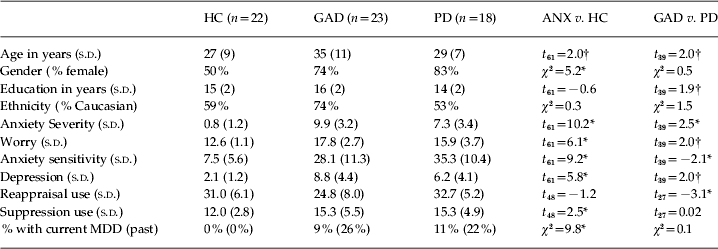
All participants met safety and eligibility criteria for fMRI scanning: no neurological conditions, no implanted ferrous metal, and no history of loss of consciousness >5 min. Demographic characteristics of the 63 participants are presented in Table 1. There were group differences on age (p < 0.07) and gender (p < 0.05), therefore all group effects analyses were also run with age and gender as covariates.
Demographics and clinical features of participants

HC, Healthy controls; GAD, generalized anxiety disorder group; PD, panic disorder group; ANX, GAD and PD groups combined; s.d., standard deviation; MDD, major depressive disorder.
* p < 0.05
† p < 0.07.
Procedure
Eligible participants underwent a medical examination, including medical history, laboratory evaluation, EKG, and drug and pregnancy screen. Participants also completed questionnaires including the Overall Anxiety Severity and Impairment Scale (OASIS; Norman et al. Reference Norman, Cissell, Means-Christensen and Stein2006), the Penn State Worry Questionnaire (PSWQ; Meyer et al. Reference Meyer, Miller, Metzger and Borkovec1990), the Anxiety Sensitivity Index (ASI; Reiss et al. Reference Reiss, Peterson, Gursky and McNally1986), and the Quick Inventory of Depressive Symptomology (QIDS; Rush et al. Reference Rush, Trivedi, Ibrahim, Carmody, Arnow, Klein, Markowitz, Ninan, Kornstein, Manber, Thase, Kocsis and Keller2003). Fifty (78%) individuals participated in an optional adjunct study, and completed the Emotion Regulation Questionnaire (ERQ; Gross & John, Reference Gross and John2003). All participants completed one fMRI scan before receiving 10 sessions of weekly individual cognitive behavioral therapy. Relationship of fMRI findings and therapy outcomes will be considered in a separate paper.
Task
Two processes were examined with the emotion regulation task: in each trial, individuals either maintained or reappraised their emotional responses to negative images. Each trial was 24 s long, with a scrambled image presented for the first 12 s and a negative image for the last 12 s (Supplementary Fig. S1). After the first 1–3 s (jittered) of scrambled image presentation the words ‘Rate Emotion (1–4)’ appeared for 3 s, cuing participants to provide a baseline rating of their emotional experience from 1 (not at all negative) to 4 (very negative). Next, 1–3 s later, participants received an instruction to either ‘Keep Up Emotion’ (Maintain) or ‘Reduce Emotion’ (Reappraise) to the negative image they were about to see. The instruction remained on the screen for 3 s, followed by continued presentation of the scrambled image (1–3 s). Participants then viewed the target negative image for 4–6 s, implementing the instruction they had just received. They then received the cue to rate their negative emotion (3 s), followed by continued presentation of the negative image (3–5 s). The period of interest was the 4–6 s when the participant was maintaining or reappraising their emotional reactions.
The images used in the task were 12 negatively valenced images for each condition, selected from the International Affective Picture System (Lang et al. Reference Lang, Bradley and Cuthbert2008), with a pixel-wise scrambled version of each image presented as a baseline at the start of each trial. More information about the images and the task are given in Campbell-Sills et al. (Reference Campbell-Sills, Simmons, Lovero, Rochlin, Paulus and Stein2011), though there is no overlap in subjects between those reported here and in Campbell-Sills et al. (Reference Campbell-Sills, Simmons, Lovero, Rochlin, Paulus and Stein2011) .
Prior to fMRI scanning, participants were trained on the task. For the Maintain condition participants were instructed to ‘maintain your emotional reaction until the picture disappears’. For the Reappraise condition, participants were asked to ‘change the way that you think about the picture in order to decrease your negative emotions’. Suggested reappraisal strategies included generating a positive interpretation or taking a more detached perspective. Participants practiced out loud on sample images, to confirm understanding.
Image acquisition
One 9-min 40-s BOLD fMRI run was acquired, using a Signa EXCITE 3.0-T GE scanner (T2*-weighted echo planar imaging, TR = 2000 ms, TE = 32 ms, FOV = 240 × 240 mm3, 64 × 64 matrix, thirty 2.6-mm axial slices with a 1.4-mm gap, 290 scans). For anatomical reference, a high-resolution T1-weighted image (SPGR, TI = 450, TR = 8 ms, TE = 3 ms, FOV = 250 × 250 mm3, flip angle = 12°, 172 sagittally acquired slices with 1-mm thickness) was obtained during the same session.
Image processing
All structural and functional image processing was done with the Analysis of Functional NeuroImages (AFNI) software package (Cox, Reference Cox1996). The AFNI function 3dToutcount was used to identify the number of voxels classified as outliers at each time point: any time point with >2 s.d. outlier voxels than the subject's mean were excluded from analysis. Voxel time-series were interpolated to correct for non-simultaneous slice acquisition and corrected for three-dimensional motion. Anatomical and echo planar volumes were co-registered using an algorithm that minimizes the amount of image translation and rotation (Saad et al. Reference Saad, Glen, Chen, Beauchamp, Desai and Cox2009).
Individual participant time-series data were analyzed with AFNI's 3dDeconvolve program. The orthogonal regressors of interest were those indicating the Maintain, Reappraise, and Baseline conditions (see Supplementary Fig. S1). Additional regressors of non-interest modeled the emotion rating periods and post-rating viewing period at the end of each trial, as well as linear and quadratic trends in the time-series and motion regressors based on the time-series alignments in the roll, pitch, and yaw directions. Regressors were convolved with a modified gamma variate function to account for the hemodynamic response (Boynton et al. Reference Boynton, Engel, Glover and Heeger1996) using the AFNI program waver. Following deconvolution, data were converted to percent signal change, by dividing the coefficient by the zero-order regressor within each voxel. Data were normalized to Talairach coordinates (Talairach & Tournoux, Reference Talairach and Tournoux1988) and subjected to a 4-mm Gaussian blur for spatial smoothing.
To protect for multiple comparisons, Monte Carlo simulations (n = 10 000) using AFNI's 3dClustSim program demonstrated that minimum cluster volumes of 640 μl for a per-voxel threshold of p < 0.01 (one-sided) for whole-brain analysis with 4-mm spatial smoothing would result in a cluster-wise p < 0.05. Therefore, only clusters of ⩾640 μl are reported.
Statistical analysis
Analyses of self-report and behavioral data were performed with PASW Statistics (version 18.0.0, USA). Single subject analysis of functional images was performed using the AFNI software package (Cox, Reference Cox1996), and group-level statistical analyses were completed using the R statistical package (http://cran.r-project.org). Group analysis was conducted at each voxel using the R library fmri to read in and write out full AFNI data files for voxel-wise analysis. Specifically, using the R library nlme, a linear mixed-effects model was computed with group (HC, PD, GAD) as a fixed factor and condition (Reappraise, Maintain; each contrasted with Baseline) as a grouped factor within subjects. Subjects were modeled as random factors.
First, to determine whether there were condition-specific group differences, we examined the group × condition interaction. Next, because examining the main effect of group by combining both conditions would be difficult to interpret, we examined the main effect of group in each condition separately, and also identified regions of overlap that showed significant group effects in both conditions. These analyses were subjected to a volume-adjusted threshold such that each voxel met a statistical threshold (p < 0.01, one-sided) and was part of a cluster of ≥640 μl, corresponding to a whole-brain adjusted p < 0.05. All group effects were also examined with age and gender as covariates. Finally, planned contrasts between HCs and anxious participants, and between GAD and PD participants, were obtained from cluster averages to describe the characteristics of the group and interaction effects. Cohen's d was computed using pooled standard deviation.
The main effect of task (Reappraise versus Maintain) across all participants was then examined; however, using the statistical and volume thresholds described above yielded clusters so large they were difficult to interpret and report. Therefore a per-voxel threshold of p < 0.001 with a minimum cluster size of 256 μl was used. Monte Carlo simulations (n = 10 000) using AFNI's 3dClustSim program demonstrated that this statistical and volume combination also yields a whole-brain cluster-wise p < 0.05.
Results
Self-report measures
Table 1 summarizes the self-report questionnaires. One-way ANOVA analyses revealed a significant main effect of group on overall anxiety severity and impairment, worry, anxiety sensitivity, and depression (p < 0.001). Follow-up t tests comparing patients and controls showed higher scores in patients on all measures (p < 0.001). Follow-up t tests comparing GAD and PD revealed differences in anxiety sensitivity (PD higher, p < 0.05) and overall anxiety severity and impairment (GAD higher, p < 0.05) only.
The groups also differed on emotion regulation use in daily life (reappraisal p < 0.005, suppression p = 0.05). Follow-up t tests showed greater use of suppression in patients (p < 0.05) with no difference between GAD and PD. Patients and controls did not differ on reappraisal use, but GAD reported less reappraisal use than PD (p < 0.005). Reappraisal use was inversely associated with overall anxiety severity and impairment in GAD (r = − 0.61, p < 0.05) but not PD (r = 0.14, n.s.). When controlling for age, gender, and depression severity, all self-report differences remained significant (p < 0.05) except group differences in suppression use (p = 0.08).
Behavioral task effects
Fig. 1 a illustrates the results of a 3 (group: HC, PD, GAD) × 3 (condition: Baseline, Maintain, Reappraise) repeated-measures ANOVA on the negative emotion ratings collected during the task. Emotion ratings differed by condition, with most negative emotion during the Maintain condition, and least during Baseline (F 2,110 = 94.0, p < 0.001). Paired t tests confirmed that emotion ratings significantly differed across all conditions in each of the three groups (p < 0.05). Ratings also differed by group, with HCs reporting less intense emotions than either PD or GAD subjects (F 2,55 = 7.3, p < 0.005). There was also a group × condition interaction (F 4,110 = 2.4, p = 0.05): HCs reported significantly less negative emotion than GAD or PD subjects during Baseline and Reappraisal, and less negative emotion than GAD subjects during the Maintain condition (p < 0.05). Emotion ratings in the GAD and PD groups did not differ from each other in any condition (p > 0.09).
(a) Negative emotion ratings during the task. HC, Healthy control; GAD, generalized anxiety disorder; PD, panic disorder. Asterisks indicate significant group differences within a condition (* p < 0.05, ** p < 0.005). (b, c) Attenuated left dorsolateral prefrontal cortex (PFC) activation during reappraisal GAD and PD is correlated with anxiety severity. Activation extracted from the region showing group differences in activation in both the Reappraise and Maintain conditions. (b) Left dorsolateral PFC activation during reappraisal and maintenance (* p < 0.05, ** p < 0.005). (c) Left dorsolateral PFC activation during reappraisal associated with anxiety severity and impairment in patients with anxiety disorders.
In order to control for differences in negative emotion at baseline, differential emotion ratings (i.e. Reappraise minus Baseline and Maintain minus Baseline) were also examined. No group differences were found for either condition (p > 0.1). All behavioral results were unchanged when controlling for age and gender.
fMRI task effects
Across all participants, greater activation to Maintain than Reappraise was observed in many brain areas, including medial supplemental motor area, bilateral inferior parietal lobule, posterior cingulate, bilateral posterior insula, and bilateral middle temporal gyrus. Greater activation to Reappraise than Maintain was observed across all participants in bilateral middle occipital gyrus, right fusiform gyrus, and right precuneus (Supplementary Table S1).
fMRI group × task interaction effects
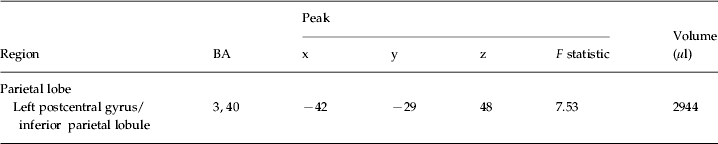
Voxel-wise whole-brain analysis of group (HC, GAD, PD) × task (Reappraise, Maintain) interactions revealed a cluster in the left post-central gyrus extending to the inferior parietal lobule. The interaction was due to significantly greater activation in HCs than either GAD or PD subjects in the Maintain condition, but no group differences during the Reappraise condition (Table 2).
Regions demonstrating a significant differential effect of condition (Reappraise versus Maintain) across groups
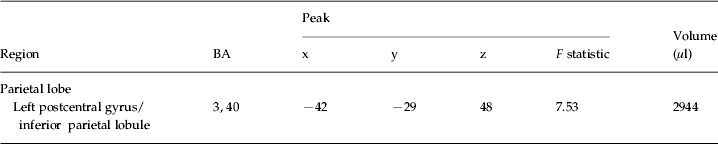
BA, Brodmann area.
fMRI group effects – maintenance
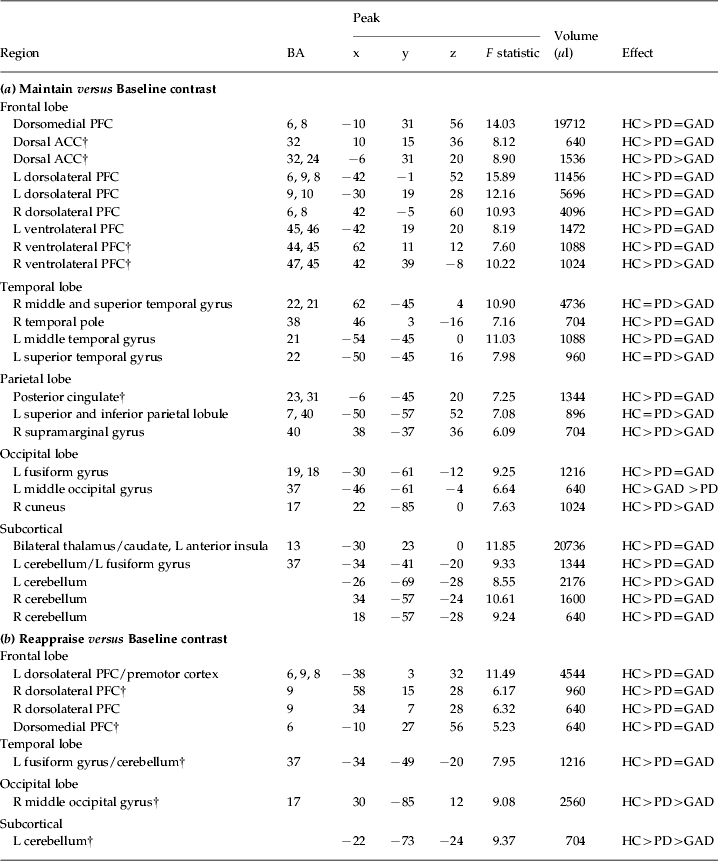
During the Maintain condition, significant group differences were observed in several prefrontal regions: dorsomedial PFC, bilateral dorsolateral and ventrolateral PFC, and dorsal anterior cingulate. These were all characterized by significantly greater activation in HCs than anxious participants (d = 1.05–1.77), with only right ventrolateral PFC and dorsal anterior cingulate demonstrating significant differences between the two anxiety groups (PD > GAD, d = 0.90 and 0.64, respectively). Of these prefrontal regions, all but right ventrolateral PFC and dorsal anterior cingulate continued to show significant group effects when controlling for age and gender.
HCs also demonstrated significantly greater activation than anxiety patients in other regions, including left anterior insula, bilateral caudate and thalamus, left superior parietal lobule, left fusiform gyrus, bilateral middle and superior temporal gyrus, posterior cingulate, and left middle occipital gyrus (d = 0.61–1.45). GAD and PD subjects differed in right middle and superior temporal gyrus and left superior parietal lobule (PD > GAD, d = 1.01–1.14), as well as left middle occipital gyrus (GAD >PD, d = 0.83). All regions except posterior cingulate continued to show significant group effects when controlling for age and gender (Table 3 a, Figs 1 and 2).
Attenuated dorsomedial prefrontal cortex (PFC) activation in generalized anxiety disorder (GAD) and panic disorder (PD) is correlated with anxiety severity during reappraisal and correlated with worry severity during maintenance. Activation extracted from the region showing activation in both the Reappraise and Maintain conditions. (a) Dorsomedial PFC activation during each condition (* p < 0.05; ** p < 0.005). (b) Dorsomedial PFC activation during reappraisal associated with anxiety severity and impairment in patients with anxiety disorders. (c) Dorsomedial PFC activation during maintenance associated with worry severity in patients with anxiety disorders.
Regions demonstrating a significant group effect in (a) the Maintain versus Baseline contrast and (b) the Reappraise versus Baseline contrast
BA, Brodmann area; PFC, prefrontal cortex; ACC, anterior cingulate cortex; L, left; R, right; HC, healthy control; PD, panic disorder; GAD, generalized anxiety disorder.
† Region no longer significant when controlling for age and gender.
fMRI group effects – reappraisal
During Reappraisal, HCs demonstrated significantly greater activation than anxiety patients in several regions, including dorsomedial and bilateral dorsolateral PFC, left fusiform gyrus and right middle occipital gyrus (d = 0.82–1.37). GAD and PD subjects differed in right middle occipital gyrus only (PD > GAD, d = 0.77). Dorsomedial PFC, left dorsolateral PFC, and left fusiform gyrus had at least four voxels of overlap with regions that also showed significant group effects during the Maintain condition. When controlling for age and gender, only bilateral dorsolateral PFC continued to show significant group effects (Table 3 b, Figs 1 and 2).
Brain-behavior relationships
Relationships between self-report measures and average brain activation were examined for the two prefrontal regions (dorsomedial and left dorsolateral PFC) that differed between anxious and control participants during both reappraisal and maintenance. Because activation in these regions did not differ between GAD and PD, correlations were conducted on the combined group of anxious participants.
Among anxious participants, those with greater anxiety severity and associated impairment showed relatively less activation in PFC during both reappraisal and maintenance. Specifically, individuals reporting greater anxiety severity and functional impairment had less activation in left dorsolateral PFC during reappraisal (r = − 0.43, p = 0.005) and in dorsomedial PFC during both reappraisal (r = − 0.38, p < 0.05) and maintenance (r = − 0.33, p < 0.05) (Figs 1 and 2). The relationships between activation during reappraisal and anxiety severity remained significant when controlling for age and gender, and marginally significant (p < 0.07) when controlling for depression severity (in dorsolateral PFC; dorsomedial PFC, n.s.).
Similarly, across anxious participants, those who worried more had less activation in dorsomedial PFC during negative emotion maintenance (r = − 0.34, p < 0.05) (Fig. 2). This relationship remained significant when controlling for age, gender, and depression severity. There were no associations between PFC activation and worry severity during reappraisal, or between anxiety sensitivity, regular reappraisal use, or negative emotion ratings and PFC activation during either condition.
Discussion
This study examined two alternative hypotheses regarding the relationship of PFC activation and emotion regulation in PD and GAD. First, based on the conceptualization that GAD involves an overactive top-down control system, we hypothesized that GAD would exhibit hyper-activation in PFC during regulation. Second, based on the emotion regulation deficits common across anxiety disorders, a competing hypothesis was that both GAD and PD involve inadequate top-down control and therefore would show attenuated prefrontal responding during emotion regulation. The main neuroimaging finding showed that HCs activated dorsomedial and bilateral dorsolateral PFC more during reappraisal than those with GAD or PD. Therefore, the results of this study are consistent with the second hypothesis and support potential cross-disorder impairment in regulation of negative emotions.
Behaviorally, the groups did not differ in self-reported negative emotion during regulation when adjusting for baseline negative emotion ratings. This is consistent with previous reports that anxious individuals can successfully regulate emotions when explicitly trained and cued to do so (Goldin et al. Reference Goldin, Manber, Hakimi, Canli and Gross2009b; Campbell-Sills et al. Reference Campbell-Sills, Simmons, Lovero, Rochlin, Paulus and Stein2011; Aldao & Mennin, Reference Aldao and Mennin2012). Furthermore, the lack of difference in emotion ratings aids in interpretation of the fMRI results, as they cannot be readily explained by differential changes in internal emotional experience.
Unlike previous investigations (Campbell-Sills et al. Reference Campbell-Sills, Simmons, Lovero, Rochlin, Paulus and Stein2011), no task effect or group × task interactions were found in PFC: group differences in prefrontal activation were present in both conditions. Both reappraisal and maintenance are active processes, and both involve conscious attempts to alter ongoing emotional experience. The use of such an active comparison condition may have contributed to the lack of differential effect in PFC, leading to the hypothesis that PFC recruitment may be broadly impaired in GAD and PD. For example, hypo-activations in PFC during a task requiring attentional control have been associated with trait anxiety (Bishop, Reference Bishop2009) consistent with concentration difficulties common in anxiety disorders (APA, 2000). Therefore, a decreased ability to recruit PFC may cut across multiple contexts relevant for anxiety disorders.
One region that did show a group × task interaction was the left inferior parietal lobule, where HCs but not anxious individuals showed greater activation during maintenance than reappraisal. The inferior parietal lobule together with the dorsolateral PFC is part of the central executive network, which is critical for top-down control during decision making, goal implementation, and other executive functions (Menon, Reference Menon2011). The attenuated activation of this system during emotion regulation is consistent with the hypothesis that anxious participants exert insufficient goal-directed top-down control over brain systems that process emotional information.
In a previous study using this task (Campbell-Sills et al. Reference Campbell-Sills, Simmons, Lovero, Rochlin, Paulus and Stein2011) PFC activation was greater in anxious participants during reappraisal, whereas here dorsolateral and dorsomedial PFC activation was greatest in HCs during both reappraisal and maintenance. However, the previous study used a non-clinical (i.e. non-treatment-seeking) sample. Studies of treatment-seeking adults with social anxiety disorder have found less PFC activation during reappraisal in anxious compared to healthy individuals (Goldin et al. Reference Goldin, Manber-Ball, Werner, Heimberg and Gross2009a, Reference Goldin, Manber, Hakimi, Canli and Grossb), in line with the present results. This suggests that heightened PFC activation in anxious, non-clinical adults could be a compensatory mechanism in individuals with dispositionally high anxiety. This notion is consistent with previous investigations suggesting that dorsolateral PFC activation may serve a compensatory mechanism in less severe patients with GAD (Etkin et al. Reference Etkin, Prater, Schatzberg, Menon and Greicius2009) or major depression (Etkin & Schatzberg, Reference Etkin and Schatzberg2011).
In contrast, anxiety associated with clinically significant impairment (i.e. disordered anxiety) could be associated with an inability to sufficiently engage PFC in the service of emotion regulation. We have previously suggested that inadequate top-down control in anxiety disorders could be the consequence of amplified bottom-up signals that make identifying salience more difficult (Paulus & Stein, Reference Paulus and Stein2010). In other words, chronic over-responsiveness of limbic circuitry in anxiety disorders (Etkin & Wager, Reference Etkin and Wager2007) may fatigue the top-down system, rendering it unable to effectively exert control when needed. Such emotion regulation deficits could perpetuate patients' belief that negative emotions are aversive and uncontrollable, continuing the cycle of amplified limbic inputs and fatigued top-down control and maintaining pathological anxiety. The inverse correlation between functional impairment and prefrontal activation supports the hypothesis that PFC hypo-activation could be a component of the transition from dispositionally high anxiety to disordered anxiety.
Although differences in neural activation between anxious and healthy participants were pronounced, there were few differences between GAD and PD. This supports the notion that decreased PFC engagement during emotion regulation is a common feature of the two disorders. However, activation in dorsomedial PFC during maintenance was inversely associated with worry severity. Worry, often conceptualized as an internal avoidance strategy, is a hallmark feature of GAD (Borkovec & Inz, Reference Borkovec and Inz1990). Individuals with more severe worry may be less comfortable with affective arousal and more likely to avoid emotional stimuli, thereby showing diminished PFC activation during maintenance of negative emotions. On self-report measures, patients with GAD reported the least use of reappraisal in their daily lives. Furthermore, reappraisal use was associated with less anxiety severity and functional impairment in GAD, but not PD. These results support the theory (Mennin et al. Reference Mennin, Heimberg, Turk and Fresco2002) that emotion dysregulation is especially important in understanding GAD.
In conclusion, patients with GAD and PD demonstrated less PFC activation than healthy controls during cognitive modulation of emotion, and those with the least PFC activation reported the greatest anxiety severity and impairment. When considered in conjunction with similar results in social anxiety disorder and PTSD (Goldin et al. Reference Goldin, Manber-Ball, Werner, Heimberg and Gross2009a, Reference Goldin, Manber, Hakimi, Canli and Grossb; New et al. Reference New, Fan, Murrough, Liu, Liebman, Guise, Tang and Charney2009), these results suggest a potential common neural basis of emotion dysregulation in anxiety disorders. Furthermore, these results highlight that emotion dysregulation may be related to functional impairment and treatment-seeking rather than a specific type of anxiety symptoms. However, given that patients with GAD reported least regular use of reappraisal, as well as the inverse association between worry and prefrontal activation, emotion dysregulation may be especially important in the etiology and maintenance of GAD (Mennin et al. Reference Mennin, Heimberg, Turk and Fresco2002).
This study has several limitations. One limitation is the lack of a passive viewing condition, which may have contributed to the lack of task effect in PFC. Although a previous study using the same task (Campbell-Sills et al. Reference Campbell-Sills, Simmons, Lovero, Rochlin, Paulus and Stein2011) did find such an effect, it was not replicated in this sample. The results should therefore be interpreted with caution. The absence of a passive viewing condition may also have contributed to the lack of group × task interaction in PFC. Without such an interaction, the alternative hypothesis that top-down control is broadly impaired in GAD and PD cannot be ruled out. Future studies should utilize a variety of comparison conditions to more clearly differentiate the processes that are impaired in anxiety disorders.
Another limitation is that patients with GAD and PD differed on overall anxiety severity and impairment (greater in GAD) and habitual use of reappraisal (less frequent in GAD). In addition, the measure of habitual emotion regulation was only available for some participants, decreasing the power to detect effects related to this variable. However, there were few differences in neural activation between GAD and PD. Therefore it is unlikely that group differences on anxiety severity or emotion regulation use account for the results. As is common in anxiety disorders (Kessler et al. Reference Kessler, Chiu, Demler, Merikangas and Walters2005), 10% of patients in this sample had co-morbid major depression, and an additional 24% reported past depressive episodes. However, associations between neural activation and anxiety changed only marginally when controlling for depressive symptoms, suggesting that depression severity cannot explain the findings.
The present study included only individuals with GAD or PD, but the results support the hypothesis that emotion dysregulation may be consistent across anxiety diagnoses. Future work should examine the neural bases of emotion regulation in other disorders. For example, emotion dysregulation in PTSD has been frequently noted (Roemer et al. Reference Roemer, Litz, Orsillo and Wagner2001; Eftekhari et al. Reference Eftekhari, Zoellner and Vigil2009; New et al. Reference New, Fan, Murrough, Liu, Liebman, Guise, Tang and Charney2009; Bonn-Miller et al. Reference Bonn-Miller, Vujanovic, Boden and Gross2011), suggesting that a better understanding of the neural bases of reappraisal in PTSD could be especially fruitful.
Last, successful emotion regulation can be accomplished in many ways, though here we only examined reappraisal and maintenance. Future work should examine subtypes of reappraisal (e.g. detachment, focusing on positive aspects) along with other emotion regulation strategies to understand how strategy selection impacts regulation success. A better grasp of the processes employed is important in moving past simply examining differences in activation location and intensity, and towards a more nuanced and mechanistic understanding.
Supplementary material
For supplementary material accompanying this paper visit http://dx.doi.org/10.1017/S0033291712002383.
Acknowledgements
Supported by NIMH grants MH65413 and MH64122 to Dr Stein. The authors are grateful to Sarah Sullivan and Taru Flagan for assistance with subject scanning and data management, to Shadha Cissell for assistance with subject evaluation, and to Ariel Lang for clinical supervision.
Declaration of Interest
Dr Stein reports that he is paid for his editorial work at UpToDate, Inc. and Depression and Anxiety (Wiley).