Introduction
There is a well-established link between cognition and functioning in schizophrenia (Green, Reference Green1996; Green et al. Reference Green, Kern and Heaton2004; Bowie et al. Reference Bowie, Leung, Reichenberg, McClure, Patterson, Heaton and Harvey2008; Kurtz et al. Reference Kurtz, Wexler, Fujimoto, Shagan and Seltzer2008; Schmidt et al. Reference Schmidt, Mueller and Roder2011; Tolman & Kurtz, Reference Tolman and Kurtz2012), and cognitive impairments have been proposed as rate-limiters for skill acquisition in this population (Smith et al. Reference Smith, Hull, Goodman, Hedayat-Harris, Willson, Israel and Munich1999). Hence, extensive effort has been devoted to developing and validating treatments aimed at improving cognition in individuals with psychosis. These cognitive remediation (CR) interventions have varied considerably as far as intervention length, mode of administration (computer, individual, group), focus of training (single v. multi-domain as well as drill-and-practice v. drill plus strategy training) and whether the intervention is administered as a stand-alone or is incorporated within a broader rehabilitation program.
With a few exceptions (e.g. Pilling et al. Reference Pilling, Bebbington, Kuipers, Garety, Geddes, Martindale, Orbach and Morgan2002; Dickinson et al. Reference Dickinson, Tenhula, Morris, Brown, Peer, Spencer, Li, Gold and Bellack2010; Rass et al. Reference Rass, Forsyth, Bolbecker, Hetrick, Breier, Lysaker and O'Donnell2012), the majority of reviews and meta-analyses on the efficacy of CR in psychosis agree on the nature of treatment outcomes (Kurtz et al. Reference Kurtz, Moberg, Gur and Gur2001; Krabbendam & Aleman, Reference Krabbendam and Aleman2003; Twamley et al. Reference Twamley, Jeste and Bellack2003; McGurk et al. Reference McGurk, Twamley, Sitzer, McHugo and Mueser2007; Grynszpan et al. Reference Grynszpan, Perbal, Pelissolo, Fossati, Jouvent, Dubal and Perez-Diaz2011; Roder et al. Reference Roder, Mueller and Schmidt2011; Wykes et al. Reference Wykes, Huddy, Cellard, McGurk and Czobor2011; Kurtz, Reference Kurtz2012). Namely, CR has been found to lead to durable, medium effect size improvements in cognition, small effect size improvements in symptoms that may attenuate after the end of the active treatment phase, and durable small to medium effect size improvements in functioning which are maximized when the intervention is provided in the context of other psychosocial rehabilitation. There is also some evidence that approaches which include combined drill-and-practice plus strategy coaching may be somewhat more effective in improving functional outcomes than drill-and-practice approaches alone (McGurk et al. Reference McGurk, Twamley, Sitzer, McHugo and Mueser2007; Wykes et al. Reference Wykes, Huddy, Cellard, McGurk and Czobor2011).
Only in recent years have investigators begun to examine potential pathways through which CR exerts an effect on functional outcomes. The handful of studies that have addressed this topic (Reeder et al. Reference Reeder, Newton, Frangou and Wykes2004, Reference Reeder, Smedley, Butt, Bogner and Wykes2006; Penades et al. Reference Penades, Catalan, Puig, Masana, Pujol, Navarro, Guarch and Gasto2010; Wykes et al. Reference Wykes, Reeder, Huddy, Taylor, Wood, Ghirasim, Kontis and Landau2012; Farreny et al. Reference Farreny, Aguado, Ochoa, Haro and Usall2013) suggest that: (a) functional improvement may be differentially predicted by change in cognition v. single-time point cognitive performance; (b) not all cognitive change that occurs in the context of CR is related to functional improvement; (c) some cognitive change that is not CR-specific also has an impact on functional improvements; and (d) additional variables may mediate the relationship between CR-specific cognitive improvements and functional gains. In sum, mechanisms through which CR makes an impact on functional outcomes are complex, and much remains to be learned.
In spite of a corpus of well over 40 randomized controlled trials, with a total of over 2000 participants, both national (Dixon et al. Reference Dixon, Dickerson, Bellack, Bennett, Dickinson, Goldberg, Lehman, Tenhula, Calmes, Pasillas, Peer and Kreyenbuhl2010) and international (National Institute for Health and Care Excellence, 2014) treatment guideline reports still have not recognized CR for psychosis as an evidence-based recommended treatment. There is a call for additional randomized controlled trials evaluating the efficacy and durability of CR, its impact on functional outcomes and its mechanisms of change. In this paper, we contribute to the growing CR literature by presenting the results of a randomized controlled trial evaluating the efficacy of a mixed (drill-and-practice preceded or followed by strategy-based training), stand-alone CR program. We evaluate the intervention's effects on proximal cognitive as well as more distal symptom and functional outcomes, both at end of treatment and at follow-up (FU). We also evaluate the potential mechanisms of treatment effects.
Based on existing literature, our hypotheses were as follows: (1) CR (v. treatment as usual; TAU) would be associated with greater improvements on trained tasks, neurocognition, and symptoms, and (2) improvements on trained tasks and neurocognition would be maintained at FU. No directional hypotheses were made about the impact of our stand-alone CR on functional outcomes, although this was also evaluated. Finally, we also explored the relationship between improvements on proximal training tasks, and how they relate to improvements on more distal measures of neurocognition, symptoms and functioning.
Method
Participants
A total of 75 participants completed baseline assessments and were randomized. Participants were recruited from local out-patient clinics and by word of mouth. All met the following criteria: Structured Clinical Interview for DSM-IV (SCID)-confirmed diagnosis of schizophrenia spectrum disorder [schizophrenia, schizo-affective disorder, psychosis not otherwise specified (NOS) or affective disorder with psychotic features], aged 18–65 years, English as primary language, no evidence of substance abuse in the past 30 days, no evidence of serious traumatic brain injury or other neurological disorder, and psychiatric stability, as evidenced by no hospitalizations, changes in medications or changes in housing in the past 30 days. All participants provided written informed consent, and the study was approved by local institutional review boards.
Study design
Participants were randomized (2:1) to 2 months of either CR or TAU, with assessments conducted at baseline, end of the 2-month active phase, and 2-month FU (4 months from baseline). Within the CR condition, participants were further randomized (1:1) to either begin with 1 month of computerized drill-and-practice training followed by 1 month of strategy-focused training or vice versa. Participants were offered five, 1 h-long individual sessions per week, for a maximum of 40 sessions during the 2-month course of CR. At the discretion of the trainer, participants could complete up to three sessions in a single day (with adequate breaks). Payment for participation was provided. Inter-rater reliability was >0.80 for symptom ratings and >0.90 for interviewer-rated functioning. Assessors were not blind to treatment allocation.
Measures
Comprehensive assessments included demographics, intelligence (2-subtest version of the Wechsler Abbreviated Scale of Intelligence; Wechsler, Reference Wechsler1999), neurocognition, symptoms, and measures of functioning (see below for descriptions of measures). Several of the computerized cognitive training tasks, set at pre-determined difficulty levels, were also administered as measures of proximal treatment effects.
Neurocognition
As the study was designed prior to the development of a standard clinical trials battery of cognitive tests, an ad hoc collection of tests was used to assess major cognitive domains. Visual attention and processing speed were assessed using the Trail Making Test Part A (time; Lezak, Reference Lezak1983). Executive function was assessed using the Wisconsin Card Sorting Test (% perseverative errors, % conceptual level; Heaton, Reference Heaton1981; Bell et al. Reference Bell, Greig, Kaplan and Bryson1997) and Trail Making Test Part B (time; Lezak, Reference Lezak1983). Verbal learning and memory were assessed using trials 1–5 total of the California Verbal Learning Test-II (CVLT-II; Delis et al. Reference Delis, Kramer, Kaplan and Ober2000) and the immediate and delayed logical memory subtests from the Wechsler Memory Scale – revised (Wechsler, Reference Wechsler1987). Visuospatial memory was assessed by Rey–Osterreith (Rey-O) immediate and delayed figure recall (Osterreith, Reference Osterreith1944). Simple attention was assessed using the digits forward subscore of the Wechsler Adult Intelligence Scale, 3rd edition (Wechsler, Reference Wechsler1997) digit sequencing task, with working memory indexed by the digits backward subscore. Category and semantic fluency was assessed using the FAS (Lezak, Reference Lezak1983). Vigilance was assessed using the Continuous Performance Test, x/a (Loong, Reference Loong1991).
Computerized training tasks
Several of the PSS CogReHab computerized training tasks employed as part of the cognitive training were also used as pre–post measures of proximal treatment effects. These tasks included a measure of simple visual reaction time (Simple Visual Reaction), auditory and visual measures of attention and working memory (Sequenced Recall Digits Visual, Sequenced Recall Digits Auditory, Sequenced Recall Reversed Digits Visual, and Sequenced Recall Reversed Digits Auditory), a measure of visuospatial memory (Shape/Place), a visual word list recall measure (Verbal Memory) and an auditory measure of story recall (Phone Message). Two additional tasks that were available as part of the computerized training package but that were not included in the cognitive training itself were also administered, an executive, Tower of Hanoi-type task (Pyramids 3) and a visuospatial memory measure (Objects and Locations). For additional details about these and other tasks in the training battery, the reader is referred to Bell et al. (Reference Bell, Bryson, Greig, Corcoran and Wexler2001) and Kurtz et al. (Reference Kurtz, Seltzer, Shagan, Thime and Wexler2007).
Symptoms
Symptoms were assessed using the Positive and Negative Syndrome Scale (PANSS; Kay et al. Reference Kay, Fiszbein and Opler1987). We used the five-factor solution (Bell et al. Reference Bell, Lysaker, Beam-Goulet, Milstein and Lindenmeyer1994) to generate five scores: positive symptoms, negative symptoms, cognitive symptoms, hostility and emotional discomfort.
Functioning
Both measures of performance-based functional capacity and measures of functioning were administered. The UCSD Performance-Based Skills Assessment (UPSA; Patterson et al. Reference Patterson, Goldman, McKibbin, Hughs and Jeste2001a ) is a measure of one's ability to perform five everyday tasks, which include paying bills and making change, navigating public transportation, and preparing shopping lists. The Social Skills Performance Assessment (SSPA; Patterson et al. Reference Patterson, Moscona, McKibbin, Davidson and Jeste2001b ) is a brief role-play measure of conversational skills. The Medication Management Ability Assessment (MMAA, Patterson et al. Reference Patterson, Lacro, McKibbin, Moscona, Hughs and Jeste2002) is a role-play measure of one's capacity to correctly follow a complex medication regimen.
Community functioning was assessed using the Independent Living Skills Survey (ILSS), self-report interview version (Wallace et al. Reference Wallace, Liberman, Tauber and Wallace2000). This measure includes assessments in 10 different domains, including appearance and clothing, personal hygiene, food preparation/storage, health maintenance, money management, transportation, leisure and community job seeking, and job maintenance. Total score was used. Finally, interviewer-rated functioning was assessed using the Quality of Life Scale (QLS; Heinrichs et al. Reference Heinrichs, Hanlon and Carpenter1984). In addition to providing a total score, this well-known measure of functioning can be subdivided into four separate domains: intrapsychic foundations, interpersonal relations, instrumental role functioning, and common objects and activities.
CR training
Computerized drill-and-practice training consisted of tasks available through the PSS CogReHab software (Bracy, Reference Bracy1995). Selected training tasks emphasized processing speed, attention and memory. Participants were presented with five to seven tasks to practise during each session, with task difficulty adjusted based on performance, and with more complex tasks phased in toward the latter part of the training. For details about the training, please refer to Bell et al. (Reference Bell, Bryson, Greig, Corcoran and Wexler2001).
Strategy-based training employed the working memory A and B modules of Cognitive Remediation Therapy (Delahunty & Morice, Reference Delahunty and Morice1993). Various paper-and-pencil tasks were provided, and participants worked with trainers to identify and apply the most effective strategies to complete these tasks. Task difficulty increased over time, and was tailored to individual performance. Examples of strategies trained include verbal mediation to help with sustained attention, Gestalt perception to aid with encoding visual materials, and use of rehearsal and chunking to encode auditory or visual materials. For additional information about the training, please refer to Wykes et al. (Reference Wykes, Reeder, Corner, Williams and Everitt1999).
Data analysis
Variables were inspected for normality, and the rank-based Blom inverse normal transformation (Blom, Reference Blom1958) was applied to the computerized tasks. For other variables a log 10 transformation was applied for positively skewed variables and a reflect and log 10 transformation for negatively skewed ones (Schinka et al. Reference Schinka, Velicer and Weiner2003), as needed. In order to determine whether there were systematic differences in key characteristics between groups, independent t tests and χ2 tests were conducted on baseline demographic variables.
To examine the effects of CR, a series of hierarchical linear mixed models with an intent-to-treat method were estimated using SAS PROC MIXED for the computerized cognitive tasks, the neuropsychological variables, the functional capacity measures (i.e. UPSA, SSPA, MMAA), the functional measures (i.e. ILSS, QLS) and the psychiatric symptom measures (i.e. PANSS five factor). Pre, post and FU time-point data were entered, and the compound symmetry (CS) model, which best fit the data and assumes equal variances at the different time points was used, with time centered at the first occasion (at pre-treatment). Time (baseline, post-treatment or FU) was included as a level 1 parameter, and group (CR or TAU) and individuals as level 2 in hierarchical linear mixed models. Initial analyses were conducted to investigate any order effect of starting the training with the computerized drill-and-practice tasks v. strategy-based paper-and-pencil exercises. Since there were no differences, CR conditions were combined for subsequent analyses. The false discovery rate (FDR) correction for multiple comparisons was applied to the computerized cognitive task and neuropsychological test analyses, due to their large number. Post-hoc group comparisons at each time point were conducted using analysis of variance (ANOVA). Effect sizes were quantified using partial eta squared, computed by re-running the above linear mixed model analyses using repeated-measures ANOVA. As is customary, the magnitude of effect sizes was interpreted as follows: small = 0.01, medium = 0.06, large = 0.14.
To explore how improvement on proximal measures made an impact on distal measures, we computed standardized residual change scores for each of the computerized tasks, neuropsychological measures and functioning measures that had improved as a result of CR. The standardized residual change scores were calculated by regressing the post-treatment scores or the FU scores on the pre-treatment scores for all study participants. Pearson correlations were then used to examine the degree of relationship among the change scores.
Results
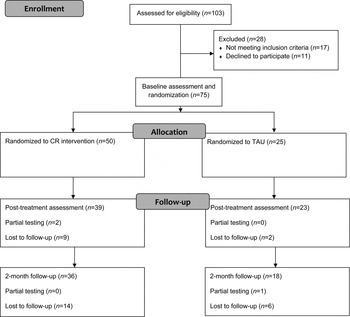
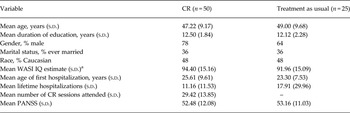
Participant flow through the study is presented in Fig. 1. In all, 50 participants were randomized to CR and 25 were randomized to TAU. Descriptive data for study participants are presented in Table 1. The CR and TAU groups did not differ on any demographic or symptom characteristics. On average, participants were in their late 40s, with age of onset in their mid 20s, and low-moderate current symptomatology. A majority of the sample were unmarried males. Of the sample, 81% (n = 61) were diagnosed with schizophrenia and 16% (n = 12) were diagnosed with schizo-affective disorder. One individual was diagnosed with psychosis NOS and one with bipolar 1 disorder with psychotic features.
Consolidated Standards Of Reporting Trials (CONSORT) flow diagram. CR, Cognitive remediation; TAU, treatment as usual.

Demographic characteristics

CR, Cognitive remediation; s.d., standard deviation; WASI IQ, Wechsler Abbreviated Scale of Intelligence intelligence quotient; PANSS, Positive and Negative Syndrome Scale.
a WASI IQ estimate based on two-test score for vocabulary and matrix reasoning.
Effects of CR on computerized cognitive tasks
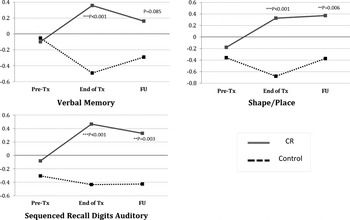
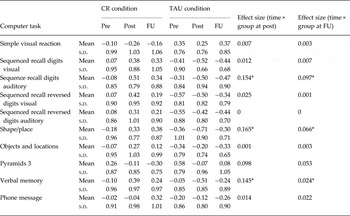
Detailed model parameter estimates and statistics for computerized cognitive tasks are presented in the online Supplementary material (Supplementary Table S1), while summary information for all computer tasks is presented in Table 2. When FDR correction was applied to the computerized task measures with significant time × group interactions, all significance levels remained <0.05. As shown in Fig. 2, CR treatment effects were found for sequenced recall digits auditory, shape/place, and verbal memory. More specifically, while the groups did not differ at baseline, the CR group showed greater improvement on the above-mentioned variables at post-treatment, and this effect was maintained at FU (at trend level for verbal memory correct, p = 0.085). Effect sizes were large at post-treatment, and ranged from small to medium-large at FU (Table 2).
Estimated means on computerized tasks over time. Tx, Treatment; FU, follow-up; CR, cognitive remediation.

Effects of CR on computerized task performance a

CR, Cognitive remediation; TAU, treatment as usual; FU, follow-up; s.d., standard deviation; ANOVA, analysis of variance.
a Interactions based on multilevel modeling analyses; effect sizes (partial eta squared) computed from repeated-measures ANOVAs; magnitude of effect sizes: small = 0.01, medium = 0.06, large = 0.14.
* p < 0.05.
Effects of CR on neuropsychological measures
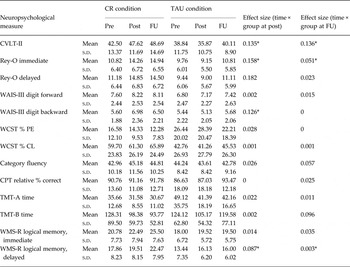
For neurocognitive variables, detailed model parameter estimates and statistics are presented in the online Supplementary material (Supplementary Table S2), while summary information for all neurocognitive variables is presented in Table 3. When FDR correction was applied to the neuropsychological measures with significant time × group interactions, all significance levels remained <0.05 with the exception of three measures that increased to p = 0.05 (Rey-O immediate at post, CVLT at post, logical memory 2 at post and FU), which we still considered meaningful, and hence retained these variables in our post-hoc group comparisons.
Effects of CR on neuropsychological tasks a

CR, Cognitive remediation; TAU, treatment as usual; FU, follow-up; CVLT-II, California Verbal Learning Test-II; s.d., standard deviation; Rey-O, Rey–Osterreith; WAIS-III, Wechsler Adult Intelligence Scale, 3rd edition; WCST, Wisconsin Card Sorting Test; PE, perseverative errors; CL, conceptual level response; CPT, Continuous Performance Test; TMT, Trail Making Test; WMS-R, Wechsler Memory Scale – Revised; ANOVA, analysis of variance.
a Interactions based on multilevel modeling analyses; effect sizes (partial eta squared) computed from repeated-measures ANOVAs; magnitude of effect sizes: small = 0.01, medium = 0.06, large = 0.14.
* p < 0.05.
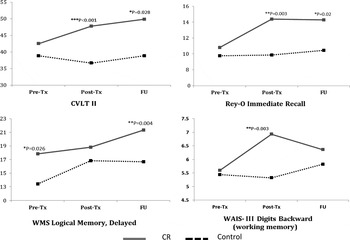
As shown in Fig. 3, participants in CR showed better performance at post-treatment on verbal learning and memory (CVLT-II), immediate visual memory (Rey-O immediate) and verbal working memory (digits backward), with medium to large effect sizes. Treatment gains found at post-treatment were maintained at FU for CVLT-II and Rey-O immediate, but not digits backward. On a measure of delayed verbal story recall (logical memory delayed) the CR group performed significantly better than TAU at both baseline and FU, but not immediately post-treatment.
Estimated means on neuropsychological measures over time. Tx, Treatment; FU, follow-up; CVLT II, California Verbal Learning Test-II; Rey-O, Rey–Osterreith; WMS, Wechsler Memory Scale; WAIS-III, Wechsler Adult Intelligence Scale, 3rd edition; CR, cognitive remediation.

Effects of CR on functional capacity
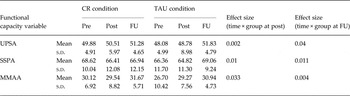
Detailed model parameter estimates and statistics for the measures of functional capacity are presented in the online Supplementary material (Supplementary Table S3). As shown in Table 4, there were no significant time × group effects on any of our measures of functional capacity, the UPSA, SSPA and MMAA.
Effects of CR on measures of functional capacity a

CR, Cognitive remediation; TAU, treatment as usual; FU, follow-up; UPSA, UCSD Performance-Based Skills Assessment; s.d., standard deviation; SSPA, Social Skills Performance Assessment; MMAA, Medication Management Ability Assessment; ANOVA, analysis of variance.
a Interactions based on multilevel modeling analyses; effect sizes (partial eta squared) computed from repeated-measures ANOVAs; magnitude of effect sizes: small = 0.01, medium = 0.06, large = 0.14.
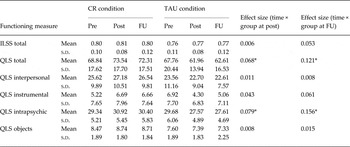
Effects of CR on functioning
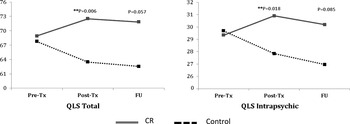
Detailed model parameter estimates and statistics for measures of functioning are presented in the online Supplementary material (Supplementary Table S4), while summary information for all measures of functioning is presented in Table 5. There was no significant time × group effect for ILSS scores. As seen in Fig. 4, treatment effects were found for QLS total, with significant post-treatment improvements (relative to TAU) marginally maintained at FU (p = 0.057). A further examination of the four QLS subscales indicated that these treatment effects were primarily driven by improvements on the QLS intrapsychic subscale, which consists of items capturing sense of purpose, motivation, curiosity, anhedonia, aimless inactivity, empathy and emotional interaction.
Estimated means on Quality of Life Scale (QLS) total and QLS intrapsychic subscale across time. Tx, Treatment; FU, follow-up; CR, cognitive remediation.

Effects of CR on functioning a

CR, Cognitive remediation; TAU, treatment as usual; FU, follow-up; ILSS, Independent Living Skills Survey; s.d., standard deviation; QLS, Quality of Life Scale; ANOVA, analysis of variance.
a Interactions based on multilevel modeling analyses; effect sizes (partial eta squared) computed from repeated-measures ANOVAs; magnitude of effect sizes: small = 0.01, medium = 0.06, large = 0.14.
* p < 0.05.
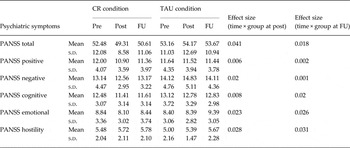
Effects of CR on psychiatric symptoms
Detailed model parameter estimates and statistics for measures of psychiatric symptoms are presented in the online Supplementary material (Supplementary Table S5). As shown in Table 6, there were no significant time × group effects on PANSS total scores or any of the five PANSS factors.
Effects of CR on psychiatric symptoms a

CR, Cognitive remediation; TAU, treatment as usual; FU, follow-up; PANSS, Positive and Negative Syndrome Scale; s.d., standard deviation; ANOVA, analysis of variance.
a Interactions based on multilevel modeling analyses; effect sizes (partial eta squared) computed from repeated-measures ANOVAs; magnitude of effect sizes: small = 0.01, medium = 0.06, large = 0.14.
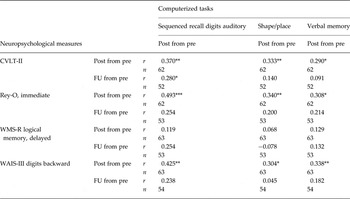
Relationship between improvement on proximal computerized tasks and neuropsychological measures
To explore how improvements in more distal measures are affected by improvements on more proximal measures, we examined co-variation between standardized residual changes from pre- to post-treatment on the improved computerized cognitive tasks in relation to the improved neuropsychological tasks. As seen in Table 7, pre–post improvement on all three of the computerized tasks correlated significantly with pre–post improvement on CVLT-II, Rey-O immediate, and digits backward, the three neuropsychological measures that improved as a result of CR (Pearson r’s ranging from 0.289 to 0.399). There was no significant relationship between improvement on computerized tasks and improvement on logical memory delayed, the task where the CR and TAU groups differed at pre-training but, due to improvement in the TAU group, performed similarly at post-training. Finally, pre–post improvement on computerized tasks did not significantly correlate with pre–FU improvements on the neuropsychological measures, with the exception of a significant correlation between pre–post change in sequenced recall digits auditory and pre–FU change in CVLT-II.
Correlations between standardized residual change scores on computerized tasks and neuropsychological measures

CVLT-II, California Verbal Learning Test-II; FU, follow-up; Rey-O, Rey–Osterreith; WMS-R, Wechsler Memory Scale – Revised; WAIS-III, Wechsler Adult Intelligence Scale, 3rd edition.
* p < 0.05, ** p < 0.01, *** p < 0.001.
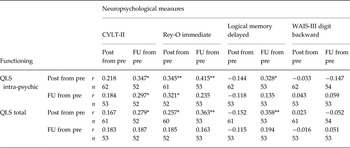
Relationship between improvement on neuropsychological measures and functioning measures
Correlations between standardized residual change scores of the neuropsychological and functional variables that significantly improved from pre to post are presented in Table 8. Changes on two of the neuropsychological measures that improved in response to CR (CVLT-II and Rey-O immediate) correlated with pre–post change in QLS total, and both pre–post as well as pre–FU change in QLS intrapsychic. Interestingly, this relationship was stronger for pre to FU than for pre–post changes on neuropsychological measures. Changes on the third variable, digits backward, did not predict changes in QLS. Interestingly, pre–FU changes in logical memory delayed, the measure that did not differentiate between CR and TAU at end of treatment but did differentiate at FU, did predict pre–post improvement in QLS total and QLS intrapsychic. Significant correlations ranged from 0.257 to 0.415.
Correlations between standardized residual change scores in neuropsychological and functioning measures

CVLT-II, California Verbal Learning Test-II; Rey-O, Rey–Osterreith; WAIS-III, Wechsler Adult Intelligence Scale, 3rd edition; FU, follow-up; QLS, Quality of Life Scale.
* p < 0.05, ** p < 0.01.
Discussion
In this paper, we examined the efficacy of combined strategy training and drill-and-practice cognitive CR for individuals with schizophrenia spectrum disorders. Our findings were mostly in line with previous research (McGurk et al. Reference McGurk, Twamley, Sitzer, McHugo and Mueser2007; Wykes et al. Reference Wykes, Huddy, Cellard, McGurk and Czobor2011). Compared with TAU, CR was associated with large post-training improvements on trained computerized cognitive tasks targeting attention, visuospatial memory, and verbal learning and memory, with persisting group differences at 2-month FU. These generalized to mostly large improvements on neuropsychological measures targeting visuospatial memory (Rey-O immediate), verbal learning and memory (CVLT), delayed verbal memory (logical memory, delayed) and verbal working memory (digits backward). We did not find any CR-associated improvements on our measures of functional capacity (UPSA, SSPA, MMAA), symptoms (PANSS) or on a self-report measure of independent living skills (ILSS), but did find an effect on an interviewer-rated measure of functioning (QLS), which appeared primarily driven by the intrapsychic foundations subscale. Finally, for those randomized to CR, there were significant, medium-sized correlations between changes on most of the significantly improved computerized tasks, neuropsychological and functioning measures.
There are several findings related to the inter-relationships among change scores on the computerized training tasks, neuropsychological test scores, and functional variables that deserve further discussion. One might expect that improvement on a specific computerized task would most strongly predict improvement on a neuropsychological measure that is most similar to that task and presumably requires similar cognitive skills, with weaker generalization to less similar tasks. We did not find this sort of pattern, despite several of the computerized and neuropsychological measures sharing many of the same qualities (e.g. sequenced recall of auditory digit list). This may have been due to potential differences in task difficulties and psychometric characteristics between the measures. Alternatively, one could argue that the drill-and-practice component of the intervention, which more narrowly targets specific cognitive functions and hence might be expected to influence the degree of relationship between computerized task performance and neuropsychological measures, was underdosed (the maximum number of sessions of computerized training our participants could complete was 20, while many contemporary studies offer 40–50 such sessions). We have, however, previously found that training may have surprising effects as far as which cognitive domains improve, even with longer training duration (Bell et al. Reference Bell, Fiszdon and Bryson2009). Moreover, as has been previously suggested (Spaulding et al. Reference Spaulding, Reed, Sullivan, Richardson and Weiler1999; Wykes et al. Reference Wykes, Reeder, Huddy, Taylor, Wood, Ghirasim, Kontis and Landau2012), CR may not so much make an impact on specific cognitive skills as improve the ability to recognize and recruit those skills that are required for the task at hand. Presumably, this ability would have been honed during the strategy-based paper-and-pencil training component of our CR, though unfortunately our study design does not allow us to directly examine this.
Another interesting finding was the pattern of inter-relationships between pre-training to post-training change scores v. pre-training to FU change scores. While pre–post changes on computerized tasks significantly predicted pre–post (but not pre–FU) improvement on neuropsychological variables, the inverse pattern was evident for correlations between functioning and neuropsychological measures, where pre–post changes in functioning were somewhat more highly related to pre–FU changes in neuropsychological measures than to pre–post changes on these measures. One potential explanation for this is that the higher degree of relationship between computerized task and neuropsychological measure changes at pre–post than at pre–FU may be due to the dominant CR-specific cognitive effects on both of these outcomes during the pre–post phase, with other, independent variables amassing more influence once CR is discontinued during the FU period. This could potentially result in greater divergence between the two outcomes over time. In turn, with regard to the pre–post changes in functioning correlating somewhat more highly with pre–FU than with pre–post changes in neuropsychological measures, it may be that different facets of CR are influencing both outcomes at post-training. For example, it may be that CR-specific factors are influencing neuropsychological change while CR-non-specific factors (e.g. increased structure and increased social interaction that are a consequence of attending CR sessions) are influencing functional change. During the FU period, on the other hand, it may be the initial pre–post changes in functioning (and in this case specifically in the richness of intrapsychic processes) that take on more prominence in influencing subsequent neuropsychological improvement. Of course the above explanations are highly speculative and primarily intended to generate further conjecture about potential mechanisms of CR effects. Whatever the case, these findings are broadly in line with several other studies that suggest a complex, multifactorial relationship between CR, and cognitive and functional change (Fiszdon et al. Reference Fiszdon, Choi, Goulet and Bell2008; Penades et al. Reference Penades, Catalan, Puig, Masana, Pujol, Navarro, Guarch and Gasto2010; Wykes et al. Reference Wykes, Reeder, Huddy, Taylor, Wood, Ghirasim, Kontis and Landau2012; Farreny et al. Reference Farreny, Aguado, Ochoa, Haro and Usall2013; Reeder et al. Reference Reeder, Harris, Pickles, Patel, Cella and Wykes2014).
CR has become a popular treatment for individuals with psychosis because of the well-documented link between cognition and functioning in this population, and the (much less well documented) idea that improvement in one will lead to favorable changes in the other. Hence, our finding of a link between cognitive change and improvement in functioning (in particular as our CR intervention was administered as a stand-alone), appears quite promising. However, the use of TAU as our only comparator condition and the lack of an attentional control condition pose important questions for the interpretation of this relationship. While there is evidence that trial quality does not affect the relationship between CR and cognitive or functional change (Wykes et al. Reference Wykes, Huddy, Cellard, McGurk and Czobor2011), it is nevertheless important to point out that without an active control group, there is no way for us to determine to what degree, if any, non-specific effects of CR and/or staff contact may have contributed to the cognitive and functional improvements in the CR group. The enhanced structure of attending a CR program, the corresponding social interactions while at the hospital with staff and other patients, and the perception that the person is doing something active for his or her mental or physical health may all influence cognition and quality of life, and especially those aspects related to motivation for treatment and self-efficacy (Boot et al. Reference Boot, Simons, Stothart and Stutts2013; Tippens et al. Reference Tippens, Purnell, Gregory, Connelly, Hanes, Oken and Calabrese2014; Schwartz & Buchel, Reference Schwartz and Buchel2015). This is particularly relevant to our findings since the only subdomain of the QLS that improved during CR was the intrapsychic foundation subscale, from which several items have been commonly used in schizophrenia research to measure an overall state of motivation (Nakagami et al. Reference Nakagami, Xie, Hoe and Brekke2008). Thus, while an initial, uncomplicated conclusion would be that it is cognitive change in the CR group that leads to improvements in quality of life, a more cautious alternative explanation that should be considered is that indirect or non-specific effects of CR may have driven at least some of these changes. Yet another possibility that has been previously raised (Silverstein et al. Reference Silverstein, Spaulding and Menditto2006), and that also takes into consideration indirect and mediating variables, is that while CR-specific effects led to improved cognition, the recognition of improved cognition led to improved self-esteem and to behaviors such as an increased willingness to persist (and succeed) at challenging tasks, and that it was these factors that contributed to enhanced functional outcome, particularly in the QLS domain of intrapsychic foundations.
Several limitations of the current study should be acknowledged. First and as noted above, the lack of a 1-month midpoint assessment, in between when participants switched from strategy training to computerized drill-and-practice training or vice versa, makes it impossible to separately evaluate the influence of these two different approaches to CR. While some have reported no or few discernible differential effects between varied approaches to CR (e.g. Franck et al. Reference Franck, Duboc, Sundby, Amado, Wykes, Demily, Launay, Le Roy, Bloch, Willard, Todd, Petitjean, Foullu, Briant, Grillon, Deppen, Verdoux, Bralet, Januel, Riche, Roy and Vianin2013; Vita et al. Reference Vita, Deste, De Peri, Barlati, Poli, Cesana and Sacchetti2013), there is nevertheless some evidence from meta-analyses to suggest that some types of CR are more likely to lead to functional change than others (McGurk et al. Reference McGurk, Twamley, Sitzer, McHugo and Mueser2007; Wykes et al. Reference Wykes, Huddy, Cellard, McGurk and Czobor2011). Second, raters were not blind to treatment allocation. This introduces the potential for rater bias; however, we would expect that if such were the case, group differences would be observed not only on the QLS but also on the symptom and functional capacity measures, all of which require some degree of rater judgment. Third, we did not adjust α level for our exploratory analyses of correlations between change scores. While this may enhance the potential for type I error, we erred on what we consider the side of caution in wishing to comprehensively assess potential CR effects and the relationships among them, with an emphasis not so much on statistical significance (there are already plenty of studies showing that CR leads to cognitive and functional changes) as on the patterns and mechanisms underlying CR's effects, particularly in light of findings that cognitive change does not necessarily need to be large to make a positive impact on functioning (Silverstein et al. Reference Silverstein, Wong, Solak, Smith, Wilkniss, Landa, Goicochea, Carpiniello, Uhlhaas, Schenkel and Savitz2005). And last, even though participants were randomized and there were no group differences at baseline, it is also possible that individual differences at baseline (regardless of condition) would have an impact on likelihood of change. However, since the covariance structure from the current study data fits best the compound symmetry (CS) model, which assumes that the slopes are the same across persons within an allocated group, the moderating effect of baseline values was null. Nevertheless, with a larger sample, the covariance structure should be re-evaluated, and other moderating variables in the relationships between baseline values and likelihood of change should be further investigated.
In closing, our findings replicate the large literature on the sustained benefits of CR. However, there is a need for further study of the mechanisms underlying CR, as underscored by lack of specific, narrowly defined pathways through which improvements on training tasks make an impact on broader cognitive changes, and then again how these broader cognitive changes affect functioning. Finally, our findings highlight the importance of carefully evaluating choice of outcome measures, and considering to what extent they may be affected by non-specific treatment effects.
Supplementary material
The supplementary material for this article can be found at http://dx.doi.org/10.1017/S0033291716001951
Acknowledgements
This study was funded by the Veterans’ Administration Rehabilitation Research and Development Service (#F3195V to J.M.F.). The sponsor had no role in the planning or conduct of the study or in the interpretation of study results.
Declaration of Interest
None.