Introduction
Systemic anticancer therapy (SACT), which includes cytotoxic agents (CTAs), molecular targeting agents (MTAs), and immune-checkpoint inhibitors (ICIs), improves the prognosis of patients with advanced cancer. However, aggressive therapy has proven to be disadvantageous for patients with advanced cancer who are near the end of life (EOL).
Earle reported that aggressive SACT near EOL resulted in an increased number of emergency department visits, hospitalizations, and admissions to intensive care units during the final month of life in patients with advanced cancer (Earle et al., Reference Earle, Neville and Lndrum2004). According to this report, SACT near EOL was tentatively defined as the last administration of therapy to patients within 14 or 30 days prior to death. Kao reported that younger age, the cancer type, and tumor chemosensitivity were predictive factors for performing SACT near EOL during the final week before death (Kao et al., Reference Kao, Shafig and Adams2009). Petra reported that patients with breast, hematological, and gynecological cancers were 2.5 times more likely to undergo SACT near EOL than other cancer patients (Petra et al., Reference Petra, Aynharan and Theresas2015). Hiramoto reported that the Glasgow Prognostic Scale and the Eastern Cooperative Oncology Group performance status (ECOG-PS) were significant prognostic factors in patients with advanced cancer in the EOL stage (Hiramoto et al., Reference Hiramoto, Hori and Inoue2019). In these studies, rates of the last administration of SACT within 14 and 30 days prior to death were reported as 3.0–11.6% and 6.3–18.8%, respectively (Earle et al., Reference Earle, Neville and Lndrum2004; Barbera et al., Reference Barbera, Paszat and Chartier2006; Braga et al., Reference Braga, Rute Fonseca and Moreira2007; Hashimoto et al., Reference Hashimoto, Yonemori and Katsumata2009; Kao et al., Reference Kao, Shafig and Adams2009; Näppä et al., Reference Näppä, Lindqvist and Rasmussen2011; Hui et al., Reference Hui, Meghan and Bruera2013; Hanny et al., Reference Hanny, Sonja and Georg2014; Petra et al., Reference Petra, Aynharan and Theresas2015; Maltoni et al., Reference Maltoni, Scarpi and Nanni2016; Hikmat et al., Reference Hikmat, Omar and David2019; Hiramoto et al., Reference Hiramoto, Hori and Inoue2019).
Recently, the use of both MTAs and ICIs has occupied important positions in SACT. However, there are few reports on the effects of using MTAs and ICIs near EOL in patients with advanced cancer in SACT (Hui et al., Reference Hui, Meghan and Bruera2013; Tsai et al., Reference Tsai, Chung and Kuo2018; Glisch et al., Reference Glisch, Hagiwara and Lyckholm2020), while other reports focused only on CTAs (Earle et al., Reference Earle, Neville and Lndrum2004; Barbera et al., Reference Barbera, Paszat and Chartier2006; Braga et al., Reference Braga, Rute Fonseca and Moreira2007; Hashimoto et al., Reference Hashimoto, Yonemori and Katsumata2009; Kao et al., Reference Kao, Shafig and Adams2009; Näppä et al., Reference Näppä, Lindqvist and Rasmussen2011; Hanny et al., Reference Hanny, Sonja and Georg2014; Petra et al., Reference Petra, Aynharan and Theresas2015; Maltoni et al., Reference Maltoni, Scarpi and Nanni2016; Hikmat et al., Reference Hikmat, Omar and David2019; Hiramoto et al., Reference Hiramoto, Hori and Inoue2019; Glisch et al., Reference Glisch, Hagiwara and Lyckholm2020).
SACT is used to improve the quality of life (QOL) of patients with advanced cancer; however, previous studies have reported that it could not improve the QOL of patients with a poor performance status (Prigerson et al., Reference Prigerson, Bao and Shah2015). Moreover, SACT near EOL has become an indicator of poor quality of cancer care. Aggressive treatment near EOL increases the number of hospitalizations in the intensive care unit and delays the palliative care referral (Hikmat et al., Reference Hikmat, Omar and David2019). Among patients for whom there was no evidence of clinical value, the American Society of Clinical Oncology expert panel identified chemotherapy use as the most widespread, wasteful, and unnecessary practice in oncology (Schinipper et al., Reference Schinipper, Smith and Raghavan2012). A better understanding of predictors and the effect on the EOL care would provide valuable information for clinicians, patients, and their families for decision making in referral to palliative care institutes.
Therefore, the objective of this study was to describe the predictors of SACT, including both MTAs and ICIs near EOL, and the effects on EOL care in patients with advanced cancer.
Methods
Study design and patients
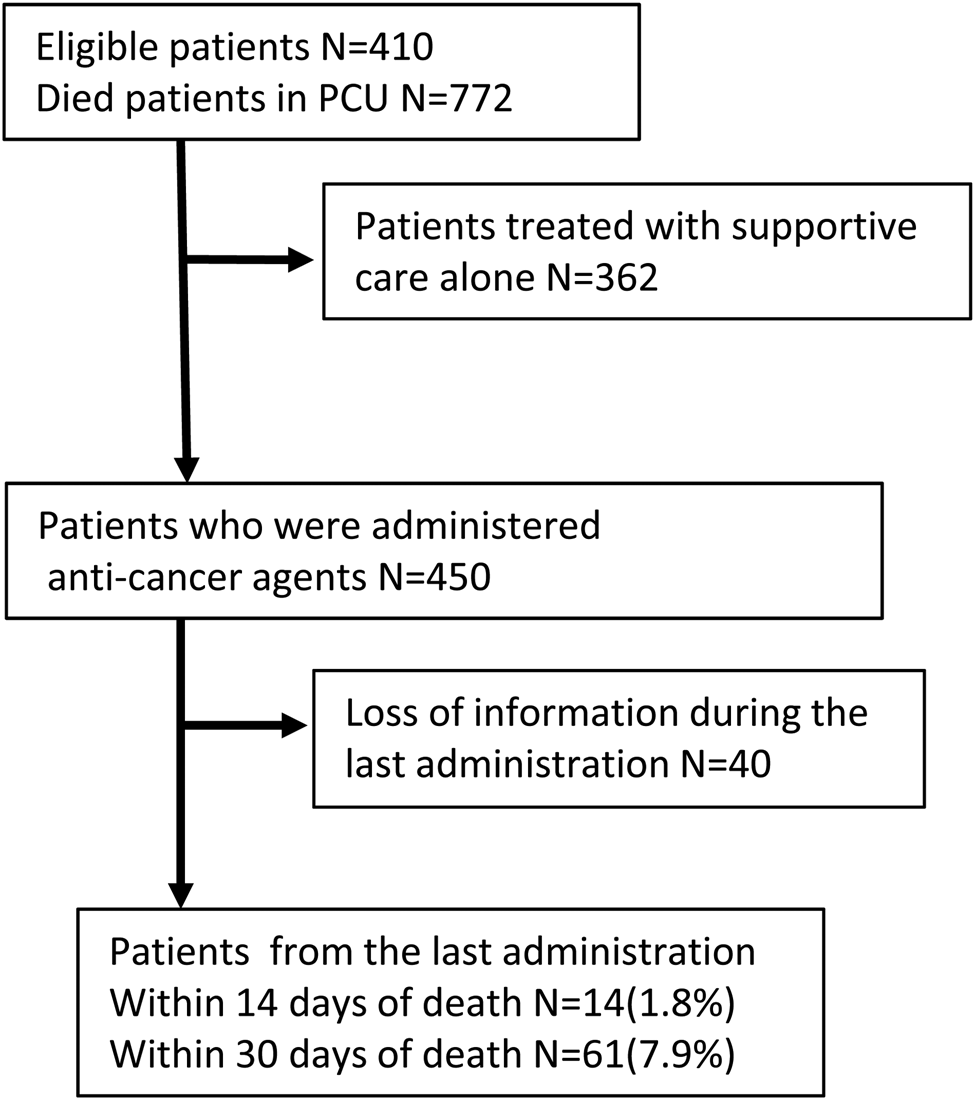
This study was conducted as a retrospective analysis. We analyzed all patients who died of advanced cancer, brain tumors, or advanced hematological malignancies from August 2016 to August 2019 at Mitsubishi Kyoto Hospital. Patients aged 20 years or older and diagnosed with advanced cancer with metastatic and recurrence states were included. We analyzed the survival time of patients who were applied anticancer agents excluded due to the loss of information about the last administration of SACT (Figure 1).
Patient selection flow.

At our department, physicians can provide both oncological treatments such as SACT and specialized palliative care, including the EOL care. We provide services such as SACT and supportive care for cancer patients from their diagnosis to death. We routinely evaluate patients’ symptoms, ECOG-PS, and blood test before the SACT administration in the outpatient treatment room. If the patient needs to be hospitalized due to SACT side effects, disease progression, and their EOL, we support them in the palliative care unit or general wards in our hospital.
Endpoints
The primary endpoint of this study was to identify related factors during the last administration of SACT near EOL after dividing the patients into two groups (patients who died within 14 or 30 days after the last administration of SACT and others) and examine differences between them.
Related factors involved data collection during the last administration of SACT near EOL and included information such as age, sex, ECOG-PS, primary cancer site, the number of metastatic sites, the number of comorbidities, and the use of MTAs, ICIs, and CTAs in the last administration. Biliary, pancreatic, esophageal, and gastric cancers were classified as upper gastrointestinal (GI) for the related factor analysis. Data regarding age, sex, primary cancer site, metastatic site, and the number of comorbidities were collected at the time of the first diagnosis in patients with metastatic and recurrent states, and ECOG-PS was applied at the last administration of SACT retrospectively.
For the factor analysis, we used the above factors in a logistic analysis after dividing them into two groups.
The secondary endpoint was to analyze the relationship between EOL symptoms and EOL treatment details. With respect to EOL symptoms, our palliative care physician took care of each patient as a daily clinical practice. Delirium was diagnosed using the confusion assessment method (Inoue et al., Reference Inoue, van Dyck and Alessi1990). The diagnoses of cancer pain, dyspnea, nausea and vomiting, and fatigue were determined based on clinical findings. The prevalence of distressing symptoms and details of EOL treatments were evaluated during the three days prior to death. We defined continuous deep sedation as the continuous use of sedatives to relieve intolerable and refractory symptoms with a total loss of patient consciousness until death (Morita et al., Reference Morita, Bito and Uchitomi2005). The number of opioids administered was recorded in terms of the oral morphine-equivalent dose.
Statistical analysis
Time of the event curves was calculated using the Kaplan–Meier method and compared using log-rank tests. The statistical influence was presented and interpreted based on multiple logistic regression models (ORs) and 95% confidence intervals (CIs). A p-value <0.05 was considered statistically significant. All analyses were performed using the R version 3.6.2. for OS X 10.11.
Ethical considerations
This study was conducted in accordance with the ethical requirements of the Declaration of Helsinki and the ethical guidelines for epidemiological research, presented by the Ministry of Health, Labour and Welfare of Japan. The hospital institutional review board approved this study.
Results
Patients’ background
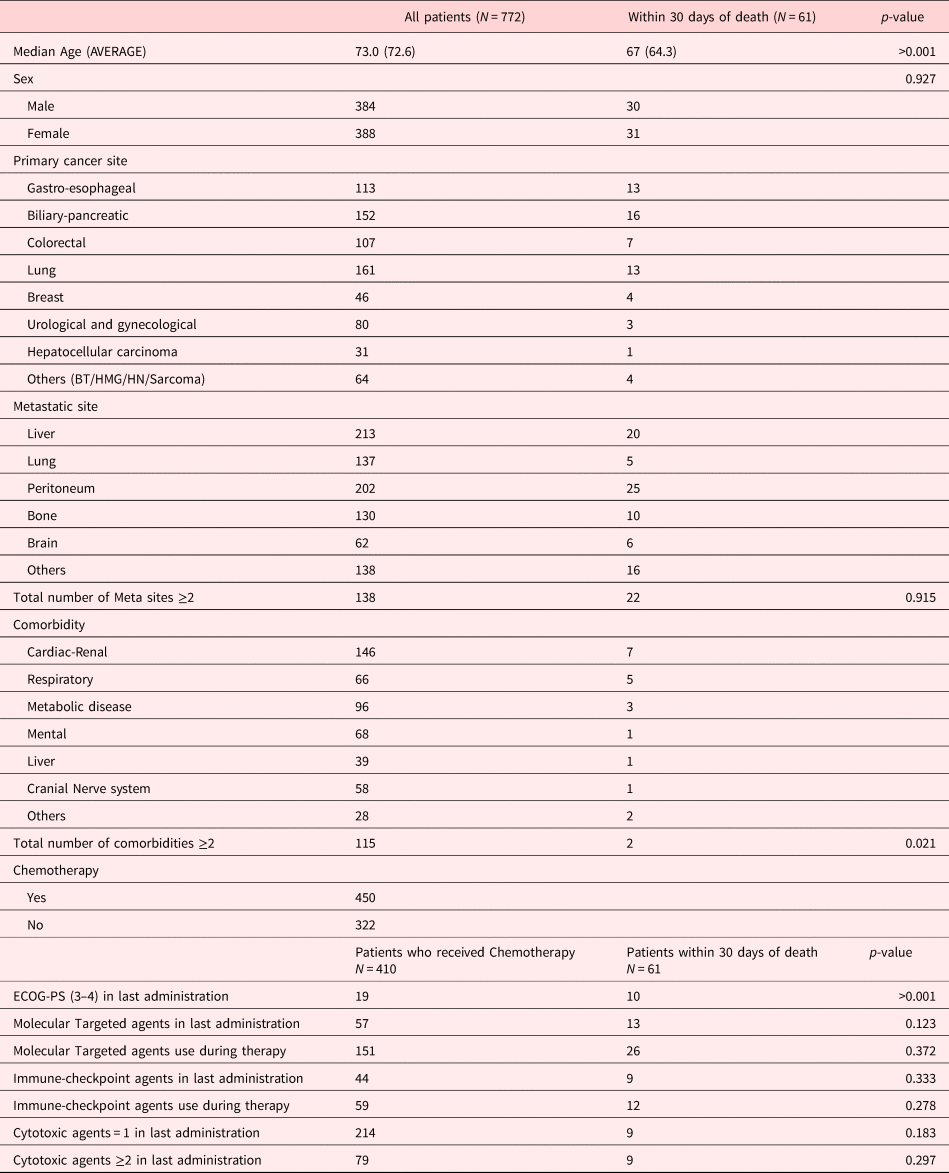
Among the 772 patients who died at our institute during the study period, 362 received supportive care only, and of the 450 patients who underwent SACT among them, 40 patients were excluded due to the loss of information regarding the last SACT administration. The number of patients who died within 14 and 30 days from the last SACT administration was 14 (1.8%) and 61 (7.9%), respectively (Figure 1). No patients died within three days from the last administration of SACT. The patients’ backgrounds are described in Table 1, and details of the last SACT administration are described in the Supplementary Appendix table.
Patient background

BT, brain tumor; HNK, head and neck cancer; HMG, hematological malignancy.
Related factors analysis
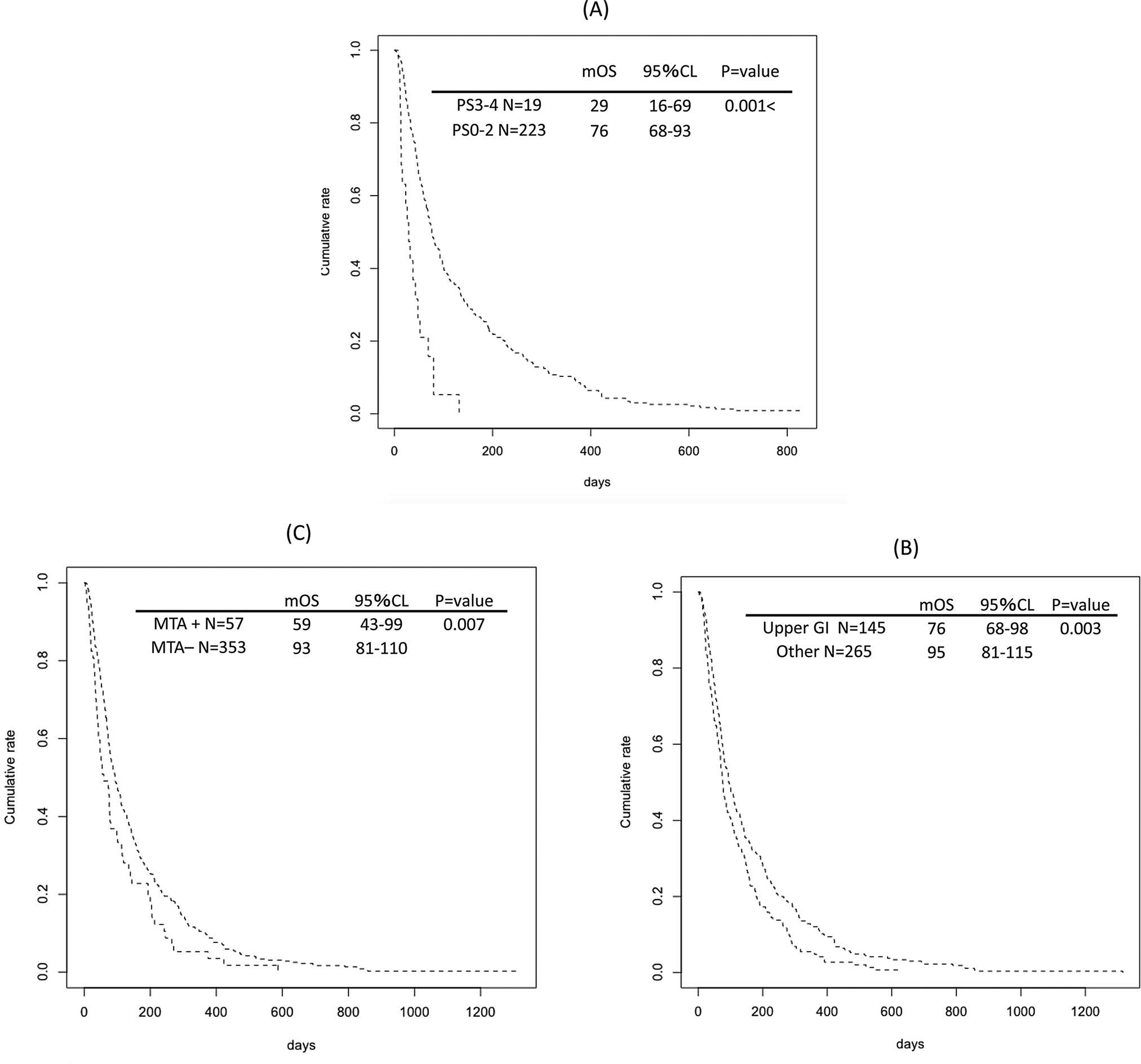
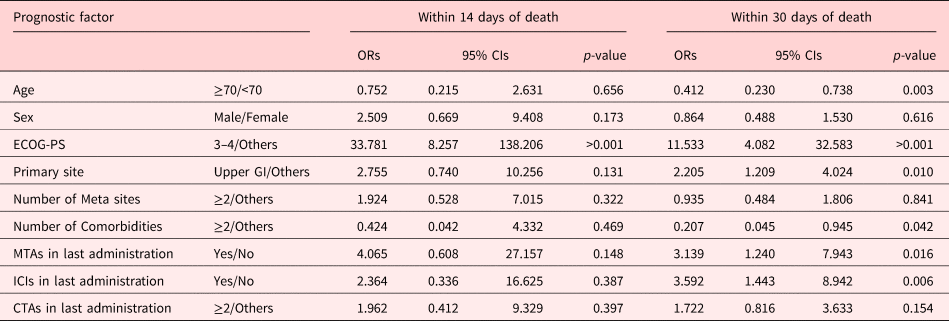
In a multivariate analysis, the ECOG-PS (OR 33.781, p < 0.001) was a significant predictor for the period within 14 days of death from the last SACT administration. Age (ORs 0.412, p = 0.003), ECOG-PS (OR 11.533, p < 0.001), primary cancer site for upper GI cancers (OR 2.205, p = 0.010), the number of comorbidities (OR 0.207, p = 0.042), MTAs (OR 3.139, p = 0.016), and ICIs (OR 3.592, p = 0.006) were significant predictors within 30 days of death (Table 2). The median survival time (MST) from the last SACT administration to death in patients with ECOG-PS 3–4 was 29 days, while that of patients with both PS 0–2 was 76 days. The MST of patients with upper GI cancers was 76 days, while that of patients with other cancers was 95 days. The MST of patients with MTA was 59 days, while that of patients without MTA was 93 days. The Kaplan–Meier survival curve was stratified by ECOG-PS, primary cancer site (upper GI), and MTAs (Figure 2).
Survival time from the last administration of SACT for patients stratified by ECOG-PS (a); Primary cancer site (b) and MTAs (c) (Kaplan–Meier survival curve).

Predictors analysis for the last administration of SACT (multi-regulation analysis)

SACT, systemic anticancer therapy; ORs, odds ratio; CIs, confidential interval; Upper GI, esophageal and gastric, pancreatic and biliary cancer; MTAs, molecular targeting agents; ICIs, immune-checkpoint inhibitors; CTA, cytotoxic agents.
Prevalence of EOL symptoms and details of EOL treatments
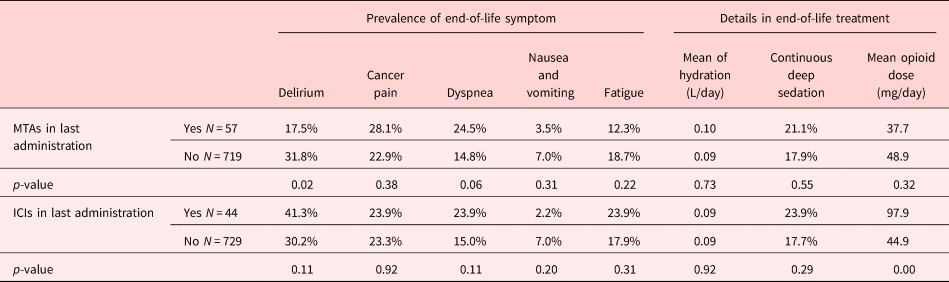
The prevalence rate of delirium in EOL patients with MTAs in the last administration of SACT was 17.5%, which was significantly lower than that in patients without MTAs (31.8%). The prevalence rate of the mean opioid dose in patients with ICIs was 97.9 mg/day, which was significantly higher than that in patients without ICIs (44.9 mg/day) (Table 3).
Relationship between the last administration of SACT, end-of-life symptom and treatment

Discussion
In this study, age, ECOG-PS, primary cancer site, the number of comorbidities, MTAs, and ICIs use were significantly associated with SACT near EOL. To the best of our knowledge, this is the first study to analyze the predictors of SACT near EOL and include both MTAs and ICIs.
In young patients, the focus is on the prolongation of life expectancy, and they tend to receive an aggressive treatment compared with elderly patients. Moreover, they hope to continue treatment near EOL and cannot decide to discontinue it, whereas palliative care referral tends to be delayed (Hashimoto et al., Reference Hashimoto, Yonemori and Katsumata2009; Hikmat et al., Reference Hikmat, Omar and David2019). The result that patients with comorbidities had a good prognosis compared with those without seems paradoxical, but considering age factors, patients with comorbidities would likely avoid aggressive treatment from the start of treatment. As a result, elderly patients with comorbidities have a good prognosis near EOL.
SACT is used to improve the QOL of patients with advanced cancer; however, previous studies have reported that it could not improve the QOL of patients with poor performance status (Prigerson et al., Reference Prigerson, Bao and Shah2015). Our study has also suggested that ECOG-PS should be considered as a factor related to SACT near EOL. Thus, an early referral to palliative care should be considered as low scores on the ECOG-PS that indicate poor prognosis.
In general, the overall survival time after the diagnosis of unresectable biliary, pancreatic, esophageal, and gastric cancers is short against SACT, and the malignancy potential is high compared with other cancers (Hiramoto et al., Reference Hiramoto, Kato and Boku2018). Moreover, there was a report that the survival time from intervention to death in palliative care facilities was also short (Hiramoto et al., Reference Hiramoto, Maeda and Morita2016). As the MST from the last administration of SACT to death was brief (76 days), compared with other cancers (95 days), it might be better to rapidly introduce palliative care.
Small molecular agents of the MTAs are commonly used in patients with non-small lung cancer (Inoue et al., Reference Inoue, Kobayashi and Usui2009). The MTAs of SACT near EOL were correlated with younger age, hematological malignancy, and lung cancer, and they were often used with CTAs in past reports (Hui et al., Reference Hui, Meghan and Bruera2013). Moreover, it has been reported that the use of MTAs near EOL was related to aggressive EOL care, which included multiple emergency department visits, hospitalization exceeding 14 days, admission to intensive care units, the use of intubation and mechanical ventilation, cardiopulmonary resuscitation, and late hospice referrals, and it should be a quality-of-care indicator in patients with non-small lung cancer (Tsai et al., Reference Tsai, Chung and Kuo2018). In our study, there were more patients with small molecular agents (84.2%) than antibodies (15.8%) who used regimens in MTAs monotherapy of SACT for lung and colorectal cancer, and 31 patients used a combination of CTAs.
The ICI use near EOL is associated with a poor performance status, lower hospice enrollment, and death in the hospital (Glisch et al., Reference Glisch, Hagiwara and Lyckholm2020). As the ICI use near EOL was a significant predictor in our study, attention should be paid to the prolonged use of ICIs for patients with poor Performance Status for the same reasons as for the MTAs. Considering past reports, it is important not to delay referral to a palliative institute such as hospice care.
There have been few reports of associations between EOL symptoms, treatment, and SACT (Hiramoto et al., Reference Hiramoto, Hori and Inoue2019). ICI neurotoxicity was associated with immune-related adverse events, so the result was paradoxical. We assume that there is a low prevalence of delirium in patients who used ICIs, as it is less intensive, and the fact that fatigue was low suggests a low possibility of delirium. Nausea and vomiting near EOL were less prevalent in patients receiving MTAs because there was less use of CTAs that affected these symptoms. The opioid use between MTAs and ICIs was different, so there may be different biological effects in patients or differences in the pharmacological effects of the opioid metabolism.
This study has several limitations. First, as it was a retrospective study conducted in a single institution in Japan, the findings may be less likely to be generalized; thus, further validation is necessary. Second, MTAs were associated with SACT near EOL. However, it is difficult to know whether it is a trend to prolong the use for patients with poor performance status due to a low burden for patients or affect the prognosis expectancy directly. To solve this problem, a prospective study is necessary to analyze the effects of MTAs near EOL, stratified according to the performance status. Third, the MTAs are divided into two types: small molecules and antibody agents, but it is difficult to analyze these classifications using statistics. Fourth, we only used a small number of ICIs in this study, but the number of ICIs used in the future will gradually increase. Fifth, we cannot analyze the rate of acute hospitalization and hospice admission separately because the institute considered in this study is an integrated palliative care unit and oncology center.
Conclusions
Age, ECOG-PS, primary cancer site, the number of comorbidities, MTAs, and ICIs use were significantly associated with SACT near EOL. Information on these factors may aid clinical decision making in referral to palliative care institutions. In addition, further investigations of SACT with MTAs and ICIs for EOL are required.
Supplementary material
The supplementary material for this article can be found at https://doi.org/10.1017/S147895152100002X.
Conflict of interest
There are no conflicts of interest to declare.