




No CrossRef data available.
Article contents
Comparing costs of home- versus hospital-based treatment of infections in adults in a specialist cystic fibrosis center
Published online by Cambridge University Press: 25 October 2005
Abstract
Objectives: This study aimed to produce valid patient-based UK National Health Service (NHS) costs for adults with cystic fibrosis to identify differences between hospital- and home-based treatments for infections.
Methods: A costing study was carried out in adults with cystic fibrosis (CF) in the United Kingdom, who required intravenous antibiotic treatments for respiratory infections, administered either at home or in the hospital. The perspective was that of the NHS hospital trust. Data were collected retrospectively for each patient for 1 year using clinical records. Data were collected for 116 adults with CF between 2000 and 2001, when 42,382 treatment days (454 courses) of intravenous antibiotics were administered; 213 courses with intention-to-treat at home and 241 courses with intention-to-treat in the hospital. The mean length of a course was 15.3 days.
Results: Patients who had >60 percent of courses at home over 1 year had a mean cost of £13,528, compared with £22,609 for patients who had >60 percent of courses in the hospital, and a mean cost of £19,927 for patients who had an equal mix of home and hospital care (p = .0001).
Conclusions: The key cost-generating events in CF respiratory infections are hospital admissions. Future studies assessing costs should concentrate on factors affecting admissions, length of stay, staff input, and alternative methods of home-care provision, rather than marginal effects, such as using different antibiotics.
Information
- Type
- RESEARCH REPORTS
- Information
- International Journal of Technology Assessment in Health Care , Volume 21 , Issue 4 , October 2005 , pp. 506 - 510
- Copyright
- © 2005 Cambridge University Press
Cystic fibrosis (CF) is the most common lethal inherited disease in European populations, affecting approximately 1 in 2,500 children (12). Antibiotic treatment is key to the management of CF-related respiratory disease. Infective respiratory exacerbations are usually treated with intravenous antibiotics. Treatment can require substantial periods of hospitalization each year (up to 8 weeks), so many patients now receive their i.v. antibiotics at home. The proposed benefits of home treatment for patients include shorter hospital stays, reduction in hospital-acquired infections, and improved health-related quality of life (HRQoL) (17).
Home administration of high-technology treatments, such as i.v. antibiotics, has become feasible because of the development of improved venous access devices and portable infusion pumps. However, many bodies with purchasing responsibility have limited knowledge of the costs of treating such patients (16). Some studies have analyzed the costs of high-technology treatment at home compared with hospital (2;3;8;14;20). We conducted a large observational study in adults with CF, which compared the costs and outcomes over 1 year of hospital-versus home-based management of respiratory infections in North West England.
METHODS
The Patients
The Manchester Adult CF Unit treats approximately 240 patients from North West England and beyond. Adult patients (16 years or older) with CF were included in this study. Ethics Committee approval was obtained, and patients were informed by letter.
Patients had to have experienced at least one infective respiratory exacerbation treated with intravenous (i.v.) antibiotics during the previous 1-year period. There is no generally accepted definition of a respiratory exacerbation. For this study, a respiratory exacerbation was defined as an increase in lower respiratory tract symptoms requiring treatment with i.v. antibiotics (19). Patients could be treated at home and/or in the hospital. Patients who received i.v. antibiotics for conditions other than respiratory exacerbations or who received treatment at hospitals in addition to the study site were excluded.
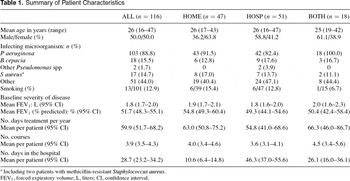
Of 128 patients receiving i.v. antibiotics for CF, 116 met all inclusion criteria (16 years old or older and at least one respiratory infective episode treated with intravenous antibiotics) and were included in the study. A “home” course was a treatment course that began at home, and a “hospital” course was one that began in the hospital. Virtually all patients had a combination of home and hospital treatments during the 1-year study period, so a pragmatic division of patients was required. HOME patients were defined as patients in whom the percentage of courses intended to be undertaken at home was more than 60 percent of the total number of courses. HOSP patients were defined as patients in whom the percentage of courses intended to be undertaken in the hospital was more than 60 percent of the total number of courses. BOTH patients were defined as patients in whom the percentage of courses intended to be undertaken at home or in the hospital was 40 to 60 percent of the total number of courses (21).
Mean baseline lung function (forced expiratory volume: FEV1) and percentage of predicted lung function (corrected for age and sex) for the 1 year before the study period were collected for each patient. Lung function was compared between the three treatment groups to assess the level of severity of illness in each group.
Design of Costing Study
The perspective of the study was the secondary care provider. One year of clinical and resource data were collected for each patient. Resource use data were patient-specific, but were necessarily collected retrospectively. Data about the following variable cost items were collected from medical records: number and type of drugs, disposables, laboratory tests, home kits, home visits, outpatient visits, and hospital stay. Admissions were recorded from ward admission books. To estimate an approximate time spent with patients at clinical outpatient visits and at home visits, a convenience sample of clinic appointments was taken from the clinic diary during April 2001. The time spent by staff (physiotherapist, doctor, CF nurse) attending the patient was recorded, and a mean length of time was calculated for each type of staff member.
Available standardized cost per unit were drawn from the NHS Trust, the British National Formulary (BNF) March 2002 (7), and from the budget of the CF unit. The BNF provides a national standard price for medicines reimbursed under the UK NHS. Cost of traveling to patients' homes was obtained from the Automobile Association. Fixed costs for each item were obtained from the NHS Trust. Avoidance of double counting was carefully observed. All costs were calculated for the year 2002 and reported in UK sterling (£).
One course of i.v. antibiotics was defined as the time between the start and end of a cycle of treatment, regardless of changes in drug, dose, or site of treatment. There is no standard method to separate courses of antibiotic treatment in patients with chronic and repetitive infective episodes, so a clinical judgment was made by the research team. It was assumed that, if the break between two cycles of treatment was fewer than 7 days, the two cycles were regarded as one course of treatment. If the break was 7 days or longer, the two cycles were regarded as two separate courses.
Cost Analysis
The analysis included cost estimates for all patients who remained in the study for 1 year. The objective of the statistical analysis was to test whether there were statistically significant differences between groups in the costs. The sample size in this study of 116, with a highly skewed distribution, indicated non-normality. Standard parametric-based approaches would not be robust, so nonparametric bootstrapping was used to compare arithmetic means of cost data (6). Nonparametric statistical tests were considered inappropriate, because they do not test differences in arithmetic means (1). The arithmetic mean is considered to be the most relevant measure for health-care policy decisions, which should be based on information about the distribution of the costs of treating a patient group, as well as the average cost. Data transformation to achieve approximate normality does not result in a comparison of arithmetic means. Analysis of variance (ANOVA) was applied to the data generated by bootstrapping, for multiple group comparisons.
RESULTS
Table 1 summarizes key patient characteristics. Baseline lung function was not significantly statistically different between the three groups. However, clinical outcome, reported in detail elsewhere, as defined by both spirometry and body weight, was better after a course of treatment in the hospital compared with home treatment, and this benefit of hospital management was maintained over 1 year of treatment (21).

Total Costs
One year of resource data was collected for each of the 116 patients included in the study, between September 2000 and September 2001. A total of 42,382 days of antibiotic treatment were administered, equating to 454 courses of i.v. antibiotics during the 1-year period; 213 courses with intention-to-treat at home and 241 courses with intention-to treat in the hospital. The mean length of a course was 15.3 days. A wide range of lengths of courses (3–172 days) was explained by some patients receiving almost continuous treatment.
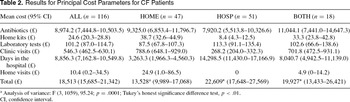
The patients were divided as follows: 47 to the HOME group, 51 to the HOSP group, and 18 to the BOTH group. There was no statistically significant difference in total days of treatment or number of courses between groups. Total costs are reported in Table 2.

The distribution of these costs was highly skewed. Four patients (3 HOSP, 1 HOME) had a cost of more than £50,000 due to long hospital stays during some courses. Statistically significant differences in total costs were found between each of the three patient groups (ANOVA: F (3, 1059), 95.24; p = .0001; Tukey's honest significance difference test, p < .01). Overall costs were lower for HOME patients than for HOSP patients (p < .01). This finding was primarily because the cost of hospital accommodation was significantly higher for HOSP patients compared with HOME patients. The total cost per hospital course was statistically significantly higher than cost per home course: mean difference, £2,836.4 (95 percent confidence interval, 2,150.7–3,522.2; p < .001).
DISCUSSION
This study examined whether differences in provision of antibiotic management of CF-associated respiratory infections led to differences in patient costs to the secondary care NHS provider. A difference was demonstrated, attributable to differences in numbers of hospital stays. There was no difference between patients in treatment days, numbers, or length of antibiotic courses. These results agree with three other UK studies, which compared the costs of home and hospital treatment of CF (5;9;13). Although different costing methods were used, these studies concluded that home treatment was cheaper than hospital treatment because of the savings in hospital admission. This study improves existing information as it provides precise, clinically relevant resource use and cost data for a relatively large number of adult patients with CF, incorporating 42,382 days (454 courses) of i.v. antibiotic treatment over 116 patient-years.
This study was not a randomized controlled trial (RCT), so there may be differences between patient groups that have not been controlled for. However, the severity of illness, measured by lung function, was not different between patients. Thus, patients were not selected for home or hospital treatment based on their severity of illness. It is likely that patients themselves have strong preferences for one treatment site and influence choice and that bed availability may have had some effect on some occasions.
Lung function, particularly FEV1, is the most important objective clinical outcome measure in CF. The main aim of treatment with intravenous antibiotics is achieving and maintaining the patient's best lung function. Although our study assessed only clinical outcome, it would have been useful to record HRQoL. However, not only can HRQoL not be assessed retrospectively, but at the time the study was conducted, a validated instrument sensitive to home and hospital treatment was not available.
RCTs may not be the most appropriate study design to assess management of patients with chronic or life-long diseases such as CF, partly because patients with these illnesses have strong preferences for treatment, so may refuse to be randomized at all (22). Although these studies may provide evidence for short-term outcomes, they rarely evaluate long-term outcomes, which are important for these patients (11). A systematic review of short-term RCTs of treatment for respiratory exacerbations in patients with CF provided preliminary indications that single-agent antibiotic therapy increased antibiotic resistance compared with combination therapy (10). However, the cumulative effect of treatment over many years was not considered and no longitudinal studies were identified. The authors concluded that a tension exists in RCTs between evaluating short-term outcomes, which indicates a need to change practice, and continuing the study to evaluate long-term outcomes. They recommended that other study designs should be considered in chronic diseases, for example, well-conducted observational studies. This limitation of RCTs is equally important for costing studies. It is necessary to measure resource use over long periods of time in chronic illness to determine real economic impact.
Unfortunately, CF costing studies vary greatly in methodological quality. Many report costs only for individual courses of treatment; report costs in children only, therefore, are not relevant to adults; or use approximate charge information rather than patient-based information. In this study, great effort was made to accurately and precisely identify resource use and unit costs, using as standardized an approach as possible. Because of more-detailed data collection in this costing study, we have been able to identify cost differences that may not have been apparent if top-down or other more-approximate estimation methods had been used. A drawback to this study, as in many costing studies, was the retrospective nature of data collection, so we had no control over quality of routinely collected data.
As in the earlier study carried out on the Manchester Adult CF Unit (20), we have also demonstrated that top-down approximations of thoracic inpatient and outpatient costs may underestimate the true cost of CF management. The Office of Health Economics Compendium of Health Statistics (2001), reports the mean cost of an outpatient attendance (thoracic medicine) as £86.00 (18), whereas, we have calculated a value of £104.40. The Office of Health Economics Compendium of Health Statistics (2001) reported the average cost of an inpatient stay (thoracic medicine) as £241.00 (18), whereas, we have calculated a value of £308.60. The cost of a CF outpatient visit or a day on a CF-specific ward can be expected to be higher than general thoracic care, as CF patients are accommodated in separate rooms and clinics and receive high levels of care and monitoring.
To conserve research resources, we have averaged staff costs across inpatient admissions rather than measure exact staff time spent with each patient, which may underestimate differences in costs between some patients. We have only included costs associated with management of infections and we have not included primary care or social services costs.
We have not reported indirect costs associated with CF infections. These are likely to be significant and differ between hospital- and home-based treatment (15). We have reported the costs of a particular management approach, where patients receive no input from contracted home-care companies. It is likely that input from these companies will increase costs associated with home-based treatment (15). Furthermore, it is not clear whether the lower cost of home-based treatment for CF infections is associated with equivalent clinical outcomes (3;4).
In conclusion, home care with no input from contracted home-care companies, incurs lower costs that hospital-based care for respiratory infections in adults with CF, due to reduced hospital stays.
Policy Implications
Our study has shown that the key cost-generating events in CF infections are hospital admissions. CF units assessing cost for both practice and research purposes should concentrate on factors affecting admissions, length of stay and staff input, rather than marginal effects, such as using different antibiotics. Current policies regarding home management of CF-related infections may reduce costs but need to take into account likely differences in patient outcomes.
CONTACT INFORMATION
Rachel A. Elliott, BPharm, MRPharmS, PhD (Rachel_Elliott@havardpilgrim.org), Clinical Senior Lecturer, Judith M. Thornton, BPharm, MRPharmS, PhD (mdeasjt2@manchester.ac.uk), Research Pharmacologist, ARC Epidemiology Unit, School of Pharmacy & Pharmaceutical Sciences, University of Manchester, Oxford Road, Manchester M13 9PL, UK
A. Kevin Webb, MD (the5webbs@hotmail.com), Consultant and clinical Director, Mary Dodd, BSc (c/o the5webbs@hotmail.com), Superintendent Physiotherapist, Manchester Adult Cystic Fibrosis Centre, Wythenshawe Hospital, Southmoor Road, Manchester M23 9LT, UK
Mary P. Tully, BPharm, MSc, MRPharmS, PhD (mary.tully@manchester.ac.uk), Clinical Lecturer, School of Pharmacy & Pharmaceutical Sciences, The University of Manchester, Oxford Road, Manchester M13 9PL, UK
We acknowledge the kind support and help of the staff from the NHS Trust, who took part in this study. We would also like to extend our thanks to all the patients who made this project possible by agreeing to take part. This study was carried out as part of a PhD project funded by the School of Pharmacy and Pharmaceutical Sciences, University of Manchester.
References
Barber JA,
Thompson S.
2000
Analysis of cost data in randomized trials: An application of the non-parametric bootstrap.
Stat Med.
19:
3219–
3236.Google Scholar
Bosso JA,
Huckendubler Stephenson SE,
Herbst JJ.
1985
Feasibility and cost savings of aminoglycosides in outpatients with cystic fibrosis.
Drug Int Clin Pharm.
19:
52–
54.Google Scholar
Bosworth DG,
Nielson DW.
1997
Effectiveness of home versus hospital care in the routine treatment of cystic fibrosis.
Pediatr Pulmonol.
24:
42–
47.Google Scholar
Bradley J,
Wallace E,
Elborn J,
Howard J,
McCoy M.
1999
An audit of the effect of intravenous antibiotic treatment on pirometric measures of pulmonary function in cystic fibrosis.
Ir J Med Sci.
168:
25–
28.Google Scholar
Bramwell EC,
Halpin DM,
Duncan-Skingle F,
Hodson M,
Geddes DM.
1995
Home treatment of patients with cystic fibrosis using the ‘Intermate’: The first year's experience.
J Adv Nurs.
22:
1063–
1067.Google Scholar
Briggs A,
Gray A.
1998
The distribution of health care costs and their statistical analysis for economic evaluation.
J Health Serv Res Policy.
3:
233–
245.Google Scholar
British Medical Association and Royal Pharmaceutical Society of Great Britain.
British National Formulary;
2001.
Donati MA,
Guenette G,
Auerbach H.
1987
Prospective controlled study of home and hospital therapy of cystic fibrosis pulmonary disease.
J Pediatr.
111:
28–
33.Google Scholar
Dyer J,
Wedlock K,
Law A,
Langton Hewer S.
2000
Cost comparisons of domiciliary intravenous antibiotics with hospital intravenous antibiotics.
Pediatr Pulmonol.
(Suppl)20:
A577.Google Scholar
Elphick HE,
Tan A.
Single versus combination intravenous antibiotic treatment for people with cystic fibrosis
Cochrane Database Syst Rev.
2005;
18:
CD002007.Google Scholar
Elphick HE,
Tan A,
Ashby D,
Smyth RL.
2002
Systematic reviews and lifelong diseases.
BMJ.
325:
381–
384.Google Scholar
Geddes D.
Cystic fibrosis: Epidemiology and pathogenesis.
In: Brewis R,
Corrin B,
Geddes D,
Gibson G, eds.
Respiratory medicine.
2nd ed.
London:
WB Saunders Company Ltd;
1995:
1317–
1329.
Gilbert J,
Robinson T,
Littlewood J.
1988
Home intravenous antibiotic treatment in cystic fibrosis.
Arch Dis Child.
63:
512–
517.Google Scholar
Kane RE,
Jennison K,
Wood C,
Black PG,
Herbst JJ.
1988
Cost savings and economic considerations using home intravenous antibiotic therapy for cystic fibrosis patients.
Pediatr Pulmonol.
4:
84–
89.Google Scholar
Krauth C,
Jalilvand N,
Wlete T,
Busse R.
2003
Cystic fibrosis: Cost of illness and considerations for the economic evaluation of potential therapies.
Pharmacoeconomics.
21:
1001–
1024.Google Scholar
Loader J,
Sewell G.
1998
The current position in England concerning home-based ambulatory infusion provided under EL(95)5.
Pharm J.
261:
R42.Google Scholar
Marco T,
Asensio O,
Bosque M,
de Gracia J,
Serra C.
2000:
Home intravenous antibiotics for cystic fibrosis
Cochrane Database Syst Rev.
CD001917.Google Scholar
Office of Health Economics.
OHE Compendium of Health Statistics.
2001
13th ed.
Pond M,
Newport M,
Joanes D,
Conway S.
1994
Home versus hospital intravenous antibiotic therapy in the treatment of young adults with cystic fibrosis.
Eur Respir J.
7:
1640–
1644.Google Scholar
Robson M,
Abbott J,
Webb K,
Dodd M,
Walsworth-Bell J.
1992
A cost description of an adult cystic fibrosis unit and cost analyses of different categories of patients.
Thorax.
47:
684–
689.Google Scholar
Thornton J,
Elliott RA,
Tully M,
Webb K,
Dodd M.
2004
Long-term clinical outcome of home and hospital intravenous antibiotic treatment in adults with cystic fibrosis.
Thorax.
59:
242–
246.Google Scholar
Summary of Patient Characteristics
Results for Principal Cost Parameters for CF Patients
 You have
Access
- 13
- Cited by