Introduction
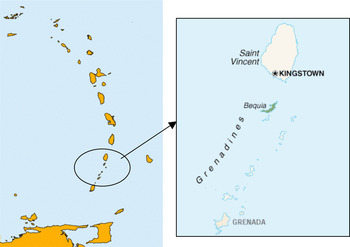
Existential constructions are a topic of special interest to linguists because of their implications for theories of subject-verb agreement (e.g. Chomsky Reference Chomsky1995; van Gelderen Reference van Gelderen1997). The examples in (1) and (2) demonstrate variation in (what we initially call) agreement in different existential constructions in the English-based varieties spoken on the island of Bequia (St. Vincent and the Grenadines) in the Eastern Caribbean (see Figure 1). Existential be may occur as morphologically singular (1a–c) or plural (2a–b), with standard (1a, 2a) or nonstandard (1b–c, 2b) agreement with the number of the postverbal subject. In Bequia, there is also variability in the form of the expletive (there or it), as well as variability in the main verb used for an existential (be, got, and have); all of these main verbs exhibit variability in agreement (as seen in (1) and (2)).
(1) Singular agreement
a. Generally speaking there istoo much noise in Bequia. (H27:1939)Footnote 1
b. And there waslot of fellows there who misunderstand. (L316:1799)
c. Well, there'sa lot of changes g- since tourists start to come in. (P14:252)
d. I would say it hassome truth in it. (H2:167)
e. It gotfire axe all- all inside the thing you know. (H3:1360)
(2) Plural agreement
a. There arevery, very few students that I can name. (L28:351)
b. There area lot of illiteracy in that- that village still. (M313:891)
c. It havecertain people here who giving, if you go to them for lumber. (P9:135)
d. It have- eh, look, it havemint. (P24:959)
While the choice of the expletive and the existential verb would appear to be straightforwardly lexical, it is an open question whether the morphological variation in the form of the existential verb is best characterized as grammatical or lexical. Productive variability in verbal morphology may be viewed as a property of grammatical relations (cf. Hundt Reference Hundt1998; Britain & Sudbury Reference Britain, Sudbury, Jones and Esch2002; Cheshire & Fox Reference Cheshire and Fox2009), though in many instances, there's in (1c) is the default variant (Eisikovits Reference Eisikovits and Cheshire1991; Smith Reference Smith2000; Tagliamonte & Smith Reference Tagliamonte, Smith and Poplack2000; Walker Reference Walker2007) and occurs nearly categorically. Such fixed-form expletive-existential constructions may be better viewed as lexical variants.Footnote 2
Location of Bequia in St. Vincent and the Grenadines.

In this article, we use a corpus of existentials from a spontaneously produced sample of speech to explore the extent to which different speakers and different groups of speakers on Bequia treat the verbal form in existentials as a productive syntactic process (i.e. agreement) or as fixed lexical variants. Although we examine the conditioning of the variation by both language-internal and language-external factors, the bulk of our argument is based on what Labov (Reference Labov1993, Reference Labov2008) calls the sociolinguistic monitor. The sociolinguistic monitor was posited to help account for a notable asymmetry in variationist studies: syntactic variables are seldom stratified along different social dimensions (cf. Cheshire Reference Cheshire1998), while phonetic variables are almost always socially stratified. Labov's initial outline of the sociolinguistic monitor (Reference Labov1993) proposed that this asymmetry arises because of the way different kinds of linguistic knowledge are stored. Syntactic knowledge is too “deep” to be available to the monitor, while phonetic and lexical knowledge is more “superficial” and thus available to the monitor. Although some syntactic variables (e.g. negative concord in English) do exhibit quite clear social stratification, Labov argues that such variables should be seen as fundamentally lexical. This seems not unreasonable for negative concord where the choice is between quite different indefinite pronominal forms (e.g. anybody ~ nobody, anything~nothing). One might make a similar argument for some of the morphosyntactic variables in French that are also stratified by social class or level of education (e.g. the periphrastic versus synthetic future (Wagner & Sankoff Reference Wagner and Sankoff2011; Roberts Reference Roberts2012); ne omission in negatives (Ashby Reference Ashby1981)). In these cases, there is also clearly a lexical quality to the variation.
This aspect of the proposed sociolinguistic monitor is one that has hardly been explored. Labov and colleagues (Reference Labov, Ash, Ravindranath, Weldon, Baranowski and Nagy2011) flesh out a different aspect of the monitor. Their research focused solely on phonetic variation ([ɪn] versus [ɪŋ] in unstressed syllables) and probed listeners' sensitivity (monitoring) of the variation according to when the first token is heard in a running text, overall rates of the variants, and changes in sensitivity in real time during the reading of a text.
What we are focussing on in this article is the fundamental difference that Labov hypothesises arises from differences in how speakers analyse a variable. We do this by building on our own insights into the apparent stability of grammatical constraints on variation over a person's lifespan. In earlier work looking at be absence in Bequia, we found that Bequians who had left their villages for extended periods and returned home later in life showed radical differences in the overall frequency with which they used be, but remarkable stability in the places they deployed it when they did use it (Meyerhoff & Walker Reference Meyerhoff and Walker2007). We called these Bequians urban sojourners because they had spent a number of years working in other English-speaking cities overseas, after which they had come back to their home village. They differ somewhat from the peripatetic norms in the Caribbean on two grounds: (i) the length of time they were away from Bequia, and (ii) the fact that their time away was spent living in extralocal English-speaking communities (as opposed to among other speakers of Caribbean Englishes, as is typically the case for people who took up work in shipping and on cruise liners). We say more about these speakers shortly.
In this article, we argue that in some villages on Bequia the community norms suggest that the existentials are genuinely grammatical: productive alternations in the form of the verb indicate that speakers are uttering existentials where the verb agrees in number with the postposed subject. We predict, therefore, based on the hypothesis of the sociolinguistic monitor and our previous analysis of be absence, that we may find changes in the frequency with which our urban sojourners use the local variants, but if the existentials are a grammatical variable in their home village, then there should be less apparent change in how and where the urban sojourners use the existentials. Conversely, if the existentials are fundamentally lexical, then they should be open to reanalysis by the urban sojourners, and we can expect to see differences not only in overall frequency of a form, but the constraints operating on it.
Our analysis necessarily must proceed on two levels: the community (village) and the individual (urban sojourners). Social stratification is a fact about group behaviour, but the sociolinguistic monitor is hypothesised to be a cognitive filter that necessarily must operate at the level of the individual. Hence, examining group behaviour necessarily masks the operation of the monitor. We therefore first establish the community norms for existentials in four villages on the island of Bequia, before focusing on how the urban sojourner from each of those villages matches, or fails to match, the community norms.
We begin by providing some background on the data analysed and the nature of the urban sojourners, before describing the facts of variation in each of the villages, taking as our variable the form of the main verb. We focus in particular on the behaviour of the urban sojourners in each village, to determine whether (as with be absence) they retain the norms of their natal village or whether there is evidence of restructuring in this aspect of their grammar. We conclude with some comments about what implications the urban sojourners' behaviour may have for the linguistic analysis of variables of this nature.
The bequia corpus
Our data come from sociolinguistic interviews recorded on Bequia between 2003 and 2005 by teenagers with family ties to the villages they were working in. All interviewees, who were over the age of forty at the time of recording, were born in their home village, and in many cases their parents (sometimes even their grandparents) also came from that village. The age restriction means our interviewees had all acquired their basic vernacular before the significant increase in tourism (and therefore contact with other varieties of English) that started in the late 1960s. This change in Bequia occurred when electricity came to the island (thereby making it more attractive to tourists) and the sailboat ferry to St. Vincent was replaced with a diesel ferry service, also facilitating movement on and off the island. In more recent years, tourism has received an additional boost from the construction of an airport in the southern part of the island (though the vast majority of visitors to Bequia continue to arrive by private boat or on cruise ships).
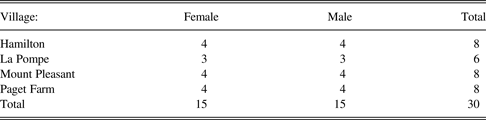
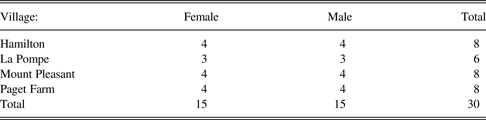
We interviewed speakers from five villages on Bequia: Hamilton, La Pompe, Lower Bay, Mount Pleasant, and Paget Farm. In this article, we concentrate on data from Hamilton, La Pompe, Mount Pleasant, and Paget Farm, drawing on a subsample of thirty interviewees distributed by village and sex as shown in Table 1.
Bequia interviewees included in the analysis of existentials by village and speaker sex.
Although Bequia is very small (seven square miles) and has a relatively shallow time depth of settlement (the island was only permanently occupied after the British took possession of it under the Treaty of Paris in 1763), residents claim that it is possible to tell what village a person comes from solely on the basis of the way they talk. This claim goes beyond the mere perception that you and your neighbour speak differently (which is surely universal, and must be related to what Freud (Reference Freud, Riviere and Strachey1963) called “the narcissism of minor differences”)—it is a claim that within the small confines of Bequia, people perceive there to be distinct ways of talking that differentiate villages. This is more like the perceptions about intervillage differences in long-settled places like Europe, but Bequia is an island that has been settled by English speakers for only the same amount of time that Australia has, so this is a remarkable degree of dialect differentiation by comparison. The most perceptually salient villages are Mount Pleasant and Paget Farm. Residents of Mount Pleasant, the historic home of the settlers of British descent, are relatively well off and prominent in local businesses. For a long time, the village maintained a distinctness from the rest of the island and was one of the white enclaves (Williams Reference Williams, Trudgill, Schreier, Schneider and Williams2010) that have been documented in the Caribbean. While nowadays there is a lot of mixing between Mount Pleasant residents and Bequians in other villages, within living memory it was not so, and the Mount Pleasant community was quite isolationist: our interviews include reminiscences from people in other villages who talk about having stones thrown at them if they crossed too far into the village. Mount Pleasant is also set apart from the rest of Bequia by their religion: most people in the village are members of the Seventh Day Adventist Church, whereas elsewhere on the island, Catholic, Protestant, and Evangelical church-going is the norm.
Residents of Paget Farm, the far-most village of a chain of villages that are collectively known as Southside, are ethnically and economically more diverse, in keeping with the history of the village as a centre for the island's whaling and fishing trades. Many people in Paget Farm continue to make a living on the sea. This is also true in La Pompe, another Southside village, which is also ethnically mixed but perhaps a little more prosperous than Paget Farm.Footnote 3 There are a growing number of guest houses and second homes built by North American snowbirds around La Pompe.
Residents of Hamilton, the community that has grown up on the site of a former plantation, are predominantly of African descent. The Hamilton community is generally less affluent than the communities in Mount Pleasant, La Pompe, and even Paget Farm, but because they have proximity to the main harbour where most of the hotels and restaurants are, the residents work in a wide range of jobs in the service sector.
Many people from Hamilton subscribe to a belief that they somehow represent the “real” Bequia—this is partly a statement about ethnicity, partly about continuity of the community, and partly about their importance to the local economy. However, on Southside and especially in Paget Farm, people also see themselves as the “real” Bequians—in this case because of their continued close ties to the sea and the boat building industries that made Bequia renowned in the nineteenth century, and other examples of cultural continuity, such as maintenance of the traditions of farine making and subsistence gardening.
Bequia's urban sojourners
As noted above, all interviewees had grown up in the village where they lived at the time of their interview. Most people interviewed showed strong loyalty to their natal village: when asked where else they would live on Bequia if they did not live in their own village, they commonly replied that they would not like to live anywhere else. Nevertheless, this loyalty has not restricted travel, and there is a long tradition of economic migration, especially for men. Many of the older men interviewed had travelled extensively in the Caribbean on merchant and/or fishing boats in their youth. In addition, we discovered afterwards that in every village we had an interview with one (sometimes two) people who had spent a number of years living in cities overseas in their youth (UK or Canada). We called these people urban sojourners (Meyerhoff & Walker Reference Meyerhoff and Walker2007) because their urban experience outside of Bequia is reframed as being a transient one upon their return to their home village; that is, by coming home, their status as belonging to a particular village was not diminished. By assigning a label like this to them, we are not claiming uniformity in their experiences as circular migrants. As Conway and colleagues (Reference Conway, Potter, Phillips, Potter, Conway and Phillips2005) note, the views return migrants have of their home and their experiences while away differ from person to person. Our research is precisely concerned with determining the extent to which they do and do not behave in linguistically similar ways.
We have noted that “[a]n urban sojourner's residence in an overseas city exposes them to more standard varieties of English, and in the recordings from our corpus, they clearly sound more like speakers of ‘Standard English’ than do their stay-at-home peers” (Meyerhoff & Walker Reference Meyerhoff and Walker2007:354). However, despite sounding more standard-like, we showed that, with respect to the variable absence of be (both as an auxiliary and as a copula), urban sojourners exhibit the same constraints on the variability as their stay-at-home peers in each village. In other words, although the overall frequency of be absence may decrease (in the case of one urban sojourner, dramatically, to the point that he almost always used be where it would be used in Standard English), the contexts which the urban sojourners favour and disfavour be absence do not differ markedly from residents of the same villages who never left (cf. Wolfram Reference Wolfram2003). We concluded that the underlying grammar of be absence for the urban sojourners remained the same as that of their stay-at-home peers and suggested this might be a general property of variable rules—speakers may alter the superficial frequency with which they use a form, but the structural constraints underlying the variation (i.e. the “grammar” of the variation) is much harder to change.
An outline of some issues with existential constructions
Existential constructions are one strategy available to speakers to introduce new or contrastive referents or information into the discourse. There are of course other ways of introducing new referents (Cheshire Reference Cheshire2005), but existentials are of particular interest. Structurally, they require the new information to be positioned postverbally, which functions (cross-linguistically) to highlight the unusualness or newness of the referent (Prince Reference Prince, Mann and Thompson1992; Birner & Ward Reference Birner and Ward1996; Ward Reference Ward, Kamio and Takami1999; Dryer Reference Dryer and Shopen2007:241). In most varieties of English, the syntactic subject position must then be filled with a dummy or expletive subject. This structural configuration presents problems for syntactic analyses of agreement that rely on relations between a syntactic head (a verb in a functional position) and its specifier (a NP in syntactic subject position) (e.g. Milsark Reference Milsark1977; Stowell Reference Stowell1978; Chomsky Reference Chomsky1995; Groat Reference Groat1995; Rupp Reference Rupp2005). Under these accounts, agreement in existentials occurs either through identification of the expletive with the postverbal subject or through covert movement (e.g. Chomsky Reference Chomsky1995; Groat Reference Groat1995; van Gelderen Reference van Gelderen1997). Noncanonical agreement (e.g. a singular verb form with a plural postverbal subject) is assumed to arise either from a specifier-head relation with the expletive (which is singular or numberless) or through “default” or unmarked agreement that surfaces whenever a syntactic subject is unavailable (e.g. Henry Reference Henry1995; Schütze Reference Schütze1999). Our study focuses on variation in both the choice of expletive subject and the verbal morphology.
In Bequia, there are two possible overt expletive subjects and three possible verbs that speakers draw on to express existentials. First is an expletive or dummy subject there followed by some form of the verb be, as shown in (3). Second is an expletive or dummy it accompanied by a form of have (see (4)) or a form of get/got (see (5)).Footnote 4 There is also a less frequent option of a null expletive (see below).
(3) there is/are NP
a. There is still some interest. (M316:1933)
b. Yeah, there is so jokes when you're in school you know. (H5:621)
c. There are very, very few students that I can name. (L28:351)
(4) it has/have NP
a. I like it being alone and it have all kind of book I coulda read. (L20:542)
b. If I meet there, it has phone and thing. (P24:243)
c. But it has some long line boats that the Japanese sell over to St. Vincent. (P22:1175)
(5) it got/get NP
a. Because it got several spirits out there. (M303:1197)
b. We deh pick them and shell out the seed, and open the seed and it get a white something what with it. (H16: 830)
The variants in (3) are the same as the existential construction found in Standard English (Britain & Sudbury Reference Britain, Sudbury, Jones and Esch2002:213; Chambers Reference Chambers and Kortmann2004:133). The variants in (4) and (5) occur throughout the Caribbean (Allsopp Reference Allsopp1996; also in some varieties of African American Vernacular English, cf. Rickford Reference Rickford1999). Given the different settlement histories of the villages in Bequia, we might expect to find more there be-type existentials in Mount Pleasant than in the other villages. For the purposes of the analysis presented in this article, we take the main verb as the (dependent) variable, and consider the different expletive subjects as a factor group (independent variable).
Analysing the variation
We analysed the data using the multiple regression function of Rbrul (Johnson 2009), which allows us to explore the variation in relation to a number of different factor groups simultaneously and to take into account the effects of individual speakers when they are modelled as a random effect. The hypotheses tested by the linguistic factor groups are informed by previous work on this variable in other varieties of English (e.g. Feagin Reference Feagin1979; Eisikovits Reference Eisikovits and Cheshire1991; Meechan & Foley Reference Meechan and Foley1994; Britain & Sudbury Reference Britain, Sudbury, Jones and Esch2002; Hay & Schreier Reference Hay and Schreier2004; Rupp Reference Rupp2005; Walker Reference Walker2007; Cheshire & Fox Reference Cheshire and Fox2009), as well as our preliminary analyses of the variation in the Bequia corpus. These factor groups are outlined in (6)–(9), with an example provided for each factor.Footnote 5
(6) Type of expletive subject
a. there
There is never a lost of respect. (L28:246)
… went in a room where there have about four- hundred people. (P20:281)
Now if there ain't got a boots or sock in, they ain't going [to school] (H12:659)
b. it
That time it had a short cut. (M303:509)
It ain't got none- none of them in that class now. (M303:418)
It was plenty [of ducona], yeah and don't talk about cake. (L31:531)
c. No overt expletive subject
Jumbie, Ø got jumbie out there. (H12:298)
Ø Had a little sailboat races and that was about it. (M103:1538)
(7) Agreement with postverbal subject
a. Singular verbal morphology, singular subject
And there wassomething in the family. (P7:82)
b. Plural verbal morphology, plural subject
It havesome people all over Bequia, … (P24:127)
c. Singular verbal morphology, plural subject
Well, there wasn't- there wasn'tmuch marriages. (M303:677)
d. Plural verb morphology, singular subject (collective)Footnote 6
There area few, but I can count on one hand, not even two. (M313:280)
e. Plural verb morphology, singular subject (noncollective)
If there areweak soil, you get weak plant. (H27:533)
f. No difference in singular/plural verbal morphology
You know, it had a girl drown. (L29:61)
(8) Sentence polarity
a. Affirmative
And there was lot a fellows there who misunderstand. (L316:1799)
b. Negative with no
So, there'sno harm in working. (M313:696)
c. Negative with -n't
It ain't got no bad food in the world, man, all food good. (H12:1420)
(9) Tense morphology
a. Nonpast morphology with nonpast temporal reference
Yes, it have police, not in Mount Pleasant. (M305:197)
b. Past morphology with past temporal reference
There was not any of the thing which they has today. (P20:8)
c. Nonpast morphology in past discourse context
Back in my days, it have people used to go to the doctor. (H4:1205)
Since we are interested not only in the linguistic factor groups affecting the variation, but also the distribution and conditioning of the variation in the different villages, we also analyse the effect of three nonlinguistic (social) factor groups: the speaker's village of origin, the speaker's status as urban sojourner or as one of their stay-at-home peers, and the speaker's sex. There is no a priori reason to suppose that speaker sex significantly impacts the use of existentials, and indeed, if the variable is grammatical and the principles underlying the sociolinguistic monitor are sound, we would predict there would be no such social stratification. But the fact that some variants are superficially more standard-like raises the possibility of a gender effect. If the relationship between be existentials and have/get existentials is stable (and we have no evidence to suggest it is not), we might expect to find more use of the more standard be existentials both in Mount Pleasant (as noted above) and in women's speech.
In our multivariate analysis we modelled the individual speaker as a random effect to strengthen our confidence in the results for other factor groups (i.e. linguistic constraints and group effects). Since the data are imbalanced in terms of the number of tokens for each speaker and the overall rate at which they use each form, modelling the speaker as a random effect helps us to overcome this imbalance when running the logistic regression.
The distribution of existentials among Bequia villages and urban sojourners
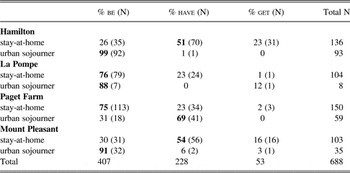
Our initial exploration of the data included all three existential variants. The summary statistics for each variant in the four villages are shown in Table 2, distinguishing between the urban sojourners and the other speakers from their home village. We have highlighted in bold the preferred variant for the community and the urban sojourners. At this point, we can note that the urban sojourners consistently diverge from their stay-at-home peers in the existential variant they prefer either quantitatively (in the case of the La Pompe urban sojourner) or qualitatively (in the case of urban sojourners in all other villages).
Overall distribution of existentials in Bequia by village and speaker type (stay-at-home vs. urban sojourner).

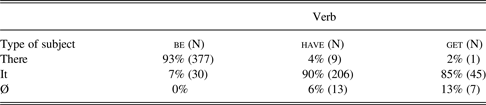
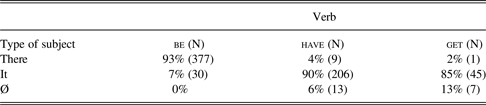
We also explored the exact co-occurrence restrictions on the main verb and the expletive subject across the corpus, shown in Table 3. With respect to subject type, have and get existentials clearly pattern alike. The obvious semantic similarity that have and get share (expressing existence through a metaphor of possession; Heine & Kuteva Reference Heine and Kuteva2002:241–42) and the fact that it and zero expletive subjects both stand in opposition to the Standard English system both justify our treatment of have and get existentials as a single variant for the remainder of the analyses.Footnote 7
Distribution of existentials in Bequia by verb and type of subject.
While the principal focus in this article is what we have called “agreement” (the form of the main existential verb), the notion of subject-verb “agreement” is generally problematic in English, and especially so in Bequia. The Standard English verbal paradigm (past and nonpast) only exhibits regular alternation between third person singular and all other persons in the nonpast. The Standard English system might therefore be more properly viewed as a system characterised by a single default past and nonpast form—with one exception (third person singular) occurring less than half the timeFootnote 8—than as a system of agreement as such.Footnote 9 Of course, be is a bit unusual in this respect, since it has three nonpast forms (am, is, are) and two past forms (was, were), but even this paradigm is fairly impoverished as agreement systems go.
The conceptual problem associated with talking about agreement is exacerbated when looking at -s-marking in nonstandard varieties of English. In Bequia, the frequency of -s-marking in third person singular with regular verbs in nonpast contexts is quite low. Millman and colleagues's (Reference Millman, Dunmore, Ingram, Kendra and Meyerhoff2008) study of twelve speakers finds only 23% (N = 60) in Mount Pleasant, 3% in Hamilton (N = 12) and 5% in Southside (N = 20). Walker's (2009) study of eighteen speakers finds a frequency of 31% (N = 13) in Hamilton, 29% (N = 41) in Mount Pleasant and 15% (N = 75) in Paget Farm. As in Standard English, be has a distinct form for first person singular (am), but the fact that the grammar is generally associated with such low frequencies of overt person inflection suggests that Bequian, too, might be more appropriately characterised as a system with a default verb form, which variably licenses certain variants in specific contexts. Whether a postposed plural subject in existential constructions is one such context is an empirical question that we will address here. In our discussion of the results, we return to the theoretical question of whether the alternation between is/are, has/have, and was/were can appropriately be considered evidence for a process of agreement.
be existentials
We had a total of 407 tokens of be existentials in the corpus, but these were distributed rather unevenly. The majority of the tokens (N = 262) were instances where the postposed subject was singular and the verb was singular (see (7a)). Only nine of these tokens were cases where the agreement did not match the postposed subject, that is, the subject was singular (not a collective noun) and the verb occurred with the plural form (see (7c)). In Table 4, we show the distribution of matching agreement and mismatching agreement in the corpus. Morphologically plural and collective singular NPs (N = 13) are grouped together as one set of plural postposed subjects, based on their semantic similarity.
Matched and mismatched agreement in the Bequia corpus, be existentials only (verbs with same singular and plural form, e.g. had; excluded: N = 17).

This skewed distribution presents challenges for quantitative analysis. We can exclude the seventeen tokens of verbs that have the same form in the plural and singular (had, got), but the very few tokens of singular postposed nouns that occurred with a plural verb form suggest that this is hardly a productive option. That means that one could argue that all tokens where there is a singular postposed subject are effectively invariant and therefore should be omitted from the analysis.
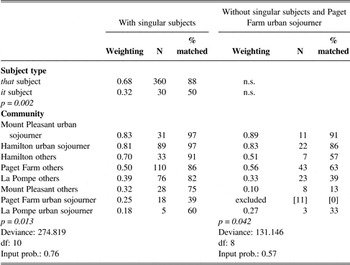
We conducted two different analyses of the data: one including all of the singular postposed subjects with a singular verb, and one excluding those forms to see whether they were skewing the results. We found one point of difference. If we include all of the singular subjects, the multivariate analysis returns subject type and community/urban sojourner as significant factors. If we exclude the singular postposed subjects, only community/urban sojourner is returned as significant, and the level of significance increases (p = 0.007). Either way, it seems clear to us that the statistics support the decision to conduct our analysis in such a way that the urban sojourners are differentiated from the rest of the people in their villages.
However, this model raised another problem. The Paget Farm urban sojourner categorically uses mismatched subjects and verb forms with plural postposed subjects and this must also be skewing the analysis. When we did a third analysis of the variation excluding her data, community is still retained as a significant constraint, but its strength goes down (p = 0.042).
The results of an analysis that corrects for the linguistic conditions and individual speakers that are invariant (or nearly so, in the case of singular subjects) can be seen on the right in Table 5.
Two models of the significant constraints on agreement between verb and postposed subjects in be existentials: with all tokens of singular postposed subjects; without all tokens of singular postposed subjects. Speaker as random effect.

In Table 2 we saw that the urban sojourners in Hamilton, Mount Pleasant, and La Pompe used be existentials more often than the rest of the community. In Table 5, if we consider the most conservative model on the right (where the singular postposed subjects and the data from the Paget Farm urban sojourner have been omitted), we can see that in Paget Farm when the stay-at-home speakers use a be existential, they are likely to match the form of the verb with the semantics of the subject. In Hamilton, we can say very little about the probability of matched agreement—the weighting of 0.51 tells us that knowing someone comes from Hamilton tells us little more about how likely they are to produce a be existential with a plural verb form. The Mount Pleasant and La Pompe communities differ markedly in terms of their overall likelihood of using a be existential (be existentials are used most often overall in La Pompe but not in Mount Pleasant; see Table 2). But when speakers from these villages produce a be existential with a postposed plural subject, in both villages they are likely to produce a verb that is not matched to the subject. In Mount Pleasant, when the be existential is used, there seems to be a strong propensity to use a nonstandard form with plurals. Notice that in La Pompe, the urban sojourner continues to disfavour a matched form of the verb with a plural postposed subject, that is, although he has an increased propensity for using the standard existential pattern overall, underneath that increase in frequency, the local agreement norms remain unchanged.
The urban sojourners from Mount Pleasant and Paget Farm represent extremes in a different way. The Mount Pleasant urban sojourner has increased the frequency with which he uses the standard existential construction, but at the same time he favours standard norms for subject-verb agreement (p = 0.89) while this is strongly disfavoured by the rest of the village overall (p = 0.10). By contrast, the Paget Farm urban sojourner, who was notable in Table 2 for her very high frequency of the Caribbean existential forms (have and get), seems to have moved away from her community norms for agreement in be existentials. When she does use a be existential and the postposed subject is plural, she never matches it with a plural verb form. So she seems to be diverging from the other speakers in her community in two ways: in the superficial frequency of forms used, and in the patterns associated with them. The net effect of this divergence is to produce something that sounds more “nonstandard” (or perhaps “local”). We will return to this consideration below.
Have/get existentials
As we saw in Table 2, the only urban sojourner who continues to productively use the Caribbean forms of existentials is the woman from Paget Farm. Furthermore, because have and get do not morphologically distinguish between singular and plural subjects in the past, all existentials with past temporal reference have to be excluded and tokens of got with nonpast temporal reference. This brings the number of have/get existentials down from a total of 281 to 103. At this point, interindividual variation and very small numbers per speaker overwhelm any group patterns (only the Paget Farm urban sojourner produces more than ten have/get existentials). As a consequence, when speaker is included as a random effect, no linguistic or social factors are selected as significant. If we exclude speaker as a random effect, and consider the groupings by village (and the Paget Farm urban sojourner), community almost reaches significance (p = 0.074). In the case of this variable, the Paget Farm community norm is to favour agreement between the verb and its postposed subject (weighting p = 0.58), and this pattern remains strong with the urban sojourner (weighting p = 0.63).Footnote 10 Hence, it is not the case that the Paget Farm urban sojourner simply fails to use agreement as we might have concluded based only on the data in Table 5; she only fails to use agreement with the standard existentials. When using the Caribbean variant, she shows productive agreement between verb and postposed subject, just like the rest of her community.
Implications and conclusion
The logic of Labov's early proposals with respect to the sociolinguistic monitor holds that grammatical variables are relatively impervious to social stratification, while phonetic and lexical variables are open to acquiring social significance. In our consideration of existential constructions we have taken the productive use of plural verb forms with a plural postposed subject to indicate that for those speakers, agreement between the semantic subject of the clause and the verb is a productive grammatical process. We first review the evidence regarding the lexical versus grammatical nature of the existential constructions in the four villages we have examined.
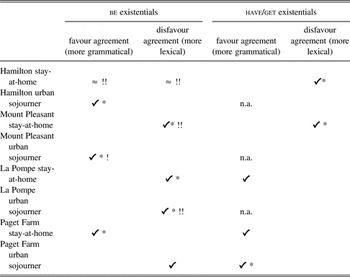
Table 6 summarises our results. It indicates whether the stay-at-home speakers or the urban sojourner favour or disfavour the use of a verb agreeing with a plural postposed subject in be and have/get existentials. The most frequent variant for every category of speaker is marked with an asterisk.
Summary of favoured agreement pattern with plural postposed subjects in different existential constructions.

* indicates most frequent variant for that category of speakers
! indicates fewer than twenty tokens total
!! indicates fewer than ten tokens total
We can see two different patterns for existentials on the island: the Southside pattern is one where the stay-at-home speakers favour be existentials, and the less frequent have/get existentials favour agreement between the verb and a postposed plural subject NP. This suggests that the have/get existentials are a grammatical variable for Southside speakers, but we can see that the two Southside communities differ slightly in whether the be existentials are also treated like grammatical variables. In Paget Farm the stay-at-home speakers favour agreement with a plural subject in be existentials, while in La Pompe the community tends not to use agreeing forms of the verb with plural subjects, suggesting that for these speakers the be existentials are more lexicalised forms.
The second pattern is in Mount Pleasant and Hamilton, where the stay-at-home speakers produce more of the have/get existentials overall. Moreover, when they produce a have/get existential, speakers in both communities tend to produce an invariant form of the verb, disfavouring agreement with a postposed plural subject. These patterns suggest that the most common form of existential in these communities is also a more lexicalised one. If Mount Pleasant stay-at-home speakers produce a be existential, they also tend not to have overt agreement with plural subjects in the form of a plural verb. This suggests that in Mount Pleasant, both the standard existential and the Caribbean existential constructions are to a greater or lesser extent lexicalised. Among the Hamilton stay-at-home speakers, it is less clear whether the be existentials are treated a grammatical or lexical variables. Note that as Table 5 showed, Hamilton stay-at-home speakers produced very few tokens of be existentials with a postposed plural subject (N = 7). Given this, it is unsurprising that the quantitative analysis is ambivalent about this group of speakers.
In three of the four villages, the urban sojourner has shifted his/her preferred existential variant. In Hamilton and Mount Pleasant, the urban sojourner prefers to use almost categorically the standard be existential, marking their speech off from their stay-at-home peers who use the Caribbean English existentials most often. In Hamilton and Mount Pleasant, the urban sojourners seem to treat these be existentials as forms that require agreement between the verb and a postposed plural subject. According to our definition of grammatical versus lexical variables, this difference means that for the urban sojourners in these villages, be existentials are a grammatical variable.
In La Pompe, the stay-at-home speakers use be existentials more often than the Caribbean variants. The urban sojourner accentuates this preference but, like the rest of the community, prefers an invariant form of the verb, suggesting that the variable is lexical for the stay-at-home speakers and has remained so (despite differences in overall frequency) for the urban sojourner.
This latter finding is consistent with predictions made in Labov's early formulations of the effects of the sociolinguistic monitor on language variation (Reference Labov1993). Although these formulations made no specific predictions about individuals or change across the lifespan, our application of this formulation of the monitor to the situation in Bequia represents a logical extrapolation: if grammatical variables generally fail to be socially stratified because grammatical knowledge is ‘deeper’ than phonetic and lexical knowledge, we expect existentials to show social differentiation (here, between villages) only if these constructions are fundamentally lexical. If we assume that intergroup differences have their origins in interindividual differences, grammatical variables ought to be least likely to change over the course of an individual's life. Lexical variables, by contrast, are clearly more labile. Indeed, when we examined the patterns for be absence in the urban sojourners from Bequia (Meyerhoff & Walker Reference Meyerhoff and Walker2007), we concluded that constraints on grammatical variables seemed to be resistant to change even when there were significant changes in the overall frequency with which the urban sojourners used a particular variant. We proposed that the constraints on grammatical variation constitute linguistic knowledge that is too deep to be adjusted substantially. However, the data presented here on existentials problematise this generalisation.
What we have found here is that the Caribbean have/get existentials seem to be a grammatical variable in the Southside villages, and the be existential seems to be a grammatical variable in Hamilton and Paget Farm. Moreover, we have found that at least two of the urban sojourners seem to have reanalysed the underlying constraint governing agreement between the verb and the postposed subject. One urban sojourner (from Paget Farm) not only changed the overall frequency with which she used the be existential but she also seemed to treat it as a lexical variable, unlike her stay-at-home peers. The Mount Pleasant urban sojourner not only shifted his preference not only for the standard be existential, but he also seemed to treat it as a grammatical variable, favouring agreement between the verb and a postposed plural subject.
The clearest counter-example to our proposal for the interaction of the sociolinguistic monitor with variables at different levels of linguistic structure lies in the Paget Farm urban sojourner: her “reanalysis” of be existentials as a lexical (i.e. invariant) form effectively entails decoupling the variable from the grammatical constraints that the rest of her community favours for be existentials. The other urban sojourners either continue to pattern with the rest of their community in whether or not they treat the existential constructions as lexical (La Pompe for be existentials) or grammatical (Paget Farm for have/get existentials). The reanalysis of be existentials as grammatical rather than lexical by the Mount Pleasant urban sojourner is consistent with the predictions of the sociolinguistic monitor. Since, for the community as a whole, be existentials are lexical, it is predicted that they might be available for reanalysis during a speaker's lifetime.
The data we have presented here suggest that we might want to refine our claims about the nature of grammatical versus lexical variables as the means for differentiating social groups in the speech community, particularly in cases where the sociolinguistic history of the community is multilingual, diglossic, or (potentially) polylectal. It is clear that existential constructions in Bequia (and perhaps throughout the Caribbean), drawing as they do on two distinct sources—one Standard English and one local/creole English—can and do differentiate speakers from different villages on the island. They can serve this purpose either as lexical or grammatical variables.
Our results suggest that, in the communities where the existentials have been analysed as fundamentally grammatical, we do find a persistence of the grammatical constraint favouring agreement even in the speech of the urban sojourners. The only exception to this pattern is the Paget Farm urban sojourner.
However, the Paget Farm urban sojourner stands out in more than this respect. As we noted, she is the only urban sojourner to prefer the Caribbean have/get existentials over the standard be existentials in general. It seems possible then that we might want to interpret her invariant use of there's/there is forms when she does use a be existential in the larger picture of her shift towards nonstandard norms. The picture she presents is coherent, even if it is unexpected, since whenever possible she seems to prefer variants that would identify her as a speaker of Caribbean English, or as a nonstandard speaker of English. As we noted, the urban sojourners are perceived to be bona fide members of the villages that they have moved back to, but this does not mean that repatriation to one's home village after having been away for a number of years is entirely unproblematic. There are acculturation issues that have to be faced in both directions (Gmelch Reference Gmelch1992).
In contrast with the uniform parallels across speakers found for be absence (Meyerhoff & Walker Reference Meyerhoff and Walker2007), the differences among speakers observed in this study demonstrate the need to isolate the study of existentials from the analysis of be variation in general (cf. the attention given to that's/tha's in other work on be; Blake Reference Blake1997).
The results of this study provide further support for conclusions we have reached in studying other grammatical variables in Bequia, where we find divergence between villages (Walker & Meyerhoff Reference Walker and Meyerhoff2006; Walker & Sidnell Reference Walker, Sidnell, Hinrichs and Farquharson2011; Daleszyńska Reference Daleszyńska2012) alongside stability across (some) individuals' grammars within each village. Thus, a major finding to emerge from all of these studies is that individual divergences in overall frequencies of occurrence of a variant may mask the underlying persistence of the linguistic conditioning of the variable (cf. Meyerhoff & Walker Reference Meyerhoff and Walker2007; Sankoff & Blondeau Reference Sankoff and Blondeau2007). Our results also argue against views that reduce the entire linguistic system to frequency matching (cf. Walker Reference Walker2008), since, as we have shown, the overall frequency of forms can and should be decoupled from the underlying constraints that determine where the forms emerge and how they interact with other aspects of the linguistic system.