

In the spring of 1957, Billy Graham stood in front of seventeen thousand people in Madison Square Garden and pleaded with sinners to repent. Americans were living in a “night of total crisis,” he thundered. He urged the Christians present “to concentrate in prayer,” to raise a “sense that God is here.” Only through such focused supplication, he insisted, would the lives of the lost be changed and hope brought to this world of darkness and sin.Footnote 1 Graham's prayerful pleas took the city by storm. The preacher's New York City Crusade had been scheduled for only a few weeks, but large crowds, totaling an estimated 2,400,000, forced him to extend it until September 1.Footnote 2 His ministry would never be the same. Nor would the new movement of evangelical Protestants he inspired, which emerged from the 1950s eager to build a broader coalition of Bible believers and exert greater influence over American life.Footnote 3
For most Americans, evangelicals included, prayer has been above all a matter of private devotion—a way to talk to God and have him talk back, a way to find solace amid pain, comfort beyond despair.Footnote 4 But to see prayer as strictly private and spiritual, or mere rote, is to miss out on one of the richest repositories of movement politics in the modern era. Prayer has been a remarkably malleable political device for citizens across the spectrum. It has functioned as a furtive mechanism for translating theological precepts into public code, for fortifying believers and communities in the face of perceived enemies, and for quietly marshaling an army of warriors against the system.Footnote 5
Graham's own prayers in New York did exactly that. On opening night he listed off worries about the world—urban blight and the absence of law and order; racism and immorality; nuclear war and the Middle East—crises that required a strong spiritual response, but by insinuation, also a political one. His prompts for people to be born again lest they succumb to communism and secularism were not exclusively sermonic. They were also woven through his invocation, in hushed tones but with clear intent to nudge his listeners toward a new political worldview. Although Graham would eventually shun Ronald Reagan's Religious Right, the words the evangelist delivered to New Yorkers were laced with the type of stark proclamations that would fuel grassroots right-wing action in the coming years. His performance at Madison Square Garden—witnessed by the eventual architect of the Southern Strategy, Vice President Richard Nixon—played no small part in stirring a movement with aims for the White House.Footnote 6
Yet evangelicals of Graham's stripe were not the only ones to pray for political power in 1957. Campaigns to awash the nation through prayer, to use it as a conduit for both individual and social salvation, played across the nation's ideological terrain in the age of Eisenhower.
Only two days after Graham opened his revival in New York, Martin Luther King, Jr., A. Philip Randolph, and Roy Wilkins coordinated a “Prayer Pilgrimage for Freedom” in Washington, D.C. Sponsored by the Southern Christian Leadership Conference (SCLC) with assistance from the National Association for the Advancement of Colored People (NAACP), the event invited “all believers in the God-given concept of the brotherhood of man and in the American ideal of equality, to assemble, review the national scene, give thanks for the progress to date, and pray for the wiping out of the evils that still beset our nation.”Footnote 7 The occasion marked the three-year anniversary of Brown v. Board of Education (1954), an opportunity to urge President Eisenhower to enforce the groundbreaking act with greater resolve. “We want to protest the intimidation and terror under which colored people are living,” Wilkins explained.Footnote 8
The event drew an estimated 27,000 pilgrims from all over the country, who arrived at the Lincoln Memorial “clothed in a quiet spirit of prayer,” as one journalist put it. They meditated for three hours on “eloquent words of Christianity and statesmanship” poured out through sermon and supplication. Obeying a pre-circulated request not to applaud or cheer, participants responded instead in a crescendo of “Amen” and “Hallelujah” as a host of black ministers and activists beseeched them to channel their righteous indignation against racial injustice.Footnote 9 “We like to think that God is on the side of our American way of life,” Randolph cautioned, “but this will only be true to the extent that our American way of life is on the side of God.”Footnote 10
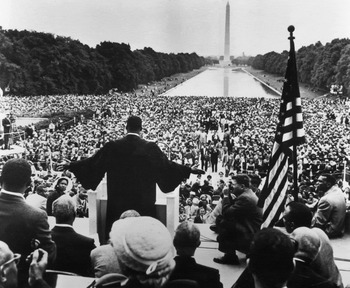
The loudest amens rang out for King, the final speaker (Figure 1). King's message, delivered with a relentlessness that left his listeners entranced, signaled his emergence as the “new voice” of the civil rights movement.Footnote 11 “Give us the ballot,” began his long list of political demands, “and we will fill our legislative halls with men of good will … we will quietly and non-violently, without rancor or bitterness, implement the Supreme Court decision of May seventeenth, 1954.” Yet the heart of King's sermon was more meditative than declarative. He pleaded for citizens to embrace love as God loves—unconditionally, and to assume a posture of humility, reflection, and devotion. “This is no day for the rabble-rouser, whether he be Negro or white,” he emphasized, but a time for “white men,” “black men,” “brown men,” and “yellow men” to unite in a gospel of Godly peace, and “work passionately and unrelentingly” for freedom—spiritual, political—of “the whole human race.”Footnote 12
Martin Luther King, Jr., the “new voice” of the civil rights movement, stands before thousands gathered at the Lincoln Memorial for the Prayer Pilgrimage for Freedom, May 17, 1957. Hulton Archive/Stringer.

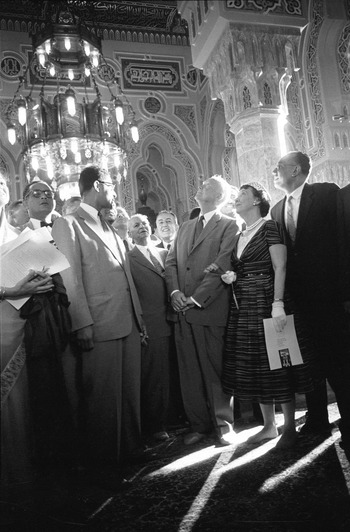
Just a few weeks later, and only two miles away from the site of King's political ascent, Dwight and Mamie Eisenhower took off their shoes and, in stockinged feet, shuffled into the prayer room of the new Washington Islamic Center and Mosque. Arab League ambassadors in attendance for the center's dedication told the President and First Lady that as Protestants, they were not required to remove their shoes, “but could slip them into cloth coverings” before tiptoeing onto the deep pile of Persian rugs covering the floor of the sanctuary. But with hundreds looking on, the Eisenhowers “chose to go all the way” (Figure 2).Footnote 13
President Dwight D. Eisenhower and First Lady Mamie Eisenhower stand in the prayer room of the new Islamic Center of Washington on June 28, 1957. The LIFE Picture Collection.

Built at a cost of over one million dollars with the support of sixteen different Muslim nations and a group of American entrepreneurs active in the Middle East, the Washington Islamic Center and Mosque was stunning and perfectly equipped to convey the theological essences of the faith to a modern, technological world. It even boasted air-conditioning and a loud speaker system, “which spares the Muezzin from spiraling up-minaret to make the Call to Prayer.”Footnote 14 To reflect the grand (and as they saw it, divine) ambitions of the venture, the Center's Board of Governors, headed by Saudi Arabia's Ambassador Sheikh Abdullah Al-Khayyal, prepared an inaugural dedication that began with a quiet veneration drawn from Koranic verses: “Our Lord burden us not with what we have not the strength to bear—Guide us in the right path, the path of those on whom Thou has bestowed Thy blessings—and those who have not gone astray.”Footnote 15 For the majority of the thousand high-profile guests who participated in the meditation, Allah offered the gift of social accord that was so desperately needed in their day.
President Eisenhower's public remarks at the event honored that conviction. In the Cold War battle against the atheistic “red menace,” he had become something of a prayer warrior himself, determined to inject God in the nation's solemnest proceedings (his inaugural, for instance) and turn the new National Day of Prayer, passed by Congress in 1952, into a unifying political weapon.Footnote 16 Those same intentions were evidenced at the Washington Mosque, where he assured his “Islamic friends” that their freedom of worship was safeguarded “under the American Constitution, under American tradition, and in American hearts.”Footnote 17 The “tri-faith” nation he envisioned—Protestants, Catholics, and Jews comprising the “American Way”—would now become a quadrilateral.Footnote 18 His call for a broad canopy of religious tolerance also shaded diplomatic objectives. Wary of global communism and intent on protecting access to Middle Eastern oil reserves, the president wanted to woo predominantly Muslim nations in the Middle East with an appeal to shared monotheism. Eisenhower courted Saudi Arabia's King Saud, who visited the United States that same year, by stressing “the common bond of faith in God” and “parallel paths to God” that the two nations followed.Footnote 19 And he made the most of the occasion at the Washington Mosque, the images and sounds of which Western media broadcasted in the Middle East, in an attempt to win the favor of its people. For the time being, the strategy worked; Muslim and Jewish leaders alike praised Eisenhower's “spiritual qualities” and “statesmanship.”Footnote 20
In a single year, prayer had ignited American political imaginations in different ways but always in substantive—not simply symbolic—fashion. While Billy Graham asked New Yorkers to pray like the Puritans, to beseech God to regenerate their lives, and awaken and realign the nation to its covenant of divine chosenness, Martin Luther King, Jr. prayed like an Old Testament prophet, imploring the devout to ask God to intercede in a society of injustice, and supply them with the moral strength to transform it. For the movement King now led, prayer was less personal communication with God than it was a collective sojourn of the faithful from darkness to light (“I felt as though my legs were praying,” Rabbi Abraham Joshua Heschel would say after the 1965 Voting Rights March). At the Washington Islamic Center, by contrast, Eisenhower tapped the ritual of prayer to consecrate the nation's bedrock of Judeo-Christian (and Muslim) values, as well as its political relationship with the Middle East. With a simple display of devotion, the removing of shoes, he sought to win the world's Muslims to shared civil religion and cooperative peace. The gesture makes for an interesting comparison with one final prayer act from 1957, one that looked past—indeed, tested—traditional religious and national boundaries altogether: the opening of a new Meditation Room at the United Nations (UN).
Plans for a “non-denominational prayer room” stretched back to 1949, even before the 1952 opening of the world organization's New York headquarters.Footnote 21 Some naysayers thought that the “idea of establishing one chamber for all religions was impractical and ‘a complete waste of time.’” But overwhelmingly Americans supported the idea. “May the spirit of God rule and reign supreme in every nation, and be the presiding guest at every conference table,” celebrated one North Carolinian.Footnote 22 But just how might one chamber capture the “spirit of God”? UN officials struggled for years to design a room that best symbolized the ecumenism they wished it to nurture and represent.Footnote 23 The makeshift space they were using in the meantime had come by 1957 to seem wholly inadequate. Tourists constantly barged in, and “irreverent young folk” made things worse. One UN official knew things had to change “when he surprised a young couple in the shadows engaging in some pagan necking.”Footnote 24
Determined to establish a permanent meditative space that would be “more dignified” and “worthy of a world organization,” UN Secretary General Dag Hammarskjöld formed an interfaith advisory board that raised funds to turn the designs of Hammarskjöld and Swedish artist Bo Beskow into a reality. Purposefully sparse, the space contained only a centered six-ton stone altar bathed in soft light and an abstract mural featuring interlocking geometric patterns “to evoke a feeling of the essential oneness of God.” “We all have within us a center of stillness surrounded by silence,” intoned Hammarskjöld upon the room's dedication, and here, he hoped, visitors might find “a place where the doors may be open to the infinite lands of thought and prayer.”Footnote 25
The product of a Swedish family of clerics, Hammarskjöld was well versed in Protestant theology, but his faith also flowed out of wider intellectual tributaries of mysticism, Quakerism, Hinduism, and Buddhism. His was a flexible yet rigorous spirituality that saw quiet contemplation as the way to truth, higher being, and universal harmony. But the words he spoke at the room's opening also revealed the secretary general's politics. He saw the UN as a “secular church,” and in that mode engaged the era's most powerful leaders and knottiest problems (his was an eventful eight-year term) with a “firm moral purpose,” as Adlai Stevenson would later say, and a determination to force a “world wearied by war” and angry political chatter to pause for peace, and for a moment at least, embrace a “stillness surrounded by silence.” No clear sacred–secular binary organized his diplomacy as he transformed the UN into an international agency with broad and active jurisdiction, and its secretary generalship into a leadership position of truly global civil service and importance.Footnote 26
Its outpouring in 1957 may have been especially intense, but Americans would remain awash in prayer politics for decades to come. Over time, evangelical leaders’ operationalization of prayer would aid their political ascent. Whether delivered in arenas like Madison Square Garden or at National Prayer Breakfasts, or more stealthily through “prayer projects” that use social media to coordinate culture war campaigns, recent generations of evangelicals—Graham's heirs—have displayed unmatched ability to turn soft whispers to Jesus into hard-edged advocacy.Footnote 27 Still, evangelicals are not the only citizens to see their supplications as a transcript of political power. On streets and boulevards, and in the nation's capital, heirs of Martin Luther King, Jr.’s theology continue their prayerful pilgrimages for freedom, in hopes that the movement of their feet and hearts will transform a broken nation. In mosques and temples around the country, prayers are offered for religious freedom, tolerance, and diplomacy of the variety ensconced in Dwight Eisenhower's doctrine. Even “nones,” the type of non-affiliated spiritual thinkers who see the world like Dag Hammarskjöld saw it, regard meditation as a means of altering the temporary, the mundane, for the sake of universal human uplift.Footnote 28