INTRODUCTION
The Rio skate, Rioraja agassizi (Müller & Henle, 1841), is a common endemic skate from coastal waters distributed along the south-west Atlantic coast from Cabo Frio (20°S, Brazil) to Península Valdés (42°S, Argentina) (Menni & Stehmann, Reference Menni and Stehmann2000). Taxonomy, distribution and some aspects of the reproductive biology of R. agassizi have been well studied off north Argentina and Uruguay (Colonello et al., Reference Colonello, García and Lasta2007; Estalles et al., Reference Estalles, Perez Comesaña, Tamini and Chiaramonte2008). Rioraja agassizi is one of the most important skates caught as by-catch in the bottom trawling fishery that operates in this region (Massa et al., Reference Massa, Lucifora, Hozbor and Boschi2004; Tamini et al., Reference Tamini, Chiaramonte, Perez and Cappozzo2006). The abundance of R. agassizi likely declined significantly and this species is categorized as vulnerable by the International Union for the Conservation of Nature (IUCN) (Kyne et al., Reference Kyne, San and Stehmann2007).
The feeding habits of R. agassizi have been studied on the continental shelf off Ubatuba, Brazil, indicating that the species fed upon a wide variety of preys, mostly crustaceans (e.g. shrimps, crabs and amphipods), fish and polychaetes (Soares et al., Reference Soares, Moraes and Correa1999; Muto et al., Reference Muto, Soares and Goiten2001). Muto et al. (Reference Muto, Soares and Goiten2001) also found ontogenetic shifts and variation among seasons in the diet composition of R. agassizi. In Argentinean and Uruguayan waters, a previous study on the diet composition of R. agassizi showed that it preys mainly on crustaceans, followed by polychaetes and teleosts (Loez & Schang, Reference Loez and Schang1982), but this study had a low sample size and samples obtained from a restricted area.
The aims of this study are to provide a quantitative analysis of the diet composition of R. agassizi, to assess the effects of sex, maturity stage, body size, season and region on the diet and also to evaluate predator–prey size relationships. Knowledge on diet composition and trophic relationships are essential for the implementation of ecosystem-level models (Braccini, Reference Braccini2008).
MATERIALS AND METHODS
Study area and sampling
The study area, between 34° and 41°S, consists of two coastal systems: (1) a stratified coastal zone (north of 37°S) influenced by the discharge of the Río de la Plata River; and (2) a homogeneous coastal zone (south of 37°S), that comprises an estuarine system, called El Rincón, characterized by the discharge of the Negro and Colorado Rivers and discharges of high-salinity waters of the San Matías Gulf (Guerrero & Piola, Reference Guerrero, Piola and Boschi1997; Lucas et al., Reference Lucas, Guerreo, Mianzan, Acha and Lasta2005).
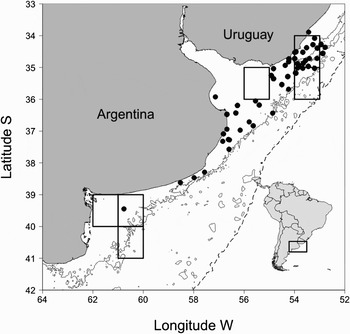
Skates were collected from scientific trawl surveys (N = 252) conducted by the Instituto Nacional de Investigación y Desarrollo Pesquero (INIDEP, Argentina), and from commercial landings (N = 374) (Figure 1). Research cruises were conducted in December (2005), February (2006) and June (2006). Commercial catches by the coastal fleet of Mar del Plata harbour were sampled during 2006 (September, October and November) and 2007 (April, May, July, August, October, November and December). For each individual captured, total length (TL, mm), sex and maturity stage were recorded. Maturity stage (juvenile or adult) was determined according to the degree of calcification of the claspers and the development of testes and reproductive ducts in males, and to the presence of eggs and observation of the uteri, oviducal glands and ovarian follicles in females (Stehmann, Reference Stehmann2002; Colonello et al., Reference Colonello, García and Lasta2007). This species reaches maturity at between 495–577 mm and 420–520 mm of TL for females and males, respectively (Colonello et al., Reference Colonello, García and Lasta2007; Estalles et al., Reference Estalles, Perez Comesaña, Tamini and Chiaramonte2008). The stomachs were excised and frozen at –20°C for subsequent analyses in the laboratory.
Map of study area showing positions of trawl stations (black circles) and cells of the fishing grid (black rectangles) where individuals of Rioraja agassizi were collected off Uruguay and north Argentina. The 50 m and 200 m isobaths are shown as solid and dashed lines, respectively. The rectangle in the inset shows the location of the study area in South America.

Diet composition and data analysis
Stomach contents were sorted and identified to the lowest possible taxon using published catalogues. Preys were counted and their wet weights recorded (±0.01 g). When possible, TL of teleosts, carapace width (CW) of brachyuran crabs and cephalothorax length (CL) of shrimps were measured.
To evaluate the importance of each prey and allow for comparisons with other studies we calculated the following indices: percentage by number (%N), percentage by mass (%M), percentage frequency of occurrence (%FO) and index of relative importance (IRI) (Pinkas et al., Reference Pinkas, Oliphant and Iverson1971). IRI was expressed in percentage (%IRI; Cortés, Reference Cortés1997).
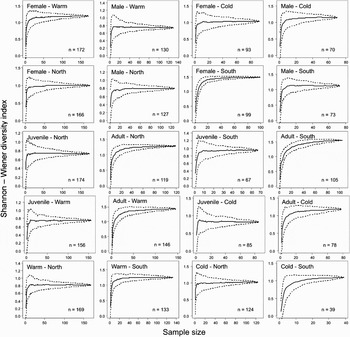
Sample size by sex, maturity stage, season and region was plotted against the mean cumulative Shannon–Wiener diversity index, randomized 100 times (Magurran, Reference Magurran2004), to determine whether a sufficient number of skates was sampled. Sample size was considered sufficient to describe diet and to conduct statistical analyses if the cumulative Shannon–Wiener diversity index reached an asymptote.
For the statistical analyses, preys were grouped into eight zoological categories: shrimps, brachyuran crabs, amphipods, isopods, cumaceans, lancelets, polychaetes and teleosts. These categories included prey with %FO ≥ 4. We evaluated if the consumption of the prey categories varied with sex, maturity stage, body size (TL), season (warm = October–March; cold = April–September) and region (north = 34°–38°S; south = 38°–41°S) using a multiple-hypothesis modelling approach (Anderson et al., Reference Anderson, Burnham and Thompson2000; Franklin et al., Reference Franklin, Shenk, Anderson, Burnham, Shenk and Franklin2001; Johnson & Omland, Reference Jonhson and Omland2004).
For each prey category, we built generalized linear models (GLM; Venables & Ripley, Reference Venables and Ripley2002) where the response variable was the number of prey consumed and the independent variables were sex, maturity stage, TL, season and region (Lucifora et al., Reference Lucifora, García, Menni, Escalante and Hozbor2009a). Models with combinations between sex + season, sex + region, maturity stage + season, maturity + region, TL + season, TL + region and season + region as independent variables, were also fitted. We also fitted a model without any of the independent variables (i.e. null model) to test the hypothesis that none of the variables tested had an effect on the consumption of a prey category (Lucifora et al., Reference Lucifora, García and Escalante2009b). Models have a negative binomial error distribution because there were too many zeros and the variance was often much greater than the mean, and a log link (Crawley, Reference Crawley2005). For each competing model, we calculated the Akaike information criterion (AIC) and the model with the lowest AIC was selected as the best model (Crawley, Reference Crawley2005). To obtain the likelihood of each competing model, Akaike's weight (w) was calculated (Franklin et al., Reference Franklin, Shenk, Anderson, Burnham, Shenk and Franklin2001; Johnson & Omland, Reference Jonhson and Omland2004). If w did not provide strong support for any competing model, we computed model averaging (Johnson & Omland, Reference Jonhson and Omland2004).
Predator–prey size relationships
Relationships between predator length and prey size were assessed using TL of skates and TL of teleost fish, CW of brachyuran crabs and CL of shrimps. We fitted regressions on the 5, 50 and 95% quantiles, in order to test an increase in minimum, medium and maximum prey size with increasing TL of skates, respectively (Scharf et al., Reference Scharf, Juanes and Sutherland1998).
RESULTS
Of the 626 skates sampled, 465 (74.28%) had food in their stomachs. Of the skates with food remains, 265 were females (246–710 mm TL) and 200 were males (240–616 mm TL). Overall, 4680 preys with a total weight of 2644.7 g were found in the stomachs. The cumulative curves of diversity reached an asymptote for all groups, indicating that sample sizes were sufficient (Figure 2).
Cumulative mean Shannon–Wiener diversity index (continuous lines) and standard deviation (dashed lines) as a function of sample size for Rioraja agassizi.

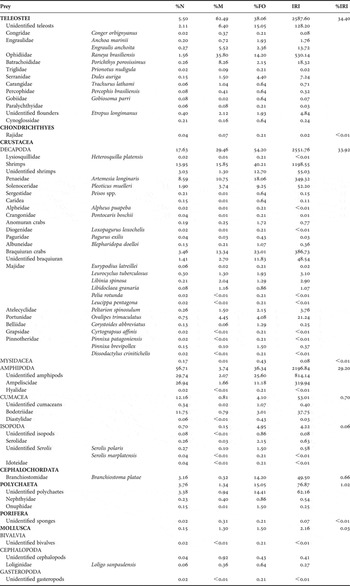
The diet of R. agassizi was composed of 61 prey species: 25 decapods, 14 teleosts, five isopods, four molluscs, three amphipods, three cumaceans, three polychaetes, one chondrichthyan, one misidacean, one lancelet and one sponge. Rioraja agassizi fed mainly on crustaceans (decapods, amphipods and cumaceans) and teleosts (Table 1). The most important prey by number was amphipods. The second major prey in terms of number was shrimps of the species Artemesia longinaris. The third major prey in number was cumaceans of the family Bodotriidae. Teleosts were the most important prey in terms of weight, with Raneya brasiliensis being the principal prey species. Artemesia longinaris was the second prey species by weight. In terms of percentage frequency of occurrence, shrimps were the most important prey, followed by teleosts and amphipods. Lancelets and polychaetes were also important preys by frequency of occurrence. Chondrichthyans, misidaceans, isopods and molluscs were less important components of the diet.
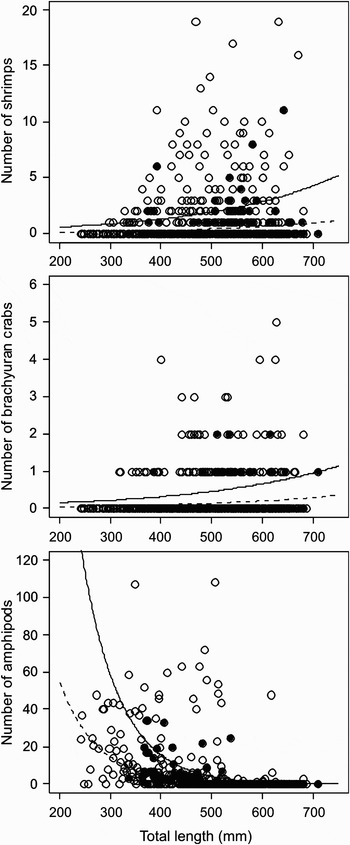
Changes in consumption of different preys, with body size and region of Rioraja agassizi estimated by generalized linear models for number of shrimps, brachyuran crabs and amphipods. The models had a log link and a negative binomial error distribution. North: solid lines and open circles; south: dashed lines and solid circles.

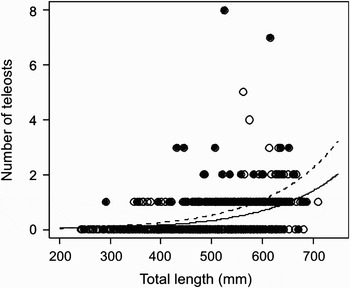
Changes in consumption of teleosts (in number) with body size and season of Rioraja agassizi estimated by generalized linear models. The models had a log link and a negative binomial error distribution. Warm: solid lines and open circles; cold: dashed lines and solid circles.

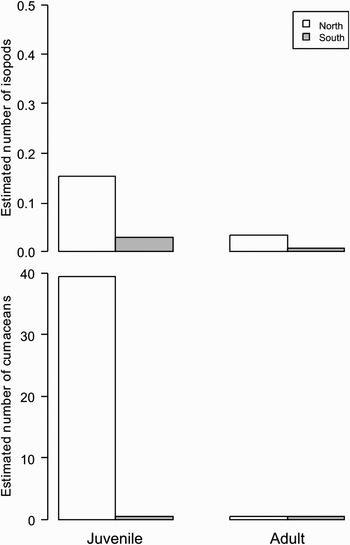
Changes in consumption of different preys, with maturity stage and region of Rioraja agassizi estimated by generalized linear models for number of isopods and cumaceans. The models had a log link and a negative binomial error distribution.

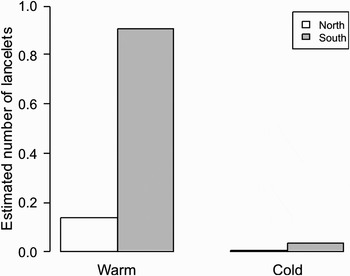
Changes in consumption of lancelets (in number) with season and region of Rioraja agassizi estimated by generalized linear models. The models had a log link and a negative binomial error distribution.

Diet composition of Rioraja agassizi. %N, percentage by number; %M, percentage by mass; %FO, percentage frequency of occurrence; IRI, the index of relative importance; %IRI, percentage of IRI. Bold indicate major taxonomic group.

Relationships between number of prey consumed with maturity stage, TL, season and region were found (Table 2). The consumption of all prey categories was independent of sex. The consumption of shrimps, brachyuran crabs and teleosts increased with increasing TL of R. agassizi (Figures 3 & 4). On the contrary, the consumption of amphipods decreased with increasing TL of R. agassizi (Figure 3). Juveniles preyed on isopods and cumaceans more heavily than adults (Figure 5). Crustaceans (i.e. shrimps, brachyuran crabs, amphipods, isopods and cumaceans) were more consumed in the northern region than in the southern region (Figures 3 & 5). The number of teleosts consumed was higher in the cold season than in the warm season (Figure 4). On the other hand, the consumption of lancelets was higher in the warm season than in the cold season: lancelets were also consumed more often in the south than in the north (Figure 6). Polychaetes had no significant relationship with any of the independent variables evaluated. The hypothesis of consumption of both isopods and cumaceans has a low w, so we computed model averaging for these models. The averaged coefficients of isopods were 1.030 (standard error = 0.577) for juveniles and –0.740 (standard error = 0.662) for the south region, with a combined w of 0.75. For cumaceans, the averaged coefficients were 2.771 (standard error = 6.832) for juveniles and –3.621 (standard error = 6.887) with a combined w of 0.71.
Best models explaining the consumption of prey category in number of Rioraja agassizi. The intercept and coefficient for the variables are given. TL, total length (mm); AIC, Akaike information criterion; w, Akaike's weights; standard errors in parentheses.

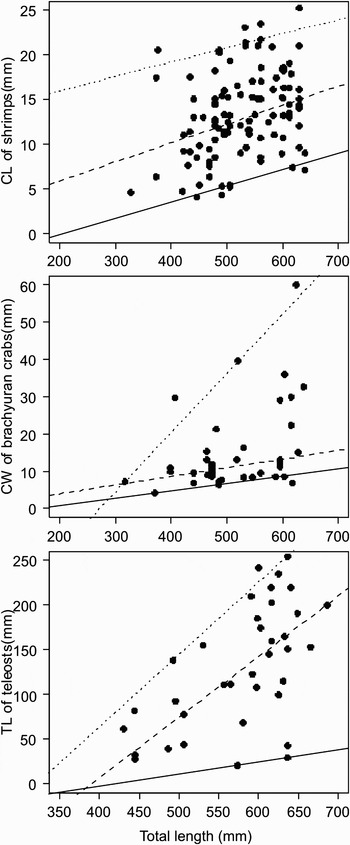
Minimun and median CL of shrimps increased significantly with the TL of skates (5% quantile regression slope = 0.017, t = 2.238, P = 0.027; 50% quantile regression slope = 0.021, t = 2.398, P = 0.018) (Figure 7). The maximum CW of brachyuran crabs consumed increased significantly with the TL of skates (95% quantile regression slope = 0.158, t = 0.061, P = 0.013) (Figure 7). As TL of skates increased, both median and maximum TL of teleosts increased significantly (50% quantile regression slope = 0.674, t = 5.251, P = <0.01; 95% quantile regression slope = 0.805, t = 5.134, P =< 0.01) (Figure 7).
Quantile regressions of cephalothorax length (CL) of shrimps, carapace width (CW) of brachyuran crabs, total length (TL) of teleost fish and total length of Rioraja agassizi. The dotted, dashed and solid lines are 5%, 50% and 95% quantile regressions, respectively.

DISCUSSION
The feeding habits of R. agassizi are demersal–benthic: it feeds mainly on amphipods, decapods (shrimps and brachyuran crabs) and teleosts, followed by isopods, cumaceans, lancelets and polychaetes. Rioraja agassizi showed changes in the diet composition with body size and it also changes its diet with season and region.
Loez & Schang (Reference Loez and Schang1982) described the diet of R. agassizi from off Mar del Plata (38°S), with samples taken in the warm season (February and March) and observed that the most important prey were crustaceans, like shrimps, amphipods and brachyuran crabs, whereas polychaetes and teleosts were less important. It contrasts with our results, where amphipods, decapods and teleosts are equally important. The most important prey species by Loez & Schang (Reference Loez and Schang1982) was the shrimp Pleoticus muelleri, whereas it was the shrimp Artemesia longinaris in the present study. This difference in the most important prey species may be due to differences in sampling areas: Loez & Schang (Reference Loez and Schang1982) reflected the diet of the more localized subpopulation of skates, since they took their samples in a very restricted area and the samples of this study covered a much larger area.
In coastal Brazilian waters some studies were conducted on the diet composition of R. agassizi (Soares et al., Reference Soares, Rossi-Wongtschowski, Alvares, Muto and Gasalla1992, Reference Soares, Moraes and Correa1999; Muto et al., Reference Muto, Soares and Goiten2001). In Ubatuba Bay (24°S), shrimps were the main prey, followed by teleosts and polychaetes, while amphipods were less important (Soares et al., Reference Soares, Rossi-Wongtschowski, Alvares, Muto and Gasalla1992; Muto et al., Reference Muto, Soares and Goiten2001). Soares et al. (Reference Soares, Moraes and Correa1999) found that the diet of R. agassizi in Ubatuba Bay consisted of shrimps and brachyuran crabs, while polychaetes and teleosts were less important. These patterns found in Brazilian waters contrast in part with our results because the main preys in the overall diet off Uruguay and north Argentina are amphipods and teleosts.
An important pattern to note is the consumption of lancelets by R. agassizi because there are no records of the consumption of lancelets by other skate species. Lancelets are consumed off Uruguay and northern Argentina by other chondrichthyan species, like the shortnose guitarfish, Zapteryx brevirostris (Barbini, Reference Barbini2006) and the apron ray, Discopyge tschudii (García, Reference García1984). Lancelets live buried or semi-buried in the substratum (Lambert, Reference Lambert2005), like polychaetes (Rouse & Pleijel, Reference Rouse and Pleijel2001). The consumption of these preys suggests that R. agassizi digs into the bottom in search of preys.
Individuals of small body size and juveniles of R. agassizi feed on small crustaceans, like amphipods, isopods and cumaceans. As body size increases R. agassizi consumes larger and faster preys, such as shrimps, brachyuran crabs and teleosts. A similar pattern was found for R. agassizi from off Mar del Plata, Argentina (Loez & Schang, Reference Loez and Schang1982) and from Ubatuba Bay, Brazil (Muto et al., Reference Muto, Soares and Goiten2001). Ontogenetic shifts are a pattern widely observed in skates (Lucifora et al., Reference Lucifora, Valero, Bremec and Lasta2000; Morato et al., Reference Morato, Solá, Grós and Menezez2003; Orlov, Reference Orlov2003; Robinson et al., Reference Robinson, Cailliet and Ebert2007; Belleggia et al., Reference Belleggia, Mabragaña, Figueroa, Scenna, Barbini and Díaz de Astarloa2008; Ruocco et al., Reference Ruocco, Lucifora, Díaz de Astarloa and Bremec2009) and these results are more a function of body size (e.g. mouth size and swimming speed) rather than of other life-history traits (Farias et al., Reference Farias, Figueiredo, Moura, Serrano, Neves and Serra-Pereira2006; Treloar et al., Reference Treloar, Laurenson and Stevens2007).
The diet composition of R. agassizi showed regional and seasonal variation. The regional pattern is characterized by a higher consumption of crustaceans (i.e. shrimps, crabs, amphipods, isopods and cumaceans) in the northern region than in the southern region. This regional difference may be explained by environmental differences between regions. The structure, dynamic, richness and abundance of the benthic community of the northern region may be different than that of the southern region, possibly caused by distinct physical variables (D. Giberto, personal communication). In the north area, the Río de la Plata estuary, bottom type, salinity and the presence of a turbidity front are considered the main variables structuring the benthic communities of this area (Giberto et al., Reference Giberto, Bremec, Acha and Mianzan2004). On the other hand, the south area is characterized by vertical homogeneity due to tidal forcing and a salinity coastal front that is maintained by the bathymetry and the mean shelf circulation (Acha et al., Reference Acha, Mianzan, Guerrero, Favero and Bava2004).
Species composition of benthic and demersal coastal communities is variable, since the distribution and abundance of many species of the marine fauna changes seasonally (Jaureguizar et al., Reference Jaureguizar, Menni, Lasta and Guerrero2006). Seasonal changes in the diet of R. agassizi are due to a higher consumption of teleosts in the cold season and an increase in the consumption of lancelets in the warm season. The seasonal variability of the abundance of teleosts (i.e. Raneya brasiliensis, Dules auriga and Etropus longimanus) and lancelets consumed by R. agassizi in the area is unknown and needs further studies. However, this pattern may be probably attributed to fluctuations in the abundance and distribution of the preys (Muto et al., Reference Muto, Soares and Goiten2001; Rinewalt et al., Reference Rinewalt, Ebert and Cailliet2007). Seasonal variations in diet have been reported for other skates in the region (e.g. Psammobatis extenta, Braccini & Perez, Reference Braccini and Perez2005; P. bergi, San Martín et al., Reference San, Braccini, Tamini, Chiaramonte and Perez2007). In Ubatuba Bay, R. agassizi also exhibits seasonal variations in the diet composition associated to a peak in the abundance of its main prey (Muto et al., Reference Muto, Soares and Goiten2001). These patterns indicate that R. agassizi is a plastic and versatile predator, adapting its feeding habits in response to regional and seasonal changes.
The size of the consumed prey increases with the size of R. agassizi. As R. agassizi increases its body size, the size of the shrimps, brachyuran crabs and teleosts increases too, but the skate do not abandon the consumption of small brachyuran crabs and teleosts. Differences in prey availability may explain the different patterns found in these preys. The shrimps A. longinaris and P. muelleri are abundant preys in this region (Giberto et al., Reference Giberto, Bremec, Acha and Mianzan2004), then large R. agassizi may be more selective, consuming only larger shrimps. On the other hand, the lower availability of crabs and teleosts together with a higher vulnerability of these small preys (i.e. higher probability of capture; Scharf et al., Reference Scharf, Juanes and Rountree2000; Lucifora et al., Reference Lucifora, García, Menni and Escalante2006), may explain the continuous inclusion of small crabs and teleosts in stomach contents of large R. agassizi. A similar pattern was present in other elasmobranchs, mainly piscivorous sharks (Scharf et al., Reference Scharf, Juanes and Rountree2000; Lucifora et al., Reference Lucifora, García, Menni and Escalante2006, Reference Lucifora, García, Menni, Escalante and Hozbor2009a; Baremore et al., Reference Baremore, Murie and Carlson2010) and not in another skate, Zearaja chilensis. The size of preys consumed by the latter species increased with increasing predator size and small preys are not consumed by large skates (Lucifora et al., Reference Lucifora, Valero, Bremec and Lasta2000; Koen Alonso et al., Reference Koen, Crespo, Gracía, Pedraza, Mariotti, Berón Vega and Mora2001).
The diet of R. agassizi was composed mainly of prey with benthic affinities, such as teleosts (e.g. Etropus longimanus), brachyuran crabs (e.g. Ovalipes trimaculatus, Leurocyclus tuberculosus and Libinia spinosa) and small invertebrates (e.g. amphipods, cumaceans, isopods and polychaetes) and also demersal–benthic prey, including shrimps (e.g. Artemesia longinaris and Pleoticus muelleri) and teleosts (e.g. Raneya brasiliensis and Dules auriga). Thereby, R. agassizi have a strong predatory interaction with the benthic community. Coastal areas from Uruguay and north Argentina are exposed to a high intensity of bottom trawling (Cousseau & Perrotta, Reference Cousseau and Perrotta2000; Brazeiro et al., Reference Brazeiro, Acha, Mianzan, Gómez and Fernández2003). This fishing gear alters the physical structure of the habitat, affecting the benthic ecology of the bottom (Kaiser, Reference Kaiser1998; Watling & Norse, Reference Watling and Norse1998), generating potential indirect effects on the fish community (Brazeiro et al., Reference Brazeiro, Acha, Mianzan, Gómez and Fernández2003), and altering the abundance and availability of preys for R. agassizi.
ACKNOWLEDGEMENTS
We are grateful to the Instituto Nacional de Investigación y Desarrollo Pesquero (INIDEP) for specimens collected during various research cruises. We also thank M. Scelzo and R. Elías (Universidad Nacional de Mar del Plata) for their help in identifying crabs and polychaetes, respectively, and 2 anonymous referees for helpful comments that greatly improved the paper. S.A. Barbini was supported by a scholarship from CIC.